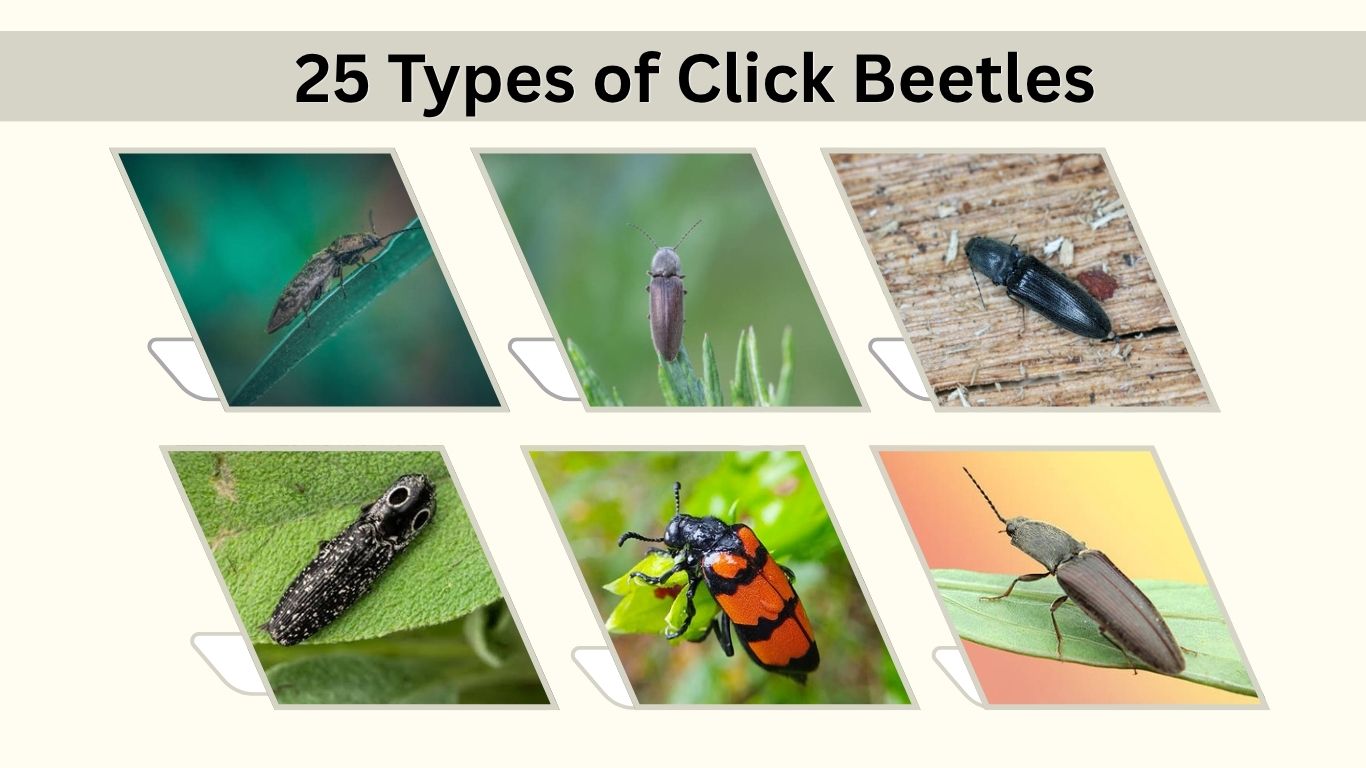
Click beetles are fascinating insects known for the sharp clicking sound and sudden jumping motion they use when flipped onto their backs. Found in forests, grasslands, gardens, farms, and wetlands, these beetles vary widely in size, color, habitat, and feeding behavior. Some species have striking eyespots or metallic bodies, while others are plain brown and difficult to identify. In this guide, you’ll discover 25 types of click beetles, along with their identification features, habitat, diet, behavior, lifespan, and life cycle.
1. Eastern Eyed Click Beetle
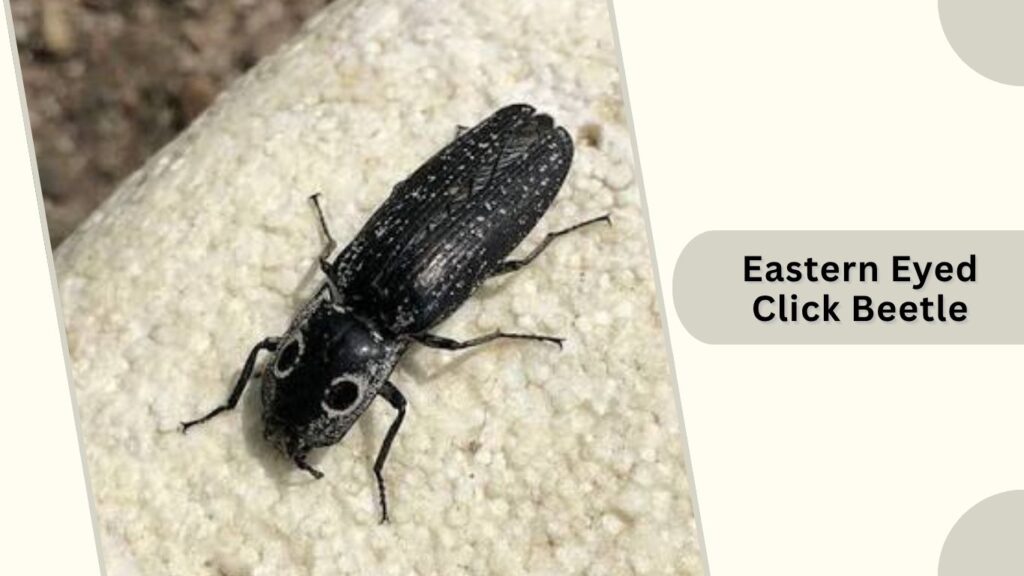
The Eastern Eyed Click Beetle is one of the most recognizable click beetles in North America. Its large false eyespots, speckled black-and-white body, and impressive size make it difficult to overlook. Scientifically known as Alaus oculatus, this beetle is especially associated with wooded areas containing dead or decaying trees, where its predatory larvae develop.
Identification
- Common Name: Eastern Eyed Click Beetle
- Scientific Name: Alaus oculatus
- Family: Elateridae
- Size: About 24–45 mm long
- Color: Black with grayish-white mottling
- Eyespots: Two large black spots surrounded by pale rings
- Body Shape: Long, narrow, and somewhat flattened
- Special Feature: Produces an audible click and can flip into the air
The eyespots are not the beetle’s real eyes. They likely help startle or confuse potential predators.
Habitat and Distribution
Eastern Eyed Click Beetles occur across much of eastern North America, with their range extending west into areas including Texas and South Dakota. They are strongly associated with deciduous and mixed woodlands.
Adults may be found on tree trunks, around dead trees, or occasionally near outdoor lights. Decaying hardwood logs are particularly important because they provide habitat for the developing larvae.
Behavior and Diet
When placed on its back, this beetle uses a specialized mechanism between its thoracic segments to launch itself upward with a clicking sound. This allows it to right itself and may also help it escape predators.
Adult feeding is limited and can include nectar and plant fluids. The larvae are much more active predators, attacking larvae of wood-boring beetles and other insects living inside decaying wood.
Lifespan and Life Cycle
Females deposit eggs around dead wood or nearby soil. After hatching, the elongated wireworm-like larvae live within decaying wood and may develop for many months.
The larvae eventually pupate inside wood or nearby soil. Adults generally emerge during warmer months. Because larval development can be prolonged, much of the beetle’s life is spent in the immature stage rather than as an adult.
2. Western Eyed Click Beetle
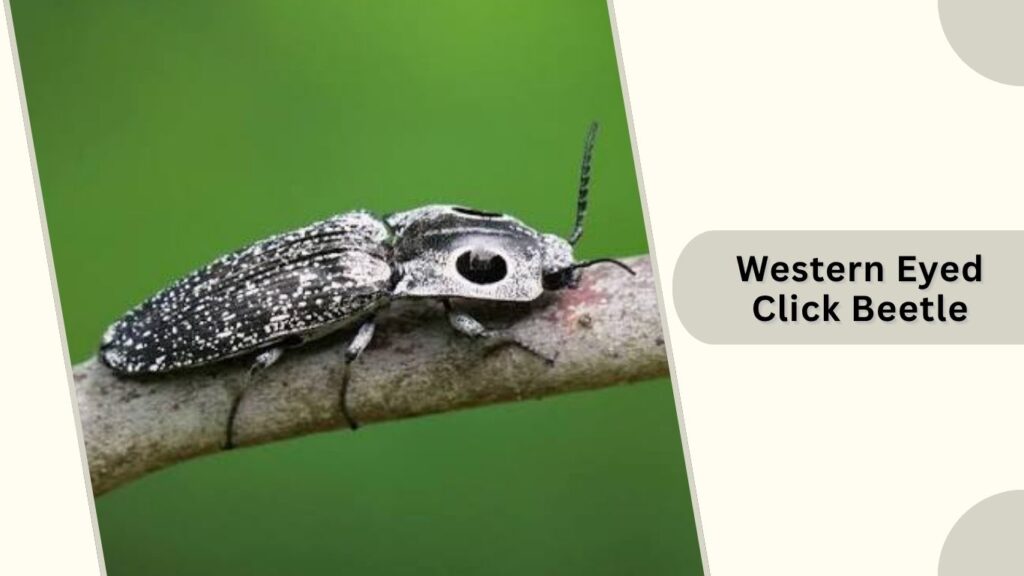
The Western Eyed Click Beetle, Alaus melanops, is a striking western relative of the Eastern Eyed Click Beetle. It has the characteristic elongated body, large false eyespots, and clicking mechanism typical of the genus. This species is particularly associated with coniferous forests, where its larvae act as predators of wood-boring insects living beneath bark.
Identification
- Common Name: Western Eyed Click Beetle
- Scientific Name: Alaus melanops
- Family: Elateridae
- Size: Approximately 20–35 mm
- Color: Dark with pale mottling
- Eyespots: Large dark spots on the pronotum
- Body: Elongated and narrow
- Defense: Powerful clicking and flipping mechanism
Its eyespots may appear less sharply contrasted than those of the Eastern Eyed Click Beetle, which can help distinguish the species.
Habitat and Distribution
The Western Eyed Click Beetle occurs across parts of western North America. Records include California, Washington, Oregon, Idaho, New Mexico, Colorado, Montana, and British Columbia.
It is especially associated with coniferous forests. Adults may be found resting on tree trunks or bark, while larvae develop inside decaying pine and other conifer wood.
Behavior and Diet
Like other click beetles, this species can produce a sudden clicking sound and throw its body upward when overturned or threatened.
The larvae are predators rather than typical root-feeding wireworms. They live under bark and in decaying wood, where they hunt larvae of wood-boring beetles. Adult feeding behavior is less thoroughly documented, though adults may associate with tree sap and recently fallen or damaged trees.
Lifespan and Life Cycle
Western Eyed Click Beetles undergo complete metamorphosis: egg, larva, pupa, and adult. The larvae spend an extended developmental period inside decaying wood.
Once fully grown, they pupate within the wood and eventually emerge as adults. Adults are most often recorded during late spring and summer, particularly June and July in many parts of their range.
3. Texas Eyed Click Beetle
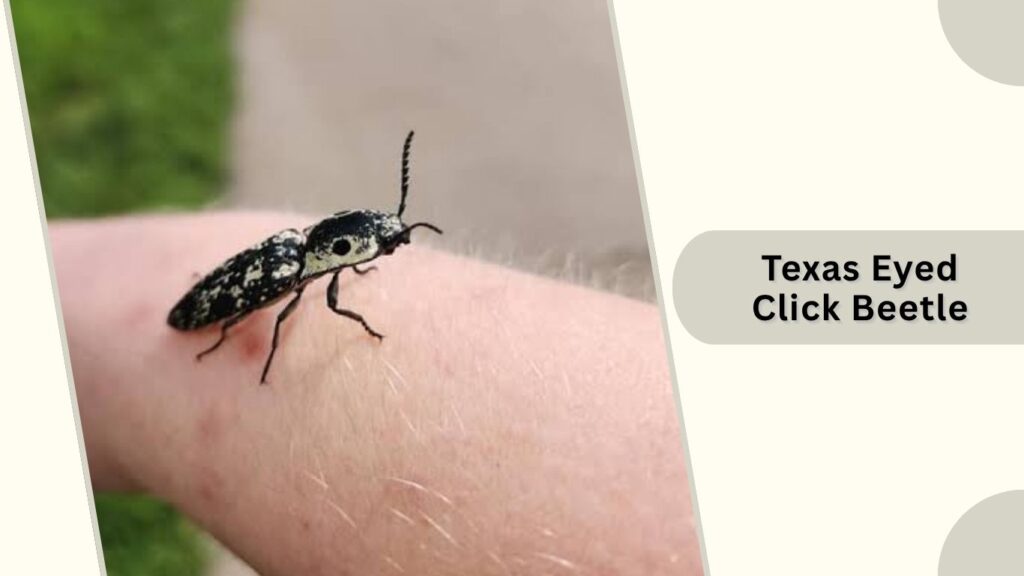
The Texas Eyed Click Beetle, Alaus lusciosus, is a large and impressive member of the click beetle family. Its bold eyespots and mottled pattern can make it look similar to the Eastern Eyed Click Beetle, but differences in markings and geographic distribution help separate the two species. It occurs primarily in the south-central and southwestern United States and Mexico.
Identification
- Common Name: Texas Eyed Click Beetle
- Scientific Name: Alaus lusciosus
- Family: Elateridae
- Size: Approximately 26–45 mm
- Body: Long and robust
- Color: Dark with white or pale mottling
- Eyespots: Large false eyes on the pronotum
- Elytra: White markings tend to appear patchy or clumped
Its patchier white markings help distinguish it from the Eastern Eyed Click Beetle, which generally has smaller, more evenly distributed pale spots.
Habitat and Distribution
The Texas Eyed Click Beetle occurs from Texas through parts of Arizona and Kansas, with its distribution continuing into Mexico. It has also been reported from central, southern, and portions of eastern Texas.
The species is associated with wooded habitats, particularly areas where pine and other trees provide decaying logs, stumps, and loose bark for developing larvae.
Behavior and Diet
Adults rely on their camouflage when resting on bark. If threatened, they can remain motionless or activate the characteristic click mechanism that propels them upward.
The larvae are predators living in dead wood. They feed on larvae and pupae of other beetles and soft-bodied insects. Adult feeding is not as well documented, although adults may use tree sap or other plant fluids.
Lifespan and Life Cycle
Females lay eggs in suitable decaying wood. The larvae hatch as elongated wireworm-like predators and develop through several growth stages while living under bark.
They later pupate inside the wood before emerging as adults. Adult activity is strongest from late spring through summer, while larvae may remain present inside dead wood throughout the year.
4. Southwestern Eyed Click Beetle
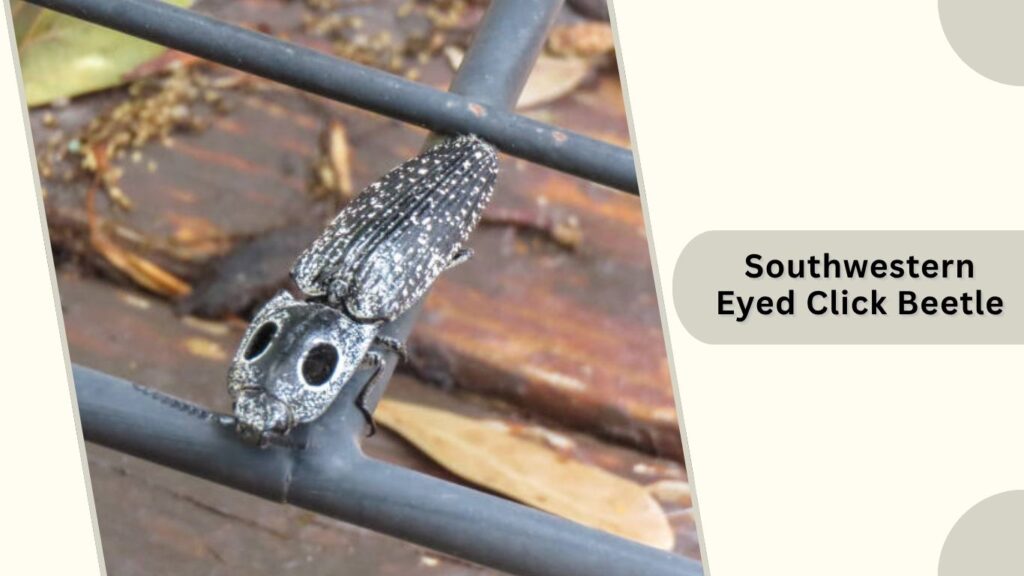
The Southwestern Eyed Click Beetle, Alaus zunianus, is another large, dramatic species known for its false eyespots and powerful clicking ability. Sometimes called the Zuni Click Beetle, it is particularly associated with the American Southwest. Its combination of mottled coloration and large eyespots provides excellent camouflage and defense against predators.
Identification
- Common Name: Southwestern Eyed Click Beetle
- Scientific Name: Alaus zunianus
- Family: Elateridae
- Size: Roughly 20–49 mm
- Color: Black with ivory, gray, or pale mottling
- Eyespots: Large, rounded dark eyespots
- Body Shape: Long and robust
- Defense: Audible click and sudden jumping motion
Its rounded eyespots and pale mottling can help distinguish it from similar Alaus species.
Habitat and Distribution
This species is strongly associated with the southwestern United States, especially Arizona, with records also extending into Sonora, Mexico. It inhabits wooded canyons, pine forests, oak woodland, and related habitats containing dead and decaying trees.
Adults may rest on trunks, logs, or stumps where their mottled bodies blend naturally with the bark.
Behavior and Diet
The Southwestern Eyed Click Beetle uses several defensive strategies. It may remain motionless when disturbed, relying on camouflage, or activate its clicking mechanism to suddenly jump away.
Its larvae inhabit dead wood and prey upon other insects, particularly wood-boring beetle larvae and pupae. This predatory role means the larvae participate in the community of insects that develops inside decomposing trees.
Lifespan and Life Cycle
Eggs are associated with decaying wood where newly hatched larvae can immediately enter a suitable feeding habitat. The larvae develop as predatory wireworms beneath bark and within rotten wood.
After reaching maturity, they form pupae within protected cavities. Adults emerge mainly during the warmer part of the year, with activity commonly increasing during spring and summer.
5. Green Click Beetle
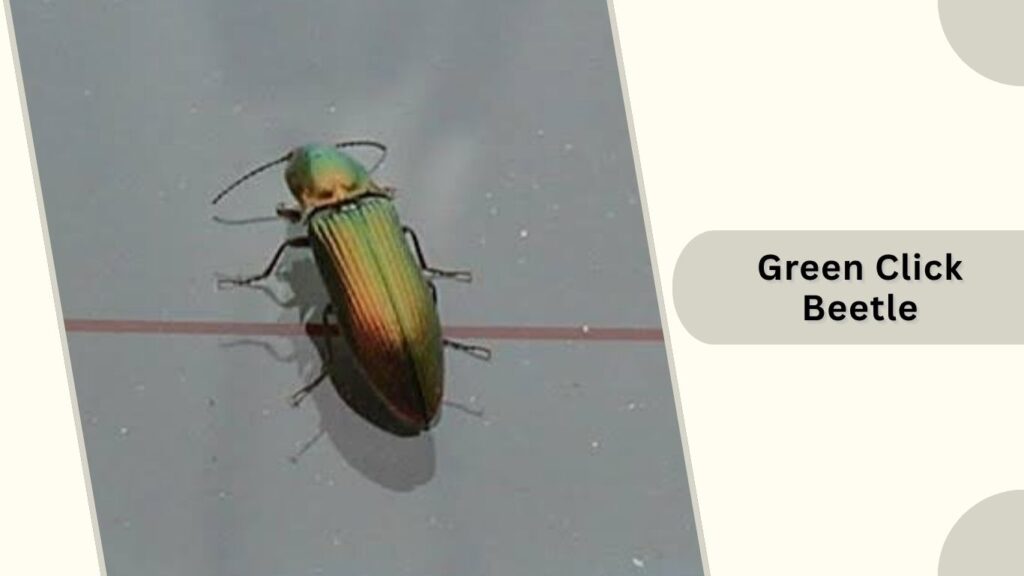
The Green Click Beetle is immediately recognizable because of its brilliant metallic coloration. Currently treated as Nitidolimonius resplendens and historically known as Ctenicera resplendens, this smaller click beetle differs greatly in appearance from the large eyed species above. Adults are usually encountered singly in forests, wetlands, and other vegetated habitats across northern North America.
Identification
- Common Name: Green Click Beetle
- Scientific Name: Nitidolimonius resplendens
- Former Name: Ctenicera resplendens
- Family: Elateridae
- Size: Approximately 11–14 mm
- Color: Metallic green, sometimes with brassy reflections
- Body Shape: Slender and elongated
- Pronotum: Rear corners extend backward
- Special Feature: Typical click-beetle jumping mechanism
The metallic green coloration makes this species quite different from the mostly brown, gray, or black click beetles commonly encountered.
Habitat and Distribution
Green Click Beetles occur across broad areas of northern North America. They have been recorded in Canada and the United States from northern and western regions eastward into parts of the Northeast.
They occupy coniferous, deciduous, and mixed forests as well as poplar groves, wetland margins, and drainage areas. Adults may rest on willow, poplar, shrubs, and fresh conifer growth.
Behavior and Diet
Adults are usually encountered individually rather than in large groups. Like other members of their family, they can use the clicking mechanism in their thorax to right themselves when overturned.
The larvae occur in leaf litter, rotting wood, peat, and moist loamy soils. Unlike many agricultural wireworms that eat plant roots, the larvae of this species are reported to be predatory.
Lifespan and Life Cycle
Green Click Beetles undergo complete metamorphosis. Eggs hatch into elongated larvae that spend their developmental period in moist soil, litter, or decaying organic material.
After the larval stage, they pupate and eventually emerge as metallic green adults. Adult records are concentrated from late spring through summer, roughly May through August, while immature stages spend considerably longer developing in protected habitats.
6. Toothed Click Beetle
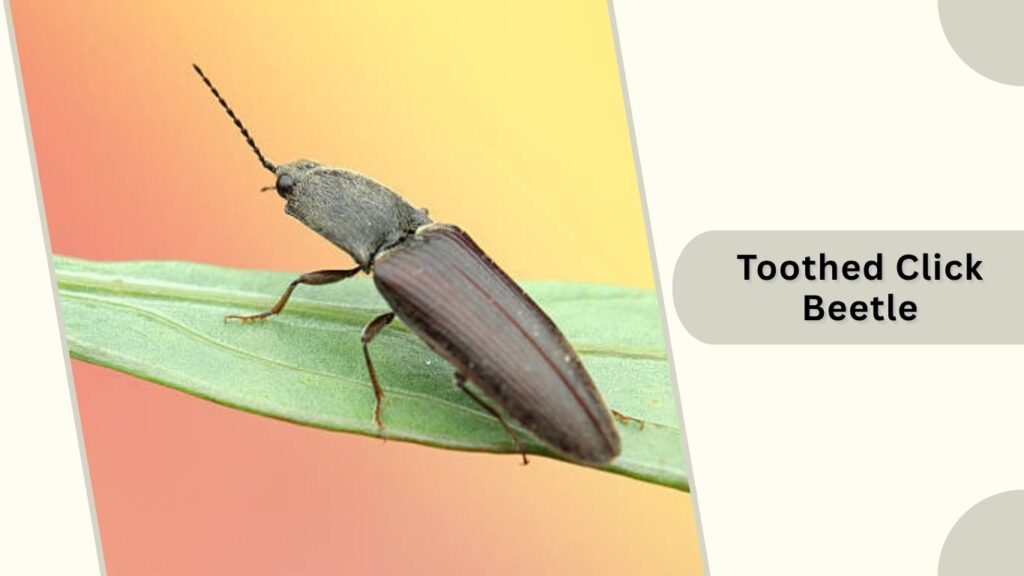
The Toothed Click Beetle (Denticollis denticornis) is a medium-sized North American click beetle associated mainly with wooded environments. Like other members of the family Elateridae, it has an elongated body and the characteristic clicking mechanism that allows it to spring into the air when overturned. Adults are commonly found on vegetation, while the larvae occupy leaf litter and decaying wood.
Identification
- Common Name: Toothed Click Beetle
- Scientific Name: Denticollis denticornis
- Family: Elateridae
- Size: About 10–16 mm
- Body Shape: Long, narrow, and slightly flattened
- Color: Usually brownish, gray-brown, or dark
- Antennae: Long and distinctly segmented
- Special Feature: Clicking mechanism beneath the thorax
Its narrow body and pointed rear corners of the pronotum give it the classic click-beetle appearance. Specimens around 11–12.5 mm have been documented.
Habitat and Distribution
Toothed Click Beetles occur in both coniferous and deciduous forests. Adults are often seen resting on leaves and other vegetation during late spring and early summer.
The larvae prefer protected, moisture-retaining microhabitats such as decomposing wood and forest leaf litter. The species is native to North America and has records across numerous Canadian provinces as well as parts of the United States.
Behavior and Diet
Adults may fly during warm weather and can be attracted to artificial lights. When threatened or placed on their backs, they use the spring-loaded structure beneath the thorax to produce a click and flip themselves upright.
Larvae develop among decomposing organic matter. Detailed species-specific feeding information is limited, but click-beetle larvae occupying rotten wood and litter may feed on small organisms or organic material depending on species.
Lifespan and Life Cycle
The Toothed Click Beetle undergoes complete metamorphosis: egg, larva, pupa, and adult. Most of its development occurs during the larval stage.
Larvae live in protected forest material before eventually pupating and emerging as adults. Adults are particularly noticeable in late spring and early summer, whereas immature stages remain concealed for much longer.
7. Twospotted Click Beetle
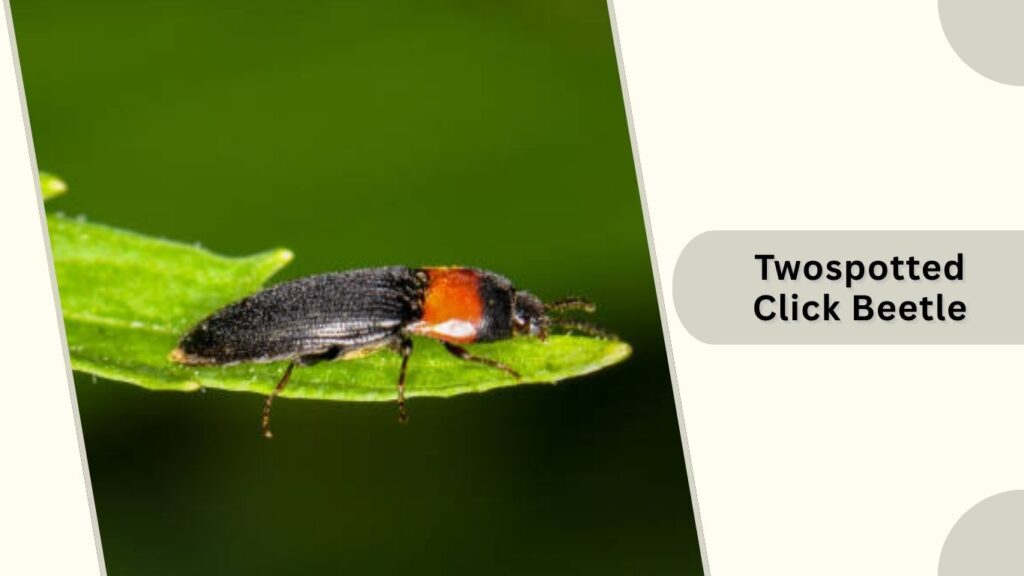
The Twospotted Click Beetle is a North American click beetle traditionally listed as Ctenicera propola propola. Its name refers to its noticeable markings, although coloration can vary between individuals and geographic populations. Like other click beetles, it has an elongated body and a specialized thoracic mechanism that helps it jump suddenly when disturbed.
Identification
- Common Name: Twospotted Click Beetle
- Scientific Name: Ctenicera propola propola
- Family: Elateridae
- Size: Around 9 mm in documented specimens
- Body Shape: Slender and elongated
- Elytra: Long, hardened wing covers
- Pronotum: Broad with pointed rear corners
- Special Feature: Capable of clicking and flipping upward
Taxonomic treatments of this group have changed over time, and some closely related western forms may appear under different generic combinations in modern collections.
Habitat and Distribution
The Twospotted Click Beetle is a North American species with records particularly associated with western and northern regions.
Adults can occur around forest margins, grasslands, meadows, and other vegetated habitats. Related records place members of the group in western landscapes containing grasses, shrubs, and wooded habitats.
The larvae normally remain concealed in soil or organic material rather than moving openly above ground.
Behavior and Diet
When overturned, the adult bends its body and releases stored tension from its thoracic clicking apparatus. The resulting snap may throw the insect several centimeters into the air.
Adults generally spend time on vegetation and may fly in suitable weather. As with many click beetles, the immature stage is a wireworm. Wireworms typically live in soil or decomposing material, where feeding habits can range from plant material to small soil organisms.
Lifespan and Life Cycle
Females place eggs in habitats suitable for larval development. After hatching, the larvae pass through multiple molts while remaining concealed.
Larval development generally occupies much more of the life cycle than the adult stage. Mature larvae pupate in protected chambers before transforming into adults, which emerge when seasonal conditions are favorable.
8. Sweet Click Beetle
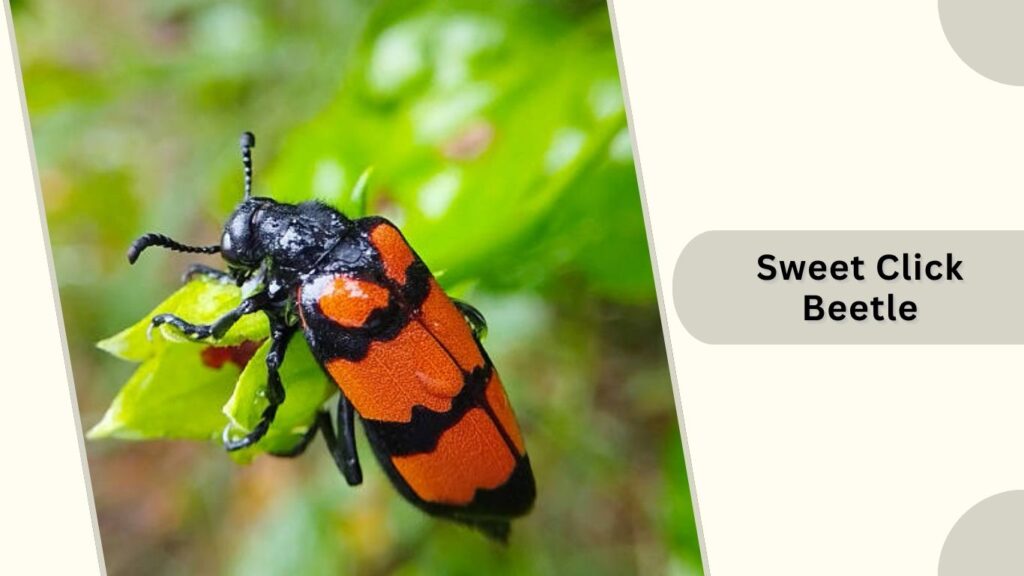
The Sweet Click Beetle (Aeolus mellillus) is a small North American species measuring only a fraction of the size of the large eyed click beetles. It is also called the Flat Wireworm in some entomological references. Adults have an attractive brown pattern with darker markings and occur across much of North America, particularly in grassy habitats.
Identification
- Common Name: Sweet Click Beetle
- Scientific Name: Aeolus mellillus
- Family: Elateridae
- Size: About 5–8 mm
- Color: Reddish or yellowish brown with darker markings
- Body Shape: Small, narrow, and elongated
- Antennae: Slender and segmented
- Special Feature: Distinct click-beetle jumping mechanism
The contrasting darker patches on the pronotum and wing covers can give this little species a particularly distinctive appearance.
Habitat and Distribution
Sweet Click Beetles occur widely across North America. Grasslands and grassy parkland are among their recognized habitats, although adults have also been recorded in hardwood woodland environments.
Adults are commonly active on the soil surface during spring and early summer and sometimes come to lights after dark.
Behavior and Diet
Adults move across the ground and low vegetation and may fly when conditions are warm. Light attraction sometimes makes them easier to observe around buildings.
Their larvae are wireworms that live primarily in soil. Unlike the predatory larvae of large Alaus click beetles, Aeolus mellillus larvae can feed on underground plant material. They therefore occupy an ecological role quite different from predatory wood-dwelling click beetles.
Lifespan and Life Cycle
The life cycle begins when females place eggs in or close to suitable soil. Larvae hatch and spend most of their development underground.
After growing through several larval stages, they pupate in protected soil chambers. Adults emerge mainly during the warmer part of the year, with spring and early summer being important periods of activity.
9. Apical Click Beetle
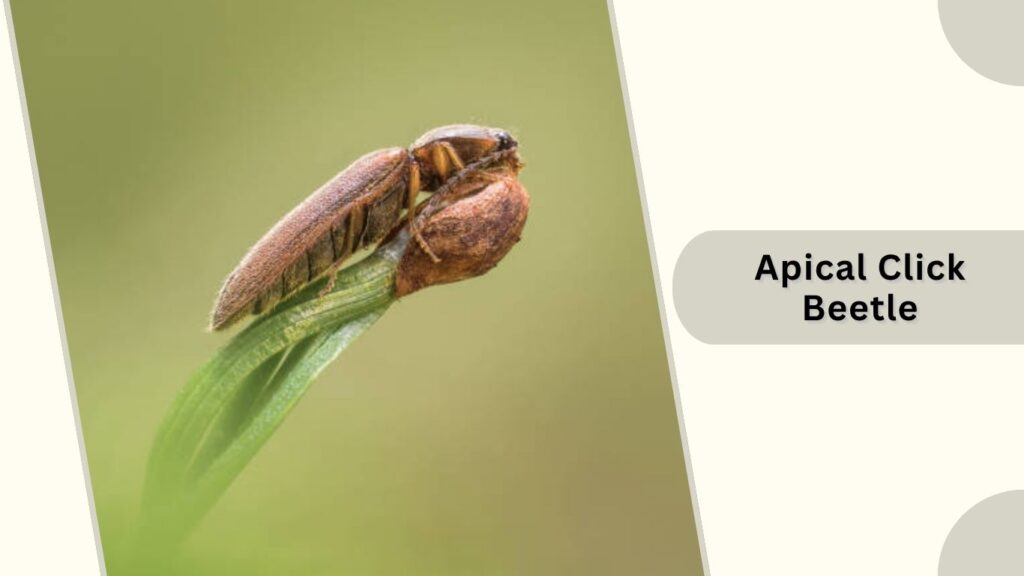
The Apical Click Beetle (Agriotes apicalis) is a western North American member of the large genus Agriotes. These beetles have the narrow, slightly flattened shape typical of click beetles and are generally brown rather than brightly colored. The species is less familiar than economically important wireworms, but it shares many of the structural characteristics that define the genus.
Identification
- Common Name: Apical Click Beetle
- Scientific Name: Agriotes apicalis
- Family: Elateridae
- Color: Brown to dark brown
- Body: Elongated and slightly flattened
- Elytra: Finely lined lengthwise
- Pronotum: Rear corners pointed
- Antennae: Slender and segmented
- Defense: Can snap and jump when overturned
Like other Agriotes, it possesses five-segmented tarsi ending in paired claws.
Habitat and Distribution
The Apical Click Beetle is native to western North America. Records include western regions of Canada and the United States.
Adults are likely to be encountered in grassy or open vegetated habitats as well as forest margins. Because larvae develop underground, areas with suitable soil moisture and vegetation provide important developmental habitat.
Behavior and Diet
Adults typically remain low in vegetation or on the soil surface. Their clicking mechanism is used primarily for righting themselves when they fall onto their backs and may also help them escape predators.
The larvae are wireworms. As is typical of many Agriotes, they live beneath the soil surface where they feed and develop. Detailed feeding studies specifically for A. apicalis are limited, so its exact dietary preferences are not as well documented as those of major agricultural wireworm species.
Lifespan and Life Cycle
Apical Click Beetles pass through egg, larval, pupal, and adult stages.
The larval phase is the longest part of the life cycle. Wireworms may remain concealed underground through multiple developmental stages before pupating. Adults then emerge above ground to mate and begin another generation.
10. Arcane Click Beetle
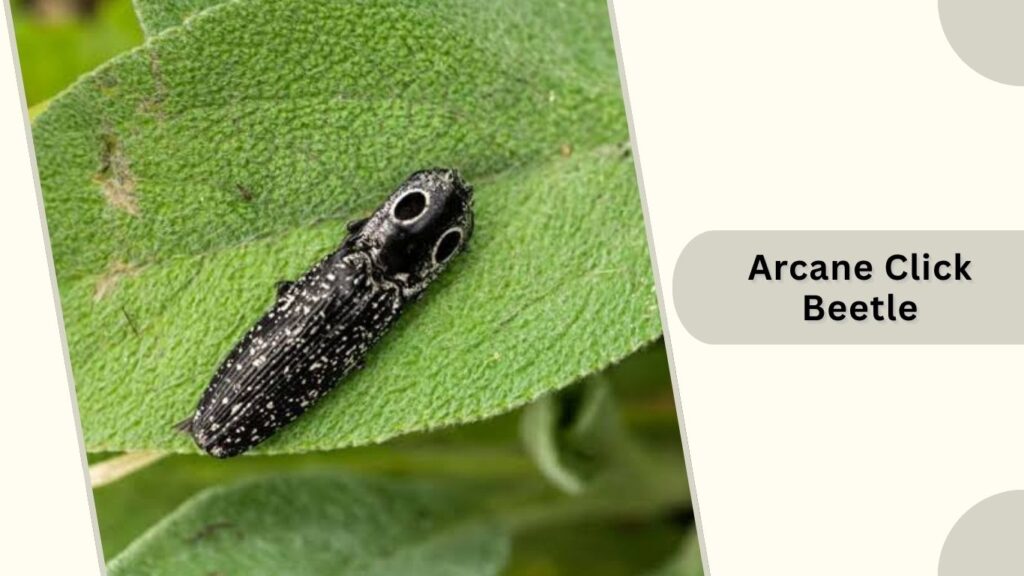
The Arcane Click Beetle (Agriotes arcanus) is a relatively little-known North American click beetle. Its scientific name is appropriate because much of its detailed natural history remains poorly documented compared with common agricultural click beetles. It belongs to Agriotes, a genus containing numerous slender brown species whose larvae are commonly known as wireworms.
Identification
- Common Name: Arcane Click Beetle
- Scientific Name: Agriotes arcanus
- Family: Elateridae
- Body Shape: Slender and elongated
- Color: Generally brown to dark brown
- Elytra: Long and finely grooved
- Pronotum: Broad with pointed rear corners
- Legs: Relatively short compared with body length
- Special Feature: Characteristic clicking apparatus
Correct species identification may require close examination because many North American Agriotes species appear very similar externally.
Habitat and Distribution
The Arcane Click Beetle is a northeastern North American species. Records and taxonomic references place it among the native Agriotes fauna of the region.
It is expected in habitats where soil conditions allow wireworms to develop, including grassy areas, meadows, field margins, and similar environments. Adults may occur on low vegetation during their active season.
Behavior and Diet
When an adult lands upside down, it can arch its body and engage the peg-and-groove mechanism underneath the thorax. Releasing this mechanism creates the familiar click and can launch the beetle upward.
The larvae live underground as wireworms. Specific dietary information for the Arcane Click Beetle is limited, but larvae within Agriotes commonly interact with roots, seeds, decaying vegetation, and other material in the soil environment.
Lifespan and Life Cycle
Like other click beetles, Agriotes arcanus undergoes complete metamorphosis. Eggs hatch into slender, hard-bodied wireworms that live beneath the soil.
They grow through a series of molts before forming pupae underground. Adults emerge after pupal development and become the above-ground reproductive stage. Species-specific lifespan data are limited, but the larval stage is expected to occupy the largest portion of its development.
11. Collared Click Beetle
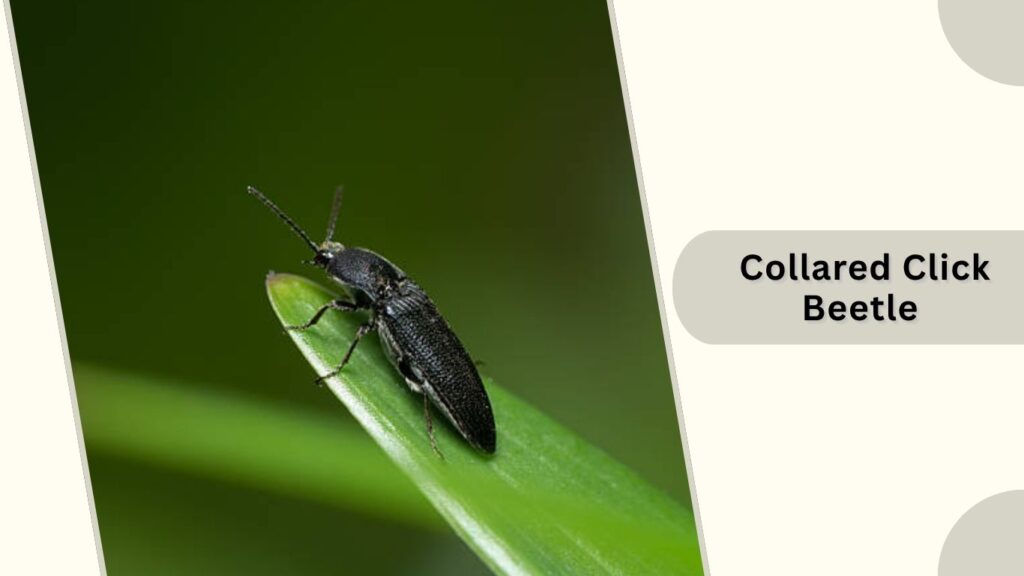
The Collared Click Beetle (Agriotes collaris) is a North American member of the click beetle family Elateridae. Like other Agriotes species, it has an elongated body, pointed rear corners on the pronotum, and the distinctive mechanism that allows it to snap its body and jump when overturned. It is recorded mainly from eastern Canada and parts of the northeastern United States.
Identification
- Common Name: Collared Click Beetle
- Scientific Name: Agriotes collaris
- Family: Elateridae
- Genus: Agriotes
- Body Shape: Narrow and elongated
- Color: Generally brown to dark brown
- Pronotum: Rear corners extend backward
- Antennae: Slender and segmented
- Special Feature: Can produce a click and flip itself upright
Many Agriotes species look similar, so reliable species-level identification may require close examination rather than color alone.
Habitat and Distribution
The Collared Click Beetle is documented in eastern North America. Canadian records include New Brunswick, Nova Scotia, Ontario, Prince Edward Island, and Quebec, while records also exist from Rhode Island in the United States. Its documented distribution may be incomplete.
Members of Agriotes are typically associated with grasslands, meadows, gardens, cultivated fields, parks, and other areas containing vegetation and suitable soil for larval development.
Behavior and Diet
Adult Collared Click Beetles use the characteristic click mechanism when they become trapped on their backs. A spine-like structure beneath the thorax snaps into a corresponding groove, launching the beetle upward.
Detailed species-specific dietary information is limited. However, Agriotes adults commonly occur on foliage and flowers, whereas their wireworm larvae live underground and commonly consume roots and other plant material.
Lifespan and Life Cycle
The species undergoes complete metamorphosis through egg, larva, pupa, and adult stages. Females deposit eggs in suitable soil, and the larvae develop underground as narrow, hard-bodied wireworms.
As with many Agriotes, the larval period is expected to occupy most of the life cycle. After completing development, the larva forms a pupal chamber in the soil before becoming an adult.
12. Common Click Beetle
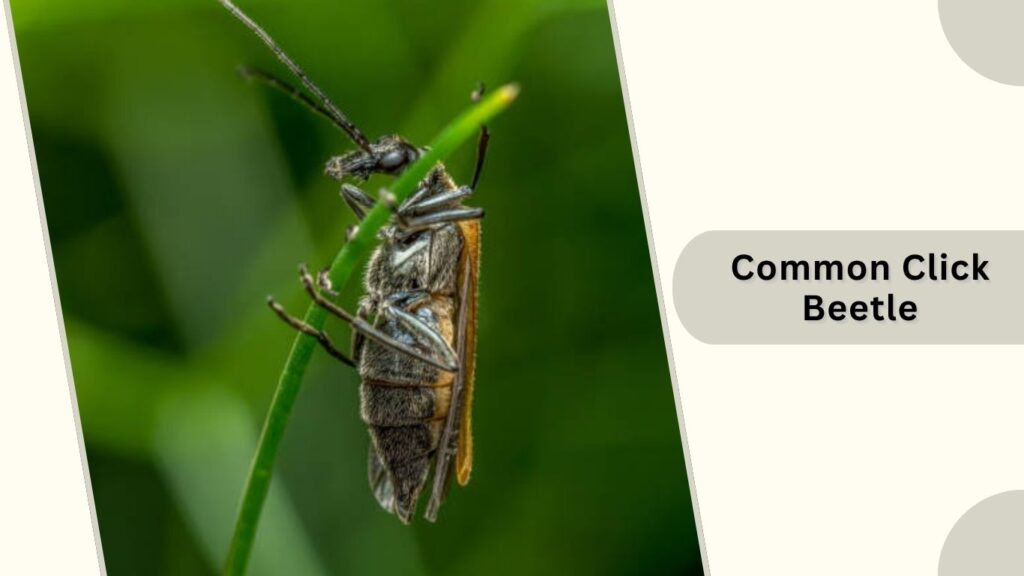
The Common Click Beetle (Agriotes sputator) is a small brown click beetle native to Europe and parts of Asia that has also been introduced into North America. Although the adult appears inconspicuous, its underground larvae, known as wireworms, are well known agricultural pests. They can damage germinating seeds, roots, seedlings, and underground portions of many crops.
Identification
- Common Name: Common Click Beetle
- Scientific Name: Agriotes sputator
- Family: Elateridae
- Size: About 6–9 mm
- Color: Reddish-brown to brown
- Body Shape: Slender, elongated, and convex
- Antennae: Approximately as long as the head and pronotum together
- Larva: Yellowish, slender wireworm
- Special Feature: Powerful clicking mechanism
Fine grayish hairs cover much of the adult’s body, while the rear corners of the pronotum form the pointed projections typical of click beetles.
Habitat and Distribution
The Common Click Beetle naturally occurs throughout much of Europe and extends into parts of western Asia. It has also been introduced into areas of North America.
Grasslands, pastures, meadows, cultivated fields, and grassy agricultural landscapes provide particularly suitable habitat. Eggs and larvae require soil with adequate moisture, making long-term grassland especially favorable for wireworm populations.
Behavior and Diet
Adults are especially active from spring into early summer. They may feed on grasses and pollen and can be encountered on flowering plants.
The larvae have much greater agricultural importance. Wireworms attack germinating seeds, seedlings, roots, and underground plant parts, including those of cereals and other crops. They move through soil in search of suitable food.
Lifespan and Life Cycle
Females lay eggs beneath the soil surface. After roughly two weeks under favorable conditions, wireworm larvae emerge and begin feeding.
Larval development commonly takes about three to four years and may involve several molts. Mature larvae pupate underground, after which adults develop. Because most of the insect’s life is spent underground, adults represent only a relatively short portion of the complete life cycle.
13. Criddle’s Click Beetle
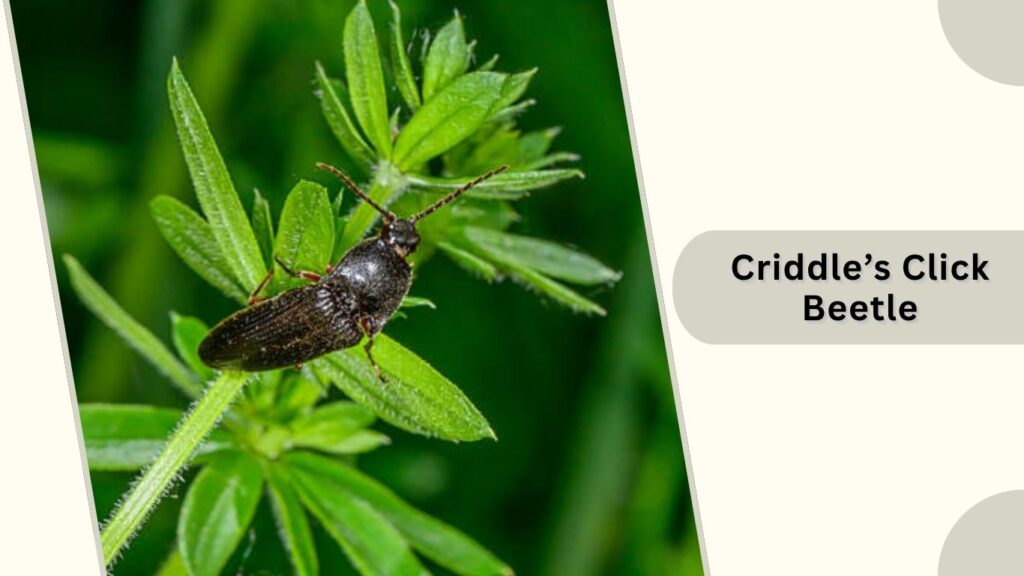
Criddle’s Click Beetle (Agriotes criddlei) is a native North American species belonging to the large genus Agriotes. It is much less thoroughly documented than economically important click beetles such as the Common or Lined Click Beetle. Even major regional field guides note that detailed descriptive information about this species remains limited, making it a comparatively little-known member of Elateridae.
Identification
- Common Name: Criddle’s Click Beetle
- Scientific Name: Agriotes criddlei
- Family: Elateridae
- Genus: Agriotes
- Body Shape: Elongated and relatively narrow
- General Form: Typical Agriotes click beetle appearance
- Pronotum: Posterior corners pointed
- Larval Form: Wireworm
- Special Feature: Clicking and jumping mechanism
Because detailed published descriptions are sparse, identification to species level should ideally rely on an entomological key or expert examination rather than general appearance alone.
Habitat and Distribution
Criddle’s Click Beetle is confirmed as a native North American species and is included in regional fauna such as the Montana Field Guide. That source currently provides limited ecological and distribution details beyond its verified taxonomic occurrence.
More broadly, North American Agriotes occur in grasslands, cultivated areas, gardens, pastures, meadows, lawns, and related habitats where the larvae can develop in soil.
Behavior and Diet
Adults possess the mechanical adaptation characteristic of Elateridae. When overturned, the beetle bends the front and rear portions of its body and releases stored force, producing a click that may throw it into the air.
Species-specific food records for A. criddlei are poorly documented. Its classification within Agriotes indicates a soil-dwelling wireworm larval stage, but dietary claims beyond that should be made cautiously until more species-specific studies are available.
Lifespan and Life Cycle
Like other click beetles, Criddle’s Click Beetle develops through egg, larva, pupa, and adult.
The immature wireworm stage occurs underground and is likely substantially longer than the adult period, as is characteristic of the genus. Once development is complete, the larva pupates in a protected soil chamber and transforms into the adult beetle.
14. Dark Click Beetle
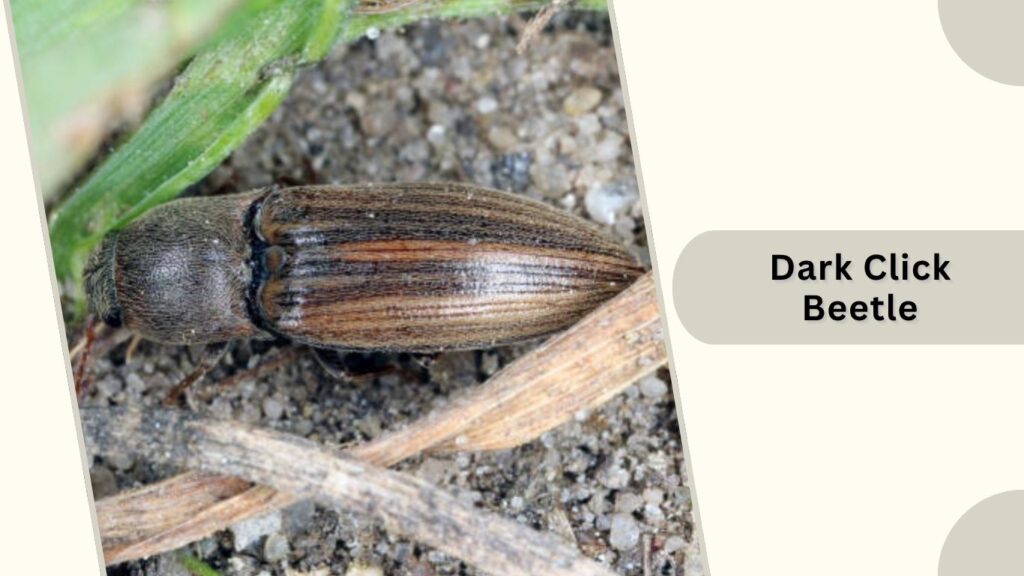
The Dark Click Beetle listed here is Agriotes fucosus, a North American species found especially across Canada. The common name “dark click beetle” can also be applied to Agriotes obscurus in some references, so scientific names are important when distinguishing them. Here, the name specifically refers to A. fucosus, consistent with this click-beetle list.
Identification
- Common Name: Dark Click Beetle
- Scientific Name: Agriotes fucosus
- Family: Elateridae
- Genus: Agriotes
- Body Shape: Slender and elongated
- Color: Generally dark brown
- Elytra: Long hardened wing covers
- Pronotum: Broad with pointed hind corners
- Larva: Wireworm
- Special Feature: Can snap its thorax and jump
Species-level identification among dark-colored Agriotes can be difficult because several species share a similar brown, elongated appearance.
Habitat and Distribution
Agriotes fucosus has a broad documented Canadian distribution. Records include Alberta, Manitoba, New Brunswick, Newfoundland, Nova Scotia, Ontario, Quebec, and Saskatchewan. Rhode Island is also listed among documented U.S. records, although available distribution information may be incomplete.
Its general ecology is consistent with other Agriotes, which commonly occupy grassy environments and soils rich in plant roots.
Behavior and Diet
Adult Dark Click Beetles can use the familiar clicking mechanism to escape when overturned. Adults of Agriotes are usually found on vegetation and generally cause much less plant damage than their larvae.
The wireworm stage occurs underground. Across the genus, larvae feed largely on underground plant material, including roots, seeds, and young plant tissues, although detailed food information specifically for A. fucosus is limited.
Lifespan and Life Cycle
Females lay eggs in soil suitable for larval development. Wireworms emerge and remain underground through successive growth stages before pupating.
Exact development times for A. fucosus are not well documented in readily available species accounts. However, Agriotes click beetles commonly spend much longer as larvae than adults, with some related species requiring several years to complete development.
15. Detached Click Beetle
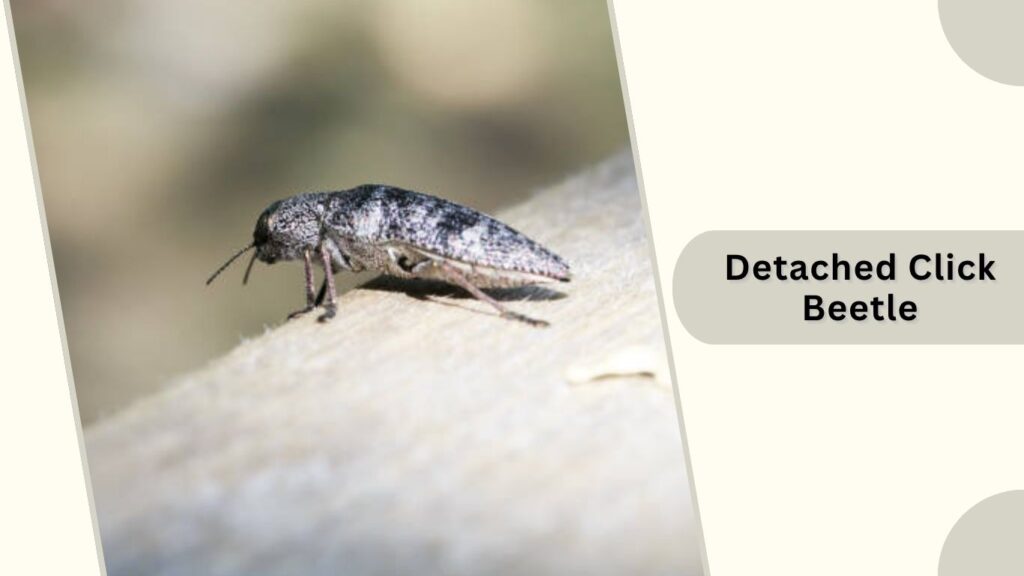
The Detached Click Beetle (Agriotes avulsus) is another North American member of Agriotes. It has been recorded in north-central and northeastern portions of the continent. Detailed biological studies of this species are scarce, so much less is known about its individual ecology than about major pest species such as A. sputator, A. lineatus, and A. obscurus.
Identification
- Common Name: Detached Click Beetle
- Scientific Name: Agriotes avulsus
- Family: Elateridae
- Genus: Agriotes
- Body Shape: Narrow and elongated
- General Color: Brownish to dark
- Elytra: Long and generally longitudinally marked
- Pronotum: Pointed at the rear corners
- Larva: Slender wireworm
- Special Feature: Clicking mechanism used to flip upright
Agriotes species can be externally similar, so precise identification of A. avulsus may require examination of small structural characters.
Habitat and Distribution
The Detached Click Beetle is recorded from north-central and northeastern North America. BugGuide also recognizes A. avulsus among North American members of the genus, although its detailed natural history is not extensively represented in commonly available references.
Habitats occupied by the genus commonly include meadows, grasslands, gardens, agricultural fields, parks, and other vegetated areas with suitable soil.
Behavior and Diet
Adults likely spend much of their active period on or near vegetation. When overturned or threatened, their thoracic clicking apparatus allows them to snap upward, sometimes repeatedly, until they regain their footing.
Detailed feeding information specifically for the Detached Click Beetle is limited. Its larvae are wireworms and live in soil, but species-specific studies are insufficient to describe their preferred foods with the same confidence available for economically important Agriotes.
Lifespan and Life Cycle
The Detached Click Beetle follows the standard click-beetle developmental pattern of egg, wireworm larva, pupa, and adult.
The larval stage takes place below ground and is expected to form the longest portion of development. Mature wireworms eventually create protected pupation sites in soil. Adults emerge afterward, mate, and produce the eggs that begin the next generation.
16. Isabelline Click Beetle
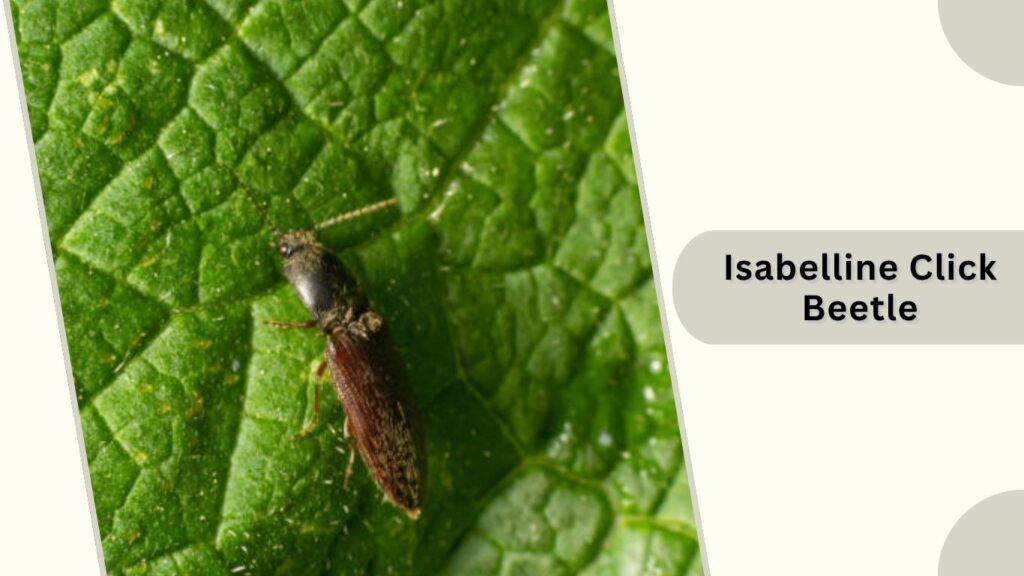
The Isabelline Click Beetle (Agriotes isabellinus) is a North American member of the click beetle family Elateridae. Like other Agriotes species, it has the narrow, elongated body and pointed thoracic corners typical of click beetles. This species is comparatively little studied, and much of its detailed ecology remains undocumented. It is primarily known from northeastern North America, including eastern Canada.
Identification
- Common Name: Isabelline Click Beetle
- Scientific Name: Agriotes isabellinus
- Family: Elateridae
- Genus: Agriotes
- Body Shape: Narrow, elongated, and nearly parallel-sided
- Color: Generally yellowish-brown to light brown
- Pronotum: Tapers toward pointed rear corners
- Larva: Slender, hard-bodied wireworm
- Special Feature: Can click and flip itself upright
Species within Agriotes can look extremely similar, so accurate identification may require close examination of small anatomical features rather than color alone.
Habitat and Distribution
The Isabelline Click Beetle is native to northeastern North America. Documented records include Ontario and Quebec, although its complete distribution may be broader than currently well-documented records suggest.
Like related Agriotes, it is associated with terrestrial habitats where its larvae can develop in soil. Meadows, grassy areas, woodland edges, and other places with vegetation and moist soil can provide suitable conditions for wireworms.
Behavior and Diet
Adults possess the familiar click-beetle escape mechanism. When lying on their backs, they rapidly flex their bodies and release a spine-like structure beneath the thorax, producing a sharp click and launching themselves upward.
Specific feeding studies for A. isabellinus are limited. Its larvae are considered wireworms, but researchers have not documented their diet as thoroughly as that of major agricultural Agriotes pests.
Lifespan and Life Cycle
The Isabelline Click Beetle undergoes complete metamorphosis through egg, larva, pupa, and adult stages.
Species-specific development times are poorly known. In Agriotes generally, the wireworm stage can persist for multiple years underground before pupation. Adults represent the shorter reproductive stage of the life cycle.
17. Lined Click Beetle
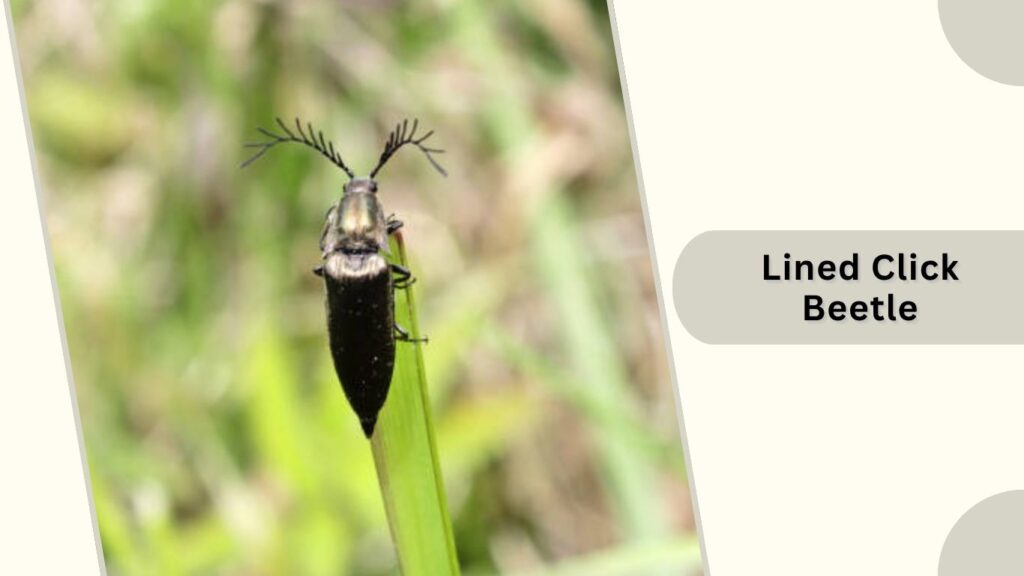
The Lined Click Beetle (Agriotes lineatus) is one of the better-known members of the genus because its wireworm larvae can damage agricultural crops. Adults are slender brown beetles with noticeable longitudinal lines along their wing covers. Native to Europe and parts of western Asia, the species has also become established in several areas of North America.
Identification
- Common Name: Lined Click Beetle
- Scientific Name: Agriotes lineatus
- Family: Elateridae
- Color: Brown to grayish-brown
- Body Shape: Narrow and elongated
- Elytra: Distinct lengthwise grooves or lines
- Surface: Covered with fine hairs
- Larva: Yellowish-brown, hard-bodied wireworm
- Special Feature: Clicking and jumping mechanism
The longitudinal markings on the elytra are among the most noticeable features and contribute to the species’ common name.
Habitat and Distribution
Lined Click Beetles are native across much of Europe and occur in western Asia and the Near East. Introduced populations are established in parts of North America, including areas of Canada and Washington State.
They are especially associated with grasslands, agricultural fields, pastures, and other vegetated habitats with moist soil. Such habitats are important because larvae spend most of their lives underground.
Behavior and Diet
Adults may move through low vegetation and can fly, especially under warm conditions. Like other click beetles, they snap themselves upward when overturned.
Wireworms cause most of the economic concern. They attack underground plant tissues, including roots, germinating seeds, and tubers. Potatoes, cereals, corn, strawberries, carrots, onions, and several other crops may be affected.
Lifespan and Life Cycle
Females place eggs in moist, vegetation-covered soil. Newly hatched larvae begin feeding underground and may pass through numerous larval stages.
Development can require several years. Mature wireworms eventually pupate in the soil, with adults emerging afterward. Adults generally live for a much shorter period than the long-lived larval stage.
18. Muddy Click Beetle
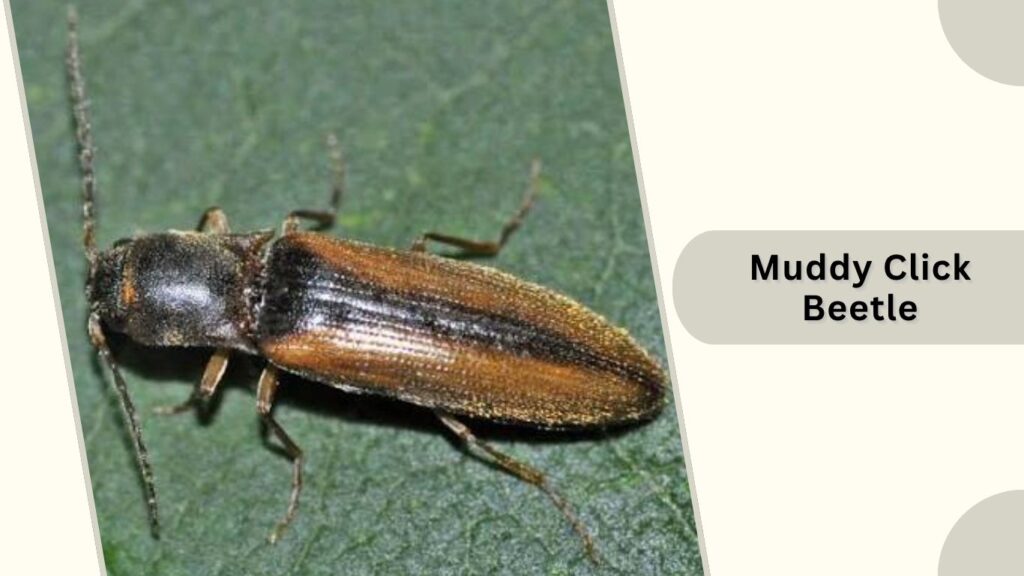
The Muddy Click Beetle (Agriotes limosus) is a native North American click beetle whose name reflects its generally subdued brownish appearance. It belongs to the soil-associated genus Agriotes, whose larvae are known as wireworms. Although this species occurs across a broad northern range, its ecology and economic importance have received less study than those of introduced agricultural pests such as the Lined Click Beetle.
Identification
- Common Name: Muddy Click Beetle
- Scientific Name: Agriotes limosus
- Family: Elateridae
- Genus: Agriotes
- Color: Usually muted brown or dark brown
- Body Shape: Slender and elongated
- Pronotum: Rear corners distinctly pointed
- Elytra: Lengthwise grooves typical of the genus
- Larva: Soil-dwelling wireworm
- Defense: Characteristic clicking mechanism
Because several Agriotes species have nearly identical brown bodies, species-level identification can require microscopic characters or molecular methods.
Habitat and Distribution
The Muddy Click Beetle has a northern North American distribution. Records include several Canadian provinces and regions, including Alberta, British Columbia, Labrador, Manitoba, and New Brunswick. Other published records extend its range through parts of northeastern North America.
It is likely associated primarily with grassy and vegetated environments containing soil suitable for larval development.
Behavior and Diet
Adults use their thoracic clicking mechanism to right themselves when overturned and possibly to escape predators.
The larvae remain underground as wireworms. They may feed on plant roots, although the precise dietary preferences of A. limosus have not been studied as thoroughly as those of better-known pest species. Its specific economic impact on crops is also not well documented.
Lifespan and Life Cycle
The life cycle includes egg, wireworm larva, pupa, and adult.
Females deposit eggs where young larvae can enter suitable soil. The larvae molt repeatedly while developing underground before creating a pupal chamber. Exact development time for the Muddy Click Beetle is poorly documented, but related Agriotes commonly spend several years in the larval stage.
19. Oblong-Necked Click Beetle
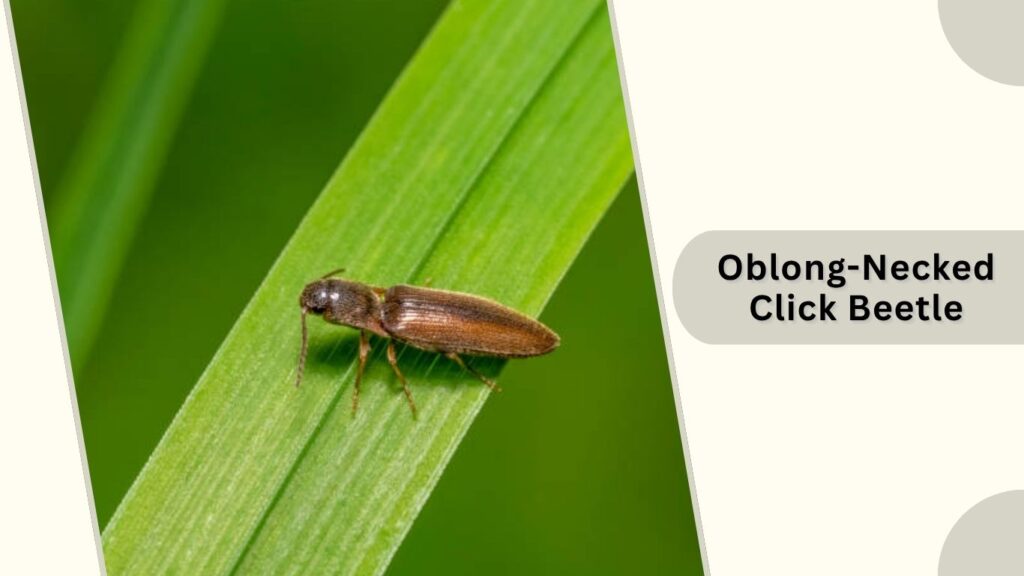
The Oblong-Necked Click Beetle (Agriotes oblongicollis) is a native eastern North American species. Its elongated pronotum helps explain its descriptive common name. Adults have been collected from flowers and other vegetation, showing that they spend at least part of their above-ground life actively moving among plants rather than remaining entirely at soil level.
Identification
- Common Name: Oblong-Necked Click Beetle
- Scientific Name: Agriotes oblongicollis
- Family: Elateridae
- Genus: Agriotes
- Body Shape: Long, narrow, and streamlined
- Pronotum: Relatively elongated or oblong
- Color: Generally brown to dark brown
- Elytra: Long with fine longitudinal grooves
- Larva: Wireworm
- Special Feature: Capable of snapping into the air
It resembles several other brown Agriotes species, making expert examination useful for reliable identification.
Habitat and Distribution
This beetle is mainly associated with eastern North America. Records include areas from New England and New York southward through parts of the eastern United States, while Canadian records include Ontario and Quebec.
Adults have been collected in fields, forest-edge vegetation, and flowering plants. Records include individuals visiting hawthorn flowers and false Solomon’s seal.
Behavior and Diet
Adults may crawl on flowers and foliage, and they can use their click mechanism if overturned or disturbed. Their presence on flowers suggests that adults interact with flowering vegetation, although detailed feeding behavior is not well documented.
The larvae develop as underground wireworms. Exact food preferences for A. oblongicollis are uncertain, and it should not automatically be assumed to cause the same level of crop damage as better-known Agriotes pests.
Lifespan and Life Cycle
Females lay eggs in or around suitable soil. The larvae remain underground while growing through successive molts.
After completing larval development, they pupate within protected soil chambers. Adults emerge afterward and become active above ground during warmer months. Exact species-specific lifespan data remain limited.
20. Opaque Click Beetle
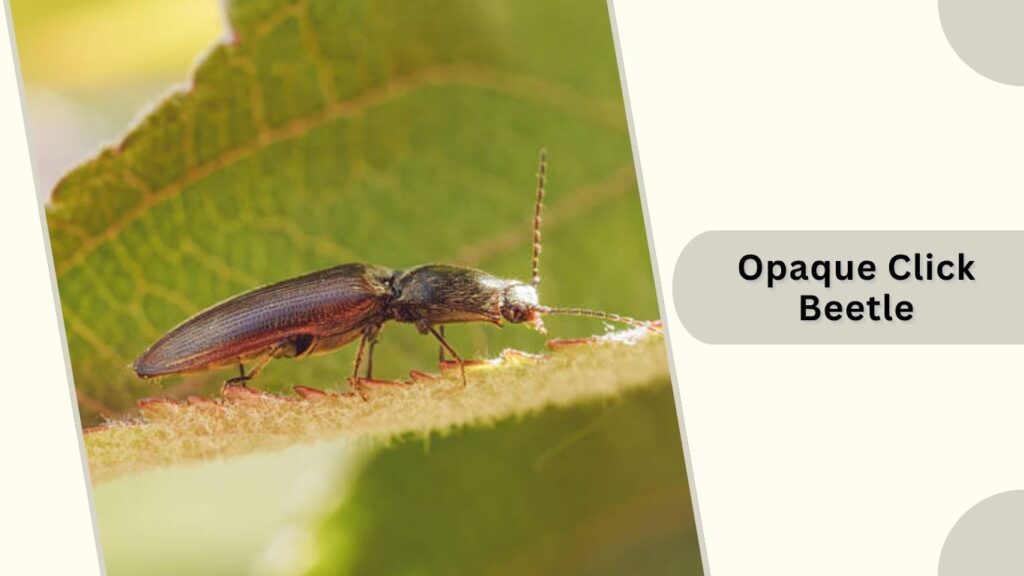
The Opaque Click Beetle (Agriotes opaculus) is a native North American click beetle that is particularly associated with western regions of the continent. Compared with major agricultural wireworm species, relatively little has been published about its natural history. Its scientific and common names are well established, but even regional field guides note that detailed biological information remains incomplete.
Identification
- Common Name: Opaque Click Beetle
- Scientific Name: Agriotes opaculus
- Family: Elateridae
- Genus: Agriotes
- Body Shape: Slender and elongated
- Color: Brown to dark brown
- Surface: Comparatively dull or opaque in appearance
- Pronotum: Rear corners pointed backward
- Larva: Wireworm
- Defense: Clicking and flipping mechanism
Like other Agriotes, it may be difficult to separate from similar species using general color and shape alone.
Habitat and Distribution
The Opaque Click Beetle is native to North America and is primarily known from northwestern portions of the continent. Taxonomic records characterize A. opaculus as a northwestern North American species.
Its immature stages are expected to occupy soil, while adults occur above ground in vegetated environments. Detailed preferences for particular forests, grasslands, or soil types have not been sufficiently documented to define a narrow habitat.
Behavior and Diet
Adults can employ the classic click-beetle mechanism. When lying upside down, they rapidly flex the thorax and abdomen, producing a click that can throw them into the air.
Species-specific feeding information for the Opaque Click Beetle is scarce. Although many Agriotes wireworms consume plant roots and underground tissues, detailed evidence for the diet and agricultural significance of A. opaculus is limited.
Lifespan and Life Cycle
The Opaque Click Beetle follows complete metamorphosis: egg, larva, pupa, and adult.
Its exact lifespan has not been well documented. Based on the broader biology of Agriotes, most development occurs during the underground wireworm stage, followed by pupation in soil and emergence of the adult reproductive stage.
21. Dusky Click Beetle
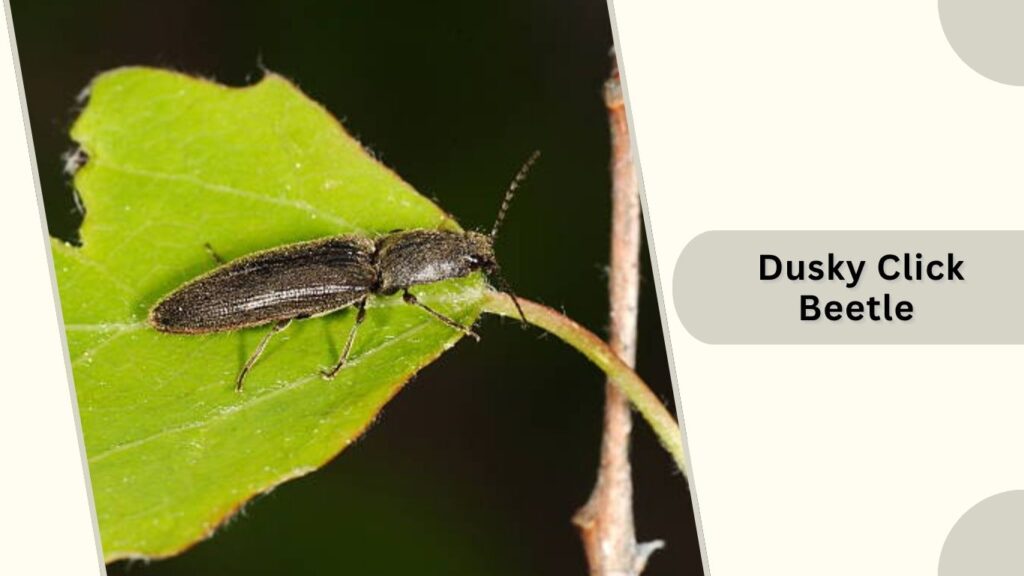
The Dusky Click Beetle (Agriotes obscurus) is a dark brown click beetle whose larvae are commonly called dusky wireworms. Native to Europe and parts of northern Asia, it was accidentally introduced into western North America. The species is especially important in agriculture because its long-lived larvae feed below ground on roots, seeds, tubers, and young plants.
Identification
- Common Name: Dusky Click Beetle
- Scientific Name: Agriotes obscurus
- Family: Elateridae
- Size: About 7–10 mm
- Color: Medium to dark brown
- Body: Elongated and slightly flattened
- Surface: Covered with fine yellowish hairs
- Pronotum: Rounded and wider than long
- Larva: Slender, hard-bodied wireworm
- Special Feature: Produces a click when flipping upright
Adults can resemble other brown Agriotes, so close examination may be necessary for reliable identification.
Habitat and Distribution
The Dusky Click Beetle is widespread in central and northern Europe and extends into northern Asia. Introduced populations occur in British Columbia and Washington, particularly around Vancouver Island and the Fraser Valley.
It favors grassy habitats such as pastures, meadows, cultivated land, and field margins. Moist soil containing abundant plant roots provides especially suitable habitat for its larvae.
Behavior and Diet
Adults are often active during spring and may move around vegetation at night. They feed mainly on grasses and other plant material.
The larvae are much more economically significant. Wireworms attack roots, germinating seeds, cereals, potatoes, vegetables, and other underground plant parts, sometimes remaining concealed in soil for years.
Lifespan and Life Cycle
Females place eggs near the soil surface during spring. Larvae generally hatch during early summer and begin feeding below ground.
The wireworm stage can last up to about four years. Mature larvae eventually pupate underground before emerging as adult click beetles, making the larval period by far the longest part of the life cycle.
22. Hood’s Click Beetle
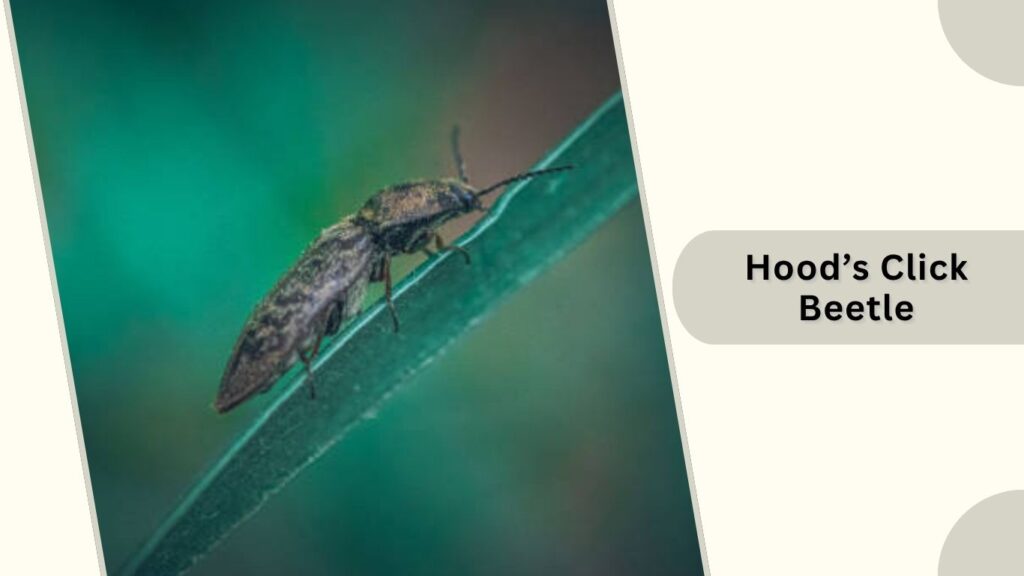
Hood’s Click Beetle (Agriotes hoodi) is a native North American click beetle belonging to the genus Agriotes. Compared with important agricultural species such as the Lined or Dusky Click Beetle, relatively little detailed biological information has been published about this species. It is primarily associated with northwestern North America and has been officially recorded in British Columbia.
Identification
- Common Name: Hood’s Click Beetle
- Scientific Name: Agriotes hoodi
- Family: Elateridae
- Genus: Agriotes
- Body Shape: Long and narrow
- General Color: Brownish
- Pronotum: Pointed at the rear corners
- Elytra: Elongated and grooved
- Larva: Wireworm form
- Special Feature: Clicking mechanism in the thorax
The Government of Canada recognizes Hood’s Click Beetle as the accepted English common name for Agriotes hoodi.
Habitat and Distribution
Hood’s Click Beetle occurs in northwestern North America. Records include British Columbia, and the species belongs to the native western Agriotes fauna.
Detailed habitat studies are limited. As with related Agriotes, the larvae are expected to spend their development in soil, while adults occur above ground around vegetation during their active season.
Behavior and Diet
Adults can use the characteristic click-beetle mechanism when overturned. By flexing the body and releasing a thoracic spine, the beetle may jump into the air and land upright.
Specific feeding information for A. hoodi remains poorly documented. It should therefore not automatically be treated as a major crop pest simply because some related Agriotes species damage crops.
Lifespan and Life Cycle
Hood’s Click Beetle undergoes complete metamorphosis: egg, larva, pupa, and adult.
The larvae are wireworm-like and develop in protected terrestrial habitats. Precise development time, adult lifespan, and food preferences have not been well established for this species, so broader Agriotes biology should be used cautiously rather than presented as species-specific fact.
23. Pubescent Click Beetle
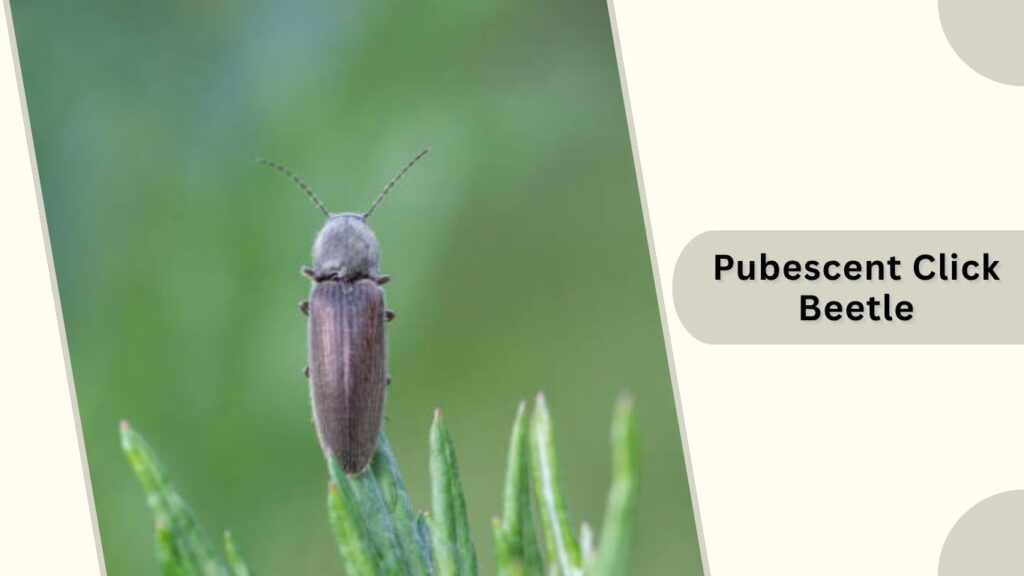
The Pubescent Click Beetle (Agriotes pubescens) is a native North American species frequently encountered in agricultural landscapes in central and eastern Canada. Despite being relatively common, its biology remains less understood than that of many invasive European Agriotes. Recent research has even shown that females produce pheromone compounds similar to those used by the Lined Click Beetle.
Identification
- Common Name: Pubescent Click Beetle
- Scientific Name: Agriotes pubescens
- Family: Elateridae
- Body: Elongated and approximately parallel-sided
- Surface: Finely hairy or pubescent
- Pronotum: Narrows toward the rear
- Color: Typically brown
- Larva: Slender wireworm
- Special Feature: Strong click-and-flip response
Several Agriotes species look very similar, so specialists may need structural characters for confident identification.
Habitat and Distribution
The species occurs in North America and has records from Manitoba, Saskatchewan, Ontario, Quebec, New Brunswick, and other Canadian regions. It is frequently detected on farmland and often occurs alongside the Wheat Wireworm, Agriotes mancus.
It has also been collected in silver maple forests, seasonally flooded habitats, and on oak foliage, showing that it is not restricted entirely to cropland.
Behavior and Diet
Adult males respond strongly to female-produced sex pheromones. Recent experiments identified geranyl butanoate and geranyl octanoate as important pheromone components.
The exact feeding ecology of the larvae is still incompletely understood. Historical evidence associates the species with agricultural soils and suggests that larvae can feed on underground plant material, but its current economic importance requires further study.
Lifespan and Life Cycle
The Pubescent Click Beetle undergoes egg, wireworm larva, pupa, and adult stages.
Its precise species-specific life history remains poorly studied. Researchers suggest that it may have a life cycle similar to A. mancus, whose immature stages spend an extended period below ground before pupation and adult emergence.
24. Rusty Click Beetle
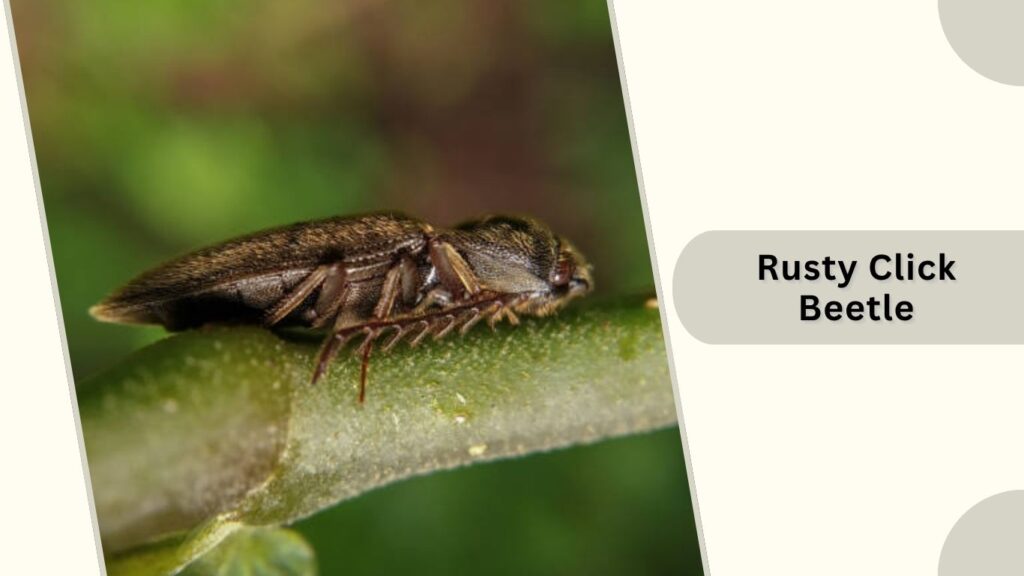
The Rusty Click Beetle in this list refers to Agriotes ferrugineipennis, a North American species—not the European Rusty Click Beetle Elater ferrugineus. A. ferrugineipennis belongs to the same soil-associated genus as many agricultural wireworms and is native to northwestern North America. Its reddish-brown wing covers help explain the descriptive common name.
Identification
- Common Name: Rusty Click Beetle
- Scientific Name: Agriotes ferrugineipennis
- Family: Elateridae
- Body Shape: Narrow and elongated
- Color: Brown to rusty brown
- Elytra: Often noticeably reddish-brown
- Pronotum: Darker and broad
- Antennae: Slender and segmented
- Larva: Wireworm
- Special Feature: Click-and-jump mechanism
One documented California specimen measured about 10.5 mm, illustrating the species’ medium-sized Agriotes form.
Habitat and Distribution
The Rusty Click Beetle is a northwestern North American species. Records include British Columbia and western areas of the United States, including California.
Because larvae are soil dwelling, suitable vegetated ground provides their developmental environment. Adults become active above ground during the warmer season.
Behavior and Diet
Adults can snap themselves into the air if placed on their backs, an ability shared throughout the click beetle family.
Specific dietary research on A. ferrugineipennis remains limited. Its wireworm larvae inhabit soil, but there is insufficient species-specific evidence to describe it as a major agricultural pest in the same way as A. lineatus or A. obscurus.
Lifespan and Life Cycle
The life cycle consists of egg, larva, pupa, and adult stages. Eggs are associated with terrestrial habitats where wireworms can develop below ground.
Detailed information on exactly how many years A. ferrugineipennis remains in the larval stage is limited. Like other Agriotes, however, the larval portion is substantially more concealed than the short above-ground adult phase.
25. Stable Click Beetle
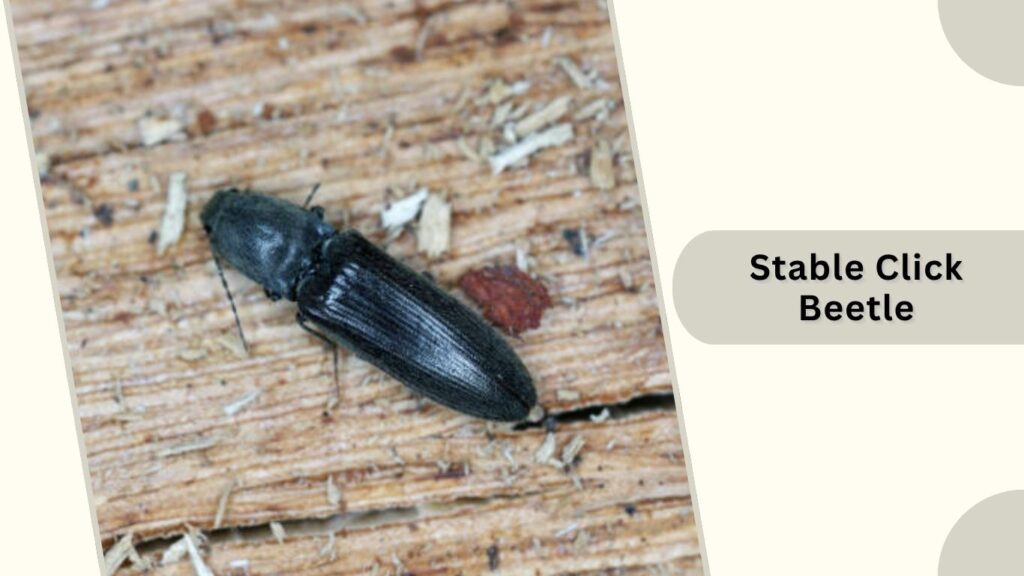
The Stable Click Beetle (Agriotes stabilis) is a native North American click beetle with an interesting ecology compared with several root-feeding relatives. It occurs across north-central and northeastern North America. Studies from eastern Canada show adults occupying forests and vegetation near wetlands, while the larvae can live in sandy soil and behave as predators within the humus layer.
Identification
- Common Name: Stable Click Beetle
- Scientific Name: Agriotes stabilis
- Family: Elateridae
- Genus: Agriotes
- Body Shape: Slender and elongated
- Color: Generally brown
- Pronotum: Pointed at the rear corners
- Elytra: Long and finely grooved
- Larva: Wireworm-like
- Defense: Produces an audible click when flipping upright
The accepted common name “Stable Click Beetle” is officially associated with Agriotes stabilis.
Habitat and Distribution
This species occurs across north-central and northeastern North America. Canadian records include several Maritime provinces and other eastern regions.
Adults have been collected from deciduous, mixed, and coniferous forests, especially around clearings. They are also found on hazel, willow, dogwood, and understory vegetation near small ponds.
Behavior and Diet
Adults commonly rest or move among understory vegetation. Like other click beetles, they can rapidly flip themselves into the air after falling onto their backs.
Interestingly, larvae have been reported from sandy soils where they behave as predators in the humus layer, rather than functioning solely as root-feeding agricultural wireworms.
Lifespan and Life Cycle
Stable Click Beetles develop through egg, larval, pupal, and adult stages. Larvae remain in soil and organic material, where they grow before eventually pupating underground.
Detailed total lifespan data are limited. Adults in eastern Canada are commonly recorded during the warmer months, while the concealed larval stage occupies a much larger portion of development.
FAQs
1. Why are they called click beetles?
Click beetles possess a specialized spine-and-groove mechanism between sections of the thorax. When a beetle is on its back, it bends its body and suddenly releases this mechanism, producing a clicking sound and often launching itself into the air.
2. Are click beetles harmful to humans?
Adult click beetles are generally harmless to people. They do not normally bite or sting. Some species are important pests because their larvae, called wireworms, feed on crop roots, seeds, and underground plant parts.
3. What is a click beetle larva called?
Most click beetle larvae are called wireworms. They are usually narrow, cylindrical, and relatively hard-bodied. Depending on the species, wireworms may eat plant material, roots, decaying matter, or other small organisms.
4. How long do click beetles live?
The life cycle varies by species. Many click beetles spend far longer as larvae than as adults, and some Agriotes wireworms remain underground for several years before pupating and emerging as adult beetles.
5. Can click beetles fly?
Yes. Adult click beetles have functional hindwings underneath their hardened elytra and can fly. The famous “click” is not their normal method of flight; it is primarily a mechanism for righting themselves and escaping danger.