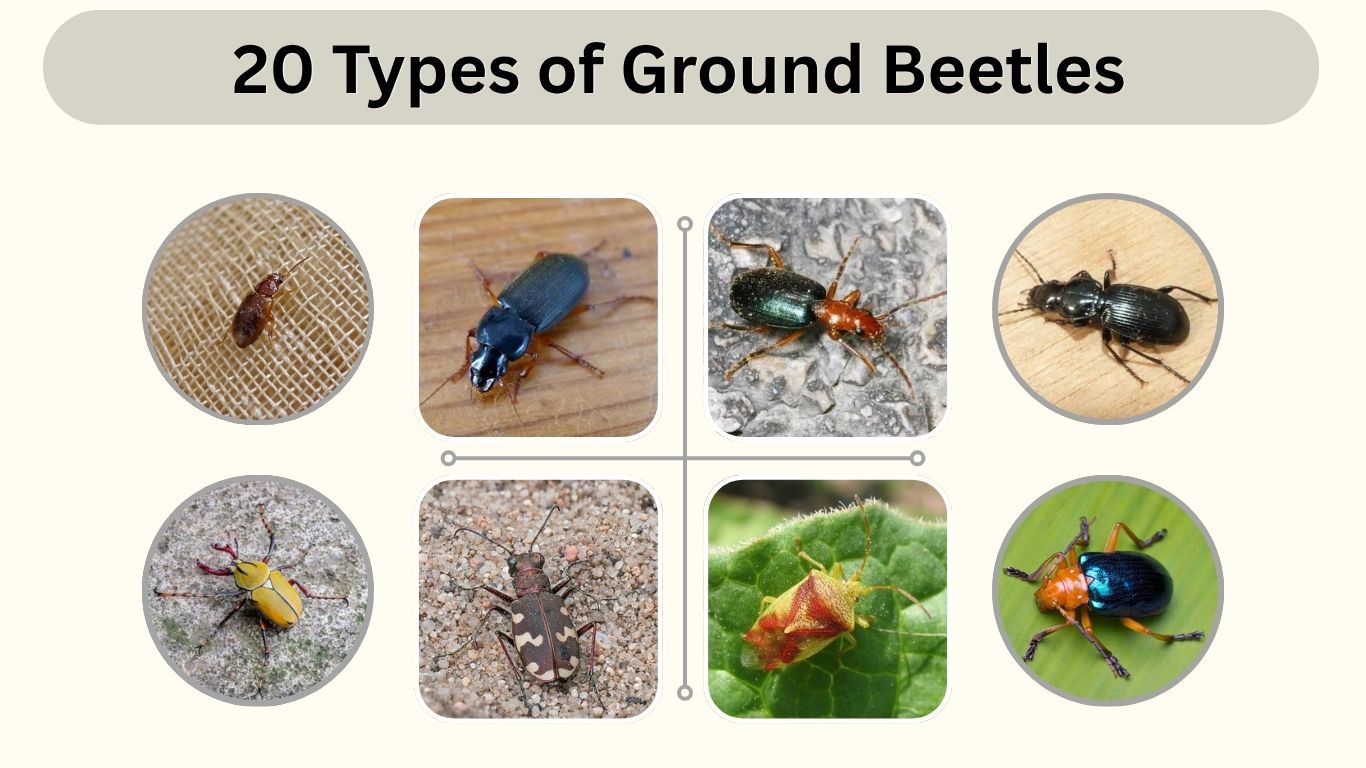
Ground beetles are fast-moving insects commonly found in gardens, forests, fields, grasslands, and agricultural areas around the world. Most species live close to the soil, hiding beneath rocks, logs, mulch, and leaf litter during the day before becoming active at night. Although many ground beetles are dark brown or black, some have metallic green, bronze, or violet coloring. In this guide, we explore 20 types of ground beetles, including their identification, habitat, diet, behavior, lifespan, and life cycle.
1. Common Black Ground Beetle
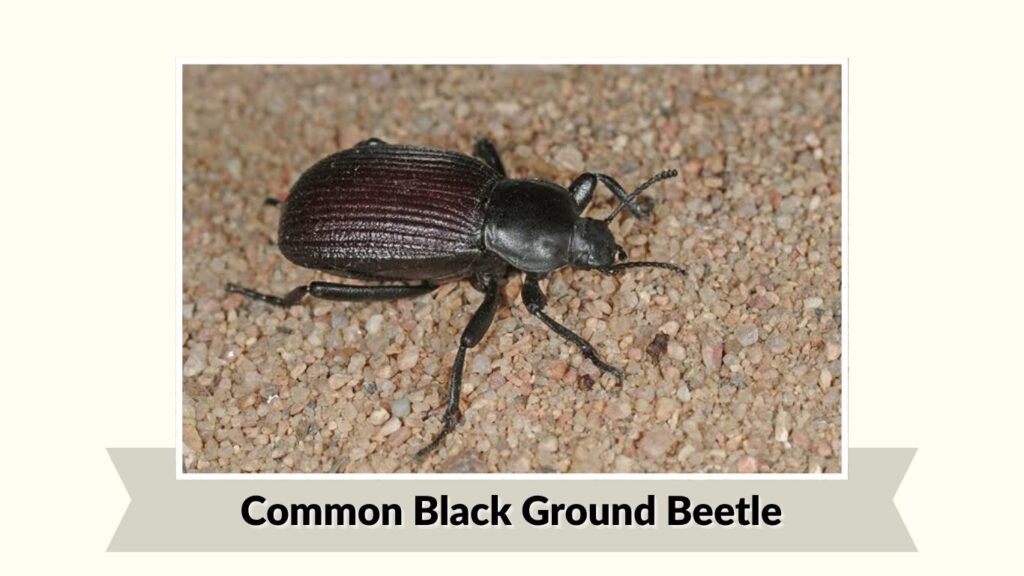
The Common Black Ground Beetle is a familiar dark-colored beetle often found beneath stones, logs, garden debris, and other protected places. Like many members of the ground beetle family, it spends much of its time running across the soil in search of small insects and other prey. Its predatory habits can make it beneficial in gardens and agricultural areas.
Identification
- Glossy black to dark brown body
- Elongated oval shape
- Hard, ridged wing covers
- Long running legs
- Prominent antennae
- Strong mandibles
- Usually medium-sized
Habitat and Distribution
Common Black Ground Beetles occur in gardens, fields, woodlands, grasslands, agricultural areas, and residential landscapes. They usually remain close to ground level and hide during daylight beneath rocks, fallen wood, mulch, or leaf litter.
Moist but well-drained soil often provides favorable conditions because it supports both shelter and abundant prey.
Behavior and Diet
These beetles are mainly nocturnal predators. They emerge after dark and move quickly across the ground searching for insect larvae, caterpillars, slugs, worms, and other small invertebrates.
Some species also consume seeds and decaying organic material. Their feeding activity can help reduce populations of several garden pests.
When disturbed, they usually run rapidly rather than fly.
Lifespan and Life Cycle
Females lay eggs in soil or protected areas near the ground. Larvae hatch with elongated bodies and strong jaws and spend their development hunting small prey.
After passing through several larval stages, they pupate in the soil. Adults later emerge and continue feeding.
Depending on species and climate, development may take several months, and adults may survive for a year or longer. Many overwinter beneath soil, stones, bark, or leaf litter.
2. Fiery Searcher
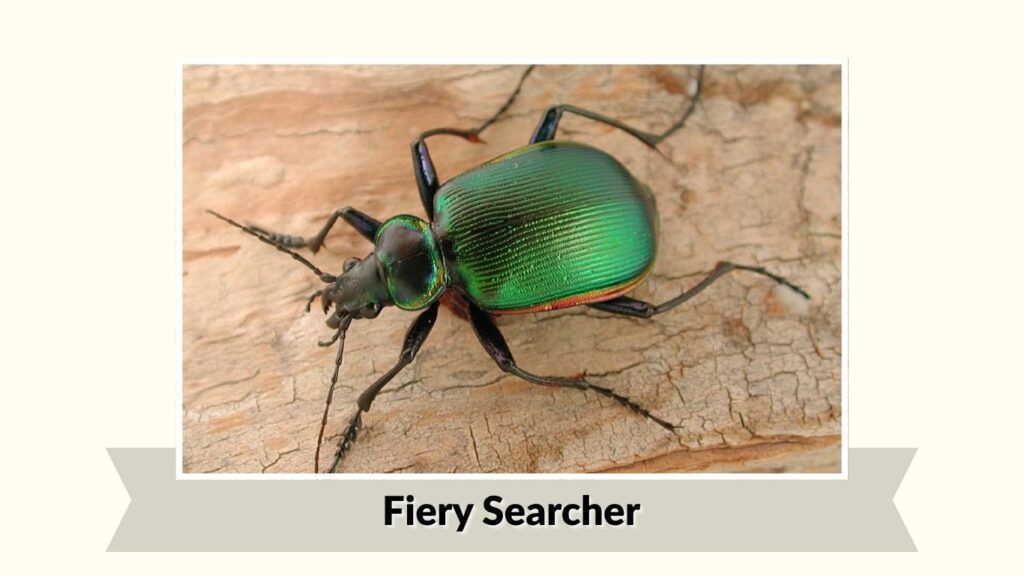
The Fiery Searcher is one of the most colorful and impressive ground beetles in North America. Its metallic green body and reddish-gold margins give it a striking appearance. Also known as a caterpillar hunter, it is especially valued because both adults and larvae actively prey on caterpillars, including several species that can damage trees and crops.
Identification
- Metallic green wing covers
- Golden or reddish margins
- Dark head and legs
- Broad, flattened body
- Strong mandibles
- Long legs
- Large compared with many ground beetles
Habitat and Distribution
Fiery Searchers are widespread across much of North America and may occur in forests, gardens, orchards, agricultural fields, and parks.
Unlike many ground beetles that stay primarily on the soil, this species may climb tree trunks and vegetation while searching for caterpillars.
Woodlands and areas with abundant moth larvae are especially suitable habitats.
Behavior and Diet
The Fiery Searcher is an active predator with a strong preference for caterpillars. Adults may attack armyworms, tent caterpillars, cutworms, and other larvae.
They are strong runners and capable climbers, allowing them to hunt both on the ground and in trees.
When threatened, they may release defensive chemicals with a strong odor. Their predatory habits make them useful natural enemies of several agricultural and forest pests.
Lifespan and Life Cycle
Females lay eggs in soil. The larvae that emerge are dark, elongated predators equipped with strong jaws.
Larvae actively hunt other insects before moving into the soil to pupate. Adults emerge after metamorphosis and may remain active through much of the warmer season.
Some adults live for more than one year and overwinter in protected places such as soil, leaf litter, or beneath logs before becoming active again in spring.
3. Bombardier Beetle
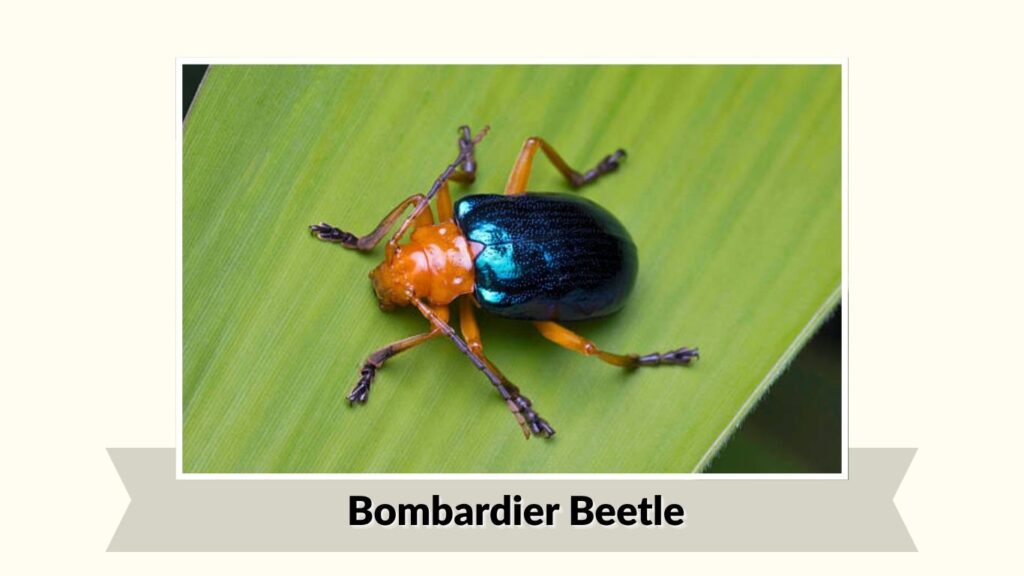
The Bombardier Beetle is famous for one of the most unusual defense systems in the insect world. When threatened, it can eject a hot, irritating chemical spray from the tip of its abdomen. Despite this dramatic defense, bombardier beetles are generally small ground-dwelling predators that spend much of their time under stones and debris.
Identification
- Dark blue or black wing covers
- Reddish or orange head and thorax in many species
- Long legs
- Slender antennae
- Elongated body
- Powerful jaws
- Distinct chemical-spraying abdomen
Habitat and Distribution
Bombardier beetles occur on several continents and inhabit woodlands, grasslands, riverbanks, fields, gardens, and areas with loose soil and natural debris.
During the day, they often shelter beneath stones, logs, bark, or fallen leaves.
Many species favor slightly moist habitats where small insects and other prey remain plentiful.
Behavior and Diet
Bombardier beetles are primarily predators. They feed on insect larvae, eggs, worms, and other small invertebrates encountered on or beneath the soil surface.
Their most famous behavior occurs when threatened. Chemicals stored separately inside the abdomen react just before being expelled, producing a rapid, hot spray directed toward a predator.
This defense helps protect them from ants, spiders, frogs, and other animals.
Lifespan and Life Cycle
Females deposit eggs in protected soil locations or small chambers. The larvae hatch as active predators and may feed on other insects during development.
After several larval stages, they enter the pupal stage before emerging as adults.
Adults may remain active for several months and can overwinter in protected locations. Development and generation numbers vary by species and climate, with warmer conditions generally allowing faster growth and longer periods of activity.
4. Six-Spotted Tiger Beetle
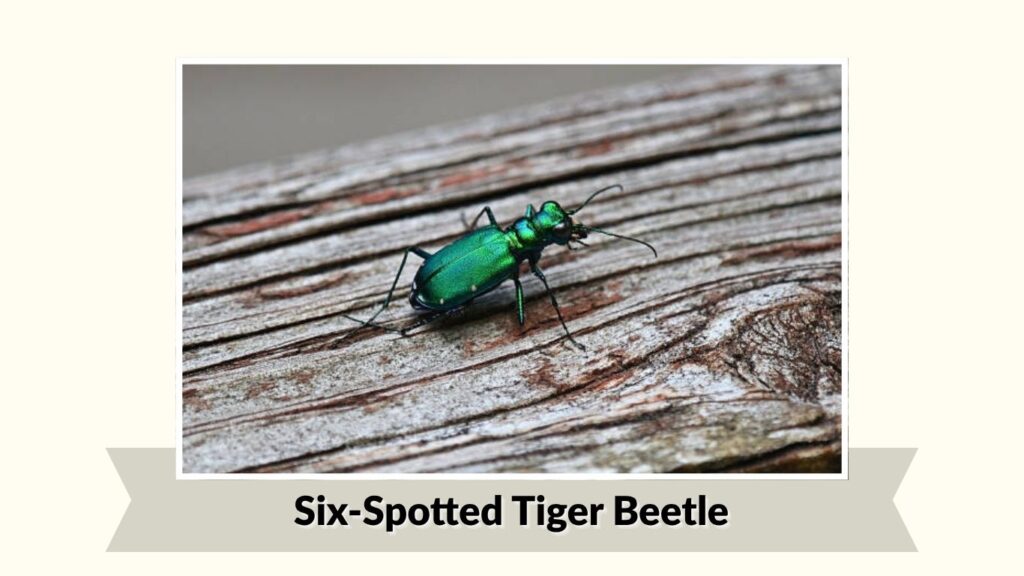
The Six-Spotted Tiger Beetle is a brilliant metallic green beetle known for its extraordinary speed and hunting ability. Although tiger beetles belong within the broader ground beetle family, they differ from many typical ground beetles by being active during daylight. Adults frequently run or fly along sunny trails while searching for small insects.
Identification
- Bright metallic green body
- Usually six small white spots on wing covers
- Long, slender legs
- Large bulging eyes
- Powerful curved mandibles
- Narrow waist
- Fast-running appearance
Habitat and Distribution
Six-Spotted Tiger Beetles are widely distributed across eastern North America.
They prefer sunny woodland paths, forest edges, dirt roads, trails, and open patches where bare soil is exposed.
Adults are particularly noticeable during spring and early summer, when they can be seen running rapidly ahead of hikers before flying a short distance and landing again.
Behavior and Diet
This species is an active visual predator. Adults use their large eyes to locate ants, flies, caterpillars, and other small insects.
They sprint toward prey and seize it with large mandibles. Their exceptional running speed sometimes forces them to stop briefly because they move too quickly to maintain clear visual tracking.
Larvae are also predators but hunt differently, remaining inside vertical burrows and ambushing passing insects.
Lifespan and Life Cycle
Females lay eggs individually in soil. The larva creates a narrow burrow and waits near the entrance with its jaws ready to capture prey.
Larval development may continue for one or more years depending on conditions.
Eventually, the larva seals the burrow and pupates underground. Adults emerge and become active during warm weather.
The entire life cycle can take roughly one to several years depending on climate and food availability.
5. Pennsylvania Ground Beetle
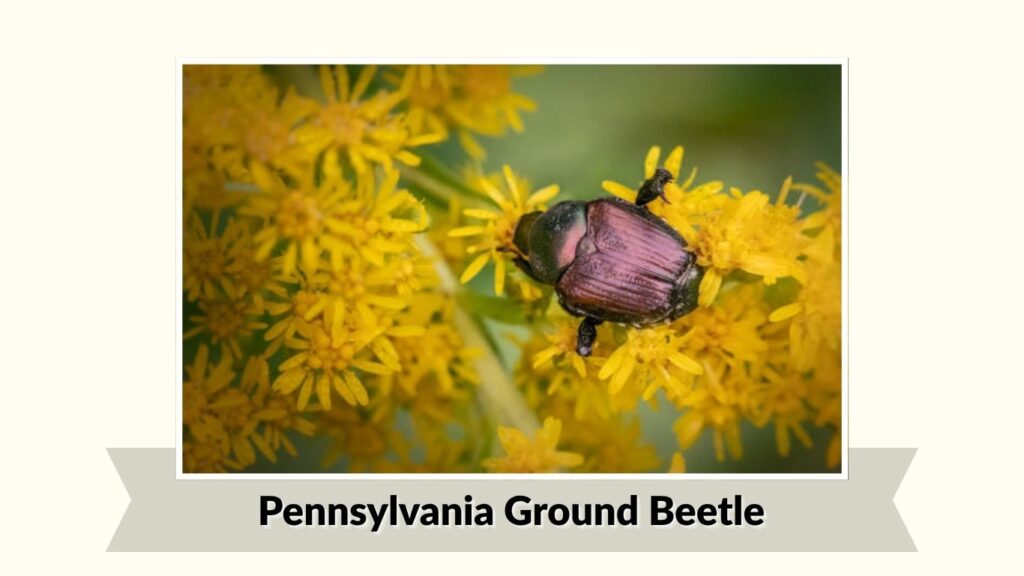
The Pennsylvania Ground Beetle is a dark, active predator commonly encountered across eastern North America. It often appears in gardens, crop fields, and around buildings, particularly at night. Although its dark coloration can make it look intimidating, it is harmless to people and may actually help gardeners by feeding on insect pests.
Identification
- Dark brown to black coloration
- Smooth or slightly grooved wing covers
- Elongated oval body
- Long running legs
- Threadlike antennae
- Strong mandibles
- Medium to large ground beetle
Habitat and Distribution
Pennsylvania Ground Beetles occur throughout much of eastern and central North America.
They inhabit agricultural fields, lawns, gardens, woodlands, and areas near buildings. During the day, they hide beneath stones, boards, logs, or thick vegetation.
At night, adults may wander onto sidewalks, patios, garages, and occasionally inside houses while hunting or attracted to lights.
Behavior and Diet
These beetles are mostly nocturnal predators. They consume caterpillars, insect larvae, small beetles, worms, and other ground-dwelling invertebrates.
Their quick running ability allows them to chase prey efficiently.
They generally avoid people and do not infest houses. An individual found indoors has usually entered accidentally and can simply be moved outside.
Lifespan and Life Cycle
Females lay eggs in soil. The larvae develop underground or near the soil surface and are also predatory.
They pass through several stages while feeding before forming pupal chambers in the soil.
Adults emerge later and continue hunting during warm seasons. In colder climates, adults or larvae may overwinter below ground or beneath protective debris.
Depending on environmental conditions, the life cycle may take close to a year, with adults potentially surviving into a second season.
6. Big-Headed Ground Beetle
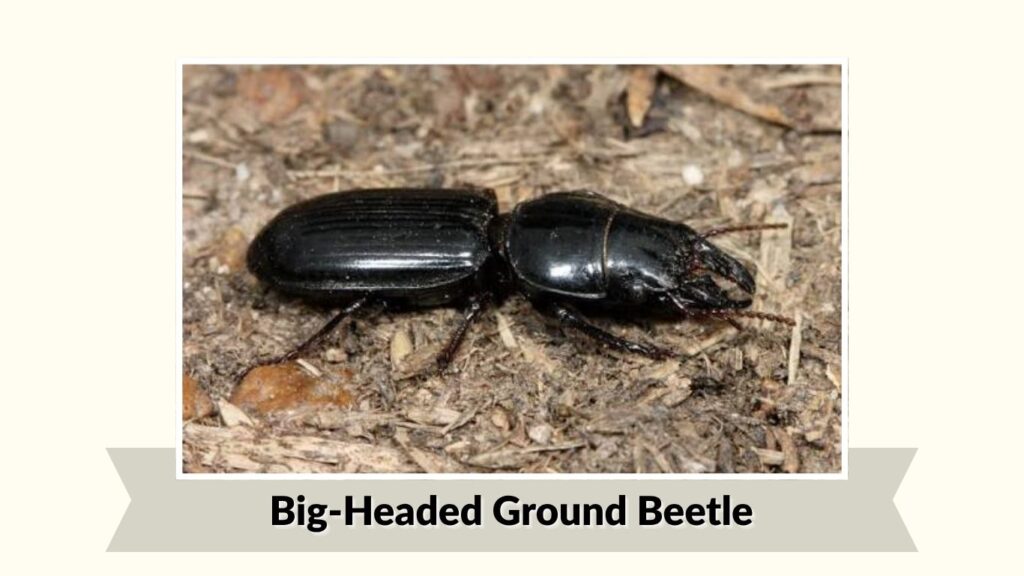
The Big-Headed Ground Beetle gets its common name from its noticeably broad head and strong jaws. These features help it crush seeds and capture small prey. Unlike strictly predatory ground beetles, many big-headed species have a mixed diet that includes both plant seeds and insects, making them important members of ground-level ecosystems.
Identification
- Broad, noticeably large head
- Strong mandibles
- Dark brown or black body
- Oval wing covers
- Long running legs
- Robust overall shape
- Threadlike antennae
Habitat and Distribution
Big-Headed Ground Beetles can occur in gardens, fields, grasslands, agricultural landscapes, woodland edges, and other areas with exposed soil.
Many remain hidden beneath rocks, mulch, logs, or plant debris throughout the day.
They frequently occur in habitats containing fallen seeds and small invertebrates, providing access to both major parts of their diet.
Behavior and Diet
These beetles may eat weed seeds as well as insects. Seeds from grasses and broadleaf plants can form a significant portion of their diet.
They also consume insect eggs, larvae, and other small arthropods when available.
Because some species eat large quantities of weed seeds, they may contribute to natural weed suppression in agricultural environments.
Most activity occurs after sunset, when the beetles emerge from daytime shelters to forage.
Lifespan and Life Cycle
Eggs are generally deposited in the soil. The larvae hatch and develop within or near the ground, feeding on available animal prey and organic resources.
After several molts, mature larvae build small chambers in the soil where they pupate.
Adults emerge and continue feeding through the active season.
Many ground beetles complete one generation annually, although timing varies among species. Adults may overwinter beneath soil or debris and resume feeding when warmer spring temperatures return.
7. Caterpillar Hunter
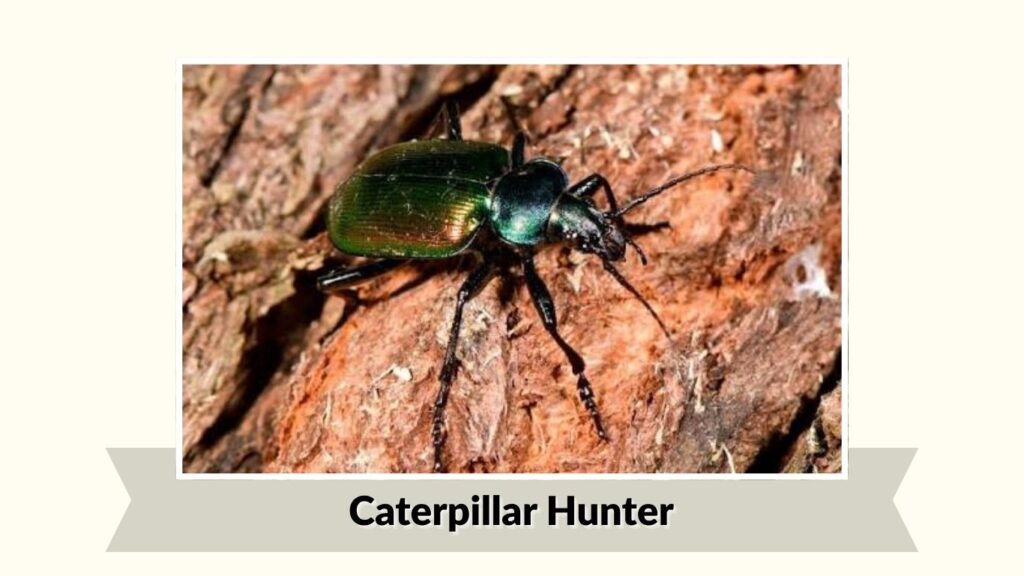
The Caterpillar Hunter is a large predatory ground beetle famous for attacking caterpillars that damage crops and trees. Members of this group are powerful runners and climbers, enabling them to pursue prey across the ground as well as on trunks and branches. Their appetite for pest larvae makes them particularly valuable in forests, orchards, and agricultural ecosystems.
Identification
- Large ground beetle
- Dark or metallic coloration
- Broad wing covers
- Long, powerful legs
- Large mandibles
- Strong climbing ability
- Often glossy or iridescent
Habitat and Distribution
Caterpillar Hunters inhabit forests, orchards, gardens, crop fields, and wooded landscapes throughout various parts of the world.
They are often associated with areas experiencing outbreaks of caterpillars because abundant prey provides ideal feeding conditions.
Some species spend considerable time climbing vegetation, while others hunt mainly on the ground.
Behavior and Diet
Caterpillars are their preferred prey. They can attack cutworms, armyworms, tent caterpillars, gypsy moth larvae, and other moth or butterfly larvae.
Adults use strong mandibles to seize and consume prey, while larvae are also aggressive predators.
Their ability to climb trees separates many caterpillar hunters from ground beetles that remain primarily on soil surfaces.
They usually become most active from evening through nighttime.
Lifespan and Life Cycle
Females lay eggs in soil during warm weather. Predatory larvae emerge and immediately begin feeding on small insects.
The larvae pass through several developmental stages before burrowing into the soil to pupate.
Adults emerge after metamorphosis and may survive for more than one season. Some species can live for two or more years under favorable conditions.
Overwintering generally occurs beneath soil, logs, bark, or accumulated leaf litter, allowing adults to resume hunting during spring.
8. False Bombardier Beetle
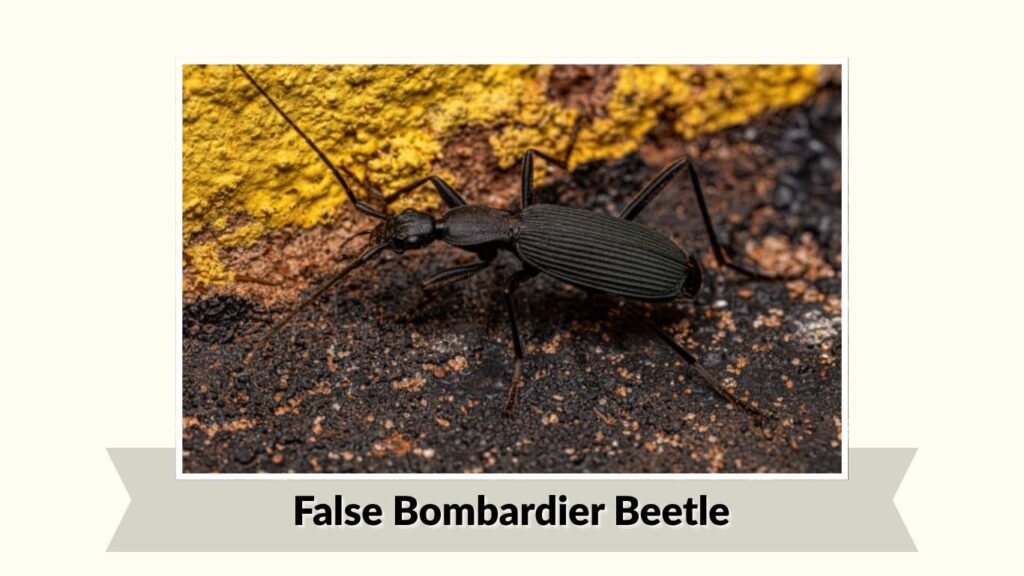
The False Bombardier Beetle resembles true bombardier beetles in coloration but lacks their famous explosive chemical defense. Many species have reddish-orange heads and thoraxes combined with dark blue or black wing covers. They are fast-moving predators commonly discovered beneath stones, boards, logs, and other objects resting on the soil.
Identification
- Orange or reddish head
- Orange-red thorax
- Dark blue, black, or metallic wing covers
- Long running legs
- Slender antennae
- Elongated body
- Resembles true bombardier beetles
Habitat and Distribution
False Bombardier Beetles are common in many parts of North America.
They live in woodlands, fields, gardens, lawns, and around buildings. During daylight, they usually remain beneath rocks, wood, leaf litter, and other debris.
Warm, humid evenings often bring adults onto open ground where they hunt for prey.
They occasionally enter houses accidentally but do not reproduce indoors under normal conditions.
Behavior and Diet
False Bombardier Beetles are mainly nocturnal predators that feed on small insects, larvae, eggs, and other invertebrates.
They run rapidly when disturbed and often attempt to hide rather than confront a threat.
Although they cannot produce the same explosive defensive spray as true bombardier beetles, some can release irritating chemicals from abdominal glands.
Their reddish-and-black appearance may also provide protective resemblance to better-defended species.
Lifespan and Life Cycle
Females lay eggs in soil or moist protected locations. Larvae hatch as elongated predators and feed on other small soil-dwelling organisms.
Following several molts, they create underground pupal chambers.
Adults emerge after metamorphosis and spend much of their time hunting near the soil surface.
The full life cycle commonly follows seasonal temperature patterns. Adults may overwinter under logs, stones, bark, or deep leaf litter and resume activity during spring.
9. Red-Cross Shield Beetle
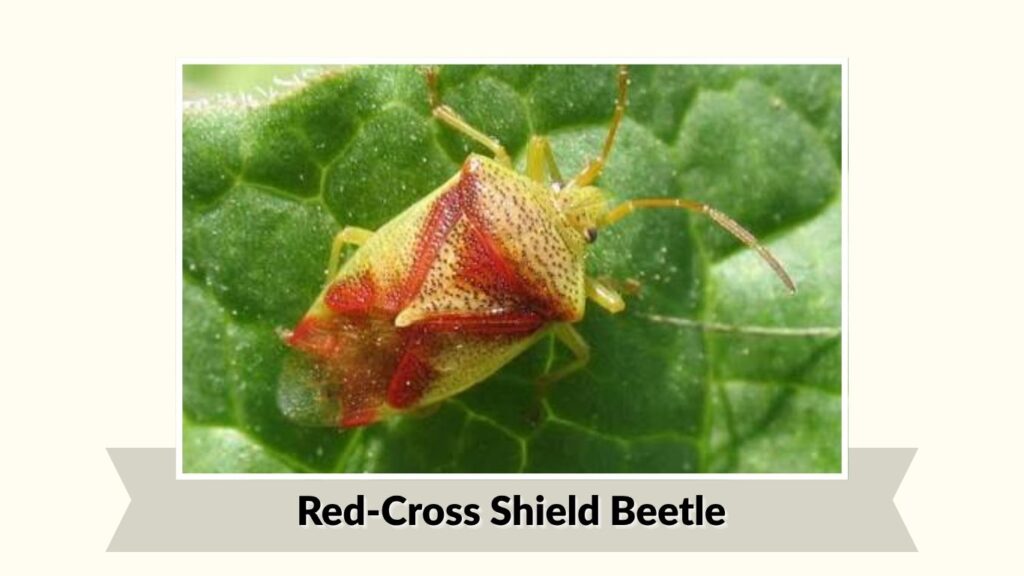
The Red-Cross Shield Beetle is recognized by its contrasting markings, which may include reddish patterns against a darker body. Despite the common name sometimes appearing in general beetle lists, “shield beetle” can refer to different unrelated beetle groups, so exact identification should ideally be based on the insect’s scientific name and location.
Identification
- Dark body coloration
- Reddish or orange markings
- Hard wing covers
- Contrasting cross-like pattern in some forms
- Six jointed legs
- Visible antennae
- Shape varies depending on species referred to by the name
Habitat and Distribution
Beetles referred to by this common name may be encountered in woodland, grassland, gardens, and areas with abundant vegetation.
Their exact geographic distribution depends on which species the name is being used for.
Like many ground-associated beetles, individuals may shelter beneath vegetation, bark, rocks, or other protective material during unfavorable weather.
Correct identification is important before making assumptions about habitat because similar common names are sometimes applied to unrelated insects.
Behavior and Diet
Feeding behavior also depends upon the exact species represented by the common name.
Predatory ground beetles generally consume insect larvae, eggs, worms, and small arthropods. Other beetles sometimes called shield beetles may instead feed on leaves or other plant material.
Observing where an individual is found and what it is feeding on can therefore provide valuable identification clues.
Lifespan and Life Cycle
Like other beetles, development includes egg, larva, pupa, and adult stages.
Females deposit eggs in locations that provide suitable food for emerging larvae. The larval stage is devoted mainly to feeding and growth before pupation occurs.
Adults emerge after metamorphosis and reproduce when conditions are suitable.
Seasonal activity and lifespan vary greatly among the species sometimes associated with this common name, so species-level identification is necessary for a more precise life-cycle estimate.
10. Green Pubescent Ground Beetle
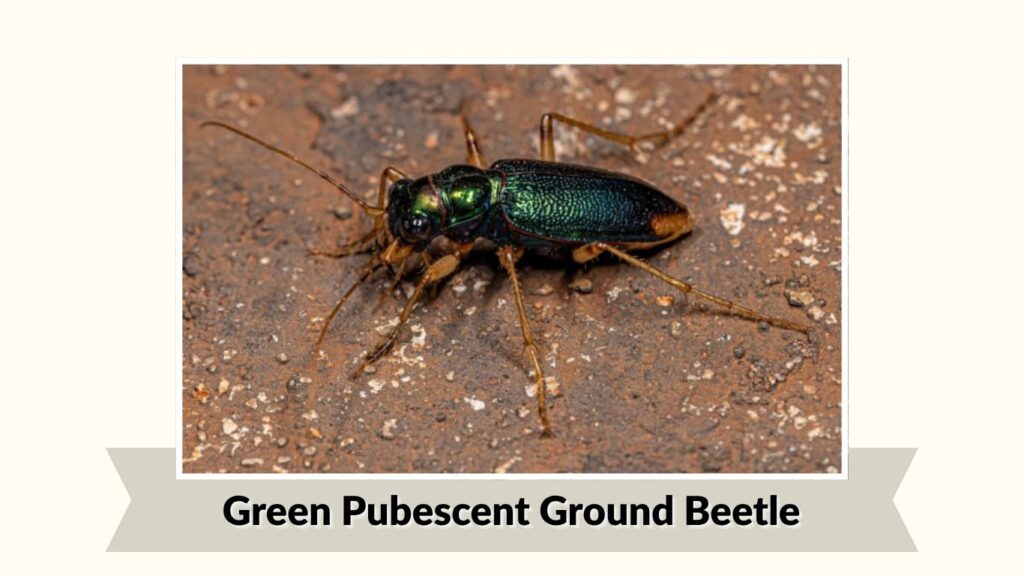
The Green Pubescent Ground Beetle is an attractive predatory beetle known for its metallic green coloration and fine hairs covering portions of the body. It commonly occurs in moist environments such as gardens, crop fields, wetlands, and stream edges. Like many ground beetles, it hunts small insects and may provide useful natural pest control.
Identification
- Metallic green or bronze-green body
- Fine pubescent hairs
- Dark head
- Long running legs
- Ridged wing covers
- Slender antennae
- Medium-sized body
Habitat and Distribution
Green Pubescent Ground Beetles are generally associated with relatively moist environments.
They may occur in agricultural fields, gardens, wet meadows, forest edges, riverbanks, marsh margins, and areas near ponds or streams.
During daylight, adults hide beneath stones, plant debris, or dense vegetation. They become more visible after dark when they move over the soil surface searching for prey.
Behavior and Diet
This beetle is primarily predatory. Adults hunt caterpillars, insect larvae, small beetles, worms, and various soft-bodied invertebrates.
Some ground beetles may also consume seeds or other organic material when animal prey is scarce.
Their long legs allow them to run quickly across bare soil and vegetation.
Because they consume several potential agricultural pests, they can contribute to natural biological control in crop fields and gardens without directly harming healthy plants.
Lifespan and Life Cycle
Females deposit eggs in moist soil. Larvae are elongated, active predators that remain primarily at or below ground level.
They pass through several developmental stages before forming pupal chambers underground.
After metamorphosis, adults emerge and begin hunting above the soil surface.
Many ground beetles have approximately one generation per year, although development depends strongly on species and temperature. Adults may live several months or longer and commonly overwinter beneath soil, vegetation, stones, or other protective material.
11. Rough Ground Beetle
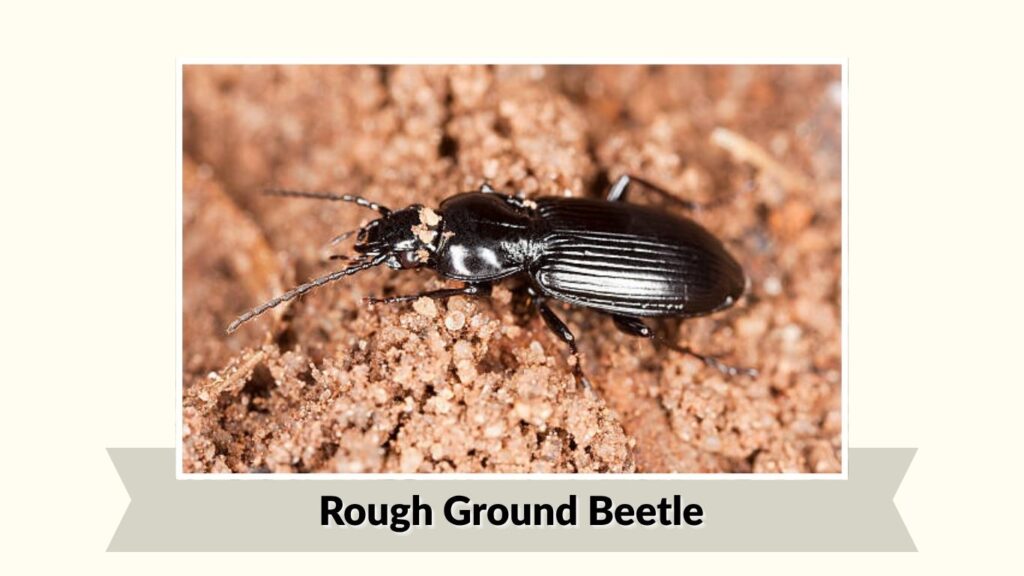
The Rough Ground Beetle is a dark, strongly textured member of the ground beetle family. Its hardened wing covers often have deep grooves, pits, or ridges that create the rough appearance behind its common name. Like most ground beetles, it spends much of its time at soil level and is usually encountered beneath rocks, logs, leaf litter, or other ground debris.
Identification
- Dark brown to black coloration
- Rough or deeply grooved wing covers
- Elongated oval body
- Strong chewing mandibles
- Long running legs
- Threadlike antennae
- Hard, heavily textured outer body
Habitat and Distribution
Ground beetles described by this common name are generally associated with woodlands, grasslands, agricultural fields, gardens, and other habitats with abundant ground cover.
During daylight hours, they commonly shelter under stones, fallen logs, bark, mulch, and decomposing vegetation. Damp soil and thick leaf litter provide particularly useful hiding places.
At night, adults leave their shelters and move across the ground searching for food.
Behavior and Diet
Rough Ground Beetles are mainly active predators. Their diet can include caterpillars, insect larvae, small worms, slugs, insect eggs, and other ground-dwelling invertebrates.
Their long legs allow them to run quickly after prey. Many spend most of their lives on the ground rather than climbing vegetation.
When disturbed, they usually escape by running into nearby cover. Some ground beetles can also release unpleasant defensive chemicals when threatened.
Lifespan and Life Cycle
Females generally deposit eggs in soil or beneath protected organic material. Larvae hatch with elongated bodies, well-developed legs, and strong jaws.
The larvae hunt small soil organisms before passing through several developmental stages. Mature larvae create chambers in the soil where pupation takes place.
Adults emerge after metamorphosis and may remain active for several months. Depending on species and climate, adults or larvae may overwinter and resume activity when warmer temperatures return.
12. European Ground Beetle
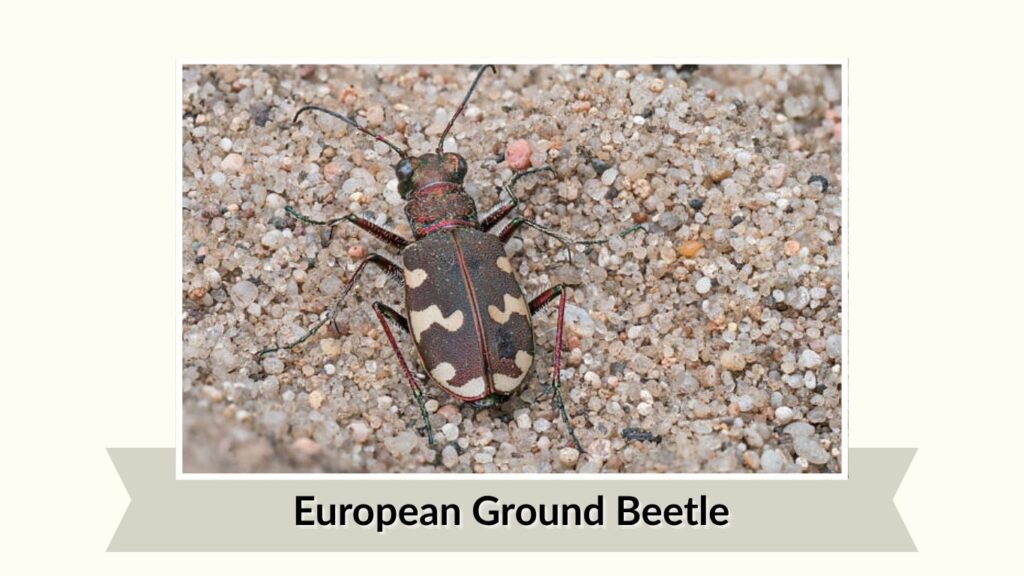
The European Ground Beetle is a large predatory species native to Europe that has also become established in parts of North America. Usually identified as Carabus nemoralis, it has a dark bronze or black body with metallic coloration along the edges. It is primarily nocturnal and is frequently found in gardens, cultivated land, parks, and woodlands.
Identification
- Dark bronze to black body
- Metallic bronze, purple, or greenish margins
- Broad oval wing covers
- Strong longitudinal ridges
- Long black legs
- Powerful mandibles
- Usually a relatively large ground beetle
Habitat and Distribution
The European Ground Beetle is native to Europe but was introduced into North America, where it now occurs in several regions. It is especially associated with human-modified habitats such as gardens, parks, cultivated fields, and residential landscapes.
It also inhabits woodlands, where adults hide beneath stones, logs, bark, and leaf litter during the day.
Moist gardens containing abundant invertebrate prey can provide excellent habitat.
Behavior and Diet
This beetle is predominantly nocturnal. It leaves daytime shelters after dark and hunts snails, slugs, slug eggs, insects, pillbugs, millipedes, and other small invertebrates.
Its strong mandibles allow it to attack relatively substantial prey compared with smaller ground beetles.
Because many of the animals it consumes can damage garden plants, its presence is generally beneficial rather than harmful.
Lifespan and Life Cycle
Breeding generally occurs during spring or early summer. Females deposit eggs in suitable soil, where the young larvae develop as active predators.
Larvae pass through several stages before pupating underground. Adults eventually emerge and begin hunting on the soil surface.
Ground beetles in this group may survive through winter in protected locations and remain alive for more than one season under suitable conditions.
13. Woodland Ground Beetle
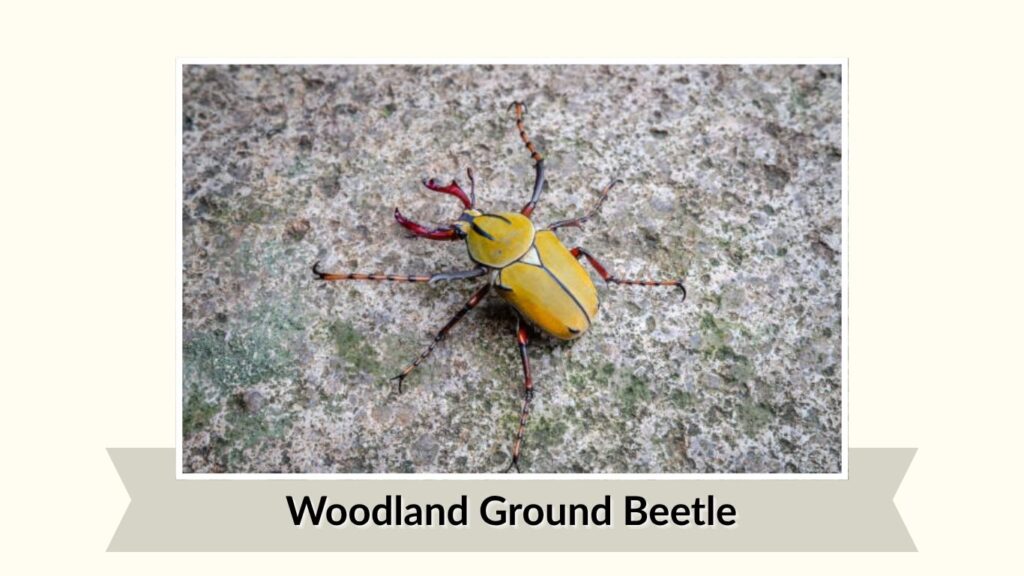
The Woodland Ground Beetle is a forest-associated member of the family Carabidae. The common name is used for Carabus sylvosus in Canada. Like many large ground beetles, it spends much of its activity period moving through leaf litter and across the forest floor while searching for small animals and other suitable food.
Identification
- Dark brown to black body
- Broad, elongated wing covers
- Strong running legs
- Prominent mandibles
- Long threadlike antennae
- Often somewhat glossy
- Typical large ground beetle shape
Habitat and Distribution
As its name suggests, this beetle is strongly associated with woodland environments.
It can be found on forest floors where fallen leaves, decaying logs, stones, bark, and other natural debris create numerous hiding places. Woodland Ground Beetles are recorded in Canada and occur in suitable forest habitats within their range.
Moist leaf litter is particularly valuable because it provides shelter while supporting insects, worms, and other potential prey.
Behavior and Diet
Woodland Ground Beetles are usually most active during evening and nighttime hours. They move through fallen leaves and beneath vegetation in search of small invertebrates.
Their potential prey includes caterpillars, beetle larvae, insect eggs, worms, and other organisms occupying the forest floor.
Powerful mandibles allow ground beetles to capture and break apart their food. During daylight they generally remain hidden, reducing exposure to birds and other predators.
Lifespan and Life Cycle
Females lay eggs in soil or decomposing organic matter. The larvae remain mostly within soil and leaf litter, where they hunt other small organisms.
After several larval stages, development continues through an underground pupal stage.
Adults emerge with hardened wing covers and begin their ground-level hunting lifestyle. Seasonal timing depends on local climate, and adults or immature stages may spend winter beneath deep litter, logs, or soil where temperatures are more stable.
14. Granulated Ground Beetle
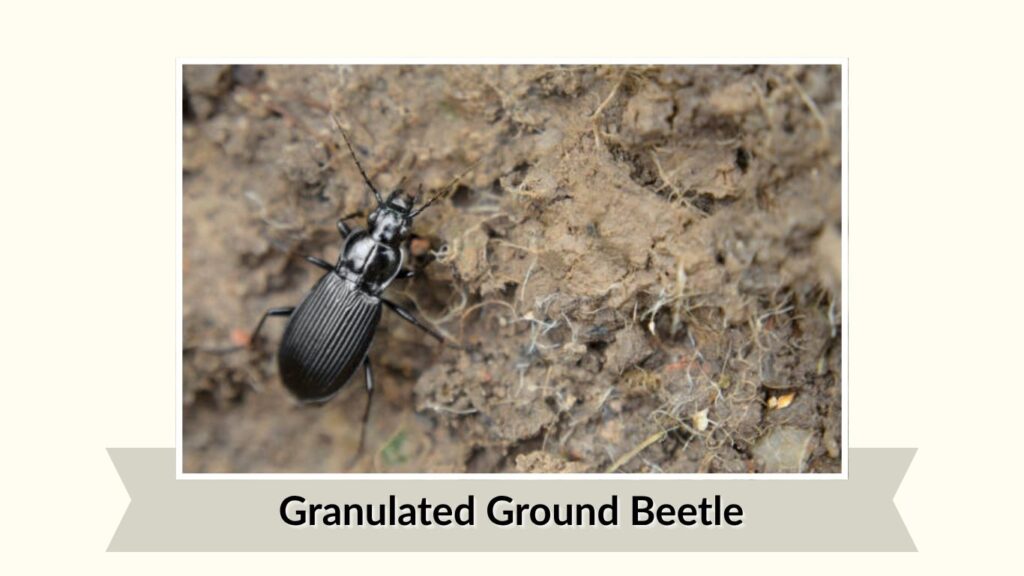
The Granulated Ground Beetle is a distinctive species with strongly sculptured wing covers that resemble rows of interconnected chains or granules. Scientifically known as Carabus granulatus, it occurs across a broad Palearctic range and has also been introduced into North America. Adults can show attractive bronze, greenish, or nearly black coloration.
Identification
- About 14–20 mm long
- Bronze, greenish, or dark coloration
- Elongated body
- Granulated or chain-like wing-cover ridges
- Black legs and antennae
- Relatively broad thorax
- Hard, strongly sculptured wing covers
Habitat and Distribution
The Granulated Ground Beetle occurs across Europe and large areas of northern Asia, extending toward the Russian Far East. Introduced populations are also established in parts of North America.
It occupies diverse habitats, including forests, fields, prairies, wetlands, river margins, lakeshores, peatlands, and occasionally gardens.
It frequently favors environments with relatively moist soil and abundant ground cover.
Behavior and Diet
This species is a ground-level predator that hunts worms, insect larvae, small arthropods, and other invertebrates.
Adults are frequently active after dark and shelter during daylight beneath logs, rocks, vegetation, or soil debris.
Interestingly, Carabus granulatus is among the comparatively few members of its genus that can retain functional wings and the ability to fly in many populations.
Lifespan and Life Cycle
Females deposit eggs in moist soil. The elongated larvae are predatory and hunt other small organisms while developing through several stages.
When fully grown, larvae create pupal chambers underground. Adults emerge afterward and continue feeding above the soil surface.
Seasonal timing varies across its large geographic range. Adults may overwinter beneath logs, vegetation, or within soil and return to activity in spring.
15. Violet Ground Beetle
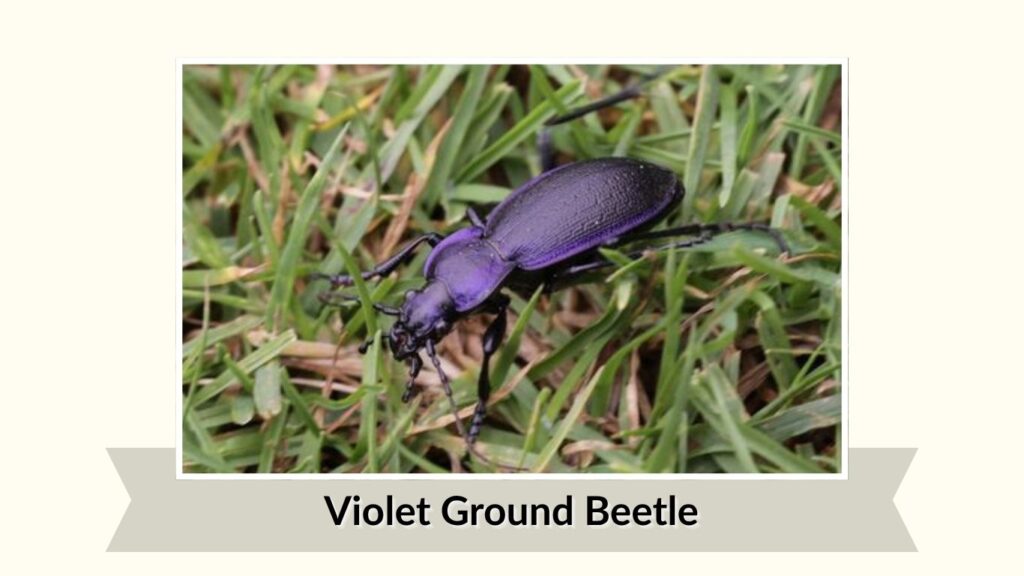
The Violet Ground Beetle is a large, striking European ground beetle distinguished by metallic violet or purple coloration along the margins of its otherwise black body. Scientifically known as Carabus violaceus, it is a powerful nocturnal predator commonly encountered in gardens and woodland habitats. Adults are flightless but can run quickly across the ground.
Identification
- Black overall body
- Violet or purple metallic margins
- Approximately 20–30 mm long
- Long black legs
- Strong mandibles
- Broad wing covers
- Flightless adult form
Habitat and Distribution
Violet Ground Beetles occur across a wide Euro-Siberian region and are common in Great Britain. They favor forests, gardens, hedgerows, grassland edges, and areas containing plenty of stones and leaf litter.
Adults usually hide in protected locations during daylight. Gardens with logs, stones, vegetation, and undisturbed ground can provide particularly suitable shelter.
Behavior and Diet
This beetle is mainly nocturnal and hunts actively after sunset.
Its diet includes slugs, leatherjackets, cutworms, caterpillars, and various other garden invertebrates. Its large size, long legs, and strong jaws enable it to attack larger prey than many smaller carabids.
Despite its intimidating appearance, it generally poses little concern to people and is considered beneficial in gardens because it consumes potential plant pests.
Lifespan and Life Cycle
Females place eggs in soil, where larvae develop as predators.
The larvae have elongated bodies and prominent jaws and remain mostly within soil or organic material while hunting. After several molts, they form pupal chambers underground.
Adults emerge later and may survive for more than one season. During winter, they use sheltered locations such as soil, logs, stones, and thick vegetation to avoid extreme temperatures.
16. Bronze Ground Beetle
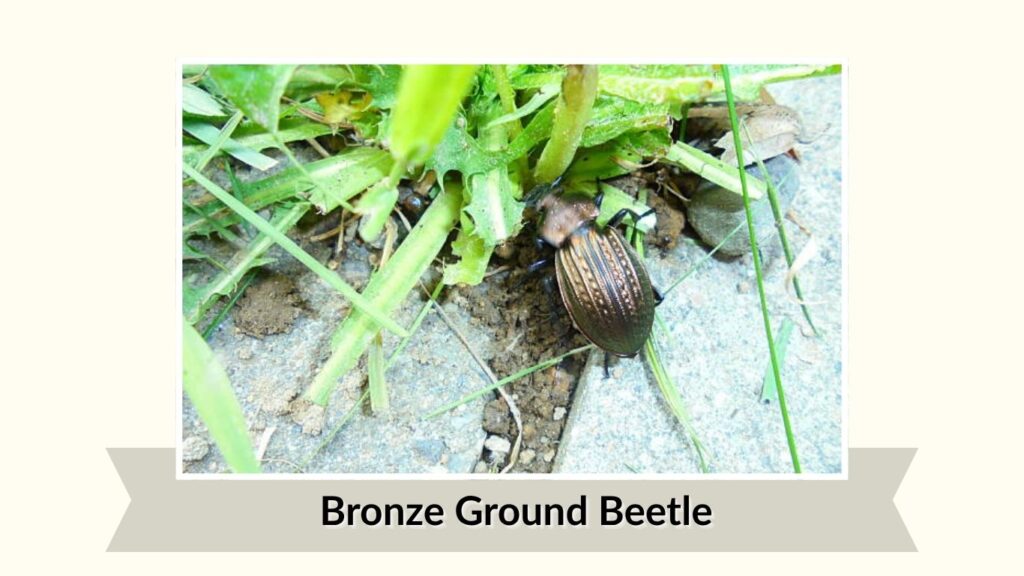
The Bronze Ground Beetle, also called the Bronze Carabid, is notable for the metallic sheen along its dark body. The name is commonly applied to Carabus nemoralis, which is also known as the European Ground Beetle. Its predatory behavior makes it useful in gardens, where it hunts several types of ground-dwelling pests.
Identification
- Dark brown to black body
- Bronze or metallic surface sheen
- Purple or greenish reflections possible
- Grooved wing covers
- Strong running legs
- Large mandibles
- Robust oval body
Habitat and Distribution
Bronze Ground Beetles are native to Europe but have been introduced to North America. They are now associated with gardens, urban parks, agricultural landscapes, and woodland habitats in their established range.
During daytime, they frequently hide under stones, logs, loose bark, or leaf litter.
Their ability to live successfully in cultivated environments helps explain why people regularly encounter them around homes and gardens.
Behavior and Diet
Adults primarily hunt at night. Their prey includes snails, slugs, slug eggs, insects, sowbugs, pillbugs, millipedes, and other invertebrates.
They search actively rather than waiting in ambush, using their strong legs to move quickly across the soil.
Gardeners often benefit from their presence because several animals in their diet can damage seedlings, flowers, and vegetables.
Lifespan and Life Cycle
Adults breed during spring or early summer. Eggs are placed in the soil, and larvae develop as predators among soil organisms and organic debris.
After progressing through several larval stages, they pupate below ground.
Adults later emerge and continue their nocturnal feeding activities. Depending on environmental conditions, adults may remain alive through winter and resume activity during the following growing season.
17. Black Clock Beetle
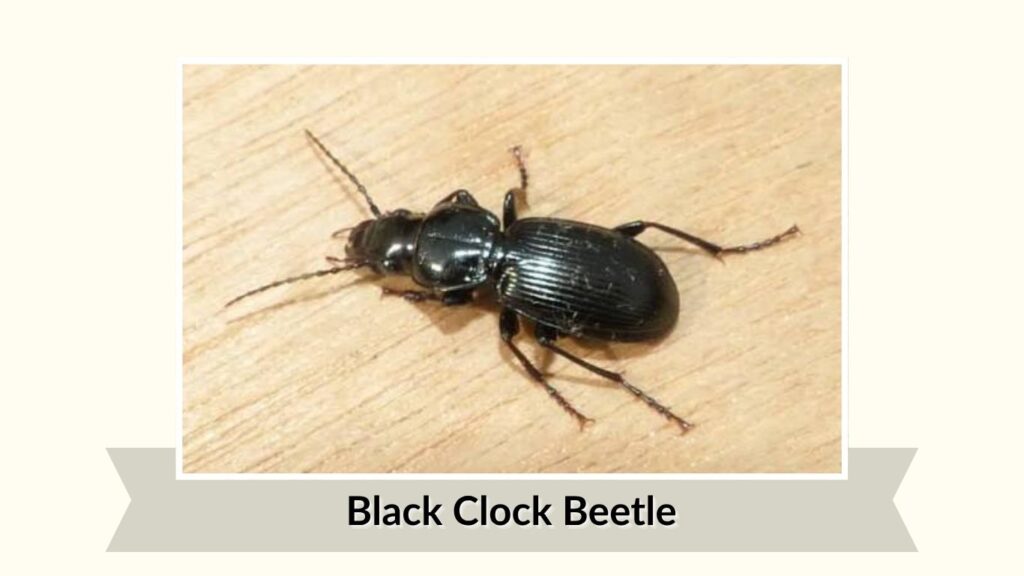
The Black Clock Beetle is a large, shiny black ground beetle commonly found in Britain and other parts of western and northern Europe. Its scientific name is Pterostichus madidus. Some individuals have completely black legs, while others have distinctive wine-red femora. This adaptable species inhabits gardens, grasslands, farmland, and woodland.
Identification
- Shiny black body
- Approximately 13–20 mm long
- Black or wine-red legs
- Smoothly rounded pronotum
- Long antennae
- Strong mandibles
- Elongated ground beetle shape
Habitat and Distribution
Black Clock Beetles occur throughout western and northern Europe and are especially common in Britain. They occupy a wide variety of environments, including gardens, grassland, agricultural fields, and dry woodland.
Adults commonly hide beneath stones, loose bark, grass tussocks, logs, and other ground cover.
They are most frequently observed during the summer when adults are actively moving through suitable habitats.
Behavior and Diet
This species is omnivorous but predominantly predatory.
It feeds on caterpillars, slugs, other ground-dwelling invertebrates, carrion, and occasionally plant material.
Adults may be active during both daytime and nighttime, although dark and damp conditions often encourage movement.
Like other ground beetles, they usually run for cover when disturbed rather than attempting to interact with people.
Lifespan and Life Cycle
Black Clock Beetles generally breed during late summer and autumn. Larvae develop through winter, while surviving adults are often especially visible from spring into summer.
Larvae are elongated predators living near or within the soil.
Most individuals follow an approximately annual developmental pattern, although some adults can survive longer, especially under cooler conditions. Pupation occurs before new adults emerge to continue the cycle.
18. Seedcorn Ground Beetle
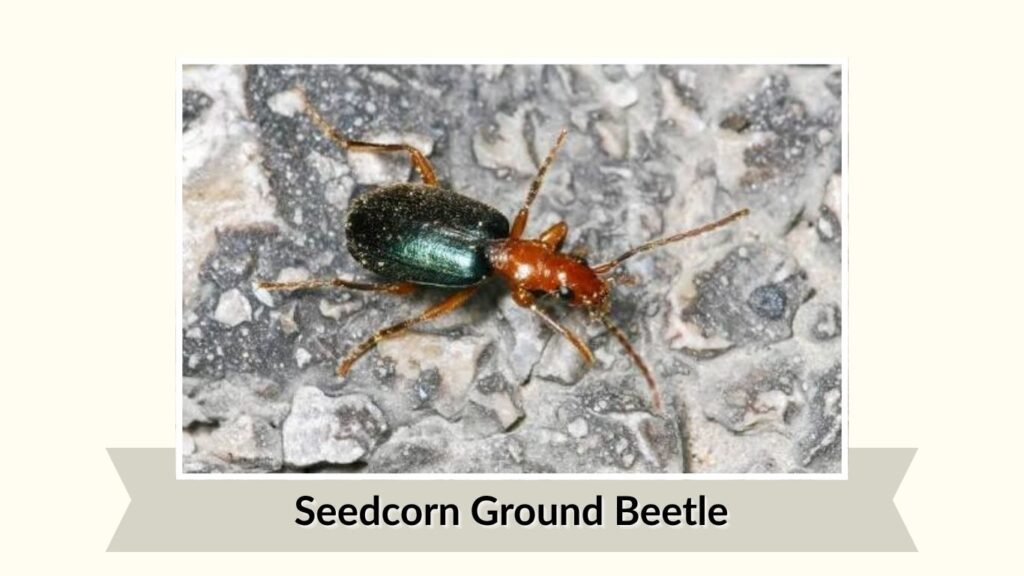
The Seedcorn Ground Beetle is a small North American ground beetle commonly associated with agricultural areas. The name is often used for species such as LeConte’s Seedcorn Beetle (Stenolophus lecontei). Unlike most beneficial ground beetles, it can occasionally damage germinating corn and other crop seeds, although it also participates in the wider ground-beetle food web.
Identification
- Small body, often only several millimeters long
- Dark brown coloration
- Narrow elongated shape
- Striped or lined wing covers
- Long legs relative to body size
- Threadlike antennae
- Usually much smaller than large Carabus species
Habitat and Distribution
Seedcorn Ground Beetles occur in North America and are commonly associated with crop fields, grassland, gardens, and other areas containing moist soil and seeds.
Adults sometimes fly toward outdoor lights at night and may accidentally enter buildings.
Fields containing recently planted crops can provide abundant food, particularly when weather conditions delay seed germination.
Behavior and Diet
Unlike strictly carnivorous ground beetles, Seedcorn Beetles may feed on plant seeds.
Some species can attack corn and soybean seeds while they are germinating, potentially reducing plant stands in agricultural fields.
They may also consume weed seeds and small invertebrates, so their ecological role is not exclusively harmful.
Adults are frequently active at night and can be strongly attracted to artificial lights.
Lifespan and Life Cycle
Females deposit eggs in soil. Larvae develop beneath or near the soil surface, where food and moisture are available.
After completing several larval stages, they pupate underground. Newly formed adults eventually emerge and may disperse by walking or flying.
Development is strongly influenced by temperature and soil conditions. Seasonal adult activity often increases during warm, wet weather and periods when crops are beginning to germinate.
19. Strawberry Seed Beetle
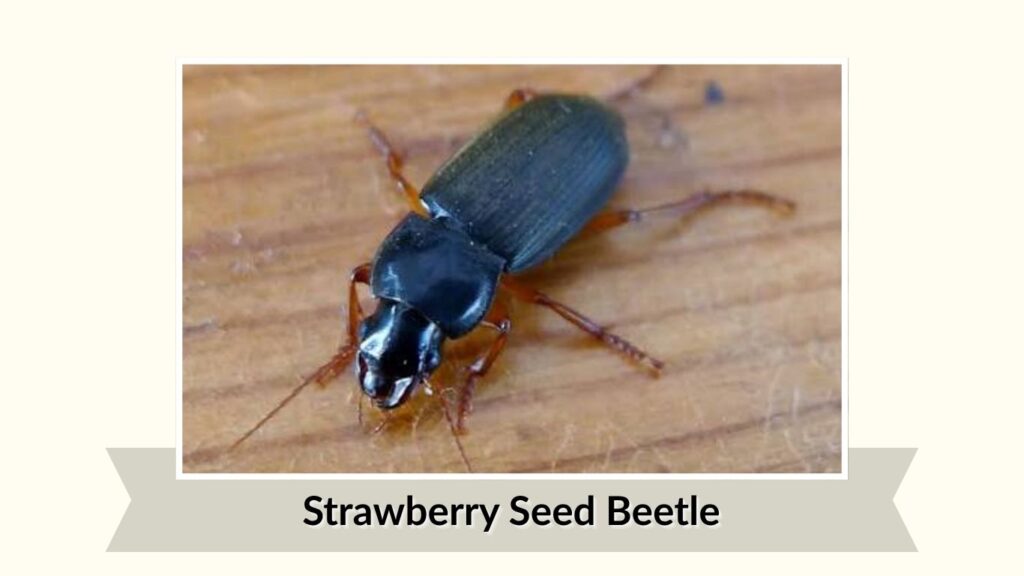
The Strawberry Seed Beetle (Harpalus rufipes) is a medium-sized ground beetle originally native to Europe. It is an omnivorous species that consumes weed seeds as well as aphids, slugs, and other small invertebrates. Despite its beneficial predatory behavior, it gets its common name from occasionally feeding on the seeds of strawberries.
Identification
- Dark brown to black wing covers
- Reddish or brownish legs
- Oval, elongated body
- Fine hairs may be visible on the body
- Strong chewing jaws
- Long antennae
- Medium-sized ground beetle
Habitat and Distribution
The Strawberry Seed Beetle is native to Europe and occurs in agricultural fields, gardens, grasslands, field margins, and other open habitats.
It is especially associated with cultivated land where weed seeds and small invertebrates provide abundant food.
During daylight, adults shelter beneath soil debris, stones, vegetation, or crop residues. They become much more active after dark.
Behavior and Diet
This beetle has a mixed diet. It consumes weed seeds, aphids, slugs, and various other small organisms. Research has documented its predation on aphids and pest slugs.
Its seed-eating behavior can be beneficial when it reduces weed populations.
However, adults may occasionally damage ripe strawberries by feeding on exposed seeds on the fruit surface, which explains the common name.
Lifespan and Life Cycle
Females lay eggs in soil. Larvae hatch and live largely underground, where they hunt small organisms and develop through several stages.
After completing larval development, pupation takes place within the soil.
Adults emerge and forage primarily at ground level. Seasonal development varies with climate, but adults can remain active for several months and may overwinter in protected locations before returning to the surface.
20. Narrow Ground Beetle
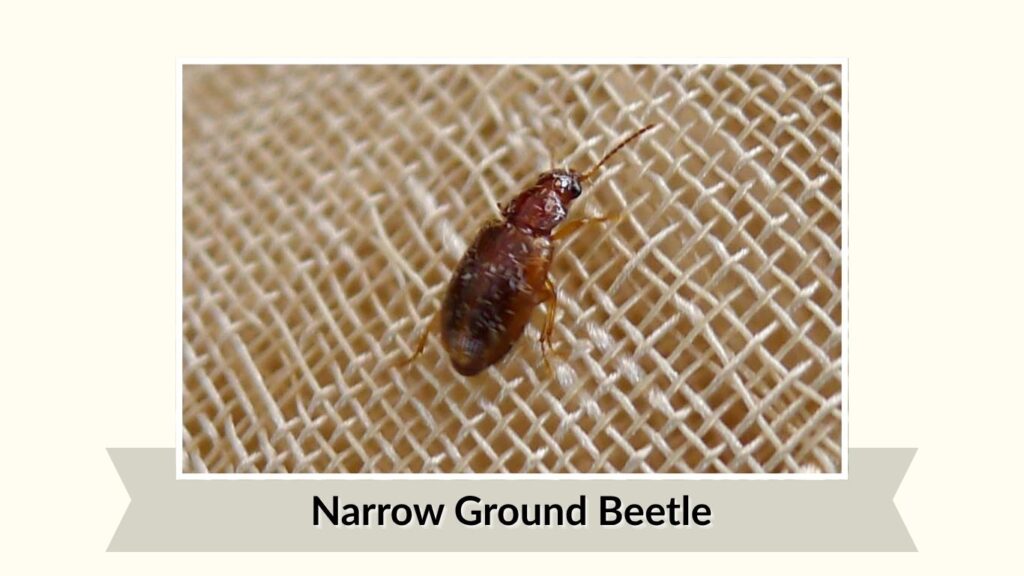
The Narrow Ground Beetle refers to slender members of the ground beetle family whose streamlined bodies allow them to move easily through soil cracks, leaf litter, and vegetation. They share many characteristics with other carabids, including strong jaws, long running legs, and primarily ground-level activity. Exact appearance and distribution vary depending on the species represented by the common name.
Identification
- Narrow, elongated body
- Dark brown or black coloration
- Long running legs
- Slender threadlike antennae
- Hard wing covers
- Strong chewing mandibles
- Streamlined shape compared with broader ground beetles
Habitat and Distribution
Narrow Ground Beetles can inhabit fields, grasslands, forests, wetlands, gardens, and agricultural areas.
Their slender shape is useful for moving beneath leaf litter, between grass stems, and through cracks in compact ground.
During the daytime they typically remain underneath natural cover such as stones, logs, dead vegetation, or soil debris. Adults emerge when conditions are cooler and more humid.
Behavior and Diet
Many narrow-bodied ground beetles are active predators.
They search for insect larvae, eggs, small worms, mites, and other tiny invertebrates. Some species may also consume plant seeds or decomposing material.
Ground beetles are generally fast runners, and most use speed rather than flight when escaping predators or chasing prey.
Their feeding habits often make them useful inhabitants of gardens and crop fields, where they can reduce populations of potential pests.
Lifespan and Life Cycle
Females usually deposit eggs in soil or beneath moist organic material.
Larvae are elongated and predatory, spending much of their development in soil or leaf litter. They molt several times before creating underground chambers where they transform into pupae.
Adults later emerge and continue feeding above ground.
Depending on the particular species, a generation may take several months to more than a year. Either adults or larvae may overwinter in protected soil and resume development or activity in spring.
FAQs
Ground beetles are one of the largest and most diverse beetle families, with species occupying habitats ranging from forests and gardens to wetlands and agricultural fields. Although their dark bodies and large jaws can appear intimidating, most are harmless to people and many provide valuable natural pest control.
1. How many types of ground beetles are there?
There are more than 40,000 described ground beetle species worldwide in the family Carabidae. They vary greatly in size and coloration, ranging from tiny brown species to large metallic green, violet, bronze, or black beetles.
2. Are ground beetles harmful to humans?
Ground beetles are generally harmless to people. They do not seek humans for food and normally run away when disturbed. Larger species may use their jaws defensively if handled roughly, and some can release unpleasant defensive chemicals, but they are not considered dangerous household pests.
3. What do ground beetles eat?
Most ground beetles eat caterpillars, insect larvae, slugs, snails, worms, insect eggs, and other small invertebrates. Some species are omnivorous and also consume weed seeds, fruit seeds, or plant material.
4. Why are ground beetles in my house?
Ground beetles usually enter homes accidentally while searching for shelter or after being attracted to outdoor lights. They normally reproduce outdoors rather than establishing household infestations. Sealing gaps around doors and windows and reducing unnecessary nighttime lighting can help prevent entry.
5. Are ground beetles good for gardens?
Yes. Most ground beetles are considered beneficial garden insects because adults and larvae consume numerous pests, including slugs, caterpillars, grubs, and insect eggs. Seed-eating species can also reduce weed seeds in the soil, making ground beetles important natural predators in healthy gardens.