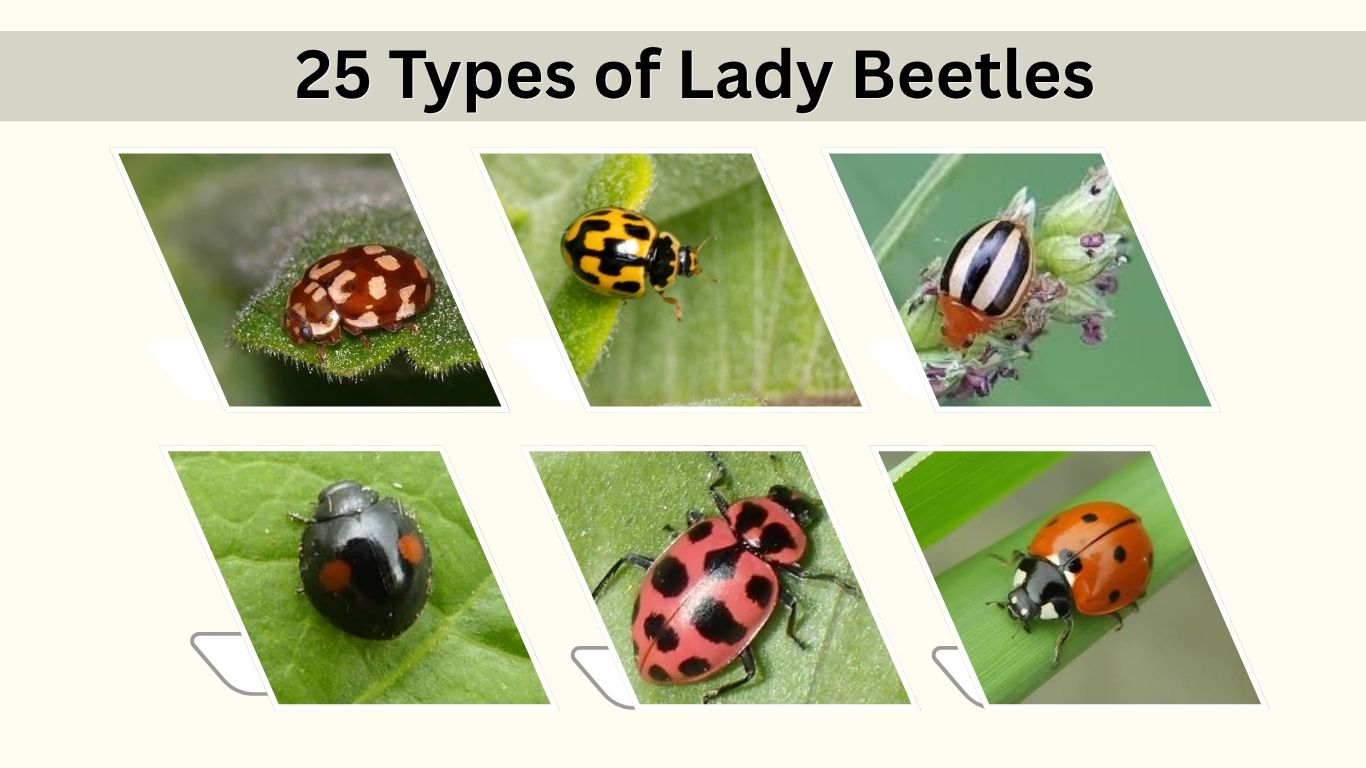
Lady beetles are colorful, beneficial insects found in gardens, forests, farms, grasslands, and many other habitats around the world. While the familiar red-and-black species are the most recognizable, lady beetles can also be yellow, orange, gray, black, brown, or even metallic blue. Different species vary in size, markings, diet, and behavior, with many feeding on aphids, scale insects, mealybugs, and other plant pests. In this guide, we explore 25 types of lady beetles, including their identification, habitat, diet, behavior, lifespan, and life cycle.
1. Seven-Spotted Lady Beetle
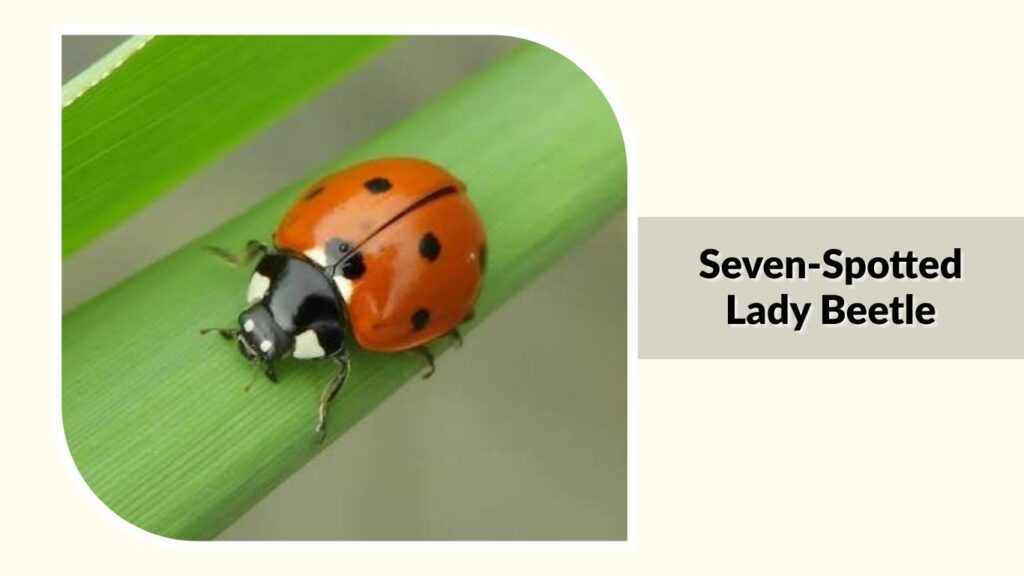
The Seven-Spotted Lady Beetle is one of the most recognizable lady beetles because of its bright red wing covers and distinctive black spots. Originally native to Europe, Asia, and parts of North Africa, it is now widespread in North America as well. Gardeners often appreciate this beetle because both adults and larvae consume large numbers of aphids and other soft-bodied plant pests.
Identification
- Bright red to orange-red wing covers
- Seven black spots in total
- Three spots on each wing cover
- One central black spot near the base
- Black head with pale markings
- Rounded, dome-shaped body
- Usually about 7–10 mm long
Habitat and Distribution
Seven-Spotted Lady Beetles live in gardens, agricultural fields, grasslands, meadows, forests, and areas where aphids are abundant. They are commonly found on crops, flowering plants, shrubs, and weeds.
During colder months, adults search for protected locations beneath leaf litter, rocks, bark, or other sheltered areas. Their broad distribution and ability to use many habitats have helped them become one of the most familiar lady beetles in temperate regions.
Behavior and Diet
This species is an active predator. Adults and larvae primarily hunt aphids but may also consume scale insects, mites, small insect eggs, and other soft-bodied prey.
When prey is scarce, adults may supplement their diet with pollen and nectar. Their strong appetite makes them valuable biological control agents in agricultural and garden environments.
Lifespan and Life Cycle
Females lay clusters of yellowish eggs near colonies of aphids so newly hatched larvae have an immediate food source. Larvae pass through several developmental stages before attaching themselves to vegetation and pupating.
Adults emerge from the pupal stage and may live for several months, depending on weather and food availability. In colder climates, adults can overwinter and become active again when temperatures rise in spring.
2. Two-Spotted Lady Beetle
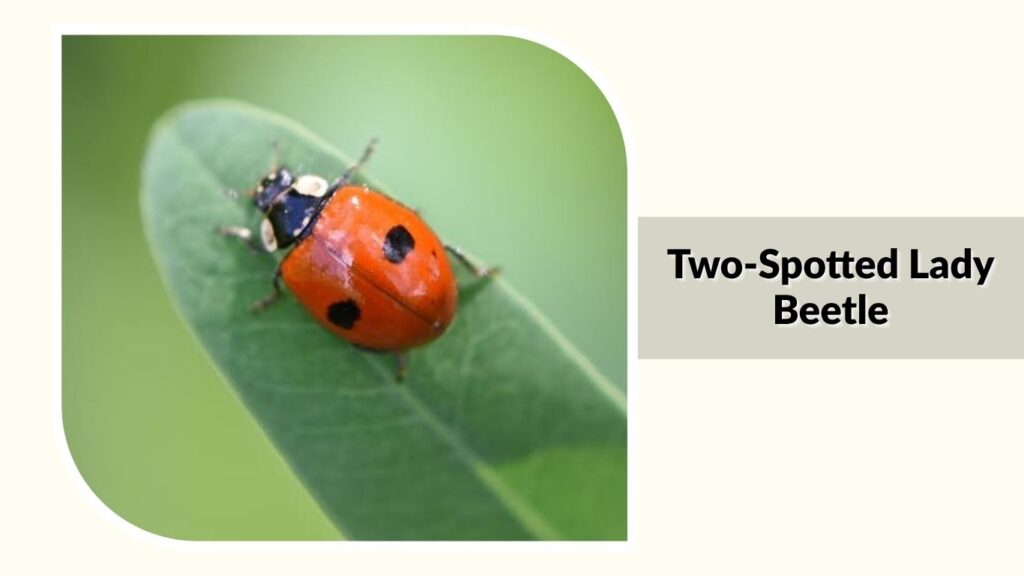
The Two-Spotted Lady Beetle is a small but highly variable species known for the two dark spots commonly visible on its wing covers. Its coloration can range from red with black markings to almost entirely black with reddish patches. It is an important predator of aphids and can be found in gardens, orchards, woodlands, and agricultural areas.
Identification
- Usually red or orange wing covers
- One black spot on each wing cover
- Two prominent spots in the typical form
- Some individuals are mainly black
- Small rounded body
- Black-and-white markings on the pronotum
- Usually around 4–6 mm long
Habitat and Distribution
Two-Spotted Lady Beetles occur across much of Europe, Asia, and North America. They inhabit woodlands, parks, gardens, orchards, hedgerows, and agricultural landscapes.
They are frequently found on trees and shrubs where aphids gather. During winter, adults shelter beneath bark, leaf litter, inside tree crevices, or occasionally around buildings.
Behavior and Diet
Aphids form the majority of their diet. Both adults and larvae actively search foliage for aphid colonies and can consume numerous prey insects during development.
They may also feed on mites, scale insects, and small insect eggs. Adults sometimes consume pollen and nectar when animal prey becomes scarce.
The beetles can release yellowish defensive fluid from their leg joints when threatened, a behavior common among many lady beetles.
Lifespan and Life Cycle
Females lay yellow eggs close to suitable prey. The eggs hatch into elongated larvae that look very different from adults and actively hunt aphids.
After completing several larval stages, they pupate on leaves or stems. Adults emerge after metamorphosis and continue feeding and reproducing.
Several generations may occur in favorable climates. Adults often survive for months, and overwintering individuals may live considerably longer than those active only during warmer seasons.
3. Nine-Spotted Lady Beetle
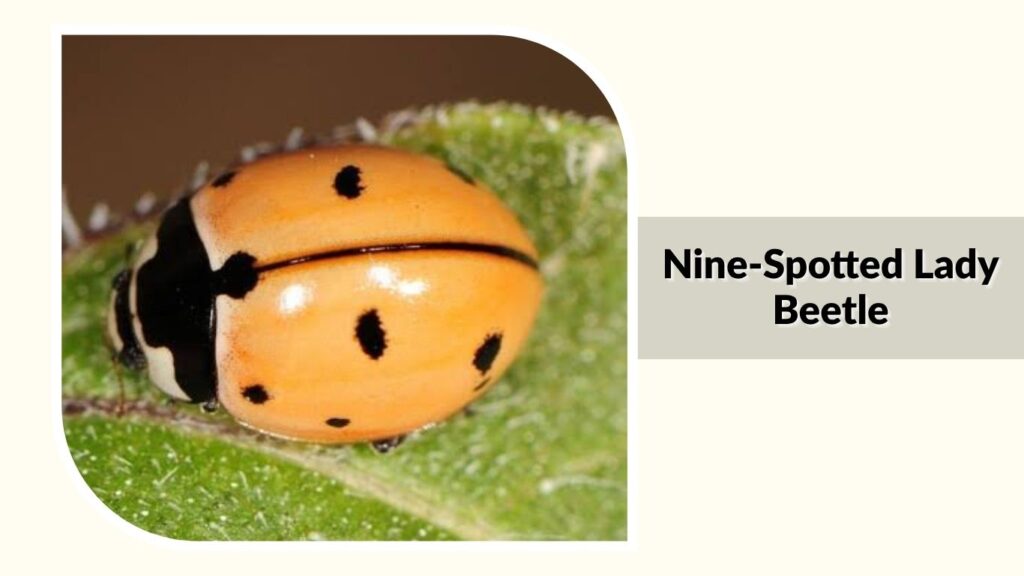
The Nine-Spotted Lady Beetle is a native North American species historically common across many agricultural and natural landscapes. It gets its name from the nine dark spots normally found across its orange-red wing covers. Although its populations declined in several areas, it remains an important native predator and a notable member of North American lady beetle communities.
Identification
- Orange to reddish wing covers
- Nine black spots
- Four spots on each wing cover
- One central spot near the base
- Pale cream markings near the head
- Oval, rounded body
- Usually about 4–7 mm long
Habitat and Distribution
Nine-Spotted Lady Beetles occur in fields, prairies, gardens, croplands, grasslands, and other open habitats. Historically, the species was widely distributed across the United States and southern Canada.
It is commonly associated with areas containing abundant aphids. Adults move between crops and wild vegetation while searching for prey and suitable places to reproduce.
Behavior and Diet
Both larvae and adults are predators of aphids. They also consume small soft-bodied insects, mites, and insect eggs when available.
Their hunting behavior involves moving steadily across leaves and stems, checking areas where prey colonies develop. This makes them useful natural enemies of agricultural pests.
Adults may occasionally consume pollen or nectar when insects are unavailable.
Lifespan and Life Cycle
Females deposit groups of elongated yellow eggs near aphid colonies. The larvae hatch and immediately begin feeding on small prey.
They grow through several molts before entering the pupal stage. Pupae remain attached to plant surfaces while the adult form develops.
Adults emerge with soft, pale wing covers that gradually harden and develop their characteristic coloration. Depending on temperature and geography, the species may produce more than one generation annually, with adults overwintering in protected sites.
4. Thirteen-Spotted Lady Beetle
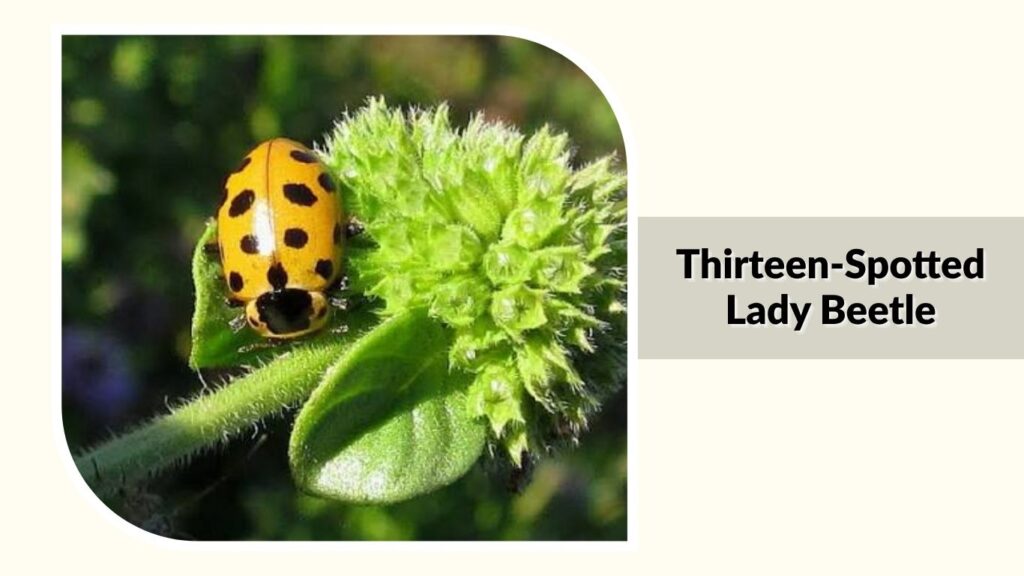
The Thirteen-Spotted Lady Beetle is a medium-sized species recognized by its elongated body and multiple black spots. Unlike many strongly rounded lady beetles, this species often appears slightly more oval. It is commonly associated with wetlands, meadows, agricultural fields, and vegetation near water, where it hunts aphids and other small insects.
Identification
- Orange-red to reddish wing covers
- Usually thirteen black spots
- Slightly elongated oval body
- Dark head and pronotum
- Pale markings near the head
- Spots may vary somewhat between individuals
- Usually around 5–7 mm long
Habitat and Distribution
Thirteen-Spotted Lady Beetles are found across large portions of North America, Europe, and northern Asia.
They particularly favor moist habitats such as marshes, wet meadows, riverbanks, lakeshores, and agricultural areas with abundant vegetation. They can also appear in gardens and crop fields.
Adults may move considerable distances while searching for prey or overwintering locations.
Behavior and Diet
Aphids are the primary prey of both adults and larvae. They also feed on other small soft-bodied insects and may consume mites or insect eggs.
The species actively searches stems and leaves rather than waiting for prey. Wetland plants, grasses, and crops can support large prey populations, making these habitats particularly attractive.
Like many lady beetles, adults may eat pollen when prey is scarce.
Lifespan and Life Cycle
Females lay clusters of eggs on plants close to aphid colonies. Larvae hatch after a short incubation period and begin feeding immediately.
The larvae pass through several stages before pupating on vegetation. After metamorphosis, adults emerge and gradually develop their mature coloration.
Adults can survive for several months and may overwinter in sheltered locations. Seasonal activity usually peaks during warmer months when aphids and other prey are abundant.
5. Fifteen-Spotted Lady Beetle
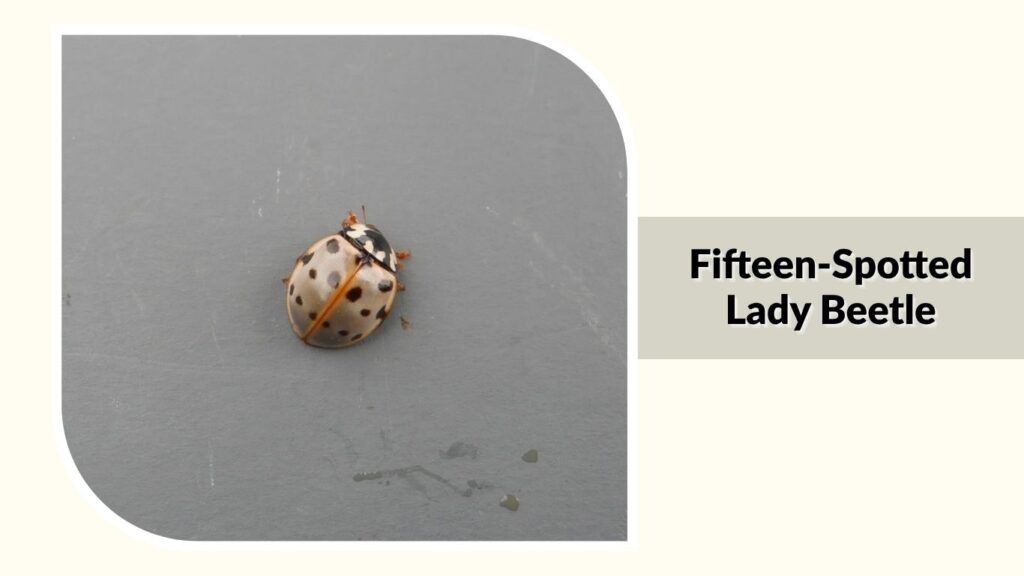
The Fifteen-Spotted Lady Beetle is a relatively large North American lady beetle with highly variable coloration. Younger adults may appear pale gray or cream with dark spots, while older individuals can become much darker. Despite its unusual appearance, it performs the same beneficial ecological role as many other lady beetles by hunting aphids and related pests.
Identification
- Usually fifteen dark spots
- Color ranges from pale gray to dark brown or black
- Older adults often become darker
- Relatively large lady beetle
- Broad and rounded body
- Pale forms can have clearly visible black markings
- Usually around 7–9 mm long
Habitat and Distribution
This species is commonly associated with deciduous forests and wooded areas across eastern North America.
Adults are often found on trees such as maples, oaks, and other broadleaf species where aphids and scale insects occur. They may also wander into parks, gardens, and wooded residential landscapes.
The species often shelters under bark, logs, and other protected areas during colder weather.
Behavior and Diet
The Fifteen-Spotted Lady Beetle is primarily predatory. Adults and larvae hunt aphids, scale insects, mites, and other small arthropods found on trees.
Its preference for wooded habitats makes it particularly useful for controlling pests affecting forest and ornamental trees.
The beetles move slowly across bark, branches, and foliage searching for prey. Adults may supplement their diet with plant material or pollen when animal prey is limited.
Lifespan and Life Cycle
Eggs are laid near concentrations of suitable prey. After hatching, the larvae go through several growth stages while feeding actively.
Mature larvae attach themselves to vegetation before pupating. Adults later emerge and begin hunting.
Several months may be spent in the adult stage, with mature beetles often surviving through winter in protected shelters. Their color may darken noticeably with age, making older adults look quite different from recently emerged individuals.
6. Twenty-Spotted Lady Beetle
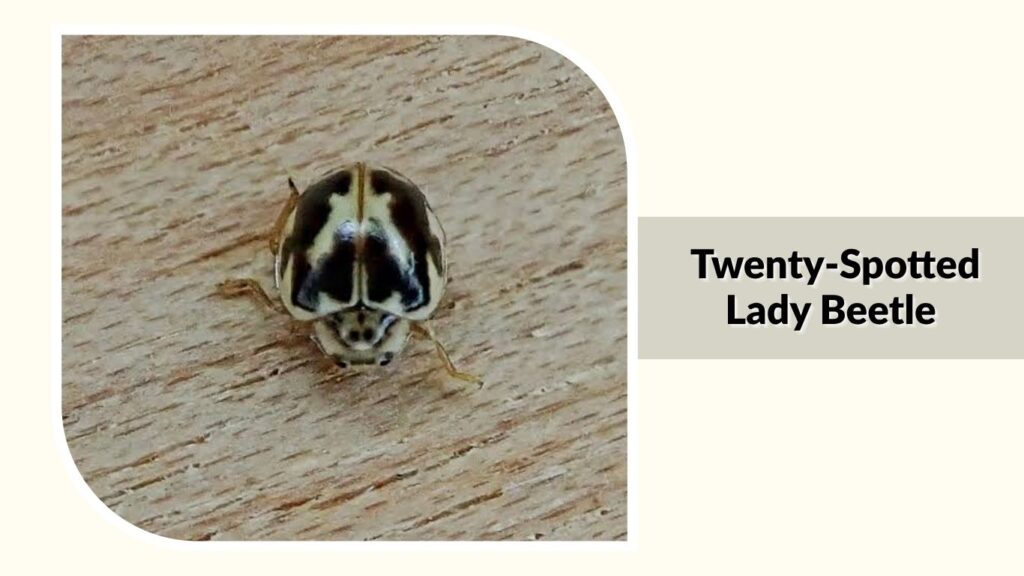
The Twenty-Spotted Lady Beetle is a tiny lady beetle that can be easily overlooked because of its small size. Unlike many familiar red lady beetles, it is usually cream, yellowish, or pale brown with numerous dark spots. Its feeding habits are also unusual because it commonly consumes fungi, particularly powdery mildew growing on plant surfaces.
Identification
- Very small body
- Cream to pale yellow coloration
- Numerous dark brown or black spots
- Usually around twenty markings
- Rounded and slightly hairy appearance
- Compact dome-shaped body
- Generally only about 2–3 mm long
Habitat and Distribution
Twenty-Spotted Lady Beetles are widespread in North America and are found wherever powdery mildew fungi develop.
Common habitats include gardens, forests, fields, parks, and areas with dense vegetation. They may occur on leaves of shrubs, vines, crops, and ornamental plants.
Because they are so small, people often overlook them even when populations are relatively abundant.
Behavior and Diet
Unlike most well-known lady beetles, this species does not depend primarily on aphids. Adults and larvae are largely fungus feeders, consuming powdery mildew and other fungal growth from leaves.
This feeding behavior gives them a specialized ecological role. They may help reduce fungal growth on certain plants, although they are not generally considered a complete solution for plant diseases.
Their small size allows them to move easily across leaf surfaces while scraping fungal material.
Lifespan and Life Cycle
Females place eggs near suitable fungal food sources. Tiny larvae hatch and begin consuming fungal growth from leaves.
After several larval stages, they pupate on plant surfaces before emerging as miniature adults.
Development is closely linked with environmental conditions that favor both vegetation and fungi. Multiple generations may occur during warm periods, while adults or other developmental stages survive unfavorable seasons depending on local climate.
7. Twenty-Two-Spotted Lady Beetle
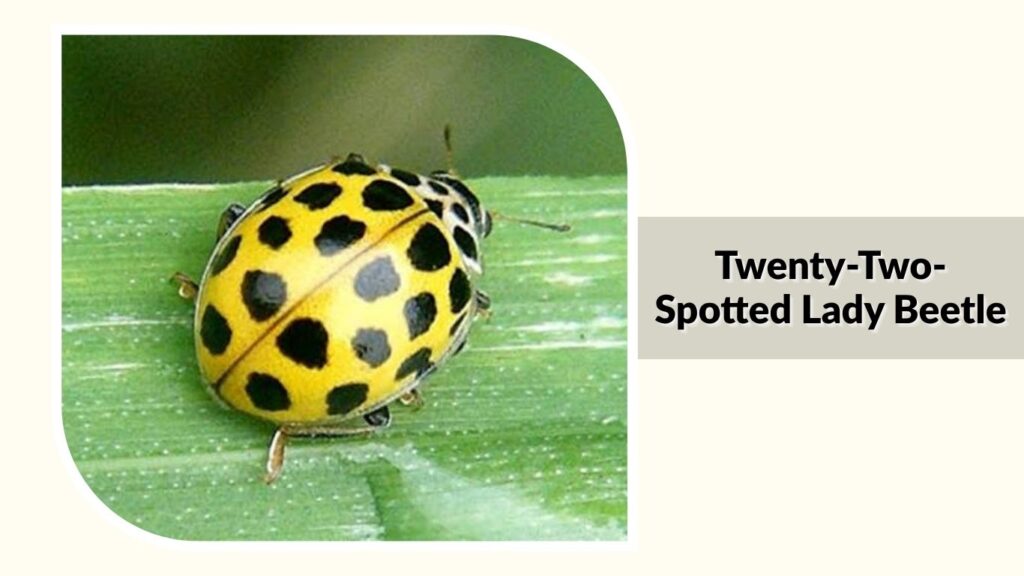
The Twenty-Two-Spotted Lady Beetle is one of the easiest lady beetles to recognize because of its bright lemon-yellow coloration and numerous black spots. Unlike familiar aphid-eating species, it specializes largely in feeding on powdery mildew fungi. Its striking pattern makes it a particularly attractive species commonly encountered in gardens, fields, and hedgerows.
Identification
- Bright yellow wing covers
- Twenty-two black spots
- Yellow pronotum with dark markings
- Small rounded body
- Strong contrast between yellow and black
- Short legs and antennae
- Usually around 3–5 mm long
Habitat and Distribution
Twenty-Two-Spotted Lady Beetles are widespread across Europe and parts of Asia. They occur in gardens, grasslands, hedgerows, woodland edges, and agricultural landscapes.
They are particularly likely to appear on plants infected with powdery mildew because fungal growth provides their main food supply.
Common locations include low-growing vegetation, shrubs, and crops where humid conditions encourage fungal development.
Behavior and Diet
The Twenty-Two-Spotted Lady Beetle primarily feeds on powdery mildew fungi rather than aphids.
Adults and larvae graze fungal spores and hyphae from the surfaces of leaves. Because their food is closely associated with fungal infection, groups of these beetles may appear on heavily mildewed vegetation.
They are generally harmless to people and do not intentionally damage healthy plants while searching for fungal food.
Lifespan and Life Cycle
Females lay small yellow eggs on vegetation where fungal growth is available. Larvae emerge and begin feeding on mildew.
After passing through several larval stages, they attach themselves to leaves or stems and pupate. Adults emerge after completing metamorphosis and continue feeding on fungal growth.
There may be multiple generations during favorable warm seasons. Adults can survive for several months, while winter is commonly spent in protected vegetation or other sheltered locations before activity increases again in spring.
8. Asian Lady Beetle
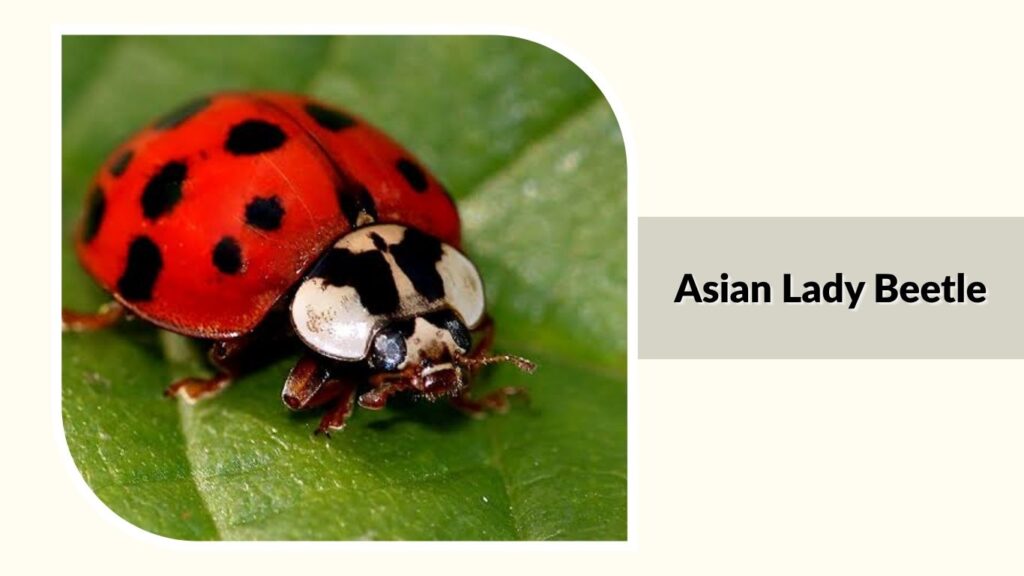
The Asian Lady Beetle is one of the most variable and widespread lady beetles encountered around homes and gardens. Originally native to Asia, it was introduced into several regions for biological pest control and later became established across much of North America and Europe. Although beneficial outdoors because it consumes aphids, large groups frequently enter buildings during autumn to overwinter.
Identification
- Color ranges from yellow and orange to deep red
- May have zero to nineteen black spots
- White or cream pronotum
- Dark markings often form an “M” or “W” shape
- Rounded, strongly domed body
- Usually larger than many native lady beetles
- Commonly about 5–8 mm long
Habitat and Distribution
Asian Lady Beetles occupy an extremely broad range of habitats, including gardens, crop fields, orchards, forests, parks, and residential landscapes.
They are now widespread across much of North America and Europe as well as their native Asian range.
During autumn, adults gather on sunny buildings and enter cracks around windows, roofs, siding, and doors. Large numbers may spend winter inside wall voids, attics, and other protected spaces.
Behavior and Diet
Asian Lady Beetles are highly effective predators of aphids, scale insects, psyllids, and other soft-bodied pests. Adults and larvae can consume large quantities of prey, which explains why the species was historically valued for biological control.
However, they can become household nuisances during winter. When disturbed, adults may release yellow defensive fluid with an unpleasant odor and can occasionally pinch exposed skin.
Lifespan and Life Cycle
Females lay yellow egg clusters on plants near aphid populations. The dark, elongated larvae hatch and actively hunt prey before progressing through several molts.
After reaching maturity, larvae pupate on leaves or stems. Adults emerge and begin feeding soon afterward.
Several generations can develop during favorable conditions. Adults commonly live for several months, and individuals that enter overwintering shelters may survive until spring, when they leave buildings and return to outdoor feeding and reproduction.
9. Convergent Lady Beetle
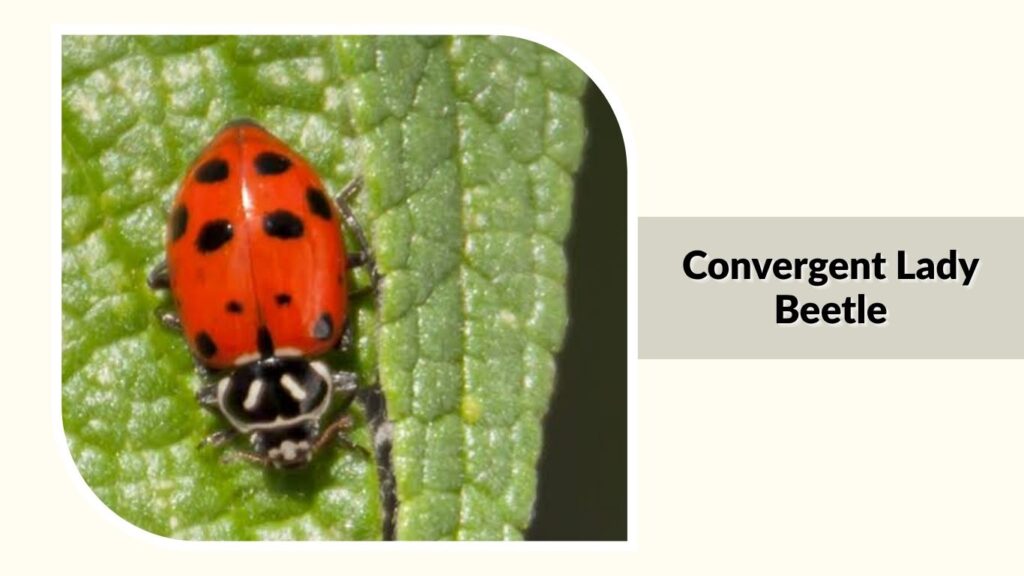
The Convergent Lady Beetle is one of the most common native lady beetles in North America. It is widely recognized for its orange-red wing covers and the distinctive pair of pale lines on the pronotum that appear to converge toward the center. This beneficial predator is frequently found in gardens, crop fields, grasslands, and orchards where aphids and other soft-bodied insects are abundant.
Identification
- Orange-red to reddish wing covers
- Usually has up to 13 black spots
- Some individuals have fewer spots
- Two pale converging lines on the pronotum
- Rounded, dome-shaped body
- Dark head with pale markings
- Usually about 5–7 mm long
Habitat and Distribution
Convergent Lady Beetles are widespread throughout much of North America. They occupy agricultural fields, gardens, grasslands, orchards, meadows, and areas containing flowering vegetation.
During cooler months, enormous numbers may gather in mountain areas or other protected locations to overwinter. Adults later disperse when temperatures rise and food becomes available.
They can be found on crops, shrubs, weeds, and trees wherever aphid populations develop.
Behavior and Diet
Aphids are their primary prey, but they also consume mites, scale insects, whiteflies, insect eggs, and other soft-bodied pests.
Adults actively move across leaves and stems searching for prey, while larvae are equally effective hunters. This feeding behavior makes convergent lady beetles valuable natural biological-control agents.
When prey becomes scarce, adults may consume pollen, nectar, or honeydew.
Lifespan and Life Cycle
Females deposit clusters of yellow eggs close to aphid colonies. After hatching, larvae immediately begin feeding and pass through several developmental stages.
The mature larva attaches itself to a leaf, stem, or another surface before pupating. An adult later emerges with pale, soft wing covers that gradually harden and darken.
Several generations can occur in warm regions. Adults may survive for months, while overwintering individuals can live considerably longer before returning to active feeding and reproduction in spring.
10. Pink-Spotted Lady Beetle
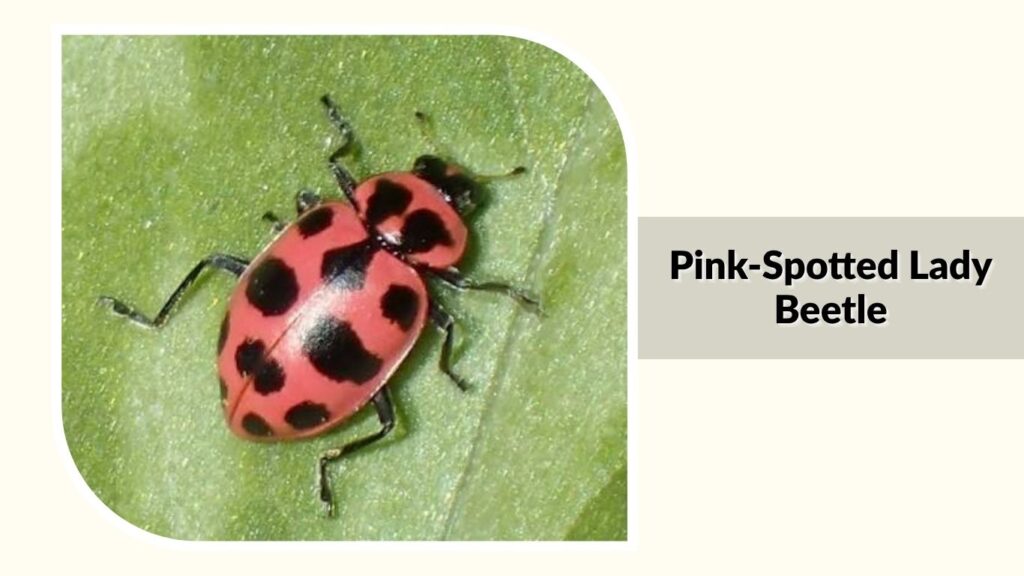
The Pink-Spotted Lady Beetle is an attractive North American species with pinkish or reddish wing covers marked by black spots. It is especially useful in agricultural habitats because its diet includes aphids, insect eggs, and pollen. Unlike many lady beetles that rely almost entirely on animal prey, this species regularly feeds on plant pollen as an important part of its diet.
Identification
- Pink, salmon, or reddish wing covers
- Six black spots on each wing cover
- Twelve spots in total
- Elongated oval body
- Dark central markings
- Black head
- Usually around 5–6 mm long
Habitat and Distribution
Pink-Spotted Lady Beetles occur across much of North America, particularly in crop fields, gardens, meadows, and grassy agricultural areas.
They are commonly associated with corn and other flowering crops where pollen is abundant. Fields containing aphids, caterpillar eggs, and other small prey can support substantial populations.
The species also occurs in natural habitats containing flowering plants and grasses.
Behavior and Diet
This lady beetle has a broader diet than many other species. Adults and larvae feed on aphids, mites, insect eggs, and other small arthropods.
Pollen is also an important food source, particularly corn pollen. This ability to survive partly on plant-based food allows adults to remain in agricultural fields even when insect prey temporarily becomes scarce.
Their feeding habits make them particularly useful predators of pest eggs in crop systems.
Lifespan and Life Cycle
Females lay yellow eggs close to locations containing suitable prey and pollen resources. Larvae hatch and pass through several developmental stages while feeding heavily.
After reaching full size, larvae pupate on vegetation. Adults emerge after metamorphosis and continue hunting or feeding on pollen.
Multiple generations can occur during the growing season. Adults may overwinter in sheltered areas such as beneath plant debris or bark, becoming active again when temperatures rise and food resources return.
11. Spotted Lady Beetle
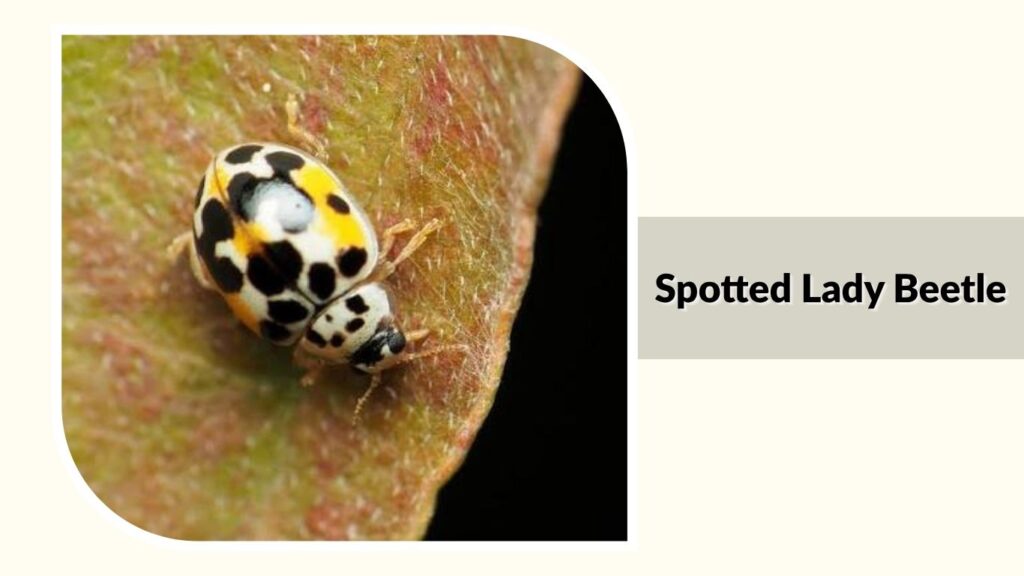
The Spotted Lady Beetle is a colorful predatory beetle commonly found in fields, gardens, and agricultural landscapes. Its orange-red wing covers are decorated with multiple black spots, giving it the classic appearance people associate with lady beetles. Both adults and larvae are important predators of aphids and several other crop pests.
Identification
- Orange to reddish wing covers
- Multiple black spots
- Rounded or slightly oval body
- Dark head and pronotum
- Pale markings around the pronotum
- Short antennae
- Usually several millimeters long
Habitat and Distribution
Spotted Lady Beetles commonly occur in open habitats where prey is abundant. These include gardens, agricultural fields, meadows, grasslands, and woodland edges.
They frequently inhabit vegetation supporting aphid colonies and may move between crop fields as pest populations change.
Adults can also be found on flowering plants where they obtain pollen or nectar when prey is limited.
Behavior and Diet
Adults and larvae are active predators. Their diet commonly includes aphids, mites, scale insects, whiteflies, and insect eggs.
They move across leaves and stems searching for small prey and can consume numerous pests during both larval and adult stages.
When threatened, adults may drop from vegetation or release defensive chemicals from their leg joints. Their bright coloration warns many predators that they are unpleasant to eat.
Lifespan and Life Cycle
Females usually lay yellow or orange egg clusters near prey populations. Larvae hatch after several days and immediately begin hunting.
They molt several times while growing before becoming pupae attached to leaves, stems, or other protected surfaces.
Adults emerge after completing metamorphosis. Depending on temperature and food availability, several generations may develop during the warmer part of the year.
Adults often overwinter in protected sites and can survive for many months before reproducing again.
12. Parenthesis Lady Beetle
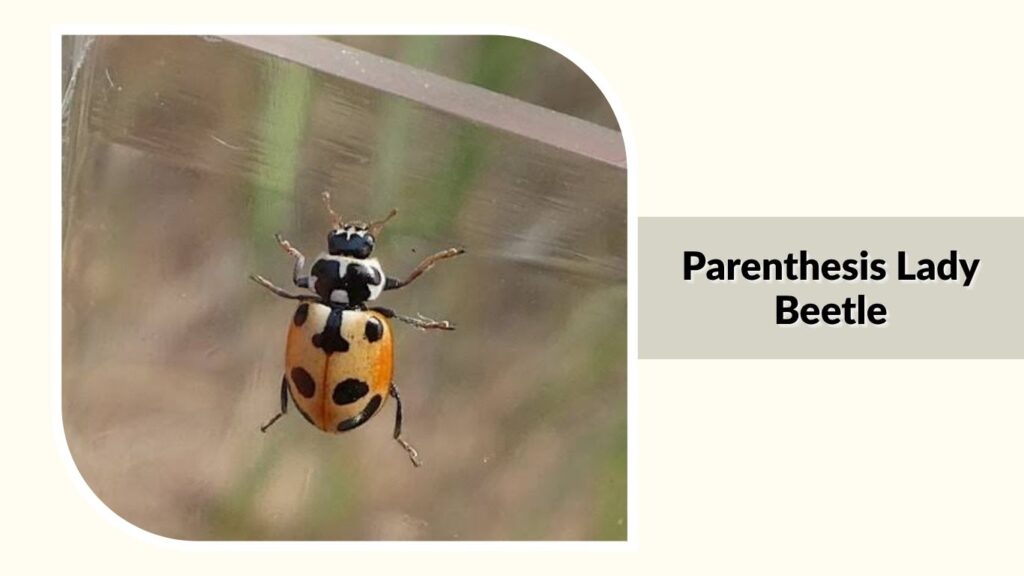
The Parenthesis Lady Beetle gets its unusual name from the curved pale markings on its dark pronotum, which resemble a pair of parentheses. This North American species is typically orange or reddish with multiple black spots. It is commonly found in gardens, fields, woodland edges, and other areas where aphids provide an abundant source of food.
Identification
- Orange-red wing covers
- Several black spots
- Black pronotum
- Pale curved markings resembling parentheses
- Rounded body
- Dark head
- Usually around 4–6 mm long
Habitat and Distribution
Lady Beetles are native to North America and can be found in much of the United States and southern Canada.
They occupy agricultural fields, prairies, gardens, roadsides, forest edges, and other open areas.
The species is particularly likely to appear on plants containing aphid colonies. It may also visit flowering vegetation when pollen or nectar is available.
Behavior and Diet
Like many predatory lady beetles, this species feeds primarily on aphids.
Adults and larvae also consume small insect eggs, mites, scale insects, and other soft-bodied arthropods when available.
They are active during warm daylight hours and frequently move between plants while searching for prey.
If disturbed, adults may quickly fly away, drop from the plant, or produce defensive fluid from their leg joints.
Lifespan and Life Cycle
Females deposit egg clusters on leaves and stems close to concentrations of aphids. Newly hatched larvae are elongated and dark, with a body shape that looks very different from the adult beetle.
After several larval molts, they enter a stationary pupal stage attached to vegetation.
Adults emerge after development is complete and begin feeding soon afterward.
Multiple generations may occur in favorable climates. Adults frequently survive through winter in sheltered areas and become active again during spring.
13. Eye-Spotted Lady Beetle
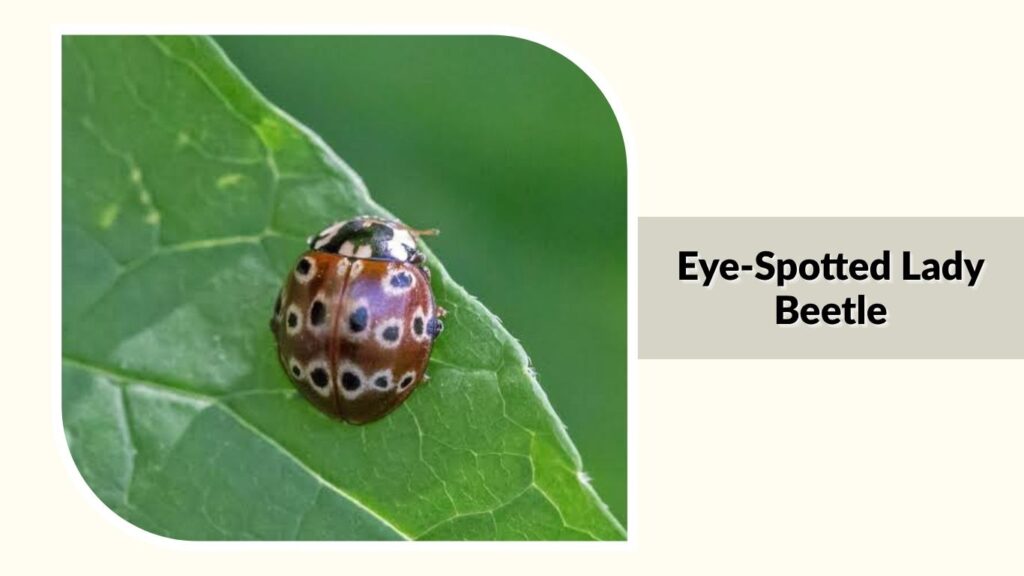
The Eye-Spotted Lady Beetle is a relatively large and distinctive species known for its dark spots surrounded by pale rings. These markings resemble eyes, giving the beetle its common name. It is often associated with coniferous trees and is an important predator of aphids and other small insects living on tree foliage.
Identification
- Large compared with many lady beetles
- Red, orange, or reddish-brown wing covers
- Multiple black spots
- Pale ring surrounding many dark spots
- Eye-like appearance of markings
- Rounded body
- Usually about 7–9 mm long
Habitat and Distribution
Eye-Spotted Lady Beetles are found throughout much of North America and parts of Eurasia.
They are particularly associated with forests containing conifers such as pine, spruce, and fir. Adults can also occur in parks, gardens, and landscaped areas where coniferous trees have been planted.
They spend much of their time on tree branches and foliage searching for aphids and similar prey.
Behavior and Diet
The species primarily feeds on aphids that infest conifer trees.
Adults and larvae may also consume other soft-bodied insects, insect eggs, and mites. Their strong predatory behavior makes them beneficial inhabitants of forest ecosystems.
Their eye-like markings may also contribute to visual defense by making them appear unusual to potential predators.
When disturbed, they can release defensive chemicals or quickly move away.
Lifespan and Life Cycle
Females lay eggs on foliage near suitable prey. Larvae hatch and begin feeding on aphids while passing through several growth stages.
The mature larva attaches itself to vegetation before pupating. Adults emerge after metamorphosis and continue hunting on trees.
In temperate areas, adults may overwinter beneath bark, leaf litter, or other protected material. They become active again in spring and may produce one or more generations during the warmer months.
14. Twice-Stabbed Lady Beetle
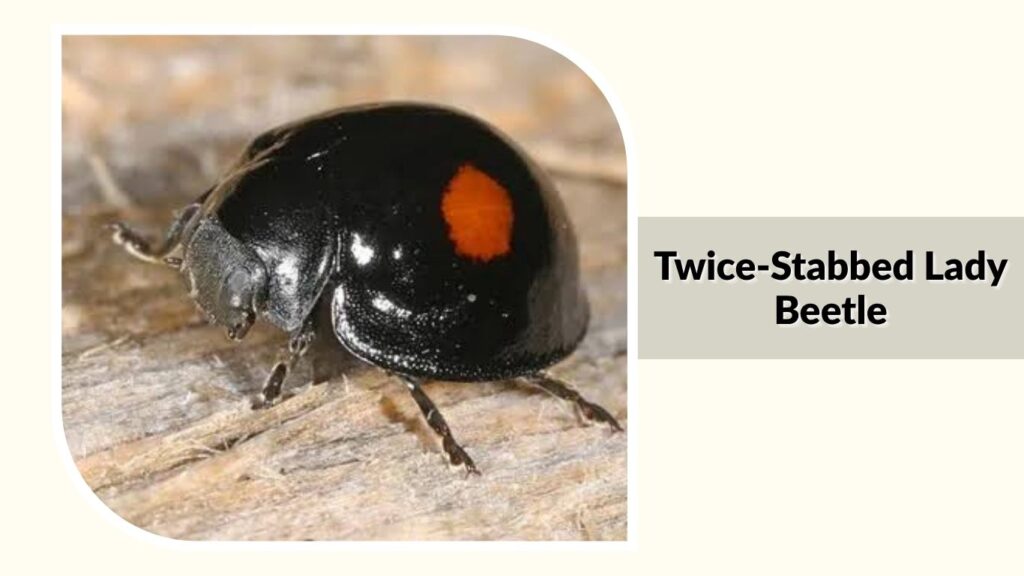
The Twice-Stabbed Lady Beetle has one of the most distinctive color patterns among lady beetles. Instead of red wing covers with black spots, it usually has a shiny black body with one bright red or orange spot on each wing cover. This small predator is frequently found on trees where it feeds heavily on scale insects.
Identification
- Glossy black wing covers
- One red or orange spot on each wing cover
- Two colored spots in total
- Rounded dome-shaped body
- Black head and pronotum
- Compact appearance
- Usually around 3–5 mm long
Habitat and Distribution
Twice-Stabbed Lady Beetles are widely distributed across North America.
They commonly inhabit forests, orchards, gardens, parks, and landscapes containing trees or shrubs infested with scale insects.
Adults frequently occur on tree trunks, branches, and bark rather than low-growing vegetation.
They may also be found in agricultural environments where woody crops support populations of scale insects.
Behavior and Diet
Scale insects are among their most important prey.
Adults and larvae also consume aphids, mealybugs, mites, and other small insects. Because scale insects remain attached to bark and plant stems, these beetles often spend significant amounts of time moving along woody surfaces.
Their black-and-red coloration may help warn predators of their chemical defenses.
When disturbed, adults can remain motionless, drop from the plant, or release defensive fluid.
Lifespan and Life Cycle
Females place eggs close to colonies of scale insects or other prey. After hatching, larvae actively crawl across bark and foliage in search of food.
Larvae molt several times before pupating on a protected surface.
Adults emerge from the pupal stage and begin feeding soon afterward. Several generations may develop where warm weather and prey remain available for long periods.
Adults commonly overwinter beneath bark or in other sheltered areas and may survive for many months.
15. Ashy Gray Lady Beetle
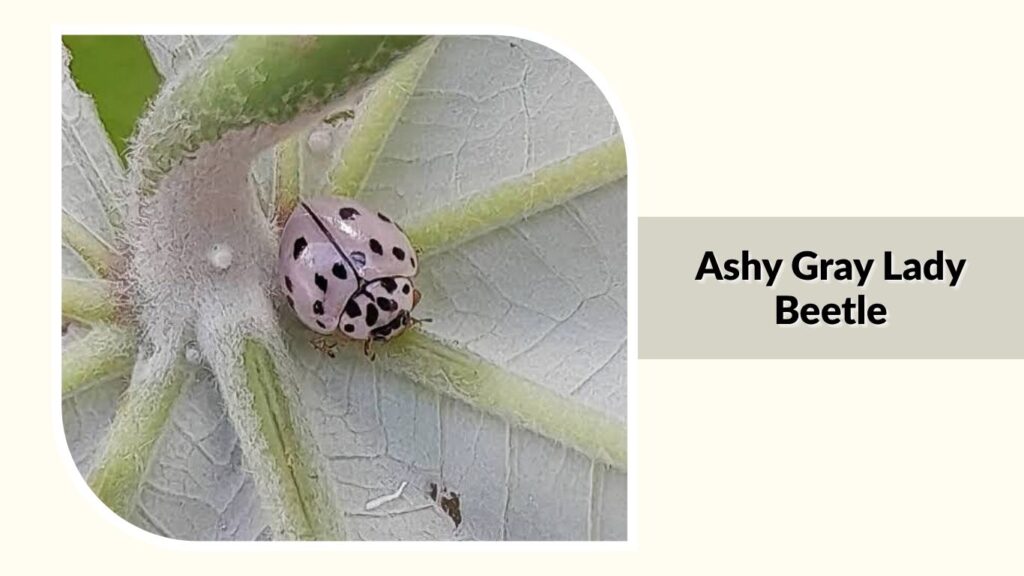
The Ashy Gray Lady Beetle is unusual because it may be gray, pale, black, or even nearly white depending on the color form. Its appearance differs greatly from the familiar red-and-black pattern of many lady beetles. Despite its unusual coloration, it is an effective predator of aphids and several other small plant pests.
Identification
- Gray, pale, or black coloration
- Several dark or pale spots depending on form
- Rounded, dome-shaped body
- Pale pronotum in many individuals
- Multiple color variations
- Small head
- Usually around 3–6 mm long
Habitat and Distribution
Ashy Gray Lady Beetles are widespread across much of North America.
They inhabit gardens, agricultural fields, forests, orchards, grasslands, and urban landscapes.
The species can be found on trees, shrubs, vegetables, weeds, and flowering plants where aphids or other prey occur.
Its broad habitat tolerance contributes to its widespread distribution.
Behavior and Diet
Both adults and larvae primarily consume aphids.
Their diet may also include mites, whiteflies, scale insects, and insect eggs. They move actively over leaves and stems while searching for prey.
Because adults occur in several distinct color forms, people sometimes mistake them for entirely different species.
Despite the differences in appearance, their feeding behavior remains similar. They can become valuable predators in gardens and agricultural systems where aphids are common.
Lifespan and Life Cycle
Females lay yellowish eggs near prey colonies. Larvae hatch and begin hunting almost immediately.
After several molts and periods of rapid growth, mature larvae attach themselves to plants and become pupae.
Adults emerge from the pupal case after development is complete. Their final coloration becomes clearer as the outer body hardens.
Depending on climate, more than one generation may develop each year. Adults can overwinter in protected locations and survive several months.
16. Polished Lady Beetle
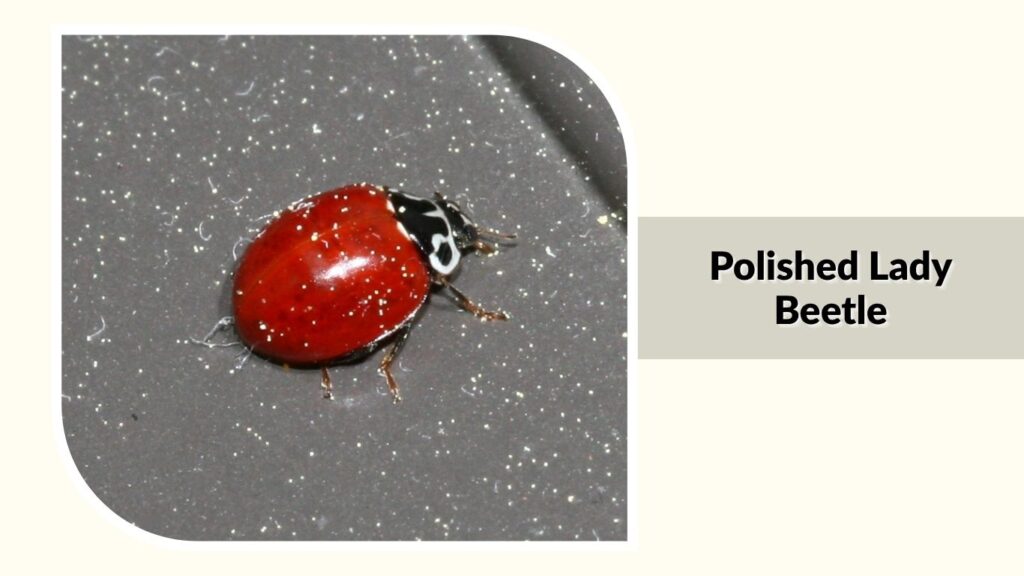
The Polished Lady Beetle is recognized for its glossy, smooth appearance and reddish or orange wing covers. The species typically has relatively few markings compared with heavily spotted lady beetles, which gives its body a polished look. It is a beneficial predator often found on vegetation containing aphids and other soft-bodied insects.
Identification
- Smooth, glossy wing covers
- Red, orange, or reddish-brown coloration
- Few or sometimes no obvious spots
- Rounded body
- Dark head
- Shiny surface
- Medium-sized lady beetle
Habitat and Distribution
Polished Lady Beetles occur in forests, gardens, fields, orchards, and other areas containing trees and shrubs.
They are often encountered on foliage where aphid populations develop.
Woodland edges and mixed vegetation can provide especially suitable habitats because they offer both prey and shelter.
Adults may move considerable distances when searching for food or overwintering locations.
Behavior and Diet
The species is primarily predatory and feeds on aphids, scale insects, small insect larvae, mites, and eggs.
Adults patrol leaves, stems, and branches in search of prey. Larvae are also aggressive hunters and can consume numerous small insects before pupating.
When prey becomes scarce, adults may feed on pollen, nectar, or other plant-derived food.
Their bright coloration and smooth surface provide the classic warning appearance associated with many lady beetles.
Lifespan and Life Cycle
Eggs are laid near prey colonies so emerging larvae have immediate access to food.
Larvae pass through several stages while growing rapidly. They then attach themselves to vegetation and enter the pupal stage.
Adults emerge after metamorphosis and spend much of their life feeding and searching for mates.
In temperate areas, adults often overwinter beneath leaf litter, loose bark, or other protected locations. Depending on conditions, the complete adult lifespan can extend for several months.
17. Mealybug Destroyer
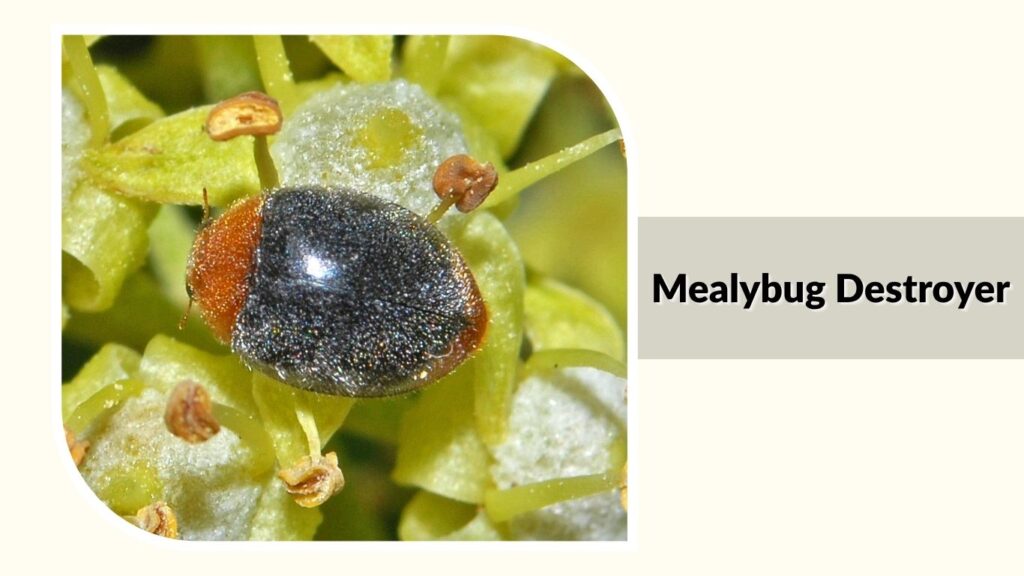
The Mealybug Destroyer is a small dark lady beetle widely used in biological pest control. Adults have dark wing covers and an orange-brown head and rear end, while the larvae resemble large mealybugs because they are covered with white waxy filaments. This camouflage allows larvae to move among mealybug colonies while feeding on their prey.
Identification
- Dark brown to black wing covers
- Orange or reddish-brown head
- Orange-brown tip of abdomen
- Oval, rounded body
- Adults usually around 3–4 mm long
- Larvae covered with white waxy filaments
- Larvae may resemble mealybugs
Habitat and Distribution
Mealybug Destroyers are native to Australia but have been introduced to many other regions for biological control.
They commonly occur in greenhouses, gardens, orchards, citrus groves, tropical landscapes, and indoor growing environments where mealybugs are present.
Warm temperatures favor their activity, which is why they are particularly useful in greenhouse and subtropical environments.
Behavior and Diet
As their name suggests, these beetles specialize in feeding on mealybugs.
Adults and larvae consume mealybug eggs, nymphs, and adults. They may also feed on scale insects and related pests.
The wax-covered larvae are especially effective predators because they can move directly through mealybug colonies without immediately appearing very different from their prey.
This feeding behavior has made the species widely used as a biological control agent in commercial agriculture and greenhouse production.
Lifespan and Life Cycle
Females lay eggs close to mealybug colonies or among their egg masses. Larvae emerge and begin feeding almost immediately.
They pass through several developmental stages while consuming increasing numbers of prey. Mature larvae eventually pupate in protected locations.
Adults emerge and continue feeding on mealybugs before reproducing.
Under favorable warm conditions, development can progress quickly and several generations may occur during the year. Adult lifespan varies with temperature and food supply, but individuals can survive for several weeks to months.
18. Steelblue Lady Beetle
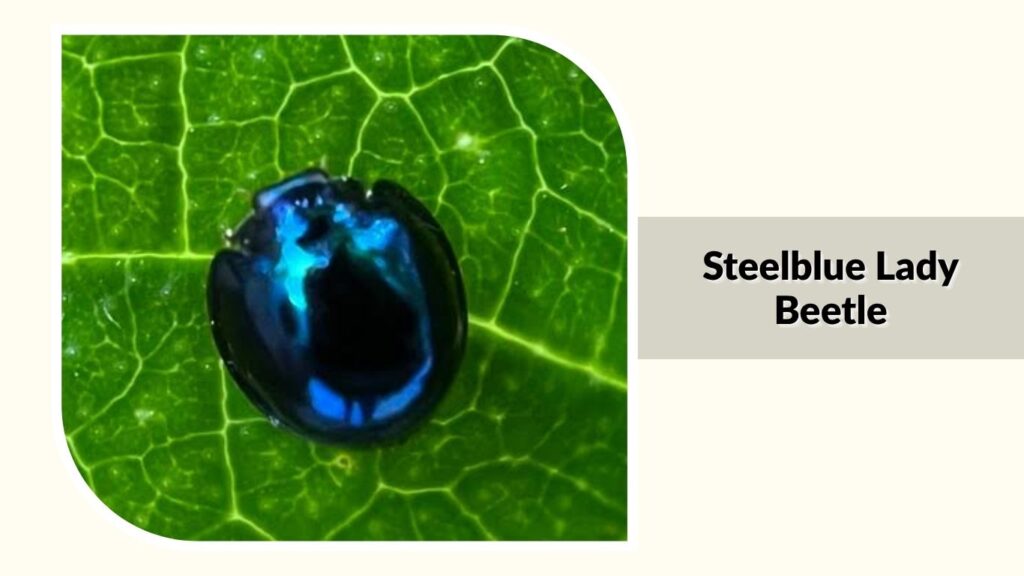
The Steelblue Lady Beetle is one of the most visually distinctive lady beetles because of its shiny metallic blue-green coloration. Instead of the familiar red-and-black pattern, its entire body has a polished, steel-like appearance. Native to Australia, this small predatory beetle is often found on trees and shrubs where scale insects and other soft-bodied pests provide abundant food.
Identification
- Metallic blue to blue-green body
- Glossy, reflective wing covers
- Rounded to oval body shape
- No prominent spots
- Dark legs and antennae
- Small, compact appearance
- Usually around 3–4 mm long
Habitat and Distribution
Steelblue Lady Beetles are native to Australia and have also become established in New Zealand and some other regions. They occur in forests, gardens, orchards, parks, and agricultural landscapes.
Adults are commonly found on trees and shrubs that support populations of scale insects. Citrus trees and ornamental plants can provide especially suitable feeding habitats.
Their small size and dark metallic coloration sometimes make them difficult to notice unless they are moving across leaves or branches in bright sunlight.
Behavior and Diet
This species is primarily predatory. Both adults and larvae consume scale insects, mealybugs, aphids, and other small soft-bodied pests.
Their appetite for scale insects makes them useful natural predators in orchards and gardens. Adults actively search leaves, twigs, and bark for prey rather than remaining in one location.
When threatened, they may drop from vegetation or remain still until the danger passes. Like many lady beetles, they rely partly on chemical defenses against predators.
Lifespan and Life Cycle
Females lay eggs near colonies of suitable prey. The larvae hatch and immediately begin searching for scale insects and other small arthropods.
After passing through several larval stages, they attach themselves to a protected surface and pupate. Adults eventually emerge with softer coloration that develops its characteristic metallic appearance as the body hardens.
Several generations may occur in warm climates where food remains available. Adults can survive for several months depending on temperature and prey abundance.
19. Cream-Spotted Lady Beetle
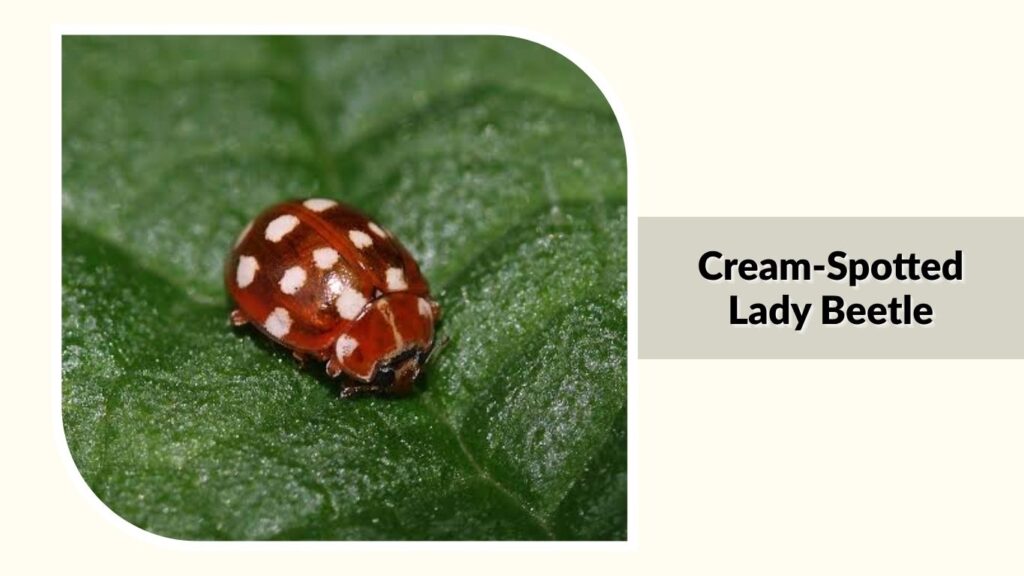
The Cream-Spotted Lady Beetle is an attractive species recognized by its chestnut, reddish-brown, or orange wing covers decorated with pale cream spots. Its coloration differs considerably from the classic red-and-black lady beetle pattern. It is mainly a predator of aphids and other small insects and is commonly associated with trees, woodland edges, parks, and gardens.
Identification
- Chestnut-brown to reddish wing covers
- Usually 14 pale cream spots
- Rounded, broad body
- Shiny wing covers
- Pale markings clearly contrast with the background
- Dark underside
- Usually around 4–6 mm long
Habitat and Distribution
Cream-Spotted Lady Beetles occur across parts of Europe, Asia, and North America. They are particularly associated with deciduous trees and shrubs.
Woodlands, hedgerows, parks, gardens, and forest edges provide suitable habitats because they support aphids and other potential prey.
Adults may be found on willow, birch, hazel, hawthorn, and various other trees. Their preference for woody vegetation means they are often noticed higher above the ground than lady beetles that specialize in grassland habitats.
Behavior and Diet
Aphids make up an important part of their diet. Adults and larvae may also consume psyllids, small insect larvae, mites, and other soft-bodied arthropods.
They actively search across leaves and branches for prey. When aphids become abundant on a tree, several beetles may gather in the same area.
Adults can fly between plants when food supplies decline, allowing them to follow seasonal changes in prey populations.
Lifespan and Life Cycle
Females deposit eggs near concentrations of prey so newly hatched larvae can begin feeding quickly.
The larvae pass through several growth stages before pupating on foliage, stems, or other protected surfaces. Adults emerge after metamorphosis and gradually develop their final coloration.
Depending on climate, one or more generations may occur annually. Adults commonly overwinter in sheltered places such as bark crevices, leaf litter, or dense vegetation before returning to active feeding in spring.
20. Orange Lady Beetle
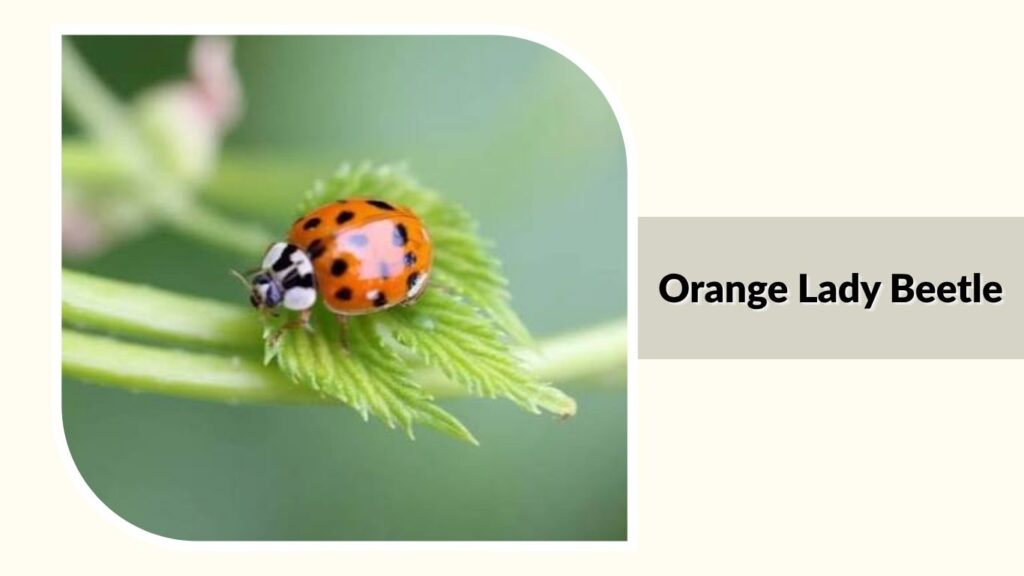
The Orange Lady Beetle is a brightly colored species distinguished by orange wing covers covered with creamy-white spots. Unlike many familiar lady beetles, it does not primarily hunt aphids. Instead, both adults and larvae commonly feed on powdery mildew and other fungi growing on plant surfaces, giving the species a specialized ecological role.
Identification
- Bright orange wing covers
- Usually 16 creamy-white spots
- Orange or pale pronotum
- Rounded, dome-shaped body
- Transparent-looking margins around parts of the body
- No typical black spotting
- Usually around 5–7 mm long
Habitat and Distribution
Orange Lady Beetles are mainly associated with Europe and parts of western Asia. They occur in woodlands, parks, gardens, hedgerows, and other environments containing broadleaf trees.
They were historically strongly associated with woodland habitats but can also thrive in urban areas containing trees affected by powdery mildew.
Sycamore, ash, hazel, and various other deciduous trees can provide suitable feeding surfaces when fungal growth develops.
Behavior and Diet
Powdery mildew fungi form an important part of the Orange Lady Beetle’s diet.
Adults and larvae move across leaves and consume fungal spores and other fungal material. This differs considerably from predatory lady beetles that actively chase aphids.
Their fungal diet means the beetles may become abundant on trees showing obvious white patches of mildew. Adults are capable fliers and move between suitable trees as food availability changes.
Lifespan and Life Cycle
Females lay eggs on vegetation where suitable fungal food is available. Larvae emerge and begin grazing across leaf surfaces.
They pass through several larval stages before pupating, usually while attached to vegetation. Newly emerged adults initially have softer and paler bodies before their orange coloration becomes fully developed.
Adults may survive for several months. During colder weather, they seek sheltered overwintering sites and become active again when temperatures rise and fungal food becomes available.
21. Kidney-Spot Lady Beetle
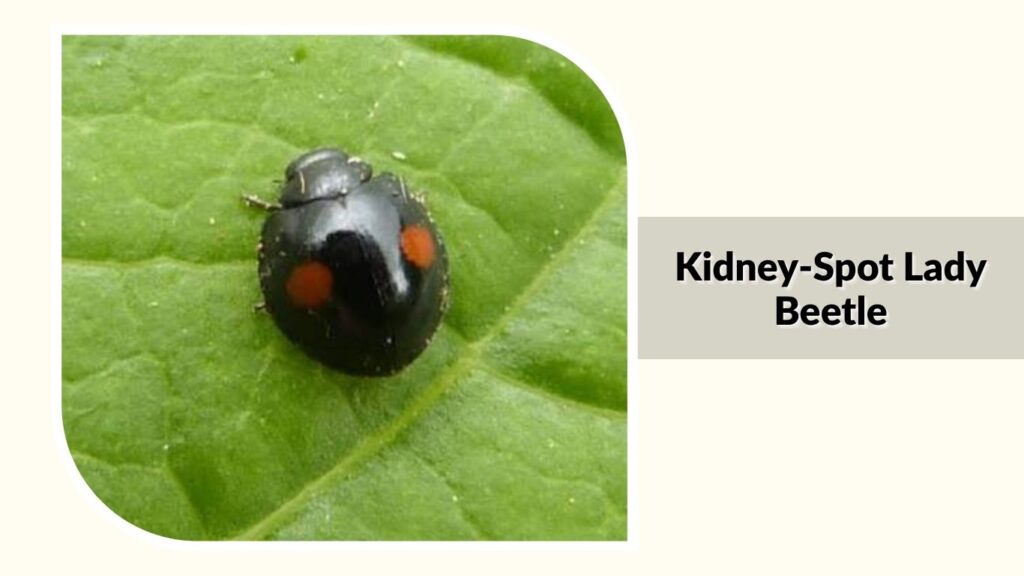
The Kidney-Spot Lady Beetle has a dramatic appearance that makes it relatively easy to distinguish from many other species. Its glossy black body carries a large reddish kidney-shaped marking on each wing cover. This European lady beetle is particularly associated with trees and shrubs where scale insects provide its primary food source.
Identification
- Glossy black wing covers
- One large red kidney-shaped spot on each side
- Two red markings in total
- Broad, strongly domed body
- Black head and pronotum
- Smooth and shiny surface
- Usually around 4–5 mm long
Habitat and Distribution
Kidney-Spot Lady Beetles occur across much of Europe and parts of Asia. They inhabit deciduous woodland, orchards, gardens, parks, hedgerows, and areas containing mature trees.
Adults are often found on trunks and branches rather than on low grass. Trees supporting scale insects are particularly attractive.
They can also occur in orchards and landscaped areas where scale populations develop on fruit trees or ornamental plants.
Behavior and Diet
Scale insects are the primary prey of Kidney-Spot Lady Beetles.
Both adults and larvae search bark, twigs, and leaves for scales and related insects. Their feeding habits make them valuable natural enemies of pests that can weaken trees by sucking plant sap.
Adults are generally active during warmer weather and can fly to new trees when prey becomes limited.
Their distinctive red-and-black appearance may serve as warning coloration, discouraging predators from attempting to eat them.
Lifespan and Life Cycle
Females place eggs near scale-insect colonies. The larvae emerge and begin feeding on the smaller stages of their prey.
After several larval molts, mature larvae attach themselves to a sheltered surface and pupate. The adult later emerges and develops its glossy black coloration.
Adults can live for several months and commonly overwinter beneath bark, among leaf litter, or in other protected locations.
Activity increases again in spring as temperatures rise and prey populations begin developing.
22. Three-Striped Lady Beetle
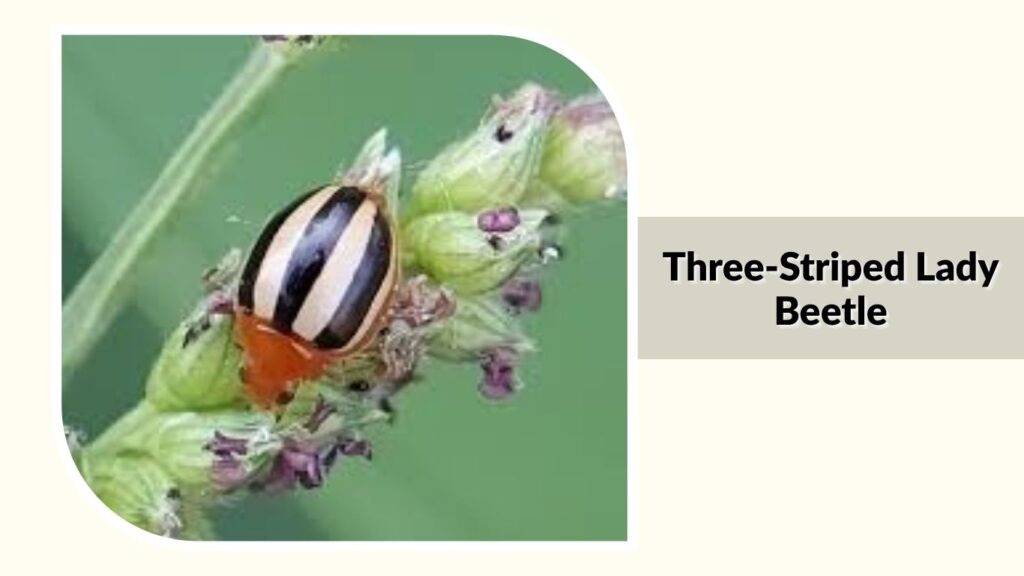
The Three-Striped Lady Beetle is an unusual species characterized by dark longitudinal stripes running along its pale wing covers. Its pattern makes it look quite different from spotted lady beetles. It occurs widely across South and Southeast Asia and is a beneficial predator of scale insects, aphids, mealybugs, and other small pests.
Identification
- Pale yellow, cream, or tan wing covers
- Three prominent dark longitudinal stripes
- One central stripe along the wing-cover seam
- Two additional dark side stripes
- Small rounded body
- Dark head and pronotum
- Easily distinguished from spotted species
Habitat and Distribution
Three-Striped Lady Beetles occur across India, Pakistan, Bangladesh, Sri Lanka, Nepal, Bhutan, Indonesia, the Philippines, and other parts of Asia.
They inhabit gardens, agricultural fields, orchards, plantations, and areas containing shrubs or trees with suitable insect prey.
Warm tropical and subtropical environments provide particularly favorable conditions. Adults often occur directly on plants infested with scale insects or aphids.
Behavior and Diet
This species is a predatory lady beetle. Adults and larvae consume scale insects, aphids, mealybugs, and similar soft-bodied plant pests.
They move steadily across stems and leaves while searching for food. Their feeding behavior can be beneficial in agricultural environments where sap-feeding insects damage crops.
Adults can fly between plants when local prey populations become depleted.
Lifespan and Life Cycle
Females deposit eggs near colonies of prey. The larvae hatch and begin feeding soon afterward, progressing through several larval stages as their bodies grow.
After reaching maturity, larvae form pupae on leaves, stems, or other stable surfaces.
Adults emerge after metamorphosis and begin feeding before eventually reproducing. Several generations may develop each year in warm climates where suitable prey remains available for long periods.
23. Broad-Striped Lady Beetle
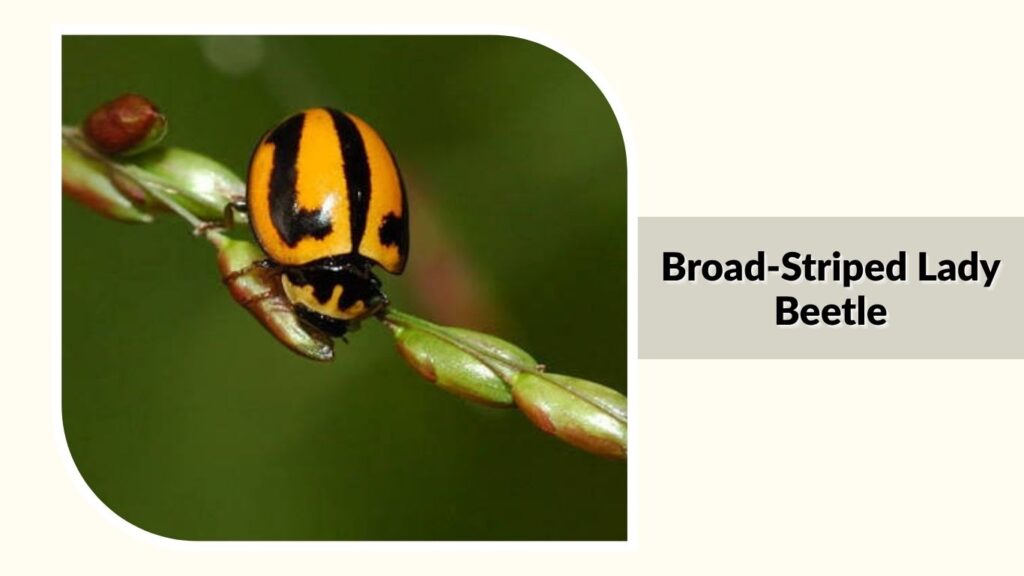
The Broad-Striped Lady Beetle is a distinctive western North American species with elongated dark markings rather than the round spots associated with most familiar lady beetles. Also called the Striped Lady Beetle, it is the only described species in its genus and occurs primarily across western portions of North America.
Identification
- Orange, reddish, or yellowish background
- Broad dark longitudinal stripes
- Elongated oval body
- Strongly contrasting wing pattern
- Dark head and pronotum
- Stripes extend along the wing covers
- Usually about 4.5–6.6 mm long
Habitat and Distribution
Broad-Striped Lady Beetles occur primarily in western North America. Records extend through parts of the western United States and into western Canada.
They inhabit grasslands, meadows, agricultural landscapes, gardens, and open areas containing aphid-infested vegetation.
Adults can move between grasses, wildflowers, crops, and shrubs as prey availability changes throughout the season.
Behavior and Diet
Like many members of the predatory lady beetle group, the Broad-Striped Lady Beetle hunts small soft-bodied insects.
Aphids are an important food source, and larvae can be particularly active predators as they move across vegetation. Adults may also consume other small arthropods and supplement their diet with pollen when necessary.
When disturbed, adults can quickly fly away or drop from vegetation.
Lifespan and Life Cycle
Females place their eggs close to potential food sources. Newly hatched larvae look dramatically different from adults and immediately begin searching for prey.
They molt repeatedly before entering the pupal stage on leaves or stems. Adults emerge after metamorphosis and continue feeding.
In temperate regions, reproductive activity is concentrated during warmer months. Adults may overwinter in sheltered locations before becoming active again the following spring.
24. Fourteen-Spotted Lady Beetle
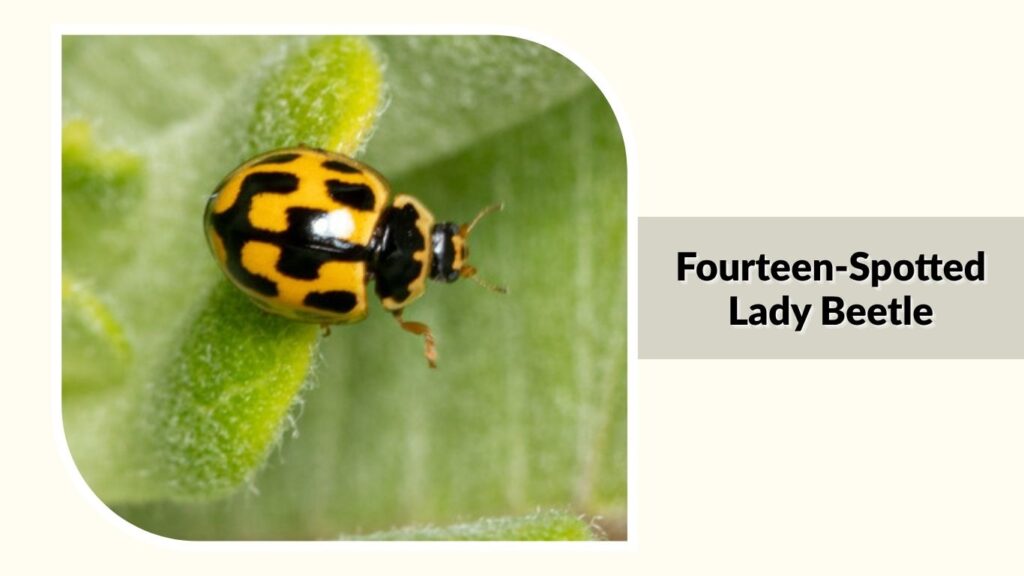
The Fourteen-Spotted Lady Beetle is a small species with an unusually variable checkerboard-like pattern. Rather than having simple round spots, its yellow and black markings often merge into rectangular or irregular shapes. It is an important predator of aphids and occurs in gardens, agricultural fields, grasslands, hedgerows, and other vegetation-rich habitats.
Identification
- Yellow and black coloration
- Fourteen dark markings in typical forms
- Spots often merge into rectangular shapes
- Checkerboard-like appearance
- Compact rounded body
- Considerable variation between individuals
- Usually around 3–5 mm long
Habitat and Distribution
Fourteen-Spotted Lady Beetles are widespread across Europe and Asia and have also become established in North America.
They tolerate many environments, including gardens, crop fields, meadows, roadside vegetation, grasslands, woodland edges, and urban parks.
Their broad habitat preferences allow them to follow aphid populations across numerous kinds of plants.
Behavior and Diet
Aphids are the primary food of both adults and larvae. They may also consume scale insects, mites, whiteflies, insect eggs, and other small soft-bodied prey.
Adults actively patrol leaves and stems and can move quickly between plants when aphids become scarce.
When prey numbers decline, adults may consume pollen and nectar. This dietary flexibility helps them survive periods when animal prey is temporarily difficult to find.
Lifespan and Life Cycle
Females lay groups of yellow eggs near aphid colonies. Larvae hatch and immediately begin hunting, consuming increasing numbers of aphids as they grow.
After several molts, the mature larva attaches itself to vegetation and becomes a pupa. An adult later emerges, initially pale and soft before developing its mature yellow-and-black pattern.
Several generations may occur during favorable seasons. Adults can survive for months and often spend winter in sheltered vegetation, leaf litter, bark crevices, or similar protected locations.
25. Eighteen-Spotted Lady Beetle
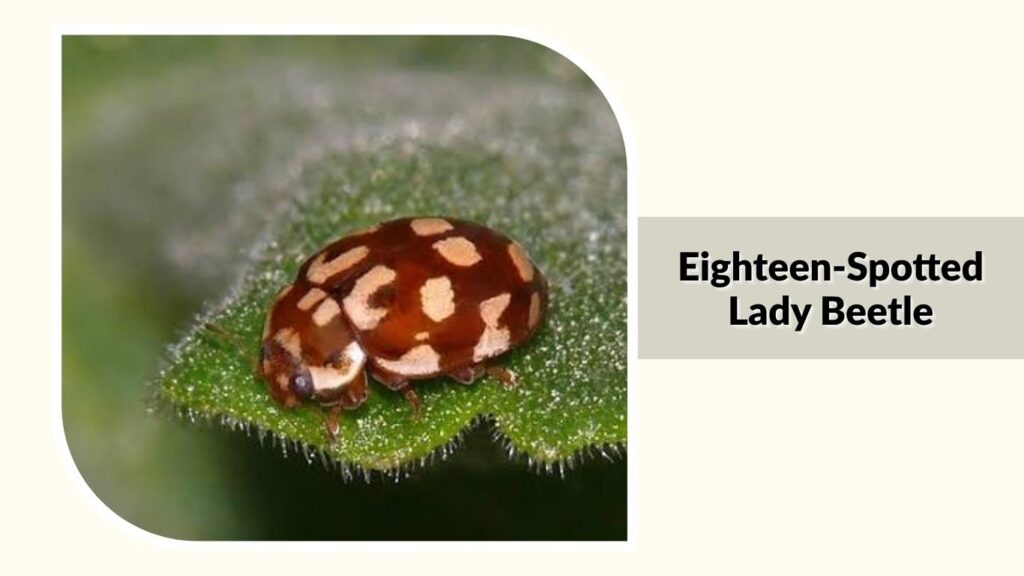
The Eighteen-Spotted Lady Beetle is a beautiful woodland species characterized by reddish-brown or chestnut wing covers decorated with numerous pale cream spots. It is particularly associated with pine and other coniferous trees, where adults and larvae hunt aphids. Its muted coloration helps it blend with bark and branches more effectively than bright red lady beetles.
Identification
- Reddish-brown to chestnut wing covers
- Eighteen pale cream or whitish spots
- Rounded oval body
- Pale markings on the pronotum
- Relatively flat compared with some lady beetles
- Cream spots arranged symmetrically
- Usually around 4–5 mm long
Habitat and Distribution
Eighteen-Spotted Lady Beetles are primarily found in Europe and parts of northern Asia.
They are strongly associated with coniferous woodland, particularly areas containing mature pine trees. They can also occur in parks, gardens, plantations, and other landscapes where conifers grow.
Adults spend much of their time among needles, branches, and bark, where their coloring provides effective camouflage.
Behavior and Diet
Aphids living on coniferous trees form the main part of their diet.
Both larvae and adults actively search pine needles, twigs, and branches for prey. They may also consume other small soft-bodied insects encountered while hunting.
Their association with trees means they are less frequently noticed at ground level than species that inhabit grasses or garden flowers.
Adults can fly between trees as aphid populations change during the growing season.
Lifespan and Life Cycle
Females lay eggs close to aphid populations on or near suitable trees. Larvae emerge and spend their developmental period actively hunting prey among foliage.
After several growth stages, the larvae pupate on vegetation or another protected surface. Adults later emerge and develop their characteristic chestnut-and-cream markings.
The adult stage may last for several months. Individuals commonly overwinter in sheltered locations such as beneath loose bark, among evergreen foliage, or within other protected woodland sites.
FAQs
Lady beetles are remarkably diverse in color, size, diet, and habitat. While many familiar species are red with black spots, others can be yellow, orange, gray, metallic blue, or almost completely black. Most predatory lady beetles are considered beneficial because they naturally reduce populations of aphids, scales, mealybugs, and other plant pests.
1. How many types of lady beetles are there?
There are more than 6,000 described species of lady beetles worldwide. They belong to the family Coccinellidae and occur in many terrestrial environments, from forests and grasslands to gardens and agricultural fields.
2. Are all lady beetles red with black spots?
No. Lady beetles occur in many colors and patterns. Species can be red, orange, yellow, brown, gray, black, metallic blue, or combinations of these colors. Some have spots, while others have stripes, patches, or no obvious markings.
3. What do lady beetles eat?
Many lady beetles are predators of aphids, scale insects, mealybugs, mites, whiteflies, and insect eggs. However, not every species has the same diet. Orange and Twenty-Two-Spotted Lady Beetles, for example, commonly feed on powdery mildew fungi, while some species also consume pollen and nectar.
4. How long do lady beetles live?
The lifespan varies by species, temperature, food availability, and climate. Many adult lady beetles survive for several months, while species that overwinter as adults may live for approximately a year or sometimes longer under favorable conditions.
5. Are lady beetles good for gardens?
Yes. Most predatory lady beetles are highly beneficial because they consume plant pests such as aphids, scales, and mealybugs. Both adults and larvae can contribute to natural pest control, reducing the number of harmful insects feeding on garden plants without damaging healthy vegetation.