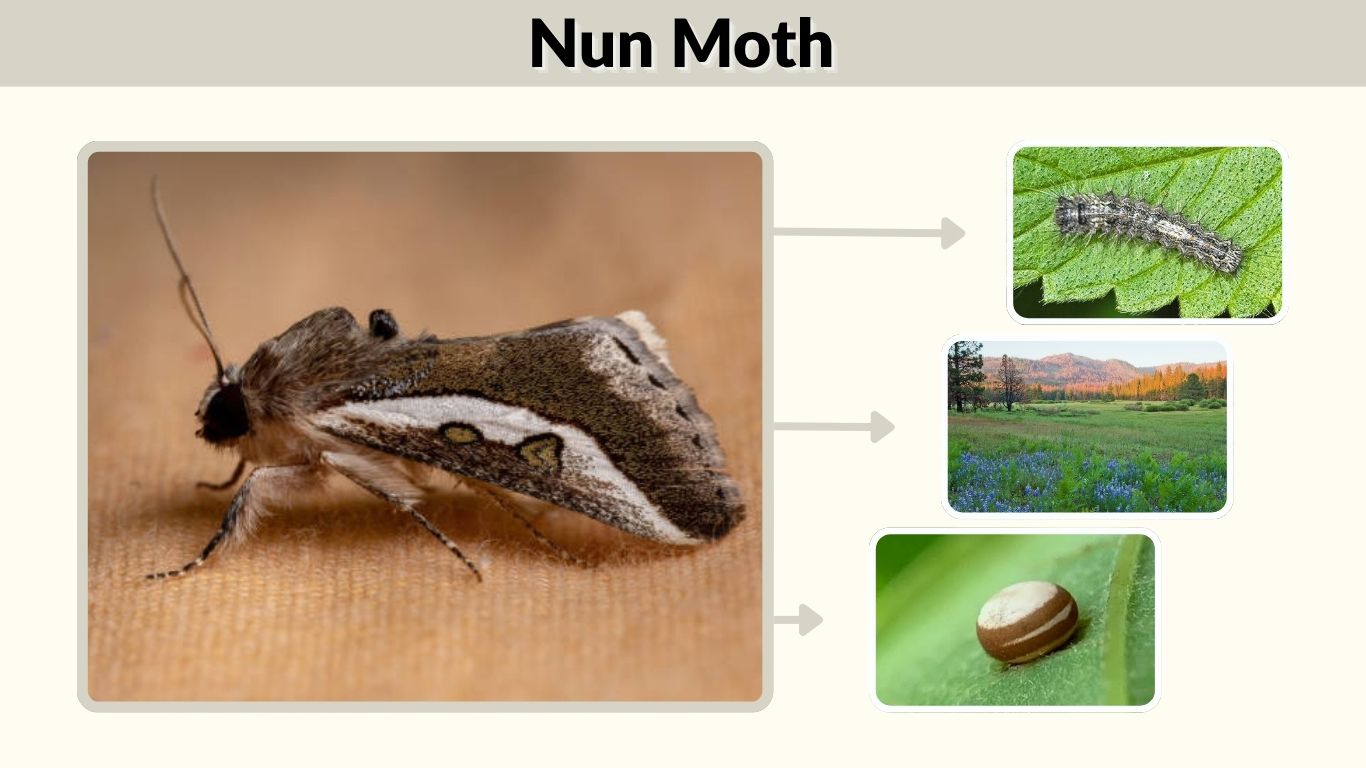
The nun moth (Lymantria monacha) is a black-and-white forest moth native to much of Europe and parts of Asia. Also called the black arches moth or black-arched tussock moth, it is best known for its white forewings crossed by irregular dark lines and for the damage its caterpillars can cause during population outbreaks. Nun moth larvae feed heavily on conifers such as spruce, pine, fir, and larch, although they can use several deciduous trees as well. Because of this broad host range, the species is considered a significant potential invasive forest pest outside its native distribution.
What Is a Nun Moth?
The nun moth belongs to the family Erebidae and genus Lymantria. Its accepted scientific name is Lymantria monacha. EPPO recognizes several English common names, including nun moth, black arches moth, and black-arched tussock moth.
The species is primarily associated with forests, where its caterpillars feed on tree foliage. Populations normally remain manageable, but periodic outbreaks can cause extensive defoliation.
Nun Moth Scientific Classification
The most important identification details are:
- Scientific name: Lymantria monacha
- Order: Lepidoptera
- Family: Erebidae
- Genus: Lymantria
- Common names: Nun moth, black arches moth, black-arched tussock moth
- Primary hosts: Spruce, pine, fir, larch, and Douglas-fir
What Does a Nun Moth Look Like?
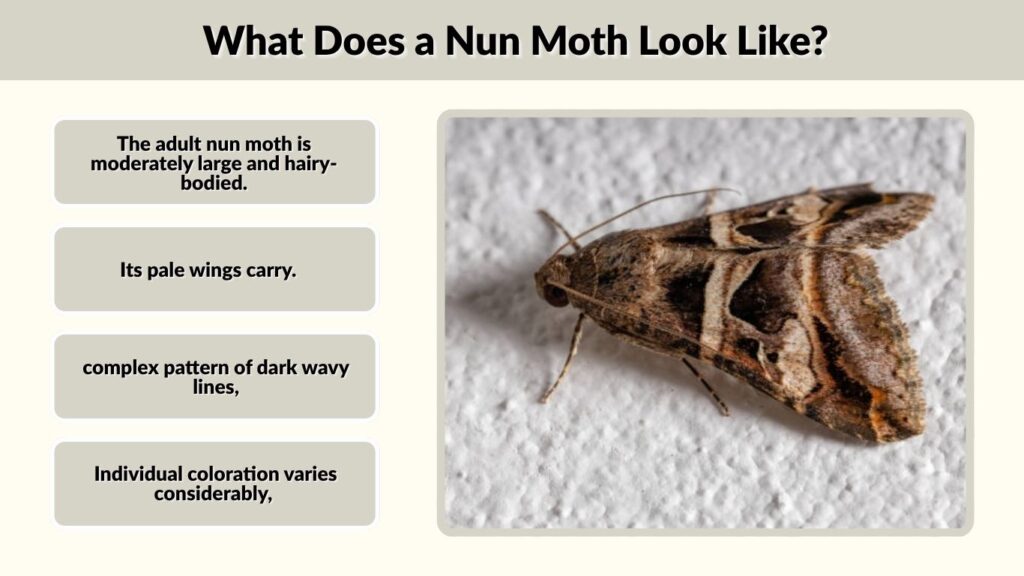
The adult nun moth is moderately large and hairy-bodied. Its pale wings carry a complex pattern of dark wavy lines, patches, and arches. Individual coloration varies considerably, and darker gray-brown or almost black forms can occur.
The contrast between pale wings and dark markings is responsible for much of the moth’s distinctive appearance.
Description of the Nun Moth’s Appearance
Typical adults have white forewings marked with numerous black or dark gray transverse lines. The hindwings are generally gray-white to gray-brown.
Females have a wingspan of approximately 45–55 mm, while males are smaller at roughly 35–45 mm. Females usually have a reddish-brown abdomen marked with black, whereas males tend to have a gray-black abdomen.
Nun Moth Colors
Not every nun moth is simply black and white. The species can vary from very pale individuals with sharp black markings to much darker moths.
Known colors include white, gray, black, reddish brown, and gray-brown. Melanic individuals can appear predominantly dark rather than white.
Why Does the Moth Look Like a Nun?
The species epithet monacha relates to the word “nun,” and “nun moth” became the widely used English common name. The moth’s striking pale-and-dark coloration has also contributed to the association with monastic clothing, although the common name should not be interpreted as the moth literally having a human-like face.
Searches for a “moth with a nun face” therefore usually refer to the unusual black-and-white pattern rather than an actual facial resemblance.
Male and Female Nun Moths
Male and female nun moths look generally similar but can be distinguished by size, antennae, and abdomen coloration.
Females are usually larger and have short, saw-like antennae. Males possess conspicuously feathery antennae, which help them detect female pheromones.
Nun Moth Female
A female commonly measures 45–55 mm across the wings. Her abdomen is usually reddish-brown with black markings, and she possesses an elongated ovipositor used to place eggs into protected crevices.
After mating, females lay eggs on tree bark and other sheltered surfaces.
Nun Moth Male
Males are generally smaller, measuring around 35–45 mm across the wings.
Their large, feather-like antennae are among the easiest features to recognize. Males are active fliers and use chemical cues to locate females.
Nun Moth Caterpillar and Life Cycle
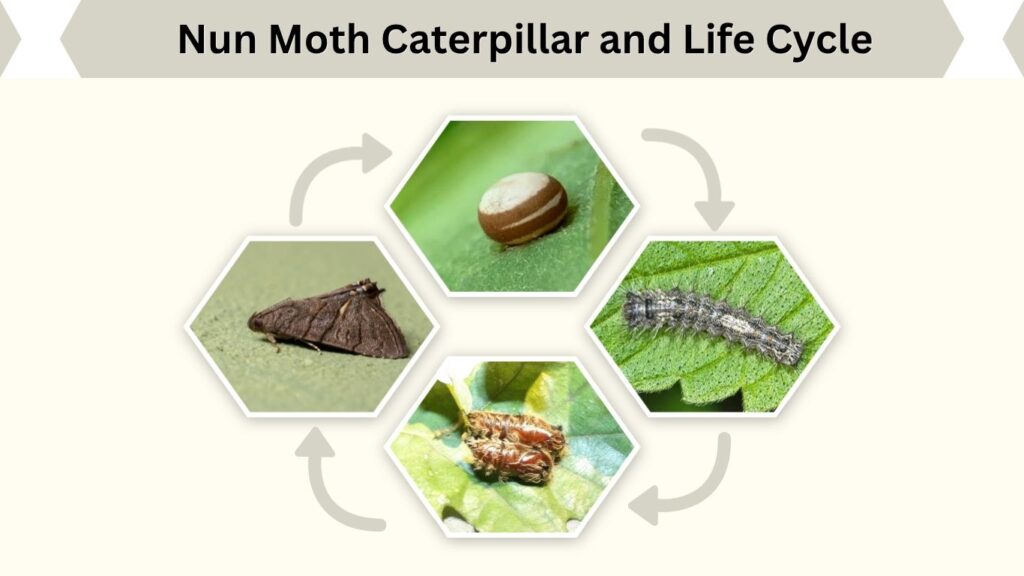
The adult moth does not cause forest defoliation. The caterpillar is the damaging stage, feeding directly on needles and leaves.
Mature larvae generally reach approximately 30–35 mm. Their bodies range from light to dark brown and carry black and white hairs, dark dorsal markings, and several colored glandular structures.
Eggs and Larvae
Nun moth eggs are about 1 mm across. They begin orange-brown or purplish and become darker with age.
Females typically place eggs in protected bark crevices. Young larvae emerge and feed on tender foliage, while older larvae are capable of consuming older needles and leaves.
What Do Nun Moth Caterpillars Eat?
Conifers are particularly important hosts. Preferred trees include spruce (Picea), larch (Larix), fir (Abies), pine (Pinus), and Douglas-fir (Pseudotsuga).
Larvae can also feed on deciduous trees including oak, birch, maple, beech, elm, cherry, apple, and others.
Nun Moth Habitat
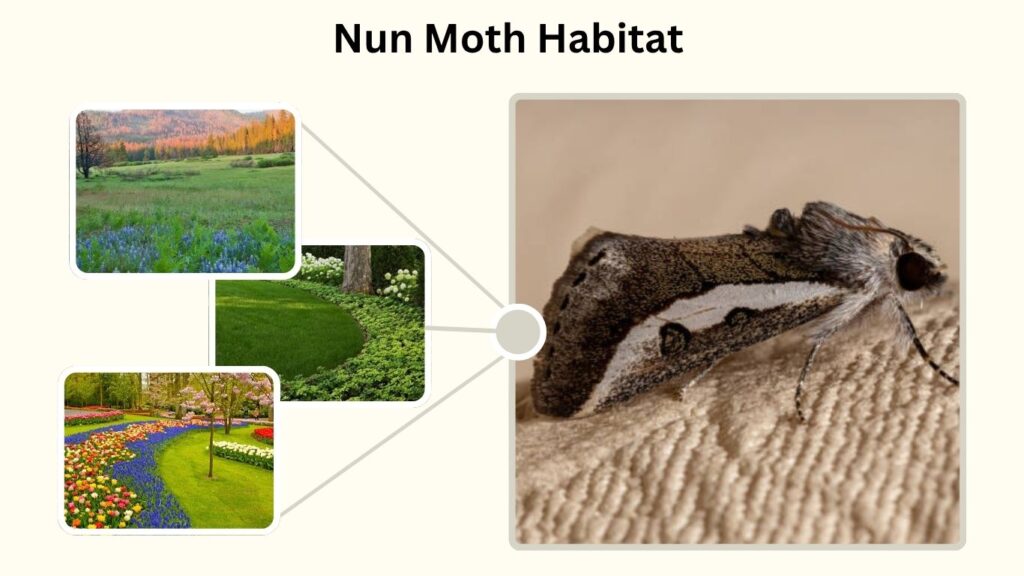
The habitat of the nun moth is strongly associated with wooded environments containing suitable host trees. Coniferous and mixed forests provide both food for caterpillars and suitable bark surfaces for egg laying.
Large forest stands dominated by spruce or pine may be particularly vulnerable during outbreaks.
Where Does the Nun Moth Live?
The species occurs throughout a broad Palearctic range. Current records include numerous European countries as well as Russia, Türkiye, China, Japan, North Korea, and South Korea.
Its distribution largely follows areas where appropriate forest hosts and climatic conditions are available.
Where Is the Nun Moth Native?
The native range of the nun moth covers Europe and substantial parts of temperate Asia. It is therefore not inherently invasive within most of this natural Eurasian distribution.
FAO records its native distribution as Europe and Asia-Pacific regions and notes no established introduced range in its summary.
Is the Nun Moth Found in North America?
The nun moth is not known to be established in North America. Canada treats it as a regulated plant pest because an introduction could threaten forests.
Research by the U.S. Forest Service has also shown that several North American conifers and broadleaf trees could support its development if it became established.
Is the Nun Moth Invasive?
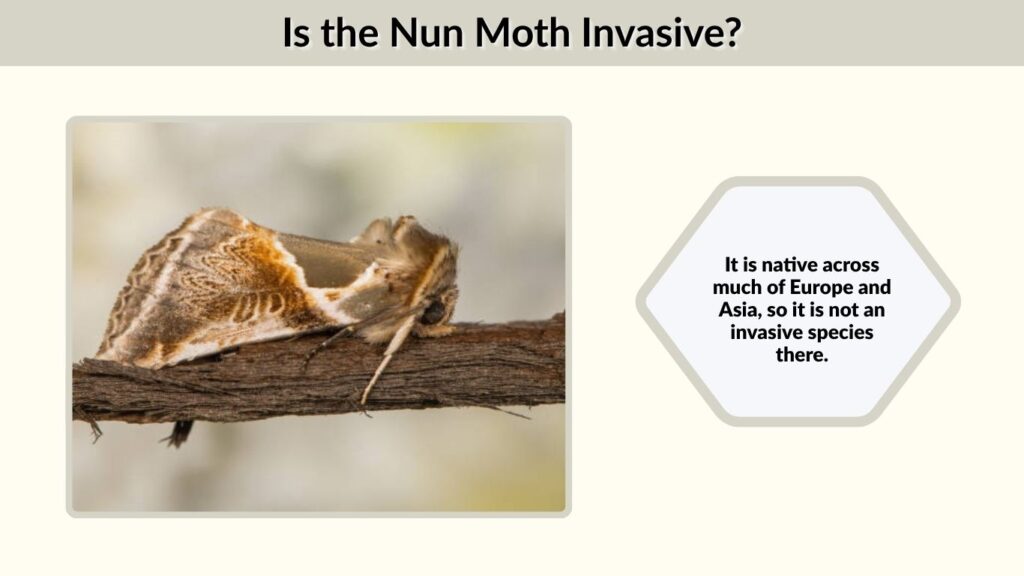
Calling the nun moth “invasive” requires geographic context. It is native across much of Europe and Asia, so it is not an invasive species there.
However, it represents an important invasive-species risk to North America because its caterpillars can survive on numerous economically and ecologically important trees. It can also be transported accidentally with wood products, containers, ships, and other international cargo.
Why Is an Introduction a Concern?
An established population could potentially spread through suitable forests and attack several native tree species.
The broad host range is particularly concerning. Experimental work has demonstrated successful survival or development on multiple North American spruces, firs, hemlocks, oaks, birches, cherries, and other trees.
What Does the Nun Moth Do Environmentally?
At normal population levels, the nun moth is simply one component of Eurasian forest ecosystems. Its larvae consume foliage and, in turn, participate in forest food webs.
The situation changes during major outbreaks. Heavy feeding can thin tree crowns, cause reddish-brown discoloration, and remove a large proportion of foliage. Repeated severe defoliation can weaken or kill trees.
Forest Damage
Spruce and pine forests can experience particularly serious damage. Young larvae often prefer new foliage, while older larvae can consume both new and older material.
Large outbreaks therefore have the potential to alter forest health and increase stress on affected trees.
Nun Moth Predators and Natural Control
Nun moth populations do not increase indefinitely. Natural mortality occurs throughout the egg, caterpillar, pupal, and adult stages.
Parasitoid insects and other natural enemies can attack moth larvae, while broader forest predators also contribute to population regulation. Environmental conditions and food availability further influence whether populations remain low or develop into damaging outbreaks.
FAQs
What is the scientific name of the nun moth?
The scientific name is Lymantria monacha.
Where is the nun moth originally from?
It is native to a broad region covering much of Europe and temperate parts of Asia.
What color is a nun moth?
Most have white or pale gray forewings covered with dark wavy markings, although darker gray-brown and nearly black forms also occur.
Where is the nun moth invasive?
It is primarily regarded as a potential invasive threat outside its Eurasian native range. It is not known to be established in North America and is regulated as a plant pest in Canada.
Are male and female nun moths different?
Yes. Females are generally larger and have short saw-like antennae, while males are smaller and have strongly feathered antennae.