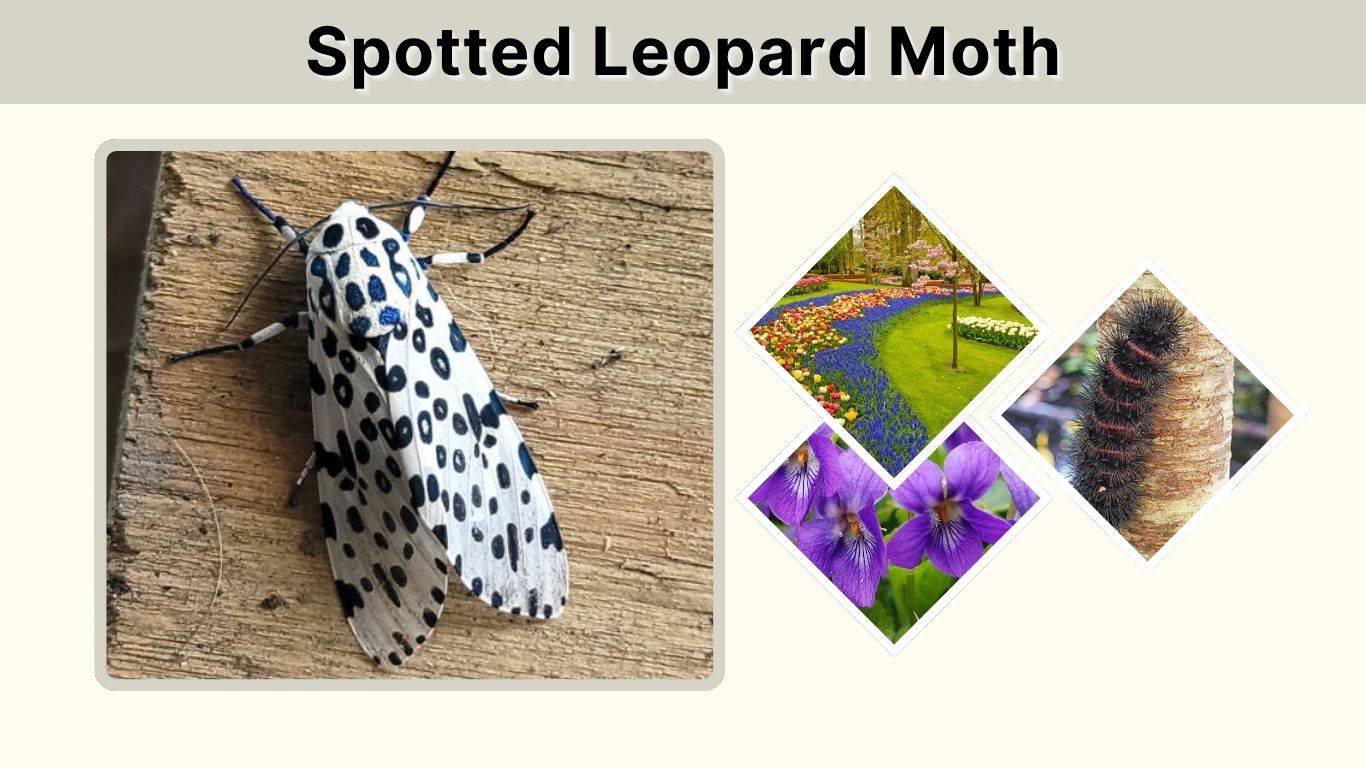
The spotted leopard moth is usually a search name for the giant leopard moth or great leopard moth (Hypercompe scribonia), a striking North American moth recognized by its bright white wings covered with black or bluish-black spots and rings. Its fuzzy black caterpillar looks completely different from the adult and can reveal reddish-orange bands when it curls up. Despite its dramatic appearance, this moth is generally harmless and is not considered an important plant pest. Understanding its appearance, caterpillar, habitat, diet, and similar-looking insects makes identification much easier.
What Is a Spotted Leopard Moth?
The name “spotted leopard moth” commonly refers to Hypercompe scribonia. More established common names include giant leopard moth, great leopard moth, and eyed tiger moth. It belongs to the tiger moth subfamily Arctiinae within the family Erebidae. Its bold black-and-white pattern makes the adult one of the easier moths to recognize.
Scientific Classification
- Scientific name: Hypercompe scribonia
- Family: Erebidae
- Subfamily: Arctiinae
- Order: Lepidoptera
- Common names: Giant leopard moth, great leopard moth, eyed tiger moth
- Wingspan: About 57–91 mm
Its large size and leopard-like markings are responsible for its common name.
Is It Really a Leopard Moth?
Yes, but “spotted leopard moth” is not usually treated as the primary standardized common name for this species. If you see a large white moth with leopard spots in eastern or central North America, the giant leopard moth is one of the strongest possibilities.
Identification should still be based on appearance and location rather than the common name alone.
What Does a Spotted Leopard Moth Look Like?
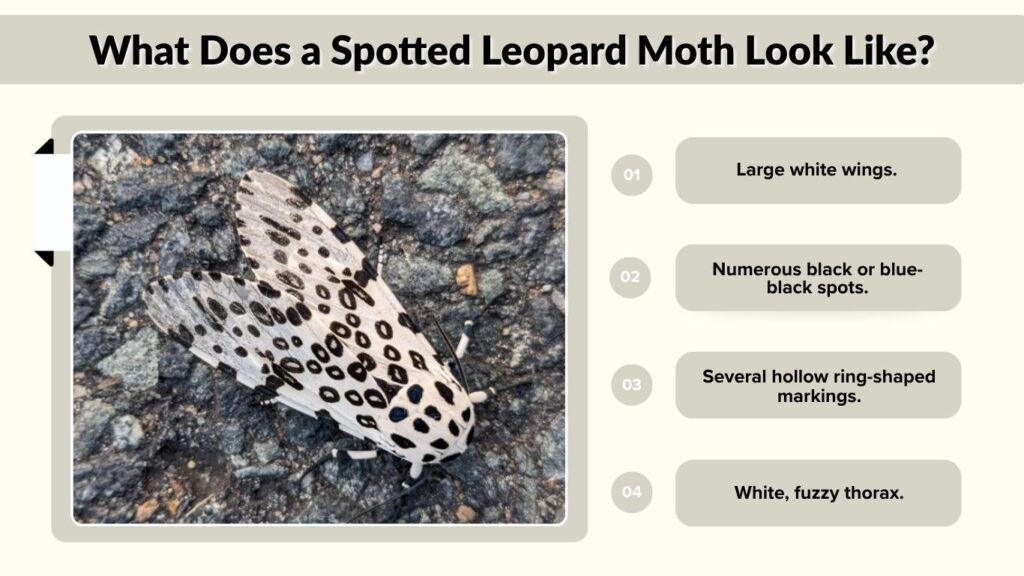
The adult is distinctive because its wings are mostly white with numerous dark spots and hollow rings. Some markings may appear blue-black or slightly metallic. The thorax is also white with dark markings, while the abdomen can show striking blue and orange coloration when the wings move apart.
Spotted Leopard Moth Identification
Look for these characteristics:
- Large white wings
- Numerous black or blue-black spots
- Several hollow ring-shaped markings
- White, fuzzy thorax
- Blue-black markings on the body
- Orange markings on parts of the abdomen
- Black-and-white banded legs
- Wingspan that can approach 9 cm
Butterflies and Moths of North America describes the forewings as white with hollow bluish-black spots, one of the species’ most recognizable features.
Black and White Spotted Leopard Moth
From a distance, the moth may appear simply black and white. Close inspection often reveals that some dark spots have bluish or iridescent tones.
The hollow circles are particularly useful for identification because they create the characteristic “leopard spot” pattern.
Spotted Leopard Moth Caterpillar
The spotted leopard moth caterpillar looks dramatically different from the adult. It is a large, black, hairy caterpillar sometimes described as a type of woolly bear. Mature caterpillars have dense, stiff black hairs covering their bodies.
When disturbed, they commonly curl into a tight ball.
What Does the Caterpillar Look Like?
Identification features include:
- Mostly black body
- Dense black bristles
- Large size when mature
- Reddish or orange bands between body segments
- Bands become especially visible when the caterpillar curls
- Cylindrical, woolly-bear appearance
BugGuide reports that mature larvae can reach around 75 mm and typically roll up when disturbed. University of Maryland sources also describe the caterpillar as large and black with red bands and shiny black bristles.
Are Giant Leopard Moth Caterpillars Dangerous?
They may look intimidating, but giant leopard moth caterpillars are not considered major pests. University of Maryland notes that they have a wide range of host plants but are generally of no economic importance and normally require no control.
It is still sensible to avoid unnecessarily handling hairy caterpillars, especially if you have sensitive skin.
What Do Spotted Leopard Moth Caterpillars Eat?
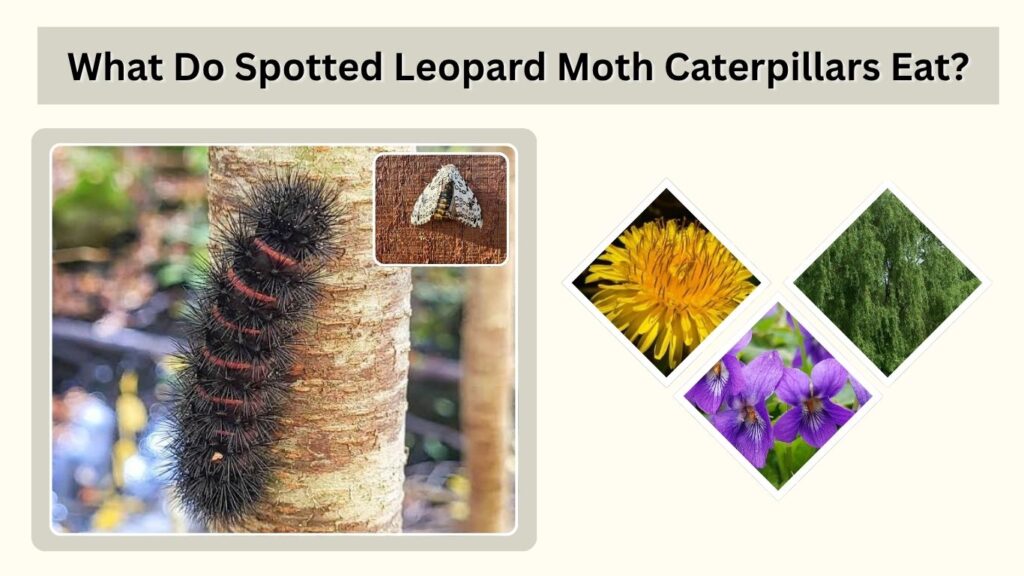
Giant leopard moth caterpillars are generalist plant feeders. Rather than relying on one specific host, they can eat the leaves of many different broadleaf plants.
This flexible diet helps explain why the species can occur in gardens, woodland edges, yards, and other vegetated environments.
Common Host Plants
Recorded hosts include:
- Dandelion
- Violet
- Willow
- Maple
- Cherry
- Sunflower
- Cabbage
- Citrus
- Honeysuckle
- Various garden plants
Butterflies and Moths of North America records a broad range of larval hosts, while University of Maryland similarly notes feeding on many broadleaf plants.
Do They Damage Gardens?
Individual caterpillars may chew leaves, but giant leopard moth larvae are generally not considered economically significant pests.
Seeing one caterpillar on a garden plant usually does not justify insecticide treatment.
Spotted Leopard Moth Habitat and Range
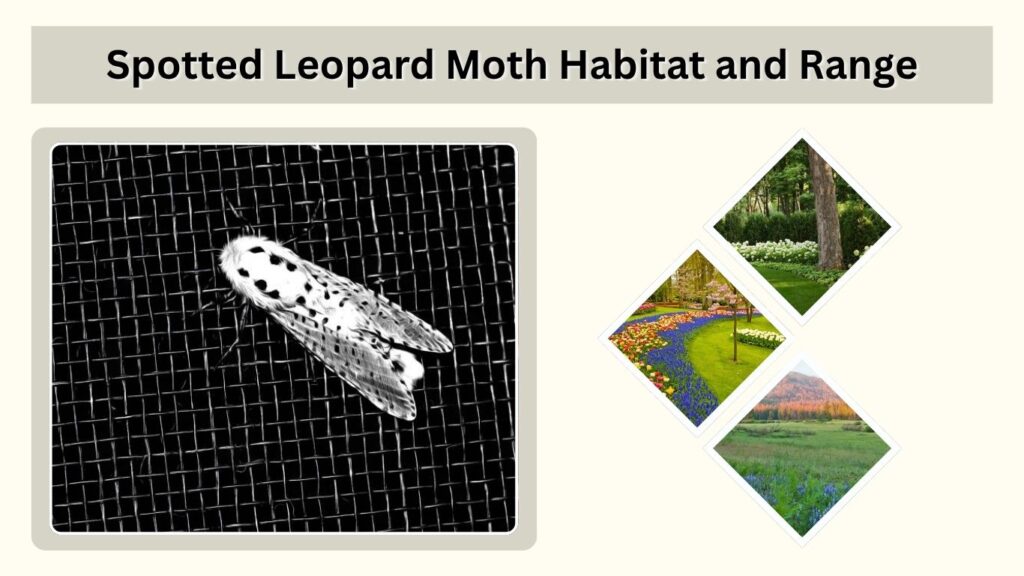
Giant leopard moths occupy a broad range across eastern and parts of central North America. They can occur in gardens, woodland margins, open areas, and places where caterpillar host plants are available.
Adults are nocturnal and may sometimes be noticed around outdoor lights.
Where Are Giant Leopard Moths Found?
Verified range information includes areas from southern Canada and the northeastern United States south to Florida and west into parts of the central United States and Texas.
Suitable habitats often include:
- Gardens
- Meadows
- Woodland edges
- Parks
- Shrubby areas
- Residential yards
- Areas containing broadleaf plants
The caterpillars may also spend colder periods in protected leaf litter or loose soil. Illinois Extension reports encountering larvae among fallen leaves during fall and spring.
Spotted Leopard Moth Life Cycle
Like other moths, the giant leopard moth undergoes complete metamorphosis. Its life cycle includes egg, larva, pupa, and adult stages.
The caterpillar is the feeding and growing stage, while the adult’s main role is reproduction.
Four Life Stages
- Egg: Females lay eggs that eventually hatch into small caterpillars.
- Larva: Caterpillars feed on various broadleaf plants and grow through several molts.
- Pupa: Mature larvae form protective cocoons and transform.
- Adult: The white-and-black spotted moth emerges, mates, and begins another generation.
Adults are most commonly recorded during the warmer months, although timing varies by climate and latitude. Butterflies and Moths of North America lists a flight period from roughly April through September across its reported range.
Giant Spotted Leopard Moth
Searches for giant spotted leopard moth generally refer to the same species, Hypercompe scribonia. “Giant” is appropriate because this is a fairly large tiger moth, with a wingspan reaching approximately 91 mm.
The combination of large size and white wings covered with dark rings makes the adult difficult to confuse with most ordinary household moths.
White Moth With Leopard Spots
If you see a white moth with black leopard-like spots, look for hollow black rings rather than only solid dots.
Those markings strongly support giant leopard moth identification within its normal geographic range.
However, another species called the wood leopard moth can look somewhat similar. University of Maryland notes that the native giant leopard moth tends to show open black rings, whereas the wood leopard moth has more closed black spots.
Leopard Moth vs. Spotted Lanternfly
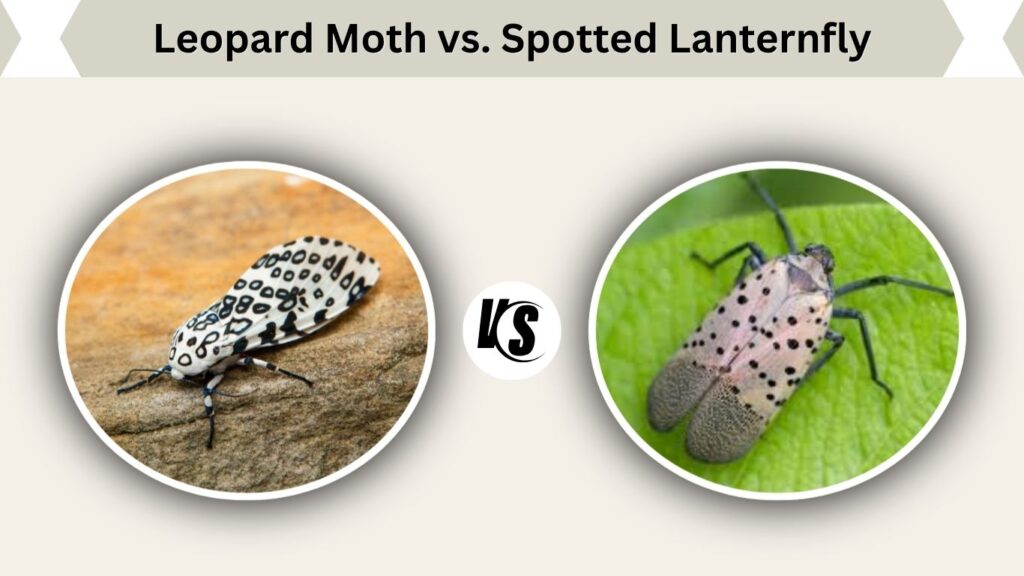
The giant leopard moth and spotted lanternfly are completely different insects, despite both having spotted wings.
The giant leopard moth is a moth in the order Lepidoptera. The spotted lanternfly (Lycorma delicatula) is an invasive planthopper that feeds on plant sap.
Key Differences
| Feature | Giant Leopard Moth | Spotted Lanternfly |
| Main color | White with black spots | Brownish-gray with black spots |
| Hindwings | Mostly pale/white | Bright red and black |
| Insect type | Moth | Planthopper |
| Caterpillar stage | Yes | No; develops through nymphs |
| Plant impact | Generally minor | Important invasive plant pest |
| Scientific name | Hypercompe scribonia | Lycorma delicatula |
Adult spotted lanternflies have light-brown spotted forewings and conspicuous scarlet hindwings, making them quite different once the wings are opened.
Should You Get Rid of a Spotted Leopard Moth?
Usually, no control is necessary. Giant leopard moths are native insects, and their caterpillars generally do not cause economically important plant damage.
If you find an adult around your home, it can usually be allowed to leave naturally or gently moved outdoors if necessary. Caterpillars encountered in gardens can normally be left alone..
FAQs
What is a spotted leopard moth?
The term usually refers to the giant leopard moth, Hypercompe scribonia, a large white tiger moth covered with distinctive black or bluish-black spots.
What does a spotted leopard moth caterpillar look like?
It is a large black, hairy caterpillar with stiff bristles. When it curls up, reddish-orange bands between its body segments become visible.
Is a giant spotted leopard moth dangerous?
No. The adult moth is not dangerous to people, and its caterpillar is generally not considered an economically important pest.
What does a white moth with leopard spots mean?
A large white moth covered with dark hollow spots in North America may be a giant leopard moth. Location, size, and wing markings should be considered for accurate identification.
Is a leopard moth the same as a spotted lanternfly?
No. A giant leopard moth is a true moth, while a spotted lanternfly is an invasive planthopper. They differ in appearance, biology, life cycle, and effects on plants.