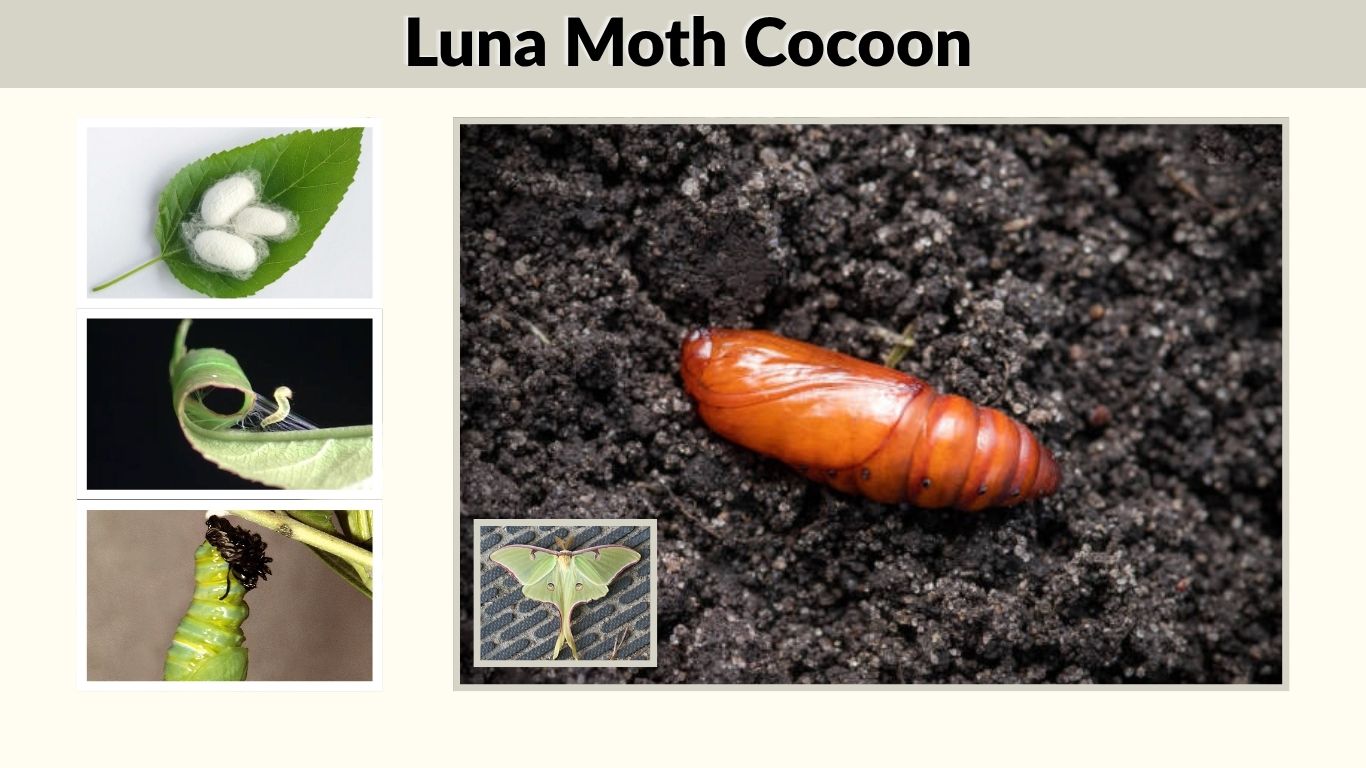
A luna moth cocoon is the protective silk covering created by a mature luna moth caterpillar before it changes into a pupa. The cocoon is usually brown, papery, irregularly shaped, and wrapped inside one or more leaves. It often falls into leaf litter, where its appearance provides camouflage. Depending on season and climate, the adult moth may emerge within several weeks or remain inside throughout winter.
Luna Moth Cocoon Quick Facts
| Feature | Description |
| Scientific name | Actias luna |
| Family | Saturniidae |
| Cocoon material | Silk combined with leaves |
| Typical color | Tan, brown, or reddish brown |
| Location | Leaf litter beneath host trees |
| Stage inside | Pupa |
| Summer duration | Commonly 10–28 days |
| Winter duration | Several months until spring |
| Adult emergence | Usually during the morning |
| Adult lifespan | Approximately one week |
Luna moths undergo complete metamorphosis through egg, caterpillar, pupa, and adult stages. The cocoon itself is not the pupa; it is the silken outer covering that protects the pupa developing inside.
What Does a Luna Moth Cocoon Look Like?
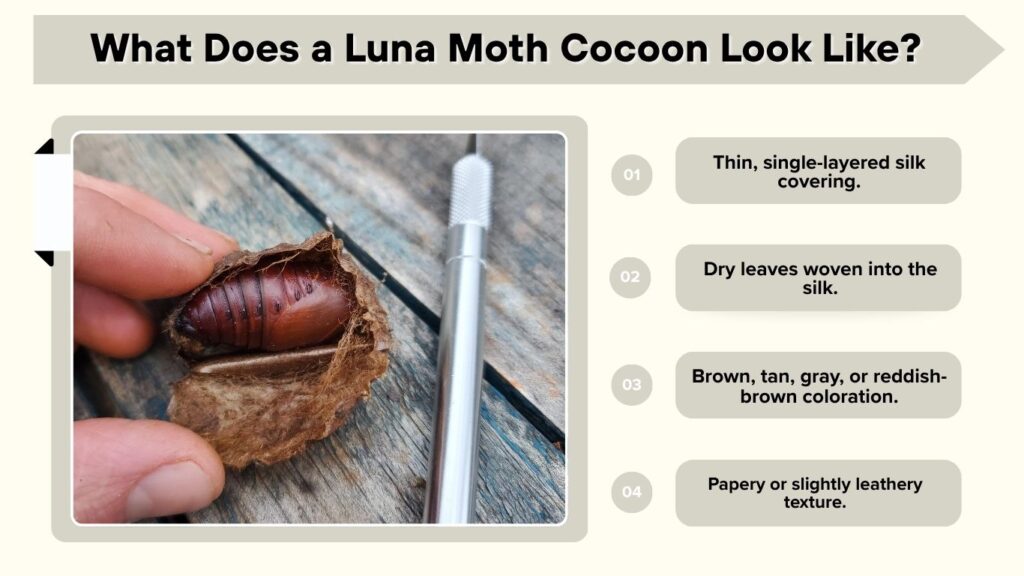
A luna moth cocoon normally looks like a dry leaf folded or loosely wrapped around a thin silken case. It may be oval, elongated, or slightly irregular rather than perfectly smooth.
Identification Features
- Thin, single-layered silk covering
- Dry leaves woven into the silk
- Brown, tan, gray, or reddish-brown coloration
- Papery or slightly leathery texture
- Usually found on or near the ground
- Commonly hidden among fallen leaves
- Roughly large enough to hold a thick, mature caterpillar
- May make a rustling sound when gently moved
The cocoon is often spun while the caterpillar is among leaves on its host plant. Because it is not firmly attached to a twig, it frequently falls when the leaf drops and remains camouflaged on the forest floor.
Is a Luna Moth Cocoon Green?
A mature luna moth cocoon is usually not bright green. A newly formed cocoon may contain fresh green leaves, making, making the entire structure look green temporarily. As the leaves dry, it normally becomes brown.
A smooth, exposed, bright-green pupa without a silken leaf covering may belong to another moth or butterfly. Luna moths characteristically form a papery silk cocoon containing leaf masearch6
How a Luna Moth Caterpillar Makes Its Cocoon
A fully grown luna moth caterpillar stops feeding and begins searching for a protected pupation site. Its green color may change to reddish brown shortly before cocoon construction earch11
The caterpillar then:
- Selects a dry or living leaf near its host plant.
- Produces silk from glands near its mouth.
- Pulls surrounding leaves around its body.
- Creates a thin silk chamber inside the leaves.
- Sheds its caterpillar skin and becomes a dark-brown pupa.
Inside the cocoon, the pupa is secured to a silk pad by small hooked structures called a cremaster. This helps stabilize the insect during transformation and adult emesearch1
Luna Moth Cocoon Stages
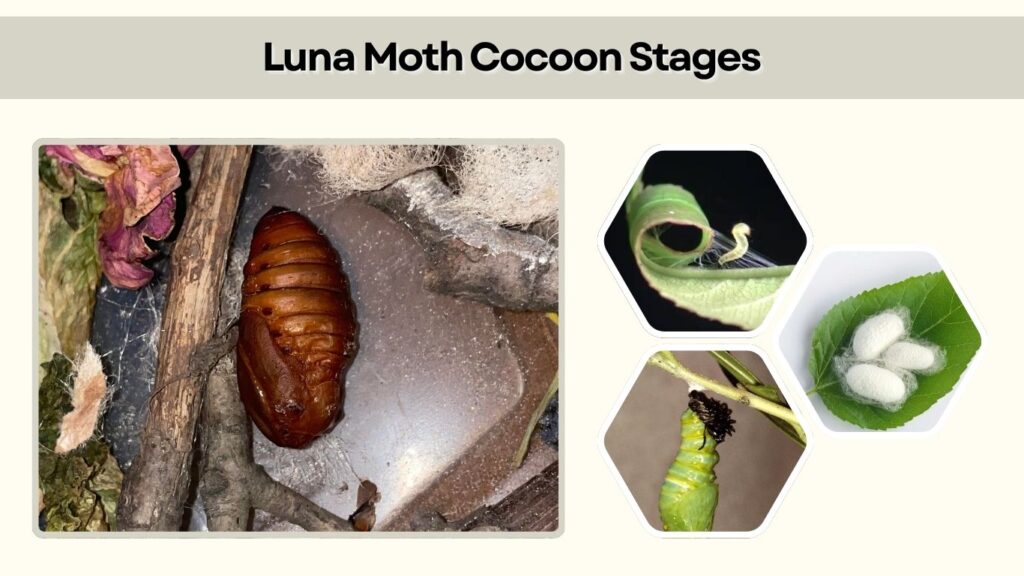
The visible cocoon changes relatively little, but the insect inside undergoes a complete transformation.
1. Cocoon Construction
The caterpillar wraps itself in leaves and produces silk around its body. A newly completed cocoon may feel soft, but it gradually dries and becomes firmer.
2. Pupa Formation
Inside the cocoon, the caterpillar sheds its final larval skin and becomes a pupa. Wings, legs, antennae, and the adult body develop during this stage.
3. Diapause or Active Development
Summer pupae may continue developing and emerge during the same season. Late-season pupae can enter diapause, a dormant state that allows them to survive winter.
4. Adult Emergence
The adult splits the pupal case and cuts through the cocoon with specialized serrated structures near the bases of its front wings. It then crawls to a suitable surface where it can hang vertically and expand itssearch7
How Long Does a Luna Moth Stay in Its Cocoon?
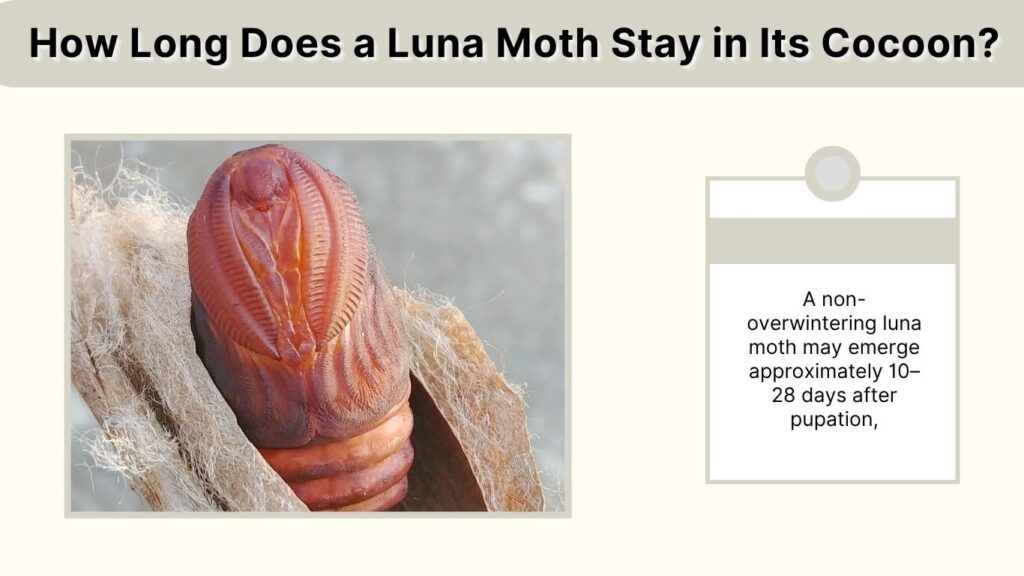
A luna moth’s cocoon time depends primarily on season, temperature, daylight length, and geographic location.
A non-overwintering luna moth may emerge approximately 10–28 days after pupation, although three to four weeks is also commonly reported. A late-season cocoon may remain dormant throughout winter and not hatch until temperatures rise in search1
| Cocoon type | Approximate duration |
| Warm-season cocoon | About 2–4 weeks |
| Late fall cocoon | Several months |
| Overwintering cocoon | Until the following spring |
| Exact timing | Varies by region and weather |
Northern populations usually produce one generation annually, while populations farther south may produce two or three. Therefore, a summer cocoon in a warm region is more likely to hatch during the same year than a late-season cocoon in a northersearch2
When Do Luna Moth Cocoons Hatch?
Adult emergence commonly occurs in spring or summer, but the precise month differs across the species’ range. Northern luna moths generally emerge once each year, while southern populations can have multiple emergence psearch6
The moth typically emerges in the morning. Its wings initially look small, soft, and wrinkled. It must climb and hang vertically while fluid is pumped through the wing veins. The expanded wings then need several hours to dry and harden before the moth can fly that eearch11
How to Care for a Luna Moth Cocoon
A wild cocoon is usually safest when left where it was found. Leaf litter provides camouflage, insulation, moisture balance, and protection from sudden temperature csearch9
When a cocoon must be moved because it is on a road, lawn-mowing area, or another dangerous surface:
- Handle it as little as possible.
- Keep the surrounding leaf material intact.
- Place it in a sheltered, ventilated container.
- Protect it from direct sunlight and standing water.
- Keep it under natural seasonal conditions.
- Provide twigs or mesh for the emerging moth to climb.
- Leave enough vertical space for its wings to expand fully.
- Do not cut open the cocoon or try to pull the moth out.
Late-season cocoons should not be kept continuously in a heated room because warmth may cause premature winter emergence. Outdoor conditions appropriate to the moth’s local climate allow diapause and spring emergence to occur natsearch3
Is My Luna Moth Cocoon Dead?
A luna moth pupa may move or produce a faint rustling sound when the cocoon is gently shifted. This movement is a positive sign of life, but a motionless cocoon is not necessarily dead. Pupae naturally remain inactive for long periods, especially during winter diearch19
Possible warning signs include severe damage, persistent mold spreading through the cocoon, leaking fluid, or a strong decaying odor. Avoid repeatedly squeezing, shaking, opening, or testing the cocoon, as unnecessary handling can damage the developing moth.
A long waiting period is normal for an overwintering cocoon. It may remain unchanged for months before emerging when seasonal conditions become suitable.
Luna Moth Cocoon vs Polyphemus Moth Cocoon
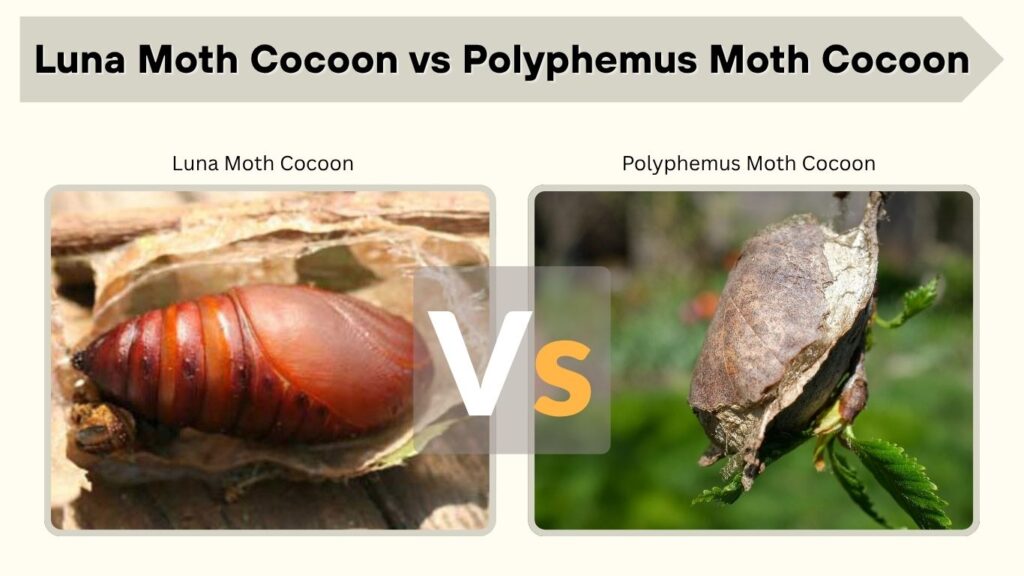
Luna and polyphemus moth cocoons can both be brown, oval, and wrapped in leaves.
| Feature | Luna moth cocoon | Polyphemus moth cocoon |
| Structure | Thin and papery | Usually thicker and tougher |
| Leaf attachment | Often loosely wrapped | Leaf often tightly incorporated |
| Final location | Commonly leaf litter | Leaf litter or attached vegetation |
| Adult moth | Green with long tails | Brown with large eyespots |
Cocoon identification alone can be difficult. Location, host tree, cocoon structure, size, and any nearby caterpillar photographs provide useful clues.
Luna Moth Cocoons for Sale
Live luna moth cocoons are sometimes sold for educational rearing. Before purchasing, confirm that the seller provides captive-bred stock rather than wild-collected cocoons.
Buyers should also check local regulations because transporting live insects across state, provincial, or national borders may require permission. A cocoon obtained from a distant climate can emerge at the wrong seasonal time or introduce genetic stock outside its natural region.
FAQs
Where do luna moth caterpillars make cocoons?
They normally make cocoons among leaves on or beneath their host trees. The leaf-wrapped cocoon often falls to the ground and remains hidden in leaf litter.
How long do luna moths remain in cocoons?
Summer cocoons commonly hatch after approximately two to four weeks. Cocoons formed late in the season may overwinter for several months and emerge the following spring.
Should a luna moth cocoon be kept in a warm place?
An overwintering cocoon should not be forced with constant indoor heat. It normally requires natural seasonal conditions so the adult emerges at an appropriate time.
Why is my luna moth cocoon moving?
The pupa inside can wiggle when disturbed, causing a rustling sound. This is normal and indicates that the pupa is alive, but frequent handling should be avoided.
What should I do after a luna moth emerges?
Allow it to climb and hang freely so its wings can expand and harden. Do not touch the soft wings. Once the wings are fully developed, release the moth outdoors in suitable weather within its natie area.