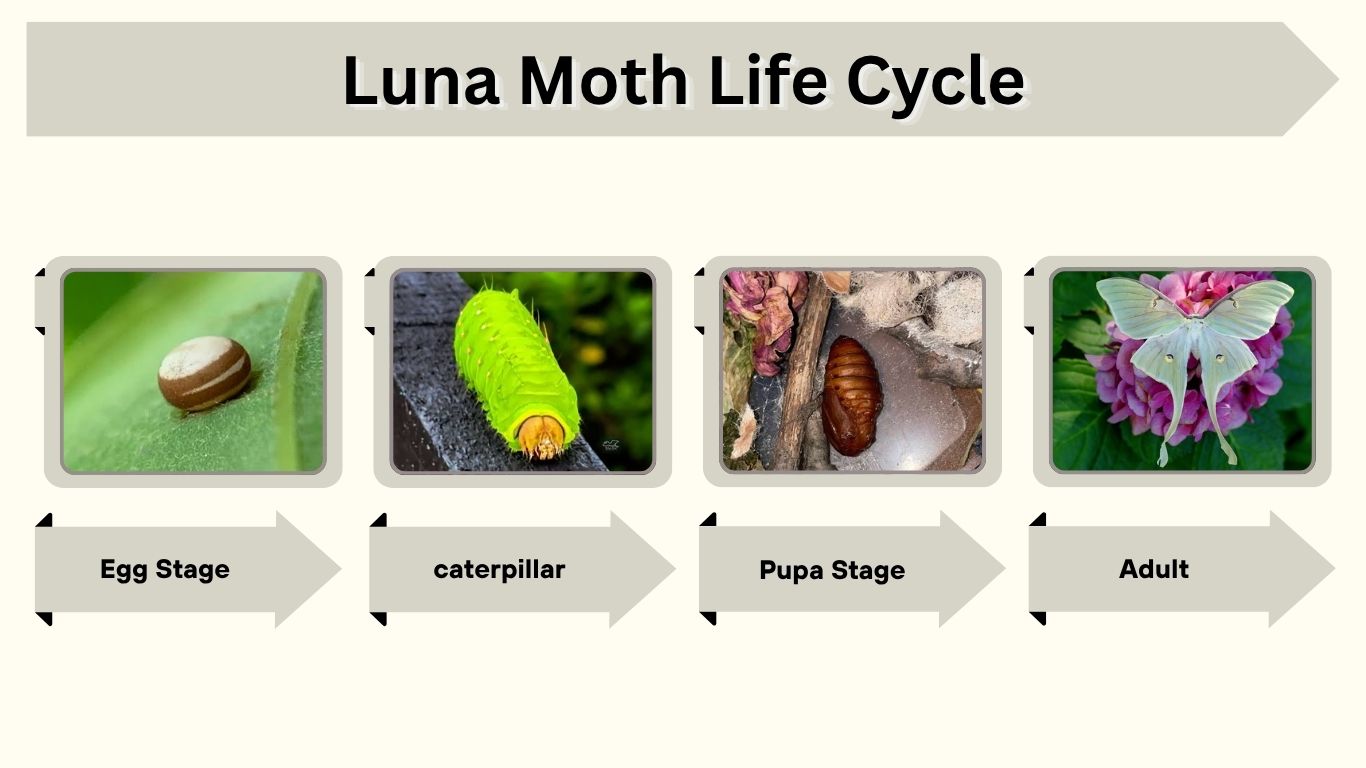
The luna moth life cycle has four stages: egg, caterpillar, pupa, and adult. Known scientifically as Actias luna, this large North American silk moth undergoes complete metamorphosis. Its eggs hatch into hungry green caterpillars, which pass through five growth stages before spinning leaf-wrapped cocoons. Adults emerge with pale-green wings but live only briefly because they cannot eat.
Luna Moth Life Cycle Timeline
The exact timeline depends on temperature, season, latitude, and whether the pupa enters winter dormancy.
| Life stage | Approximate duration | Main activity |
| Egg | 7–13 days | Embryo develops |
| Caterpillar | About 3–6 weeks | Feeds and grows through five instars |
| Pupa in cocoon | 10–28 days or several months | Transforms into an adult |
| Adult moth | About 4–10 days | Mates and lays eggs |
| Overwintering generation | May span much of a year | Pupa remains dormant until spring |
Warm-season pupae may develop into adults within several weeks. Late-season pupae usually enter diapause and remain inside their cocoons throughout winter, making the complete life-cycle length much longer.
Stage 1: Luna Moth Eggs
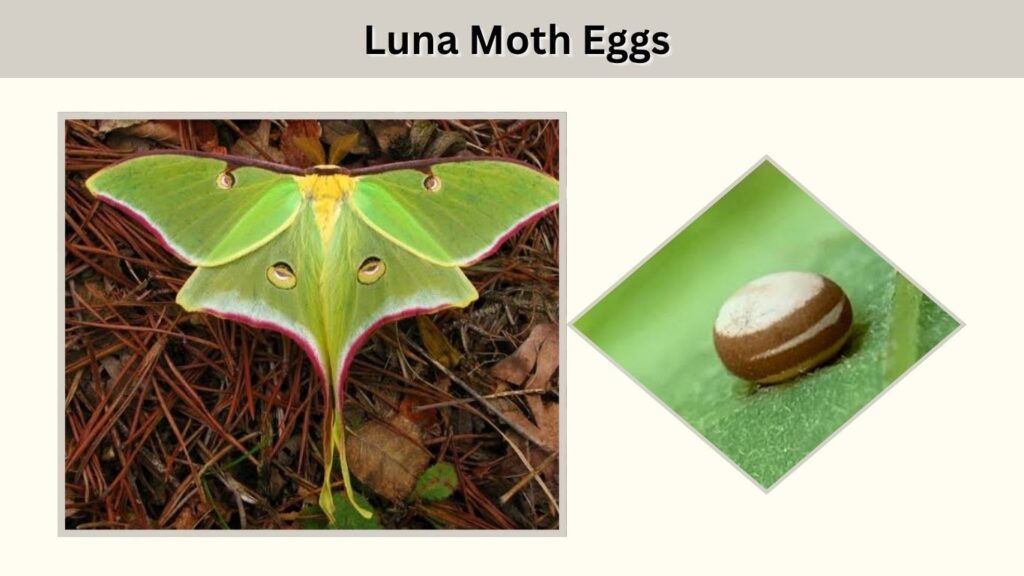
After mating, a female luna moth lays her eggs on suitable caterpillar host plants. Eggs may be deposited individually or in small clusters on the upper or lower surfaces of leaves. A female can produce several hundred eggs during her short adult life.
What Do the Eggs Look Like?
Luna moth eggs are:
- Slightly oval and flattened
- White, cream, or pale gray
- Mottled with brown adhesive
- Approximately 1.9 millimeters long
- Firmly attached to the host plant
- Sometimes darker shortly before hatching
The eggs generally hatch after 7–13 days. The newborn caterpillar may eat part of its eggshell before beginning to feed on leaves.
Stage 2: Luna Moth Caterpillar
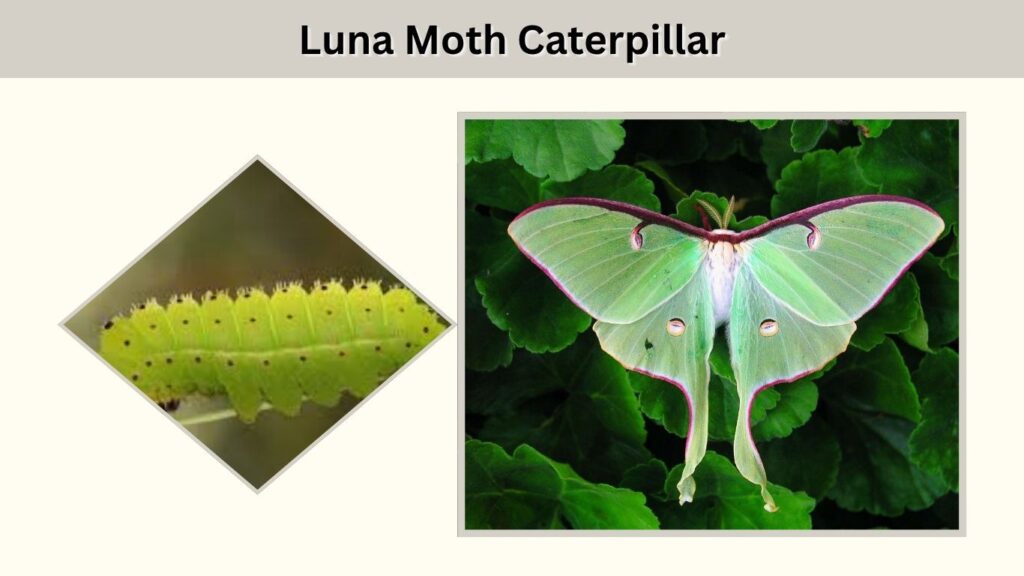
The caterpillar, or larva, is the feeding and growth stage. Newly hatched larvae are tiny, but mature caterpillars can reach approximately 55–70 millimeters, or about 2⅛–2¾ inches long.
Young caterpillars differ in appearance from mature ones. Full-grown larvae are usually bright green with yellowish lines, short white hairs, and reddish or pink spots along their body segments.
Luna Moth Caterpillar Instars
A luna moth caterpillar develops through five instars. An instar is the period between two molts. Because the caterpillar’s outer skin cannot expand indefinitely, it sheds that skin as it grows.
The five instars progress from a caterpillar only several millimeters long to a thick larva about the size of an adult finger. Development from hatching to pupation generally requires three to six weeks, although cooler temperatures can extend the process.
What Do Luna Moth Caterpillars Eat?
The caterpillars eat leaves from broadleaf trees and shrubs. Important host plants include:
- Hickory
- Walnut
- White birch
- Sweetgum
- Persimmon
- Sumac
- Pecan
- Black gum
Host preferences vary geographically. Northern populations frequently use white birch, while southern populations often use walnut, hickory, sweetgum, sumac, and persimmon.
When fully grown, the caterpillar stops feeding and begins wandering in search of a pupation site. Its green body may become reddish-brown shortly before it constructs a cocoon.
Stage 3: Cocoon and Pupa
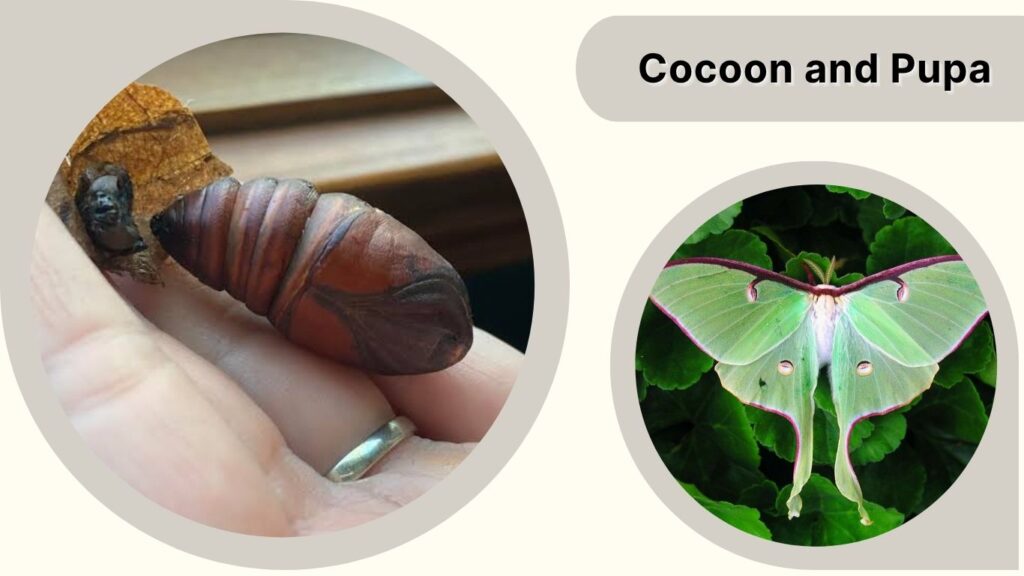
The mature caterpillar produces silk and wraps itself inside one or more leaves. The finished luna moth cocoon is usually thin, brown, papery, and irregularly shaped.
Inside the cocoon, the caterpillar sheds its final larval skin and becomes a pupa. The cocoon is the protective silk-and-leaf covering, while the pupa is the transforming insect inside it.
How Long Is the Pupal Stage?
Warm-season luna moths may emerge approximately 10–28 days after pupation. However, late-season pupae respond to shorter daylight periods by entering diapause, a dormant condition that lasts through winter. These moths normally emerge the following spring.
The cocoon often falls into leaf litter because it is wrapped in a leaf rather than firmly attached to a branch. Fallen leaves camouflage and insulate the pupa during winter. Removing all leaf litter beneath host trees can therefore remove overwintering luna moth cocoons.
Stage 4: Adult Luna Moth
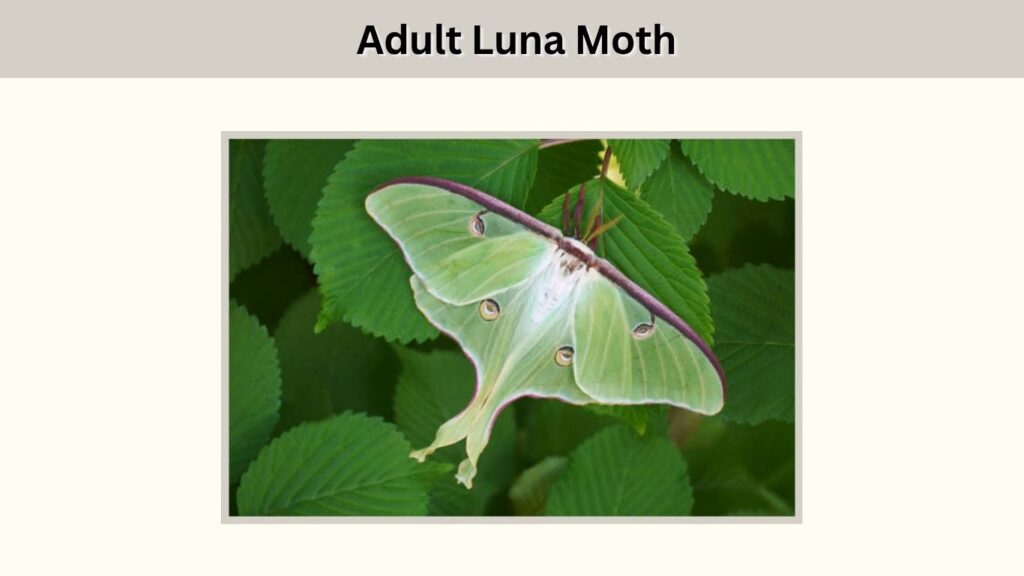
Adult emergence usually occurs in the morning. The moth splits its pupal case and cuts through the cocoon using specialized structures near the bases of its front wings.
The newly emerged moth initially has small, soft, wrinkled wings. It must climb onto a vertical surface and hang while fluid expands the wings. The wings then dry and harden before the moth becomes active that evening.
What Does an Adult Luna Moth Look Like?
Adult luna moths have:
- Pale-green or yellow-green wings
- Transparent eyespots on all four wings
- Long, curved hindwing tails
- A fuzzy white body
- Pink, purple, reddish, or yellow wing margins
- A wingspan commonly measuring 75–105 millimeters
Males have broader, bushier antennae, while females usually have narrower antennae and fuller abdomens.
Adult Luna Moth Lifespan
An adult luna moth normally lives for only several days to approximately one week. Adults have vestigial mouthparts, so they cannot eat or replace the energy used during flight and reproduction.
The adult stage follows a short reproductive schedule:
- The moth emerges and expands its wings.
- The female releases pheromones at night.
- Males use their large antennae to locate her.
- Mating normally occurs after midnight.
- The female begins laying eggs the following evening.
- Both adults die after using their stored energy.
Females may continue laying eggs over several nights. Males are strong fliers and may travel considerable distances while following a female’s scent.
How Many Generations Occur Each Year?
The number of generations depends on climate:
| Region | Typical generations |
| Southern Canada and northernmost United States | One |
| Ohio Valley and nearby regions | Two |
| Southern United States | Up to three |
| Parts of Florida and Louisiana | Adults may occur in many months |
Northern luna moths commonly spend winter as dormant pupae and complete one generation annually. Warmer southern climates allow the egg-to-adult cycle to repeat several times in the same year.
Luna Moth Lifespan vs Adult Lifespan
The phrase “luna moth lifespan” can refer to two different periods.
The adult lifespan is only around four to ten days. The complete life cycle, beginning with the egg and ending after adult reproduction, lasts considerably longer. A summer generation may finish within several weeks, while an overwintering generation can span much of a year because the pupa remains dormant until spring.
FAQs
What are the four luna moth life stages?
The four stages are egg, caterpillar or larva, pupa inside a cocoon, and adult moth. This process is called complete metamorphosis because the caterpillar looks and behaves very differently from the winged adult.
How long does the luna moth life cycle take?
A warm-season generation may develop within several weeks, but timing varies with temperature. Late-season pupae enter diapause and remain inside their cocoons through winter, causing that generation’s complete cycle to span many months.
How long is a luna moth a caterpillar?
The caterpillar stage commonly lasts around three to six weeks. During this period, the larva passes through five instars, repeatedly molts, and consumes host-tree leaves to store the energy needed for pupation and adult reproduction.
How long does an adult luna moth live?
The adult generally survives for several days to about one week. It cannot eat because its mouthparts are nonfunctional. Stored energy from the caterpillar stage powers flight, mating, pheromone production, and egg laying.
At what stage does a luna moth survive winter?
Luna moths normally overwinter as pupae inside brown, leaf-wrapped cocoons. Short daylight periods trigger diapause in late-season caterpillars. The protected pupa remains dormant in leaf litter before the adult emerges during suitable spring weather.