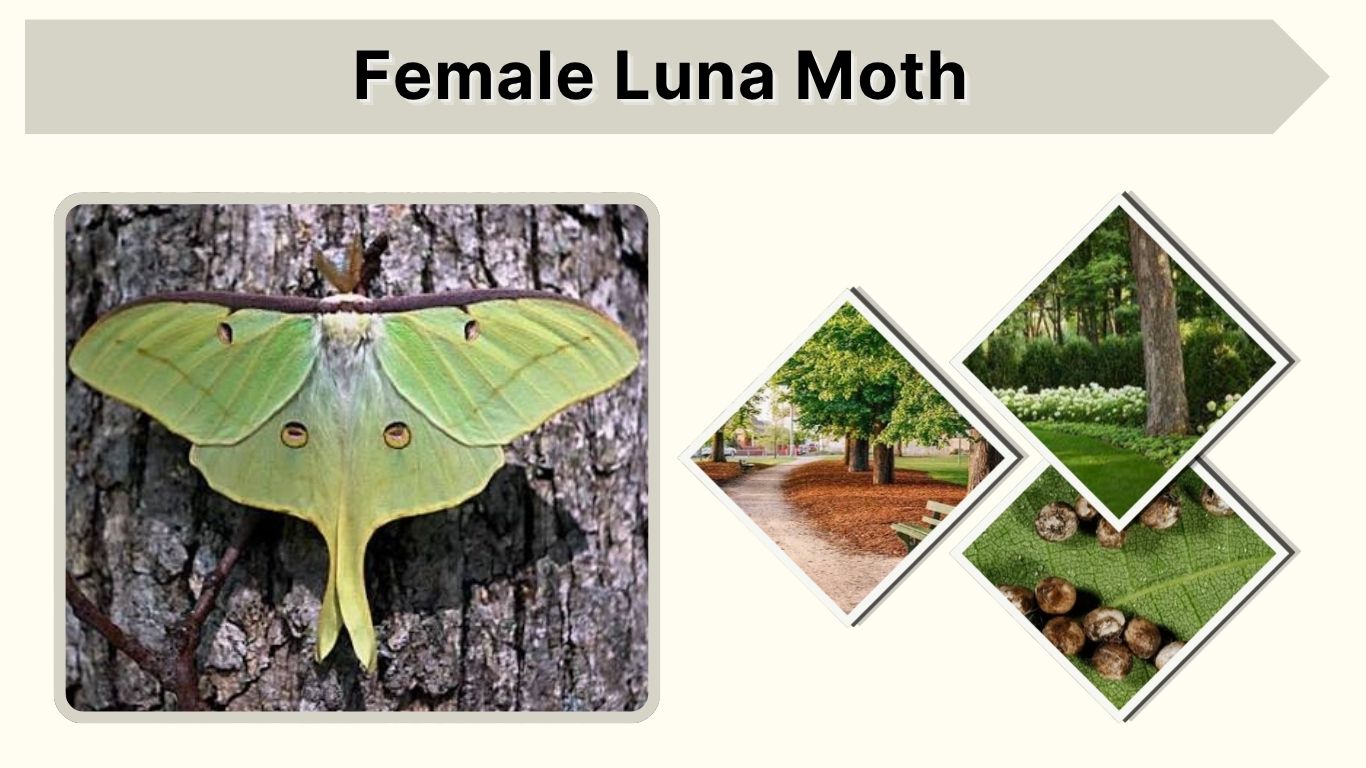
A female luna moth, Actias luna, is a large pale-green silk moth recognized by its long hindwing tails, transparent eyespots, narrow feathery antennae, and full abdomen. Females look similar to males, but the sexes can usually be separated by antenna width and body shape. The female’s primary adult role is to attract a mate and lay eggs because adult luna moths have reduced mouthparts and do not eat.
Female Luna Moth Quick Facts
| Feature | Description |
| Scientific name | Actias luna |
| Family | Saturniidae |
| Wingspan | About 3–4⅛ inches |
| Main color | Pale or blue-green |
| Antennae | Feathery but relatively narrow |
| Abdomen | Usually fuller than the male’s |
| Adult diet | Does not eat |
| Main adult activity | Mating and laying eggs |
| Adult lifespan | Several days to about one week |
| Danger to humans | Harmless |
Luna moths occur across forested portions of eastern North America, from southern Canada through the eastern United States and west into parts of the Great Plains and Texas.
What Does a Female Luna Moth Look Like?
Female luna moths have broad pale-green wings, one transparent eyespot on each wing, pinkish or yellowish wing margins, and a long curved tail extending from each hindwing. Their bodies are fuzzy, with pale thoracic hair and pinkish-purple legs. Adults have a wingspan of approximately 75–105 millimeters, or about 3–4⅛ inches.
Female Identification Features
- Narrow, comb-like antennae
- Large, rounded wings
- Pale green or blue-green coloration
- Transparent eyespots bordered by dark rings
- Long tails on the hindwings
- Thick or rounded abdomen
- Pink, purple, reddish, or yellow wing edges
- Fuzzy body and legs
Color should not be used alone to determine sex. UF/IFAS notes that females tend to be more blue-green and males more yellow-green, but season, locality, lighting, and individual variation can change their appearance.
Female vs Male Luna Moth
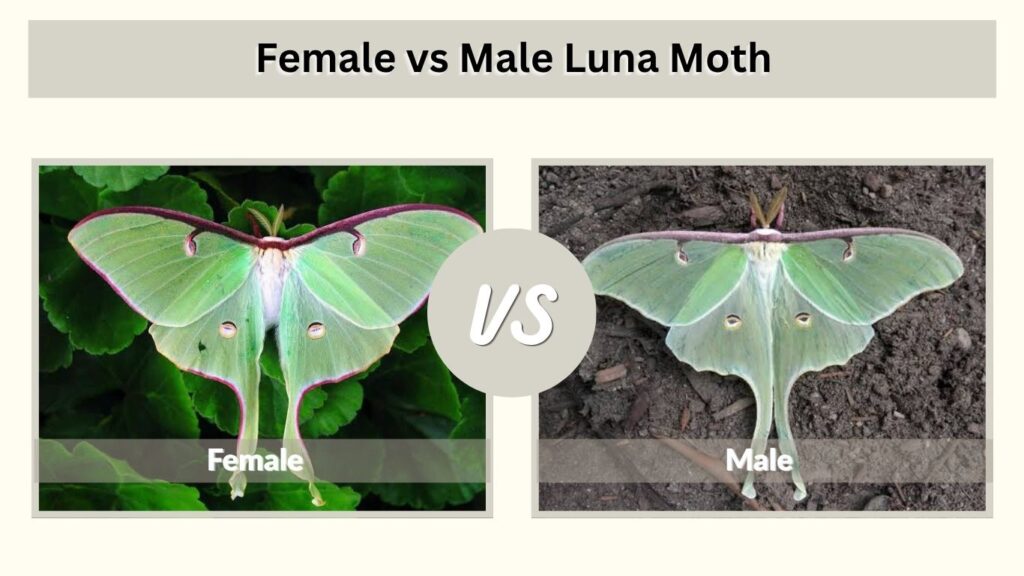
The antennae provide the quickest and most dependable way to distinguish a male and female luna moth.
| Feature | Female luna moth | Male luna moth |
| Antennae | Narrower and less bushy | Broad, heavily feathered |
| Abdomen | Fuller and more rounded | Slimmer |
| Size | Often slightly larger | Often slightly smaller |
| Color | Commonly blue-green | Commonly yellow-green |
| Behavior | Calls males and lays eggs | Flies in search of females |
| Egg laying | Yes | No |
Both sexes have comb-like antennae, but the male’s branches are considerably wider. The increased surface area contains scent receptors that help him detect the female’s mating pheromones.
Are Female Luna Moths Bigger Than Males?
Females are usually slightly larger and have noticeably fuller abdomens, particularly before laying their eggs. However, the difference is not always obvious because body size varies among individuals and populations. Antenna width is generally more reliable than overall size.
Female Luna Moth Antennae
The female’s antennae are feathery, but they look relatively thin and narrow compared with the male’s large, bushy antennae. Both are technically quadripectinate, meaning they have comb-like branches arranged along four sides.
Male antennae are adapted to locate the chemical signal released by a receptive female. A photograph taken from directly above the head usually provides the clearest view for sex identification.
Female Luna Moth Mating Behavior
A newly emerged female spends several hours expanding and drying her wings. Once mature, she releases sex-attractant chemicals called pheromones, usually while remaining perched on vegetation or another stable surface. Males fly upwind and follow the scent trail to find her.
Mating generally occurs after midnight and may last for several hours. Females typically begin laying eggs during the evening after mating and continue over several nights.
How Long Will a Female Wait to Mate?
There is no fixed waiting time for every female. A receptive female can begin releasing pheromones shortly after her wings have fully expanded and hardened. She may continue calling on later nights when a male does not arrive immediately.
Bright outdoor lighting can interfere with normal moth behavior by attracting or disorienting adults. Turning unnecessary exterior lights off during luna moth season can reduce this disturbance.
Female Luna Moth Laying Eggs
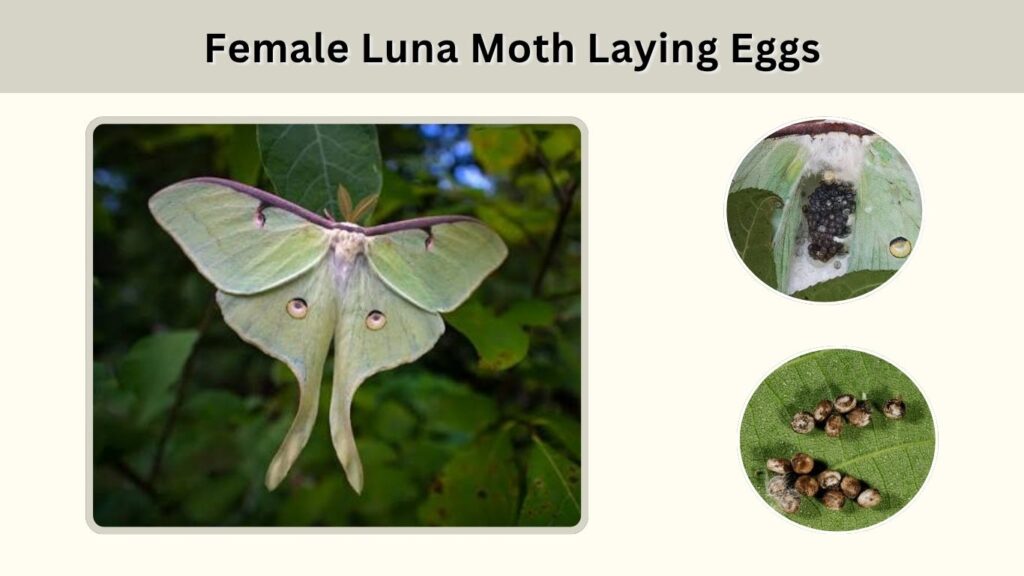
A female lays pale, slightly oval eggs either singly or in small groups. Eggs may be placed on the upper or lower surfaces of leaves belonging to suitable caterpillar host plants.
Common host trees include:
- Hickory
- Walnut
- Sweetgum
- White birch
- Persimmon
- Sumac
Plant preferences differ geographically. White birch is particularly important in northern areas, while walnuts, hickories, sweetgum, persimmon, and sumac are frequently used farther south.
A female can lay hundreds of eggs during her brief life. The eggs commonly hatch after approximately one week, although temperature and local conditions affect development.
Do Females Die After Laying Eggs?
Female luna moths do not necessarily die immediately after depositing the first eggs. They may lay eggs over several nights before exhausting their stored energy. Because adults cannot feed, their lives are naturally brief and devoted almost entirely to reproduction.
Female Luna Moth Habitat
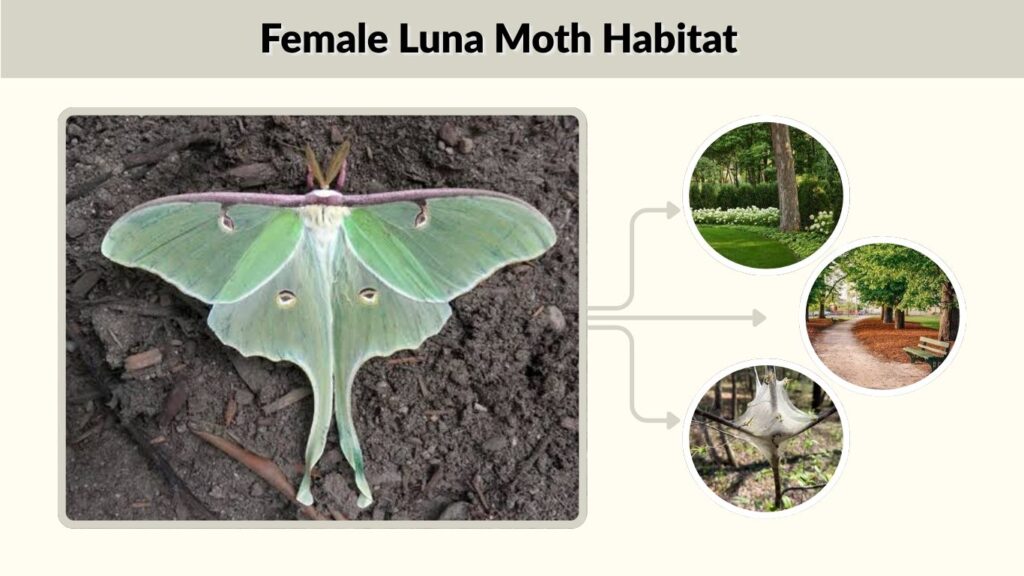
Female luna moths are usually associated with deciduous forests, woodland edges, parks, and yards containing suitable caterpillar host trees. Adults are nocturnal and may be found resting on tree trunks, walls, screens, or vegetation during daylight.
Artificial lights sometimes attract both sexes, although males may appear more frequently because they fly greater distances while searching for females. Luna moths are strong fliers, but a female ready to mate may remain relatively still while releasing pheromones.
Female Luna Moth Life Cycle
A female passes through the same four developmental stages as a male:
- Egg: The egg develops on a suitable host plant and usually hatches in about a week.
- Caterpillar: The green larva feeds alone and grows through five instars.
- Pupa: The mature caterpillar spins a thin brown cocoon among leaves.
- Adult: The moth emerges, expands its wings, mates, and reproduces.
Development from hatching to pupation generally takes a month or longer, depending on temperature. Northern populations usually have one generation annually, while southern populations may produce two or three generations.
Can You Identify a Female Caterpillar or Cocoon?
A male and female luna moth caterpillar cannot normally be separated by external color or markings. Both sexes pass through similar green larval stages.
The brown leaf-wrapped cocoon also does not provide an obvious external indication of sex. However, an exposed pupa can be examined: UF/IFAS reports that female pupae have two longitudinal notches on the underside of particular abdominal segments, while male pupae lack these notches. Opening a healthy cocoon merely to determine sex is not recommended because it could injure or disturb the pupa.
Does a Female Luna Moth Eat?
Adult female luna moths do not eat or drink. Their mouthparts are vestigial and cannot function for feeding. All the energy required for flying, mating, and laying eggs was stored while the moth was a caterpillar.
This explains why the adult stage is so brief. The adult exists mainly to reproduce, while nearly all feeding and growth occur during the caterpillar stage.
Are Female Luna Moths Dangerous?
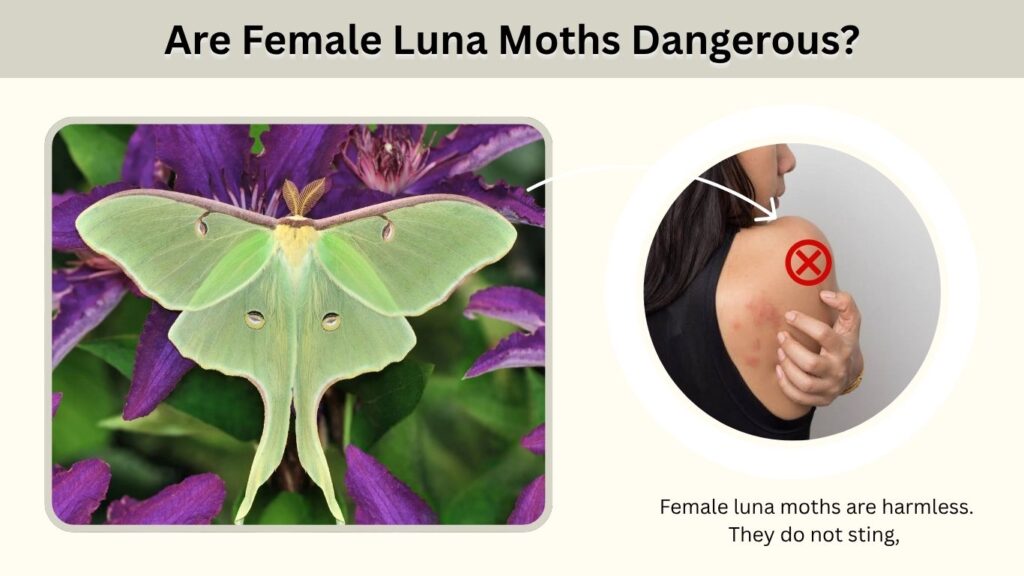
Female luna moths are harmless. They do not sting, bite, contain venom, or damage clothing and stored food. The caterpillars feed on tree leaves, but they are rarely abundant enough to cause significant damage to healthy host trees.
Avoid touching the wings because their scales and delicate structure can be damaged. A resting moth should be allowed to leave on its own.
FAQs
How can you tell whether a luna moth is female?
Examine the antennae and abdomen. A female has relatively narrow, less-feathery antennae and a fuller abdomen. A male has very broad, bushy antennae and a slimmer body.
What color is a female luna moth?
Females are generally pale green or blue-green, with transparent eyespots and pinkish, purple, reddish, or yellowish wing margins. Color varies with season and location.
Do female luna moths have feathery antennae?
Yes. Both sexes have comb-like antennae, but the female’s antennae are much narrower. The male’s large, broadly feathered antennae are adapted for detecting female pheromones.
Can a female luna moth lay eggs without mating?
An unmated female may deposit eggs, but they are generally infertile and will not develop normally. Successful reproduction requires mating with a male.
How long does a female luna moth live?
The adult generally lives only several days to about one week. Because she cannot eat, she relies on stored energy to mate and lay eggs before dying.