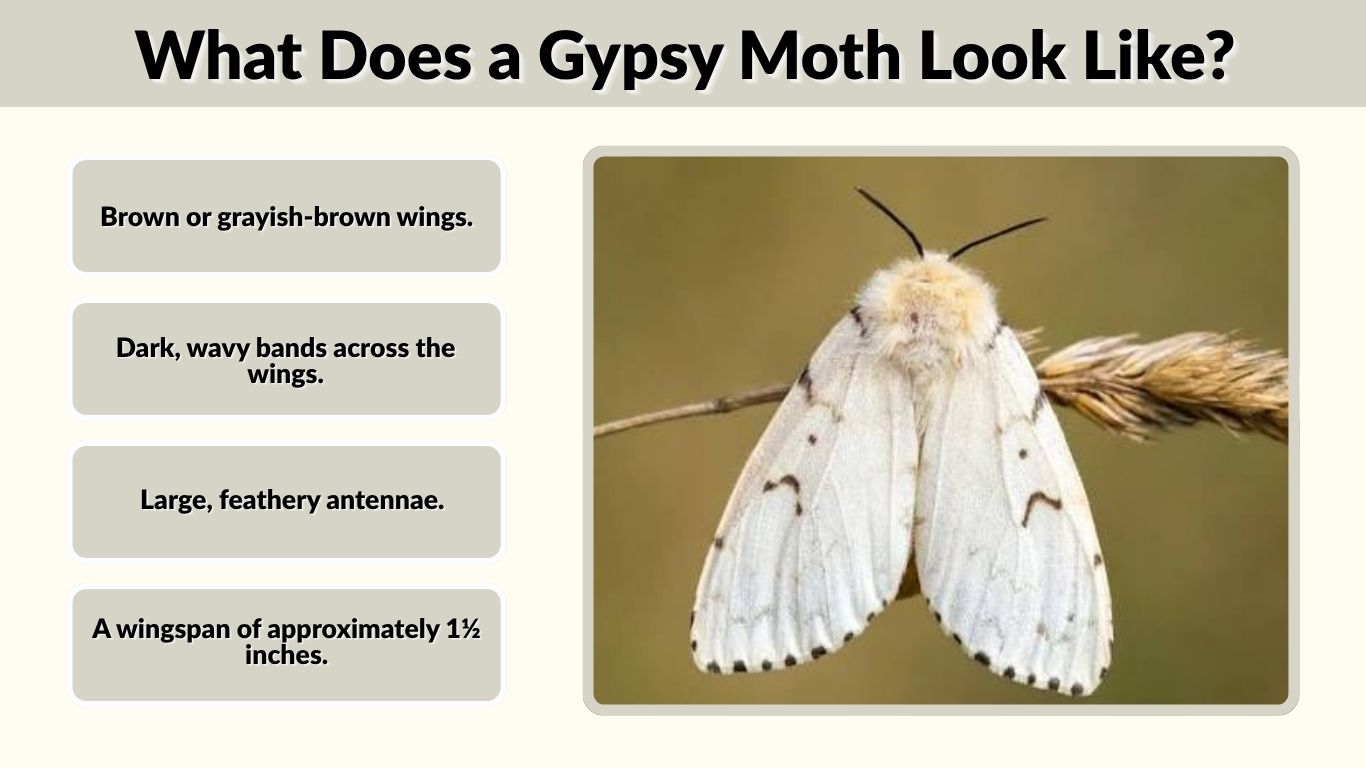
A gypsy moth, now officially called a spongy moth, looks different at each stage of its development. Adult males are small and brown, while females are larger, pale cream, and unable to fly in the established North American form. The caterpillar is easier to recognize because mature individuals have five pairs of blue spots followed by six pairs of red spots. Egg masses resemble fuzzy tan patches on tree bark, and pupae look like dark reddish-brown cases hidden in protected locations.
What Does an Adult Gypsy Moth Look Like?
Adult spongy moths appear during summer, after the damaging caterpillar stage ends. Males and females look sufficiently different that they can initially appear to be separate species.
Male Gypsy Moth Appearance
An adult male has:
- Brown or grayish-brown wings
- Dark, wavy bands across the wings
- Large, feathery antennae
- A slender body
- A wingspan of approximately 1½ inches
- A rapid, irregular flight pattern
Males use their feathered antennae to detect pheromones released by females. They may be seen flying during the day or around trees, buildings, and outdoor objects.
Female Gypsy Moth Appearance
A female is considerably lighter and heavier than a male. She typically has:
- Cream, white, or pale beige wings
- Dark brown zigzag or saw-toothed markings
- A thick, hairy abdomen
- Thin rather than feathery antennae
- A wingspan of approximately two inches
- A heavy-bodied appearance
Females of the established European form in North America have wings but generally cannot fly. They remain close to where they emerged, attract males, and deposit a fuzzy egg mass nearby.
| Feature | Male spongy moth | Female spongy moth |
| Color | Brown or grayish brown | Cream or nearly white |
| Size | Smaller | Larger and heavier |
| Antennae | Broad and feathery | Relatively thin |
| Flight | Active flyer | Generally flightless |
| Wing markings | Dark wavy bands | Dark zigzag markings |
The USDA describes males as having a wingspan of approximately 1½ inches and females as having a wingspan of about two inches.
What Does a Gypsy Moth Caterpillar Look Like?
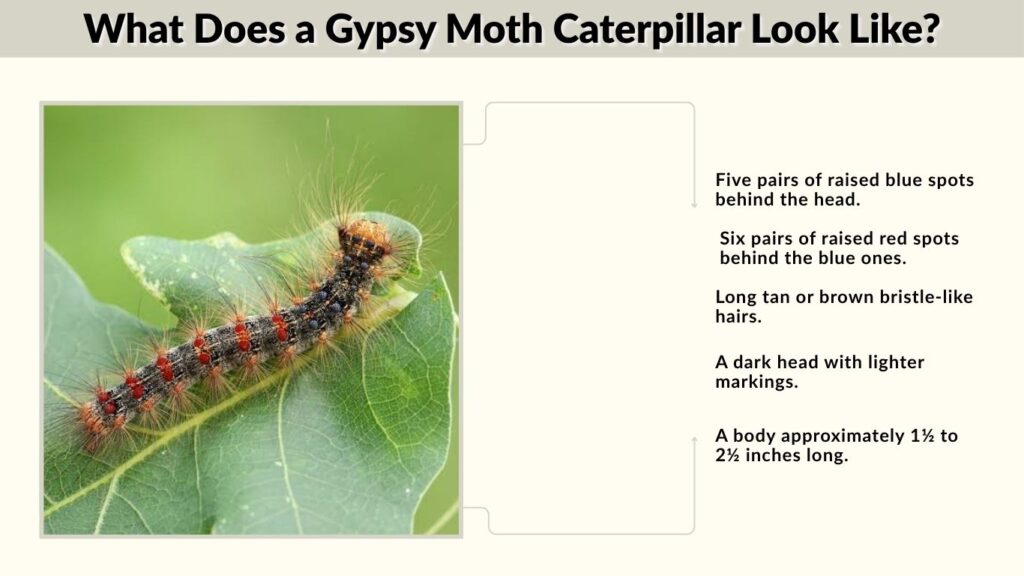
The caterpillar is the most recognizable and damaging stage. Its appearance changes as it grows, so the familiar blue-and-red pattern may be absent from newly hatched larvae.
Baby Gypsy Moth Caterpillar
A newly hatched caterpillar is:
- Approximately one-eighth inch long
- Predominantly black or dark brown
- Covered with relatively long hairs
- Small enough to be difficult to see individually
- Capable of hanging from a silk thread
Young caterpillars use silk threads to catch air currents. This behavior, known as ballooning, carries them from the egg mass to nearby trees and sometimes over considerable distances.
They initially chew small holes in young leaves. At this age, identification is easiest when numerous tiny caterpillars are found near a fuzzy tan egg mass.
Mature Gypsy Moth Caterpillar
As the caterpillar grows, its body becomes mottled gray, brown, yellowish, or nearly black. Mature individuals develop the defining pattern:
- Five pairs of raised blue spots behind the head
- Six pairs of raised red spots behind the blue ones
- Long tan or brown bristle-like hairs
- A dark head with lighter markings
- A body approximately 1½ to 2½ inches long
The spots appear in two rows running along the back. Although other caterpillars may have red or blue markings, the five-blue-pair and six-red-pair sequence is the best visual clue.
Older caterpillars often hide in bark crevices or beneath loose objects during the day and climb into trees to feed at night. During a large outbreak, they may feed both day and night.
What Do Gypsy Moth Eggs Look Like?
Individual eggs are tiny and usually hidden beneath a protective covering. Homeowners generally notice the complete egg mass rather than separate eggs.
Identifying an Egg Mass
A spongy moth egg mass looks like:
- A fuzzy or felt-like patch
- An oval or irregularly rounded shape
- Buff, tan, pale brown, or yellowish coloring
- Approximately 1½ inches long and ¾ inch wide
- A dried sponge attached firmly to a surface
The female covers her eggs with hair from her abdomen, creating the spongy appearance that inspired the insect’s new common name. A mass may hold several hundred eggs and sometimes up to 1,000.
Egg masses can be found on tree trunks, branches, stones, fences, walls, firewood, trailers, vehicles, patio furniture, children’s toys, and lawn equipment.
Hatched vs. Unhatched Egg Masses
An unhatched mass generally looks full, firm, and relatively uniform. After hatching, tiny openings may be visible, and the mass can appear faded, broken, or weathered.
Do not assume that an old-looking mass is empty. When removing egg masses, scrape them into soapy water rather than dropping them onto the ground.
What Does a Gypsy Moth Cocoon Look Like?
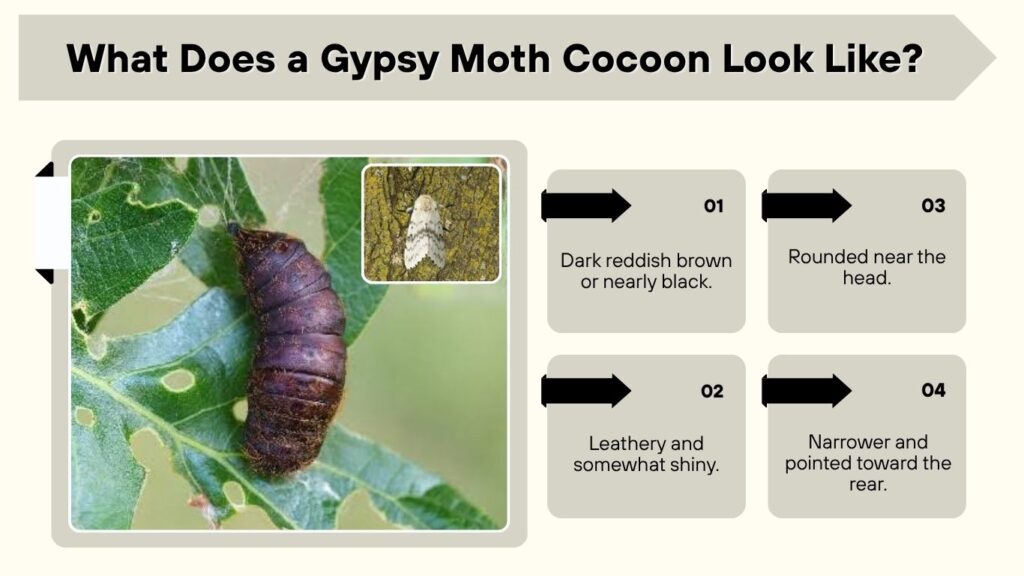
Spongy moths do not make the thick, obvious cocoons associated with silkworms. The mature caterpillar attaches itself in a protected place with a small amount of silk and transforms into a pupa.
Pupa Identification
A spongy moth pupa is usually:
- Dark reddish brown or nearly black
- Leathery and somewhat shiny
- Rounded near the head
- Narrower and pointed toward the rear
- Covered with scattered hairs
- Attached with thin, inconspicuous silk
Female pupae are generally larger than male pupae. They may be found in bark crevices, beneath branches, under siding, on fences, behind outdoor furniture, or within other sheltered locations.
Pupae do not feed or move around. An empty case may remain attached after the adult emerges.
What Does a Gypsy Moth Nest Look Like?
Spongy moths do not construct communal nests or large silk tents. People frequently mistake their fuzzy egg masses for nests because multiple eggs remain together in one patch.
Egg Mass or Tent Caterpillar Nest?
A tan patch attached directly to bark is probably a spongy moth egg mass. A large white or gray silk web located in a branch fork is more likely to be an eastern tent caterpillar nest.
Young spongy moth caterpillars produce individual silk strands for dispersal, but they do not gather inside a permanent web. Older larvae may cluster on trunks, yet these groups are not surrounded by a tent.
What Does Gypsy Moth Poop Look Like?
Caterpillar droppings are known as frass. The size increases as the caterpillar grows and eats more foliage.
Identifying Frass
Spongy moth frass usually appears as:
- Small, firm pellets
- Dark green when relatively fresh
- Brown or black after drying
- Scattered beneath infested trees
- Accumulated on decks, vehicles, furniture, and walkways
During a heavy infestation, thousands of caterpillars may feed overhead. Falling frass and small pieces of chewed leaves can create a pattering sound that resembles light rain.
Frass itself does not confirm the species because many leaf-eating caterpillars produce similar pellets. Look for blue-and-red-spotted caterpillars or tan egg masses nearby.
What Does Gypsy Moth Damage Look Like?
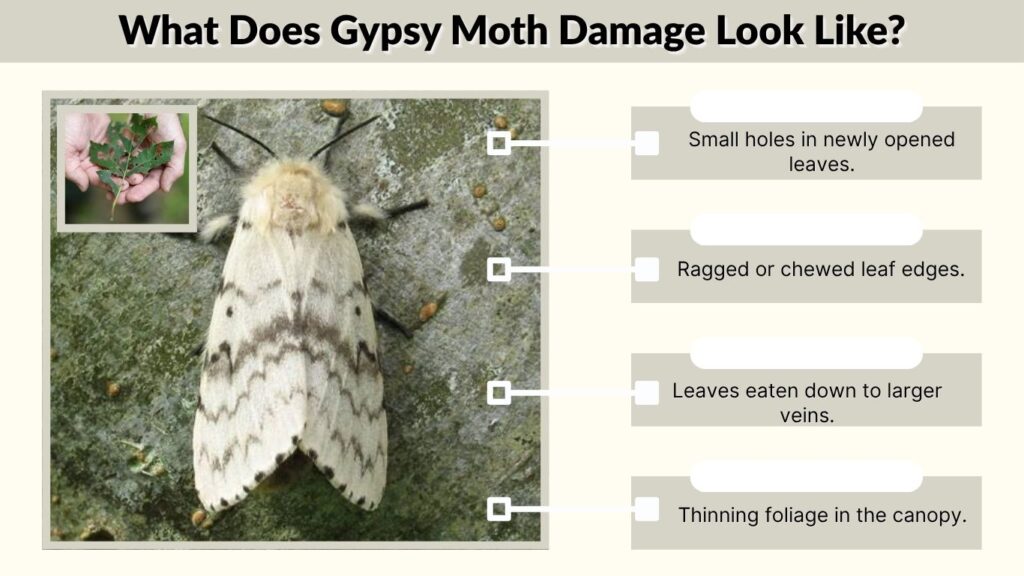
Only the caterpillar feeds on trees. Adult moths reproduce but do not cause defoliation.
Signs on Trees
Typical damage includes:
- Small holes in newly opened leaves
- Ragged or chewed leaf edges
- Leaves eaten down to larger veins
- Thinning foliage in the canopy
- Partially or completely bare branches
- Caterpillars resting on the trunk
- Frass collecting beneath the tree
Severely affected trees can develop a bare, winter-like appearance in late spring or early summer. Oaks are strongly preferred, but caterpillars also consume aspen, birch, willow, alder, apple, basswood, and many other plants.
Older caterpillars may feed on pine, spruce, hemlock, and other conifers when preferred hardwood foliage becomes scarce.
Caterpillars That Look Like Gypsy Moths
Several hairy caterpillars may be mistaken for spongy moth larvae. Body markings and web-building behavior provide the most useful differences.
Tent Caterpillars
Eastern tent caterpillars have a solid white line running down the back and create conspicuous silk tents in branch forks.
Forest tent caterpillars have pale, keyhole-shaped or footprint-like marks along the back. Despite their name, they do not build true tents but may leave silk trails or mats.
Browntail Moth Caterpillar
A browntail moth caterpillar has broken white stripes along its sides and two distinctive reddish-orange spots near the rear. It lacks the complete series of blue and red spot pairs. Its microscopic hairs can produce particularly persistent skin irritation.
White-Marked Tussock Moth Caterpillar
This species has four pale, toothbrush-like tufts along its back, a bright red head, long black hair pencils near the front, and a dark rear tuft. Its unusual arrangement of hairs clearly separates it from a mature spongy moth caterpillar.
What Does a Gypsy Moth Rash Look Like?
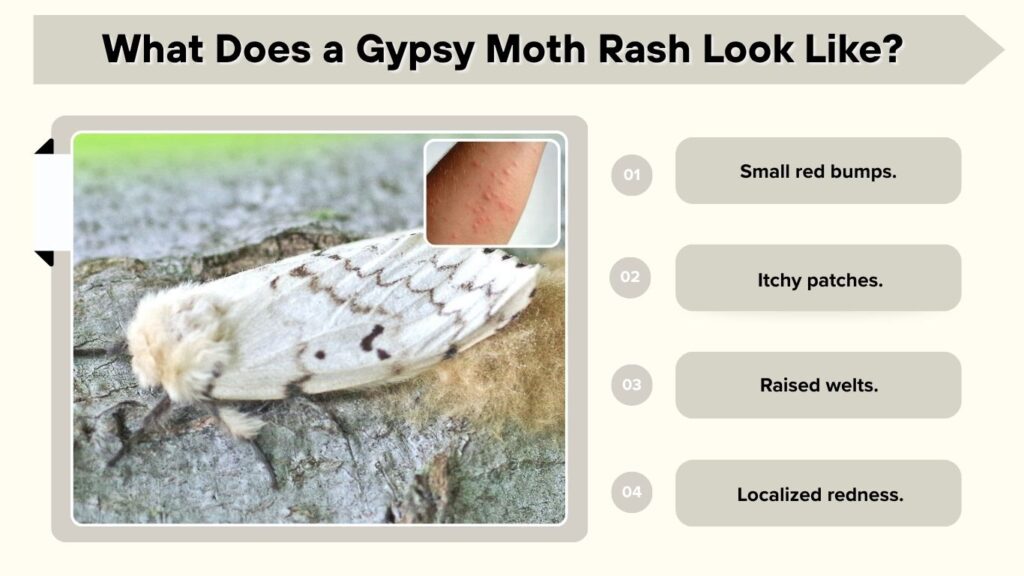
Spongy moth caterpillars do not bite or sting. However, their hairs can irritate sensitive skin.
A reaction may appear as:
- Small red bumps
- Itchy patches
- Raised welts
- Localized redness
- Mild swelling
- A burning or prickling sensation
The rash may develop after touching a caterpillar or contacting contaminated clothing, firewood, outdoor furniture, or tree bark. Wash exposed skin without rubbing it, change clothing, and use a cool compress. Seek medical care for breathing difficulty, facial swelling, eye exposure, or a severe reaction.
FAQs
Are male and female gypsy moths different colors?
Yes. Males are brown or grayish brown, while females are cream or nearly white with dark wing markings.
What is the easiest way to identify the caterpillar?
Look for five pairs of blue spots followed by six pairs of red spots along the back of a mature, hairy caterpillar.
How big do gypsy moth caterpillars get?
Fully grown caterpillars are generally between 1½ and 2½ inches long.
Do gypsy moths make webs in trees?
No. They may produce individual silk strands, but they do not create communal tents. A large web usually belongs to another caterpillar species.
What trees do gypsy moths prefer?
Oaks are among their favorite hosts. They also commonly feed on aspen, birch, willow, alder, apple, basswood, and many other trees.