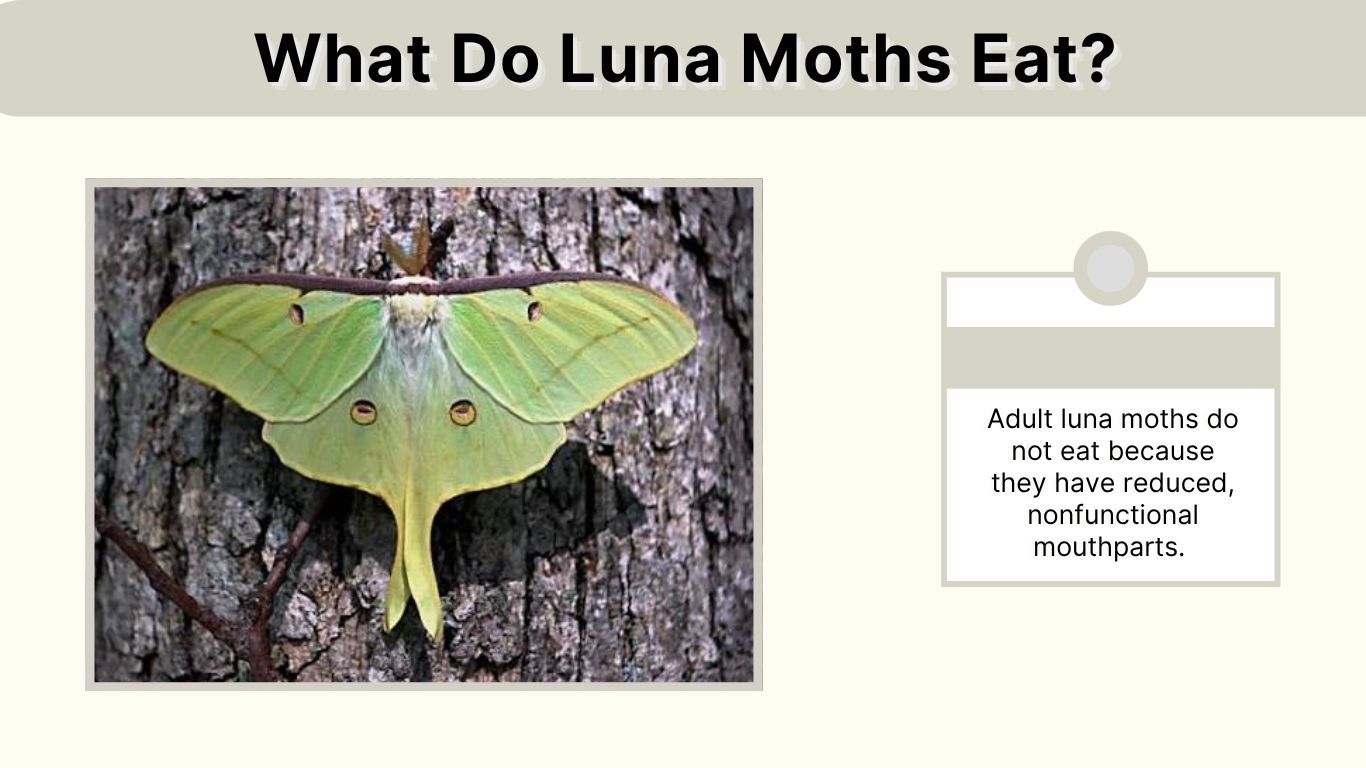
Luna moths are famous for their pale green wings, long hindwing tails, and large size. However, their feeding habits change dramatically during their life cycle. Adult luna moths do not eat because they have reduced, nonfunctional mouthparts. Instead, they survive on energy stored while they were caterpillars. Luna moth caterpillars eat the leaves of several deciduous trees, including hickory, walnut, sweetgum, birch, and persimmon. Below are 10 common food plants that support growing luna moth larvae.
Do Adult Luna Moths Eat?
Adult luna moths do not consume leaves, nectar, fruit, or water. Unlike butterflies and many other moths, they do not have a functional proboscis for drinking liquids.
After emerging from their cocoons, adults rely entirely on fat and energy accumulated during the caterpillar stage. Their brief adult life is dedicated to finding a mate and reproducing.
Most adult luna moths live for approximately one week. During this period, males fly in search of females, while females mate and lay their eggs on suitable host plants.
Because adults cannot eat, offering sugar water, flowers, fruit, or honey will not help them. A healthy adult luna moth simply needs a safe outdoor environment where it can complete its natural reproductive cycle.
What Do Luna Moth Caterpillars Eat?
Luna moth caterpillars feed on the fresh leaves of broadleaf trees. Their preferred host plants can vary by location, climate, and local tree availability.
The caterpillars generally remain on the tree where the female deposited her eggs. They eat frequently and pass through five growth stages, called instars, before creating a cocoon.
| Food plant | Plant part eaten | How common it is |
| Hickory | Fresh leaves | Very common |
| Walnut | Fresh leaves | Very common |
| Sweetgum | Fresh leaves | Common |
| Birch | Fresh leaves | Common |
| Persimmon | Fresh leaves | Common |
| Pecan | Fresh leaves | Common |
| Sumac | Fresh leaves | Regional |
| White oak | Fresh leaves | Occasional |
| Willow | Fresh leaves | Regional |
| Beech | Fresh leaves | Occasional |
10 Common Foods Luna Moth Caterpillars Eat
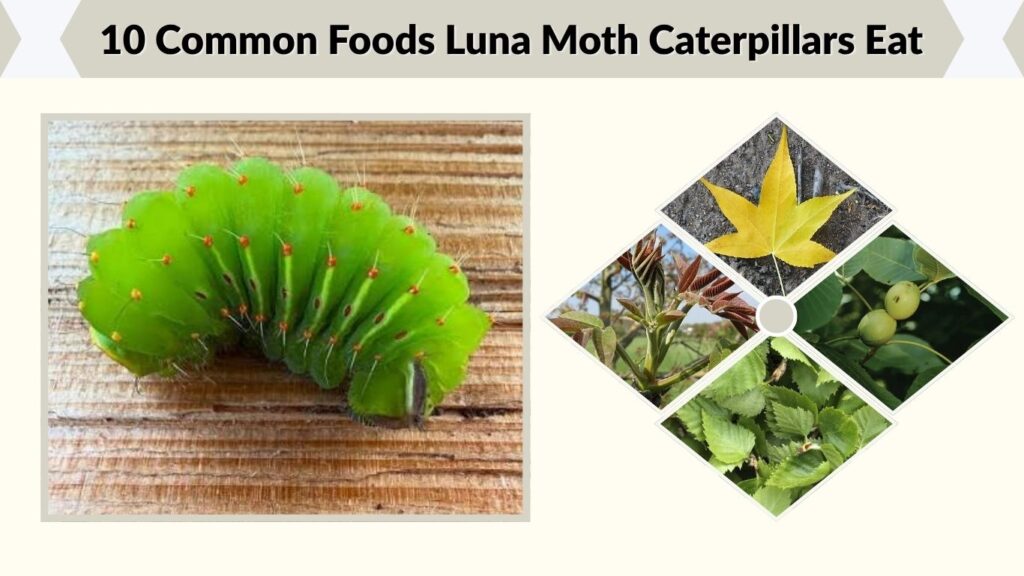
The term “food” refers to the host-tree leaves consumed during the caterpillar stage. Luna moth larvae do not normally eat household foods, stored grains, fabric, or garden vegetables.
1. Hickory Leaves
Hickory is one of the most important food plants for luna moth caterpillars. Females may lay their eggs on the undersides of hickory leaves, allowing the newly hatched larvae to begin feeding immediately.
Caterpillars chew from the leaf edges and gradually consume larger portions as they grow. Several hickory species can support them, depending on what grows in the surrounding area.
2. Walnut Leaves
Walnut trees are another widely recognized host for luna moth larvae. Both black walnut and other native walnut species may provide suitable foliage.
Young caterpillars eat relatively small amounts, but mature larvae can consume considerable leaf material. Despite this feeding, luna moth caterpillars rarely occur in numbers high enough to cause serious damage to a healthy walnut tree.
3. Sweetgum Leaves
Sweetgum is a particularly common luna moth host in southern and eastern regions. Its star-shaped leaves offer a dependable food source throughout the caterpillar’s development.
A female may deposit eggs individually or in small groups on the tree. After hatching, the larvae remain among the foliage, where their green coloration provides effective camouflage.
4. Birch Leaves
Luna moth caterpillars may feed on several birch species. Birch trees are especially important in northern parts of the luna moth’s range, where other preferred host plants may be less abundant.
The larvae consume the soft leaf tissue while usually leaving the thicker veins behind. Their feeding may create irregular edges and missing sections on affected leaves.
5. Persimmon Leaves
Persimmon trees provide broad, nutritious leaves that can support developing luna moth caterpillars. Females may select persimmon trees as egg-laying sites in forests, woodland edges, farms, and gardens.
The larvae do not typically eat persimmon fruit. Their diet consists mainly of the tree’s leaves, which provide the nutrients required for growth and later adult development.
6. Pecan Leaves
Pecan belongs to the same general plant family as hickory and is another suitable host. Luna moth caterpillars may feed along the edges of pecan leaflets and consume increasingly large portions as they mature.
Their presence does not usually threaten an established pecan tree. Natural predators, weather, and low population density generally prevent major infestations.
7. Sumac Leaves
Sumac is a regional host plant for luna moth larvae. These shrubs and small trees commonly grow along roadsides, woodland borders, open fields, and disturbed areas.
Luna moth caterpillars feed on the leaflets rather than the red fruit clusters. Sumac can provide an important alternative when larger host trees are unavailable.
8. White Oak Leaves
Some luna moth caterpillars feed on white oak leaves, although oak may not be equally preferred across all regions. Local luna moth populations can develop different host preferences based on available vegetation.
The larvae chew the leaf margins and softer tissue. A few caterpillars will not significantly harm a mature white oak tree.
9. Willow Leaves
Willow trees may serve as host plants in moist habitats near streams, ponds, wetlands, and low-lying woodlands. Their abundant foliage can provide food for larvae during warmer months.
Willow is considered more important in certain areas than others. Luna moth females generally choose plants that are suitable for the local caterpillar population.
10. Beech Leaves
Beech is another possible food plant for luna moth caterpillars. Its smooth, broad leaves can support larval feeding in forests where beech trees are common.
Beech may be used less frequently than hickory, walnut, or sweetgum. However, regional differences make it difficult to identify one host tree that every luna moth population prefers.
How Luna Moth Caterpillars Feed
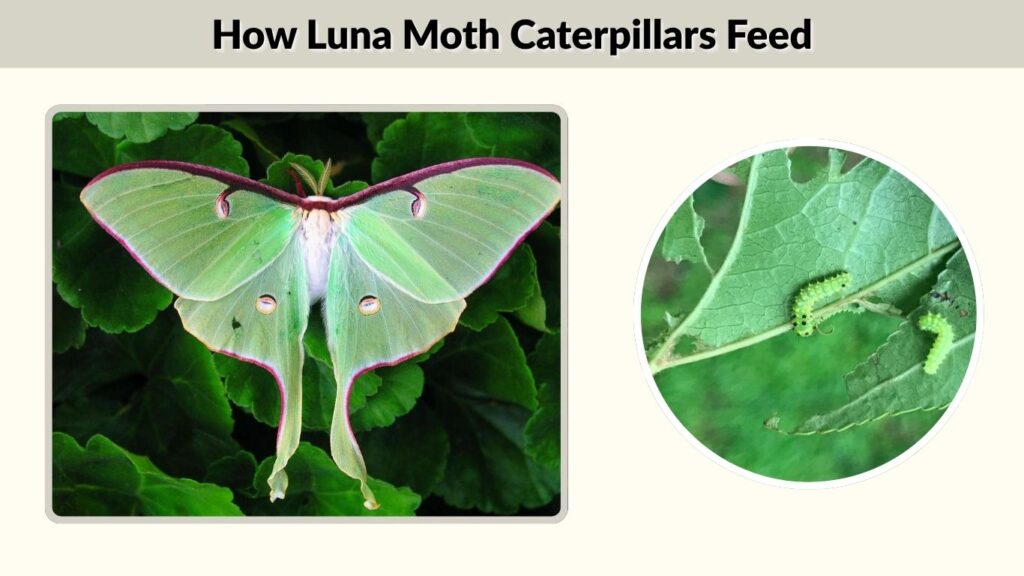
Luna moth caterpillars have strong chewing mouthparts. Newly hatched larvae begin by eating small sections of tender foliage. As their bodies grow, they consume larger portions and may eat almost continuously during active periods.
Early Caterpillar Stages
Young larvae are small and may initially appear brownish or green. They remain close to where they hatched and begin feeding on the surrounding leaves.
Their limited size means the early feeding damage is usually difficult to notice.
Mature Caterpillar Stage
Mature luna moth caterpillars are large, bright green, and capable of consuming much more foliage. They may reach approximately 2½ to 3 inches long before pupating.
Once fully grown, the caterpillar stops eating and searches for a suitable place to make its cocoon. It usually wraps itself in silk among fallen leaves on the ground.
Can Luna Moth Caterpillars Change Food Plants?
Luna moth caterpillars may accept more than one host species, but transferring them between plants is not always successful. A caterpillar raised on one tree may reject unfamiliar leaves or experience digestive problems after a sudden change.
When caring for a caterpillar temporarily, provide fresh leaves from the exact tree on which it was found. Avoid leaves treated with pesticides, herbicides, or other chemicals.
Place the leaf stems in water to keep them fresh, but cover the water container so the caterpillar cannot fall inside. The enclosure should also have good airflow and be cleaned regularly.
Do Luna Moths Damage Trees?
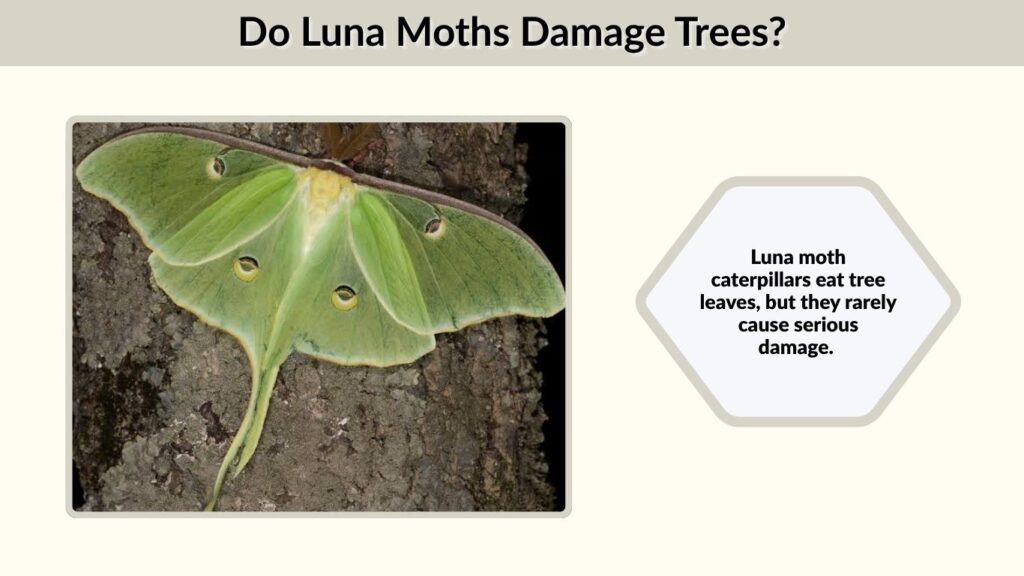
Luna moth caterpillars eat tree leaves, but they rarely cause serious damage. The moths do not normally appear in the extremely large numbers associated with destructive forest pests.
Healthy mature trees can tolerate the loss of a small number of leaves. Luna moths are also beneficial members of the ecosystem, serving as food for birds, bats, insects, and other wildlife.
Chemical control is generally unnecessary. If a caterpillar is found in an inconvenient location, it can be carefully moved to a nearby branch of the same host-tree species.
What Do Baby Luna Moths Eat?
Baby luna moths are caterpillars, not miniature winged moths. After hatching, they eat fresh leaves from the host plant where their eggs were laid.
They cannot eat dry leaves, lettuce, grass, fruit, or artificial food intended for unrelated caterpillar species. Fresh, untreated host leaves are essential for their survival and development.
FAQs
Do luna moths eat nectar?
Adult luna moths do not drink nectar because they lack functional feeding mouthparts. They live on stored energy collected during the caterpillar stage. Although adults may land near flowers, they cannot use them as a food source.
Do luna moths eat fruit?
Neither adult luna moths nor their caterpillars normally eat fruit. Adults do not feed at all, while caterpillars consume fresh leaves from suitable host trees. Persimmon may be a host plant, but the larvae eat its leaves rather than its fruit.
Do luna moth caterpillars eat milkweed?
Milkweed is not considered a primary host for luna moth caterpillars. They are more likely to eat hickory, walnut, sweetgum, birch, persimmon, pecan, sumac, willow, oak, or beech leaves.
How long do luna moth caterpillars eat?
Luna moth caterpillars generally feed for several weeks while passing through five growth stages. Temperature, food quality, and geographic location can affect development time. They stop eating shortly before spinning their cocoons and entering the pupal stage.
What should I feed a luna moth caterpillar?
Feed it fresh, pesticide-free leaves from the same tree where it was discovered. Hickory, walnut, sweetgum, birch, persimmon, and pecan are common hosts. Do not suddenly switch plants unless necessary, because the caterpillar may reject unfamiliar foliage.