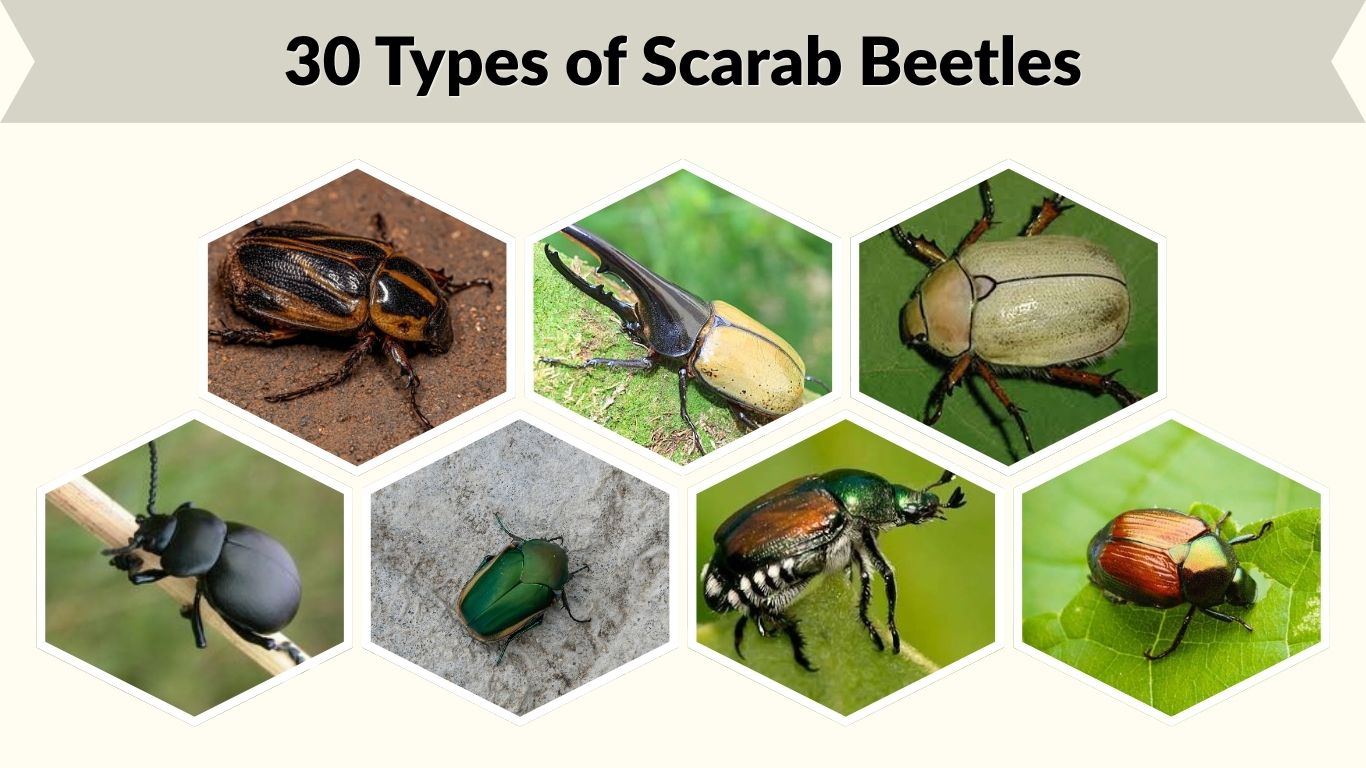
Scarab beetles are a diverse group of insects found in forests, gardens, grasslands, farms, and tropical habitats around the world. Some species, such as Japanese beetles and masked chafers, can damage plants and lawns, while others, including dung beetles and rhinoceros beetles, play important roles in decomposition and nutrient recycling. In this guide, you’ll discover 30 types of scarab beetles, along with their identification features, habitat and distribution, behavior and diet, and lifespan and life cycle.
1. Japanese Beetle
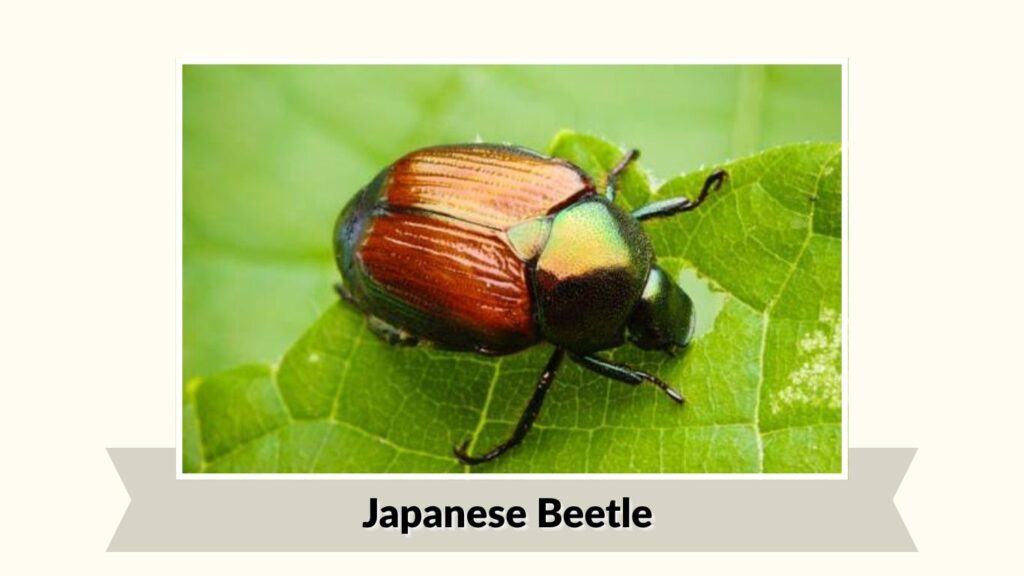
The Japanese beetle is one of the most recognizable scarab beetles because of its shiny metallic coloration. Although attractive in appearance, it can be a serious garden and agricultural pest. Adults feed on the leaves, flowers, and fruits of many plants, while their larvae live underground and feed mainly on grass roots.
Identification
- Adult length: about 8–12 mm
- Metallic green head and thorax
- Coppery-brown wing covers
- Small white hair patches along both sides of the abdomen
- Oval, slightly rounded body
- Larvae are creamy-white, C-shaped grubs
- Scientific name: Popillia japonica
Habitat and Distribution
Japanese beetles are native to Japan but have become established across large parts of North America. They are especially common in lawns, gardens, orchards, parks, golf courses, and agricultural fields where suitable host plants and moist soil are available.
Adults often gather in sunny locations on flowers and foliage. Females prefer grassy areas with sufficiently moist soil for laying their eggs. Irrigated lawns can therefore provide excellent conditions for developing larvae.
Behavior and Diet
Adult Japanese beetles are active during warm, sunny conditions and commonly feed in groups. They chew plant tissue between the leaf veins, producing a distinctive skeletonized appearance.
Their diet is extremely broad and can include roses, grapes, raspberries, fruit trees, beans, corn, and many ornamental plants. Underground larvae mainly consume grass roots and other organic plant material, sometimes causing patches of damaged turf.
Lifespan and Life Cycle
Japanese beetles normally complete one generation each year. Females deposit eggs in the soil during summer. The eggs hatch into small grubs that begin feeding on roots.
As temperatures fall, the larvae move deeper underground and overwinter. They return closer to the surface during spring and resume feeding before pupating. Adults usually begin emerging during early to midsummer.
Adult beetles generally survive for several weeks, during which they feed, mate, and reproduce. The entire life cycle from egg to adult typically takes about one year.
2. Green June Beetle
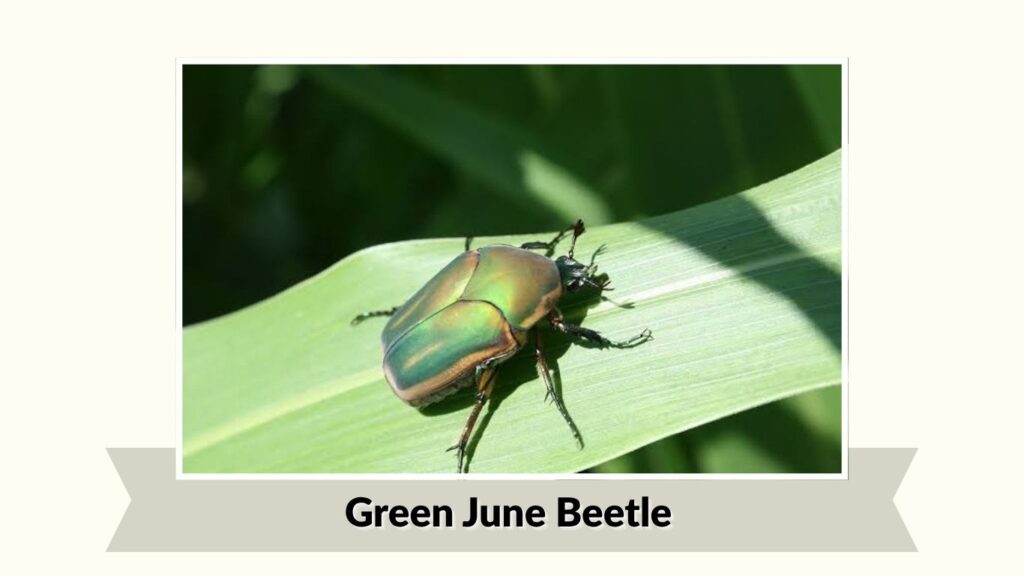
The Green June beetle is a large, brightly colored scarab commonly seen flying close to lawns during summer. Its metallic green body can make it look intimidating, but it is generally harmless to people. Adults primarily feed on ripe or damaged fruits, while the larvae develop in soil containing abundant organic matter.
Identification
- Adult length: approximately 15–25 mm
- Bright metallic green upper body
- Golden, bronze, or brownish coloration along the body edges
- Broad, oval-shaped body
- Strong legs designed for digging
- Larvae are large, white, C-shaped grubs
- Scientific name: Cotinis nitida
Habitat and Distribution
Green June beetles are mainly found in the eastern and central regions of the United States. They occur in lawns, gardens, pastures, orchards, compost-rich soil, and areas containing decomposing organic material.
Adults become especially noticeable during summer when they fly low over grassy areas. Their somewhat loud and clumsy flight often makes them easy to notice.
Larvae favor loose, moist soil rich in decaying plant matter or manure.
Behavior and Diet
Adults feed mostly on soft, ripe, damaged, or fermenting fruits. Peaches, grapes, berries, figs, and similar fruits can attract large numbers of beetles.
They may also consume tree sap and other sugary plant materials. Unlike Japanese beetles, they do not usually cause extensive skeletonization of leaves.
The larvae feed mainly on decaying organic matter in the soil. They may occasionally disturb turf by tunneling but are important decomposers in many environments.
Lifespan and Life Cycle
Green June beetles generally have one generation per year. Females lay eggs in rich soil during summer. Larvae hatch and spend several months underground feeding on organic material.
The grubs overwinter underground and become active again when temperatures rise. They eventually create chambers in the soil where they pupate.
Adults usually emerge during summer and remain active for several weeks. After mating and egg laying, the next generation begins its underground development.
3. June Beetle
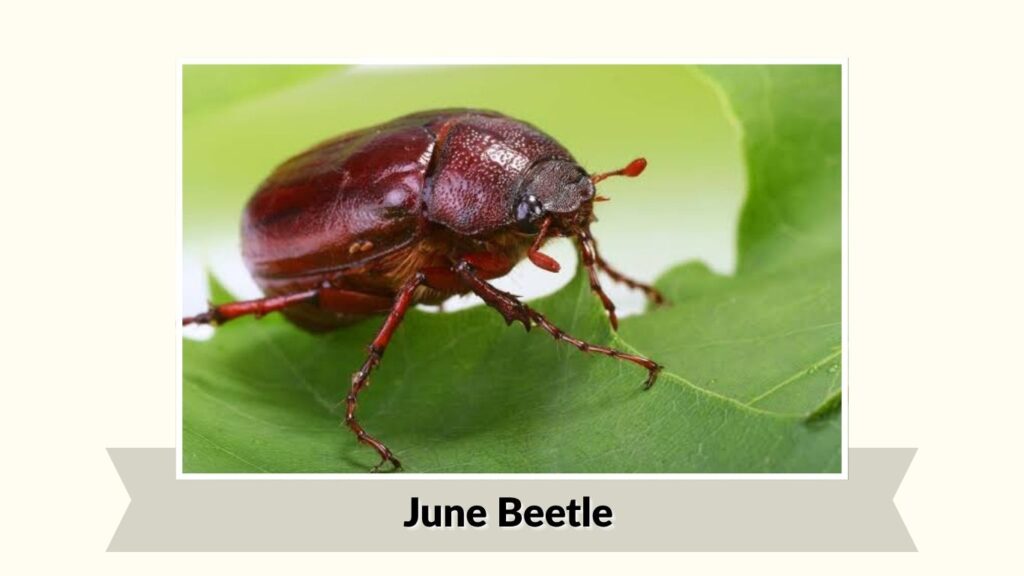
June beetle is a common name applied to numerous scarab beetles, especially species belonging to the genus Phyllophaga. These sturdy beetles often appear around outdoor lights during warm spring and summer evenings. Adult feeding can damage foliage, while their underground larvae, commonly called white grubs, may harm lawns and crop roots.
Identification
- Adult length: commonly 12–25 mm
- Usually brown, reddish-brown, or dark brown
- Oval and heavily built body
- Smooth or slightly hairy appearance
- Antennae end in small fan-like clubs
- Strong, spiny legs
- Larvae are white, C-shaped grubs with brown heads
- Many species belong to the genus Phyllophaga
Habitat and Distribution
June beetles occur widely throughout North America, although similar scarab beetles are found in many other regions. They commonly inhabit lawns, agricultural fields, woodlands, gardens, pastures, and suburban landscapes.
Adults spend much of the daytime concealed in vegetation or soil and become active after sunset. Artificial lights often attract them in surprisingly large numbers.
Their larvae remain underground, especially in grassy or cultivated areas.
Behavior and Diet
Adult June beetles generally feed on the foliage of trees, shrubs, and other plants. Their preferred hosts vary among species, but oak, walnut, fruit trees, and ornamental plants are commonly visited.
Adults are primarily nocturnal. Their heavy bodies and awkward flight sometimes cause them to bump into windows, walls, or people near lights.
The larvae feed underground on plant roots. Large grub populations may weaken lawns and crops by damaging root systems.
Lifespan and Life Cycle
The life cycle varies by species and may take one to several years. Females lay eggs in soil, where larvae hatch and begin feeding on roots.
White grubs pass through several developmental stages while remaining underground. In colder regions, they move deeper into the soil during winter.
After reaching maturity, larvae pupate inside underground cells. Adults eventually emerge, often during late spring or early summer, giving the group its familiar name.
4. May Beetle
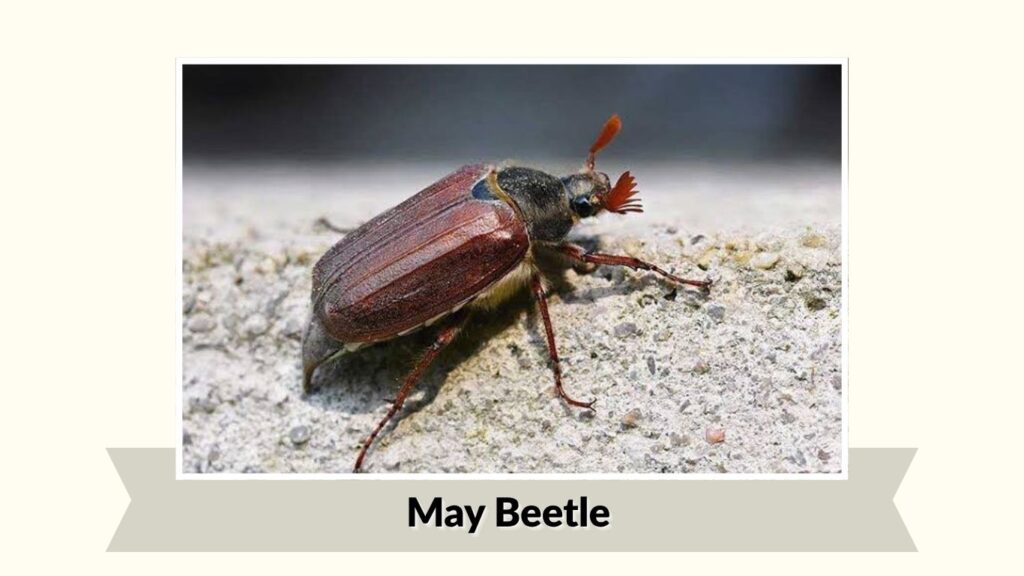
May beetles are robust scarab beetles closely related to many insects commonly called June bugs. The name is often associated with beetles that emerge during spring, particularly species of Melolontha in Europe. Their large size, fan-shaped antennae, and noticeable evening flights make them easy to recognize during their seasonal emergence.
Identification
- Adult length: commonly about 20–30 mm
- Brown or reddish-brown coloration
- Broad, elongated oval body
- Distinctive fan-shaped antennae
- Pale triangular markings may appear along the abdomen
- Strong legs with small spines
- Larvae are large, creamy-white C-shaped grubs
- Common European species belong to Melolontha
Habitat and Distribution
May beetles are especially associated with Europe and parts of western Asia, although related beetles occur elsewhere. They inhabit grasslands, farms, meadows, gardens, forest edges, and areas containing deciduous trees.
Adults commonly emerge in large numbers during spring. During the day they may remain relatively inactive among vegetation, becoming more active around dusk.
Their larvae live underground in grassy areas and agricultural soil.
Behavior and Diet
Adult May beetles primarily feed on foliage from deciduous trees and shrubs. Oak, beech, maple, and fruit trees may serve as food sources.
Large populations can remove significant amounts of foliage, although healthy mature trees often tolerate moderate feeding.
Larvae are root feeders. They consume roots of grasses, cereals, vegetables, and other plants and can become damaging agricultural pests when populations are high.
Lifespan and Life Cycle
May beetles usually have a relatively long life cycle compared with many scarabs. Depending on climate and species, development may require approximately three to four years.
Females deposit eggs underground. The larvae grow slowly while feeding on roots and overwinter several times in the soil.
After reaching full size, the grub pupates underground. The adult forms inside the soil and eventually emerges during spring, often around April or May. Adults live for only several weeks, focusing mainly on feeding and reproduction.
5. European Chafer
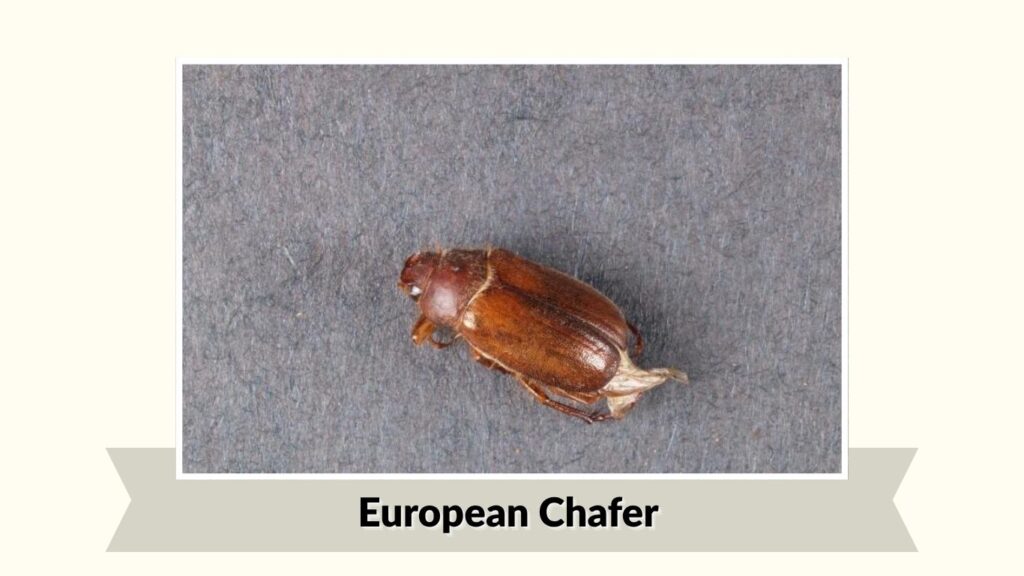
The European chafer is a medium-sized scarab beetle best known as a turf pest. Adults cause relatively little damage, but their larvae can seriously weaken lawns by feeding on grass roots. Introduced populations have become established in parts of North America, where the species can be particularly troublesome in residential lawns and recreational turf.
Identification
- Adult length: approximately 12–15 mm
- Light brown to reddish-brown coloration
- Oval, compact body
- Head and thorax may appear slightly darker
- Fan-shaped antennal tips
- Adults lack the bright metallic colors of many scarabs
- Larvae are white, C-shaped grubs with brown heads
- Scientific name: Rhizotrogus majalis
Habitat and Distribution
European chafers originated in Europe but have been introduced into parts of North America. They are particularly associated with lawns, parks, golf courses, sports fields, pastures, and other grassy environments.
Females prefer soil beneath turf when laying eggs. Moist soil helps eggs and young larvae survive, making irrigated landscapes favorable habitats.
Adults often gather around trees or fly over lawns during warm summer evenings.
Behavior and Diet
Adult European chafers feed little compared with many other scarab species. Their most important impact occurs during the larval stage.
The grubs feed heavily on grass roots, reducing the ability of turf to absorb water and nutrients. Damaged grass can become yellow, thin, or easily pulled away from the soil.
Animals such as skunks, raccoons, and birds may dig through infested lawns searching for grubs, creating additional damage.
Lifespan and Life Cycle
European chafers normally complete one generation each year. Adults emerge during early summer, mate, and females lay their eggs in soil.
Young larvae begin feeding on grass roots during summer and continue developing into autumn. They move deeper underground when temperatures become very cold but return toward the root zone when conditions improve.
Heavy feeding typically resumes in spring. Mature larvae then pupate underground before becoming adults. Adult activity is relatively short and mainly focused on mating and reproduction.
6. Oriental Beetle
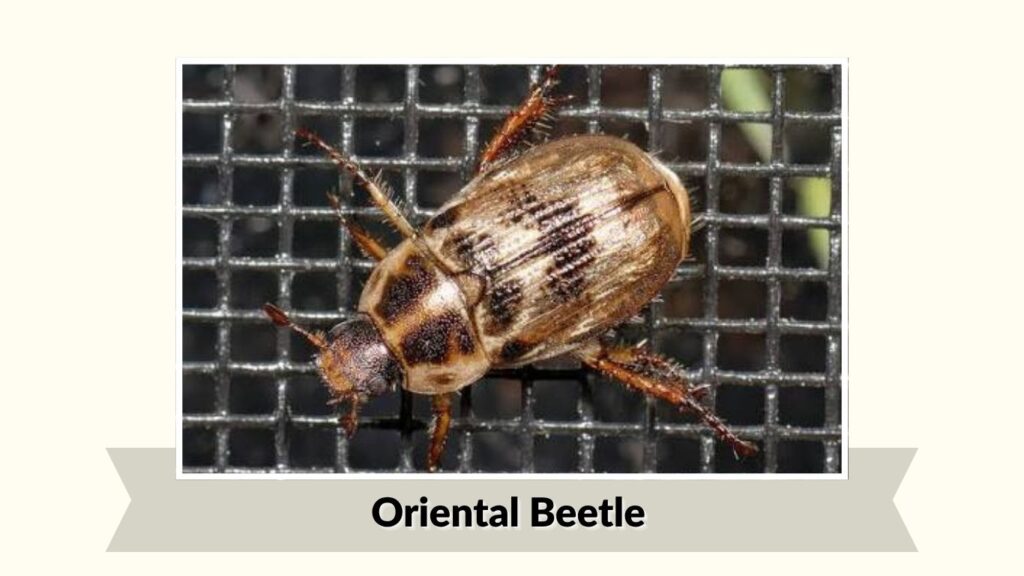
The Oriental beetle is a small scarab that can be difficult to notice because of its mottled brown coloration. Despite its modest appearance, its larvae can damage turfgrass, ornamental plants, and nursery crops. Adults are often active during warm weather, while most economically important feeding occurs beneath the soil.
Identification
- Adult length: approximately 7–11 mm
- Brown, tan, or black-and-tan mottled appearance
- Dark irregular markings on the wing covers
- Compact, oval body
- Clubbed antennae
- Adults may vary considerably in color
- Larvae are white, C-shaped grubs
- Scientific name: Anomala orientalis
Habitat and Distribution
Oriental beetles originated in Asia and later became established in parts of North America. They are particularly common in portions of the northeastern United States.
Typical habitats include lawns, golf courses, nurseries, flower beds, gardens, and agricultural fields. They favor soils that provide both moisture and suitable plant roots for developing larvae.
Adults may remain hidden among low vegetation during much of the day.
Behavior and Diet
Adult Oriental beetles feed on flowers and foliage but are generally considered less destructive above ground than Japanese beetles.
The larvae cause more concern because they feed on roots of turfgrass and various ornamental or nursery plants. Heavy infestations can produce thinning, browning, or weakened turf.
Adults are most active during warmer months. Males can locate females by detecting chemical pheromones, an ability that is also used in monitoring traps designed for this beetle.
Lifespan and Life Cycle
Oriental beetles generally produce one generation per year. Females lay eggs in soil during summer, and newly hatched larvae begin feeding on roots.
The grubs grow through several stages before moving deeper into the soil as colder weather approaches. They overwinter as larvae and resume feeding near the surface during spring.
When development is complete, the larvae pupate underground. Adults emerge during late spring or summer, mate, and restart the annual cycle. Adult life lasts only a fraction of the full life cycle, while most of the year is spent in the underground larval stage.
7. Asiatic Garden Beetle
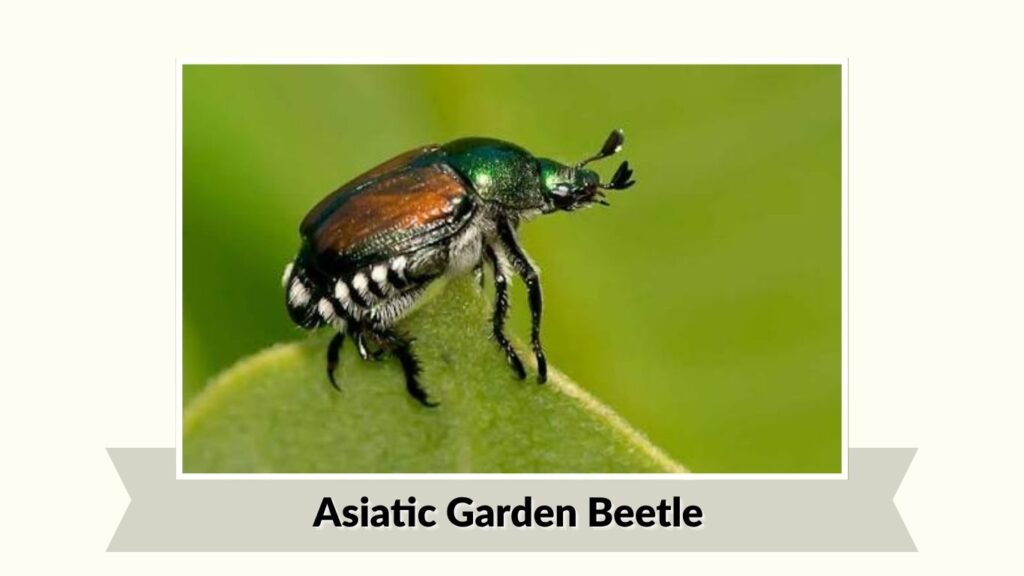
The Asiatic garden beetle is a small, cinnamon-brown scarab that is much less colorful than many other members of the family. Originally native to Japan and China, it has become established in parts of North America. Adults are primarily nocturnal and can damage many vegetables, flowers, fruits, and ornamental plants, while the grubs live underground and feed on plant roots.
Identification
- Adult length: about 3/8 inch or 9–10 mm
- Cinnamon-brown to reddish-brown body
- Smooth, oval, coffee-bean-like shape
- Slight velvety or iridescent appearance
- Strong legs adapted for moving through soil
- Adults are often attracted to lights at night
- Larvae are white, C-shaped grubs with brown heads
- Scientific name: Maladera formosae
Habitat and Distribution
The Asiatic garden beetle originated in East Asia and was first detected in the United States in New Jersey in the early 20th century. It is now established across much of the eastern United States and occurs in gardens, lawns, agricultural fields, nurseries, orchards, and other areas containing suitable host plants.
Adults generally remain hidden in soil or vegetation during daylight. At night they become active and may gather around porch lights, windows, and other illuminated areas.
Behavior and Diet
Adult Asiatic garden beetles are nocturnal feeders. They chew irregular holes and notches along the edges of leaves and have been recorded feeding on more than 100 kinds of plants.
Vegetables, herbs, fruit crops, flowers, shrubs, and ornamental plants may all be attacked. The larvae live below ground, where they consume roots and decaying organic material. Grubs can occasionally damage turf, corn, soybeans, sweet potatoes, blueberries, and other crops.
Lifespan and Life Cycle
In cooler parts of its range, the Asiatic garden beetle normally completes one generation each year. Females burrow into moist soil and lay clusters of eggs that generally hatch in roughly two weeks.
The larvae feed underground and overwinter as grubs. During spring, they return to feeding before pupating in the soil. Adults usually begin appearing from late spring through summer, although seasonal timing varies with climate.
Adults continue feeding and reproducing through the warmer months before the next generation passes winter underground.
8. Rose Chafer
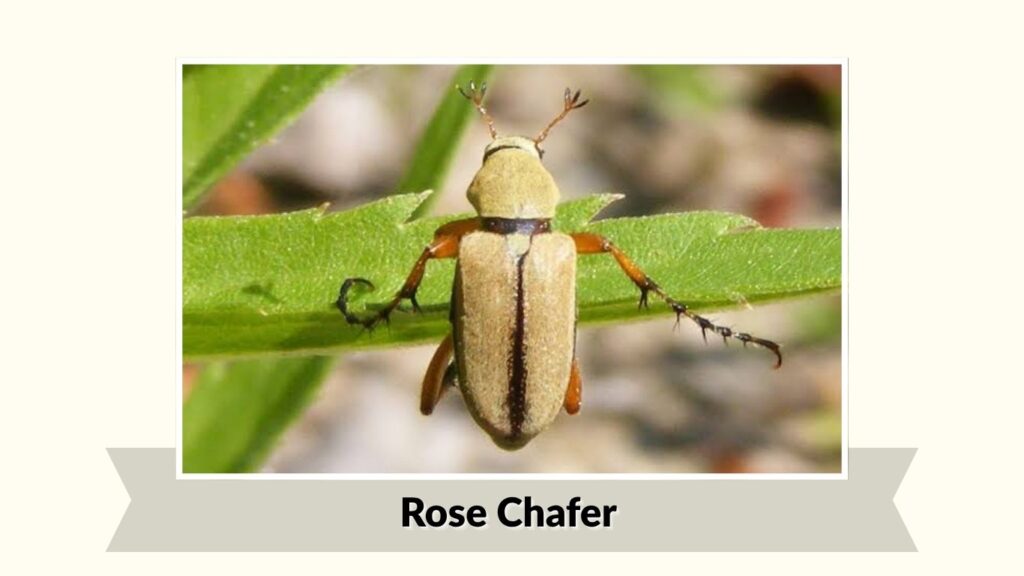
The rose chafer is a slender scarab beetle known for gathering on flowers during late spring and early summer. Despite its name, it does not feed exclusively on roses. Adults consume flowers, foliage, and fruit from numerous plants and can become troublesome when large numbers appear together. Its larvae live underground and feed primarily on grass and weed roots.
Identification
- Adult length: approximately 8–12 mm
- Slender rather than strongly rounded body
- Pale tan, yellowish, or light greenish coloration
- Reddish-brown to orange legs
- Numerous small spines on the legs
- Short, plate-like antennal clubs
- Larvae are white, C-shaped grubs
- Scientific name: Macrodactylus subspinosus
Habitat and Distribution
Rose chafers occur across much of North America and are particularly common in areas with sandy soil. Gardens, vineyards, orchards, meadows, grassy fields, and landscapes containing flowering plants can provide suitable habitat.
Adults are most noticeable on roses, peonies, grapes, raspberries, strawberries, fruit trees, and other flowering or fruiting plants. Sandy locations are especially favorable because females commonly deposit their eggs in sandy soil.
Behavior and Diet
Adult rose chafers frequently gather in groups and consume blossoms, leaves, and developing fruit. Feeding on foliage often leaves irregular holes or a skeletonized appearance where tissue between larger veins has been removed.
Roses and peonies are common targets, but grapes, raspberries, strawberries, apples, cherries, and many ornamental plants can also be attacked.
Larvae behave very differently. They remain underground and feed mainly on roots of grasses and weeds rather than ornamental flowers.
Lifespan and Life Cycle
Rose chafers normally produce one generation per year. Adults emerge from the ground around late May or early June in many temperate locations and feed for approximately three to four weeks.
After mating, females deposit eggs in soil. Eggs hatch after roughly two to three weeks, producing white grubs that feed on grass and weed roots.
The larvae overwinter below the frost line. When spring arrives, they move upward, complete their development, and pupate. New adults then emerge to begin another annual cycle.
9. Bumble Flower Beetle
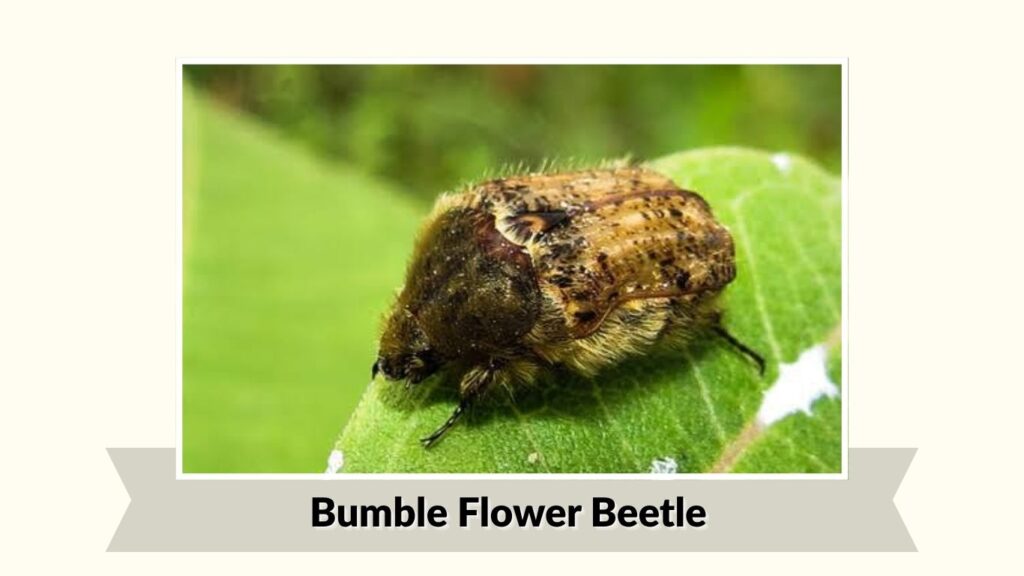
The bumble flower beetle is a fuzzy brown scarab whose appearance and buzzing flight can make it resemble a small bumblebee. Adults are commonly found around flowers, fermenting tree sap, and overripe fruit. Unlike many pest scarab grubs, its larvae primarily consume decomposing organic material and can help recycle nutrients in compost and soil.
Identification
- Adult length: approximately 12–16 mm
- Yellowish-brown to cinnamon-colored wing covers
- Irregular small black markings
- Dense yellow-brown hairs on the head and thorax
- Broad, oval body
- Makes a noticeable buzzing sound while flying
- Larvae are white, C-shaped grubs
- Scientific name: Euphoria inda
Habitat and Distribution
Bumble flower beetles are widely distributed across much of North America. They can be found in fields, meadows, gardens, orchards, farms, compost piles, and other areas containing flowers or decomposing plant material.
Larvae are particularly associated with compost, decaying vegetation, rotting wood, manure, and soils rich in organic material. Adults often appear around flowering plants or places where damaged fruit and fermenting plant sap are available.
Behavior and Diet
Adults feed on nectar and pollen as well as fermenting sap, injured fruit, ripe fruit, and decaying vegetables. They can occasionally damage corn or soft fruit, but serious plant injury is relatively uncommon.
The larvae perform a useful ecological role by feeding primarily on decomposing organic matter rather than healthy plant roots.
Adults are strong fliers. Their fuzzy bodies and loud buzzing flight are responsible for the common name “bumble flower beetle.”
Lifespan and Life Cycle
Bumble flower beetles usually complete one generation annually. Females place eggs in soil containing abundant organic matter or in compost.
The developing grubs consume decomposing material and eventually mature and pupate underground. In Utah, for example, larvae mature during early to midsummer and adults emerge from about mid-August through September.
Adults may then find protected sites in which to overwinter and become active again when warmer conditions return. Seasonal timing varies somewhat across the beetle’s broad geographic range.
10. Figeater Beetle
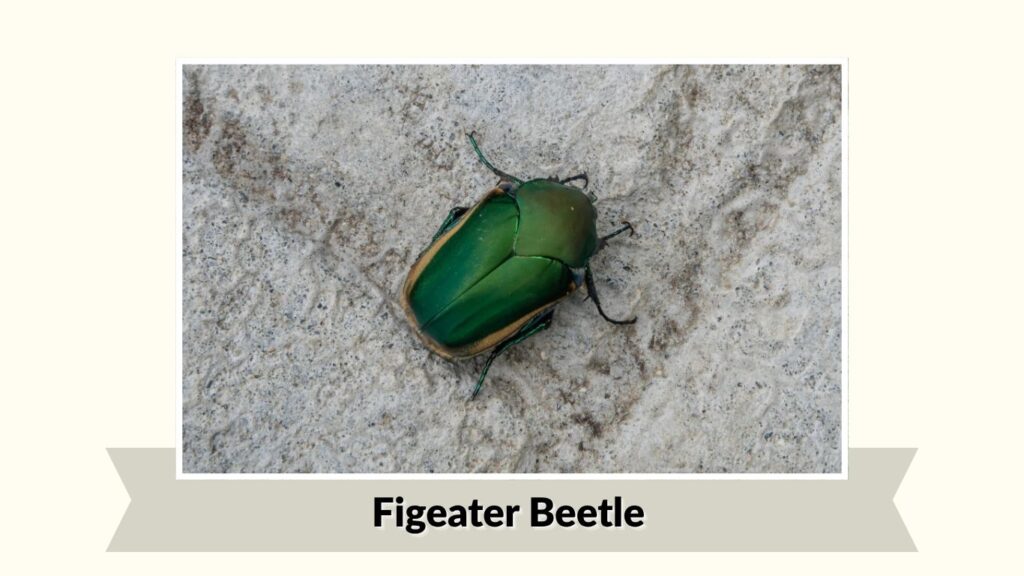
The figeater beetle is a large and impressive metallic-green scarab commonly seen flying during warm summer weather. It is also called the green fruit beetle or western green June beetle. Adults are strongly attracted to ripe and fermenting fruits, while the large grubs develop in compost, manure, mulch, and other decomposing organic material.
Identification
- Adult length: about 19–34 mm
- Brilliant metallic-green body
- Brown or tan margins along the wing covers
- Broad, oval body
- Prominent legs
- Short hornlike projection on the front of the head
- Clubbed antennae with plate-like tips
- Larvae can grow to approximately 2 inches long
- Scientific name: Cotinis mutabilis
Habitat and Distribution
Figeater beetles are primarily associated with the southwestern United States and Mexico, with populations particularly familiar in California and surrounding regions.
They thrive around gardens, orchards, compost piles, farms, lawns, and landscapes containing abundant decomposing organic matter. Adults are capable of flying considerable distances in search of suitable food.
The larvae develop beneath compost, manure, grass clippings, organic mulch, and similar materials.
Behavior and Diet
Adult figeater beetles are strong, noisy fliers and can frequently be seen moving through gardens during daylight. They are particularly attracted to figs, peaches, plums, grapes, apricots, berries, and other soft fruits.
They generally prefer fruit that is already ripe, damaged, cracked, or beginning to ferment rather than attacking hard immature fruit.
Larvae are decomposers. They consume rotting organic matter rather than healthy plant roots and can help break down compost and plant debris.
Lifespan and Life Cycle
Figeater beetles pass through four stages: egg, larva, pupa, and adult. Females place eggs just beneath decomposing organic material. The eggs can hatch in about a week.
Larvae pass through three growth stages while feeding on decaying matter. They overwinter as grubs and mature during the following spring.
The larvae then construct cells from soil particles and pupate. Adults can be present from late spring through early fall. The species normally has one generation each year, with most of the life cycle spent as a larva.
11. Rainbow Scarab
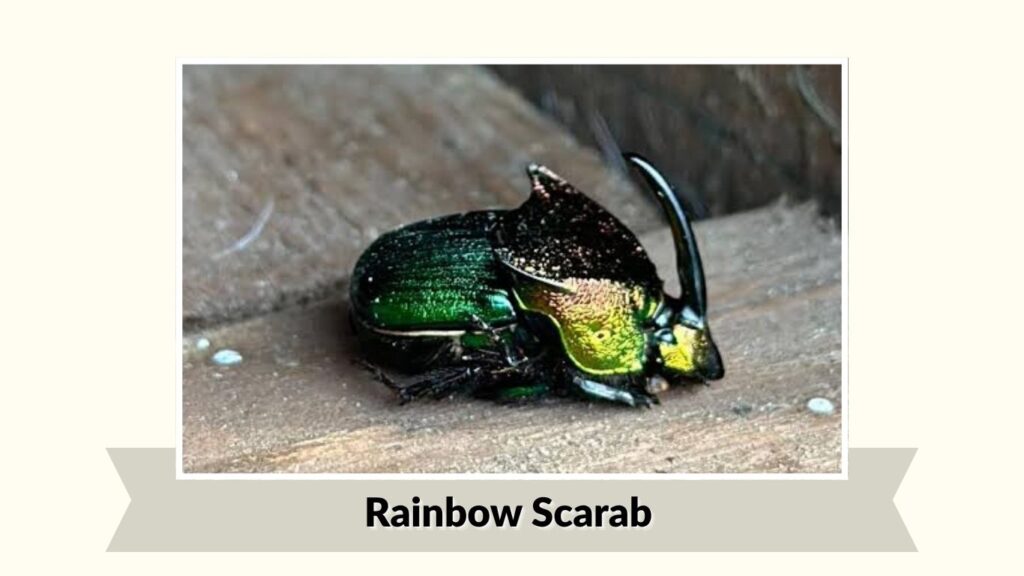
The rainbow scarab is one of North America’s most colorful dung beetles. Its combination of metallic green, gold, copper, and reddish coloration gives it an unmistakable appearance. Rather than feeding on living plants, this beneficial scarab relies mainly on mammal dung, which adults bury underground for food and reproduction.
Identification
- Adult length: approximately 11–22 mm
- Brilliant metallic green wing covers
- Coppery-red or reddish pronotum
- Gold, blue, or iridescent highlights may be visible
- Males may possess a prominent curved horn
- Major males generally have larger horns than minor males
- Females have very small or reduced horns
- Strong front legs adapted for digging
- Scientific name: Phanaeus vindex
Habitat and Distribution
Rainbow scarabs have a broad North American distribution, occurring from the eastern United States westward into parts of the Southwest and south into northern Mexico.
They tolerate a surprisingly wide range of environments, from portions of the Sonoran Desert to subtropical Florida and areas of the northeastern United States.
They are most often associated with open areas where mammal dung is available, including pastures, grasslands, farms, woodland edges, and wildlife habitats.
Behavior and Diet
Rainbow scarabs are dung beetles and feed primarily on mammalian feces. Adults locate fresh dung and dig beneath or close to it.
Instead of simply remaining at the surface, they transport portions underground. Adults can excavate chambers and prepare dung masses that provide both food and breeding resources.
By burying animal waste, rainbow scarabs help return nutrients to the soil, reduce surface dung accumulation, and contribute to natural decomposition processes.
Lifespan and Life Cycle
Reproduction takes place underground. Adults excavate chambers beneath dung and form portions of the material into brood provisions. Eggs are associated with these buried food supplies.
After hatching, the larvae feed on the stored dung rather than searching for food above ground. They pass through several larval stages before pupating inside the protected underground chamber.
New adults later emerge and search for fresh dung to feed and reproduce. The exact timing of development and adult activity varies with climate and geographic location.
12. Sacred Scarab
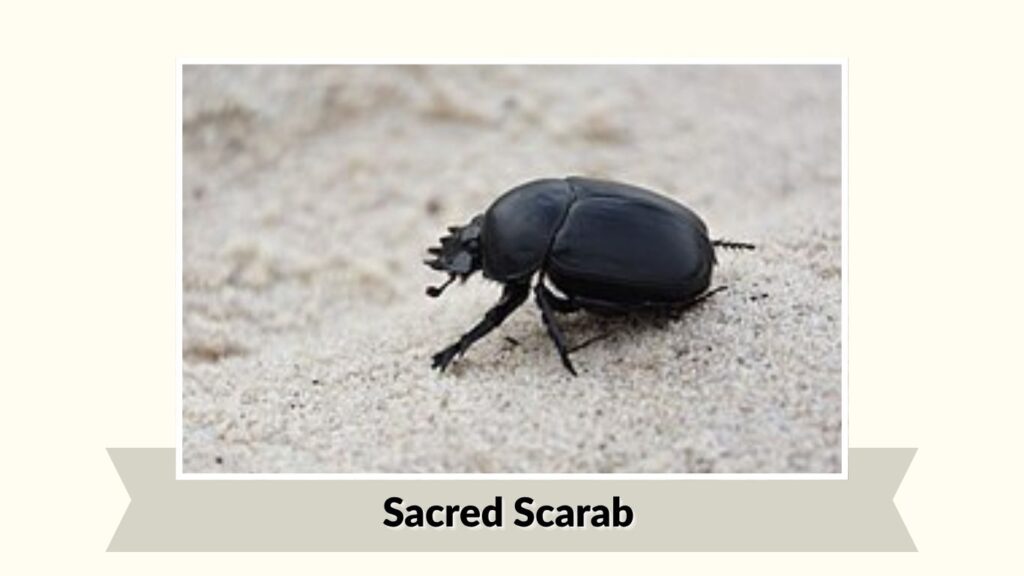
The sacred scarab is perhaps the world’s most culturally famous dung beetle. Ancient Egyptians associated its habit of rolling a round dung ball with the movement of the sun across the sky. Beyond its historical importance, it is an ecologically valuable scarab that removes and buries animal dung in warm, open habitats.
Identification
- Adult length: commonly about 25–40 mm
- Robust, rounded body
- Uniform matte-black coloration
- Broad, flattened head
- Tooth-like projections along the front of the head
- Wide, powerful front legs adapted for digging
- Long, curved hind legs useful for controlling dung balls
- Lacks the metallic colors seen in many other scarabs
- Scientific name: Scarabaeus sacer
Habitat and Distribution
The sacred scarab occurs across North Africa, southern Europe, and western parts of Asia. Its range is strongly associated with the Mediterranean region.
Typical habitats include open grasslands, grazing areas, coastal dunes, marshes, dry scrublands, and other environments where large herbivorous animals provide abundant dung.
In portions of southern Europe, the species is particularly associated with coastal dunes and marshland near the Mediterranean and Black Sea regions.
Behavior and Diet
Sacred scarabs are classic “roller” dung beetles. An adult cuts and shapes fresh dung into a ball, then rolls it away from the original dung pile, often walking backward while controlling the ball with its hind legs.
After locating suitable ground, the beetle digs a chamber and buries the ball. Dung serves as the primary food source for adults.
This behavior also helps remove animal waste from the surface and transfers organic nutrients into the soil.
Lifespan and Life Cycle
When preparing to reproduce, a female selects suitable dung and forms a special breeding ball. She buries it in a deeper chamber and shapes the material into a pear-like form.
A single egg is deposited in a cavity within the brood ball. After hatching, the larva remains protected underground and feeds on the dung supplied by the female.
The larva grows through its immature stages and eventually pupates before emerging as an adult. A female may prepare several individual brood balls during her reproductive period, giving each developing larva its own underground food supply.
13. Tumblebug
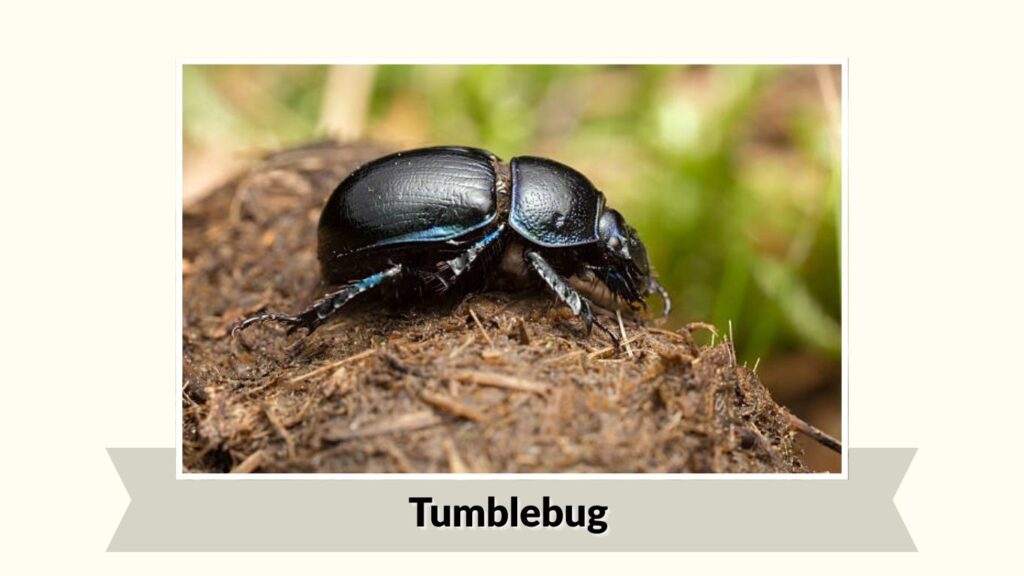
Tumblebugs are dung beetles known for shaping animal dung into balls and rolling them away from the original dung pile. They belong to the scarab beetle family and play an important role in recycling nutrients. Their behavior is especially noticeable in pastures, grasslands, and other places where large mammals regularly leave dung.
Identification
- Adult length: commonly 10–25 mm
- Usually black, dark brown, or metallic in color
- Rounded and strongly built body
- Broad head adapted for pushing dung
- Powerful front legs designed for digging
- Hind legs help control and roll dung balls
- Antennae end in plate-like clubs
- Many species belong to the genus Canthon
Habitat and Distribution
Tumblebugs occur in many warm and temperate regions, especially throughout the Americas. They are commonly found in grasslands, cattle pastures, open woodlands, farms, prairies, and wildlife habitats.
Their presence depends heavily on the availability of animal dung. Areas used by cattle, deer, horses, and other mammals can support large populations. Some species prefer open sunny habitats, while others are more common in forests.
Behavior and Diet
Tumblebugs feed primarily on mammal dung. Adults arrive quickly at fresh droppings and cut off portions, which they shape into compact balls.
The beetle then rolls the ball away, sometimes over surprisingly long distances. This behavior reduces competition with other dung beetles. The ball may be buried as food or used for reproduction.
By moving dung underground, tumblebugs improve soil fertility, recycle nutrients, and help reduce surface waste.
Lifespan and Life Cycle
The life cycle begins when adults bury a dung ball in a small underground chamber. A female lays an egg near or inside the prepared food supply.
After hatching, the larva feeds on the stored dung. It passes through several grub stages before pupating inside the chamber.
A new adult eventually emerges and begins searching for dung. Depending on the species and climate, tumblebugs may produce one or several generations each year. Adults can remain active for several months during warm seasons.
14. Earth-Boring Dung Beetle
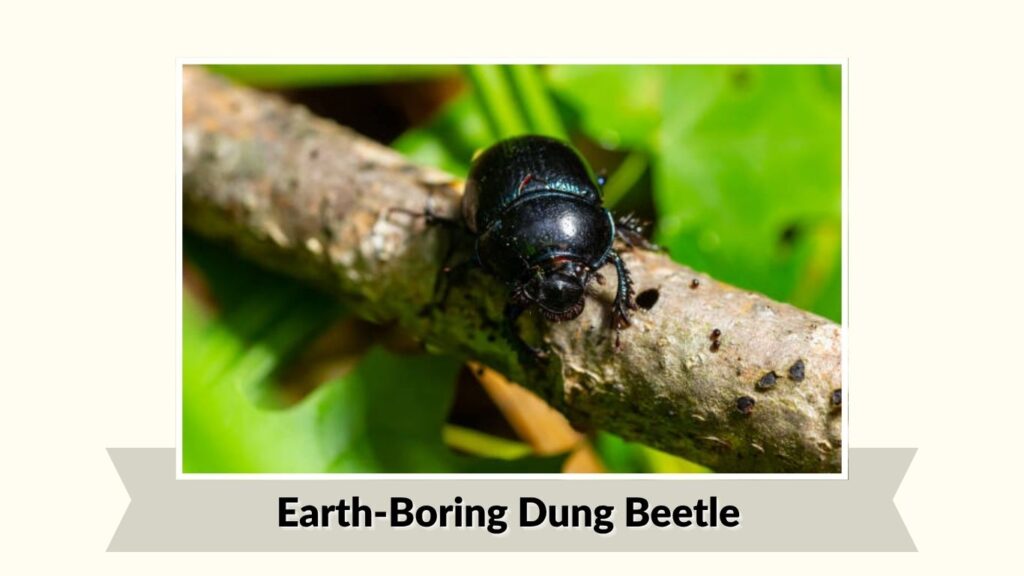
Earth-boring dung beetles differ from classic dung rollers because they usually dig directly beneath or beside a dung source. Instead of transporting dung far away, they pull pieces underground into tunnels. Their burrowing activity improves soil structure while also recycling nutrients and removing animal waste from the surface.
Identification
- Adult length: often 10–30 mm
- Black, dark brown, or slightly metallic body
- Compact and strongly convex shape
- Powerful front legs with broad digging teeth
- Short, clubbed antennae
- Thick exoskeleton
- Some males develop small horns or projections
- Many belong to the family Geotrupidae
Habitat and Distribution
Earth-boring dung beetles occur across Europe, Asia, North America, and other temperate regions. They are commonly found in pastures, woodland edges, farmland, meadows, and areas frequented by livestock or wildlife.
They prefer soils that are loose enough for tunneling. Moist but well-drained ground is particularly suitable because adults must excavate underground nesting chambers.
Behavior and Diet
Adults feed mainly on dung, although some species also consume decaying plant material, fungi, or rotting organic matter.
Instead of rolling dung balls, they dig deep tunnels beneath the food source. Pieces of dung are carried underground and stored in side chambers.
This behavior aerates soil and increases the amount of organic material below the surface. Their tunnels can also improve water penetration and nutrient movement.
Lifespan and Life Cycle
Adults usually reproduce after locating a suitable dung source. A male and female may cooperate in excavating a burrow and transporting dung into underground chambers.
The female lays eggs in separate brood cells containing stored food. After hatching, the larvae feed on the dung provided by the adults.
Larvae develop underground and eventually pupate within the burrow. The full life cycle varies among species and climates, but many require several months to approximately one year to complete development.
15. Minotaur Beetle
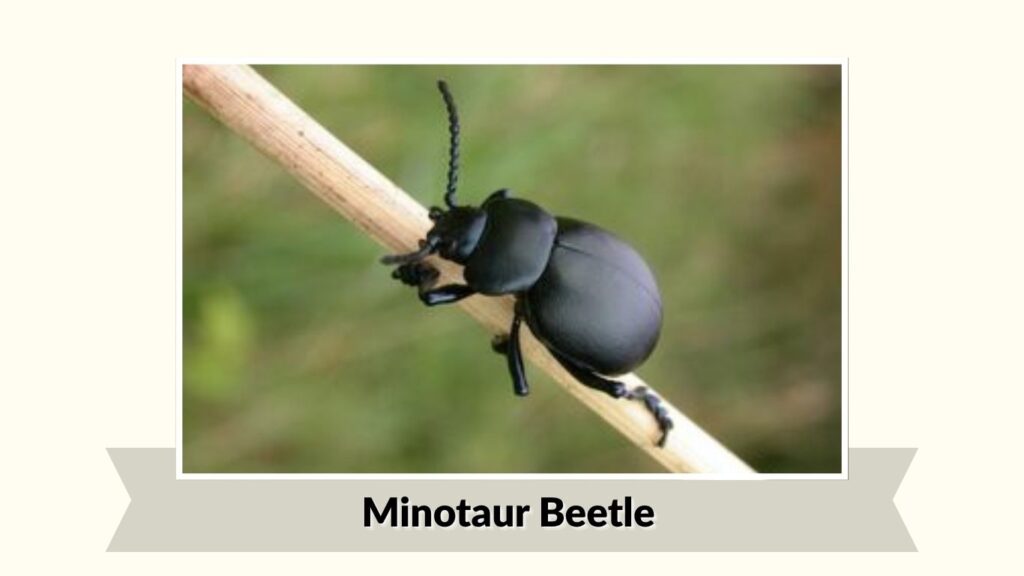
The Minotaur beetle is a distinctive earth-boring scarab relative known for the impressive horn-like projections found on males. Despite its intimidating appearance, it is not dangerous to people. It spends much of its life underground and relies heavily on herbivore dung as a food source for both adults and developing larvae.
Identification
- Adult length: approximately 15–25 mm
- Glossy black body
- Males have three prominent horn-like projections
- Females lack the large male horns
- Strong, toothed front legs
- Thick, rounded body
- Deep grooves visible on the wing covers
- Scientific name: Typhaeus typhoeus
Habitat and Distribution
Minotaur beetles occur mainly in western Europe, including Britain and parts of mainland Europe. They are typically associated with sandy heathland, grassland, dunes, open woodland, and other areas containing light, well-drained soil.
They are especially common where rabbits, deer, sheep, cattle, or other mammals provide a steady source of dung.
Behavior and Diet
Adults feed largely on dung and spend much of their time digging beneath the soil surface. They construct deep burrows and transport dung underground to provision their offspring.
The horns of male Minotaur beetles are mainly associated with competition and mating rather than feeding. Males may use them when competing over access to females or burrows.
Their feeding and tunneling activities help decompose waste and improve soil quality.
Lifespan and Life Cycle
Breeding adults dig vertical tunnels that may extend deep into the soil. Several side chambers are created and stocked with pieces of dung.
Females lay eggs inside these provisioned chambers. The larvae hatch and consume the stored material while remaining protected below ground.
After completing several larval stages, they pupate and later emerge as adults. Development can take many months, and adult activity often occurs from autumn through spring in milder climates.
16. Hercules Beetle
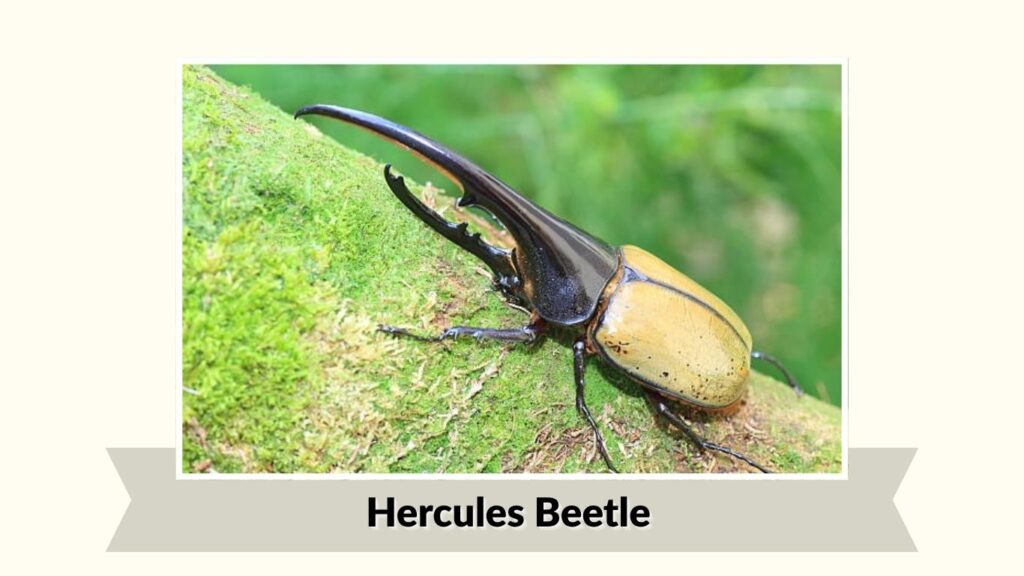
The Hercules beetle is one of the largest and most dramatic scarab beetles in the world. Males are famous for their enormous horns, which can make up a substantial portion of their total body length. Despite their powerful appearance, adults are generally harmless and spend much of their time feeding on fruit and tree sap.
Identification
- Adult length: up to about 170 mm including horns
- Males have two enormous opposing horns
- Females lack the large horns
- Olive, yellowish, or greenish wing covers
- Dark spots may appear on the wing covers
- Head and thorax are typically black
- Strong legs with sharp claws
- Scientific name: Dynastes hercules
Habitat and Distribution
Hercules beetles are native to tropical regions of Central America, South America, and the Caribbean. They inhabit humid tropical and subtropical forests where decaying wood is abundant.
Adults are often found around fallen fruit, tree sap, and forest vegetation. Larvae develop inside or beneath rotting logs and decomposing wood.
Behavior and Diet
Adult Hercules beetles feed mainly on ripe fruit, fermenting fruit, and tree sap. They are generally nocturnal and are sometimes attracted to artificial lights.
Males use their huge horns during contests with other males. Two beetles may grapple and attempt to lift or throw one another from a feeding or mating site.
Larvae feed on decaying wood and play a role in breaking down dead forest material.
Lifespan and Life Cycle
Females lay eggs in rotting wood or soil rich in decomposed woody material. The larvae hatch and grow into extremely large white grubs.
The larval stage lasts much longer than the adult stage and may continue for one to two years. Mature larvae construct chambers where they pupate.
Adults emerge after metamorphosis and generally survive for several months. During that time, they feed, mate, and reproduce, completing the cycle.
17. Eastern Hercules Beetle
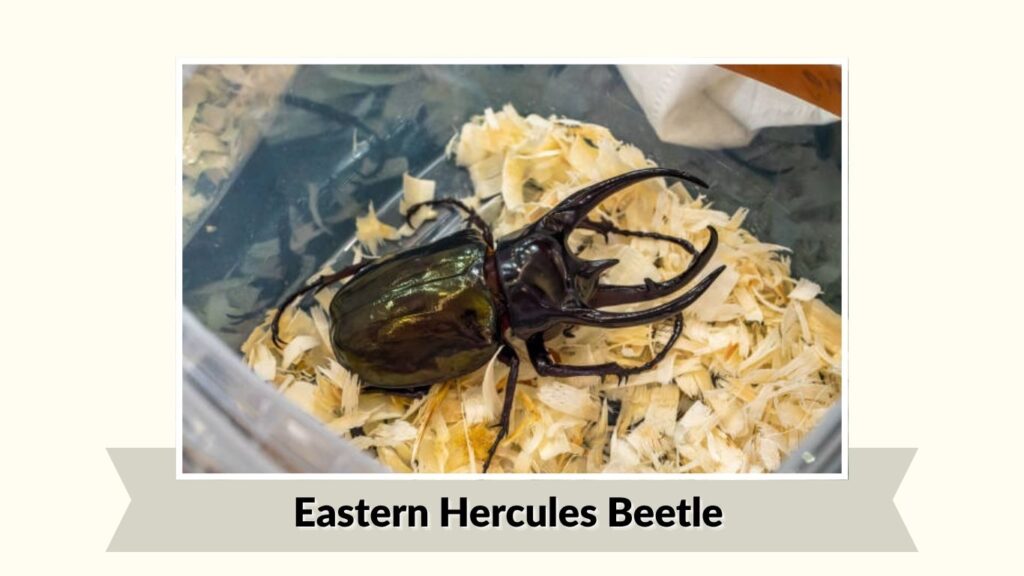
The Eastern Hercules beetle is one of the largest beetles in North America. Male beetles are instantly recognizable by their long, curved horns, while females are hornless and more robust in appearance. These beetles are usually found around forests where their larvae can develop inside decaying hardwood.
Identification
- Adult length: approximately 35–60 mm, excluding extreme horn length
- Males have one large upper horn and one lower horn
- Females have no large horns
- Wing covers are greenish-gray, yellowish, or olive
- Irregular dark spots may be present
- Black head and thorax
- Strong, hooked legs
- Scientific name: Dynastes tityus
Habitat and Distribution
Eastern Hercules beetles occur primarily in the eastern United States. Their range extends through much of the Southeast and into parts of the Midwest and eastern regions.
They are most commonly associated with deciduous forests, wooded parks, and landscapes containing old or fallen hardwood trees.
Larvae need decaying wood, especially rotting hardwood logs and stumps, for successful development.
Behavior and Diet
Adults feed on tree sap and overripe or fermenting fruit. They are mostly nocturnal and may fly to outdoor lights during warm summer evenings.
Male horns are used primarily in competition. Males wrestle with rivals and attempt to lift or push them away when competing for access to females.
The larvae feed on rotten wood rather than living trees, meaning they usually do not cause significant damage to healthy forests.
Lifespan and Life Cycle
Females deposit eggs in decomposing wood or in soil immediately around rotting logs. After hatching, larvae feed on softened woody material for an extended period.
The grub stage may last one to two years depending on environmental conditions. Mature larvae create pupal chambers from surrounding material.
Adults emerge during warm weather and typically live for several months. Most of the beetle’s life is therefore spent underground or inside decaying wood as a larva.
18. Western Hercules Beetle
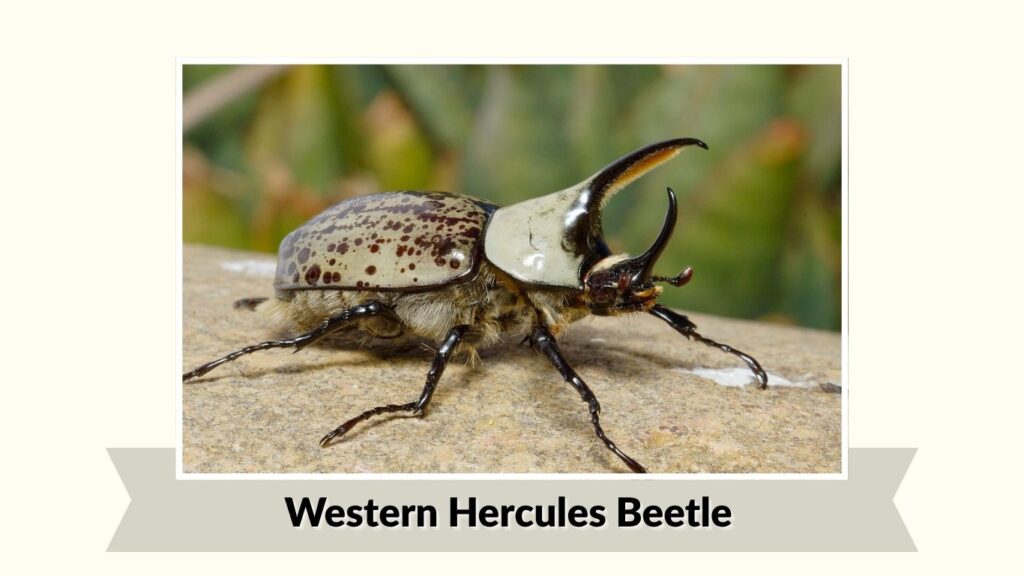
The Western Hercules beetle is a large rhinoceros beetle found in the southwestern United States and parts of Mexico. Like its eastern relative, males have impressive horns used in contests. Its pale wing covers covered with dark spots provide good camouflage against bark and other natural surfaces.
Identification
- Adult length: approximately 35–60 mm
- Males possess long, curved horns
- Females lack prominent horns
- Pale gray, greenish-gray, or yellowish wing covers
- Numerous dark spots or markings
- Black head and thorax
- Strong, spiny legs
- Scientific name: Dynastes grantii
Habitat and Distribution
Western Hercules beetles are found mainly in the southwestern United States, particularly Arizona and New Mexico, as well as northern Mexico.
They inhabit oak woodlands, mountain forests, canyons, and other areas containing mature trees and decaying wood. Their distribution is strongly influenced by suitable habitat and moisture.
Adults may be encountered around lights, tree sap, and fallen fruit during warm summer nights.
Behavior and Diet
Adults feed on sap and ripe or fermenting fruits. They are largely nocturnal and usually remain hidden during daylight hours.
Males use their horns to wrestle rivals. They position an opponent between the upper and lower horns and attempt to lift or throw it aside.
Larvae feed on decomposing wood and organic material. This makes them useful decomposers rather than pests of healthy trees.
Lifespan and Life Cycle
Females lay eggs near or inside decaying hardwood. The young larvae feed on decomposed wood and gradually grow into very large white grubs.
The larval stage generally lasts much longer than adulthood and may continue for one or more years. Once fully grown, a larva creates a chamber and pupates.
Adults usually emerge during summer, when warm weather encourages feeding and mating activity. They survive for several months, while the majority of their overall life cycle is spent as larvae.
19. Coconut Rhinoceros Beetle
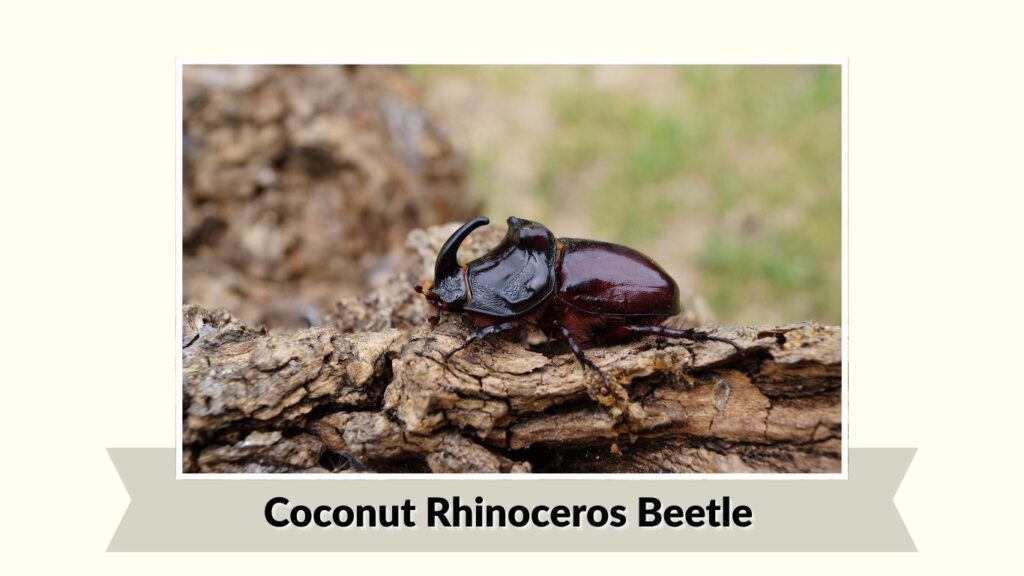
The Coconut rhinoceros beetle is a large, powerful scarab beetle best known as a serious pest of coconut and other palm trees. Adults bore into palm crowns and feed on tender tissue, sometimes causing significant damage to developing leaves. Its large size, glossy dark body, and horn-like projection make it easy to recognize.
Identification
- Adult length: about 30–50 mm
- Dark brown to black body
- Smooth, shiny appearance
- Males usually have a longer horn on the head
- Females have a shorter horn
- Broad, heavy body
- Strong, spiny legs
- Larvae are large, creamy-white C-shaped grubs
- Scientific name: Oryctes rhinoceros
Habitat and Distribution
Coconut rhinoceros beetles are native to parts of Asia but have spread to many tropical regions, including islands across the Pacific.
They are commonly found in coconut plantations, palm-growing areas, gardens, forests, compost piles, rotting logs, and sites containing decomposing palm material.
Adults are strongly associated with coconut palms but may also attack oil palms, date palms, and other palm species.
Behavior and Diet
Adult beetles bore into the crown of palm trees and feed on soft plant tissue. Their feeding can create characteristic V-shaped cuts in emerging leaves.
Severe infestations can weaken young palms and may even kill them if the growing point is heavily damaged.
The larvae do not attack healthy palms directly. Instead, they feed on decomposing organic matter, particularly rotting wood, compost, manure, and decaying palm trunks.
Lifespan and Life Cycle
Females lay eggs in rotting plant material, compost, sawdust, manure, or decaying logs. Eggs hatch into large white grubs that feed on decomposing material.
The larval stage passes through several growth stages and may last several months. Mature larvae construct pupal chambers from soil and organic matter.
Adults emerge and begin searching for suitable palms. Under favorable tropical conditions, the entire life cycle can be completed within several months, allowing multiple generations over time.
20. European Rhinoceros Beetle
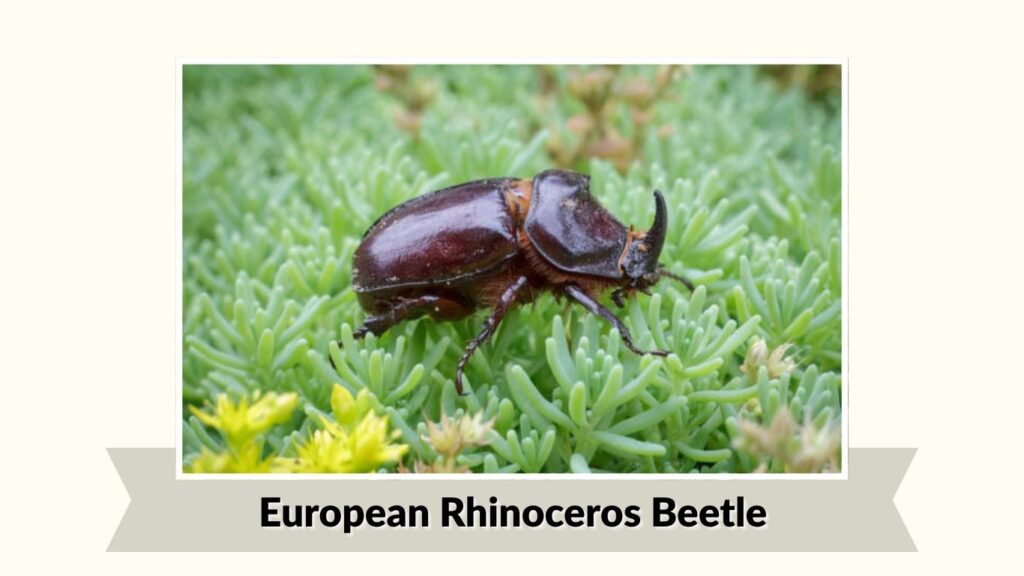
The European rhinoceros beetle is one of Europe’s largest scarab beetles. Males are especially distinctive because of the curved horn on the head, which gives the species its rhinoceros-like appearance. Despite its impressive size, it is harmless to people and mainly contributes to decomposition during the larval stage.
Identification
- Adult length: approximately 25–40 mm
- Dark reddish-brown to chestnut coloration
- Males have a prominent curved horn
- Females have only a small raised projection
- Strong, rounded body
- Smooth and shiny wing covers
- Powerful digging legs
- Scientific name: Oryctes nasicornis
Habitat and Distribution
European rhinoceros beetles are widely distributed throughout Europe and extend into parts of North Africa and western Asia.
They are often found in forests, parks, gardens, compost heaps, sawdust piles, wood-chip areas, and places containing decomposing timber.
Larvae require large amounts of decaying organic material, so modern compost piles can provide suitable breeding habitats.
Behavior and Diet
Adults are mainly nocturnal and may fly during warm summer evenings. They are sometimes attracted to lights.
Adult feeding is limited, and many individuals rely largely on stored energy accumulated during the larval stage. Some may consume tree sap or other sugary liquids.
The larvae feed on decomposing wood and organic matter. They help break down dead plant material and return nutrients to the soil.
Lifespan and Life Cycle
Females lay eggs in rotting wood, compost, old sawdust, or similar materials. The larvae hatch and grow into large white grubs.
Larval development can take two to four years depending on temperature and food availability. During this period, the grubs consume large quantities of decomposing material.
Once fully developed, the larva pupates inside a chamber. Adults eventually emerge, usually during the warmer months. The adult stage is relatively short compared with the lengthy larval period.
21. Elephant Beetle
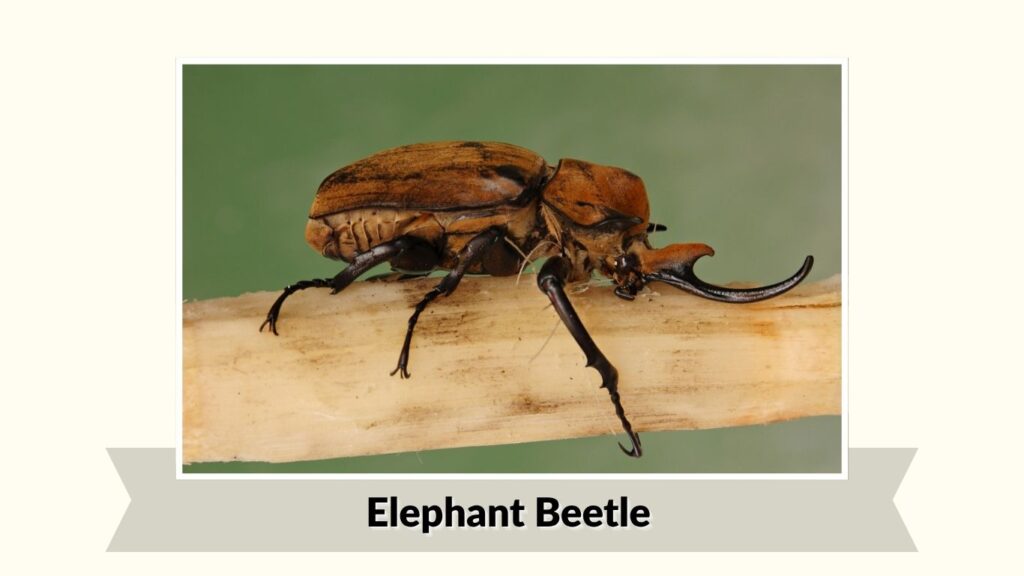
The Elephant beetle is a massive rhinoceros beetle found in tropical forests of Central and South America. Males possess prominent horns and can reach impressive sizes. Although their appearance may seem intimidating, they are not dangerous to humans and spend much of their time feeding on tree sap and ripe fruit.
Identification
- Adult length: commonly 70–120 mm
- Dark brown to black body
- Dense covering of fine yellowish or golden hairs
- Males have a long central horn
- Additional shorter horns occur on the thorax
- Females lack large horns
- Broad, heavily built body
- Scientific name: Megasoma elephas
Habitat and Distribution
Elephant beetles inhabit tropical rainforests from Mexico through Central America and into parts of northern South America.
They are strongly associated with mature forests containing large trees, fallen logs, and abundant decaying wood.
Adults are generally found near tree trunks, sap flows, ripe fruit, and forest vegetation. Larvae live inside decomposing logs or beneath rotting woody material.
Behavior and Diet
Adult elephant beetles feed mainly on tree sap and soft, ripe fruit. They are primarily nocturnal and may remain hidden during daylight hours.
Males use their horns during competition for females. Rival males may push, lift, or overturn one another.
Larvae feed on decomposing wood rather than living trees. Their feeding helps break down fallen timber and supports nutrient recycling in tropical forest ecosystems.
Lifespan and Life Cycle
Females deposit eggs in rotting logs, tree cavities, or decomposing wood. The larvae hatch and remain inside this material for a long developmental period.
Grubs can grow exceptionally large and may spend two or more years feeding before reaching maturity.
Once fully developed, the larva constructs a protective chamber and pupates. Adults emerge after metamorphosis and typically live for several months, focusing mainly on feeding and reproduction.
22. Ox Beetle
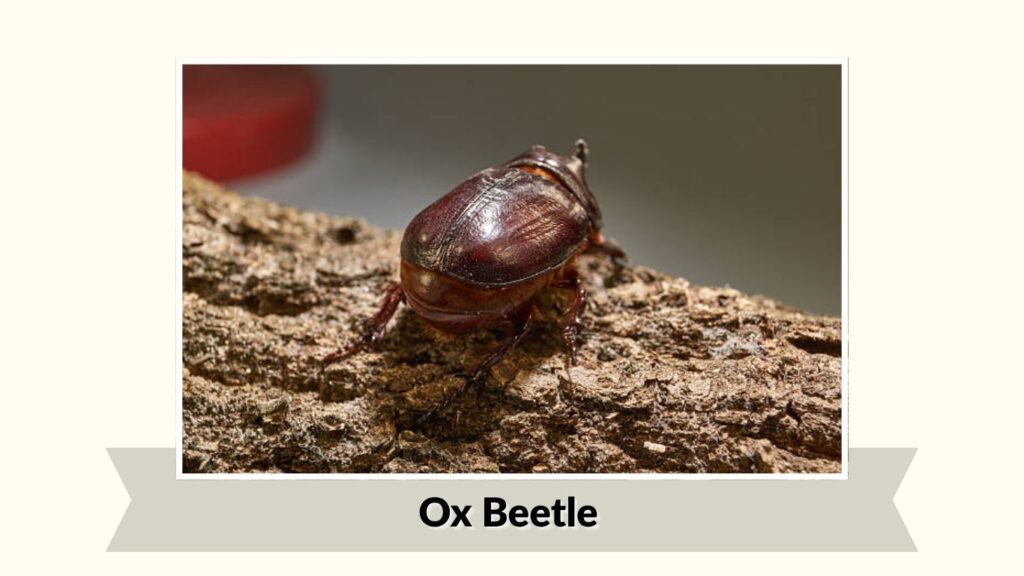
The Ox beetle is a robust rhinoceros beetle found mainly in the southern United States and parts of Central America. Male beetles have three prominent horn-like projections, giving them a distinctive appearance. Adults are mostly nocturnal, while the larvae develop in soil rich in decomposing organic matter.
Identification
- Adult length: approximately 25–40 mm
- Dark brown, reddish-brown, or nearly black
- Males usually have three horns
- One horn occurs on the head
- Two additional horns occur on the thorax
- Females lack prominent horns
- Broad, rounded body
- Scientific name: Strategus aloeus
Habitat and Distribution
Ox beetles occur from the southern United States through Mexico and into parts of Central America.
They are commonly found in grasslands, farmland, gardens, wooded areas, compost-rich soil, and places containing decaying vegetation.
Adults may also occur around palm trees, ornamental landscapes, and areas where organic debris accumulates.
Behavior and Diet
Adult Ox beetles are mainly active at night. They may feed on decaying plant matter, roots, sap, or other plant materials.
Males use their horns during contests with rivals. These interactions usually involve pushing and lifting rather than serious injury.
The larvae live underground and feed on decomposing organic matter, including rotting roots, wood, and plant debris.
Lifespan and Life Cycle
Females lay eggs in soil rich in decomposing plant material. The larvae hatch as white grubs and spend several months feeding and growing.
They pass through multiple larval stages before forming pupal chambers underground.
Adults eventually emerge, usually during warm weather. Depending on environmental conditions, the life cycle may take close to one year, although development can vary with temperature and food availability.
23. Unicorn Beetle
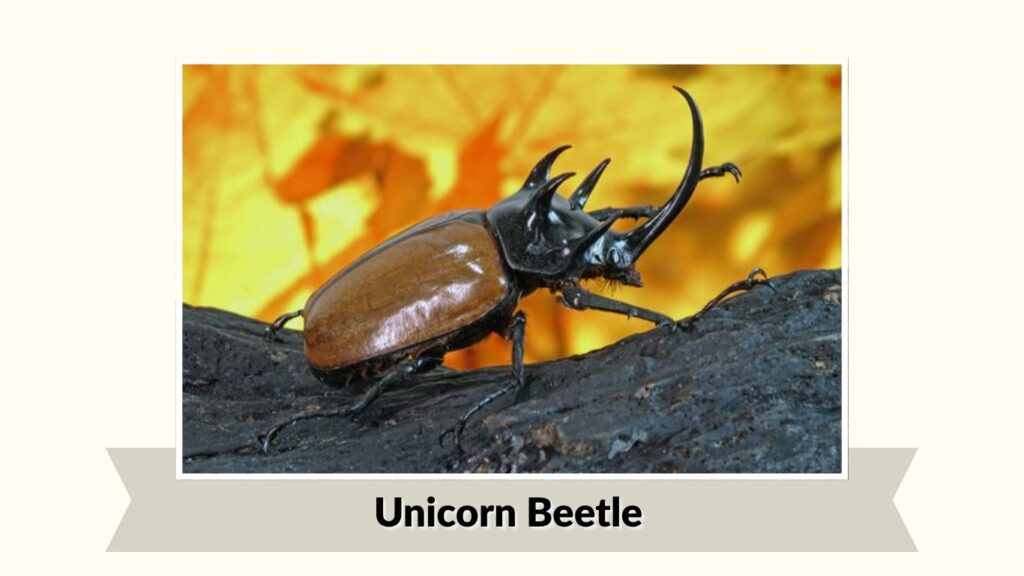
The Unicorn beetle is a rhinoceros beetle named for the single prominent horn found on the male’s head. It is commonly encountered in parts of the southeastern United States. Despite its dramatic appearance, it is harmless and plays a beneficial role during its larval stage by feeding on decaying wood.
Identification
- Adult length: approximately 25–35 mm
- Shiny brown to dark reddish-brown body
- Males have a single prominent horn
- Females lack the large horn
- Thick, rounded body
- Strong, toothed front legs
- Larvae are large, white, C-shaped grubs
- Scientific name: Dynastes? No — commonly associated with Xyloryctes jamaicensis
Habitat and Distribution
Unicorn beetles are mainly found in the eastern and southeastern United States.
They occur in hardwood forests, suburban landscapes, parks, and areas containing old trees, fallen logs, or decomposing wood.
Larvae develop in rotting hardwood, while adults may be found around trees or attracted to outdoor lights during warm nights.
Behavior and Diet
Adults are primarily nocturnal and spend much of the day hidden beneath bark, leaf litter, or vegetation.
They may feed on tree sap and other plant liquids, although adults often eat relatively little compared with their larvae.
The larvae consume rotting hardwood and other decomposing organic material. This feeding assists with the breakdown of dead wood and contributes to nutrient recycling.
Lifespan and Life Cycle
Females lay eggs in decaying logs, rotting stumps, or soil containing large amounts of decomposed wood.
After hatching, larvae feed and grow inside the decaying material. Their development may continue for one or more years.
Mature larvae create chambers in which they pupate. Adults then emerge during the warmer part of the year, mate, and begin another generation.
24. Goliath Beetle
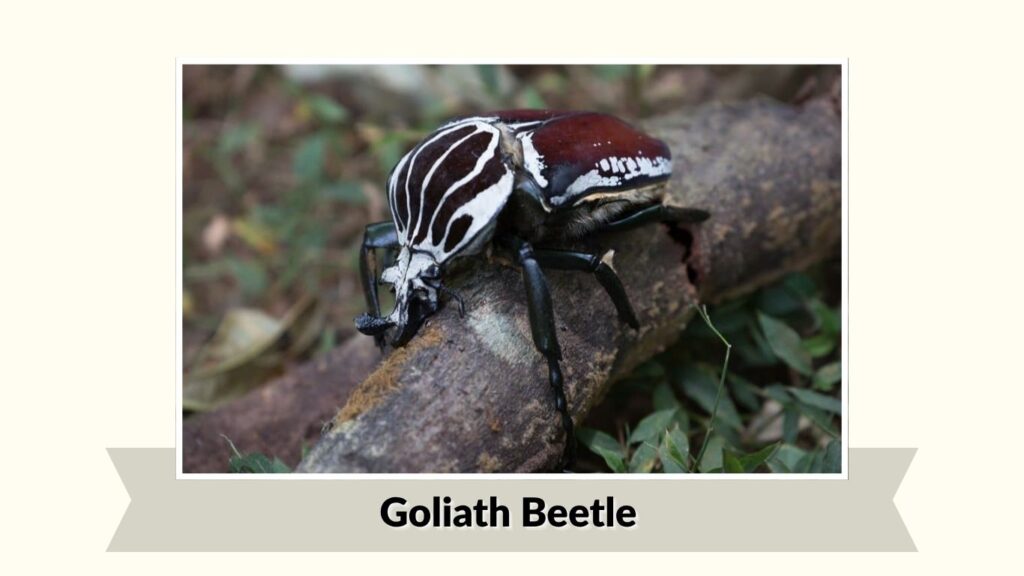
Goliath beetles are among the heaviest and most spectacular beetles in the world. They belong to the scarab family and are native to tropical Africa. Their bold black-and-white patterns, large bodies, and horned males make them highly recognizable. Adults feed on sugary plant materials, while larvae develop in decaying organic matter.
Identification
- Adult length: approximately 50–110 mm
- Bold black, white, or brown patterning
- Thick, heavily built body
- Males have a Y-shaped horn on the head
- Females lack the large horn
- Strong legs with sharp claws
- Body coloration varies among species
- Belongs to the genus Goliathus
Habitat and Distribution
Goliath beetles occur across tropical and equatorial Africa. Different species occupy rainforests, woodland edges, savannas, and other warm habitats.
They are especially associated with areas containing large trees, abundant plant sap, fruit, and decomposing vegetation.
Adults often remain high in trees, which can make them difficult to observe despite their large size.
Behavior and Diet
Adult Goliath beetles consume tree sap, nectar, soft fruit, and other sugary foods. They are powerful climbers and can grip bark using their strong claws.
Males may use their horned heads when competing with rival males. They attempt to push or lift opponents away from favorable feeding or mating locations.
Larvae are very different in diet. They consume decomposing organic matter and require substantial amounts of protein-rich material while growing.
Lifespan and Life Cycle
Females lay eggs in soil or decomposing organic material. The larvae grow into enormous grubs and pass through several developmental stages.
The larval period can last several months and represents the longest part of the life cycle. Once mature, the larva constructs a chamber and pupates.
After metamorphosis, the adult emerges and becomes active above ground. Adult Goliath beetles generally live for only a few months, while the complete development from egg to adult can take close to a year depending on species and environmental conditions.
25. Derby’s Flower Beetle
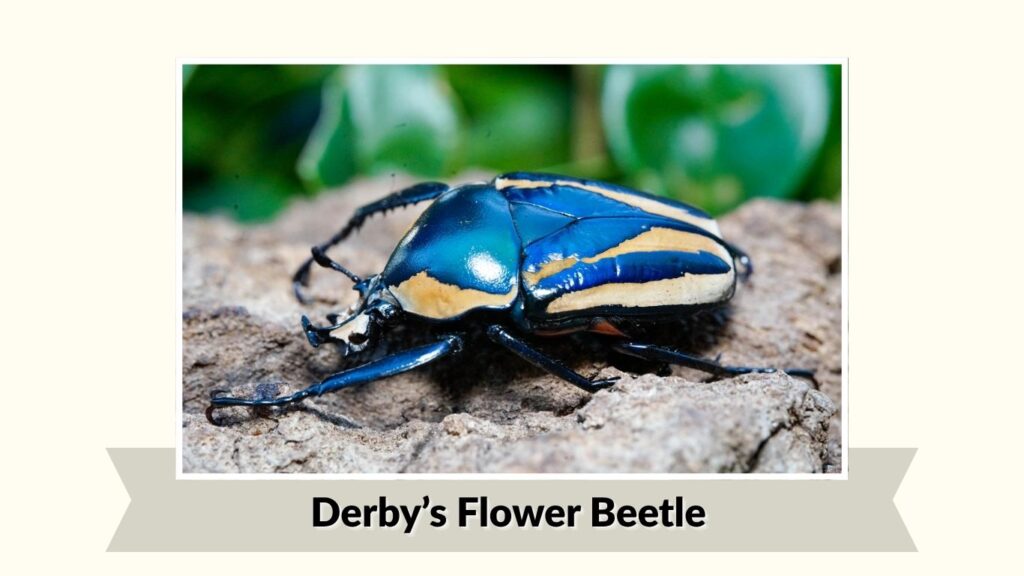
Derby’s flower beetle is a striking scarab known for its glossy coloration and contrasting markings. It belongs to the flower chafer group and is native to Africa. Adults are active during warm daylight hours and are often found around flowers, fruit, and tree sap. Their large size and attractive appearance also make them well known among beetle enthusiasts.
Identification
- Adult length: approximately 35–50 mm
- Glossy green, bronze, or dark coloration
- Distinct white or cream markings
- Strong, elongated legs
- Broad but slightly flattened body
- Males may have a small horn-like projection
- Females are generally more rounded
- Scientific name: Dicronorhina derbyana
Habitat and Distribution
Derby’s flower beetles are native to sub-Saharan Africa. They occur in tropical and subtropical woodlands, savannas, forest edges, and other warm environments containing flowering or fruiting vegetation.
Adults are usually encountered around trees, flowers, and fallen fruit. Larvae prefer decomposing organic material, especially soil mixed with rotting leaves and wood.
Warm temperatures and abundant plant material provide the best conditions for their development.
Behavior and Diet
Adults are primarily fruit and nectar feeders. They consume ripe bananas, mangoes, papayas, and other soft fruits as well as flower nectar, pollen, and tree sap.
They are active during daylight and are strong fliers. Males may compete with one another for access to females or feeding areas.
The larvae feed mainly on decomposing leaves, wood fragments, and other organic material rather than healthy plants.
Lifespan and Life Cycle
Females lay eggs in moist, organic-rich soil. The eggs hatch into white grubs that pass through several larval stages.
Larval development can last several months, during which the grubs feed heavily on decomposing vegetation. Mature larvae construct chambers from soil and organic debris before pupating.
Adults emerge after metamorphosis and generally survive for several months. The complete life cycle may take around eight months to a year depending on temperature, humidity, and food availability.
26. Sun Beetle
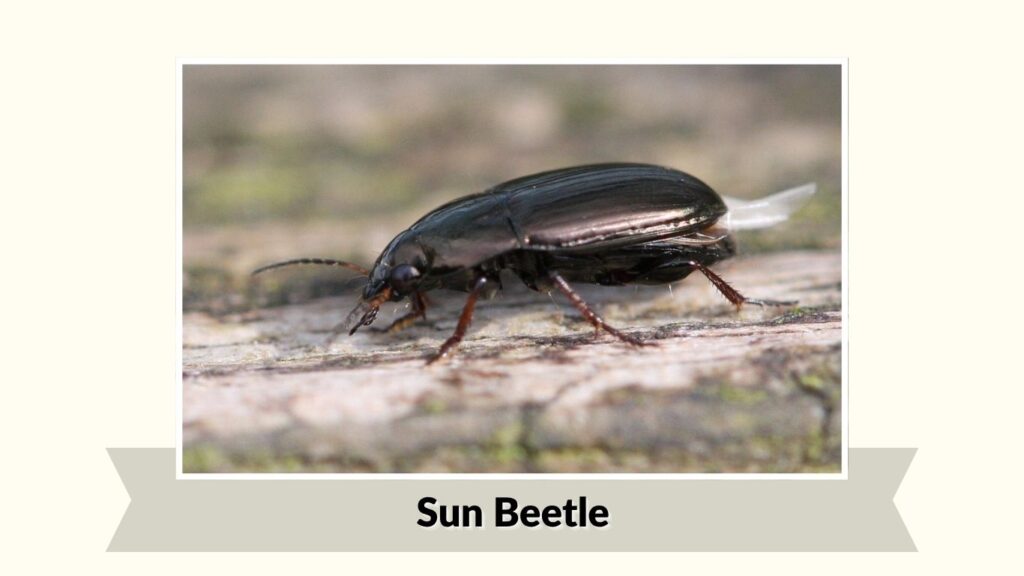
The Sun beetle is a brightly colored African flower chafer often recognized by its yellowish body covered with dark markings. It is active during daylight, especially under warm conditions. Adults frequently visit flowers and ripe fruits, while the larvae spend their development in decomposing organic material.
Identification
- Adult length: approximately 20–30 mm
- Yellow, orange, or brownish body
- Numerous dark spots or irregular markings
- Slightly flattened oval body
- Strong legs adapted for climbing
- Clubbed antennae
- Larvae are thick, white C-shaped grubs
- Scientific name: Pachnoda marginata
Habitat and Distribution
Sun beetles are native to tropical and subtropical regions of Africa. They inhabit savannas, open woodlands, forest edges, gardens, and agricultural areas.
Adults prefer warm, sunny locations containing flowering plants and fruit. They may be found feeding on damaged or overripe fruits that have fallen to the ground.
Larvae usually develop in decomposing leaves, rotting wood, compost, and nutrient-rich soil.
Behavior and Diet
Adult Sun beetles feed on pollen, nectar, tree sap, and soft fruit. Bananas, mangoes, papayas, and other sugary fruits are especially attractive.
They are mainly diurnal, meaning they are active during the daytime. Their strong flight allows them to move between flowers and fruiting plants.
Larvae function primarily as decomposers. By consuming dead plant material, they contribute to the recycling of nutrients within the soil.
Lifespan and Life Cycle
Females place their eggs in moist substrate containing abundant decomposing vegetation. The eggs hatch into small white grubs that grow through several larval stages.
The larval stage normally lasts several months. Fully developed larvae create protective pupal chambers using surrounding soil and organic material.
After emerging as adults, Sun beetles usually survive for several months. Under favorable warm conditions, the complete life cycle can be completed within roughly six to twelve months.
27. Emerald Flower Chafer
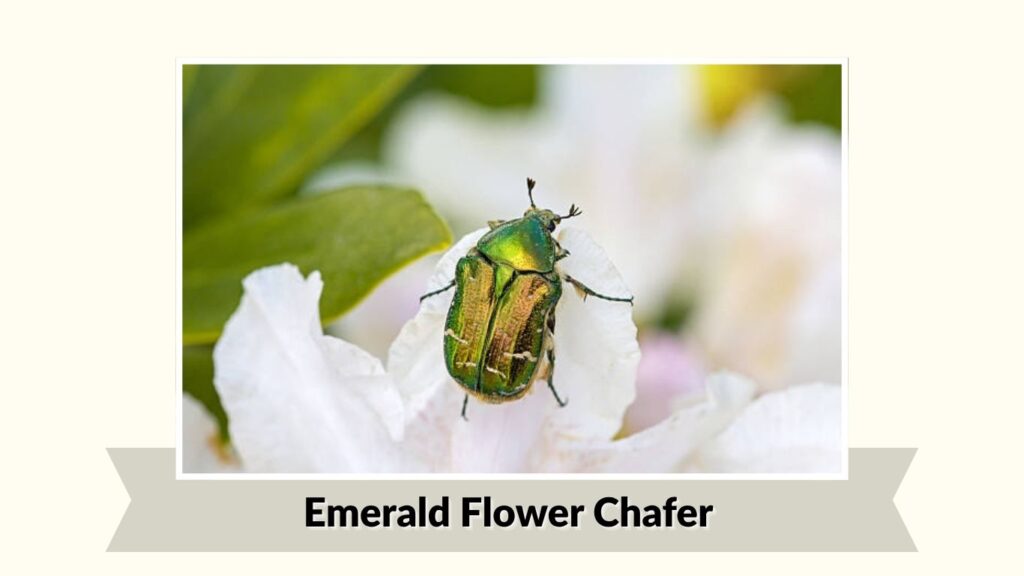
The Emerald flower chafer is an eye-catching scarab distinguished by its brilliant metallic green coloration. Like other flower chafers, adults are often associated with flowers, fruits, and sap flows. Its vivid reflective body gives it a jewel-like appearance, while its larvae quietly develop in decaying organic material.
Identification
- Adult length: commonly 20–30 mm
- Brilliant metallic emerald-green coloration
- Smooth, glossy wing covers
- Oval and slightly flattened body
- Strong legs with small spines
- Clubbed antennae
- Larvae are creamy-white C-shaped grubs
- Often represented by metallic flower-chafer species such as Protaetia
Habitat and Distribution
Emerald flower chafers occur primarily across parts of Europe and Asia, depending on the species represented by the common name.
They favor warm woodlands, forest edges, parks, orchards, gardens, and areas containing mature trees.
Adults are frequently found near flowers, tree sap, or ripe fruit. Larvae develop inside decomposing wood, tree cavities, leaf litter, or rich organic soil.
Behavior and Diet
Adults feed on pollen, nectar, ripe fruit, and fermenting tree sap. They may occasionally chew flowers or soft fruit when present in large numbers.
Most are active during warm daylight conditions and can fly strongly between feeding sites.
The larvae live largely out of sight and consume decomposing plant material. Rather than attacking healthy trees, they help break down dead wood and organic debris.
Lifespan and Life Cycle
Females lay eggs in rotting wood, compost, tree cavities, or humus-rich soil. Larvae hatch and spend several months feeding on decomposing material.
Some species may remain in the larval stage for a year or longer depending on environmental conditions.
Once mature, the larva creates a pupal chamber and undergoes metamorphosis. Adults usually appear during spring or summer and spend the warmer months feeding, mating, and reproducing.
28. Goldsmith Beetle
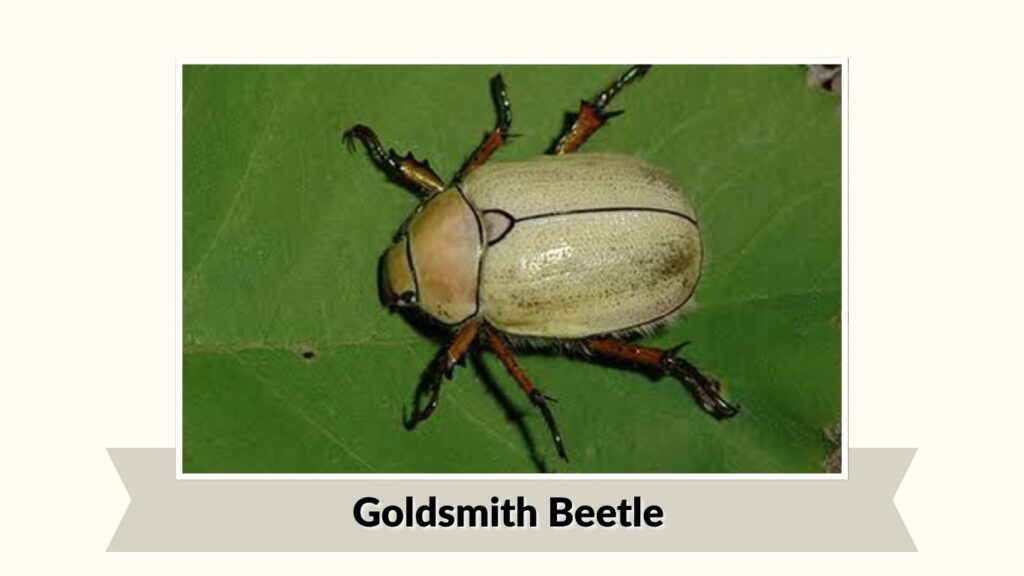
The Goldsmith beetle is one of the most beautiful scarabs found in North America. Its golden-yellow body can reflect green or copper tones in sunlight, giving it a polished metallic appearance. Adults are often associated with trees, while the underground larvae feed mainly on plant roots and decomposing material.
Identification
- Adult length: approximately 20–26 mm
- Bright golden-yellow or yellowish-green coloration
- Metallic or slightly reflective appearance
- Broad, oval body
- Fine hairs may cover portions of the body
- Strong, spiny legs
- White C-shaped larvae
- Scientific name: Cotalpa lanigera
Habitat and Distribution
Goldsmith beetles are native to North America and occur mainly across the eastern and central United States.
They inhabit deciduous forests, woodland edges, parks, gardens, and areas containing trees such as willow, poplar, oak, and other broadleaf species.
Adults are sometimes attracted to artificial lighting at night. The larvae remain underground in soil near plant roots.
Behavior and Diet
Adult Goldsmith beetles feed primarily on the foliage of trees and shrubs. They may consume leaves of willow, poplar, oak, pear, and other woody plants.
Although they can occasionally cause visible feeding damage, populations are usually not large enough to create severe problems.
The larvae feed underground on roots and decomposing organic material. Their hidden lifestyle means they are rarely observed unless soil is disturbed.
Lifespan and Life Cycle
Females lay their eggs in soil, where the larvae hatch and begin feeding underground.
The grubs pass through several larval stages and may remain below the surface through winter. Development can take one to two years depending on climate.
Mature larvae pupate underground, and adults usually emerge during late spring or summer. Adults remain active for several weeks or months while feeding and reproducing before completing their life cycle.
29. Masked Chafer
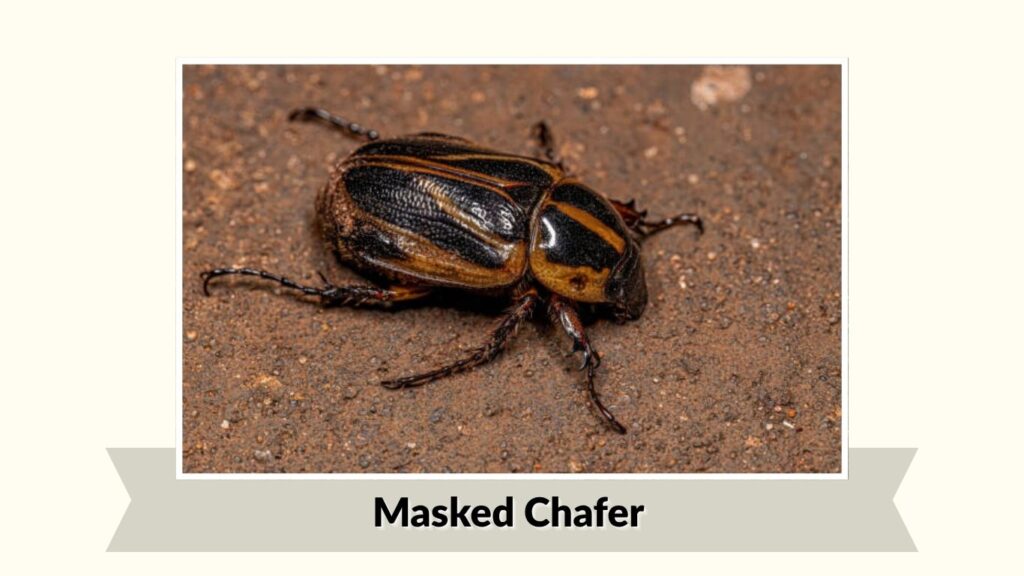
Masked chafers are medium-sized brown scarab beetles best known because their larvae can become serious turfgrass pests. Adults are relatively plain in appearance and feed very little, but their underground grubs consume grass roots. Large populations can produce brown, weakened patches across lawns, golf courses, and other grassy areas.
Identification
- Adult length: approximately 10–14 mm
- Light brown to reddish-brown body
- Dark brown or black markings across the face
- Oval, compact shape
- Smooth wing covers
- Clubbed antennae
- Larvae are white C-shaped grubs with brown heads
- Commonly belong to the genus Cyclocephala
Habitat and Distribution
Masked chafers are widespread across North America, with several species occupying different regions.
They are strongly associated with lawns, golf courses, parks, pastures, athletic fields, and other grassy environments. Adult females choose suitable soil beneath turf for egg laying.
Warm, moist soil generally favors egg survival and early grub development.
Behavior and Diet
Adult masked chafers are mainly nocturnal and are strongly attracted to outdoor lighting. Adults typically feed little or may not feed significantly at all.
The larvae are responsible for most damage. Grubs feed on grass roots, reducing the plant’s ability to absorb moisture and nutrients.
Severely damaged turf may turn brown and can sometimes be lifted from the soil like loose carpet because much of the root system has been destroyed.
Lifespan and Life Cycle
Most masked chafers complete one generation each year. Adults emerge during summer, mate, and females deposit eggs in moist soil.
The eggs hatch into young grubs that feed on grass roots through summer and autumn. As temperatures drop, larvae move deeper underground.
They return toward the root zone during spring, resume feeding, and eventually pupate. New adults emerge during summer, beginning the cycle again.
30. Sugarcane Beetle
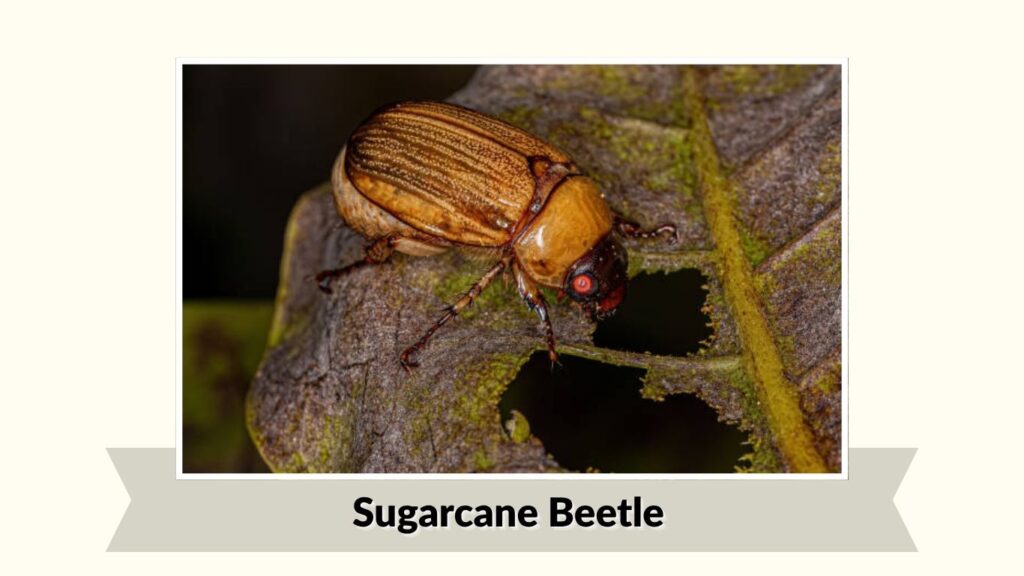
The Sugarcane beetle is a robust black scarab that can become an important agricultural pest. Despite its name, it does not feed only on sugarcane. Adults may damage corn, turfgrass, rice, sweet potatoes, and other crops by feeding near the base of young plants or below the soil surface.
Identification
- Adult length: approximately 13–16 mm
- Shiny black or very dark brown body
- Broad, strongly rounded shape
- Powerful front legs adapted for digging
- Fine grooves visible on the wing covers
- Short clubbed antennae
- Larvae are white C-shaped grubs
- Scientific name: Euetheola humilis
Habitat and Distribution
Sugarcane beetles occur mainly in the southeastern and south-central United States as well as other warmer parts of the Americas.
They inhabit agricultural fields, pastures, lawns, golf courses, and other areas containing grasses or crop plants.
Adults spend much of their time near or below the soil surface. Warm climates and abundant vegetation provide particularly favorable conditions.
Behavior and Diet
Adults feed around the stems, roots, and crowns of various plants. Young corn plants can be especially vulnerable because beetles may chew through underground stems and cause plants to wilt or die.
Sugarcane, rice, turfgrass, sweet potatoes, and several other crops may also be attacked.
Adults are mostly nocturnal and can be attracted to lights. Larvae live underground and feed primarily on decomposing plant matter and roots.
Lifespan and Life Cycle
Sugarcane beetles generally produce one generation per year. Adults may overwinter in soil and become active again during spring.
Females lay eggs underground, and larvae develop through several grub stages while feeding in the soil. Mature larvae eventually construct pupal cells.
New adults emerge later in the growing season. Seasonal timing varies according to temperature and geographic location, but much of the life cycle occurs underground.
FAQs
1. What are scarab beetles?
Scarab beetles are members of the family Scarabaeidae, one of the largest beetle families. The group includes dung beetles, rhinoceros beetles, flower chafers, June beetles, Japanese beetles, and many other species. They vary greatly in size, coloration, feeding habits, and ecological role.
2. Are scarab beetles harmful to humans?
Most scarab beetles are harmless to humans. Even large species such as Hercules, Goliath, and rhinoceros beetles are not venomous and generally do not attack people. Their strong legs or claws may feel uncomfortable if handled, but they normally present little danger.
3. Are all scarab beetles garden pests?
No. Some scarabs, including Japanese beetles, masked chafers, and Sugarcane beetles, can damage plants or turf. Others are highly beneficial. Dung beetles recycle animal waste, while many rhinoceros and flower beetle larvae help decompose dead wood and vegetation.
4. What do scarab beetles eat?
Their diets vary considerably. Some adults feed on leaves, flowers, fruit, pollen, nectar, or tree sap. Dung beetles consume animal dung, while many larvae feed on roots, decaying wood, compost, or other decomposing organic matter.
5. How long do scarab beetles live?
Lifespan depends heavily on the species. Many scarabs complete their life cycle in about one year, while large rhinoceros beetles may spend one to three years developing as larvae. The adult stage is usually much shorter and may last from several weeks to several months.