
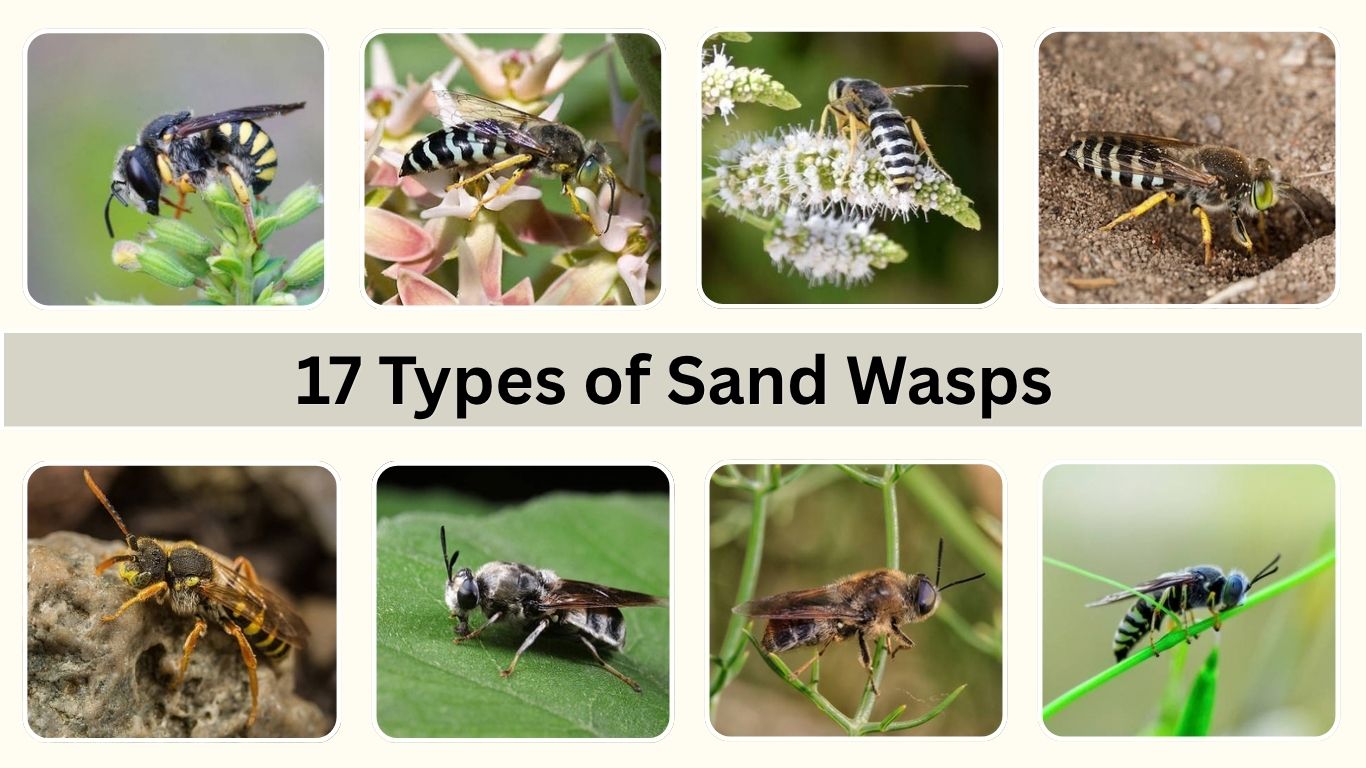
Sand wasps are ground-nesting insects known for digging burrows and hunting prey to feed their young. Many belong to the genus Bembix, a diverse group found across different regions of the world. While some species have distinctive colors, others look remarkably similar and require expert examination to identify accurately. This guide introduces 17 sand wasp species, exploring their identification, habitats, behavior, and lifecycles. From the American sand wasp to lesser-known relatives, each entry highlights documented details while acknowledging where species-specific information remains limited.
1. American Sand Wasp
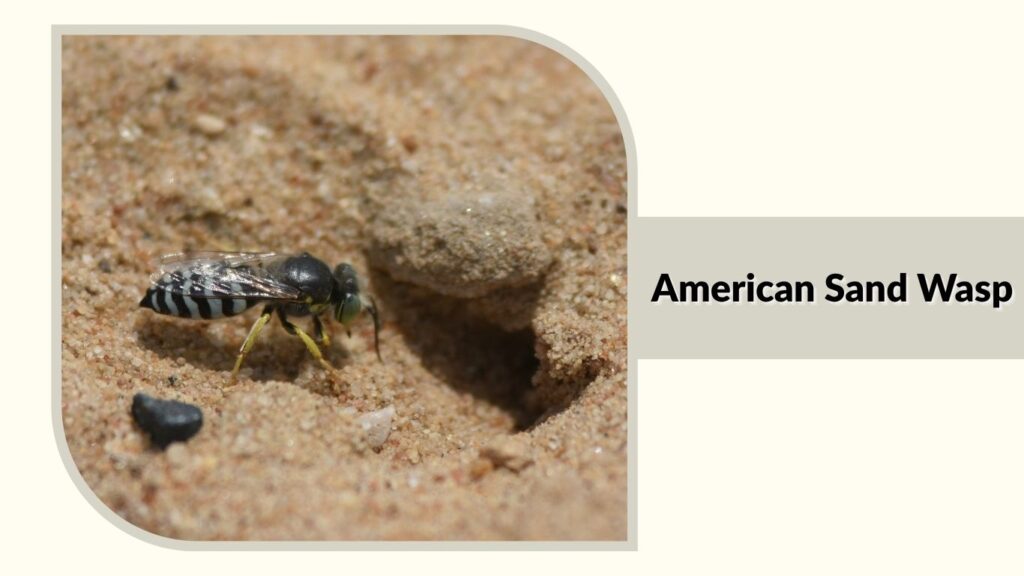
The American sand wasp, scientifically known as Bembix americana, is a robust insect that excavates underground nests and catches flies for its offspring. Adults visit flowers for nectar. Although several females may nest close together, each maintains her own burrow and cares for her young independently. These nesting aggregations offer opportunities to observe digging, hunting, and courtship.
Identification
- Adults typically measure approximately 16–20 mm long.
- Mostly black body with pale spots forming interrupted abdominal bands.
- Large, prominent green compound eyes.
- Mostly yellow legs.
- Clear wings with brown veins.
- Short, pale hairs covering the head and thorax.
Closely related species can look similar, so these features should be considered together.
Habitat and Distribution
Its recorded range includes the United States, southern Canada, Mexico, and parts of the Caribbean. Females favor exposed ground with little vegetation, particularly sandy soil. Nearby flowers supply nectar, while suitable nesting patches may be used repeatedly.
Behavior and Diet
Adults consume nectar, whereas larvae eat flies captured by females. A female immobilizes her prey and carries it beneath her body into the nest. Males may perform low, circling flights above nesting grounds while waiting for females to emerge, a courtship activity called a “sun dance.”
Lifespan and Lifecycle
Development follows egg, larva, pupa, and adult stages. The female lays an egg on captured prey and brings additional flies as the larva grows. After feeding, the larva pupates. Males generally emerge before females. Adult longevity varies and should not be expressed as a fixed number without supporting observations.
2. Bembix belfragei
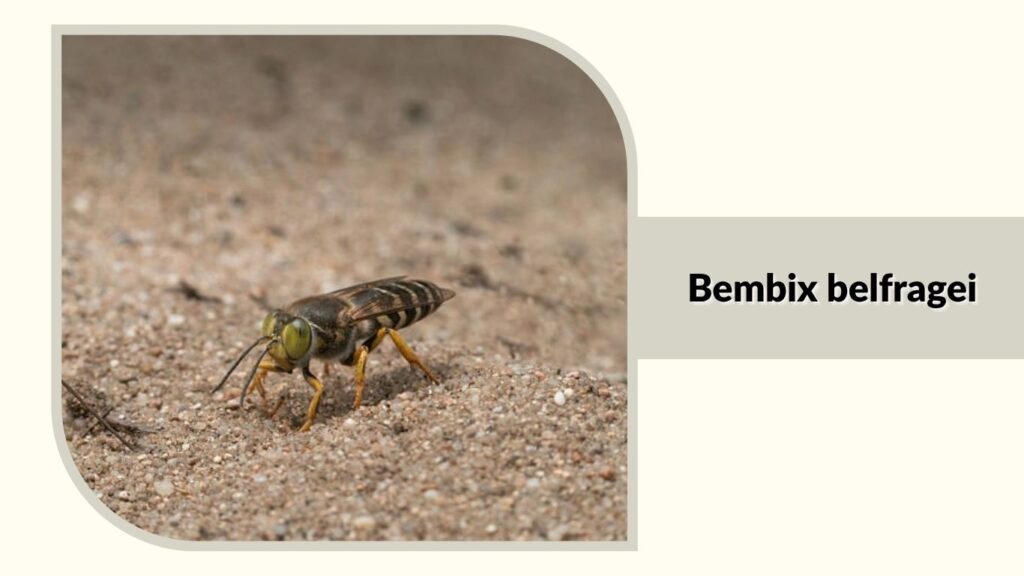
Bembix belfragei is a recognized member of a genus of solitary, ground-nesting wasps. These insects do not maintain colonies with workers and queens. Detailed identification requires anatomical examination, so observing a striped wasp near sandy ground is insufficient to confirm this species. Its scientific name distinguishes it without introducing an unverified common name.
Identification
- A member of the sand wasp genus Bembix.
- General appearance overlaps with related species.
- Large eyes and a robust build are characteristic of the genus.
- Identification requires comparison using a specialist key.
- Color alone does not reliably establish the species.
Habitat and Distribution
Exposed sandy soil is characteristic nesting habitat for Bembix. However, a complete range and detailed habitat preferences for Bembix belfragei are not established in this account. The worldwide distribution of its genus should not be mistaken for the distribution of this individual species.
Behavior and Diet
Across Bembix, females capture insects for their offspring, while adults obtain nectar from flowers. Some members of the belfragei species group are active around dawn and dusk. That group-level observation should not automatically be treated as the activity schedule of every species within it.
Lifespan and Lifecycle
The lifecycle includes egg, larva, pupa, and adult stages. Larvae consume prey supplied within underground cells before pupating. Exact provisioning methods, seasonal timing, and adult lifespan remain unspecified for this species.
3. Bembix bidentata
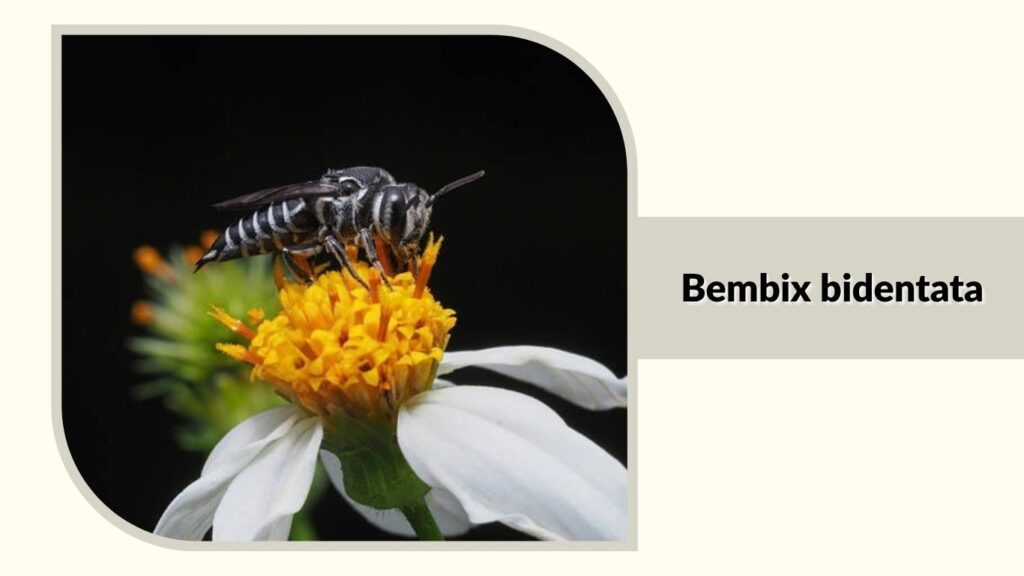
Bembix bidentata is a sand wasp recorded from parts of southern Europe and western and central Asia. It belongs to the same genus as the American sand wasp, although its distribution and diagnostic features differ. Scientific identification is more dependable than assigning an informal common name based on appearance, particularly among similar-looking solitary wasps.
Identification
- A recognized species within Bembix.
- General body form resembles other sand wasps.
- Large compound eyes are characteristic of the genus.
- Species confirmation depends on diagnostic anatomical features.
- Photographs can assist comparison but may not settle identification.
Habitat and Distribution
Published records include southern Europe, Turkey, Syria, Israel, Turkmenistan, and Tajikistan. These establish geographical occurrence rather than proving occupation of every suitable habitat in those countries. Open sandy soil provides the typical nesting setting associated with its genus.
Behavior and Diet
The general Bembix pattern involves females excavating nests and supplying captured insects to their larvae. Adults visit flowers for nectar. Fly hunting is characteristic of the genus, but a precise prey list for Bembix bidentata requires species-specific observations.
Lifespan and Lifecycle
Development proceeds through complete metamorphosis: egg, larva, pupa, and adult. Larvae feed within brood cells before pupation. Exact development periods, adult longevity, and seasonal generations are not established here.
4. Bembix borrei
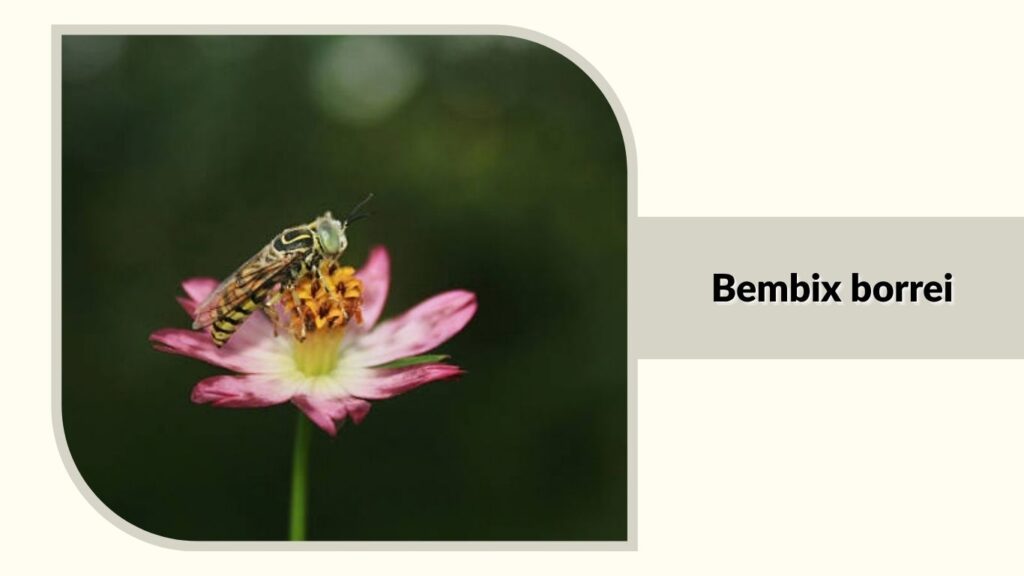
Bembix borrei is a solitary sand wasp studied in Sri Lanka and southern India. Females nest in sand or sandy loam and capture flies for their developing offspring. They can also use piles of construction sand, demonstrating that suitable nesting soil may occur in human-modified surroundings. Its relatively shallow burrows contain a single brood cell.
Identification
- A stocky build characteristic of Bembix.
- Large compound eyes and conspicuous pale markings.
- Rapid flight around nesting grounds.
- Females may carry captured flies beneath their bodies.
- Precise identification requires comparison with related species.
These clues help recognize a sand wasp but do not uniquely identify Bembix borrei.
Habitat and Distribution
Research documents the species in Sri Lanka and southern India. Nesting sites include pure sand, sandy loam, and accumulated building sand. Workable soil allows females to excavate short burrows and establish protected cells for their offspring.
Behavior and Diet
Females hunt several kinds of flies. Recorded prey includes flies associated with domestic animals, organic waste, and flowers. Mothers deliver additional prey as their larvae develop, a strategy known as progressive provisioning.
Lifespan and Lifecycle
An egg develops into a larva inside the nest cell. The larva consumes captured flies before entering the pupal stage and eventually emerging as an adult. A fixed adult lifespan is not established in this account.
5. Bembix capensis
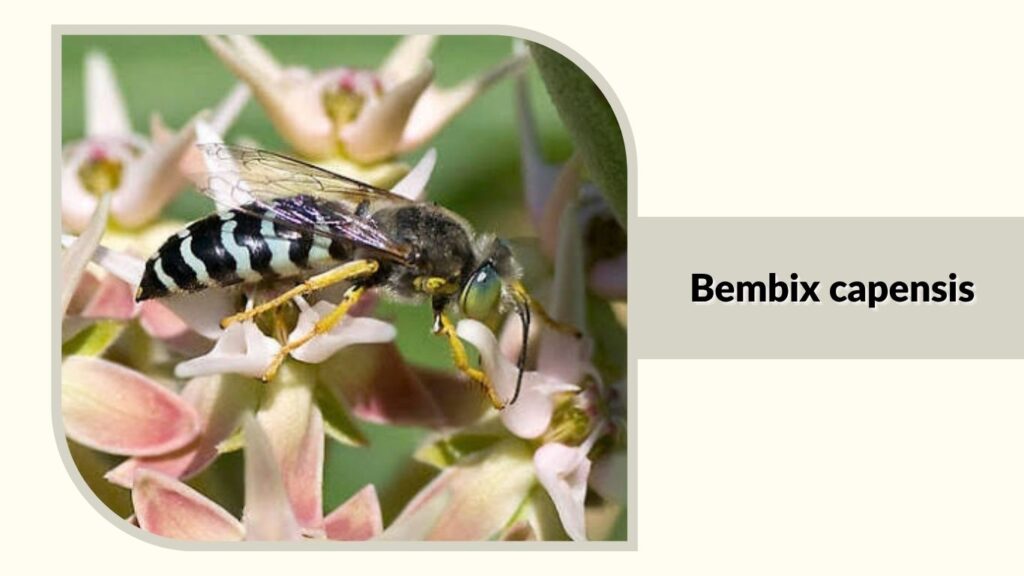
Bembix capensis is a recognized sand wasp recorded in South Africa. It belongs to a genus whose females excavate underground nests and supply insects to their offspring. Detailed species-specific natural-history information is limited in the material available for this profile. Confirmed occurrence records therefore provide a firmer basis than assumptions drawn from better-studied relatives.
Identification
- Classified within the genus Bembix.
- General appearance resembles other sand wasps.
- Identification depends on detailed anatomical characters.
- Location can support comparison but cannot confirm identity.
- A specific size or color pattern is not established here.
Habitat and Distribution
South Africa is included in published records for this species. Exposed sandy soil is characteristic nesting habitat for the genus, but that general preference does not establish its complete range or every habitat it occupies.
Behavior and Diet
In Bembix, adults commonly obtain nectar, while females capture prey for their young. Flies are characteristic larval food within the genus. A particular prey list or hunting schedule for Bembix capensis should not be inferred from another species.
Lifespan and Lifecycle
Development follows egg, larva, pupa, and adult stages. Larval growth depends on food supplied within nest cells. Exact development times, yearly generations, and adult longevity remain unspecified.
6. Bembix cinerea
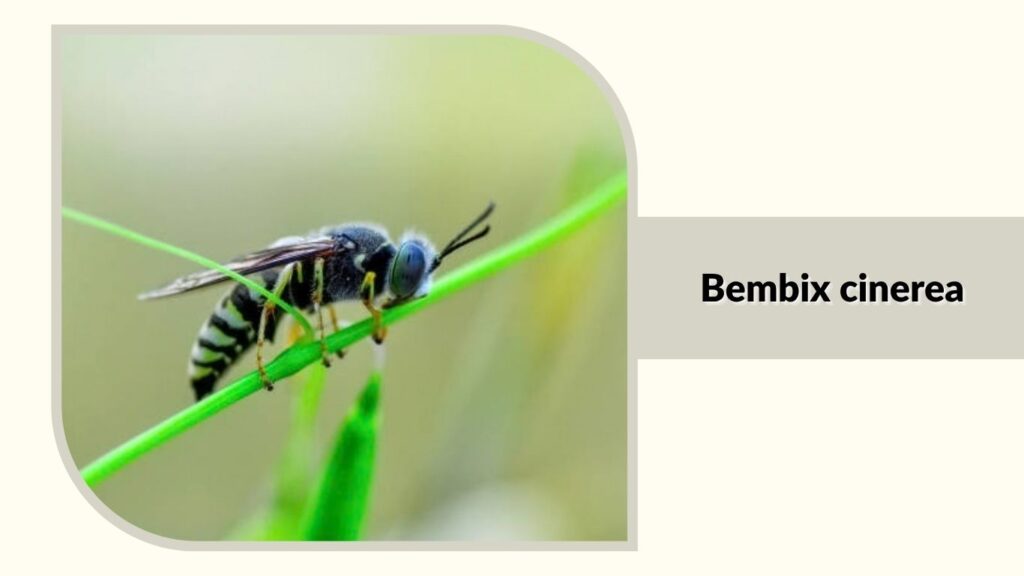
Bembix cinerea is a recognized species described by Handlirsch in 1893. It belongs to the sand wasp genus Bembix, but accessible species-specific information is sparse. Its scientific name distinguishes it from other members of the genus. General sand wasp biology offers context, while its precise appearance, range, and nesting behavior require more specialized documentation.
Identification
- A recognized member of Bembix.
- Identification requires a taxonomic description or specialist key.
- Body markings alone are insufficient for confirmation.
- Photographs from several angles can help comparison.
- Its name should not be interpreted as proof of a particular color.
Habitat and Distribution
A dependable geographical range was not established for this profile. Sandy nesting ground is characteristic of Bembix generally, but assigning this species to particular countries, deserts, or coastlines would require verified records.
Behavior and Diet
The genus contains solitary predators whose females supply insects to underground brood cells. Adult nectar feeding and larval consumption of flies are characteristic patterns. These provide background rather than a confirmed account of this species’ prey preferences.
Lifespan and Lifecycle
The lifecycle includes egg, larva, pupa, and adult stages. Exact lifespan, brood size, and emergence season remain unconfirmed here. Those details should not be borrowed from another species.
7. Bembix flavescens
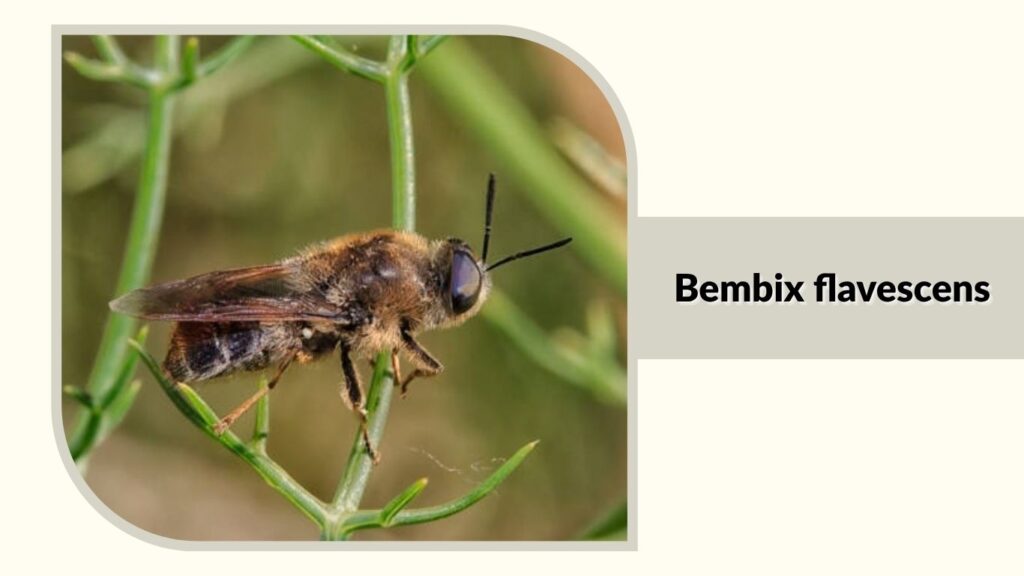
Bembix flavescens is a conspicuous sand wasp with black-and-yellow coloration and greenish eyes. In the Canary Islands, it is associated with coastal beaches and sandy dunes. Females excavate nests in loose sand and repeatedly provide flies for their young. Flower visits connect the adults to nearby vegetation, while suitable sandy ground supports reproduction.
Identification
- Adults measure approximately 15–20 mm long.
- Black head and thorax with fine whitish hairs.
- Greenish compound eyes.
- Face and legs largely yellow.
- Yellow abdomen with irregular black bands.
- Some males have noticeably paler abdominal markings.
Habitat and Distribution
The species occurs in North Africa and southern Europe, including the Canary Islands. Within the Canaries, it occupies coastal sandy habitats. Alteration of beaches and dunes can affect the ground available for nesting.
Behavior and Diet
Adults visit flowers, including Heliotropium and Limonium. Females capture flies for larvae, with recorded prey including hoverflies, blowflies, and members of the housefly family. Adults may be seen flying close to the ground or resting on sand.
Lifespan and Lifecycle
A female constructs a single-cell nest and lays an egg on the first captured fly. She returns with more prey as the larva grows. Pupation follows larval development, and adult emergence completes the cycle. Exact adult longevity is not established here.
8. Bembix furcata
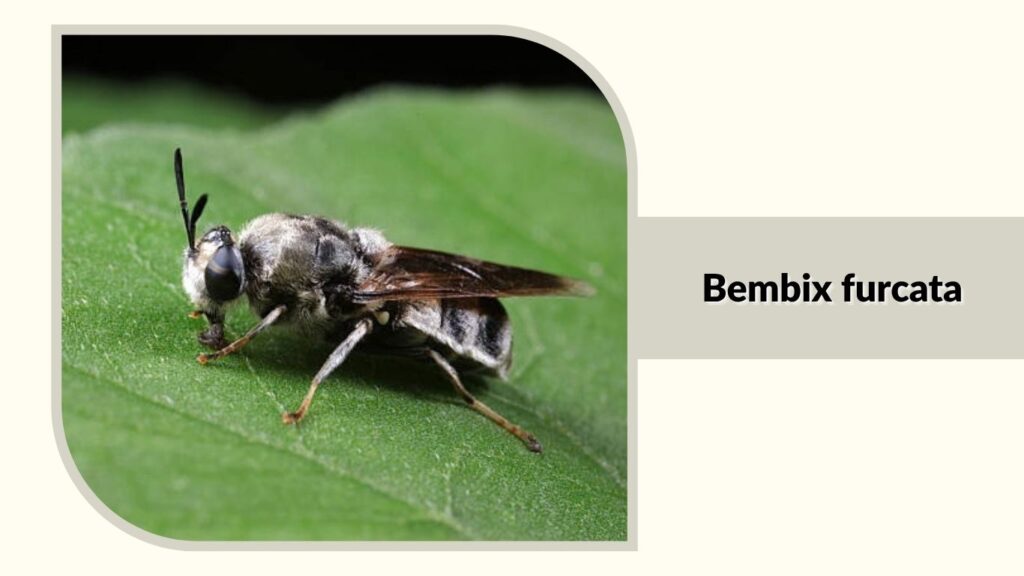
Bembix furcata is an Australian sand wasp sometimes described as a blue digger wasp. Museum specimens confirm its occurrence in Australia, while field surveys have recorded individuals tending sandy burrows on Tasmania’s offshore islands. Its coloration and nesting activity provide useful observation clues, although confident species identification still requires comparison with closely related wasps.
Identification
- A robust sand wasp belonging to Bembix.
- Often described as having a blue or blue-green appearance.
- Large eyes and a distinct waist.
- Adults may attend burrows in sandy ground.
- Anatomical comparison is needed for confident identification.
Color and digging behavior alone do not establish the species.
Habitat and Distribution
Australian museum collections contain specimens of Bembix furcata. A survey of lungtalanana, also known as Clarke Island, recorded wasps attending sandy burrows. This provides direct evidence of nesting activity at that locality.
Behavior and Diet
Burrow attendance is documented for the species. The wider Bembix pattern involves females capturing flies for their larvae and adults feeding on nectar. Particular prey families and hunting routines remain unspecified here.
Lifespan and Lifecycle
Development passes through egg, larva, pupa, and adult stages. Underground nests shelter immature offspring. Exact development periods, overwintering arrangements, and adult lifespan require species-specific observations.
9. Bembix integra
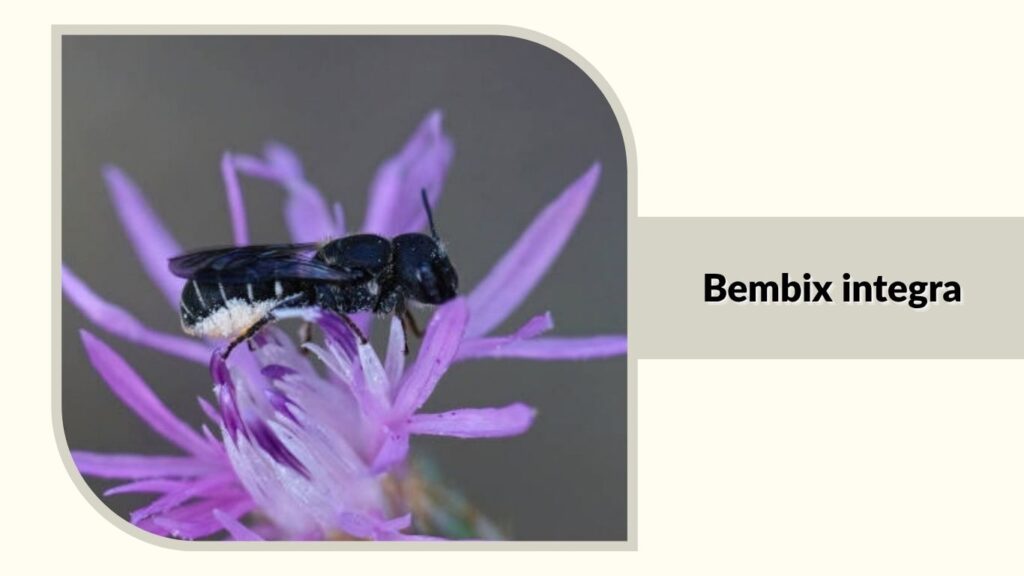
Bembix integra is a recognized sand wasp described by Panzer in 1801. It belongs to a genus known for underground nesting and capturing prey for developing offspring. Its taxonomic history includes older names, making careful interpretation important when comparing records. Body color and nesting behavior can indicate a sand wasp, but they cannot establish this species alone.
Identification
- A recognized member of Bembix.
- General appearance overlaps with related species.
- Specialist keys use diagnostic anatomical features.
- Older records may use Bembex integra.
- Bembix dubia is treated as a synonym rather than a separate species.
Habitat and Distribution
Open sandy ground is characteristic nesting habitat for the genus. A complete range and detailed habitat preferences for Bembix integra are not established in this profile. Older names should be checked when interpreting distribution records.
Behavior and Diet
Across Bembix, females capture insects for larvae, while adults obtain nectar from flowers. Fly hunting is particularly characteristic. A precise prey list or nesting routine for Bembix integra requires observations of the species itself.
Lifespan and Lifecycle
Development proceeds through egg, larva, pupa, and adult stages. Larvae grow using food supplied in brood cells. Exact development periods, adult longevity, and annual generations remain unspecified.
10. Bembix labiata
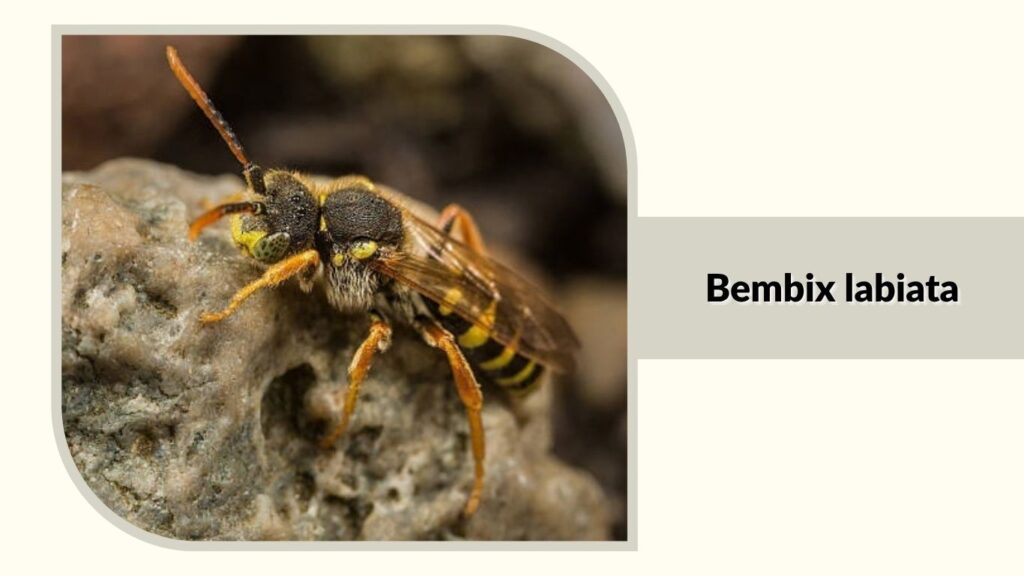
Bembix labiata is a recognized sand wasp described by Fabricius in 1798. It appears in taxonomic records more readily than in detailed natural-history accounts. Its accepted scientific identity supports its inclusion here, while information about appearance, range, and behavior needs careful distinction from general characteristics shared by the wider genus.
Identification
- Classified within Bembix.
- Species confirmation requires a reliable taxonomic key.
- Color patterns alone are insufficient.
- Clear views of the face, abdomen, and legs may aid comparison.
- Older literature may refer to Bembex labiata.
Habitat and Distribution
A dependable geographical range was not established from the information reviewed. Members of Bembix generally excavate sandy soil, but that does not justify assigning this species to particular countries or habitats without occurrence records.
Behavior and Diet
The genus includes solitary predators whose females supply captured insects to their offspring. Adults commonly visit flowers for nectar. The precise prey preferences and provisioning strategy of Bembix labiata remain unconfirmed in this account.
Lifespan and Lifecycle
Complete metamorphosis involves egg, larva, pupa, and adult stages. Species-specific measurements of development time and adult lifespan are not established here. Figures from better-studied relatives should not be substituted.
11. Bembix lunata
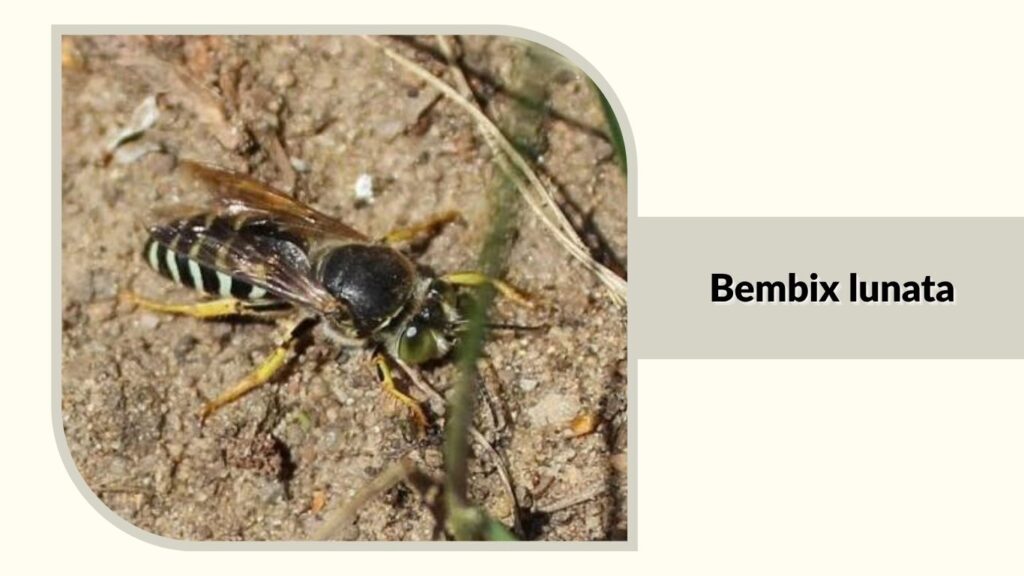
Bembix lunata stands out because of its predominantly light reddish body coloration. Scientific accounts document specimens from southern India and Sri Lanka and record its hunting of several kinds of flies. These details provide a more distinctive profile than the familiar black-and-yellow appearance associated with many wasps, although anatomical examination remains important for reliable identification.
Identification
- Predominantly light red ground coloration.
- Robust body and large compound eyes.
- Males in one revision measured approximately 14.2–18.5 mm.
- Males possess a small spine on part of the middle-leg base.
- Confirmation requires comparison with a specialist description.
Habitat and Distribution
A Smithsonian revision documents specimens from southern India and Sri Lanka. Earlier Indian observations include the Nilgiri Hills. These records establish regional occurrence rather than occupation of every suitable sandy habitat.
Behavior and Diet
Recorded prey includes flies in the genera Stomoxys, Haematobia, and Musca. These include flies associated with livestock or human surroundings. The records demonstrate fly hunting by females rather than relying solely on assumptions about the genus.
Lifespan and Lifecycle
The lifecycle includes egg, larva, pupa, and adult stages. Captured prey supports larval development before pupation. A fixed adult lifespan or complete seasonal schedule is not established in this profile.
12. Bembix occidentalis
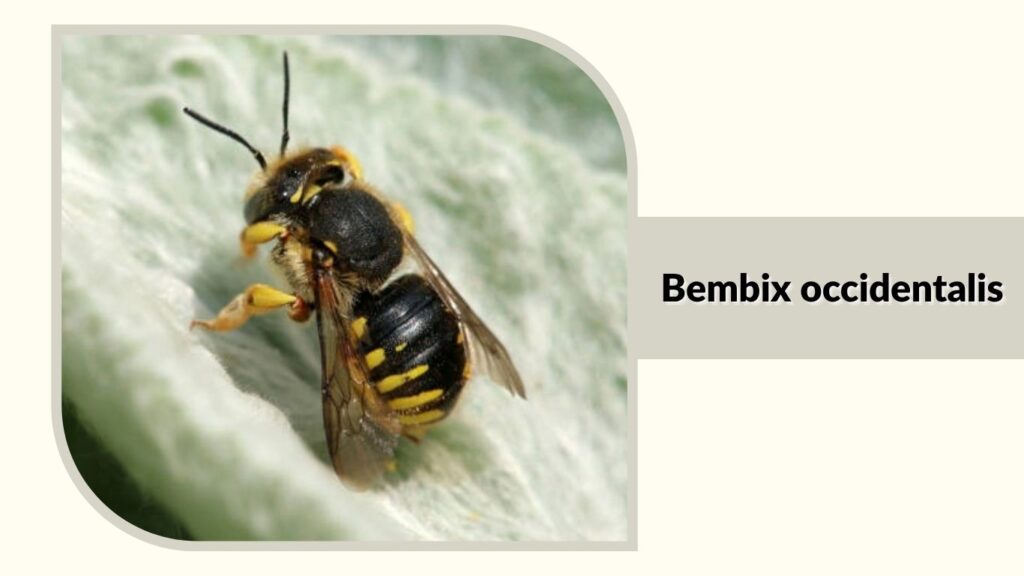
Bembix occidentalis is a recognized sand wasp described by W. Fox in 1893. Its taxonomic history includes several older names associated with the same species. Understanding these synonyms prevents duplicate entries in species lists. Detailed natural-history information is less readily available, so confirmed taxonomy should remain separate from broader characteristics of Bembix.
Identification
- A member of the sand wasp genus Bembix.
- Species-level anatomical comparison is necessary.
- General coloration cannot confirm its identity.
- Older records may use Epibembex occidentalis.
- Bembix beutenmulleri is associated with this species in current taxonomic records.
Habitat and Distribution
Sandy ground is characteristic nesting habitat for the genus, but a complete species range was not verified here. The name “occidentalis” should not be used alone to infer a western range or assign particular locations.
Behavior and Diet
Females in Bembix generally excavate nests and capture insects for their larvae. Adults obtain nectar. The exact prey choices, nesting arrangements, and activity periods of this species require more specific evidence.
Lifespan and Lifecycle
Development includes egg, larva, pupa, and adult stages. Nest cells shelter the immature offspring. Exact longevity, emergence dates, and overwintering details remain unspecified.
13. Bembix oculata
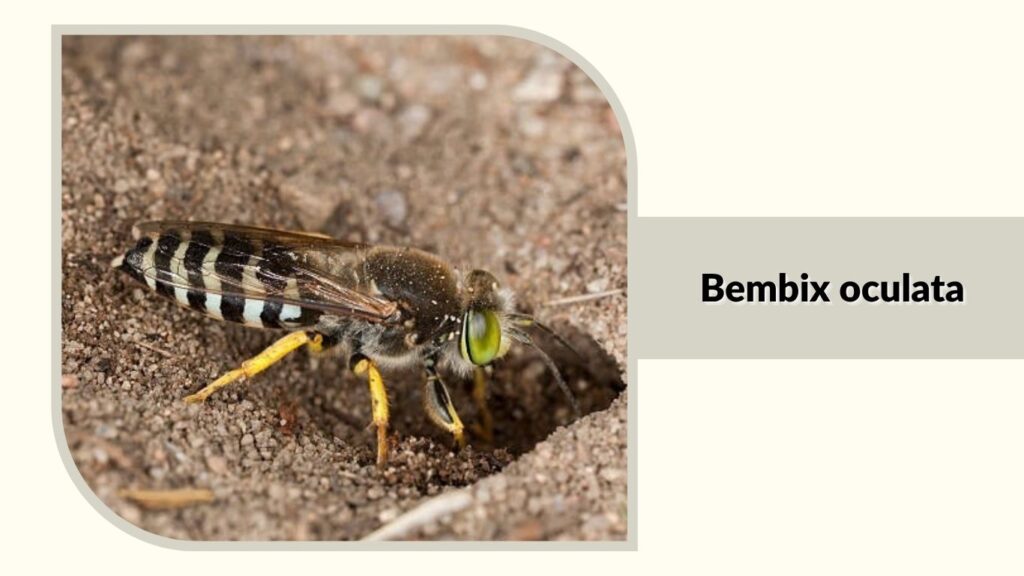
Bembix oculata has documented nesting behavior in European studies and occurrence records from Tunisia. Research in southern Spain examined how soil firmness influences nesting locations. It provides an example of how the physical properties of sandy ground can affect nest placement, rather than assuming that every patch of bare sand offers equally suitable conditions.
Identification
- A robust sand wasp belonging to Bembix.
- Large compound eyes and a distinct waist.
- Appearance resembling several related species.
- Females may be seen attending ground burrows.
- Specialist keys are needed for confident confirmation.
Habitat and Distribution
Records include Tunisia, while nesting research has been conducted in Granada, southern Spain. One studied site was an athletics landing pit, showing that artificial sandy patches can provide nesting opportunities when conditions are suitable.
Behavior and Diet
Research has examined its nest structure, captured prey, and natural enemies. Females provide insect prey for their offspring. Nest placement, maintenance, and hunting are important parts of their reproductive activity.
Lifespan and Lifecycle
Development follows egg, larva, pupa, and adult stages. Larvae consume prey supplied within the nest before pupating. Exact lifespan and seasonal timing should not be reduced to an unsupported fixed number.
14. Bembix olivacea
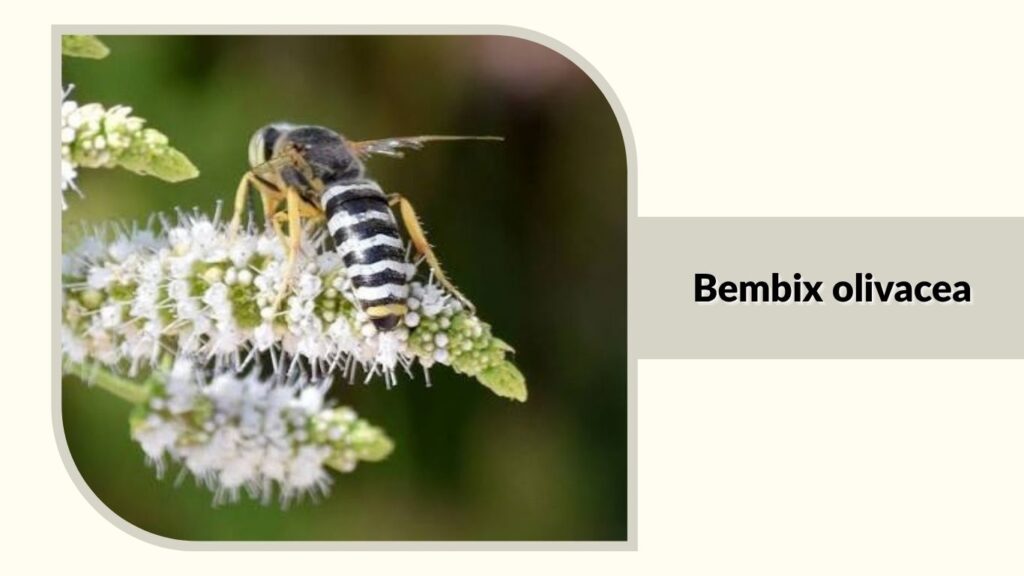
Bembix olivacea is recorded across parts of Europe, Africa, and western Asia. It belongs to the ground-nesting genus Bembix, whose females capture insects to feed their young. Its broad recorded distribution makes it relevant to several regional wasp faunas. Nevertheless, a striped body or digging behavior is insufficient to distinguish it confidently from similar species.
Identification
- A recognized member of Bembix.
- Its general body form resembles other sand wasps.
- Markings may overlap with those of related species.
- Confirmation requires a specialist identification key.
- Its name alone is not a reliable guide to coloration.
Habitat and Distribution
Published records include Spain, France, Italy, Greece, Morocco, Algeria, and Tunisia. The species is also reported from Turkey, Iran, and Saudi Arabia. These establish occurrence rather than continuous distribution throughout those countries.
Behavior and Diet
The species belongs to a group associated with underground nesting and provisioning young with captured insects. Adults obtain nectar, while larvae consume prey. Particular hunting preferences should be based on species-specific observations.
Lifespan and Lifecycle
Development passes through egg, larva, pupa, and adult stages. Larval feeding occurs inside a protected brood cell before pupation. Exact development periods and adult longevity are not established here.
15. Bembix orientalis
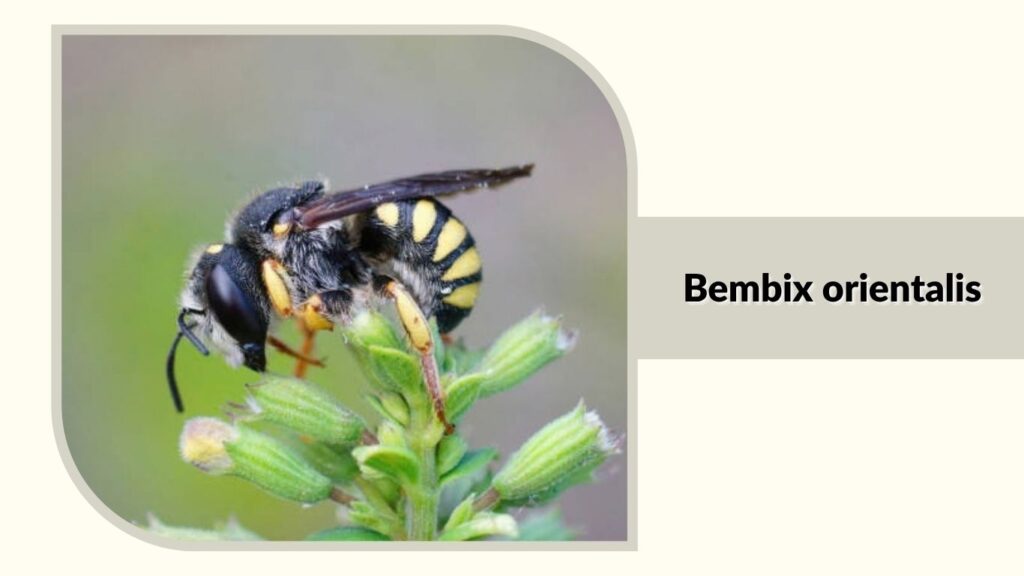
Bembix orientalis is a solitary sand wasp whose nesting behavior has been studied in Sri Lanka. Females construct relatively short, shallow burrows and provide flies for their offspring. Observations also describe males flying near the ground around nesting areas. These documented activities offer a clearer picture of the species than appearance alone, which overlaps with other sand wasps.
Identification
- Stocky build characteristic of Bembix.
- Large compound eyes and conspicuous pale markings.
- Rapid flight near nesting grounds.
- Females carrying flies into burrows.
- Anatomical comparison needed for species confirmation.
Habitat and Distribution
A study recorded the species nesting in a sandy-loam field near Colombo, Sri Lanka. Females constructed shallow nests with a single brood cell. This demonstrates that nesting substrate need not consist entirely of loose, pure sand.
Behavior and Diet
Females capture flies with different habits, suggesting varied prey selection. They bring additional food as their larvae develop. In the studied population, males flew back and forth close to the ground and occasionally landed, rather than performing a circling “sun dance.”
Lifespan and Lifecycle
An egg develops into a larva that feeds on captured flies. Continued deliveries support growth until pupation. Adult emergence completes the cycle. Precise adult lifespan and universal seasonal timing are not established.
16. Bembix planifrons
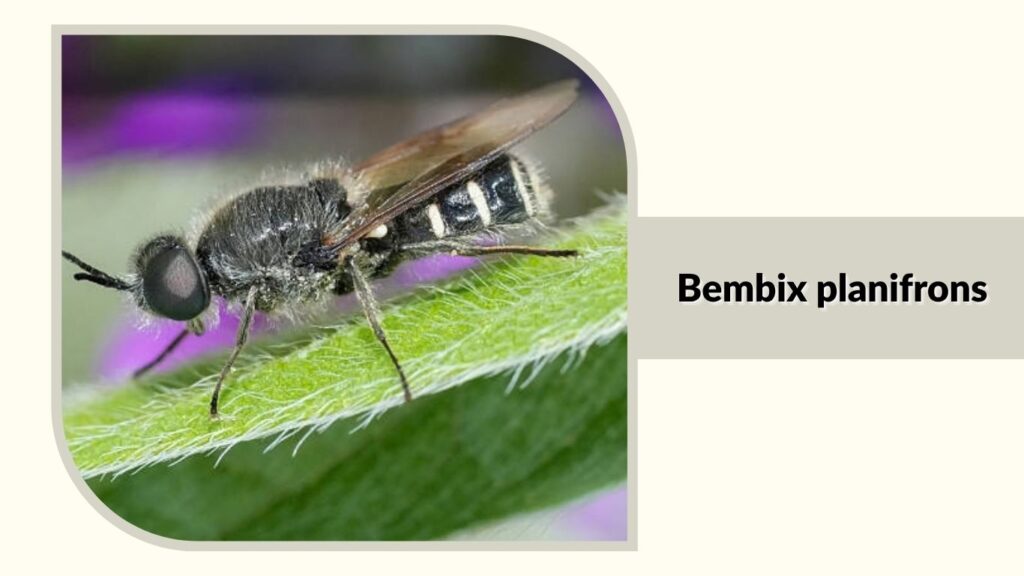
Bembix planifrons is a recognized species described by F. Morawitz in 1891. It also lends its name to a species group used when discussing relationships within Bembix. Detailed field information is less readily available than for some relatives, so anatomical identification and verified locality records are particularly important when preparing a dependable account.
Identification
- Classified within the sand wasp genus Bembix.
- Diagnostic anatomical features are needed for identification.
- Body shape or markings alone are insufficient.
- Older records may use Bembex planifrons.
- Bembix parvula is listed as a synonym.
Habitat and Distribution
The species appears in taxonomic work covering Russia and adjacent territories. This does not imply occurrence throughout Russia. Sandy soil is characteristic habitat for the genus, while precise local preferences require verified records.
Behavior and Diet
Across Bembix, females excavate burrows and capture prey for their offspring. Adults commonly feed on nectar. A specific prey list, daily activity period, or provisioning schedule for Bembix planifrons remains unspecified here.
Lifespan and Lifecycle
Development follows complete metamorphosis through egg, larva, pupa, and adult stages. Larvae rely on food supplied within brood cells. Species-specific development periods and adult longevity need reliable observations.
17. Bembix turca
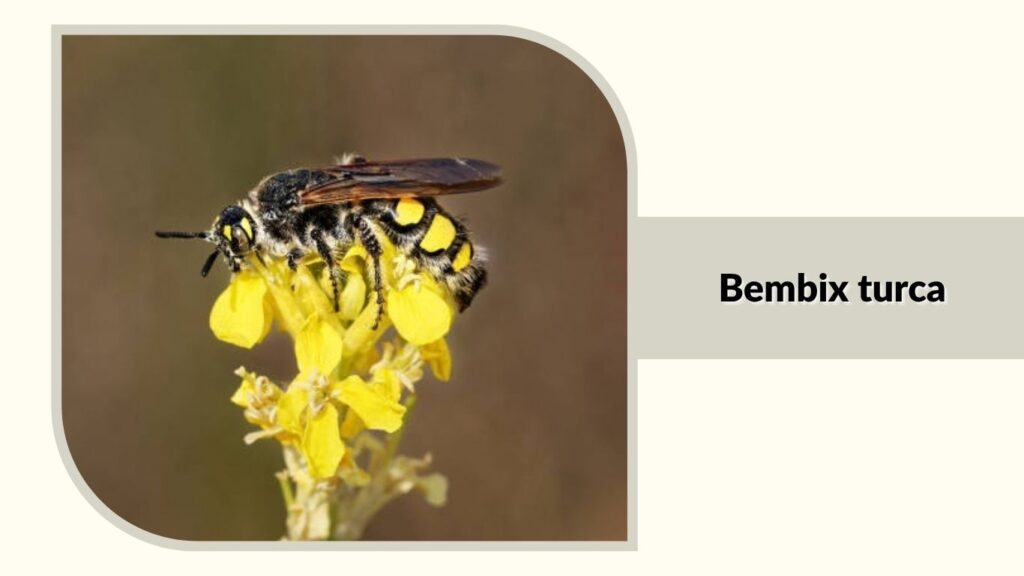
Bembix turca is a recognized sand wasp described by Dahlbom in 1845. Its taxonomic history includes older names subsequently treated as synonyms. Separating those labels from accepted species helps produce an accurate list without counting the same insect more than once. Species-specific ecological details remain less accessible than the general biology of its genus.
Identification
- A member of Bembix.
- Identification requires a specialist description or key.
- Color alone cannot reliably distinguish the species.
- Older records may use Bembex turca.
- Bembix atra is listed as a synonym.
Habitat and Distribution
The species is included in faunal literature concerning Kazakhstan. A complete geographical range was not established here. Its name should not be interpreted as evidence that it is restricted to Turkey.
Behavior and Diet
Members of Bembix are solitary predators whose females supply captured insects to larvae. Adults visit flowers for nectar. These general patterns provide context, while the exact hunting preferences and nesting routine of Bembix turca require species-specific evidence.
Lifespan and Lifecycle
The lifecycle includes egg, larva, pupa, and adult stages. Offspring consume supplied prey before pupating and emerging as adults. Exact longevity, emergence season, and annual generations remain unspecified.
FAQs
1. What are sand wasps?
Sand wasps are wasps that typically excavate nests in sandy soil. Many belong to the genus Bembix. Females capture insects to feed their developing larvae, while adults commonly obtain nectar from flowers.
2. Are sand wasps solitary or social?
Bembix sand wasps are solitary. Several females may nest close together in suitable ground, but each maintains her own nest. These gatherings are called nesting aggregations, rather than colonies with queens and workers.
3. What do sand wasps eat?
Adults generally feed on nectar. Females capture insects, especially flies, for their larvae. Prey preferences vary between species, so not every sand wasp hunts exactly the same insects.
4. Where do sand wasps build their nests?
They commonly nest in exposed sandy ground with little vegetation. Depending on the species, nesting sites may include dunes, sandy fields, paths, or artificial sand patches. Some also use sandy loam.
5. How can you identify different sand wasp species?
Body markings, eye color, size, and location provide useful clues, but many species look similar. Reliable identification often requires a specialist key and close examination of anatomical features. Clear photographs from several angles can help.
