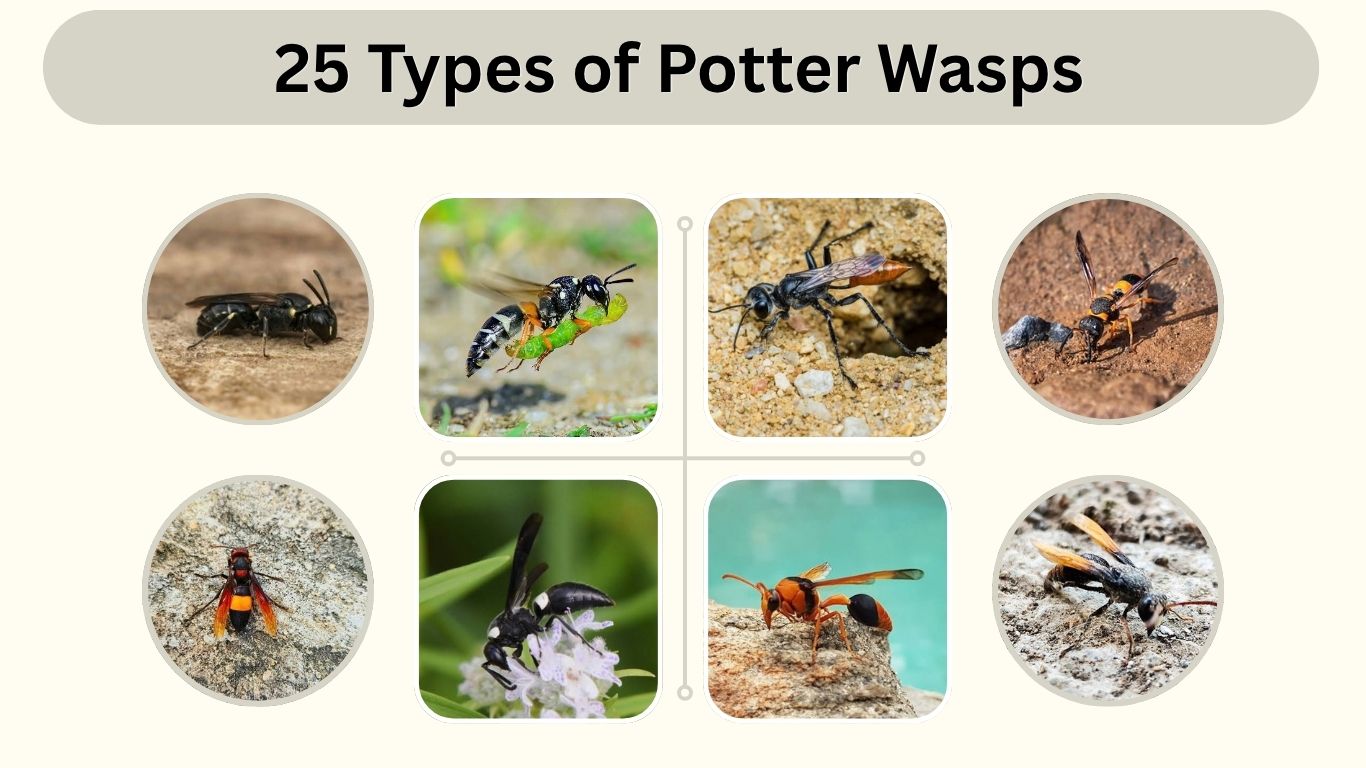
Potter wasps are remarkable solitary wasps recognized for their skill in building small mud nests that often resemble tiny pots or jars. Belonging mainly to the subfamily Eumeninae, these wasps play an important role in nature by controlling populations of caterpillars and other insect larvae. Unlike social wasps, they usually live and work alone rather than forming large colonies. In this guide, you’ll discover 25 types of potter wasps, including their identification features, habitat and distribution, behavior, diet, lifespan, nesting habits, and complete lifecycle.
1. Fraternal Potter Wasp
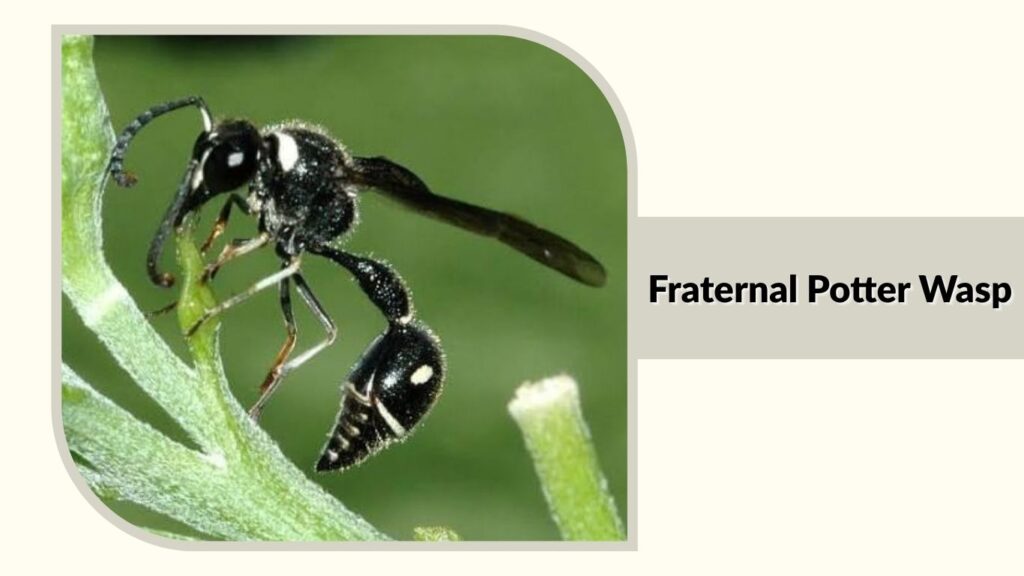
The Fraternal Potter Wasp (Eumenes fraternus) is a solitary potter wasp native to much of eastern and central North America. Unlike social wasps that live in colonies, females independently construct small, jug-shaped mud nests. These wasps are valuable predators because they capture caterpillars to feed their developing young while adults commonly visit flowers for nectar.
Identification
- Common Name: Fraternal Potter Wasp
- Scientific Name: Eumenes fraternus
- Family: Vespidae
- Subfamily: Eumeninae
- Size: About 15–20 mm long
- Body Color: Mainly black with pale yellow or whitish markings
- Wings: Dark or smoky and relatively evenly pigmented
- Body Shape: Narrow waist with a distinctly stalked abdomen
- Nest: Small rounded or jug-shaped structure made from mud
Habitat and Distribution
Fraternal Potter Wasps occur primarily across eastern and central North America, including parts of Canada and the United States. They are commonly associated with woodland edges, shrubby fields, gardens, meadows, and other places where flowering plants and caterpillars are available. Females may attach their mud nests to leaves, flower stalks, or occasionally human-made structures.
Behavior and Diet
This species is solitary rather than colony-forming. A female constructs an individual mud chamber, lays an egg inside, and provisions the nest with several captured caterpillars. The larva consumes these stored caterpillars as it grows. Adult wasps mainly obtain energy from flower nectar and can be seen visiting plants such as goldenrod, fleabane, mountain mint, and boneset.
Lifespan and Lifecycle
The lifecycle begins when a female places an egg inside a prepared mud nest containing caterpillar prey. After hatching, the larva feeds on the stored food, develops through its immature stages, and eventually pupates before emerging as an adult. Fraternal Potter Wasps can produce two generations per year, with the later generation overwintering in the prepupal stage before completing development when conditions become favorable.
2. Boll’s Potter Wasp
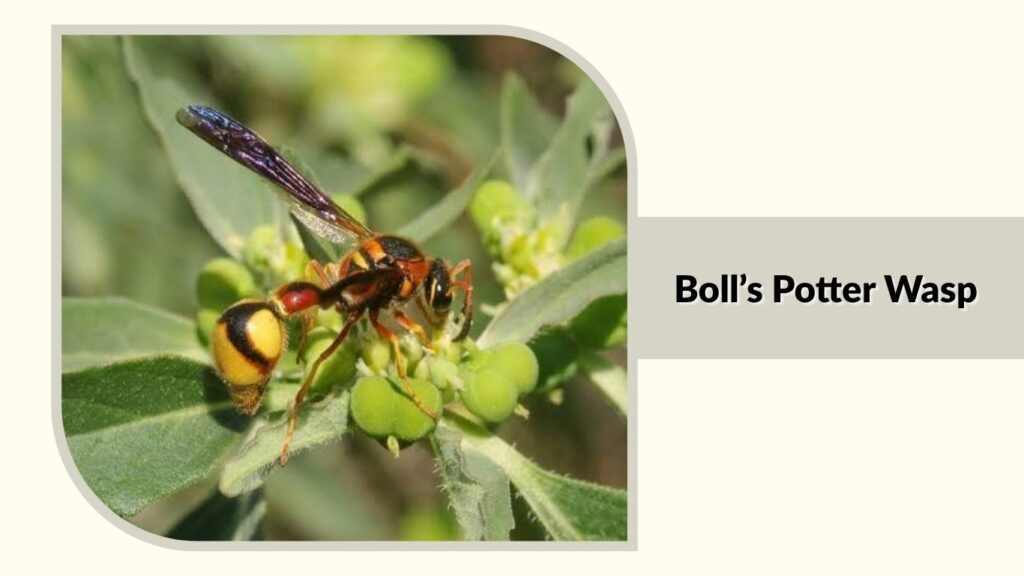
The Boll’s Potter Wasp (Eumenes bollii) is a solitary member of the potter and mason wasp subfamily Eumeninae. It is known for the narrow waist typical of Eumenes wasps and for constructing protected nesting cells for its offspring. The species occurs across parts of western and central North America and extends into Mexico.
Identification
- Common Name: Boll’s Potter Wasp
- Scientific Name: Eumenes bollii
- Family: Vespidae
- Subfamily: Eumeninae
- Body Length: Roughly 10–15 mm
- Appearance: Slender body with a strongly narrowed waist
- Color: Typically dark with contrasting yellow, orange, or reddish markings
- Wings: Dark, narrow wings that fold lengthwise when resting
Habitat and Distribution
Boll’s Potter Wasps are recorded from Alberta and across much of the western United States, extending east into parts of the central United States and south into Mexico. They can occur around open woodland, grassland, gardens, roadsides, and other places where flowers and caterpillar prey are available.
Behavior and Diet
Like other Eumenes, this species is solitary. Females work independently rather than maintaining colonies with queens and workers. Adults visit flowers for nectar, while females hunt caterpillars and other suitable insect larvae. Captured prey is stung and immobilized before being carried to the nest as food for developing larvae.
Lifespan and Lifecycle
The exact adult lifespan of Boll’s Potter Wasp is not well documented. Its lifecycle follows complete metamorphosis: egg, larva, pupa, and adult. A female prepares a nest cell, lays an egg, and provisions the chamber with paralyzed prey. The larva consumes this stored food before pupating and eventually emerging as an adult.
3. Smith’s Potter Wasp
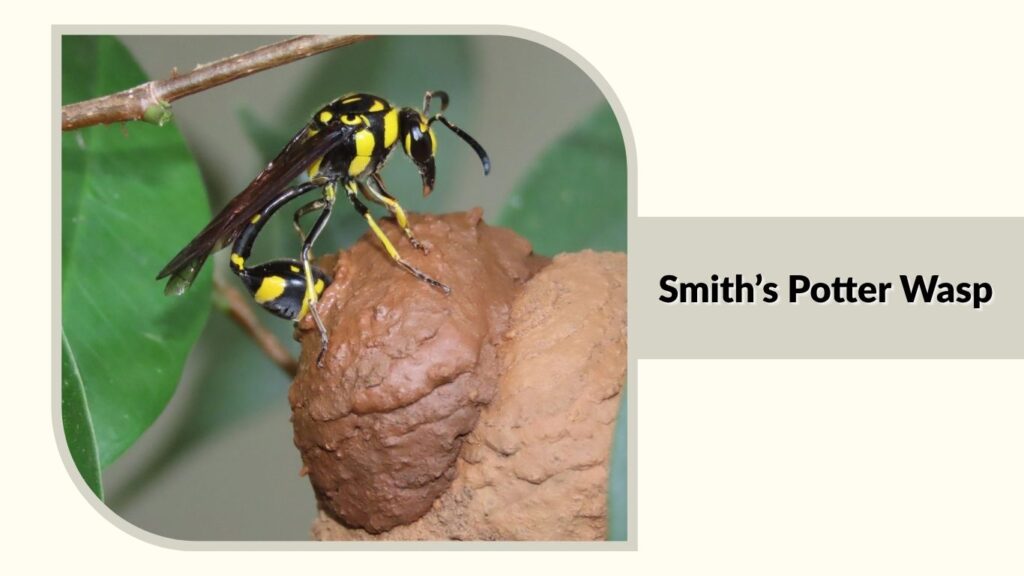
The Smith’s Potter Wasp (Eumenes smithii) is a solitary potter wasp native to the United States. It can be distinguished from related Eumenes species partly by its reddish or ferruginous markings, especially in populations from the southeastern portion of its range. It is a beneficial predator of plant-feeding insect larvae.
Identification
- Common Name: Smith’s Potter Wasp
- Scientific Name: Eumenes smithii
- Family: Vespidae
- Subfamily: Eumeninae
- Body Shape: Slender with a long, narrow first abdominal segment
- Color: Dark body with reddish, yellow, or ferruginous markings
- Female Face: Clypeus largely black
- Wings: Fold lengthwise when the wasp is resting
Habitat and Distribution
Smith’s Potter Wasp occurs mainly in the eastern and south-central United States. Documented states include Alabama, Florida, Georgia, Kansas, Mississippi, North Carolina, Oklahoma, Tennessee, and Texas. It can inhabit gardens, woodland borders, meadows, and other sunny habitats rich in flowering plants.
Behavior and Diet
Adults obtain carbohydrates by drinking nectar from flowers. Females also spend considerable time searching leaves and vegetation for caterpillars. These prey are paralyzed with a sting and transported to individual nest cells. Because each female works independently, the species does not create the large defensive colonies associated with yellowjackets.
Lifespan and Lifecycle
A female lays an egg inside a prepared nesting chamber and adds enough paralyzed caterpillars to support the developing larva. After hatching, the larva feeds until mature and then pupates inside the protected nest. The adult later emerges to mate and repeat the cycle. Specific adult longevity varies with season and environmental conditions.
4. European Potter Wasp
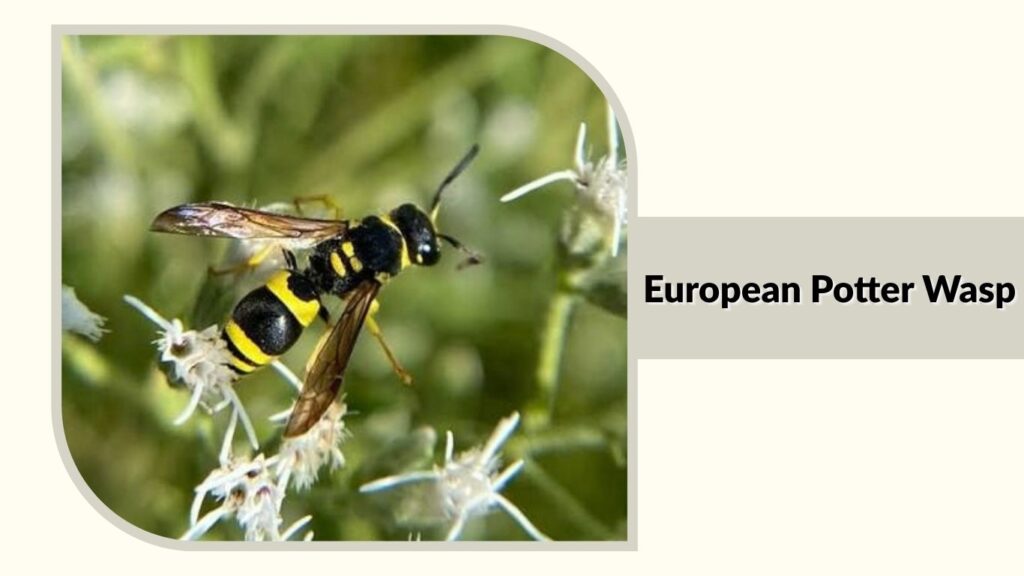
The European Potter Wasp (Ancistrocerus gazella), also called the European tube wasp, is a solitary species originally native to Europe. It has also become established in parts of North America. Rather than constructing large exposed colonies, females usually locate narrow cavities and divide them into individual brood chambers.
Identification
- Common Name: European Potter Wasp
- Other Name: European Tube Wasp
- Scientific Name: Ancistrocerus gazella
- Family: Vespidae
- Subfamily: Eumeninae
- Body Color: Mostly black with yellow markings
- Body Shape: Compact compared with long-waisted Eumenes
- Nest Type: Existing holes or narrow cavities divided with mud
Habitat and Distribution
The species is native across a broad portion of Europe, including countries such as France, Germany, Italy, Spain, Poland, Sweden, and Norway. It has also been introduced into northeastern and eastern North America. Adults can occur in gardens, woodland edges, parks, urban areas, and around buildings where suitable nesting holes are present.
Behavior and Diet
Females search for small cavities in wood, stems, walls, and other structures. They hunt caterpillars, paralyze them, and place them inside brood cells. Adults feed primarily on nectar and can also consume aphid honeydew. One female may gather numerous caterpillars while provisioning a nest.
Lifespan and Lifecycle
Each nest contains one or more individually separated brood cells. An egg is placed in a cell along with stored prey and the entrance is sealed with mud. The larva feeds on the caterpillars, pupates within the protected cavity, and later emerges as an adult.
5. South American Potter Wasp
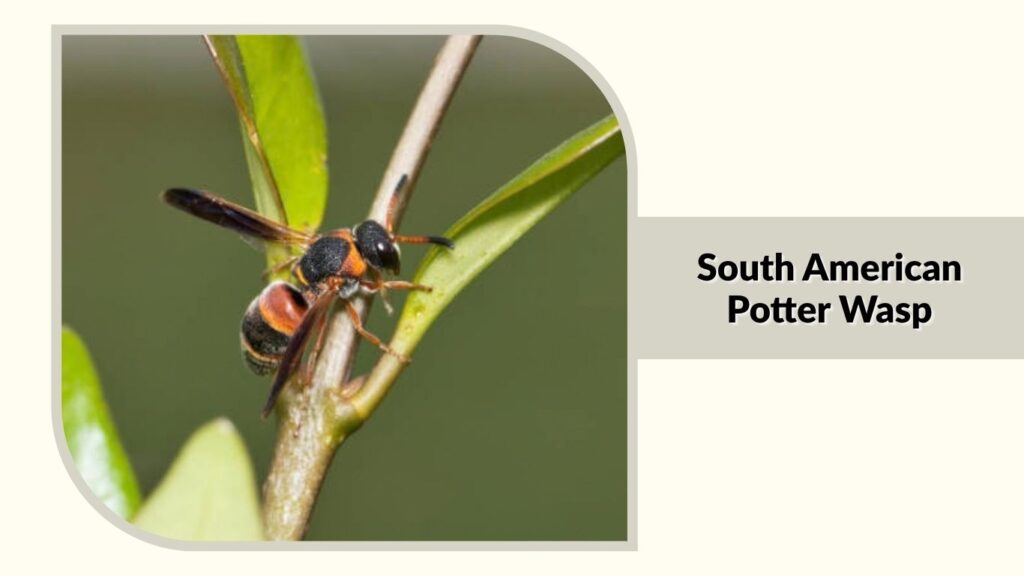
The South American Potter Wasp (Zeta argillaceum) is one of the better-known potter wasps of the Neotropics. Its characteristic mud nests may be attached to walls, branches, and other protected surfaces. The species is widespread from Mexico through much of South America and has also established populations in southern Florida.
Identification
- Common Name: South American Potter Wasp
- Scientific Name: Zeta argillaceum
- Family: Vespidae
- Subfamily: Eumeninae
- Body: Slender with a narrow connection between thorax and abdomen
- Color: Generally dark with contrasting lighter markings
- Nest: Rounded mud cells with a small opening
- Lifestyle: Solitary
Habitat and Distribution
Its native range extends through the Neotropics from Mexico to Argentina. The species has also become established in Florida. It adapts well to modified habitats and can live around gardens, forest edges, farms, parks, and urban buildings. Mud nests may sometimes be grouped closely together on protected surfaces.
Behavior and Diet
Adult South American Potter Wasps feed on nectar. Females hunt caterpillars, including moth larvae, and immobilize them for their offspring. A female builds a mud chamber, stocks it with prey, deposits an egg, and seals the chamber. Despite several nests sometimes appearing together, females do not form social colonies.
Lifespan and Lifecycle
One egg develops within each provisioned nest cell. After hatching, the larva consumes the living but paralyzed caterpillars stored by its mother. It eventually completes its larval growth, pupates, and transforms into an adult. The mud chamber provides protection throughout these vulnerable developmental stages.
6. Orange-Tailed Potter Wasp
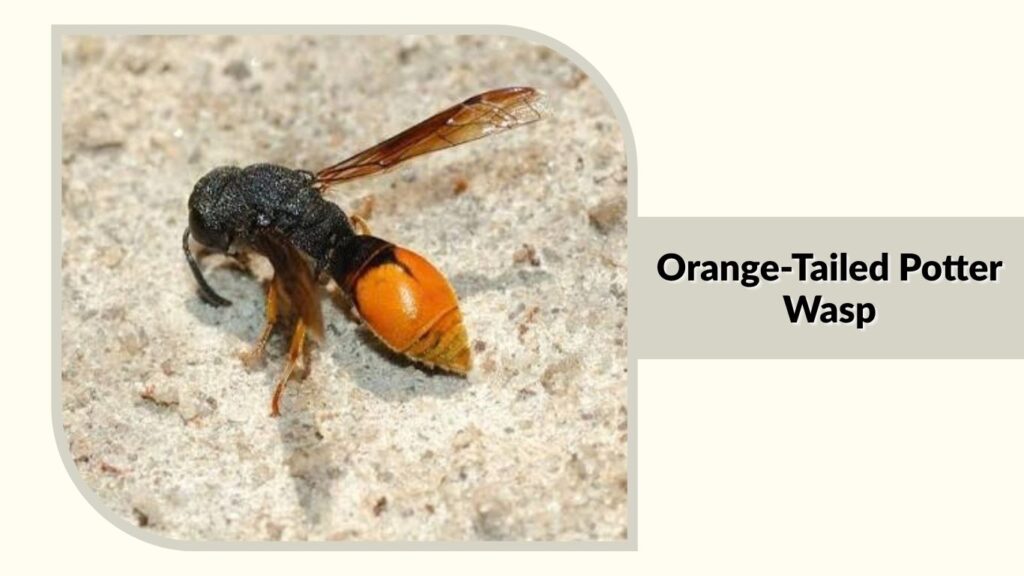
The Orange-Tailed Potter Wasp (Delta latreillei) is a large and conspicuous Australian potter wasp. Its combination of orange and black coloration makes it easy to notice when it visits flowers or collects mud. It is widespread across tropical and subtropical Australia and has also been introduced to New Zealand.
Identification
- Common Name: Orange-Tailed Potter Wasp
- Scientific Name: Delta latreillei
- Family: Vespidae
- Subfamily: Eumeninae
- Size: A relatively large potter wasp
- Color: Strong orange and black pattern
- Waist: Long and distinctly narrowed
- Nest: Constructed from collected mud
Habitat and Distribution
Orange-Tailed Potter Wasps are particularly widespread in warmer parts of Australia. They occur in tropical and subtropical environments, including woodland, scrub, gardens, parks, and urban areas. Their ability to use mud and sheltered nesting surfaces allows them to survive close to human habitation.
Behavior and Diet
Adults commonly visit flowers to drink nectar. Females regularly travel between water or damp soil and the nest while gathering mud. They also search vegetation for caterpillars, which are stung, paralyzed, and placed into brood chambers. Unlike social hornets, these wasps operate independently and normally avoid unnecessary conflicts with people.
Lifespan and Lifecycle
The female constructs a mud nest, deposits an egg, and supplies the developing offspring with immobilized caterpillars. The larva remains inside the nest while feeding and growing. It eventually pupates, undergoes metamorphosis, and emerges as a winged adult. Development rate varies with temperature, food availability, and season.
7. Yellow-and-Black Potter Wasp
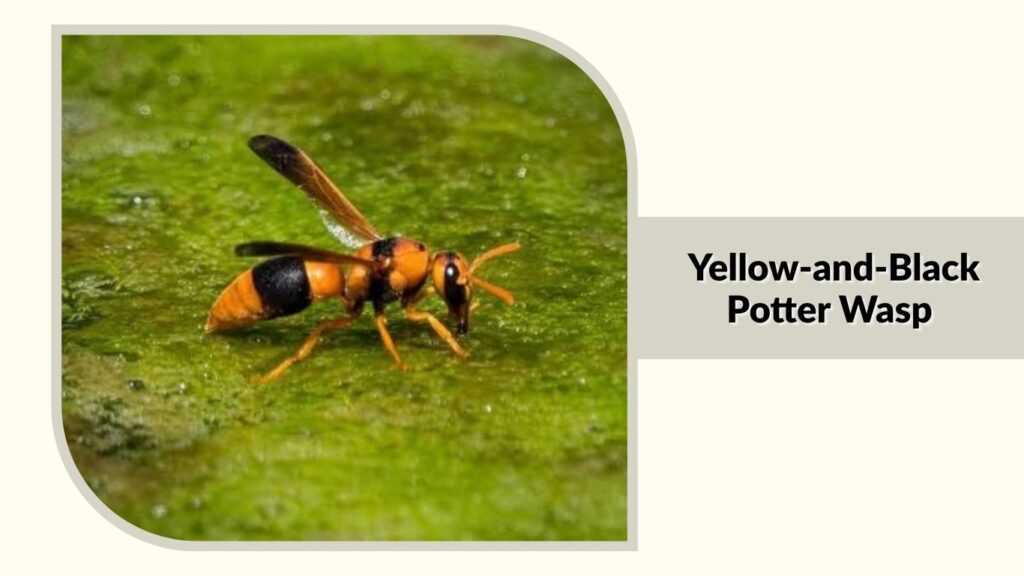
The Yellow-and-Black Potter Wasp (Delta campaniforme) is a striking member of the subfamily Eumeninae. Its contrasting coloration and long waist give it the classic appearance associated with many Delta potter wasps. It has an exceptionally broad distribution across parts of Asia, Africa, Australia, and the Pacific.
Identification
- Common Name: Yellow-and-Black Potter Wasp
- Scientific Name: Delta campaniforme
- Family: Vespidae
- Subfamily: Eumeninae
- Color: Black with conspicuous yellow markings
- Body Shape: Long, narrow waist and enlarged rear abdomen
- Wings: Usually smoky or brownish
- Lifestyle: Solitary predator
Habitat and Distribution
This species has been recorded from countries including India, China, Thailand, Malaysia, Indonesia, the Philippines, Singapore, Australia, South Africa, Namibia, Zimbabwe, and several Pacific locations. It can occupy tropical and subtropical gardens, woodland edges, agricultural areas, and disturbed environments.
Behavior and Diet
Adults frequently obtain nectar from flowers, while females hunt caterpillars for their young. The prey is subdued with the sting rather than immediately killed. A female transports these caterpillars to a prepared nesting chamber and supplies enough food for the larva to develop without further parental feeding.
Lifespan and Lifecycle
Reproduction centers around individually provisioned brood cells. A female places an egg in the chamber, adds paralyzed caterpillars, and seals the nest. The larva hatches and consumes the stored prey before pupating. Once metamorphosis is complete, the adult breaks out of the nesting chamber and begins an independent life.
8. Black Potter Wasp
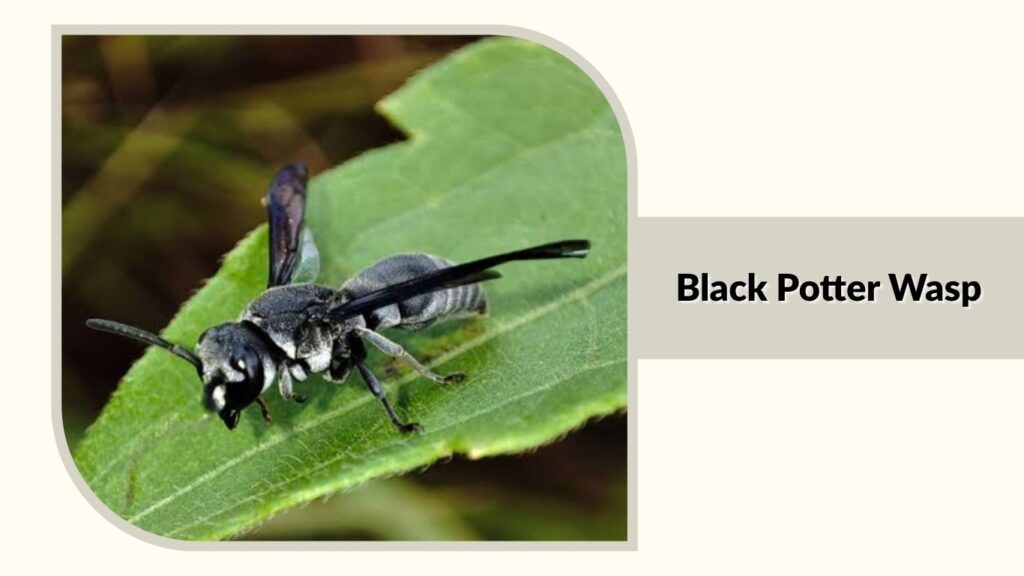
The Black Potter Wasp (Delta pyriforme philippinense) is a recognized member of the potter wasp group distinguished by its predominantly dark coloration. It belongs to the same subfamily as other mud-building Delta wasps and shares their solitary lifestyle and caterpillar-hunting behavior. The name is formally associated with this taxon in insect common-name databases.
Identification
- Common Name: Black Potter Wasp
- Scientific Name: Delta pyriforme philippinense
- Family: Vespidae
- Subfamily: Eumeninae
- Body Color: Predominantly dark brown to black
- Body Shape: Slender waist followed by a broader abdomen
- Wings: Dark or smoky
- Lifestyle: Solitary nesting wasp
Habitat and Distribution
This potter wasp is associated with warm parts of Asia. Related forms of Delta pyriforme occur widely through South and Southeast Asia, including areas of India, China, Taiwan, Malaysia, Singapore, Indonesia, and nearby regions. They typically inhabit warm open woodland, gardens, agricultural areas, and places where wet soil for nest construction is accessible.
Behavior and Diet
The adult wasp obtains energy from nectar and other sugar sources. Females are active predators that search plants for suitable caterpillars. They sting their prey and transport it to their nests, where it serves as food for a developing larva. The wasp is solitary, so each female is responsible for constructing and provisioning her own nests.
Lifespan and Lifecycle
Its lifecycle includes egg, larval, pupal, and adult stages. A female prepares a brood chamber and supplies it with caterpillars before sealing it. The larva develops without further care from its mother. After consuming its food supply, it pupates inside the nest and later emerges as an adult.
9. Catskill Potter Wasp
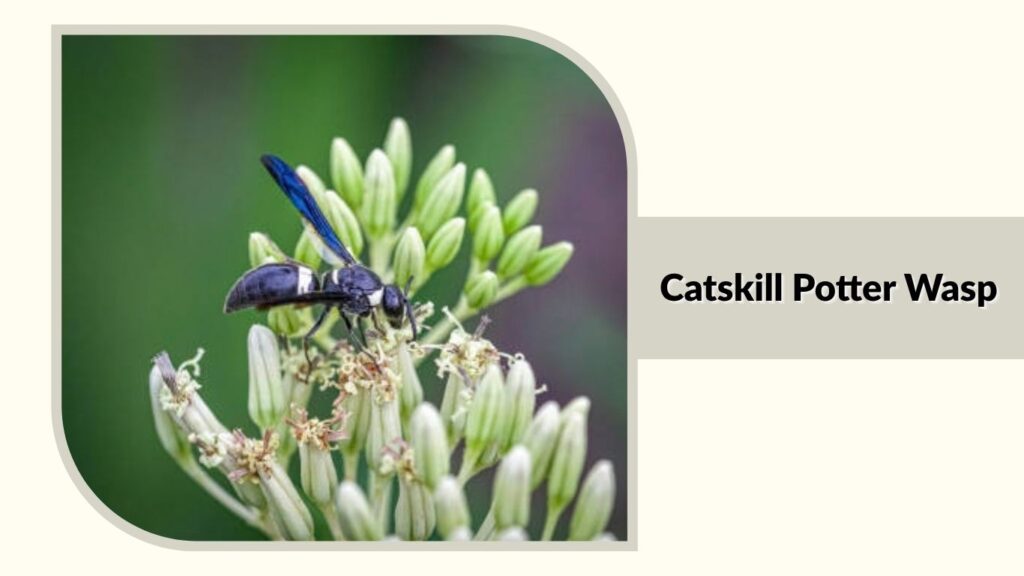
The Catskill Potter Wasp (Ancistrocerus catskill) is a North American member of the potter and mason wasp group. It belongs to Ancistrocerus, a genus whose members are solitary and typically use mud in nest construction or modification. The species is especially associated with northern and eastern parts of North America.
Identification
- Common Name: Catskill Potter Wasp
- Scientific Name: Ancistrocerus catskill
- Family: Vespidae
- Subfamily: Eumeninae
- Body Color: Mainly black with yellow or pale markings
- Body Shape: Compact abdomen without the extremely long petiole of Eumenes
- Wings: Folded lengthwise when resting
- Lifestyle: Solitary
Habitat and Distribution
Catskill Potter Wasps occur in North America and have been documented in the northeastern United States, including Maine. Suitable habitats include woodland edges, meadows, gardens, and areas containing hollow stems, holes, cracks, or other potential nesting locations.
Behavior and Diet
Like other Ancistrocerus, it does not establish a social colony. Females independently prepare nests and collect paralyzed prey. Members of this genus primarily provision their brood with insect larvae, especially caterpillars. Adults instead rely mainly on nectar and other sugary foods for their own energy.
Lifespan and Lifecycle
After mating, females prepare nesting cells, lay eggs, and provide each cell with immobilized prey. The sealed chamber protects the young wasp as it feeds and develops. The larva eventually pupates and transforms into an adult. Exact adult longevity is not well established and may differ according to climate, season, and local environmental conditions.
10. Cross Potter Wasp
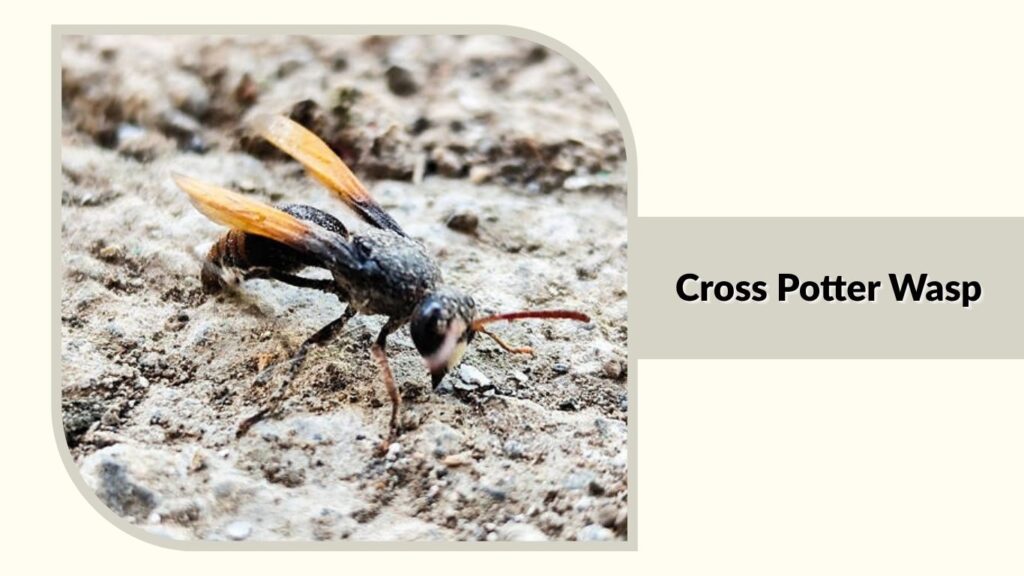
The Cross Potter Wasp (Eumenes crucifera) is a solitary North American wasp belonging to the potter and mason wasp subfamily Eumeninae. Like other members of Eumenes, it has a distinctive narrow waist and constructs protected brood cells for its offspring. The species is widely distributed across Canada and large portions of the United States.
Identification
- Common Name: Cross Potter Wasp
- Scientific Name: Eumenes crucifera
- Family: Vespidae
- Subfamily: Eumeninae
- Body Shape: Slender with a long, narrow waist
- Color: Primarily dark with contrasting pale or yellow markings
- Wings: Narrow and folded lengthwise while resting
- Lifestyle: Solitary
Habitat and Distribution
Cross Potter Wasps have been recorded across much of Canada and many areas of the United States, including both eastern and western states. They may be encountered in open woodland, meadows, grasslands, gardens, roadsides, and other sunny places where nectar-producing flowers and caterpillar prey are available.
Behavior and Diet
Adults feed mainly on nectar from flowers. Females hunt caterpillars that will become food for their young. The prey is stung and paralyzed before being transported to the nest. The female works alone and does not establish a worker colony.
Lifespan and Lifecycle
The lifecycle consists of egg, larva, pupa, and adult. A female prepares a brood chamber, places an egg inside, and provisions it with paralyzed prey. The larva feeds on this food supply before pupating. After completing metamorphosis, the adult emerges and begins feeding, mating, and reproducing independently.
11. Heath Potter Wasp
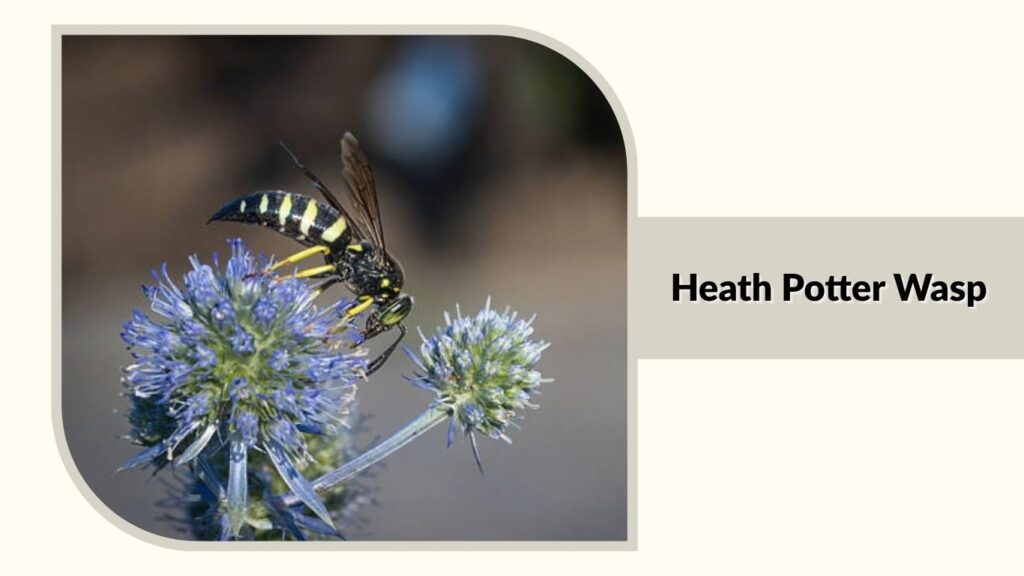
The Heath Potter Wasp (Eumenes coarctatus) is one of the best-known European potter wasps. It is especially notable for constructing tiny clay pots that are attached to vegetation. The species occurs across Europe and extends into North Africa and parts of Asia. In Britain, it is strongly associated with heathland habitats containing exposed clay and nearby water.
Identification
- Common Name: Heath Potter Wasp
- Scientific Name: Eumenes coarctatus
- Family: Vespidae
- Subfamily: Eumeninae
- Body: Slender with a very narrow waist
- Color: Black with variable pale yellow markings
- Nest: Small pot-shaped structure made from clay
- Wings: Fold lengthwise when resting
Habitat and Distribution
The Heath Potter Wasp inhabits heathlands, open sandy areas, scrub, and other warm habitats containing exposed clay or damp soil. Its range covers numerous parts of Europe, while related populations occur through North Africa and eastward into China and Japan. In Britain, nests are commonly attached to heather, gorse, or dead grass stems.
Behavior and Diet
Females collect clay and water to build individual pot-shaped nests. They then hunt small caterpillars, paralyze them, and place them inside the pot as food for the larva. Adults obtain their own energy mainly from flower nectar.
Lifespan and Lifecycle
Females lay a single egg in each provisioned pot before sealing it. The larva hatches, consumes the stored caterpillars, and develops inside the protective clay chamber. In favorable conditions, an early brood may be followed by a partial second generation during the same year.
12. Canadian Potter Wasp
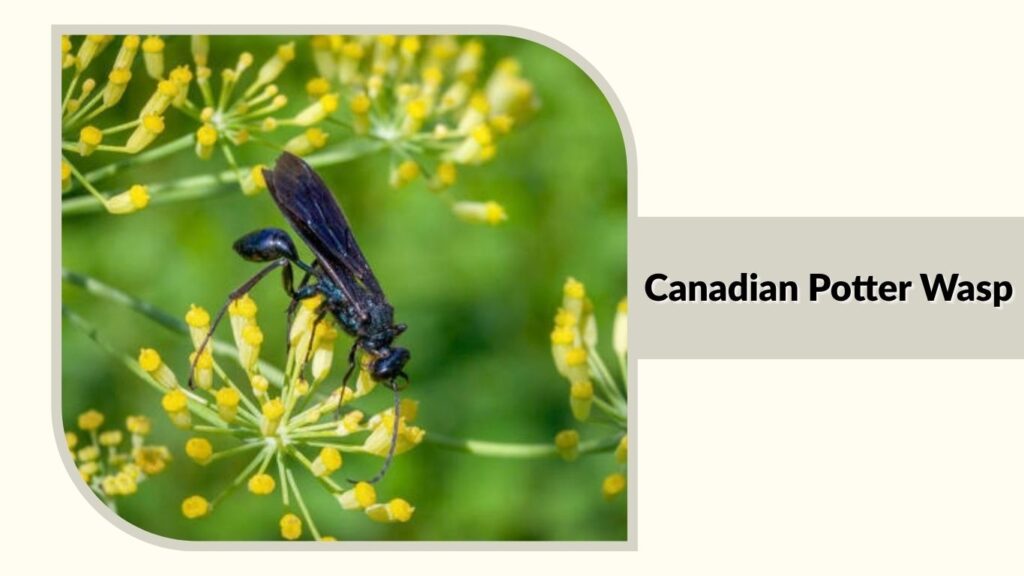
The Canadian Potter Wasp (Symmorphus canadensis) is a widespread North American member of Eumeninae. Although it does not always build the classic free-standing clay pots associated with Eumenes, it belongs to the same potter-and-mason wasp group. Females frequently use existing holes in wood and plant stems and separate their brood cells using mud.
Identification
- Common Name: Canadian Potter Wasp
- Scientific Name: Symmorphus canadensis
- Family: Vespidae
- Subfamily: Eumeninae
- Forewing Length: Approximately 4.5–7.3 mm
- Body: Mainly black
- Markings: Yellow to ivory markings
- Nest Type: Existing cavities partitioned with mud
- Lifestyle: Solitary
Habitat and Distribution
Canadian Potter Wasps occur through most of Canada and the United States, although they are generally absent from Arctic, high-boreal, and southwestern desert regions. They can inhabit woodland edges, gardens, fields, and other locations where dead wood, hollow stems, and insect prey are plentiful.
Behavior and Diet
Females nest in holes in wood and hollow twigs. Rather than building an entire nest from mud, they use mud to make partitions and entrance plugs. They hunt leaf-mining beetle and moth larvae, particularly leaf beetles, and place the immobilized prey inside brood cells.
Lifespan and Lifecycle
An egg is deposited in a prepared cell containing prey. After hatching, the larva feeds on the stored insects and grows within the protected cavity. It later pupates before emerging as an adult. Exact adult longevity is not well documented and varies according to environmental conditions and season.
13. Caterpillar-Hunting Potter Wasp
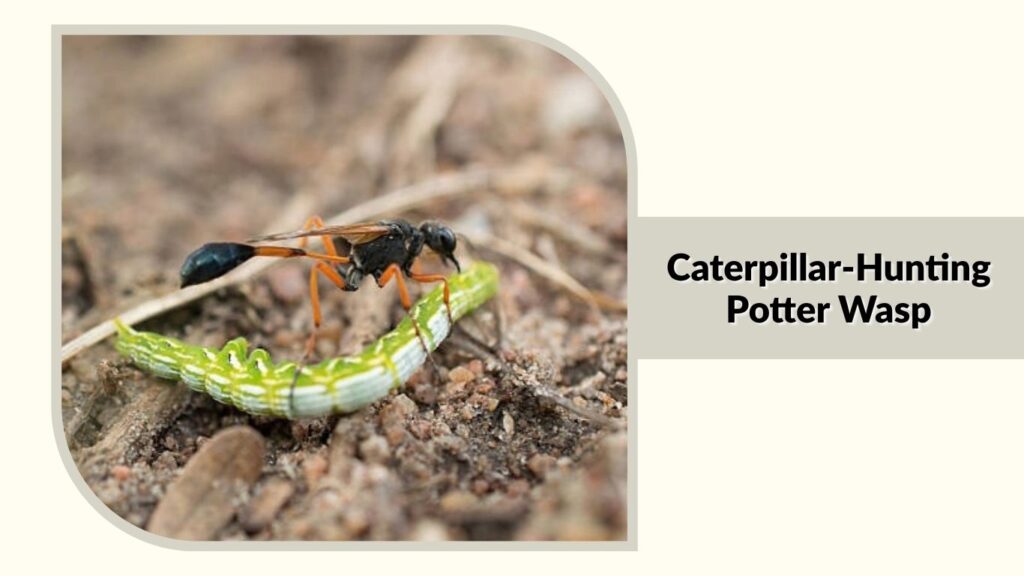
The Caterpillar-Hunting Potter Wasp (Ancistrocerus trifasciatus) is a solitary wasp whose common name reflects its predatory behavior. Females actively search vegetation for insect larvae to provision their nests. It is widespread in parts of Europe and is particularly associated with hollow stems and other narrow cavities suitable for nesting.
Identification
- Common Name: Caterpillar-Hunting Potter Wasp
- Scientific Name: Ancistrocerus trifasciatus
- Family: Vespidae
- Subfamily: Eumeninae
- Color: Mainly black with yellow markings
- Body Shape: Compact with a moderately narrow waist
- Wings: Folded lengthwise at rest
- Nest Type: Hollow stems and similar cavities
Habitat and Distribution
The species occurs in Britain and across other parts of Europe. It can be found in parks, gardens, woodland, hedgerows, and other vegetated habitats. Adults are most noticeable from summer into autumn, particularly where flowering plants provide nectar.
Behavior and Diet
Females search for small caterpillars and beetle larvae. Once suitable prey is found, it is paralyzed and carried back to a nesting cavity. The female creates separate chambers for individual offspring. Adults feed mainly on nectar rather than consuming the prey collected for their larvae.
Lifespan and Lifecycle
Eggs are laid in provisioned brood cells within hollow stems or other cavities. Each larva consumes the prey provided by its mother and then pupates. Adults eventually emerge from the nest to feed and mate. These nests can also be attacked by parasitic jewel wasps, including members of the Chrysis group.
14. Walden’s Potter Wasp
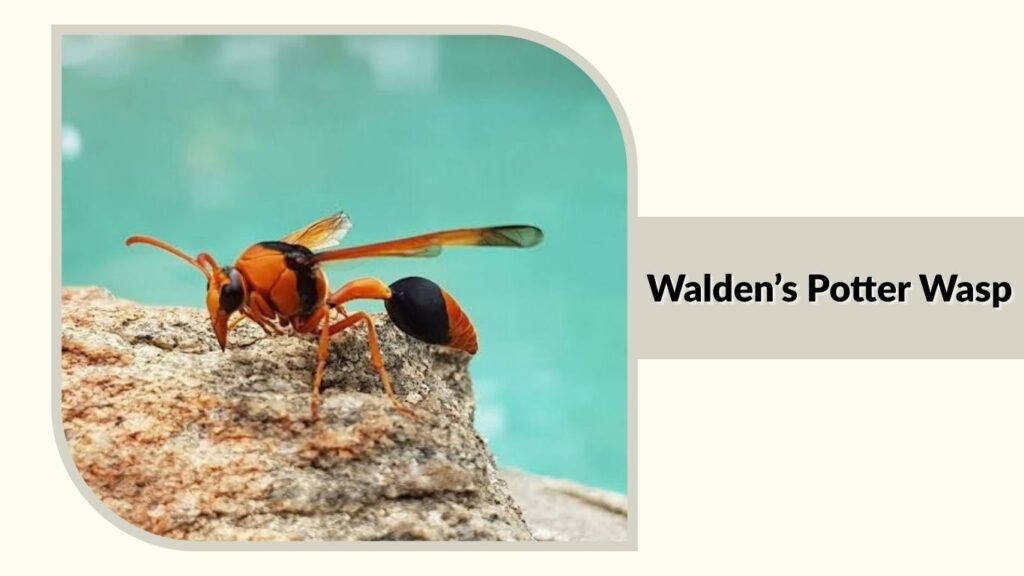
The Walden’s Potter Wasp (Ancistrocerus waldenii) is a northern North American species belonging to the potter and mason wasp subfamily. Unlike species that produce small jug-shaped pots, this wasp may construct mud nests directly on rocks and walls or use cavities in mortar. Its range reaches unusually far north, including a documented occurrence in western Greenland.
Identification
- Common Name: Walden’s Potter Wasp
- Scientific Name: Ancistrocerus waldenii
- Family: Vespidae
- Subfamily: Eumeninae
- Body Color: Primarily black with pale yellow bands
- Abdomen: Several pale bands may be visible
- Body Shape: Compact and robust
- Nest: Mud nest or mud-modified cavity
Habitat and Distribution
Walden’s Potter Wasp occurs across Canada and parts of the northern United States, with western forms extending farther south through mountainous areas. The species has also been documented in western Greenland. Suitable environments include rocky landscapes, woodland margins, open areas, and places containing walls, stones, or mortar cavities suitable for nests.
Behavior and Diet
Females construct mud chambers on rocks and walls or take advantage of existing holes. They capture caterpillars, including tortricid moth larvae, and provision their nests with immobilized prey. Adults obtain energy by visiting flowers for nectar.
Lifespan and Lifecycle
A female places an egg in each prepared brood cell and supplies it with prey before sealing the chamber. The larva feeds independently after hatching, eventually pupating within the nest. The adult emerges after completing development. The precise adult lifespan has not been well established.
15. White-Banded Potter Wasp
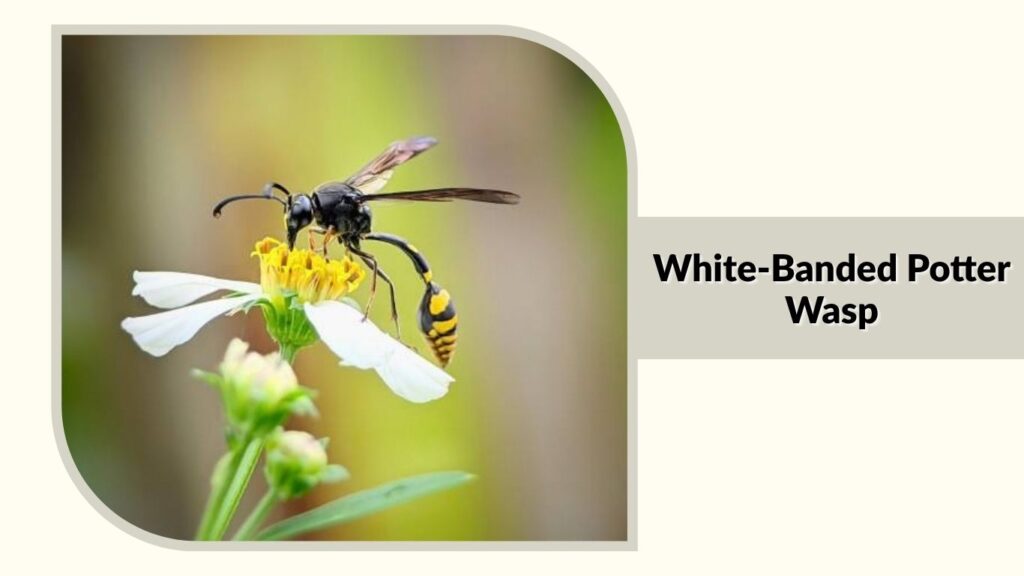
The White-Banded Potter Wasp (Ancistrocerus albophaleratus) is a broadly distributed North American species easily associated with the pale markings that contrast with its otherwise dark body. Like many Ancistrocerus, it commonly nests in pre-existing cavities rather than making a completely free-standing pottery-like structure.
Identification
- Common Name: White-Banded Potter Wasp
- Scientific Name: Ancistrocerus albophaleratus
- Family: Vespidae
- Subfamily: Eumeninae
- Body Color: Predominantly black
- Markings: Whitish, ivory, or pale yellow bands
- Body Shape: Compact with a narrowed waist
- Nest Type: Wood borings, hollow stems, galls, and rock crevices
Habitat and Distribution
The White-Banded Potter Wasp occurs widely throughout Canada and the northern United States. Its range extends southward along mountainous areas into states such as North Carolina, New Mexico, and Arizona. It inhabits woodland, gardens, rocky areas, meadows, and other places containing natural nesting cavities.
Behavior and Diet
Females use wood holes, hollow stems, abandoned galls, and similar cavities as nesting sites. Mud is used to separate individual brood cells and seal the entrance. Recorded prey includes caterpillars from several moth families, such as Tortricidae, Gelechiidae, and Geometridae.
Lifespan and Lifecycle
The female provisions each brood cell with paralyzed caterpillars and places an egg inside. After the nest is sealed, the larva hatches and consumes the stored prey. It then pupates within the protected chamber. Development ends when the fully formed adult emerges and begins its independent reproductive life.
16. Four-Toothed Mason Wasp
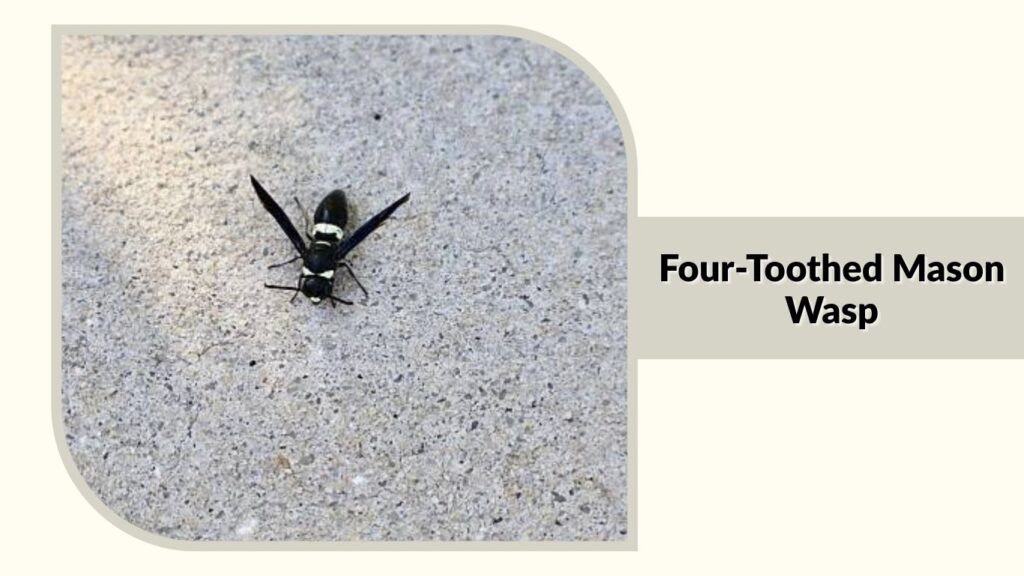
The Four-Toothed Mason Wasp (Monobia quadridens) is technically called a mason wasp, but it belongs to Eumeninae, the same subfamily commonly known as the potter and mason wasps. It is one of the more recognizable North American species because of its dark body and broad ivory abdominal marking.
Identification
- Common Name: Four-Toothed Mason Wasp
- Scientific Name: Monobia quadridens
- Family: Vespidae
- Subfamily: Eumeninae
- Color: Mostly black
- Abdominal Marking: Broad ivory-colored band
- Wingspan: Up to roughly 18 mm
- Lifestyle: Solitary
- Nest: Usually constructed in existing cavities
Habitat and Distribution
This species is widespread through eastern North America. Its range extends from parts of southern Canada through much of the eastern United States and south into northern Mexico. It occurs around woodland edges, gardens, fields, farms, and urban or suburban locations containing suitable nesting cavities.
Behavior and Diet
Females often use abandoned carpenter-bee tunnels, hollow stems, and old mud-dauber nests. Their primary prey consists of small caterpillars from several moth families. The female paralyzes these caterpillars and places them in brood cells. Adults also visit flowers and can consume nectar and pollen.
Lifespan and Lifecycle
Four-Toothed Mason Wasps commonly produce two generations per year. Eggs develop into larvae that feed on stored caterpillars before pupating. One generation emerges during the warmer season, while another can overwinter in the nest and emerge the following year.
17. Hidalgo Mason Wasp
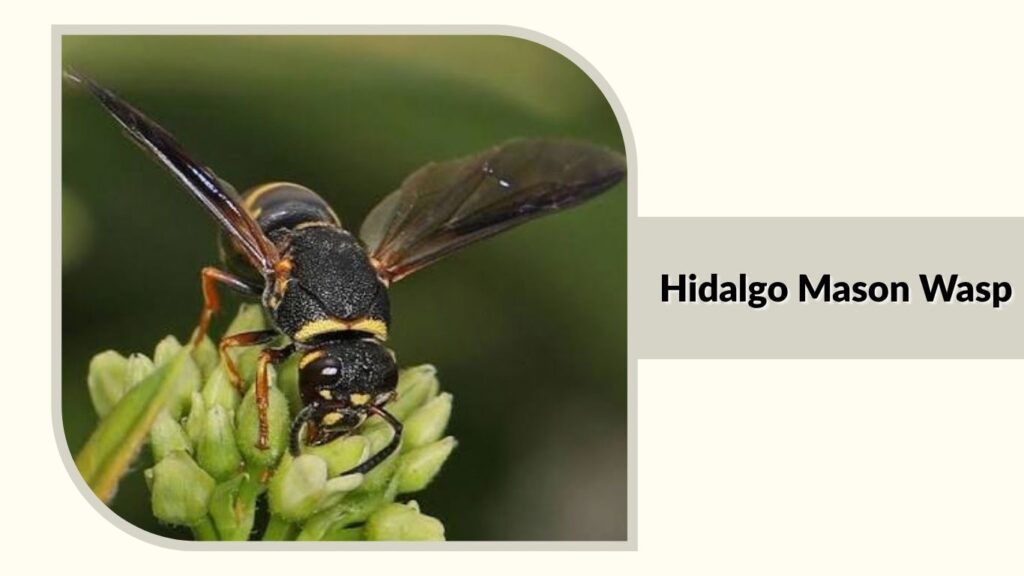
The Hidalgo Mason Wasp (Euodynerus hidalgo) is another true member of Eumeninae and therefore part of the broader potter-and-mason wasp group. It is a solitary North American species recognized by distinctive structural features of its abdomen. Its coloration varies considerably between populations, with some individuals showing more black and others displaying extensive reddish markings.
Identification
- Common Name: Hidalgo Mason Wasp
- Scientific Name: Euodynerus hidalgo
- Family: Vespidae
- Subfamily: Eumeninae
- Body Color: Variable black, reddish, and yellow patterning
- Abdomen: Distinctive raised margins on the second and third tergites
- Lifestyle: Solitary
- Nest: Existing holes or abandoned insect nests
Habitat and Distribution
Hidalgo Mason Wasps are widely distributed across the United States, with their range extending into Canada and south through parts of Mexico. They occupy open woodland, gardens, dry banks, fields, and other habitats containing suitable nesting cavities and abundant caterpillar prey.
Behavior and Diet
Females nest in wood borings and may also use abandoned mud nests made by other insects. In some populations, they use burrows in clay banks. Firmly packed sand or mud can be used to separate and seal brood cells. Females primarily hunt small moth caterpillars, particularly pyralid larvae, for their offspring.
Lifespan and Lifecycle
A female deposits an egg in a prepared chamber and adds paralyzed caterpillars. After the egg hatches, the larva consumes this stored food supply and grows without further parental feeding. It later pupates inside the chamber before emerging as an adult. Adult longevity is not precisely documented and depends on season and environmental conditions.
18. Black-and-White Mason Wasp
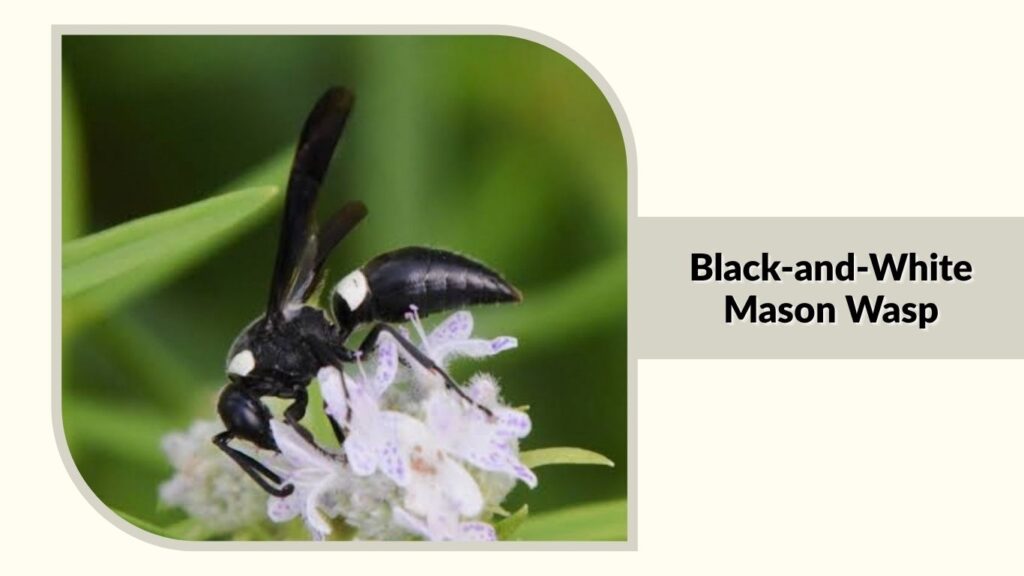
The Black-and-White Mason Wasp (Euodynerus leucomelas) is a solitary member of the potter and mason wasp subfamily Eumeninae. It has contrasting pale markings over a predominantly dark body and occurs across a large part of North America. Females use existing cavities rather than forming large social nests, making small brood chambers separated with mud.
Identification
- Common Name: Black-and-White Mason Wasp
- Scientific Name: Euodynerus leucomelas
- Family: Vespidae
- Subfamily: Eumeninae
- Body Color: Mainly black with pale yellow, ivory, or whitish markings
- Wings: Darkened and folded lengthwise at rest
- Lifestyle: Solitary
- Nest Type: Pre-existing cavities divided with mud
Habitat and Distribution
This species occurs throughout much of Canada and across northern and western portions of the United States, extending south into areas such as North Carolina, Tennessee, New Mexico, and Arizona. It can inhabit woodland edges, gardens, shrubby areas, and places containing hollow twigs or other suitable nesting cavities.
Behavior and Diet
Females commonly nest in cavities inside sumac twigs. They create partitions and closing plugs with mud. Caterpillars from several moth families are collected as larval food. Adults, like many other Eumeninae, visit flowers for nectar while females perform all nest construction and prey gathering independently.
Lifespan and Lifecycle
After preparing a cavity, the female creates individual brood cells and places an egg in each provisioned chamber. The larva feeds on the stored caterpillars, grows, and then pupates inside the nest. Following metamorphosis, the adult emerges to feed and reproduce. Seasonal timing varies across its broad geographical range.
19. Cryptic Mason Wasp
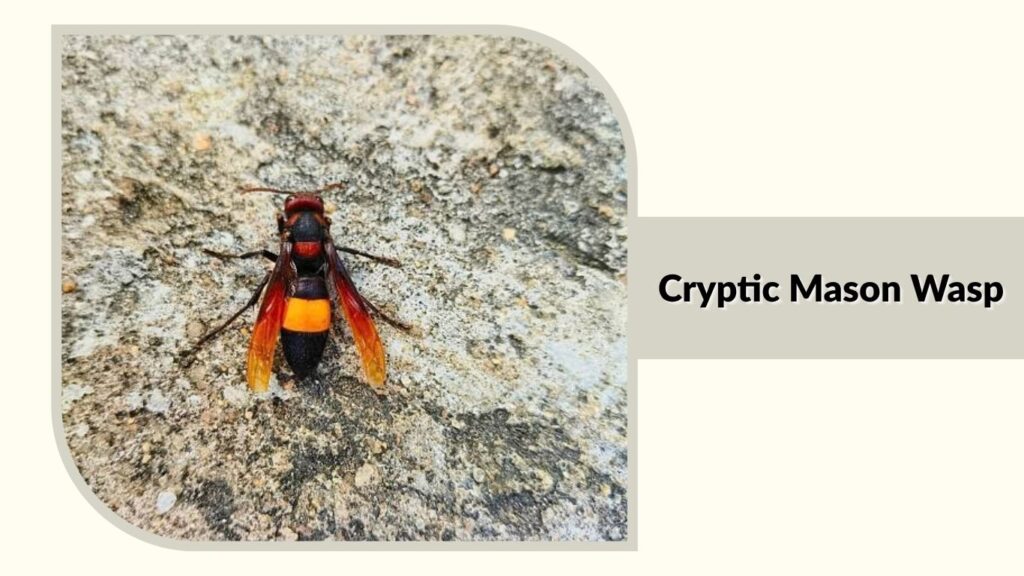
The Cryptic Mason Wasp (Euodynerus crypticus) is a ground-nesting member of Eumeninae found across parts of North America and Mexico. Its coloration can vary geographically, but reddish-brown and yellow markings are often visible against the darker body. Unlike cavity-nesting relatives, females may establish small groups of individual nests in the ground.
Identification
- Common Name: Cryptic Mason Wasp
- Scientific Name: Euodynerus crypticus
- Family: Vespidae
- Subfamily: Eumeninae
- Female Size: About 13.5–15 mm
- Male Size: About 9.5–11.5 mm
- Color: Dark with yellow and reddish-brown markings
- Lifestyle: Solitary ground nester
Habitat and Distribution
The Cryptic Mason Wasp occurs in parts of Canada, the United States, and Mexico. Records extend from Ontario and Alberta through much of the eastern United States and west toward Wyoming, Utah, and Arizona, with its range continuing south into Mexico.
Behavior and Diet
Females dig vertical burrows in the soil, sometimes nesting near other females without becoming truly social. They use water to soften hard soil during excavation and separate their underground brood cells with clay partitions. Recorded prey includes skipper caterpillars, which are captured and stored for developing larvae.
Lifespan and Lifecycle
The female places an egg within a provisioned underground brood cell. When the egg hatches, the larva consumes the caterpillars left by its mother. It eventually enters the pupal stage inside the protected chamber before emerging as an adult. As with other solitary potter wasps, each female independently produces and provisions her offspring.
20. Pitted Mason Wasp
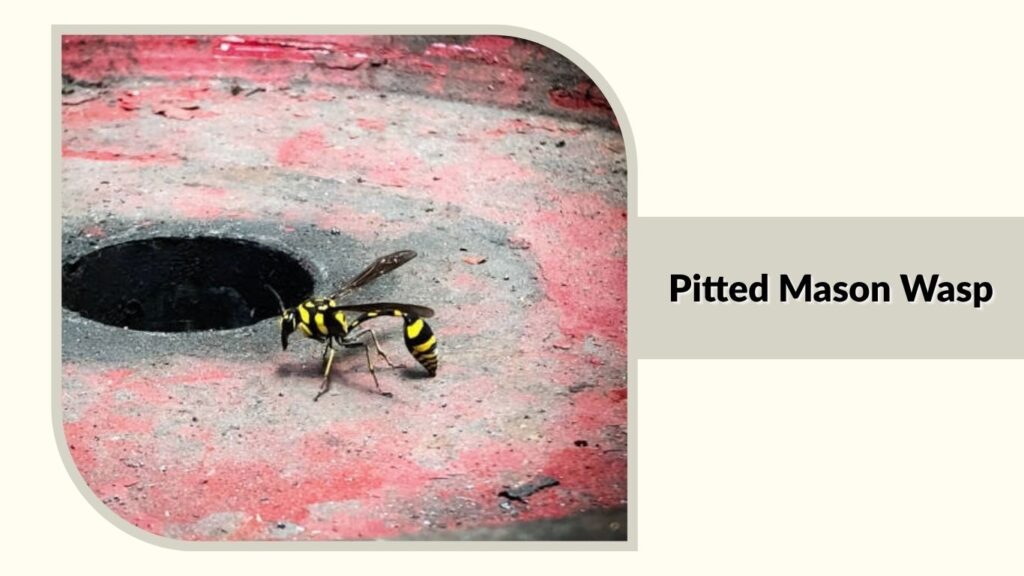
The Pitted Mason Wasp (Euodynerus foraminatus) is one of the more widespread North American members of the potter and mason wasp group. It readily uses natural and artificial cavities, making it adaptable to different habitats. Females seal and divide their nesting chambers using mud or firmly packed sand.
Identification
- Common Name: Pitted Mason Wasp
- Scientific Name: Euodynerus foraminatus
- Family: Vespidae
- Subfamily: Eumeninae
- Body Color: Mostly black
- Markings: Yellow or sometimes ivory
- Body Shape: Compact with a narrowed waist
- Nest Type: Hollow stems, wood holes, and other cavities
Habitat and Distribution
The Pitted Mason Wasp occurs across all Canadian provinces and is transcontinental in the United States. Its distribution also reaches Mexico. It can be found around woodland, gardens, fields, parks, and developed environments wherever appropriate nesting cavities and caterpillar prey are available.
Behavior and Diet
Females nest in wood borings, hollow twigs, old paper-wasp cells, and even artificial materials such as corrugated cardboard. Mud or agglutinated sand is used to create cell partitions and entrance plugs. Their prey includes caterpillars from several moth families, including Tortricidae, Gelechiidae, Pyralidae, and Crambidae.
Lifespan and Lifecycle
Each brood cell receives an egg and a supply of captured caterpillars. The developing larva consumes this stored food before pupating within the cavity. The adult later emerges by breaking through the cell closure. Development and adult activity are strongly influenced by seasonal temperatures and local climate.
21. Ringed Mason Wasp
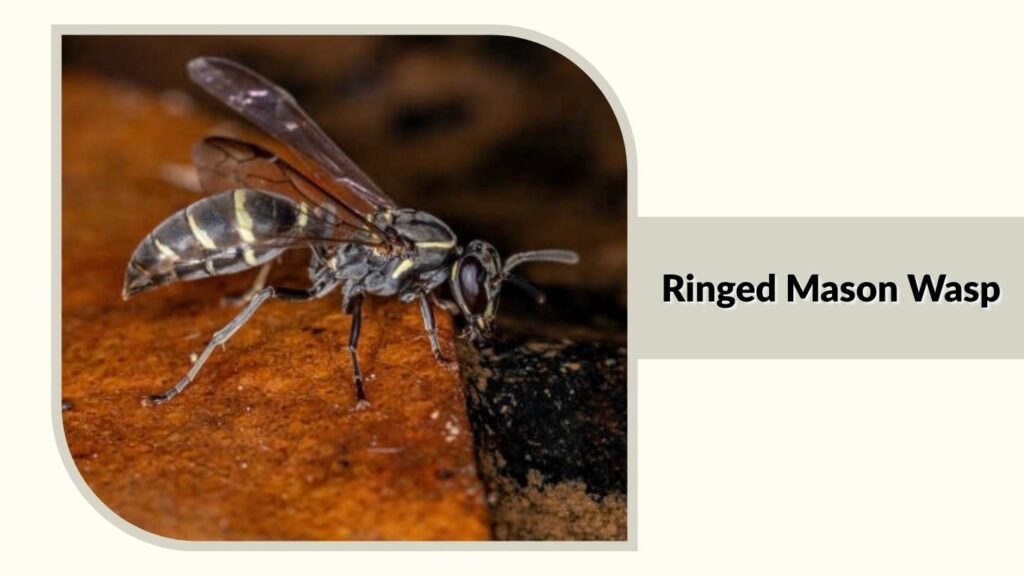
The Ringed Mason Wasp (Euodynerus annulatus) is a distinctive North American Eumeninae species with several recognized geographic forms. It is unusual among potter and mason wasps because females commonly excavate nests in soil and construct a short chimney-like mud tube above the burrow entrance.
Identification
- Common Name: Ringed Mason Wasp
- Scientific Name: Euodynerus annulatus
- Family: Vespidae
- Subfamily: Eumeninae
- Body: Dark with yellow and reddish markings
- Wings: Folded lengthwise while resting
- Nest Type: Underground burrow
- Special Feature: Mud chimney around the nest entrance
Habitat and Distribution
Ringed Mason Wasps have a broad North American range. They occur across much of the United States, parts of southern Canada, and northern Mexico. They inhabit open areas with suitable soil, flowering plants, and nearby water sources used during nest construction.
Behavior and Diet
Females excavate nests in both relatively hard and soft soils. Water is carried back to the nesting area and used to soften the soil, while excavated material can be incorporated into the entrance chimney. Their larvae are provisioned with moth caterpillars, while adults visit flowers for nectar.
Lifespan and Lifecycle
After excavating a brood chamber, the female lays an egg and supplies the cell with captured caterpillars. The larva feeds on this prey before pupating underground. After metamorphosis, the new adult emerges through the burrow entrance. The precise length of the adult stage varies with environmental and seasonal conditions.
22. Walking Mason Wasp
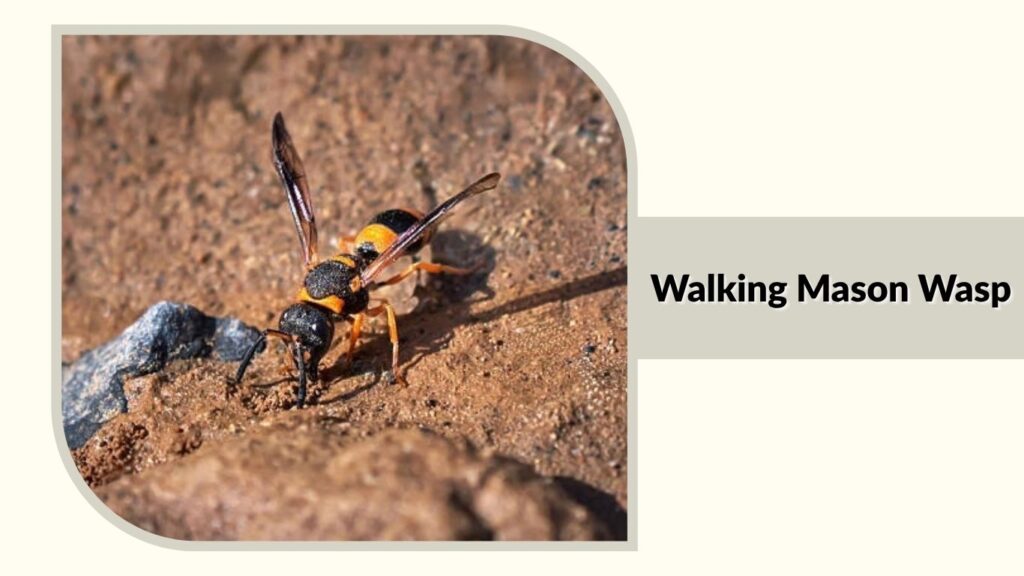
The Walking Mason Wasp (Parancistrocerus pedestris) is a solitary North American species belonging to Eumeninae. Females usually occupy narrow cavities in wood or hollow plant stems and create separate brood chambers using mud or sand. Like most members of this group, it is an important natural predator of caterpillars.
Identification
- Common Name: Walking Mason Wasp
- Scientific Name: Parancistrocerus pedestris
- Family: Vespidae
- Subfamily: Eumeninae
- Body: Compact and narrow-waisted
- Color: Dark with pale yellow or reddish markings
- Wings: Fold longitudinally at rest
- Lifestyle: Solitary
Habitat and Distribution
The species occurs in eastern North America, including parts of southeastern Canada and the eastern United States. Its U.S. distribution extends west toward Minnesota, Kansas, and New Mexico. It is associated with woodland borders, gardens, fields, and other areas containing suitable nesting stems or wood cavities.
Behavior and Diet
Females use borings in wood as well as stems of sumac and elder. Brood chambers are separated by mud partitions, although some southern populations may use firmly agglutinated sand. Females hunt small caterpillars, particularly members of the moth family Gelechiidae.
Lifespan and Lifecycle
The female prepares a sequence of brood cells, provisioning each with prey before closing it. An egg develops into a larva that consumes the stored caterpillars and eventually pupates. Once metamorphosis is completed, the adult exits the nesting cavity and begins feeding on nectar and searching for mates.
23. Keyhole Wasp
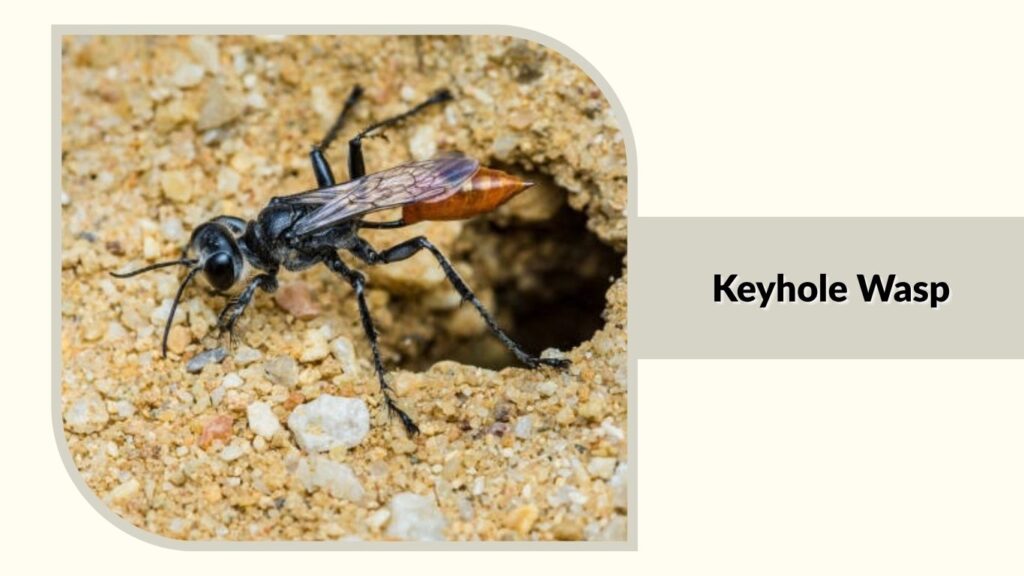
The Keyhole Wasp (Pachodynerus nasidens) is a potter and mason wasp famous for using narrow artificial cavities as nesting sites. Its tendency to occupy keyholes, electrical openings, small tubes, and similar spaces gives the species its common name. It is native to tropical America but has established populations in several regions outside its original range.
Identification
- Common Name: Keyhole Wasp
- Scientific Name: Pachodynerus nasidens
- Family: Vespidae
- Subfamily: Eumeninae
- Body Shape: Compact with a narrow waist
- Color: Mainly dark with contrasting lighter markings
- Nest Type: Existing narrow cavities
- Lifestyle: Solitary
Habitat and Distribution
The species is native to Central and South America and the Caribbean, with populations also occurring in the southern United States. Human transport has helped it establish on Pacific islands, in Japan, and in parts of Australia.
Behavior and Diet
Instead of always building an entire exposed mud nest, females frequently occupy empty insect nests and human-made holes. They use mud to divide and close these spaces. Caterpillars are collected and placed inside the cells for the larvae, while adults depend largely on sugary food sources such as flower nectar.
Lifespan and Lifecycle
A female constructs or modifies a cavity, adds prey, deposits an egg, and seals the brood cell. The larva feeds on the stored caterpillars before pupating. Once development is complete, the adult cuts through the nest closure and emerges.
24. Black-Headed Mason Wasp
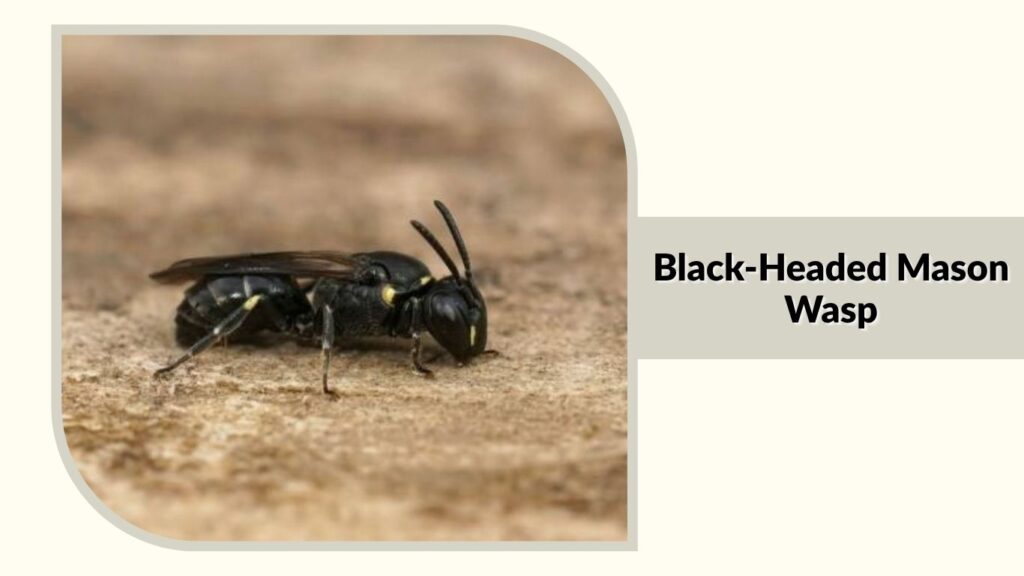
The Black-Headed Mason Wasp (Odynerus melanocephalus) is a solitary European member of the potter and mason wasp subfamily. It is strongly associated with exposed soils containing clay, where females excavate burrows and create characteristic short chimney-like structures around their entrances.
Identification
- Common Name: Black-Headed Mason Wasp
- Scientific Name: Odynerus melanocephalus
- Family: Vespidae
- Subfamily: Eumeninae
- Head: Predominantly dark
- Body: Narrow-waisted and wasp-like
- Nest: Underground burrow
- Entrance: Usually surrounded by a short mud chimney
Habitat and Distribution
In Britain, the species has been recorded from Devon eastward to Kent and north toward Northamptonshire. Typical habitats include grasslands, heathlands, clayey cliffs, landslips, saltmarsh edges, railway embankments, pits, and other open places containing exposed clay-rich soil.
Behavior and Diet
Females excavate their nests in the soil and construct a small chimney around the entrance. Their brood cells have been recorded containing weevil larvae and small moth caterpillars. Adults visit flowers such as wild carrot, clover, and speedwell for nectar.
Lifespan and Lifecycle
After completing a chamber, the female provisions it with prey and deposits an egg. The larva hatches and consumes the supplied insects before entering the pupal stage. Eventually, a mature adult emerges from the underground nest. In Britain, adults are most often observed during early summer.
25. Purbeck Mason Wasp
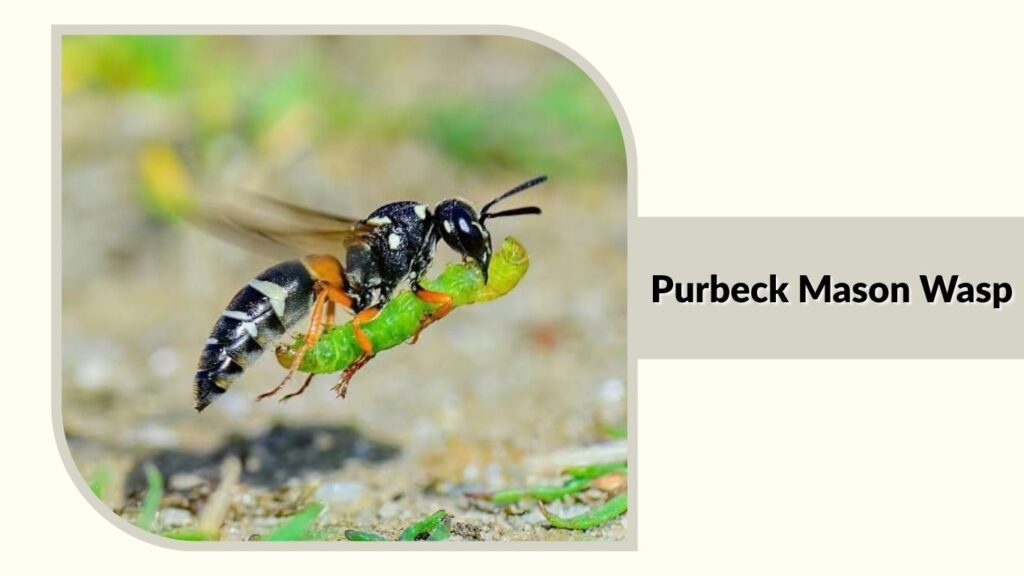
The Purbeck Mason Wasp (Pseudepipona herrichii) is a rare member of Eumeninae best known from lowland heath habitats in southern England. It has specialized nesting and feeding requirements, making suitable habitat particularly important for its survival. Like other potter and mason wasps, it lives independently rather than forming large social colonies.
Identification
- Common Name: Purbeck Mason Wasp
- Scientific Name: Pseudepipona herrichii
- Family: Vespidae
- Subfamily: Eumeninae
- Lifestyle: Solitary
- Nest Type: Burrow in exposed clay
- Adult Food Source: Flower nectar
- Larval Food: Caterpillar prey
Habitat and Distribution
In Britain, the Purbeck Mason Wasp is strongly associated with lowland heath in Dorset, particularly around the Poole Basin and Isle of Purbeck. Suitable sites need exposed clay for nesting, access to water, nectar-producing vegetation, and appropriate caterpillar prey.
Behavior and Diet
Females use exposed clay to establish nesting burrows and require nearby water to assist with nest construction. Bell heather is an important nectar source for adults. Research in Britain identified caterpillars of the moth Acleris hyemana as the known prey supplied to developing larvae.
Lifespan and Lifecycle
A female excavates and prepares brood cells before collecting caterpillars for her offspring. An egg is deposited in each provisioned chamber. The larva develops by consuming the stored prey and subsequently pupates within the nest. The next adult generation eventually emerges to begin feeding, mating, and nesting independently.
FAQs
1. Are Potter Wasps Dangerous to Humans?
Potter wasps are generally not dangerous or aggressive toward humans. They are solitary wasps and do not defend large colonies like yellowjackets or hornets. Females can sting if they are grabbed, trapped, or seriously threatened, but they normally avoid people and prefer to focus on hunting prey and building nests.
2. Do Potter Wasps Sting?
Yes, female potter wasps have a functional sting. They primarily use it to paralyze caterpillars and other insect larvae that are stored as food for their offspring. Stings to humans are uncommon because potter wasps are usually calm and nonaggressive unless directly handled or disturbed.
3. What Do Potter Wasps Eat?
Adult potter wasps mainly feed on flower nectar and other sugary substances. Their larvae have a very different diet. Females capture caterpillars and sometimes other insect larvae, paralyze them with their sting, and place them inside brood chambers where the developing young can feed on them.
4. Where Do Potter Wasps Build Their Nests?
Nesting habits vary between species. Some construct characteristic pot- or jug-shaped mud nests on plants, rocks, walls, or other surfaces. Others use hollow stems, abandoned insect tunnels, cracks, wood holes, or underground burrows. Mud is often used to construct, divide, or seal individual brood cells.
5. Are Potter Wasps Beneficial?
Yes. Potter wasps are considered beneficial predators because they hunt caterpillars and other insect larvae, including species that may damage garden and agricultural plants. Adults also visit flowers for nectar and can contribute to pollination while moving between blossoms.