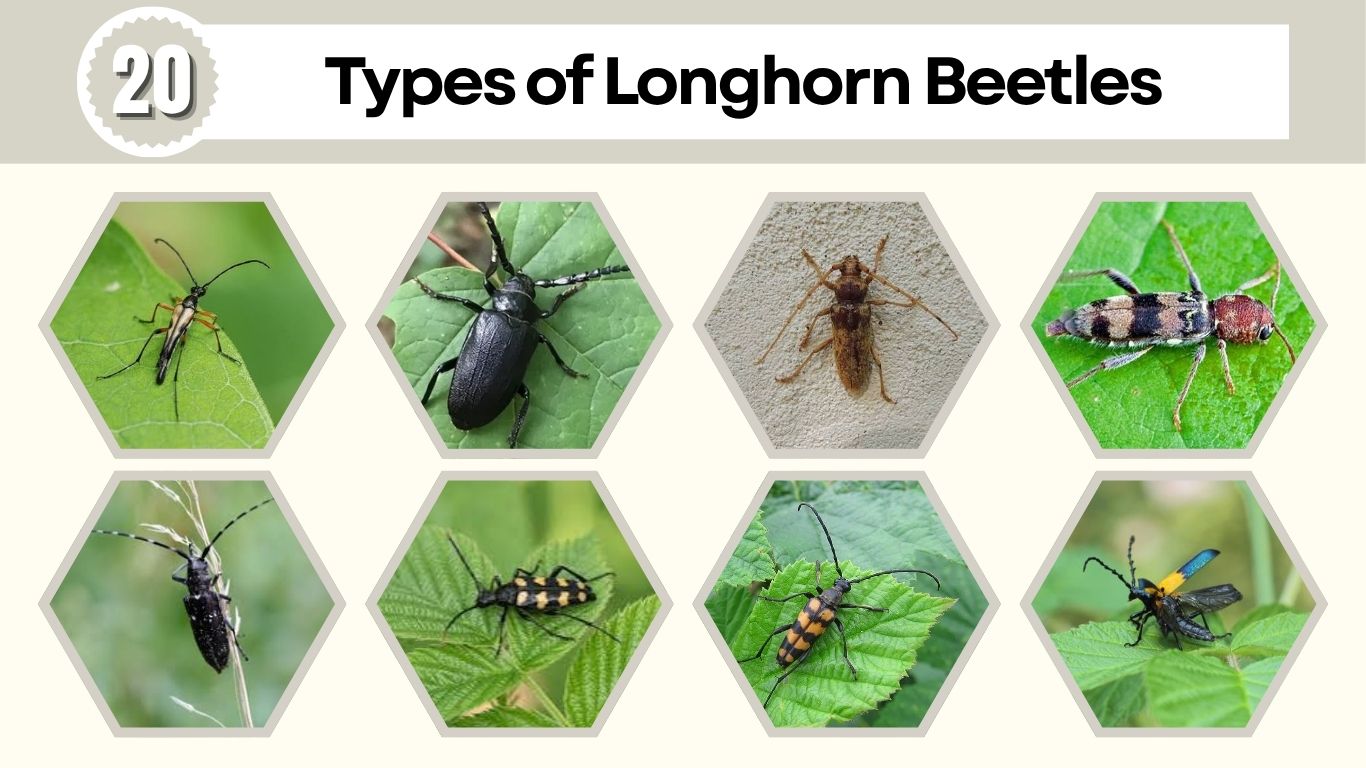
Longhorn beetles are easily recognized by their unusually long antennae, which can sometimes exceed the length of their bodies. These beetles occur in forests, gardens, orchards, grasslands, and many other habitats around the world. Some species are harmless decomposers, while others can damage trees and woody plants during their larval stage. In this guide, you’ll discover 20 types of longhorn beetles, including their identification features, habitats, feeding behavior, and life cycles, helping you better understand these distinctive and fascinating beetles.
1. Asian Longhorned Beetle
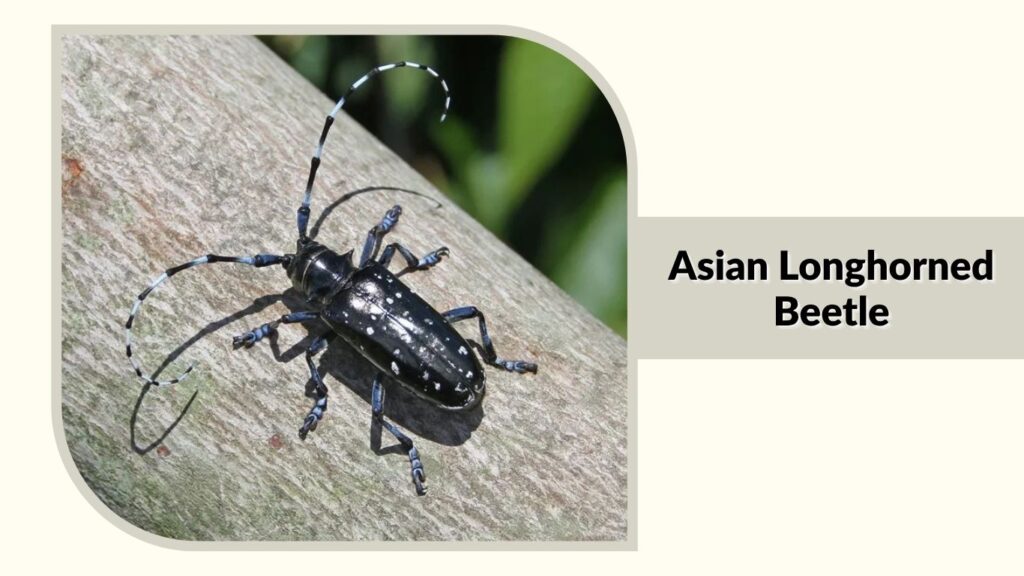
The Asian Longhorned Beetle is a large, striking beetle best known for its glossy black body covered with pale spots and extremely long antennae. It is native to parts of Asia but has become an invasive pest in some other regions. Its larvae bore deep into hardwood trees, weakening branches and trunks over time.
Identification
- Glossy black body
- White or cream-colored spots on the wing covers
- Very long black-and-white banded antennae
- Adults usually about 1–1.5 inches long
- Bluish or pale feet
- Smooth, shiny appearance
- Females generally larger than males
Habitat and Distribution
Asian Longhorned Beetles are associated mainly with hardwood trees. They can infest maples, elms, willows, poplars, and several other broadleaf species. Native populations occur in China and nearby parts of Asia, while introduced populations have been detected in North America and Europe.
Behavior and Diet
Adults feed on bark, leaves, and young twigs, but the larvae cause the most serious damage. Females chew small pits in tree bark and lay eggs inside. After hatching, larvae tunnel through the wood, disrupting the movement of water and nutrients.
Lifespan and Lifecycle
The lifecycle commonly takes one to two years, depending on climate. Eggs hatch into wood-boring larvae that remain inside the tree for many months. Mature larvae pupate within the wood, and adults later emerge through round exit holes.
2. Citrus Longhorned Beetle
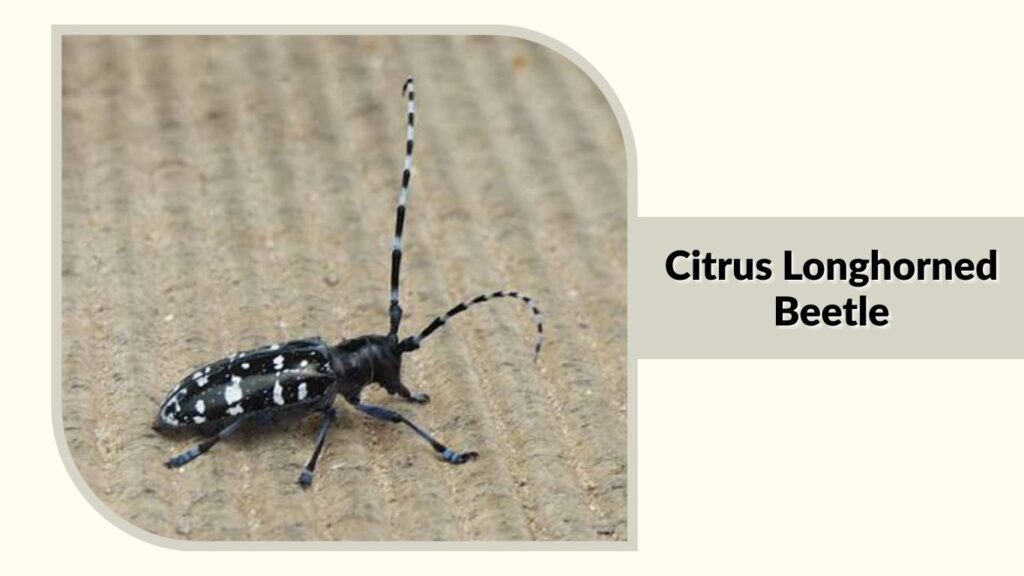
The Citrus Longhorned Beetle is another large Asian longhorn beetle that attacks a broad range of trees. Despite its common name, it does not feed only on citrus. It can infest many ornamental and fruit trees, making it an important pest where it becomes established outside its native range.
Identification
- Shiny black body
- Numerous irregular white spots
- Very long antennae
- Antennae often banded in black and pale blue or white
- Adults about 1–1.5 inches long
- Broad body shape
- Strong mandibles
Habitat and Distribution
This species is native to East Asia and is found in woodland, orchards, gardens, nurseries, and urban landscapes. It attacks trees such as citrus, maple, willow, apple, and many other broadleaf species.
Behavior and Diet
Adults feed on bark and foliage, while the larvae tunnel into roots and lower trunks. The larval feeding weakens trees structurally and can eventually kill heavily infested plants. Females typically lay eggs near the base of host trees.
Lifespan and Lifecycle
After eggs hatch, larvae tunnel beneath the bark and deeper into the wood. They remain inside the host for months before pupating. Adults later emerge through circular holes and begin feeding, mating, and laying eggs.
3. Red Milkweed Beetle
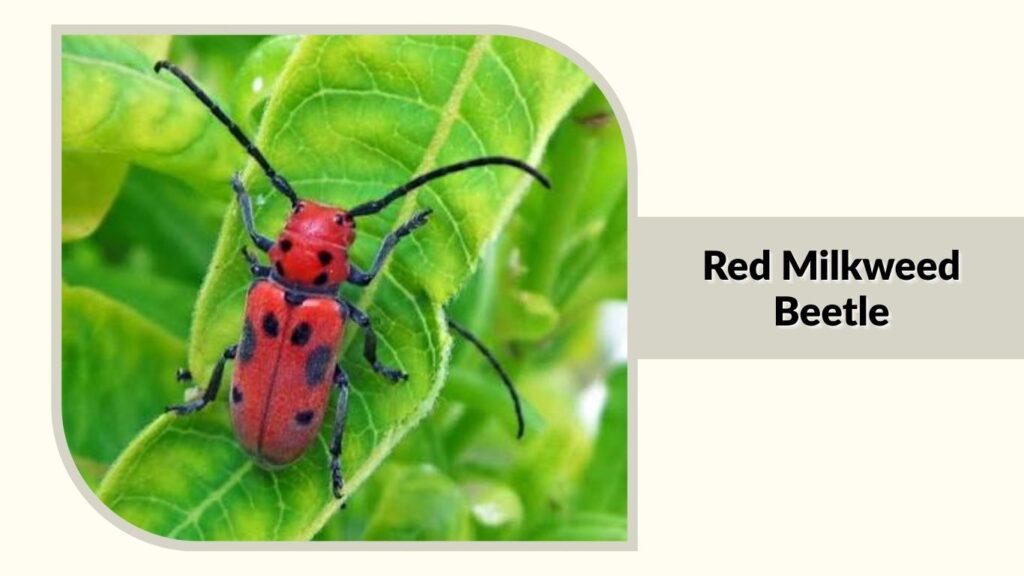
The Red Milkweed Beetle is one of the most colorful longhorn beetles in North America. Its bright red body is marked with black spots, giving it a distinctive appearance. It is closely associated with milkweed plants, especially common milkweed, which provides food for both adults and developing larvae.
Identification
- Bright red or orange-red body
- Black spots on the wing covers
- Black antennae
- Antennae relatively long
- Medium-sized body
- Black legs
- Distinctive red-and-black warning coloration
Habitat and Distribution
Red Milkweed Beetles are commonly found in fields, meadows, roadsides, and gardens where milkweed grows. They are widespread across much of eastern and central North America.
Behavior and Diet
Adults feed mainly on milkweed leaves, flowers, and stems. Larvae live underground and feed on milkweed roots. Adults are often active during warm sunny days and may squeak when handled by rubbing body parts together.
Lifespan and Lifecycle
Females lay eggs near milkweed plants. Larvae hatch and move underground, where they feed on roots throughout their development. They pupate in the soil, and adults typically appear during summer.
4. Cottonwood Borer
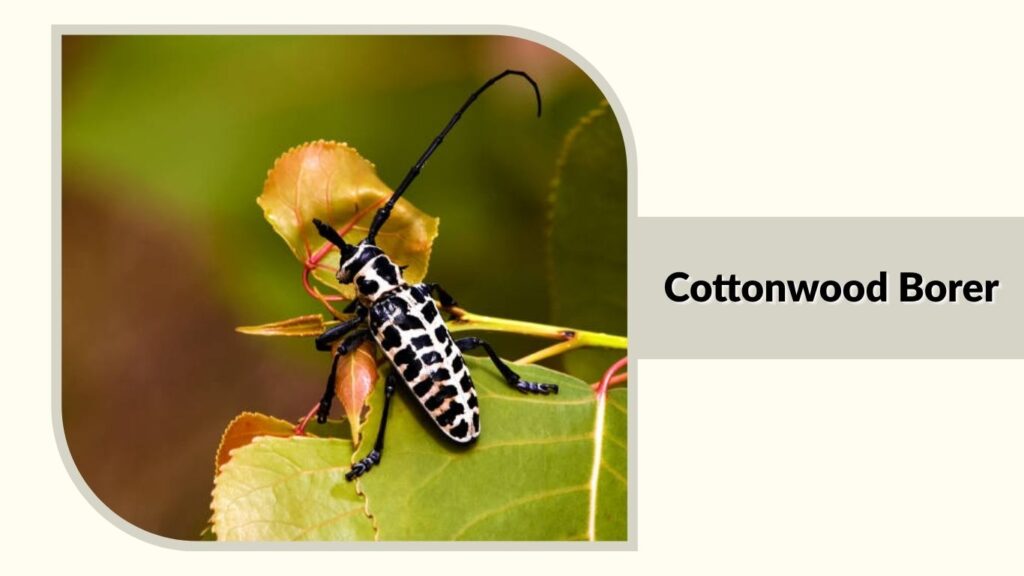
The Cottonwood Borer is a large, dramatic longhorn beetle recognized by its black-and-white patterned body. It is commonly associated with cottonwood, poplar, and willow trees. The larvae bore into tree roots and lower trunks, sometimes causing noticeable damage to young or stressed trees.
Identification
- Large black-and-white patterned body
- Long black antennae
- White markings across the wing covers
- Adults can reach about 1–1.5 inches long
- Broad thorax
- Strong legs
- Bold contrasting coloration
Habitat and Distribution
Cottonwood Borers occur mainly in central and eastern North America. They are found near rivers, wetlands, woodland edges, and other places where cottonwoods and related trees grow.
Behavior and Diet
Adults feed on bark and tender shoots. Larvae tunnel through roots and lower trunks, where they may weaken young trees. Females usually lay eggs near the tree base or in cracks in the bark.
Lifespan and Lifecycle
The larval stage can last one or more years. Larvae feed within the woody tissues, then pupate inside the tree. Adults emerge during warmer months and begin the reproductive cycle again.
5. Locust Borer
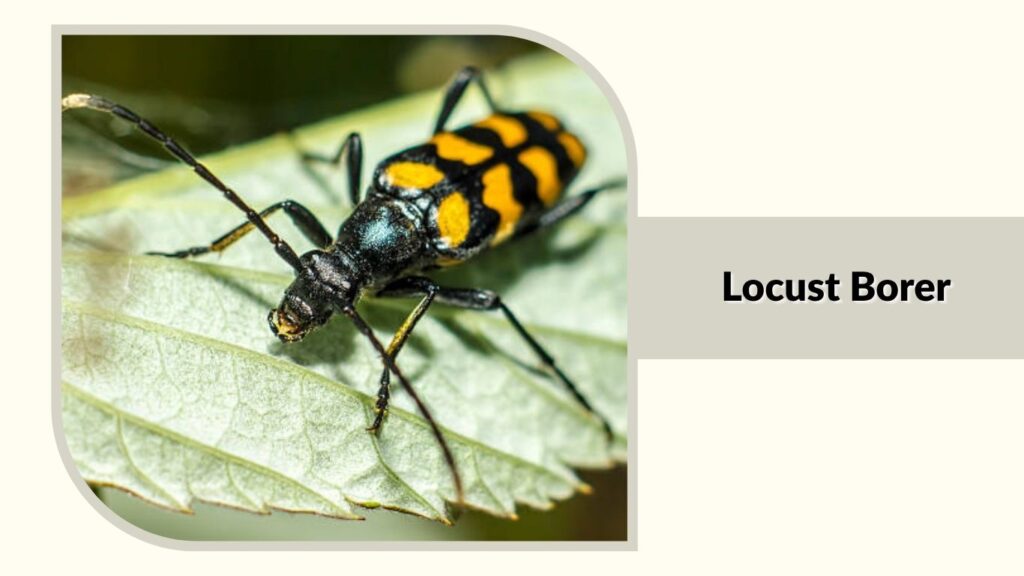
The Locust Borer is a striking yellow-and-black longhorn beetle that resembles a wasp. It is strongly associated with black locust trees and is commonly seen on goldenrod flowers in late summer and early fall. The larvae bore into locust wood and can weaken already stressed trees.
Identification
- Black body with bright yellow markings
- Yellow bands on the wing covers
- Long black antennae
- Wasp-like appearance
- Adults about 0.5–1 inch long
- Narrow, elongated body
- Yellow markings on the thorax
Habitat and Distribution
Locust Borers are widespread across much of eastern North America wherever black locust trees grow. They are often found in open woodland, old fields, roadside areas, and urban landscapes.
Behavior and Diet
Adults frequently feed on goldenrod pollen and nectar. Females lay eggs in cracks in black locust bark. After hatching, the larvae tunnel into the tree, feeding beneath the bark and within the wood.
Lifespan and Lifecycle
Eggs are laid in late summer or fall. Larvae hatch and overwinter beneath the bark before resuming feeding in spring. They pupate inside the wood, and adults usually emerge in late summer.
6. Elderberry Borer
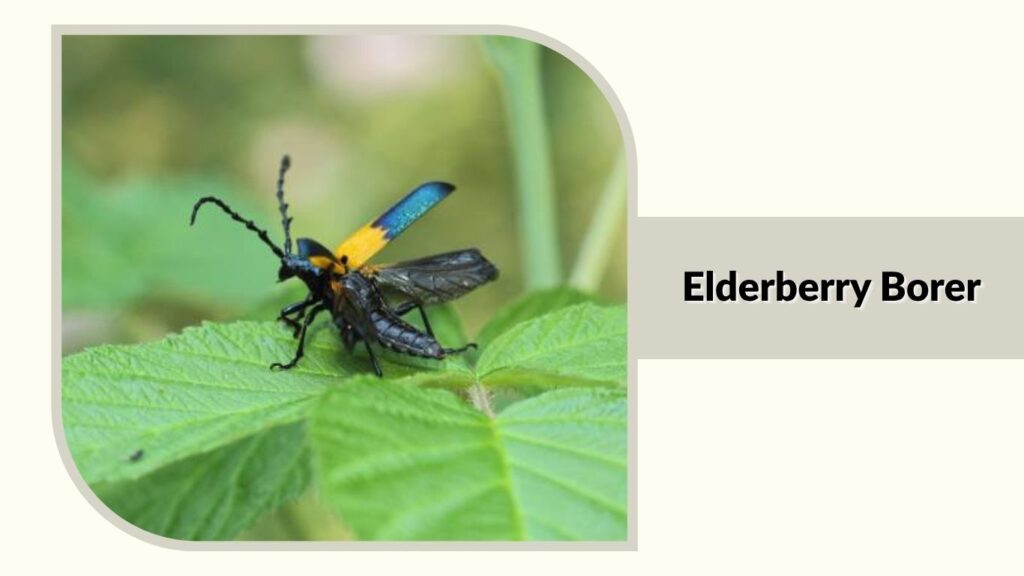
The Elderberry Borer is a beautiful metallic longhorn beetle associated with elderberry plants. Its dark body is decorated with blue, black, and yellow markings, making it easy to distinguish from many other longhorn beetles. The larvae develop inside elderberry stems and roots.
Identification
- Dark blue or black body
- Yellow or cream markings
- Metallic appearance
- Long antennae
- Medium to large size
- Distinctive patterned wing covers
- Sturdy legs
Habitat and Distribution
Elderberry Borers occur in eastern North America. They are usually found in wetlands, woodland edges, stream banks, and gardens where elderberry shrubs grow.
Behavior and Diet
Adults are often seen resting on elderberry foliage or nearby vegetation. Larvae feed inside the stems and roots of elderberry plants, while adults may feed on leaves and plant tissue.
Lifespan and Lifecycle
Females lay eggs on elderberry plants. Larvae tunnel into the stems and roots and may remain there for an extended period. Mature larvae pupate inside the plant, with adults emerging during the warmer part of the year.
7. Red-Headed Ash Borer
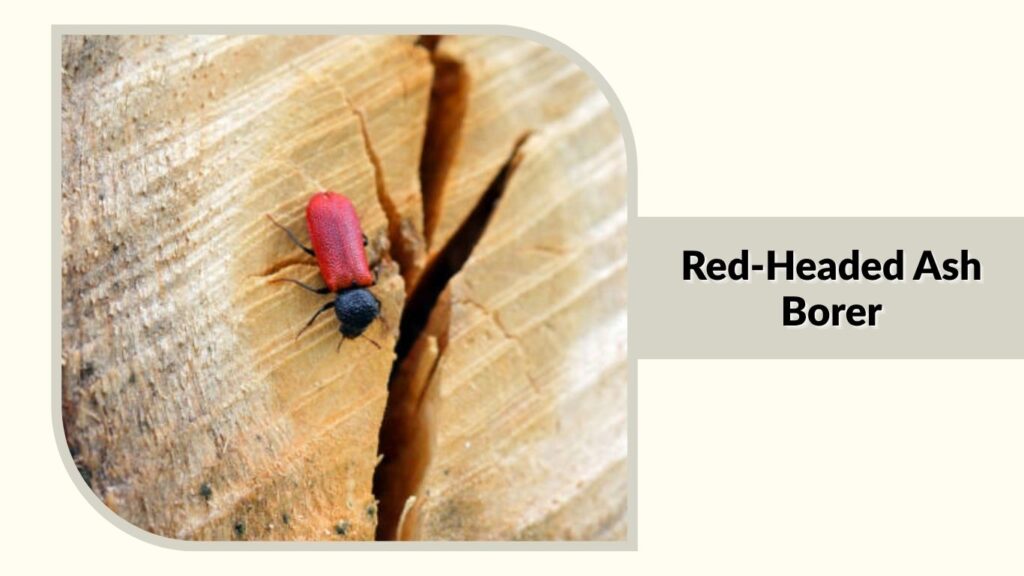
The Red-Headed Ash Borer is a medium-sized longhorn beetle with reddish coloration and distinctive yellow bands across the wing covers. Despite its name, it can use several hardwood species as hosts, particularly trees that are weakened, dying, or recently cut.
Identification
- Reddish-brown head and body
- Yellow bands on dark wing covers
- Long antennae
- Narrow body
- Adults generally less than 1 inch long
- Strongly patterned appearance
- Legs often reddish
Habitat and Distribution
This species occurs widely across North America. It is often found in forests, woodlots, lumber yards, orchards, and areas containing dead or recently cut hardwood.
Behavior and Diet
Adults may visit flowers and tree surfaces. Larvae develop under bark and in wood, especially in ash, oak, hickory, and other hardwoods. They usually attack stressed or dead material rather than healthy trees.
Lifespan and Lifecycle
Females lay eggs on suitable bark. Larvae tunnel through the inner bark and sapwood, eventually forming pupal chambers. Adults later emerge through small round or oval exit holes.
8. White-Spotted Sawyer
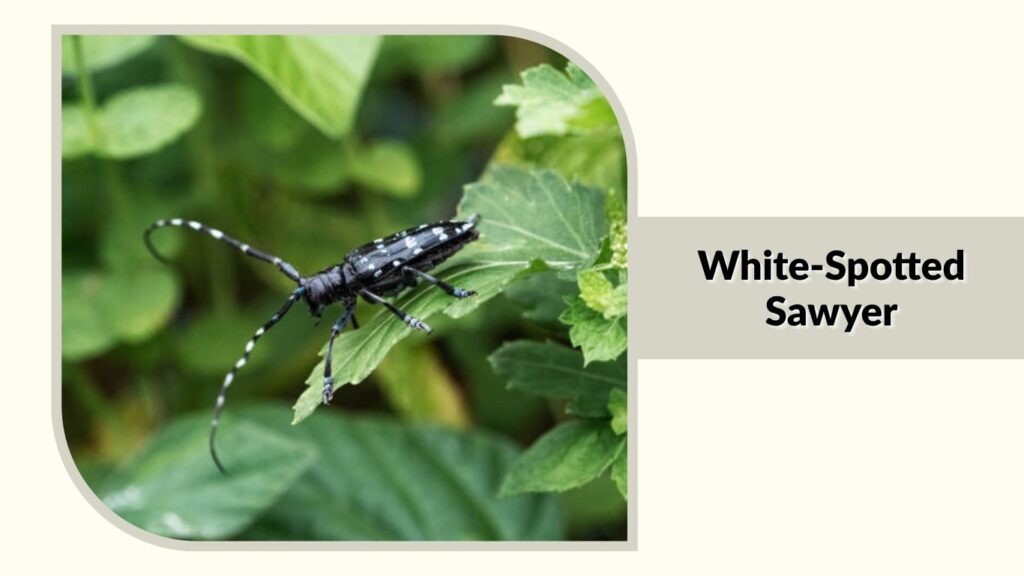
The White-Spotted Sawyer is a large dark longhorn beetle commonly found around conifer forests. It is especially associated with pine, spruce, and fir. The larvae usually develop in weakened, dying, or recently dead trees and therefore play a role in wood decomposition.
Identification
- Dark brown to black body
- One noticeable white spot near the center of the wing covers
- Very long antennae
- Adults usually 0.75–1.25 inches long
- Males have especially long antennae
- Rough, textured body
- Strong legs
Habitat and Distribution
White-Spotted Sawyers are widespread in northern North America. They occur in coniferous forests, logged areas, burned woodland, and locations where dead or stressed pine and spruce are present.
Behavior and Diet
Adults feed on bark and twigs of conifers. Females lay eggs in weakened or recently dead trees. The larvae tunnel beneath the bark and into the wood, helping break down dead trees.
Lifespan and Lifecycle
Larvae spend many months feeding inside wood before pupating. Depending on climate and host quality, development may take one or more years. Adults usually emerge during late spring or summer.
9. Northeastern Pine Sawyer
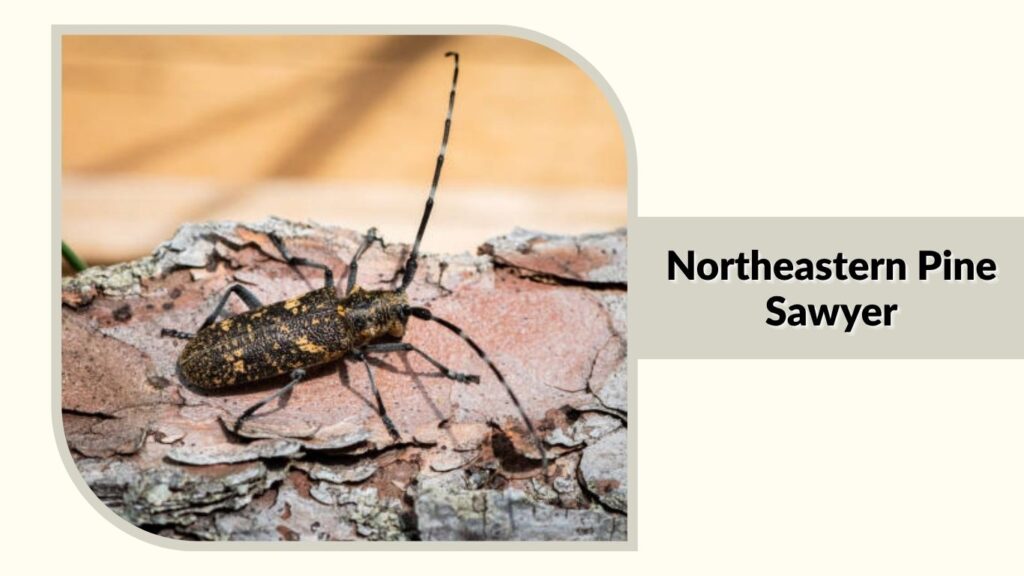
The Northeastern Pine Sawyer is a large longhorn beetle that develops primarily in pine trees. It is usually associated with weakened, dying, damaged, or recently felled conifers. Its long antennae and dark mottled coloration are typical of many sawyer beetles.
Identification
- Dark gray, brown, or black body
- Mottled wing-cover pattern
- Very long antennae
- Large elongated body
- Strong mandibles
- Rough-textured surface
- Adults commonly around 1 inch or longer
Habitat and Distribution
This beetle is found in northeastern North America, particularly in pine-dominated forests. It is also common in logging areas and around trees damaged by storms, fire, disease, or other stresses.
Behavior and Diet
Adults feed on bark and twigs. Females select weakened or dead pine trees for egg laying. Larvae bore through the inner bark before moving deeper into the wood.
Lifespan and Lifecycle
Eggs hatch into larvae that remain hidden inside the tree for much of their development. After growing through several larval stages, they pupate in the wood. Adults emerge during warm weather and disperse to find mates and host trees.
10. Southern Pine Sawyer
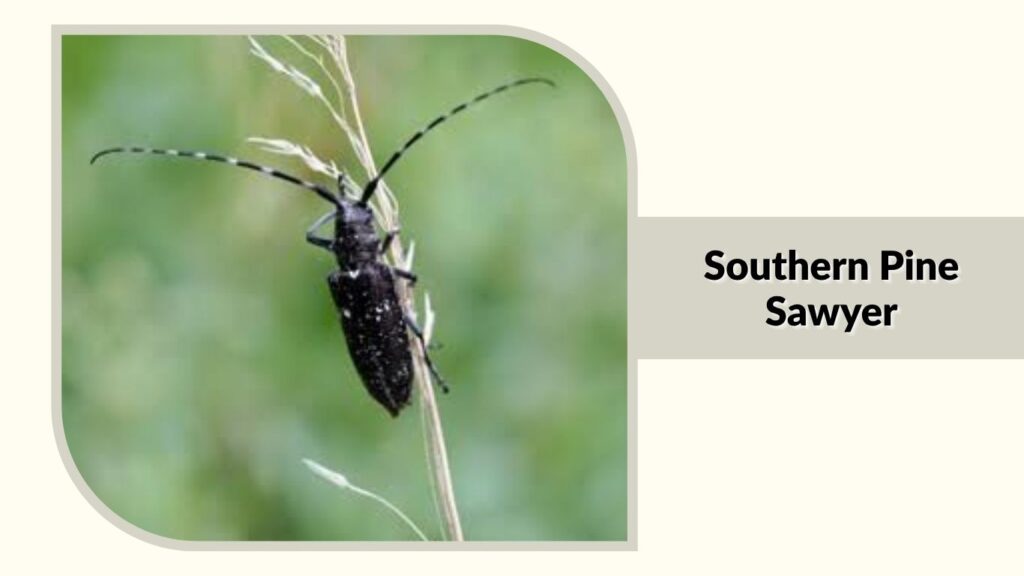
The Southern Pine Sawyer is a large longhorn beetle associated with pine forests in warmer regions. Like other sawyer beetles, it usually attacks weakened or recently dead trees rather than healthy vigorous pines. Its larvae create large tunnels in wood while developing.
Identification
- Dark brown or gray-black body
- Mottled pattern on the wing covers
- Extremely long antennae
- Large, cylindrical body
- Strong mandibles
- Rough, textured appearance
- Long legs
Habitat and Distribution
Southern Pine Sawyers are found mainly in the southeastern United States. They occur in pine forests, timber areas, storm-damaged woodland, and places with freshly cut or stressed pine.
Behavior and Diet
Adults feed on bark and tender twigs. Females lay eggs on weakened or freshly dead pine trees. Larvae tunnel beneath the bark and into the wood, where they feed for an extended period.
Lifespan and Lifecycle
After hatching, larvae bore through the wood and enlarge their tunnels as they grow. They later construct pupal chambers inside the tree. Adults emerge through large round exit holes and are most active during warmer months.
11. Banded Longhorn Beetle
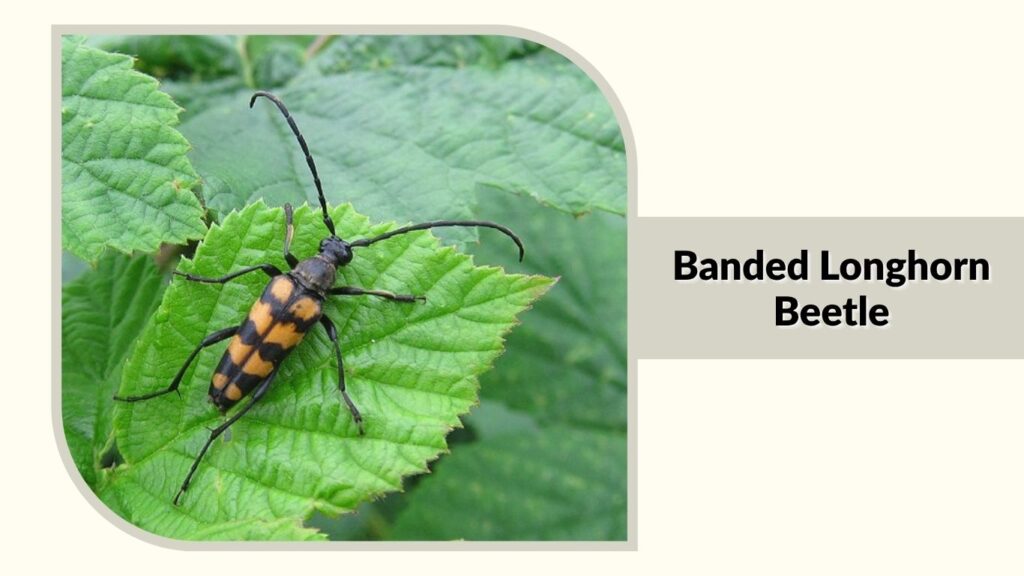
The Banded Longhorn Beetle is a slender, flower-visiting longhorn beetle recognized by the contrasting bands across its wing covers. Adults are commonly seen on flowers during warm weather, while the larvae develop inside dead or decaying wood. Their markings can vary, but the banded pattern is usually the easiest feature to notice.
Identification
- Slender elongated body
- Contrasting dark and pale bands on the wing covers
- Long segmented antennae
- Brown, black, yellow, or orange markings
- Relatively narrow thorax
- Adults usually small to medium-sized
- Frequently seen on flowers
Habitat and Distribution
Banded Longhorn Beetles are commonly found in woodlands, forest edges, meadows, gardens, and areas containing flowering plants. They are especially noticeable during summer when adults visit flowers for pollen and nectar.
Behavior and Diet
Adults feed mainly on pollen and nectar, often spending long periods on flowers in sunny areas. The larvae develop inside dead or dying branches and logs, where they feed on woody tissue. This makes them more closely associated with decomposition than with serious damage to healthy trees.
Lifespan and Lifecycle
Females lay eggs on suitable dead or weakened wood. Larvae hatch and tunnel through the wood while growing. They later pupate inside the host material, and adults emerge during the warmer months. Development may take one year or longer depending on temperature and wood condition.
12. Ivory-Marked Beetle
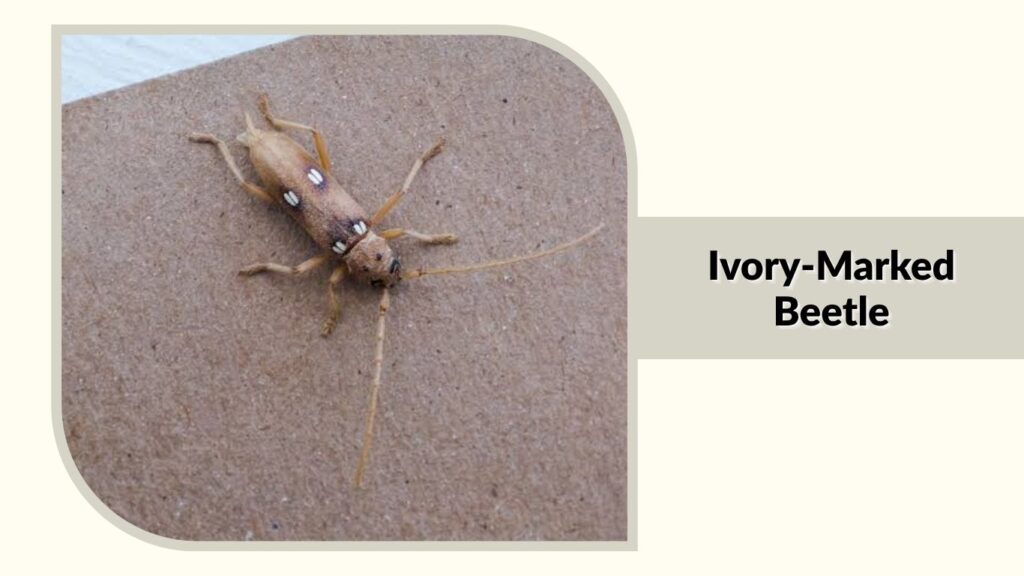
The Ivory-Marked Beetle is a striking longhorn species recognized by pale ivory-colored spots on otherwise dark wing covers. It is often found around hardwood forests and recently cut timber. Although larvae can bore into wood, they usually develop in dead, weakened, or freshly cut trees rather than healthy ones.
Identification
- Dark brown to black body
- Four pairs of pale ivory-colored spots
- Long antennae
- Cylindrical body shape
- Yellowish or tan markings on the thorax
- Adults usually around 0.7–1 inch long
- Strong legs and jaws
Habitat and Distribution
Ivory-Marked Beetles occur across much of eastern and central North America. They are associated with hardwood forests, lumberyards, firewood piles, and recently cut logs. Host trees may include oak, hickory, maple, and other hardwoods.
Behavior and Diet
Adults may feed on bark, sap, or flowers. Females generally choose dead or weakened hardwood for egg laying. Larvae tunnel through the sapwood and deeper wood as they develop.
Lifespan and Lifecycle
Eggs hatch into pale larvae that remain concealed within the wood. Larval development may continue for one or more years, especially in dry lumber. Pupation occurs inside the wood, and adults later emerge through round exit holes.
13. Rustic Borer
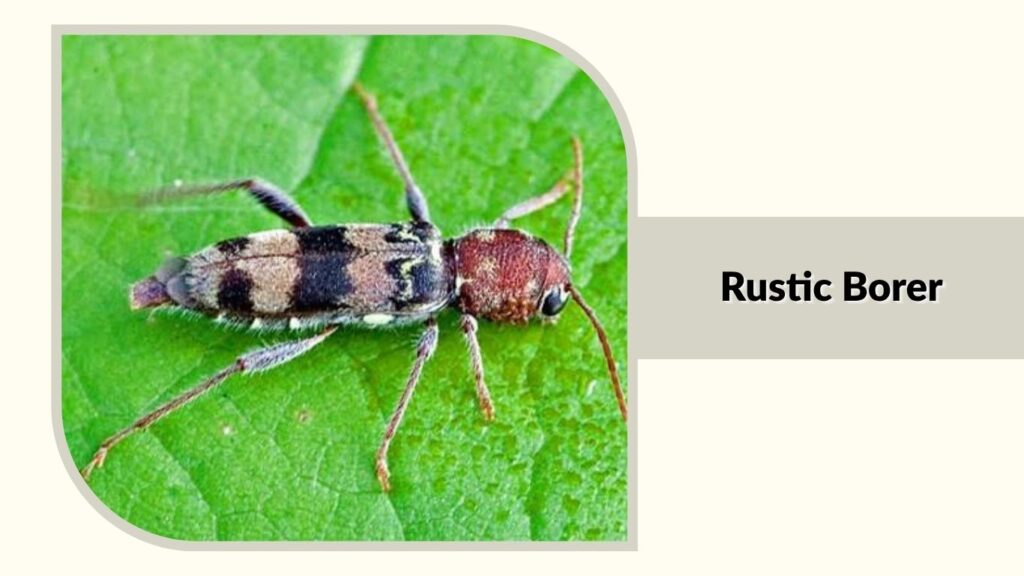
The Rustic Borer is a large, brown longhorn beetle associated with dead and decaying hardwoods. Its mottled coloration blends well with bark, making it difficult to spot when resting on tree trunks. Larvae play a role in breaking down dead wood in forest environments.
Identification
- Brown or gray-brown body
- Mottled bark-like coloration
- Long antennae
- Broad cylindrical body
- Rough-textured wing covers
- Adults often relatively large
- Camouflaged appearance
Habitat and Distribution
Rustic Borers are usually found in forests, wooded areas, parks, and places containing dead or fallen hardwood trees. They may also occur around firewood and lumber.
Behavior and Diet
Adults are often nocturnal and may be attracted to lights. Females seek dead or dying trees where they deposit eggs. Larvae tunnel through the wood and feed on internal tissues.
Lifespan and Lifecycle
Larvae may spend one or more years developing within logs or tree trunks. Once fully grown, they form pupal chambers inside the wood. Adults emerge during warm weather and become active mainly at night.
14. Red Oak Borer
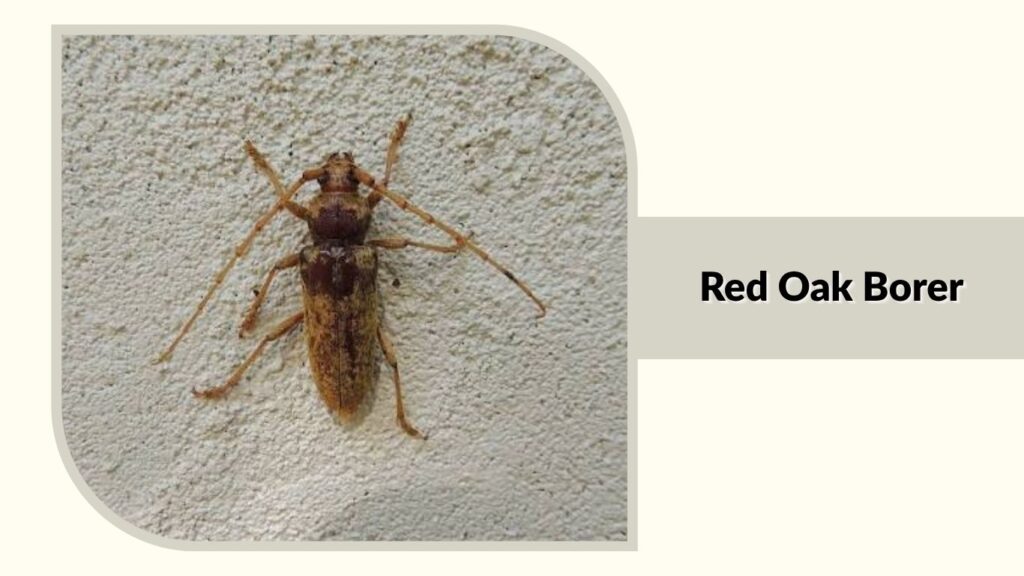
The Red Oak Borer is a longhorn beetle strongly associated with oak trees, particularly red and black oaks. Unlike many longhorn species that prefer dead wood, its larvae can develop inside living trees and may contribute to weakening stressed oaks.
Identification
- Reddish-brown body
- Pale or cream-colored markings
- Long antennae
- Narrow cylindrical shape
- Adults roughly 0.6–1 inch long
- Light markings may form irregular patches
- Strong jaws
Habitat and Distribution
Red Oak Borers occur mainly in eastern and central North America. They are most common in oak forests, woodland edges, parks, and landscapes where red oak group trees are abundant.
Behavior and Diet
Adults may feed on bark or sap, while larvae tunnel through the inner bark and sapwood. Large infestations can create extensive galleries and weaken already stressed trees.
Lifespan and Lifecycle
Females lay eggs in bark cracks. Larvae hatch and begin boring beneath the bark before entering deeper wood. Development commonly spans more than one season, and adults emerge through round holes after pupation.
15. Twig Girdler
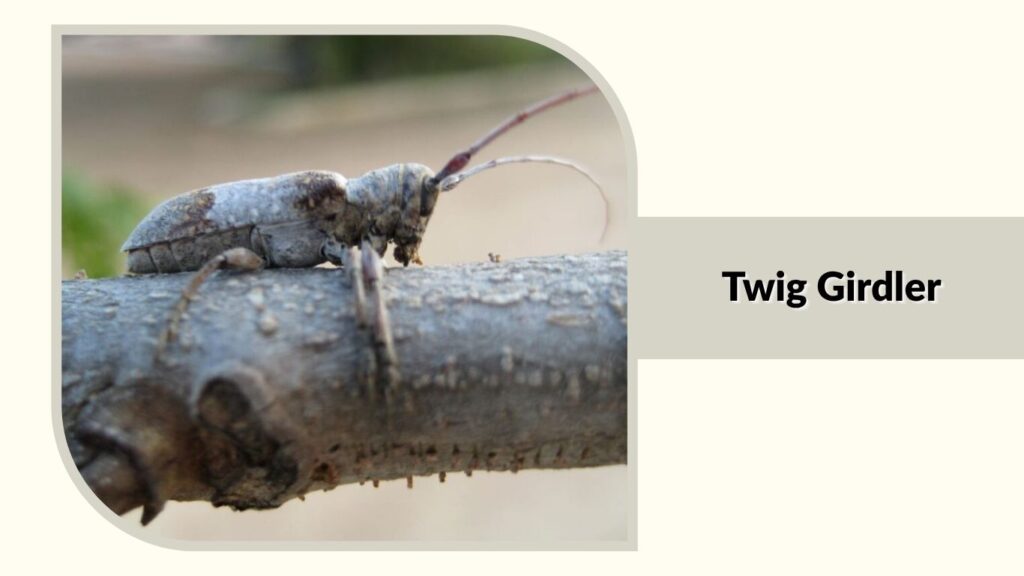
The Twig Girdler is a distinctive longhorn beetle known for its unusual egg-laying behavior. Females chew a circular groove around a twig before laying eggs, causing the branch to break and fall. The fallen wood provides a suitable environment for larval development.
Identification
- Gray-brown or dark brown body
- Long antennae
- Stout cylindrical shape
- Fine gray hairs on the body
- Adults generally around half an inch long
- Strong jaws
- Often found near freshly cut twigs
Habitat and Distribution
Twig Girdlers are common in eastern and central North America. They occur in woodlands, orchards, yards, and landscapes containing hickory, pecan, oak, elm, and other suitable host trees.
Behavior and Diet
Females girdle twigs by chewing around the branch until only a small central section remains. They then place eggs in the weakened twig. Wind eventually causes the branch to fall, allowing larvae to develop in dead wood on the ground.
Lifespan and Lifecycle
Eggs remain inside girdled twigs until larvae hatch. Larvae feed through the fallen branch for several months, overwintering within the wood. They pupate later and emerge as adults, usually producing one generation per year.
16. Brown Prionid
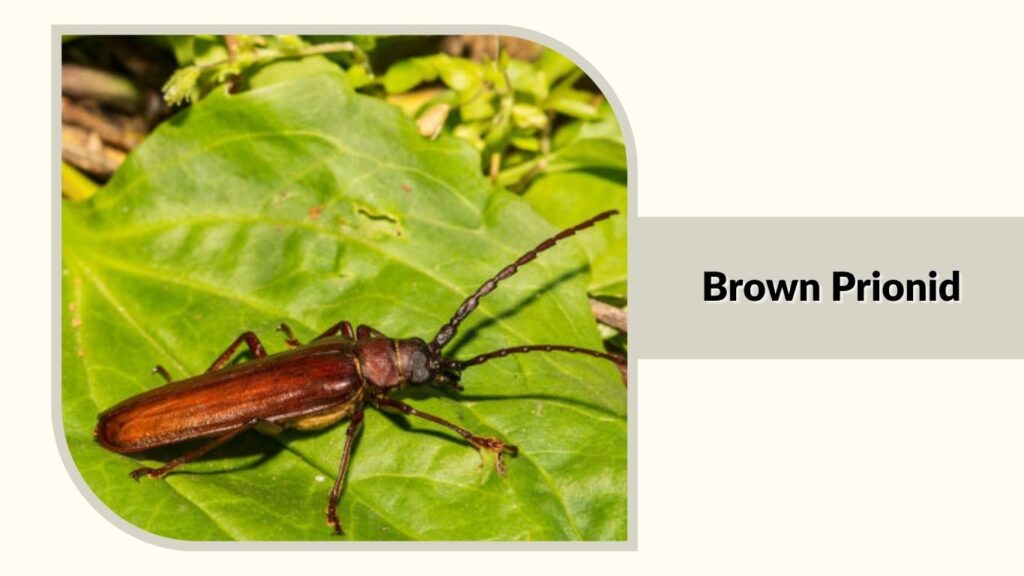
The Brown Prionid is a large, robust longhorn beetle often noticed at night around lights. Its reddish-brown to dark brown body and powerful jaws give it an imposing appearance. The larvae live underground and feed on decaying roots and woody material.
Identification
- Reddish-brown to dark brown body
- Large, heavy build
- Long segmented antennae
- Broad thorax
- Strong jaws
- Adults may exceed 1 inch in length
- Smooth to slightly textured wing covers
Habitat and Distribution
Brown Prionids occur in forests, parks, rural landscapes, and other areas containing old trees and decaying roots. Adults are often attracted to outdoor lights during summer nights.
Behavior and Diet
Adults are mostly nocturnal and may not feed extensively. Their larvae live underground and consume decaying roots, buried wood, and other woody material. This feeding contributes to decomposition in forest soils.
Lifespan and Lifecycle
Females lay eggs near the bases of trees or in soil containing decaying wood. Larvae may spend several years underground before pupating. Adults emerge during warm months and are often short-lived compared with the long larval stage.
17. Broad-Necked Root Borer
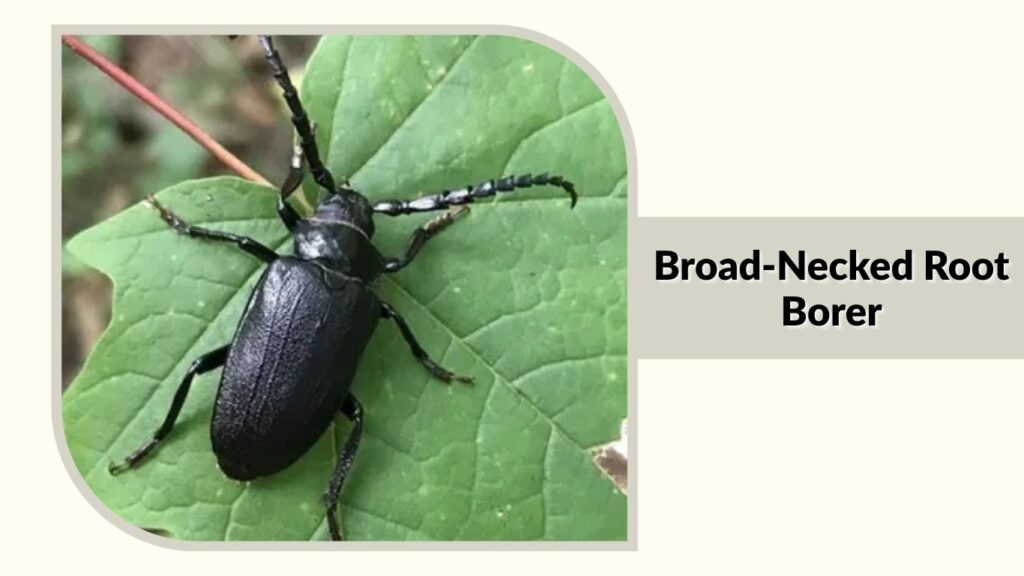
The Broad-Necked Root Borer is a large longhorn beetle with a powerful body and broad thorax. It is frequently seen during summer evenings, especially around lights. Its larvae live underground, where they feed on the roots of trees and shrubs.
Identification
- Large reddish-brown to black body
- Very broad thorax
- Strong jaws
- Long antennae
- Heavy, robust appearance
- Adults may reach 1–2 inches long
- Females generally larger than males
Habitat and Distribution
This beetle is found mainly in eastern North America. It occurs in forests, orchards, yards, and parks containing mature trees and shrubs. Adults commonly appear during midsummer.
Behavior and Diet
Adults are mainly nocturnal. Females spend time near the ground searching for suitable egg-laying sites. Larvae feed underground on roots, especially those of weakened or dead woody plants.
Lifespan and Lifecycle
Eggs are laid in soil near host plants. Larvae burrow underground and may feed for several years before reaching maturity. They pupate beneath the soil surface, and adults later emerge during summer.
18. California Prionus
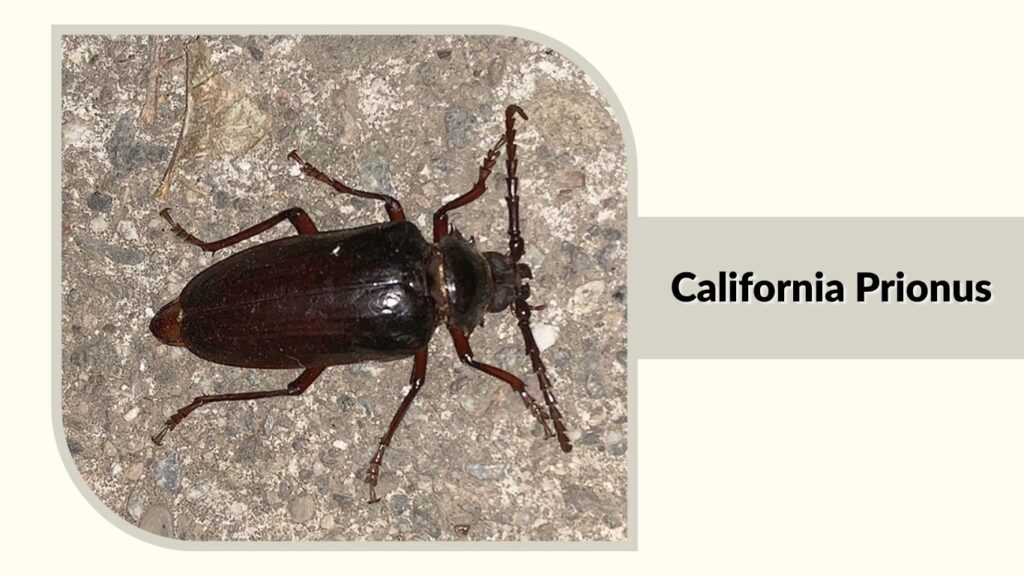
The California Prionus is a large root-boring longhorn beetle found in western North America. Adults are reddish-brown and active at night, while the larvae live underground and feed on the roots of many trees, shrubs, and agricultural plants.
Identification
- Large reddish-brown body
- Thick, heavy build
- Long antennae
- Broad thorax
- Strong legs
- Adults often 1–2 inches long
- Males may have more strongly segmented antennae
Habitat and Distribution
California Prionus occurs throughout much of western North America. It can be found in orchards, vineyards, forests, gardens, and areas containing suitable woody roots.
Behavior and Diet
Adults are nocturnal and may be strongly attracted to lights. Larvae feed on roots underground and can damage orchard trees, grapevines, and other woody plants when populations are high.
Lifespan and Lifecycle
Females deposit eggs in soil close to host roots. Larvae hatch and remain underground for several years while feeding and growing. Mature larvae pupate in the soil, and adults emerge in summer.
19. Tile-Horned Prionus
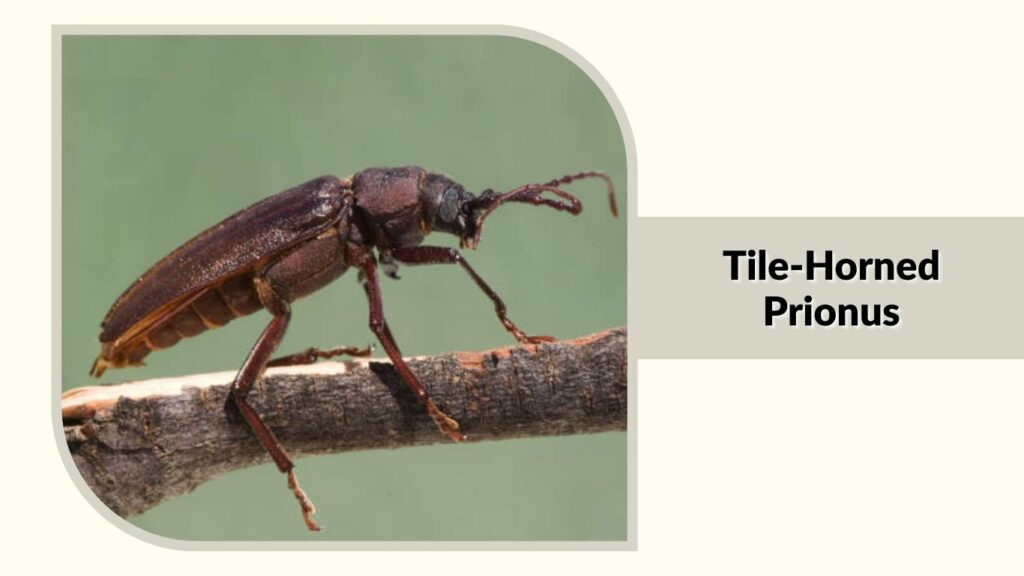
The Tile-Horned Prionus is a large longhorn beetle distinguished by the unusual shape of its antennae. Males have broad, flattened antennal segments that overlap somewhat like roof tiles. Like other prionids, its larvae live underground and feed on roots and buried wood.
Identification
- Large dark brown or reddish-brown body
- Broad, heavy appearance
- Long antennae
- Males have flattened, plate-like antennal segments
- Strong jaws
- Robust legs
- Adults often over 1 inch long
Habitat and Distribution
Tile-Horned Prionus beetles are found mainly in eastern and central North America. They inhabit forests, fields, parks, and areas with mature woody plants.
Behavior and Diet
Adults are primarily nocturnal and often attracted to lights. Males use their specialized antennae to detect pheromones released by females. Larvae develop underground in roots and decaying wood.
Lifespan and Lifecycle
Females lay eggs in soil near suitable roots. Larvae may take several years to complete development. After pupating underground, adults emerge during summer evenings to mate and reproduce.
20. Flower Longhorn Beetle
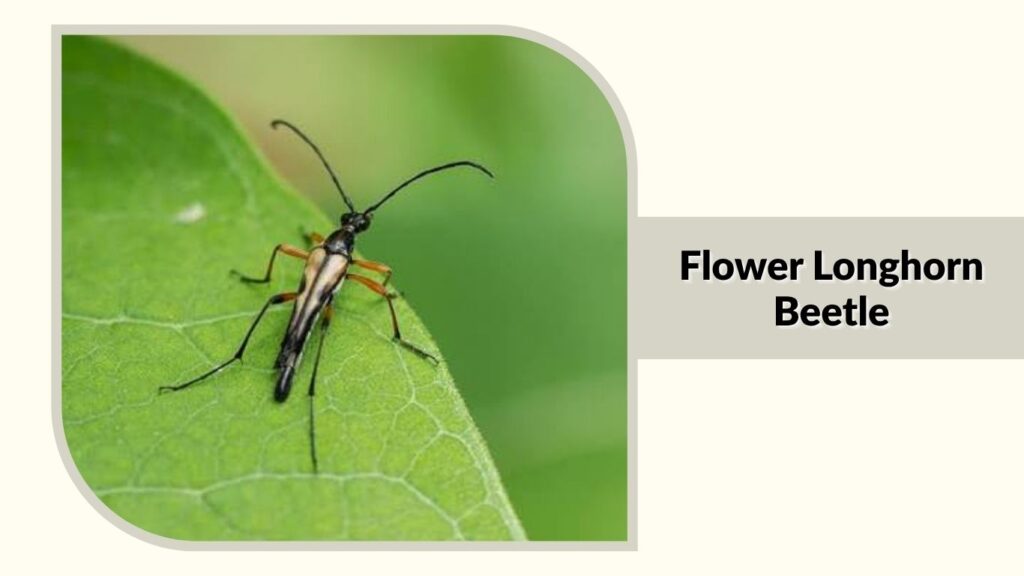
Flower Longhorn Beetles are a broad group of slender longhorn beetles commonly seen feeding on flowers. Many are brightly patterned and resemble wasps or other insects. Their larvae usually develop in dead or decaying wood, while adults serve as frequent flower visitors.
Identification
- Slender elongated body
- Long antennae
- Often brightly patterned
- Black, yellow, orange, or reddish markings
- Narrow thorax
- Adults usually small to medium-sized
- Commonly seen on flowers
Habitat and Distribution
Flower Longhorn Beetles occur in forests, meadows, gardens, and woodland edges throughout many parts of the world. Adults are particularly common in sunny areas containing abundant flowers.
Behavior and Diet
Adults feed on pollen and nectar and can often be seen moving rapidly between flowers. Their larvae typically develop in dead branches, logs, or decaying wood, contributing to natural decomposition.
Lifespan and Lifecycle
Females lay eggs on dead or weakened wood. Larvae bore through the wood while feeding for several months or longer. After pupation, adults emerge during the warmer months and begin visiting flowers.
FAQs
1. Why do longhorn beetles have such long antennae?
Long antennae help longhorn beetles detect chemicals, locate mates, explore their surroundings, and find suitable host plants. In many species, male antennae are noticeably longer than those of females.
2. Are longhorn beetles harmful to trees?
Some species can seriously damage living trees, while many others develop only in dead, dying, or weakened wood. The impact depends heavily on the species and the health of the host tree.
3. Do longhorn beetles bite people?
Longhorn beetles do not normally attack people. Large individuals have strong jaws and may pinch if handled roughly, but they are not considered dangerous to humans.
4. Where do longhorn beetles live?
Longhorn beetles occur in forests, gardens, orchards, grasslands, parks, and many other habitats containing trees or woody plants. Adults may be found on bark, flowers, leaves, or around lights at night.
5. What do longhorn beetle larvae eat?
Most longhorn beetle larvae feed inside wood, bark, stems, roots, or other plant tissues. Some specialize in living trees, while many develop in dead or decaying wood and help break it down naturally.