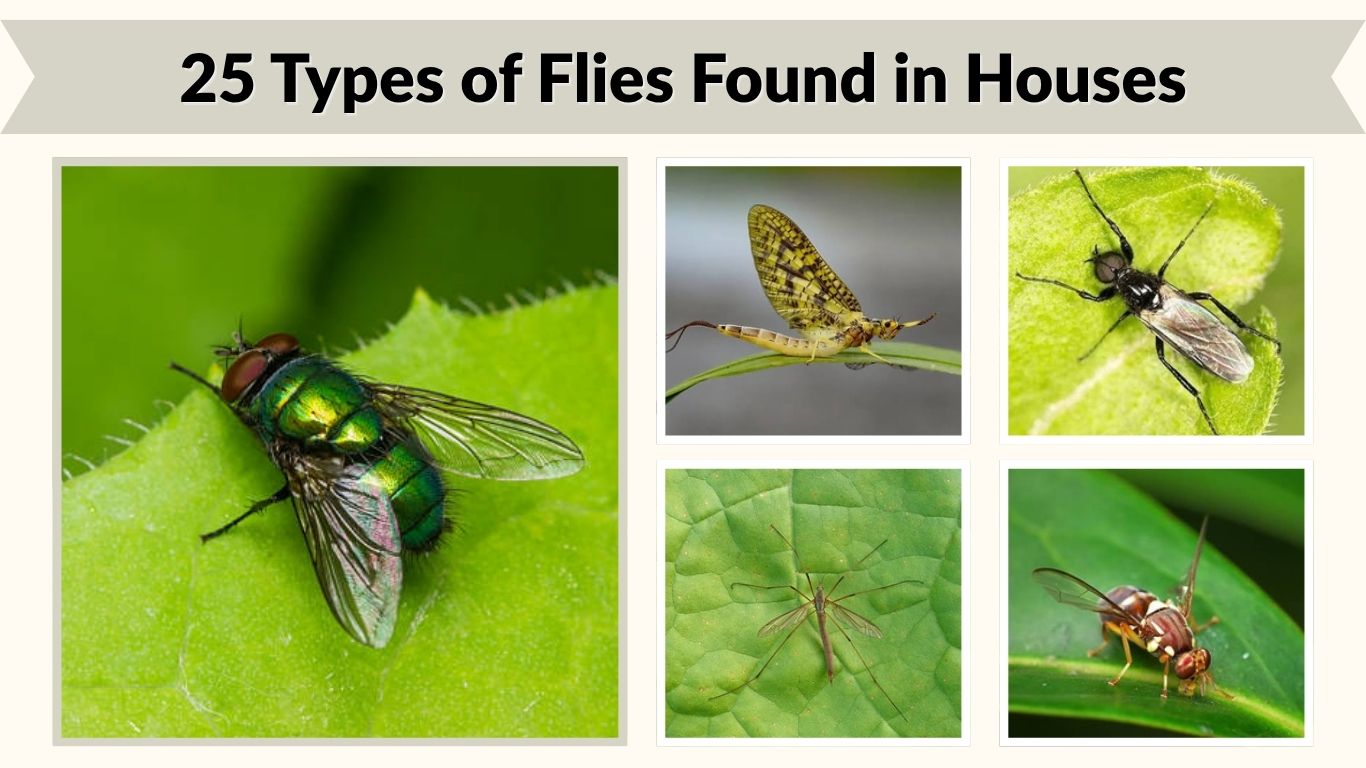
Many types of flies can enter houses while searching for food, moisture, warmth, or suitable breeding material. Some, such as house flies, fruit flies, and drain flies, reproduce indoors and may become persistent pests. Others, including hover flies and crane flies, usually enter accidentally and cause no harm. Household flies vary considerably in size, color, behavior, diet, and preferred habitat. Some can contaminate food, while others serve as pollinators, predators, or decomposers. This guide covers 25 types of flies found in and around houses, along with their identification features, habitats, diets, life cycles, and behaviors.
1. Common House Fly
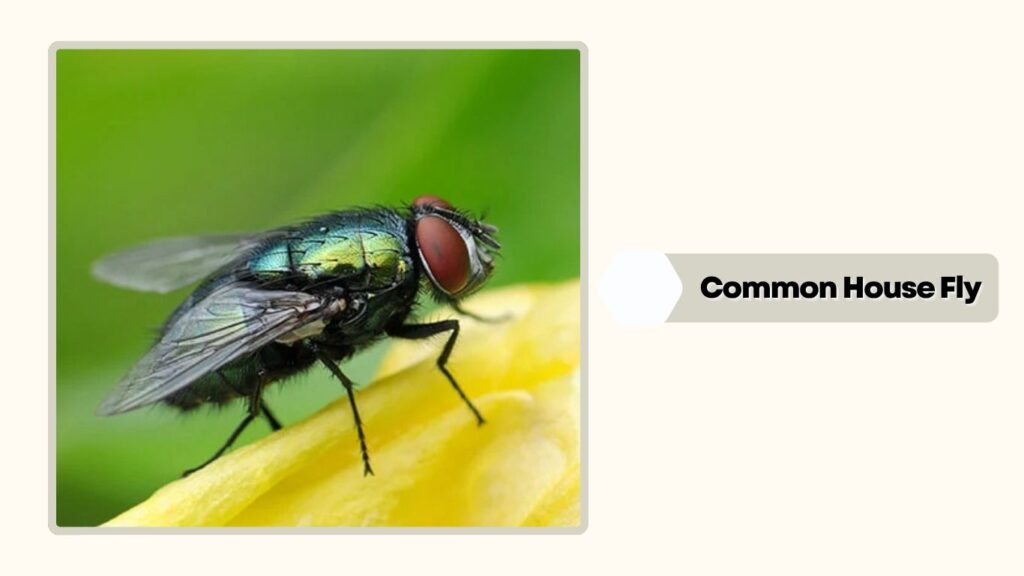
The common house fly (Musca domestica) is one of the most widespread flies living near people. It frequently enters homes, restaurants, markets, farms, and other buildings where food and organic waste are available. Although it cannot bite, it may transfer harmful microorganisms onto food and household surfaces.
Identification
- Adult size: About 6–7 millimeters long
- Body color: Dull gray
- Thorax: Four dark vertical stripes
- Abdomen: Yellowish or gray with dark markings
- Eyes: Large and reddish
- Wings: One transparent pair
- Mouthparts: Soft and sponge-like
Habitat and Distribution
Common house flies occur almost worldwide. They thrive around kitchens, garbage containers, livestock barns, food-processing areas, markets, and sewage. Warm weather, moisture, and accessible organic material create ideal conditions for breeding.
Diet and Feeding
House flies consume liquid or dissolved food. They feed on garbage, manure, decaying food, sugary drinks, and exposed human food. Because they cannot chew, they release saliva onto solid material and then draw up the softened liquid.
Life Cycle and Behavior
Females lay eggs in manure, garbage, or rotting organic matter. The eggs hatch into pale maggots, which feed before becoming pupae. Adults later emerge and begin reproducing. In warm conditions, the entire life cycle may be completed in only one to three weeks.
2. Lesser House Fly
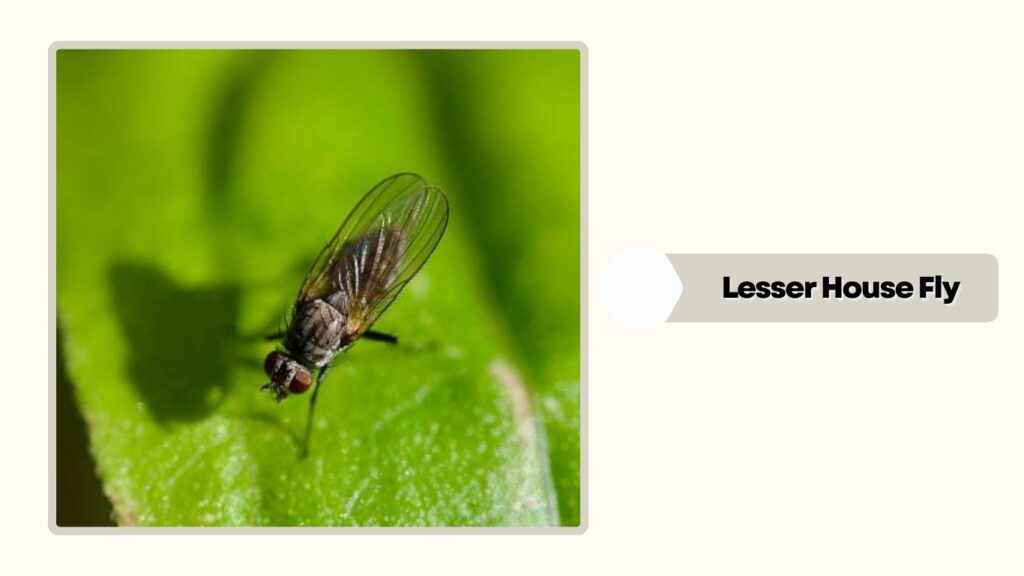
The lesser house fly (Fannia canicularis) is a small indoor fly frequently seen circling beneath lights or in the center of rooms. It resembles the common house fly but has a slimmer body and more irregular flight pattern. It does not bite, though it may contaminate food and surfaces.
Identification
- Adult size: About 4–6 millimeters long
- Body color: Grayish-black
- Body shape: Slender and narrow
- Thorax: Three faint dark stripes
- Abdomen: Yellow markings often visible in males
- Flight: Slow, repetitive circling
Habitat and Distribution
Lesser house flies are widely distributed and commonly occur around homes, poultry facilities, livestock buildings, restaurants, and waste-storage areas. Indoors, males often fly continuously below hanging lights, ceilings, or shaded porches.
Diet and Feeding
Adults consume liquids from garbage, manure, decaying food, and other organic materials. They may also visit flowers for nectar. Their larvae feed on moist waste, including poultry manure, compost, rotting vegetables, and animal bedding.
Life Cycle and Behavior
Females lay eggs in damp, decomposing organic matter. The unusual larvae are flattened and have numerous feathery projections around their bodies. After feeding, they pupate in a drier location. Development usually requires several weeks, depending on temperature and food availability.
3. Cluster Fly
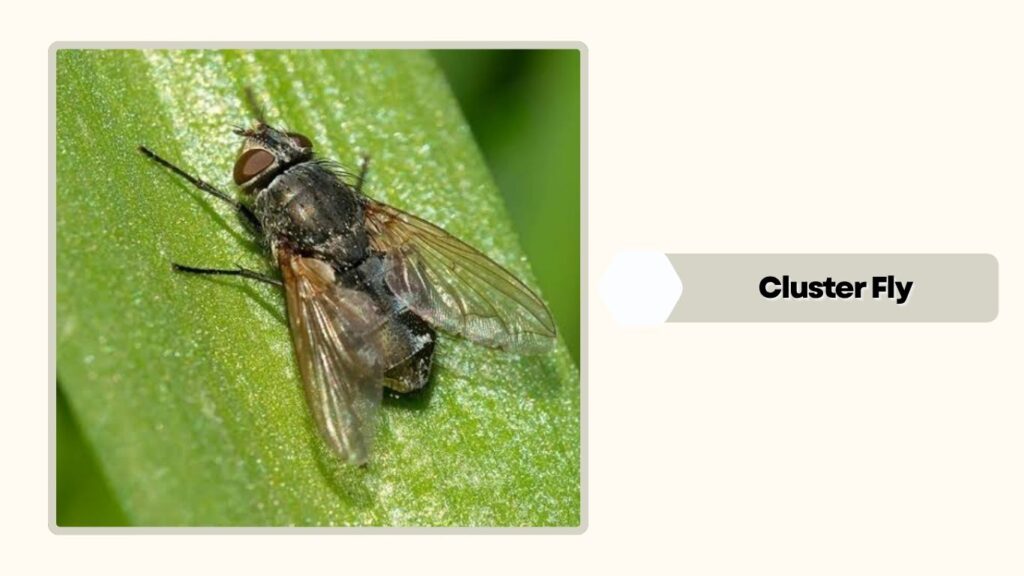
Cluster flies are slow-moving insects that enter houses to spend the colder months in protected areas. The common cluster fly (Pollenia rudis) resembles a large house fly but does not reproduce in household garbage. Large groups may gather around windows on warm winter or early spring days.
Identification
- Adult size: About 7–10 millimeters long
- Body color: Dark gray
- Thorax: Covered with short golden hairs
- Abdomen: Dark with a checkered pattern
- Wings: Overlap when resting
- Movement: Slow and sluggish
Habitat and Distribution
Cluster flies live outdoors during spring and summer. In autumn, they enter houses through small gaps around windows, roofs, siding, vents, and utility lines. They commonly shelter inside attics, wall cavities, basements, and unused rooms.
Diet and Feeding
Adults mainly feed on flower nectar, plant sap, fruit juices, and other sugary liquids. Their larvae have a very different diet because they develop as parasites inside earthworms. Cluster flies do not breed in food, manure, or household garbage.
Life Cycle and Behavior
Females lay eggs in soil containing earthworms. After hatching, the larvae enter earthworms and feed internally before pupating underground. The adults become inactive during winter but may awaken when indoor temperatures rise, causing them to gather near windows.
4. Face Fly
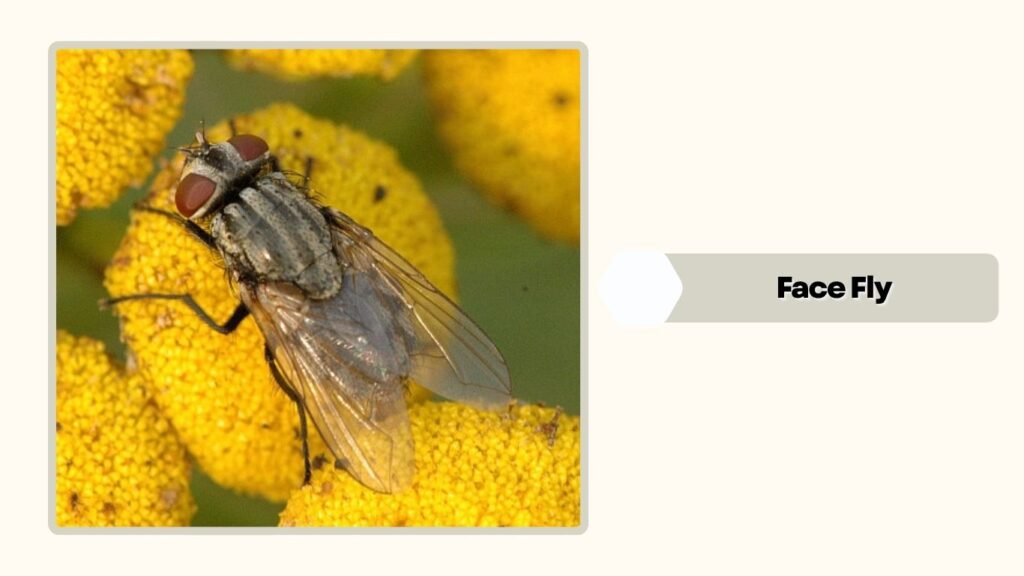
The face fly (Musca autumnalis) is a close relative of the common house fly. It primarily affects cattle and other livestock but may enter houses and farm buildings during cooler weather. Adults gather around an animal’s eyes, nostrils, and mouth to consume natural secretions.
Identification
- Adult size: About 6–10 millimeters long
- Body color: Dark gray
- Thorax: Four dark vertical stripes
- Abdomen: Gray-black in females and orange-sided in males
- Eyes: Large and reddish-brown
- Appearance: Similar to a common house fly
Habitat and Distribution
Face flies are most common in agricultural areas with grazing cattle. Adults spend much of their time outdoors in pastures but seek sheltered locations during cold weather. They may overwinter inside barns, attics, wall spaces, and upper floors of buildings.
Diet and Feeding
Adults feed on animal tears, saliva, nasal mucus, blood from wounds, manure fluids, nectar, and other sugary substances. They do not usually bite through healthy skin. Their feeding activity can irritate livestock and contribute to the spread of certain eye infections.
Life Cycle and Behavior
Females lay eggs in fresh cattle manure. The larvae develop within the dung before moving into nearby soil to pupate. Several generations may occur during warm weather. As temperatures decline, adults gather in protected locations and remain inactive until spring.
5. Stable Fly
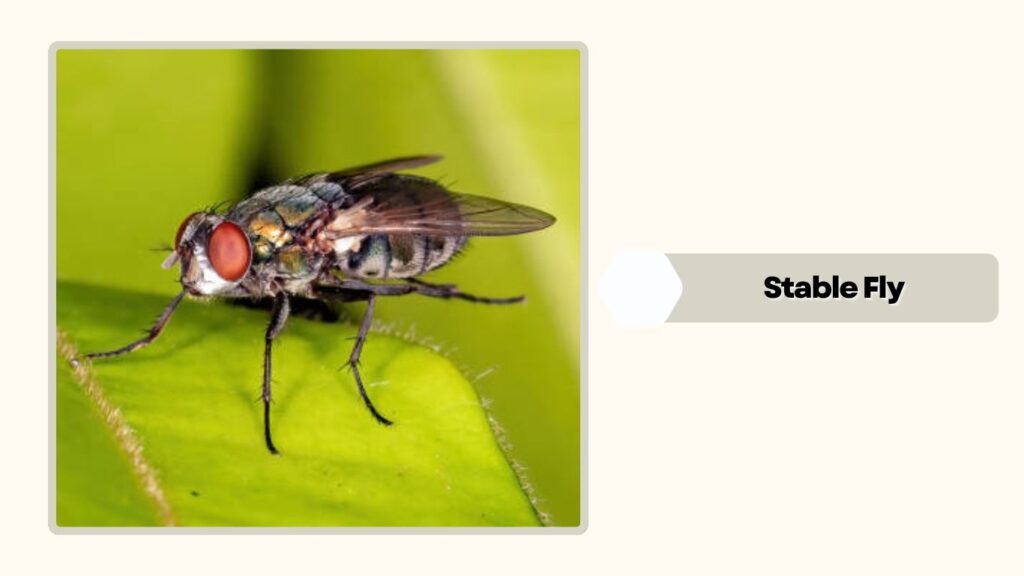
The stable fly (Stomoxys calcitrans) looks similar to a common house fly, but it has a sharp proboscis designed for feeding on blood. Both males and females bite people and animals. Its painful feeding habits make it a significant pest around homes, farms, kennels, and recreational areas.
Identification
- Adult size: About 5–8 millimeters long
- Body color: Gray
- Thorax: Four dark vertical stripes
- Abdomen: Several rounded dark spots
- Proboscis: Stiff and projects forward
- Wings: Clear and slightly spread when resting
Habitat and Distribution
Stable flies occur worldwide and are common near livestock barns, horse stables, kennels, compost piles, and coastal areas. They breed in damp straw, grass clippings, manure-contaminated bedding, spoiled feed, and other decomposing plant materials.
Diet and Feeding
Both sexes feed on the blood of mammals. They frequently bite people around the ankles and lower legs while targeting the legs, belly, and ears of livestock. Their bites cause immediate sharp pain and may leave itchy, irritated marks.
Life Cycle and Behavior
Females lay eggs in moist, decaying vegetation mixed with animal waste. The larvae feed within this material before pupating in nearby dry areas. Adults are active during daylight and rest on walls, fences, or vegetation between blood meals.
6. False Stable Fly
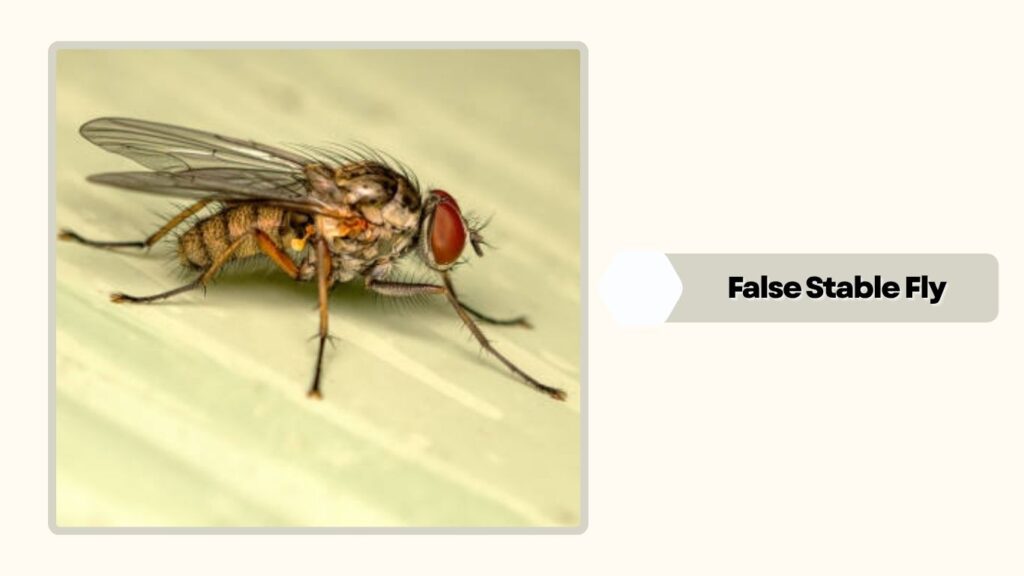
The false stable fly (Muscina stabulans) resembles both the common house fly and the blood-feeding stable fly. Despite its name and appearance, it does not bite people or animals. It commonly enters homes, barns, poultry houses, and food-storage areas while searching for suitable breeding material.
Identification
- Adult size: About 8–10 millimeters long
- Body color: Dark gray or black
- Thorax: Four dark longitudinal stripes
- Abdomen: Gray with yellowish sides
- Eyes: Large and reddish
- Mouthparts: Soft and unable to pierce skin
Habitat and Distribution
False stable flies occur across many temperate regions. They are commonly found around livestock facilities, garbage, compost, kitchens, animal carcasses, and decaying vegetation. Adults may enter buildings through open windows and damaged screens.
Diet and Feeding
Adults consume liquids from flowers, manure, garbage, animal waste, and decomposing food. Their larvae initially feed on decaying organic matter. As they mature, they may become predators and consume maggots belonging to other fly species.
Life Cycle and Behavior
Females lay eggs in manure, carrion, garbage, or rotting vegetation. The larvae feed for several days before moving into a dry, protected area to pupate. Several generations may develop annually when temperatures remain warm and food is abundant.
7. Fruit Fly
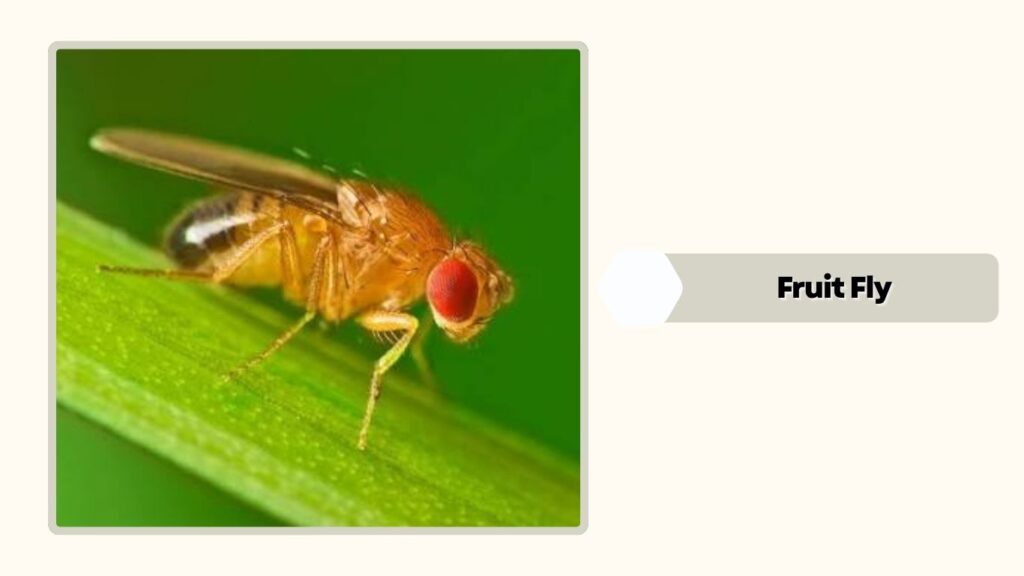
Fruit flies are tiny household insects commonly found around overripe produce, fermenting liquids, and food waste. The common fruit fly (Drosophila melanogaster) reproduces rapidly and can create a noticeable indoor infestation within days. It does not bite, but it may contaminate food and kitchen surfaces.
Identification
- Adult size: About 3–4 millimeters long
- Body color: Tan or yellowish-brown
- Eyes: Usually bright red
- Abdomen: Marked with dark horizontal bands
- Wings: Clear and relatively short
- Flight: Slow and hovering
Habitat and Distribution
Fruit flies occur worldwide and thrive in kitchens, restaurants, markets, grocery stores, orchards, breweries, and compost areas. Indoors, they gather around fruit bowls, recycling containers, garbage disposals, drains, and open beverage bottles.
Diet and Feeding
Adults feed on yeasts and microorganisms growing on fermenting fruits and vegetables. They are also attracted to vinegar, wine, juice, soda, beer, and sugary residue. The larvae consume microbes and soft organic material at the breeding site.
Life Cycle and Behavior
Females lay eggs on moist, fermenting material. The larvae hatch, feed, and later form pupae near the food source. Under warm conditions, development from egg to adult may take approximately eight to ten days, allowing populations to increase quickly.
8. Drain Fly
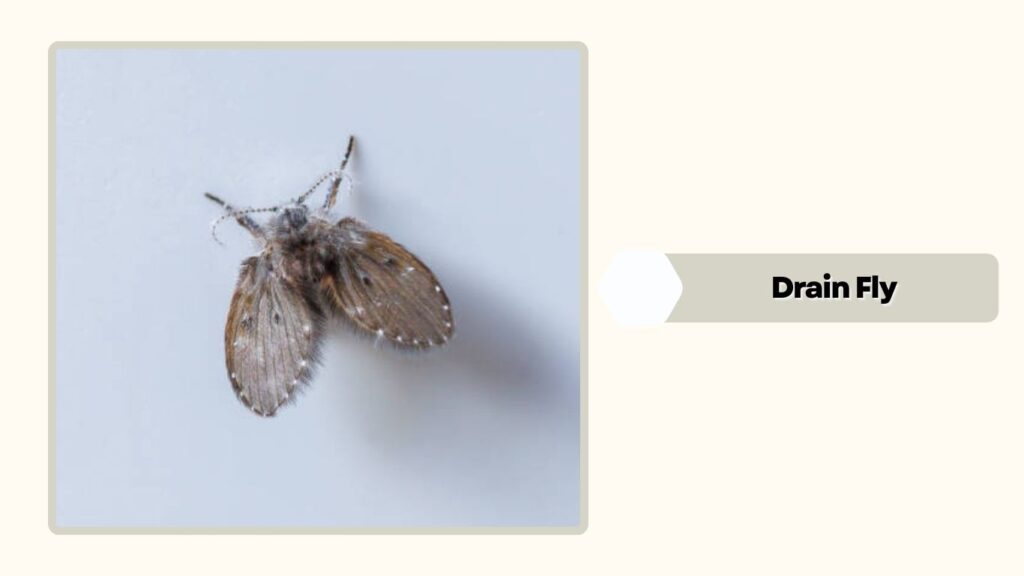
Drain flies are small, fuzzy insects belonging to the family Psychodidae. They are also called moth flies because their broad, hairy wings resemble those of tiny moths. They commonly gather around sinks, showers, floor drains, sewage systems, and other damp household locations.
Identification
- Adult size: About 2–5 millimeters long
- Body color: Gray, brown, or black
- Body: Covered with fine hairs
- Wings: Broad, rounded, and hairy
- Antennae: Long and segmented
- Flight: Weak and irregular
Habitat and Distribution
Drain flies reproduce in moist places containing slimy organic buildup. Common indoor habitats include sink drains, shower drains, sewage pipes, sump pits, leaking plumbing, and rarely used toilets. Outdoors, they may develop in stagnant water and wet compost.
Diet and Feeding
Adult drain flies consume nectar, contaminated water, and sugary liquids. Their larvae feed on bacteria, fungi, algae, and decomposing organic matter growing inside drains. Removing this gelatinous buildup eliminates their main food and breeding source.
Life Cycle and Behavior
Females place clusters of eggs in moist organic residue. The larvae remain inside the slime while feeding and developing. They later pupate near the surface. Adults usually rest on nearby walls and may complete their entire life cycle within one to three weeks.
9. Phorid Fly
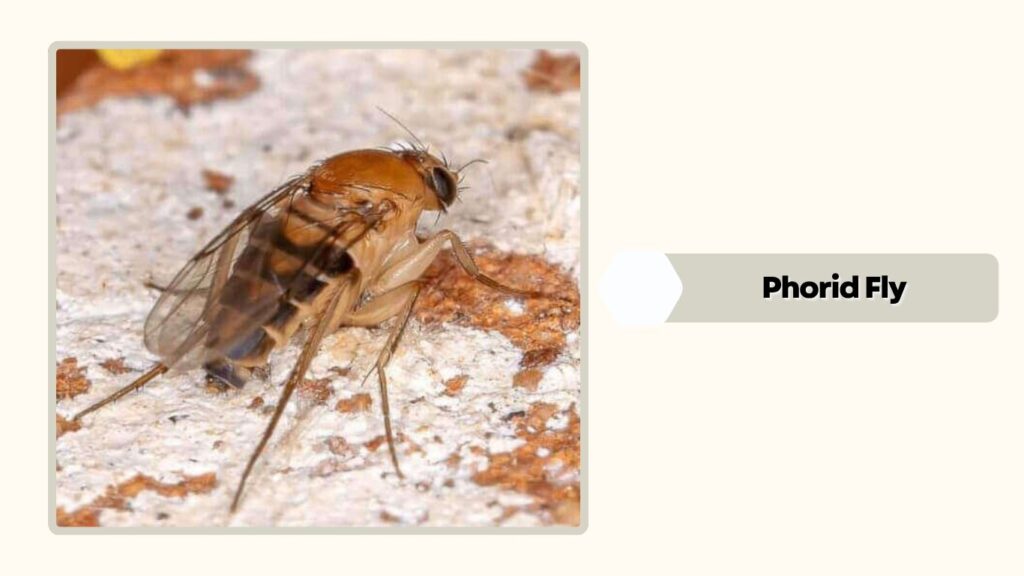
Phorid flies are tiny, humpbacked insects that commonly infest homes, restaurants, hospitals, and commercial kitchens. They are often called scuttle flies because they rapidly run across surfaces instead of immediately taking flight. Their presence may indicate hidden decay, sewage leakage, or plumbing problems.
Identification
- Adult size: About 1–6 millimeters long
- Body color: Tan, brown, yellow, or black
- Thorax: Strongly rounded or humpbacked
- Antennae: Short and rounded
- Wings: Clear with heavy veins near the front
- Movement: Fast and irregular running
Habitat and Distribution
Phorid flies occur worldwide and live around drains, sewers, garbage, carrion, manure, fungi, and decomposing food. Indoors, they may breed beneath appliances, inside damaged pipes, under floors, or around forgotten organic waste.
Diet and Feeding
Adults consume sugary liquids and fluids released by decaying material. Depending on the species, larvae may feed on sewage, fungi, carrion, food waste, insect eggs, or other arthropods. Some species develop as parasites of ants.
Life Cycle and Behavior
Females lay numerous eggs directly on suitable organic material. The larvae hatch and feed before crawling toward a drier place to pupate. Warm temperatures accelerate their development. Successful control depends on locating and removing the concealed breeding source.
10. Fungus Gnat
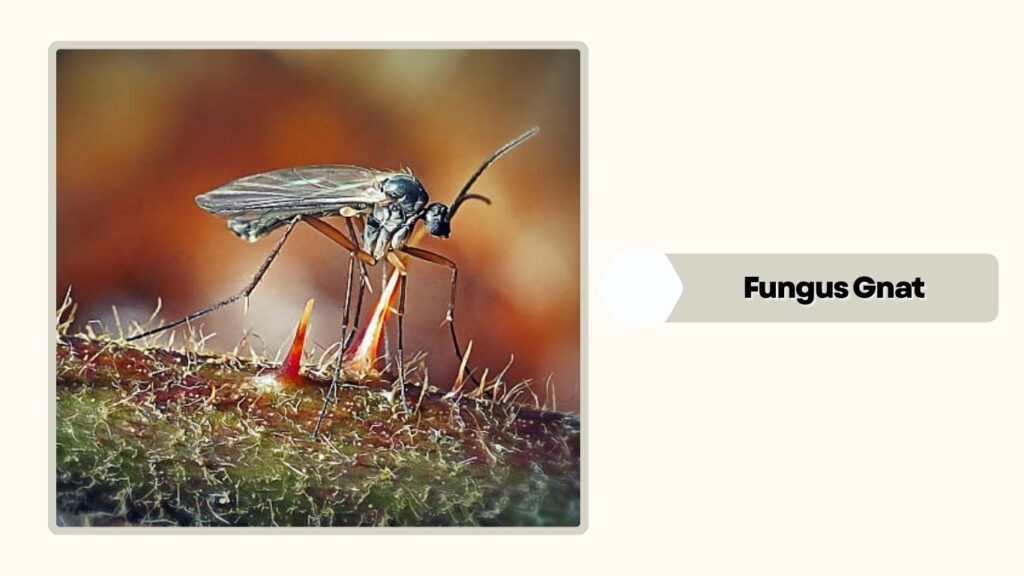
Fungus gnats are tiny, mosquito-like flies often seen around houseplants and damp potting soil. Most indoor species belong to the family Sciaridae. Adults are mainly a nuisance, but their larvae can damage seedlings, young roots, and delicate plants when populations become unusually large.
Identification
- Adult size: About 2–5 millimeters long
- Body color: Gray, brown, or black
- Legs: Long and slender
- Antennae: Thin and relatively long
- Wings: Clear or smoky
- Appearance: Similar to a miniature mosquito
Habitat and Distribution
Fungus gnats prefer moist, shaded environments containing fungi and decaying vegetation. Indoors, they reproduce in overwatered plant containers, poorly drained potting soil, greenhouses, and accumulated plant debris. Adults often gather near windows or lights.
Diet and Feeding
Adults consume little but may drink water or flower nectar. Their transparent, black-headed larvae feed on fungi, algae, root hairs, and decomposing plant matter. Heavy infestations can injure healthy roots and increase the risk of plant disease.
Life Cycle and Behavior
Females deposit eggs in damp soil. The larvae feed beneath the surface before pupating near the top layer. Adults are weak fliers and remain close to plants. Allowing the upper soil to dry between waterings helps interrupt their life cycle.
11. Blow Fly
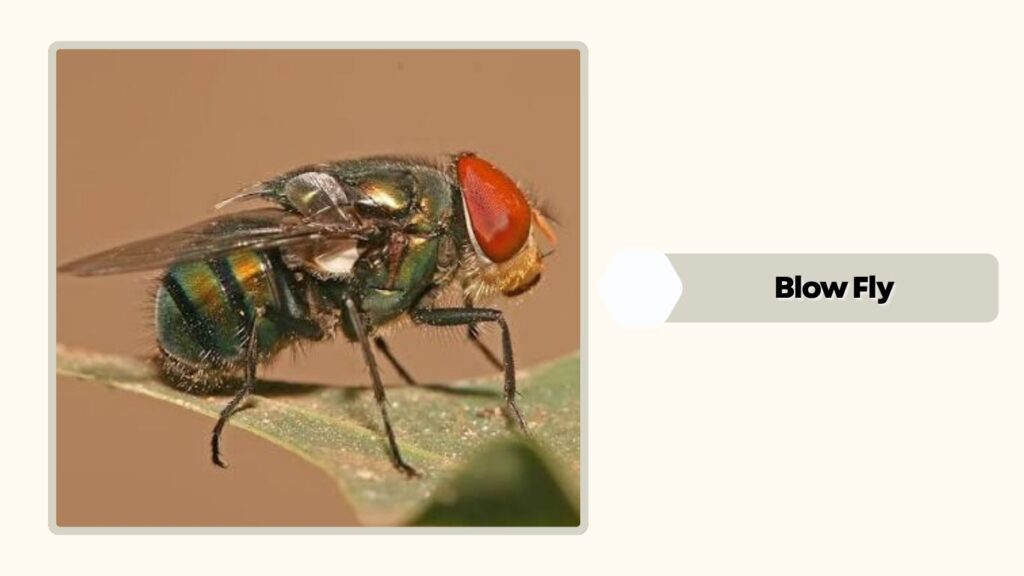
Blow flies belong to the family Calliphoridae and are known for their shiny bodies and loud buzzing. They are commonly attracted to garbage, animal waste, meat, and carcasses. Finding many blow flies inside a house may indicate a dead rodent or another hidden source of decay.
Identification
- Adult size: About 8–14 millimeters long
- Body color: Metallic blue, green, bronze, or black
- Body shape: Thick and robust
- Eyes: Large and reddish
- Wings: Clear with dark veins
- Flight: Fast and noisy
Habitat and Distribution
Blow flies occur worldwide in cities, farms, forests, and grasslands. Around houses, they gather near garbage containers, pet waste, spoiled meat, and dead animals. They enter through doors, windows, vents, and damaged screens.
Diet and Feeding
Adults consume nectar, animal fluids, sugary substances, feces, and liquids from decomposing tissue. Their larvae mainly eat carrion, meat, or animal waste. Some adults also visit flowers and contribute to pollination.
Life Cycle and Behavior
Females lay clusters of eggs on meat, carcasses, wounds, or waste. The eggs hatch into maggots that feed rapidly. Mature larvae leave the food source and pupate in a dry, protected location before emerging as adults.
12. Blue Bottle Fly
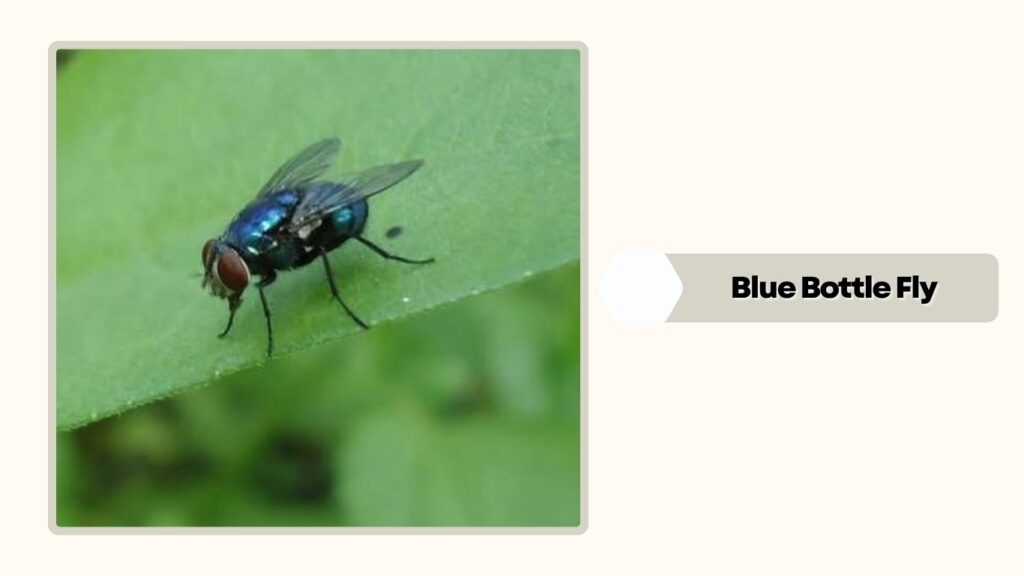
The blue bottle fly is a large blow fly recognized by its brilliant metallic-blue abdomen. One common species is Calliphora vomitoria. These flies help decompose dead animals outdoors, but their appearance inside a home may reveal a concealed carcass, spoiled meat, or exposed garbage.
Identification
- Adult size: About 10–14 millimeters long
- Abdomen: Bright metallic blue
- Thorax: Dull gray or black
- Body: Stout with noticeable bristles
- Eyes: Large and red
- Wings: Clear with dark veins
Habitat and Distribution
Blue bottle flies inhabit urban areas, farmland, forests, and other environments across many temperate regions. Around homes, they are attracted to garbage, pet waste, spoiled meat, and dead rodents. Adults may rest on sunny walls or windows.
Diet and Feeding
Adults feed on flower nectar, sugary liquids, feces, carrion fluids, and other decomposing materials. Larvae consume decaying animal tissue. Adults may transfer microorganisms to food after visiting contaminated material.
Life Cycle and Behavior
Females lay pale eggs in clusters on carcasses, meat, or animal waste. The maggots feed together before moving away to pupate. Temperature strongly affects their development, and a complete generation may occur within several weeks during warm weather.
13. Green Bottle Fly
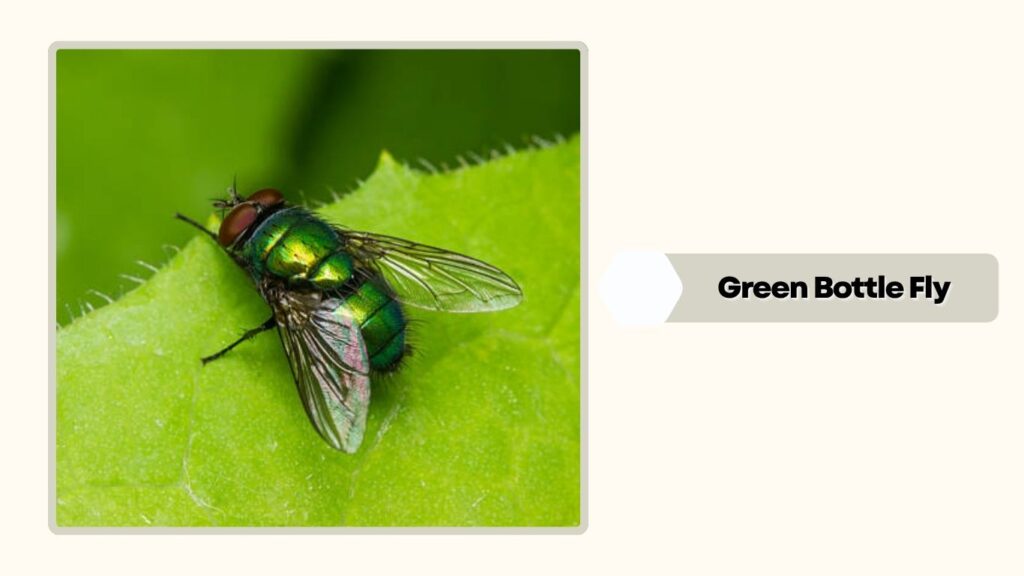
Green bottle flies are metallic-green members of the blow fly family. The common green bottle fly (Lucilia sericata) is frequently found around garbage, carrion, animal wounds, and pet waste. It plays an important role in decomposition but can contaminate exposed food after visiting unsanitary material.
Identification
- Adult size: About 8–12 millimeters long
- Body color: Metallic green or greenish-gold
- Body shape: Rounded and compact
- Eyes: Large and reddish
- Legs: Black and moderately bristled
- Wings: Transparent with visible veins
Habitat and Distribution
Green bottle flies occur widely in urban, agricultural, and natural environments. They gather around garbage containers, outdoor markets, livestock facilities, animal carcasses, and dog waste. Indoors, they are often found resting near bright windows.
Diet and Feeding
Adults consume nectar, sugary liquids, feces, carrion fluids, and secretions from wounds. Their larvae usually feed on dead tissue. Under controlled medical conditions, sterile larvae may be used to remove damaged tissue from difficult wounds.
Life Cycle and Behavior
Females lay eggs on carrion, meat, waste, or open wounds. The larvae hatch quickly and feed before crawling into dry surroundings to pupate. Adults are strong fliers and can locate decomposing material through scent from a considerable distance.
14. Flesh Fly
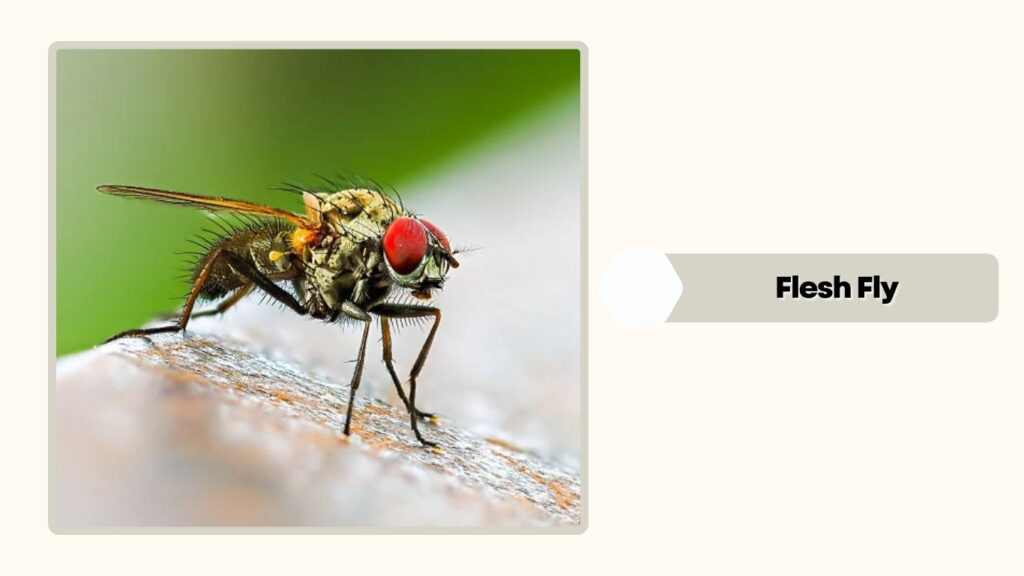
Flesh flies belong to the family Sarcophagidae and are commonly recognized by their striped thorax and checkered abdomen. They are associated with carcasses, feces, garbage, and other decomposing substances. Their appearance indoors may indicate nearby animal remains or accumulated organic waste.
Identification
- Adult size: About 8–14 millimeters long
- Body color: Gray or dark gray
- Thorax: Three dark vertical stripes
- Abdomen: Black-and-gray checkered pattern
- Eyes: Usually red
- Body: Stout with numerous bristles
Habitat and Distribution
Flesh flies occur worldwide in cities, farms, woodlands, and grasslands. Around houses, they may visit garbage containers, compost, animal waste, outdoor toilets, and dead animals. Adults sometimes enter buildings while searching for suitable breeding sites.
Diet and Feeding
Adults consume nectar, sugary liquids, animal waste, and fluids from decaying tissue. The larvae may eat carrion, dung, rotting vegetation, or living invertebrates. Some species develop as parasites of snails and insects.
Life Cycle and Behavior
Most flesh flies deposit living larvae rather than laying exposed eggs. The larvae immediately begin feeding on suitable material. Once mature, they move into soil or another sheltered location and form pupae. Warm conditions can shorten their development considerably.
15. Black Soldier Fly
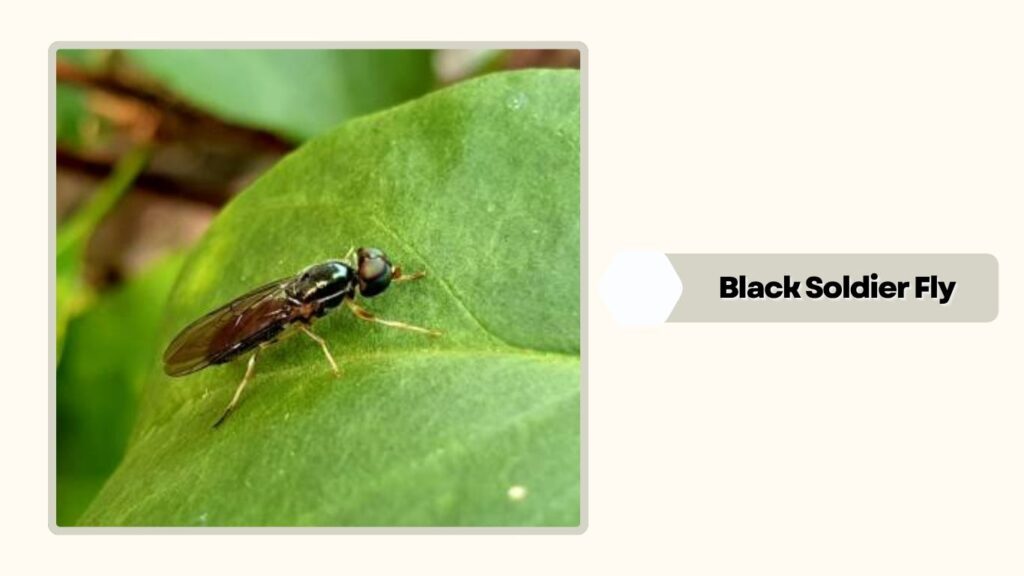
The black soldier fly (Hermetia illucens) is a dark, wasp-like insect commonly found near compost, manure, and food waste. Adults neither bite nor sting and rarely become persistent indoor pests. Their larvae are efficient decomposers that can consume large quantities of organic material.
Identification
- Adult size: About 15–20 millimeters long
- Body color: Mostly black
- Legs: Dark with pale or white sections
- Wings: Smoky and folded over the abdomen
- Antennae: Long and forward-pointing
- Appearance: Similar to a slender wasp
Habitat and Distribution
Black soldier flies are widespread in warm and temperate regions. They occur around compost piles, livestock facilities, garbage containers, decaying vegetation, and outdoor food waste. Adults usually remain outside but may accidentally enter homes.
Diet and Feeding
Adult black soldier flies consume little or no food and rely largely on stored energy. The larvae feed on manure, kitchen scraps, spoiled food, and decomposing plant or animal matter. They are commercially raised for waste processing and animal feed.
Life Cycle and Behavior
Females place eggs in dry cracks close to decaying material. After hatching, the larvae move toward the food and feed actively. Mature larvae leave the wet material to pupate in a dry location. Adults focus mainly on mating and reproduction.
16. Latrine Fly
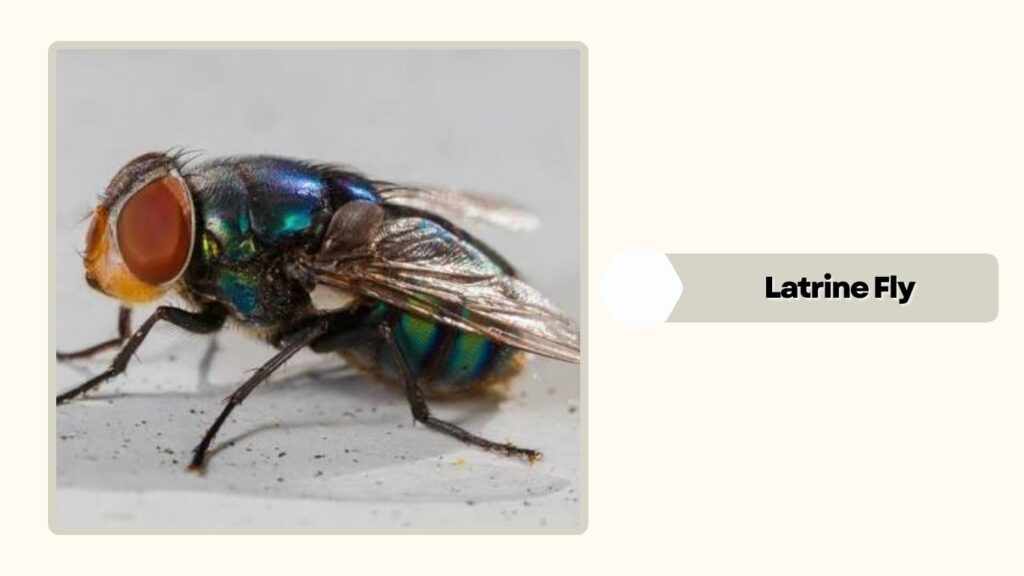
The latrine fly (Fannia scalaris) is a small, dark fly related to the lesser house fly. It is strongly associated with feces, sewage, manure, and other decomposing organic materials. Although it does not bite, it can become a sanitation concern when adults enter kitchens or land on food.
Identification
- Adult size: About 5–7 millimeters long
- Body color: Dark gray or black
- Body shape: Slender
- Thorax: Marked with faint dark stripes
- Wings: Clear with visible veins
- Flight: Slow and circling
Habitat and Distribution
Latrine flies occur around outdoor toilets, sewage systems, animal facilities, garbage areas, and poorly maintained drains. Adults may enter homes through open doors, windows, vents, and plumbing openings, particularly when suitable waste is nearby.
Diet and Feeding
Adults consume liquids from feces, sewage, garbage, manure, and decomposing vegetation. They may also visit flowers for nectar. Their larvae feed within moist organic waste, where bacteria and other microorganisms are abundant.
Life Cycle and Behavior
Females lay eggs on feces, manure, rotting vegetation, or similar materials. The flattened larvae have rough projections around their bodies. After feeding, they move to a drier location to pupate. Proper sanitation and waste removal help prevent infestations.
17. Window Fly
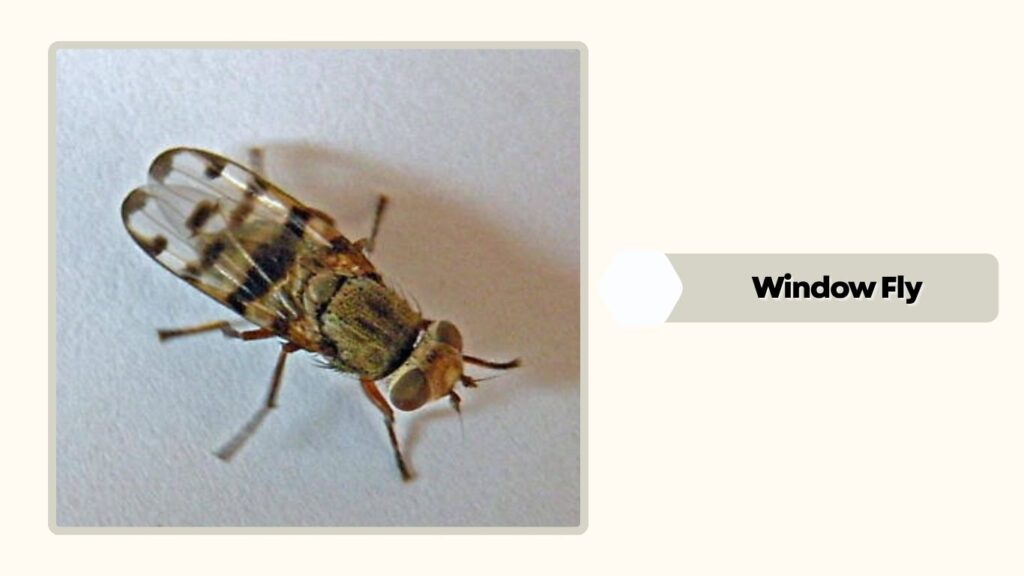
Window flies belong to the family Scenopinidae and are often discovered resting near household windows. Adults are small, dark, and somewhat flattened. They usually enter accidentally or emerge from larvae developing in wall spaces, carpets, stored materials, bird nests, or other sheltered locations.
Identification
- Adult size: About 3–9 millimeters long
- Body color: Black or dark brown
- Body shape: Slender and slightly flattened
- Eyes: Large and dark
- Wings: Clear or lightly smoky
- Antennae: Short and compact
Habitat and Distribution
Window flies occur in many regions and inhabit forests, grasslands, gardens, animal nests, and buildings. Indoors, their larvae may live in cracks, roof spaces, carpets, stored materials, or abandoned insect nests. Adults move toward windows because they are attracted to light.
Diet and Feeding
Adults may consume nectar, honeydew, or other sugary plant liquids, though the feeding habits of some species remain poorly understood. The larvae are predators that eat beetle larvae, moth larvae, termites, and other small insects.
Life Cycle and Behavior
Females place eggs near habitats containing suitable prey. The long, narrow larvae hunt inside soil, wood, nests, or household crevices. After pupating, adults may emerge indoors and gather at windows while attempting to reach the outside.
18. Shore Fly
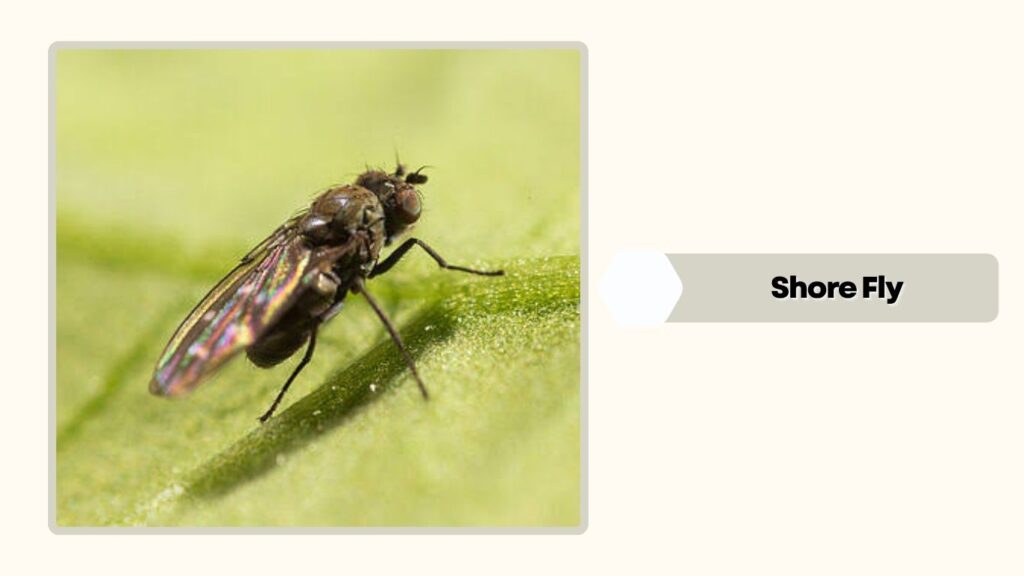
Shore flies are small insects belonging to the family Ephydridae. They are usually associated with algae, mud, and shallow water but may enter homes and greenhouses containing excessive moisture. Adults do not bite, and they generally cause little damage to healthy plants.
Identification
- Adult size: About 2–6 millimeters long
- Body color: Dark gray, brown, or black
- Body shape: Short and robust
- Eyes: Often reddish
- Wings: Clear or patterned
- Antennae: Short with visible bristles
Habitat and Distribution
Shore flies inhabit pond edges, marshes, wet soil, drainage areas, and other damp environments. Indoors, they may breed in overwatered plant containers, leaking plumbing, algae-covered surfaces, or greenhouses where standing water remains.
Diet and Feeding
Adults and larvae primarily consume algae, bacteria, yeasts, and decomposing organic matter. Unlike fungus gnat larvae, shore fly larvae generally do not feed on living plant roots. Adults may spread soil particles and microorganisms between damp surfaces.
Life Cycle and Behavior
Females lay eggs near algae or moist organic material. The larvae develop in the wet layer before pupating nearby. Adults are stronger fliers than fungus gnats and often rest on plant leaves, pots, walls, or windowsills.
19. Small Dung Fly
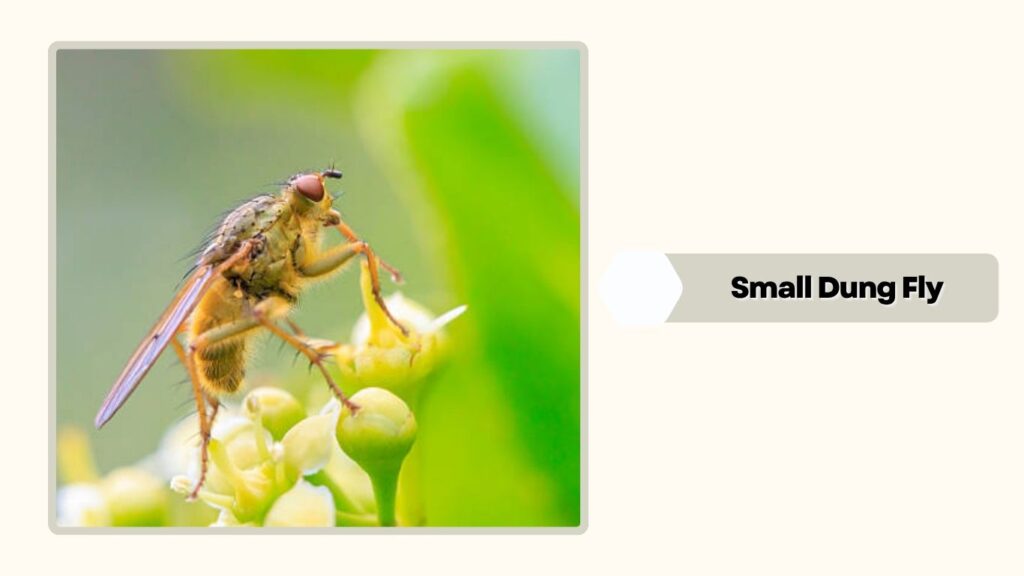
Small dung flies belong to the family Sphaeroceridae and are sometimes called lesser dung flies. These tiny, dark insects develop in manure, garbage, sewage, compost, and other decaying organic matter. Their presence indoors often indicates an overlooked moisture or sanitation problem.
Identification
- Adult size: About 1–6 millimeters long
- Body color: Black, brown, or dark gray
- Body shape: Short and compact
- Hind legs: Thickened first foot segment
- Wings: Clear or slightly darkened
- Movement: Short flights and quick running
Habitat and Distribution
Small dung flies occur worldwide in livestock facilities, compost piles, sewage systems, garbage areas, animal burrows, and wetlands. Inside houses, they may breed in drains, dirty garbage containers, pet waste, damp organic debris, or material trapped beneath appliances.
Diet and Feeding
Adults consume fluids from dung, decomposing vegetation, fungi, sewage, and food waste. Their larvae feed on microorganisms and decaying organic substances. Some species occupy specialized environments such as seaweed, animal nests, and caves.
Life Cycle and Behavior
Females deposit eggs directly in moist organic material. The larvae feed before pupating inside or near the breeding source. Warm conditions allow some species to develop rapidly. Removing waste, repairing leaks, and cleaning drains usually provide effective control.
20. Cheese Skipper Fly
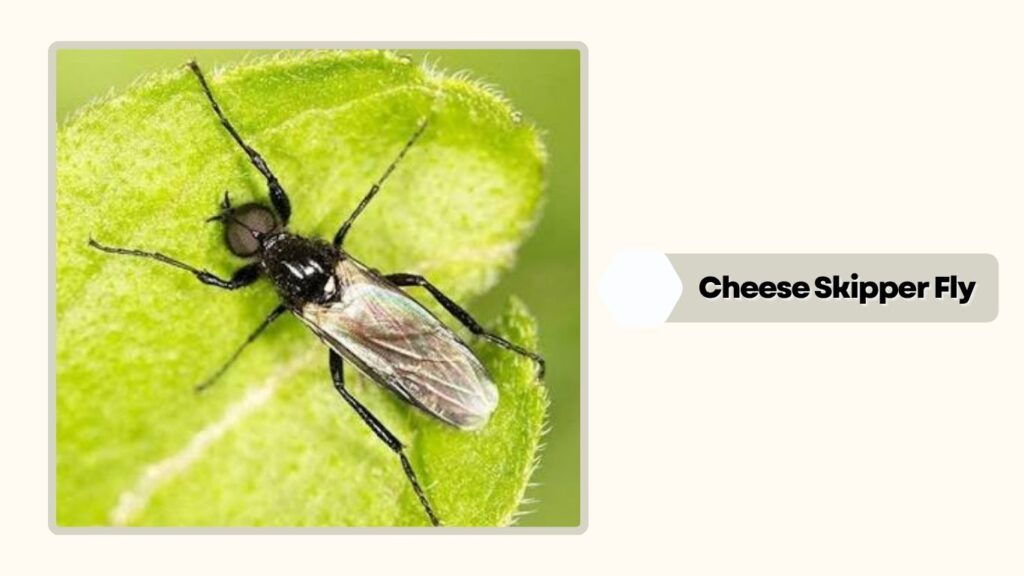
The cheese skipper fly (Piophila casei) is a small fly associated with aged cheese, cured meat, animal products, and decomposing material. Its name comes from the larvae’s ability to curl their bodies and jump several centimeters when disturbed or searching for a place to pupate.
Identification
- Adult size: About 3–5 millimeters long
- Body color: Shiny black or bronze
- Head: Reddish or yellowish
- Eyes: Dark red
- Wings: Clear and narrow
- Larvae: Cream-colored and capable of jumping
Habitat and Distribution
Cheese skipper flies occur worldwide around food-processing facilities, meat-storage areas, garbage, carrion, and homes containing improperly stored animal products. They are especially attracted to strong-smelling, protein-rich foods that have begun to age or decay.
Diet and Feeding
Adults consume liquids from decaying animal products and other organic matter. Their larvae feed on aged cheese, cured meats, smoked fish, animal fat, carrion, and decomposing tissue. Contaminated food should never be eaten.
Life Cycle and Behavior
Females lay eggs directly on suitable food. After hatching, the larvae feed before jumping away to locate a dry place for pupation. Adults later emerge and reproduce. Refrigeration, sealed containers, sanitation, and disposal of contaminated products help prevent infestations.
21. Coffin Fly
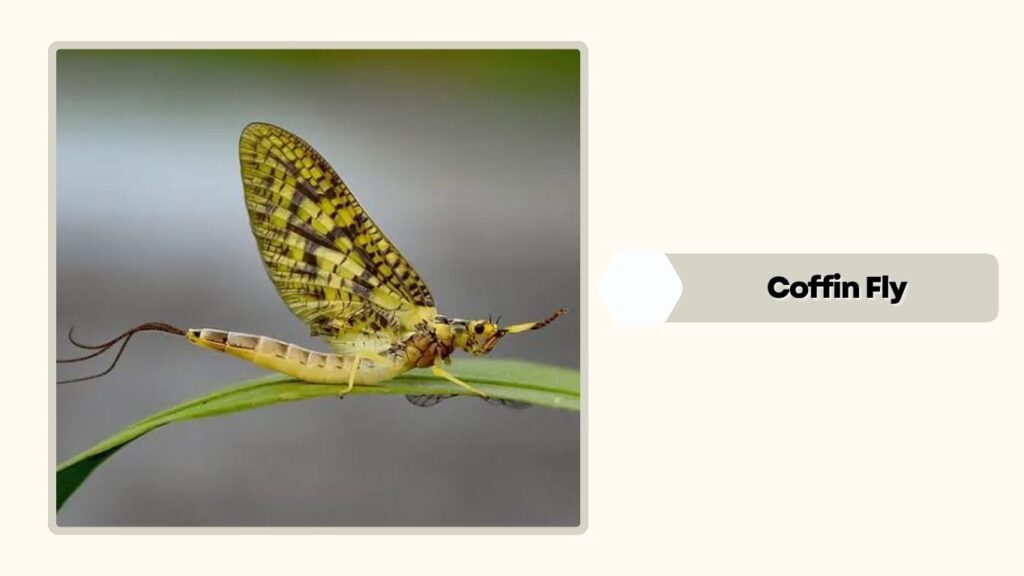
The coffin fly (Conicera tibialis) is a tiny member of the phorid fly family. It receives its unusual name from its ability to reach buried remains by moving through small gaps in soil. Around houses, it may develop in carrion, spoiled food, sewage, or other concealed organic material.
Identification
- Adult size: About 2–3 millimeters long
- Body color: Dark brown or black
- Thorax: Rounded and humpbacked
- Antennae: Short and compact
- Wings: Clear with strong front veins
- Movement: Runs rapidly across surfaces
Habitat and Distribution
Coffin flies occur in houses, basements, drains, sewers, burial sites, and locations containing decomposing animal material. Indoors, they may breed beneath floors, behind walls, inside damaged plumbing, or around the remains of rodents and other small animals.
Diet and Feeding
Adults consume fluids released by decaying organic matter. Their larvae feed on carrion, spoiled animal products, feces, sewage, and similar materials. They can survive in dark, enclosed locations where many other flies cannot easily reproduce.
Life Cycle and Behavior
Females lay eggs directly on suitable decomposing material. The larvae feed before moving to a drier location to pupate. Adults often run instead of flying. Removing the hidden breeding source is necessary to stop an indoor infestation.
22. Hover Fly
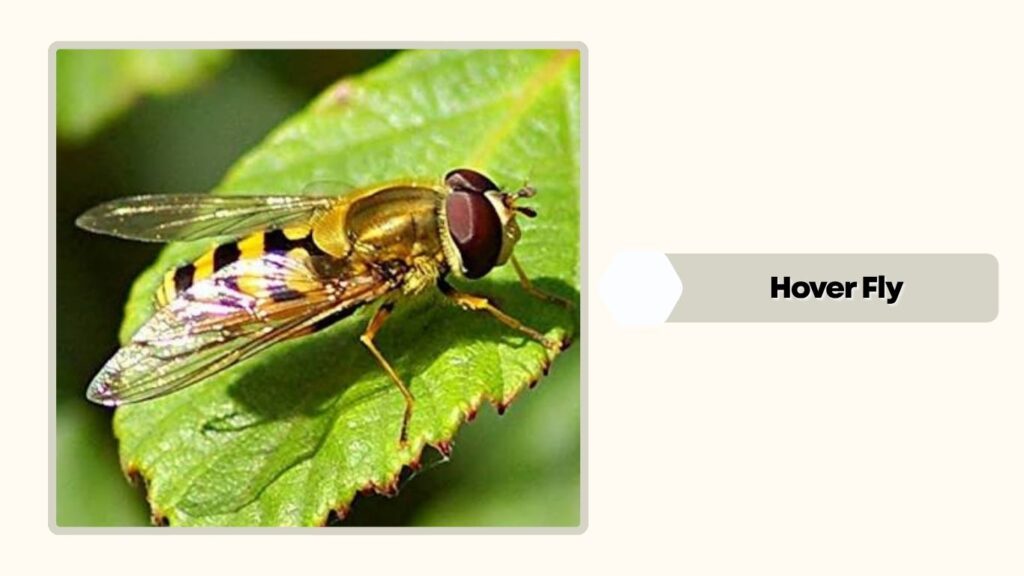
Hover flies belong to the family Syrphidae and are known for remaining almost motionless in the air. Many have yellow-and-black markings that make them resemble bees or wasps. However, hover flies cannot sting and rarely create indoor infestations.
Identification
- Adult size: About 4–25 millimeters long
- Color: Often yellow and black
- Wings: One functional pair
- Eyes: Large and prominent
- Antennae: Usually short
- Flight: Fast with precise hovering
Habitat and Distribution
Hover flies occur worldwide in gardens, meadows, farms, forests, wetlands, and urban parks. Adults occasionally enter houses through open doors or windows, especially when flowers or bright indoor spaces attract them.
Diet and Feeding
Adult hover flies mainly consume flower nectar and pollen, making them valuable pollinators. Their larvae have varied diets. Many species prey on aphids and other soft-bodied pests, while some larvae consume decaying material or live in stagnant water.
Life Cycle and Behavior
Females lay eggs near the food needed by their larvae. Predatory larvae begin hunting aphids soon after hatching. They eventually pupate on leaves, stems, or nearby surfaces. Their resemblance to stinging insects helps discourage predators.
23. Crane Fly
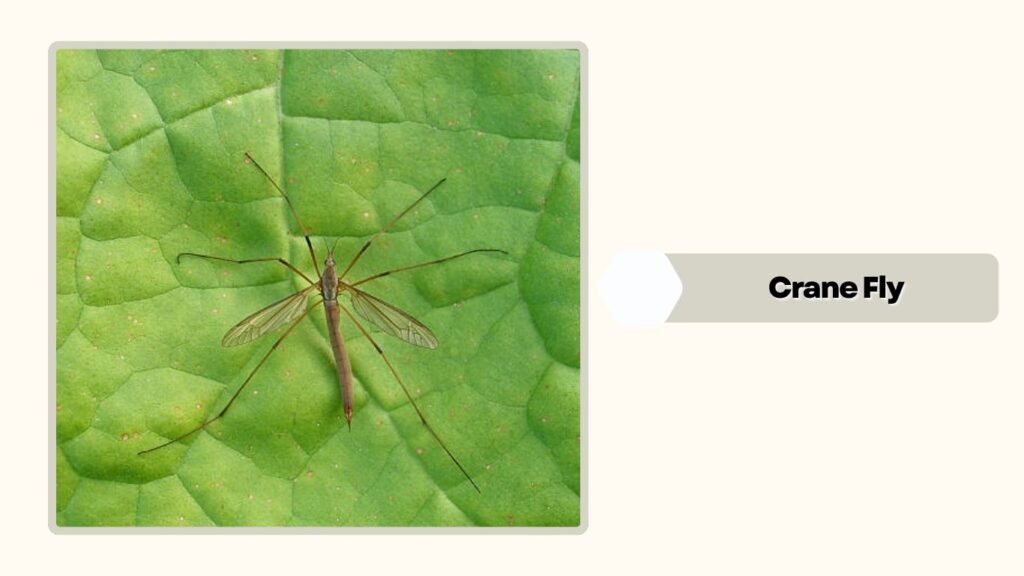
Crane flies are slender, long-legged insects belonging mainly to the family Tipulidae. They resemble oversized mosquitoes but do not bite people or consume blood. Adults sometimes enter houses after being attracted to lights, particularly during humid spring and autumn evenings.
Identification
- Adult size: About 10–35 millimeters long
- Body: Long, narrow, and delicate
- Legs: Extremely long and easily detached
- Wings: Clear, smoky, or patterned
- Antennae: Slender and segmented
- Appearance: Similar to a giant mosquito
Habitat and Distribution
Crane flies inhabit moist gardens, lawns, wetlands, forests, grassy fields, and stream banks. Adults commonly rest on walls, plants, or window screens. Those found indoors usually entered accidentally and cannot reproduce successfully in dry household conditions.
Diet and Feeding
Many adults eat little or nothing because they live briefly. Species that feed may consume nectar, pollen, or water. The larvae generally eat decaying vegetation, algae, microorganisms, or plant roots in moist soil and aquatic habitats.
Life Cycle and Behavior
Females lay eggs in wet soil, water, or decomposing vegetation. The thick-skinned larvae are called leatherjackets. Most contribute to decomposition, although some may damage lawns by eating roots. Adults concentrate mainly on mating and egg production.
24. Vinegar Fly
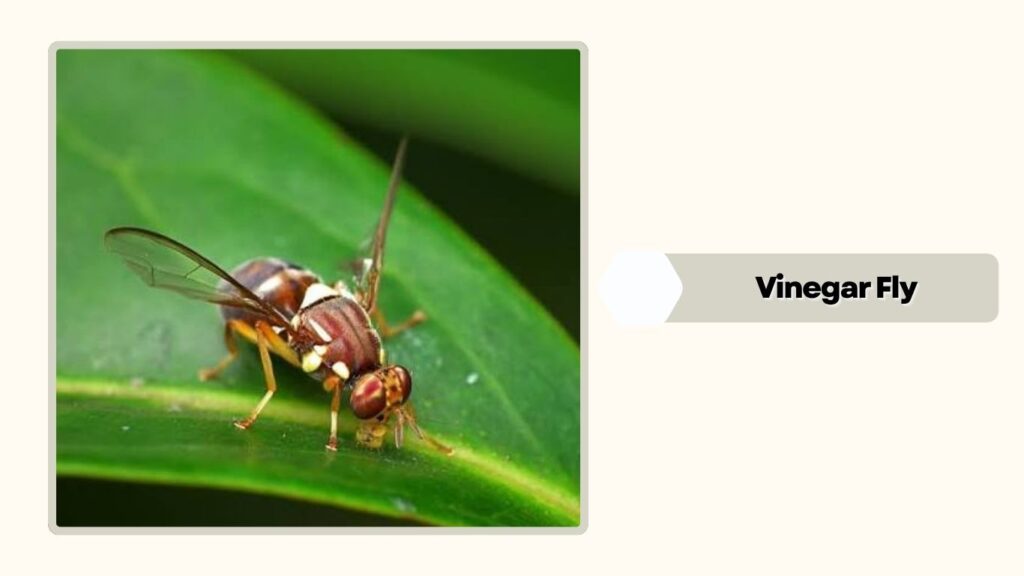
Vinegar flies are small flies belonging to the family Drosophilidae. They are closely associated with fruit flies and are strongly attracted to fermenting liquids. Indoors, they gather around vinegar, wine, beer, overripe fruit, recycling containers, and sugary residue.
Identification
- Adult size: About 2–4 millimeters long
- Body color: Tan, yellowish-brown, or dark brown
- Eyes: Commonly bright red
- Abdomen: Marked with dark bands
- Wings: Clear and short
- Flight: Slow and hovering
Habitat and Distribution
Vinegar flies occur worldwide in kitchens, restaurants, markets, breweries, orchards, and food-processing facilities. They reproduce wherever yeast grows on moist, fermenting material. Drains and dirty garbage containers may also provide suitable breeding sites.
Diet and Feeding
Adults consume yeasts, bacteria, and sugary liquids associated with fermentation. Their larvae feed on microorganisms growing within overripe fruit, spilled beverages, vinegar residue, and decaying plant material. They do not normally feed on fresh, undamaged fruit.
Life Cycle and Behavior
Females place eggs on moist, fermenting substances. The larvae hatch quickly and feed before forming pupae nearby. Under warm conditions, a generation may be completed in eight to twelve days. Removing fermenting material interrupts their rapid reproduction.
25. Tachinid Fly
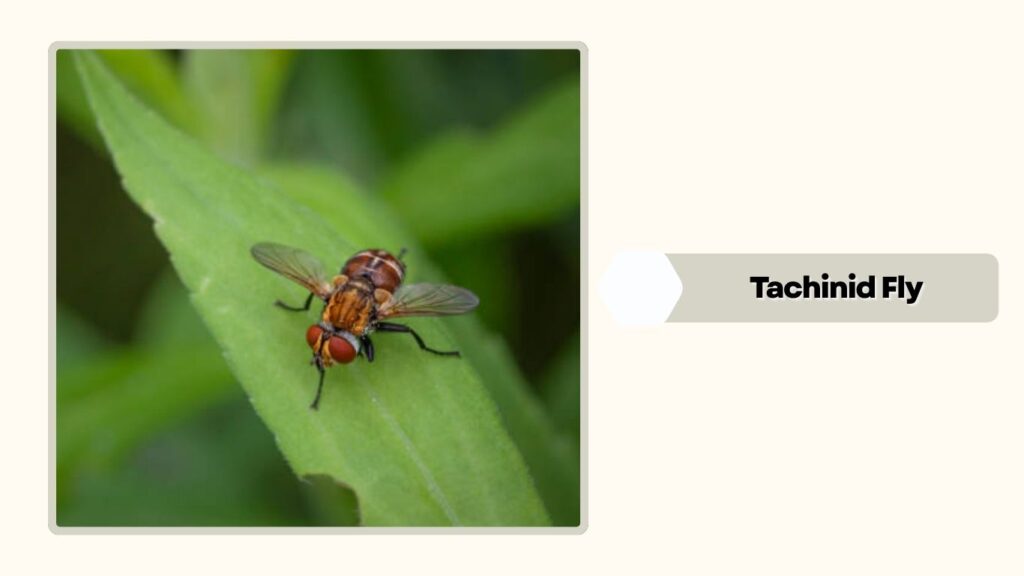
Tachinid flies belong to the family Tachinidae and vary greatly in appearance. Many resemble house flies, blow flies, or small bumblebees. They rarely infest houses and generally enter accidentally. Their parasitic larvae are beneficial because they naturally control numerous insect pests.
Identification
- Adult size: About 2–20 millimeters long
- Body: Stout and commonly bristled
- Color: Gray, black, brown, orange, or metallic
- Abdomen: Often covered with strong hairs
- Wings: Clear, smoky, or lightly colored
- Appearance: Highly variable between species
Habitat and Distribution
Tachinid flies occur worldwide in gardens, forests, grasslands, farms, and urban green spaces. Adults frequently visit flowers with easily accessible nectar. They may enter houses through open windows but usually leave without reproducing indoors.
Diet and Feeding
Adults consume nectar, pollen, honeydew, and other plant liquids. Their larvae develop inside caterpillars, beetles, grasshoppers, true bugs, and other arthropods. The growing larva eventually kills its host, helping reduce certain pest populations.
Life Cycle and Behavior
Females attach eggs to a host, place them on nearby vegetation, or deposit live larvae. The young larva enters an insect and feeds internally. After leaving the host, it pupates and later becomes an adult. Tachinid flies neither bite nor sting people.