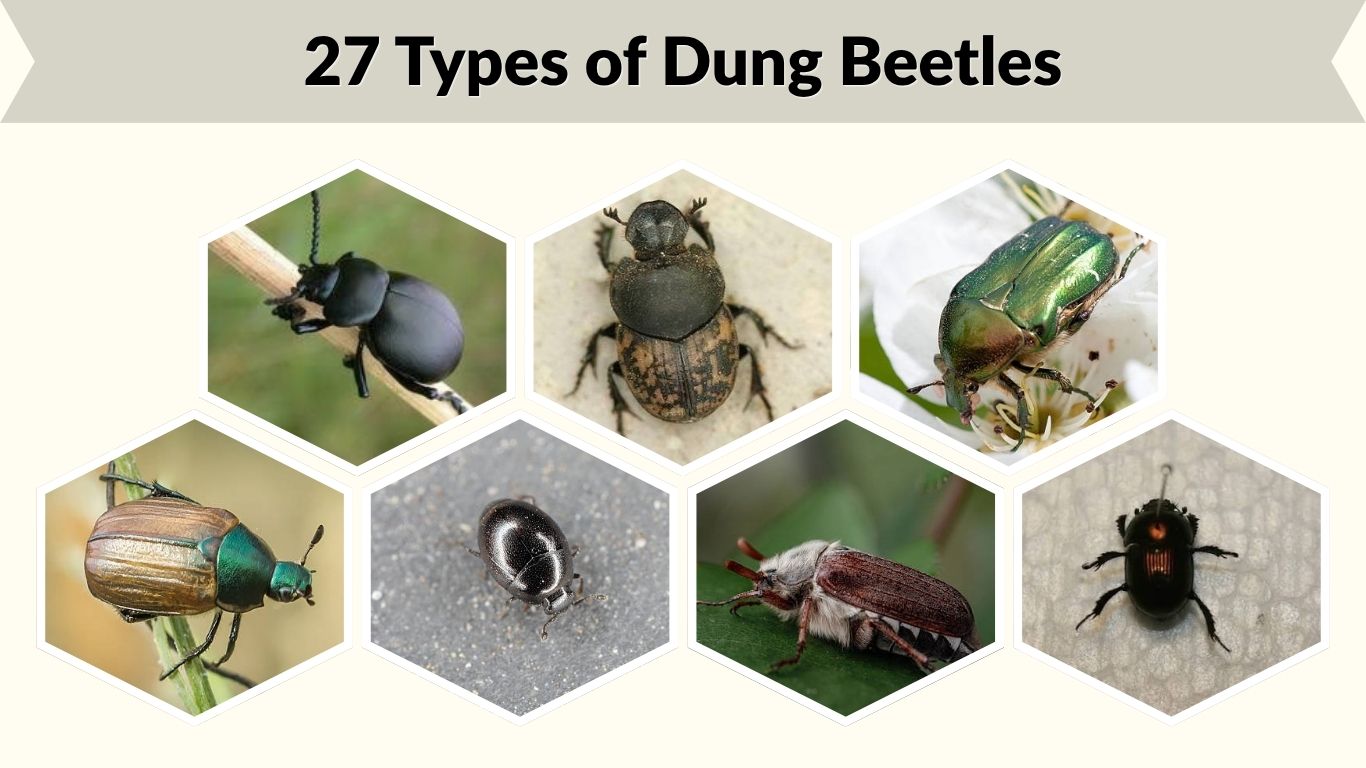
Dung beetles are remarkable insects that help recycle animal waste, enrich soil, and support healthy ecosystems. Different types of dung beetles use manure in unique ways: some roll it into balls, others bury it underground, while certain species live directly inside dung. They also vary widely in size, color, horn shape, habitat, and behavior. In this guide, you’ll discover 27 types of dung beetles, including their identification features, habitat and distribution, feeding behavior, and life cycle.
1. Rainbow Scarab
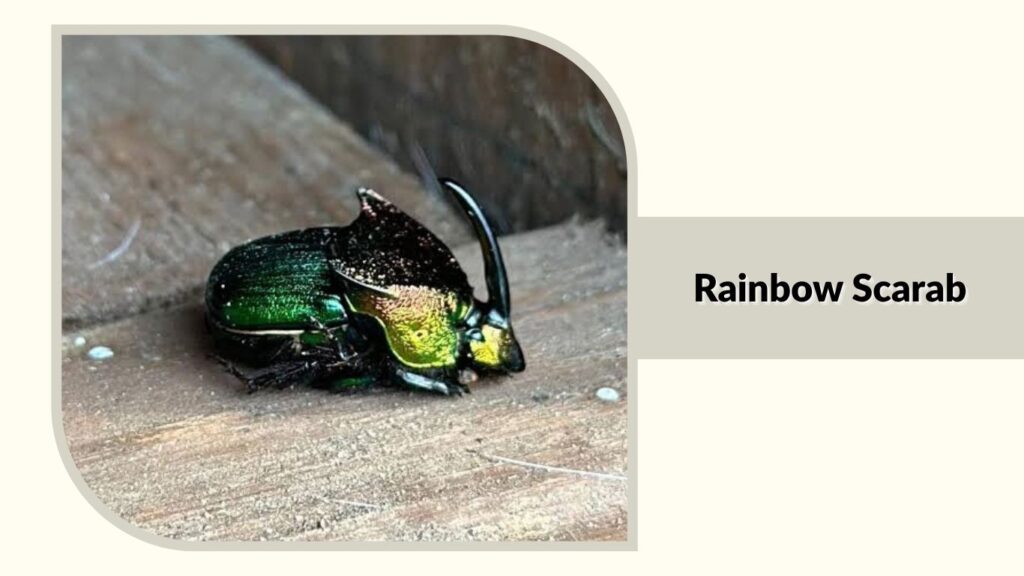
The Rainbow Scarab is one of the most colorful dung beetles in North America. Its metallic body can reflect green, blue, copper, gold, and reddish tones, making it easy to recognize compared with many darker dung beetles. Despite its attractive appearance, it plays a practical ecological role by burying animal dung, recycling nutrients, improving soil structure, and reducing waste on the ground.
Identification
- Common name: Rainbow Scarab
- Scientific name: Phanaeus vindex
- Body shape: Compact, rounded, and strongly built
- Color: Metallic green, blue, copper, bronze, and reddish reflections
- Male feature: Large backward-curving horn on the head
- Female feature: Usually lacks the prominent male horn
- Size: Commonly around 12–22 mm long
- Family: Scarabaeidae
The brightly metallic body is the species’ most noticeable feature. Males are especially distinctive because their horn gives them a striking appearance.
Habitat and Distribution
Rainbow Scarabs occur across much of the eastern and central United States and extend into parts of Mexico. They are commonly found in pastures, grasslands, open woodlands, farms, and other places where mammal dung is readily available.
They spend considerable time underground. Adults dig tunnels beneath or close to dung piles, creating chambers where food can be stored and eggs can be laid. Areas supporting livestock or wild mammals can provide especially suitable habitat.
Behavior and Diet
Rainbow Scarabs primarily feed on animal dung. Adults locate fresh droppings and transport portions underground rather than rolling large dung balls across the ground like some other dung beetles.
Their tunneling behavior helps remove waste from the soil surface. By burying dung, they return nutrients to the soil, improve aeration, and may reduce breeding opportunities for some pest flies.
Males may also use their prominent horns when competing with other males for access to tunnels or females.
Lifespan and Life Cycle
The life cycle begins when a female lays eggs in prepared underground chambers containing dung. After hatching, the larvae feed on the stored dung and pass through several growth stages before pupating.
Adults later emerge from the soil and continue feeding, mating, and digging. Development speed depends on environmental conditions such as temperature, moisture, and food availability. Like other dung beetles, the Rainbow Scarab’s entire life cycle is closely connected to nutrient-rich animal waste.
2. Gazelle Scarab
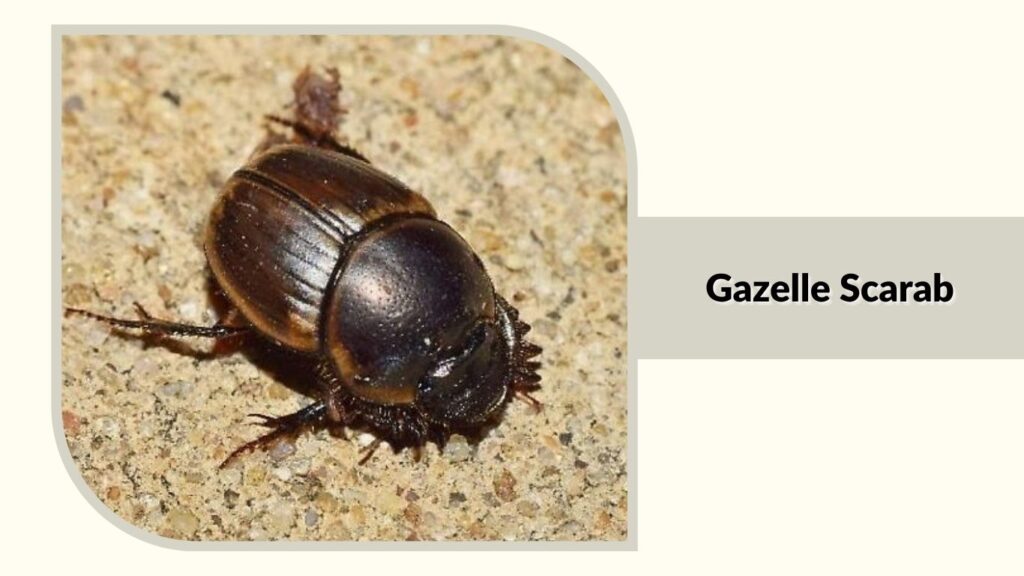
The Gazelle Scarab is a small but highly effective dung beetle known for rapidly burying livestock dung. Scientifically known as Digitonthophagus gazella, it originated in the Indo-African region and has been introduced to several warmer parts of the world for pasture improvement and dung control. Its tunneling behavior helps recycle nutrients and can reduce the amount of manure left exposed on grazing land.
Identification
- Common name: Gazelle Scarab
- Scientific name: Digitonthophagus gazella
- Size: About 10–13 mm long
- Color: Usually brown to dark brown
- Body shape: Compact and oval
- Male feature: Two short horns on the head
- Family: Scarabaeidae
The brown wing covers may show cloudy or slightly darker markings, while males can often be distinguished by their small paired horns.
Habitat and Distribution
The Gazelle Scarab is associated mainly with warm tropical and subtropical grasslands and pastures. It has become widespread in areas where cattle and other grazing animals provide abundant dung.
It was intentionally introduced into parts of the United States beginning in Texas during the 1970s and later spread through portions of the southern United States.
Behavior and Diet
Gazelle Scarabs are tunneling dung beetles. Adults locate fresh dung and excavate tunnels underneath or beside it. Portions of dung are carried underground and used for feeding and reproduction.
This behavior helps move organic matter into the soil rather than leaving it on the pasture surface. Their activity can therefore contribute to nutrient recycling, soil improvement, and faster manure breakdown.
Lifespan and Life Cycle
Females create underground brood chambers and provision them with dung before laying eggs. After hatching, larvae remain underground and feed on the stored dung.
The larvae pass through several developmental stages before becoming pupae. Adults later emerge from the soil to find new dung deposits and reproduce. Temperature and moisture strongly influence the speed of development.
3. Sacred Scarab
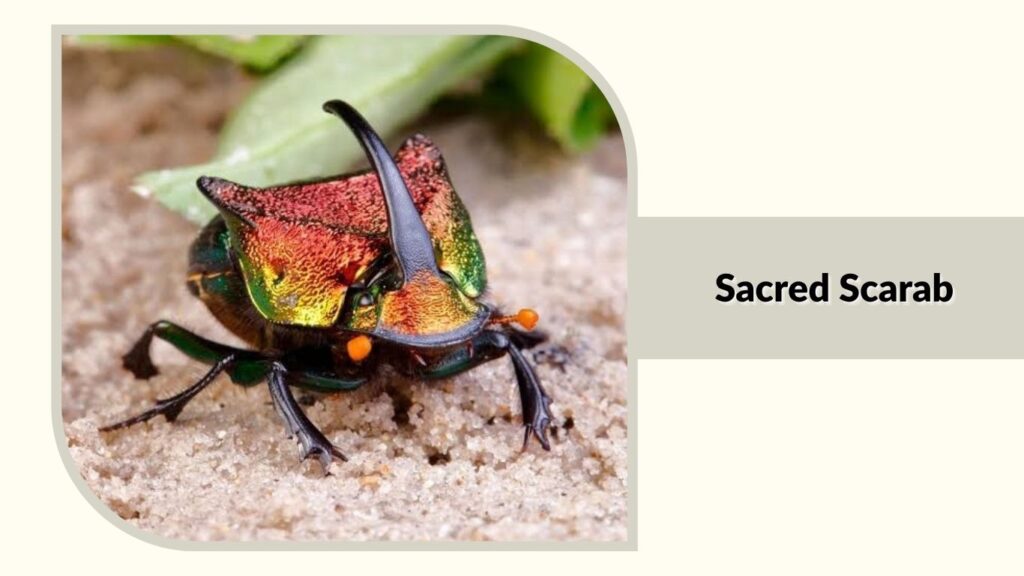
The Sacred Scarab is one of the world’s most famous dung beetles. Known scientifically as Scarabaeus sacer, it is especially associated with Ancient Egypt, where its dung-rolling behavior became a symbol of renewal and transformation. In nature, however, it is an important recycler that cuts pieces from animal dung, forms them into balls, and rolls them to suitable burial locations.
Identification
- Common name: Sacred Scarab
- Scientific name: Scarabaeus sacer
- Color: Usually matte black
- Body: Broad, robust, and slightly flattened
- Head: Wide with tooth-like projections
- Legs: Strong, especially the hind legs
- Family: Scarabaeidae
Its broad head and powerful legs are well suited for shaping and moving dung balls.
Habitat and Distribution
Sacred Scarabs occur naturally across parts of southern Europe, North Africa, and western Asia. They favor open, warm landscapes where grazing mammals regularly produce fresh dung.
Dry grasslands, sandy areas, and livestock-grazed landscapes can provide suitable habitat. Their activity is particularly noticeable during warm conditions when fresh dung is abundant.
Behavior and Diet
The Sacred Scarab is a classic roller. It cuts a portion of dung from a larger pat, shapes it into a ball, and pushes it away using its hind legs.
After reaching a suitable site, the beetle buries the ball underground. Some dung balls are consumed by adults, while others are prepared for reproduction.
Lifespan and Life Cycle
A female lays an egg with a buried dung provision. The larva feeds on that stored material as it grows.
After passing through its larval stages, it pupates underground and eventually emerges as an adult. Because the larva develops inside a protected food supply, the carefully prepared dung ball plays an essential role in successful reproduction.
4. Bull-Headed Dung Beetle
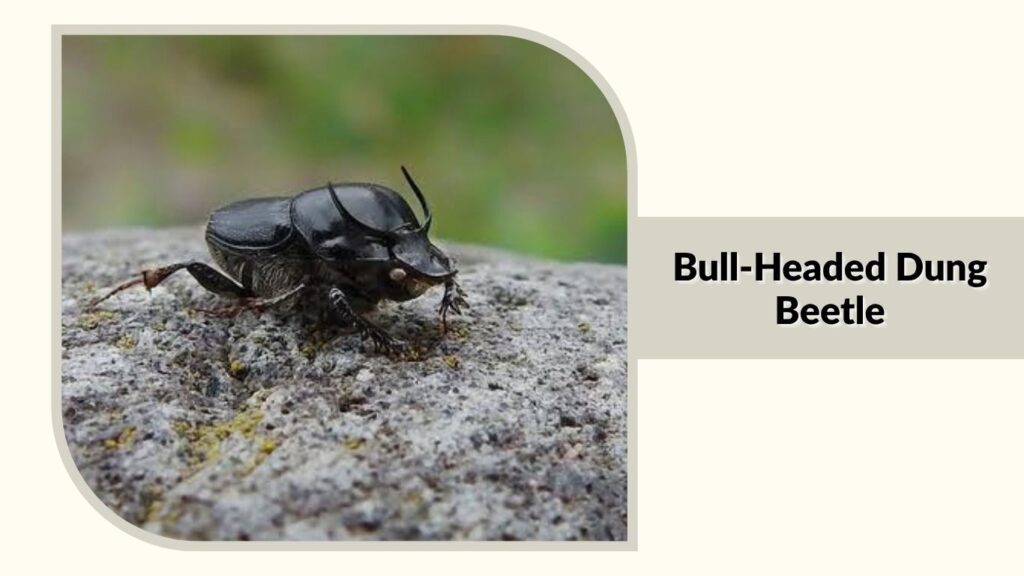
The Bull-Headed Dung Beetle, Onthophagus taurus, is named for the impressive curved horns developed by large males. Despite its dramatic appearance, it is a relatively small dung beetle. It is particularly associated with cattle pastures, where adults tunnel beneath dung pats and bury manure underground. This activity helps reduce surface dung and supports nutrient recycling in agricultural soils.
Identification
- Common name: Bull-Headed Dung Beetle
- Scientific name: Onthophagus taurus
- Size: About 8–11 mm long
- Color: Black to reddish brown
- Body: Small and oval
- Major males: Two long, curved horns
- Minor males: Much shorter horns
- Females: Usually hornless
The large horns of major males resemble those of a bull, giving the species its common name.
Habitat and Distribution
This species originated in the Mediterranean region but has become established in other parts of the world. In North America, it occurs particularly in agricultural landscapes and cattle pastures.
It was introduced into the United States and has expanded through parts of eastern North America.
Behavior and Diet
Bull-Headed Dung Beetles are tunnelers. Adults dig directly beneath dung pats and transport dung into underground chambers.
Male behavior is especially interesting. Large horned males may defend tunnels and fight rivals, while smaller males with reduced horns can use alternative reproductive strategies.
Lifespan and Life Cycle
Females place eggs in brood balls created from dung inside underground tunnels. Larvae feed within these food provisions and eventually pupate.
The species can produce multiple generations during favorable seasons, and adults or pupae may survive through colder periods depending on local conditions.
5. Humpback Dung Beetle
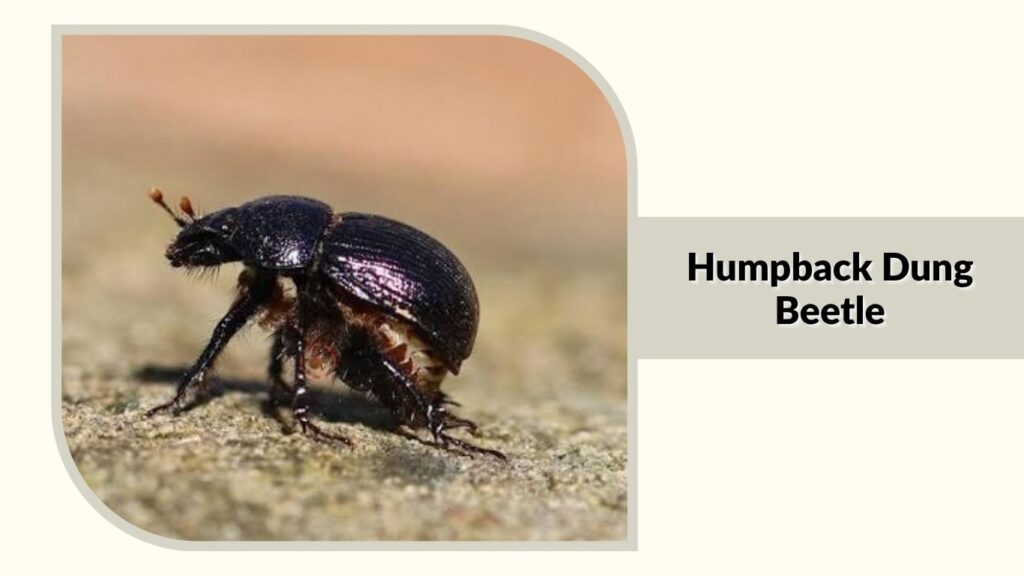
The Humpback Dung Beetle is a large North American dung beetle scientifically known as Deltochilum gibbosum. It gets its common name from the prominent raised humps visible on the wing covers of males. Unlike many pasture-centered dung beetles, this species is strongly associated with wooded habitats, where it feeds on dung and other decaying organic materials.
Identification
- Common name: Humpback Dung Beetle
- Scientific name: Deltochilum gibbosum
- Size: About 20–25 mm
- Color: Usually black
- Body: Broad and strongly domed
- Male feature: Prominent humps on the wing covers
- Head: Broad with tooth-like projections
- Family: Scarabaeidae
Males show the characteristic humps more clearly, while females lack these prominent raised structures.
Habitat and Distribution
The Humpback Dung Beetle occurs primarily in the southeastern United States, with records extending from the Mid-Atlantic south to Florida and west toward Texas and nearby regions.
It is commonly associated with woodland habitats rather than open pastures.
Behavior and Diet
This species is a roller-type dung beetle. Adults can use dung, carrion, rotting fruit, and fungi as food resources.
When using dung for reproduction, adults shape a brood mass and move it away from competing insects before burying it in a shallow underground chamber.
Lifespan and Life Cycle
The female prepares a brood ball that is typically pear-shaped and may cover it with soil or plant material before placing it underground.
An egg is deposited with the food supply. After hatching, the larva feeds on the prepared material, develops through several stages, pupates, and later emerges as an adult.
6. Small Black Dung Beetle
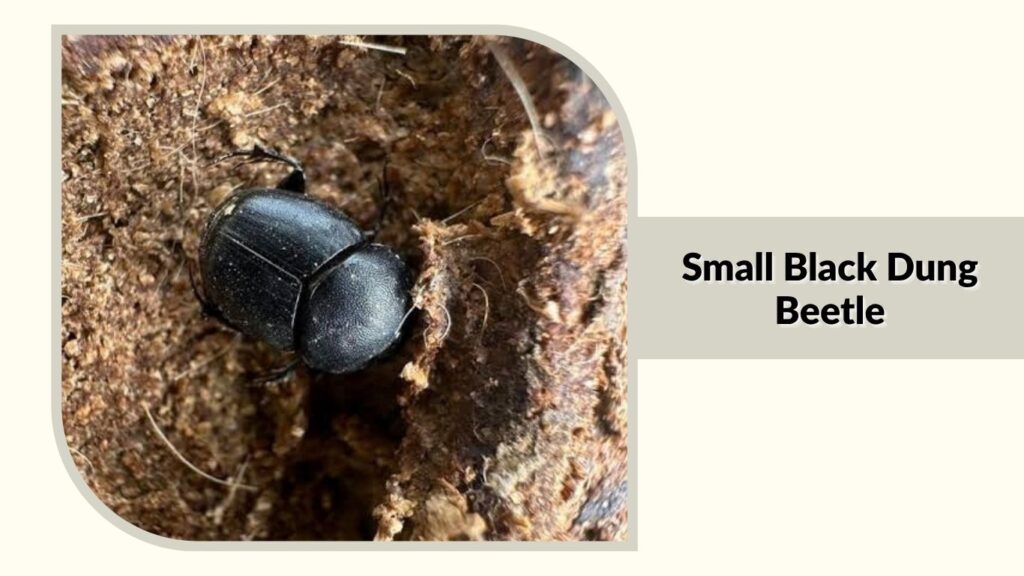
The Small Black Dung Beetle, scientifically known as Copris minutus, is a compact dung beetle native to North America. Although much smaller than many conspicuous scarabs, it performs the same valuable ecological work by using and burying animal dung. Both males and females can possess horn-like structures, making this species particularly interesting among smaller dung beetles.
Identification
- Common name: Small Black Dung Beetle
- Scientific name: Copris minutus
- Size: About 8–13 mm
- Color: Black
- Body: Rounded, thick, and compact
- Horns: Both sexes can have horns
- Family: Scarabaeidae
- Subfamily: Scarabaeinae
Its solid black coloration and compact scarab-like body help distinguish it from many brown or brightly metallic dung beetles.
Habitat and Distribution
The Small Black Dung Beetle occurs across much of eastern North America, with records extending from southeastern Canada through the eastern United States and west toward parts of the Great Plains and Texas.
It can occur in pastures, woodland edges, farms, and other habitats where mammal dung is available.
Behavior and Diet
Adults are attracted to animal dung, which provides both food and material for reproduction. Rather than rolling dung long distances, these beetles typically use underground chambers.
Dung burial moves organic nutrients directly into the soil and reduces the amount of manure remaining at the surface.
Lifespan and Life Cycle
Adults excavate underground chambers associated with dung and prepare food provisions for their developing young. Eggs are laid in these protected areas.
After hatching, larvae feed on dung before pupating underground. Adult activity varies with season and climate; in some southern locations, adults may be encountered through much of the year.
7. European Dung Beetle
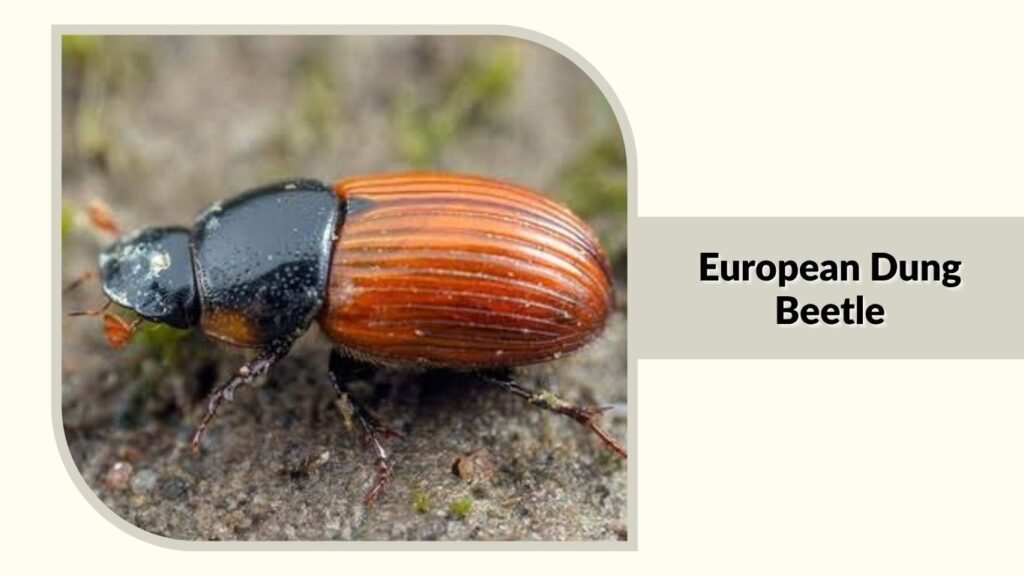
The European Dung Beetle, Aphodius fimetarius, is a widespread dung-associated scarab also known as the Red Dung Beetle. Unlike rollers that transport dung away or tunnelers that bury large quantities beneath a pat, this species commonly lives and develops directly within dung. It is particularly associated with mammal dung from large grazing animals and plays an important role in breaking down manure.
Identification
- Common name: European Dung Beetle
- Scientific name: Aphodius fimetarius
- Alternative name: Red Dung Beetle
- Family: Scarabaeidae
- Subfamily: Aphodiinae
- Body: Small, elongated-oval, and compact
- Color: Often dark with reddish-brown wing covers
- Lifestyle: Primarily a dung dweller
Its relatively small size and habit of living directly within dung distinguish it from larger rolling species.
Habitat and Distribution
This species is native to Europe and is widespread across the broader Holarctic region. It has also been introduced into other areas, including parts of Australia and East Asia.
Pastures and farmland containing cattle, horses, and other large mammals provide ideal habitat.
Behavior and Diet
Both adults and larvae are strongly associated with mammal dung. They feed directly within or beneath dung pats rather than routinely forming large balls.
This feeding activity accelerates decomposition and helps release nutrients back into pasture soils. European Aphodius dung beetles are generally classified as dung dwellers.
Lifespan and Life Cycle
Females lay eggs in suitable dung, giving newly hatched larvae immediate access to food. Larvae remain associated with the dung while feeding and growing.
After completing their larval stages, they pupate and eventually become adults. Seasonal timing varies with climate, but access to fresh dung and suitable temperatures strongly influences reproduction, development, and adult activity.
8. Cape Flightless Dung Beetle
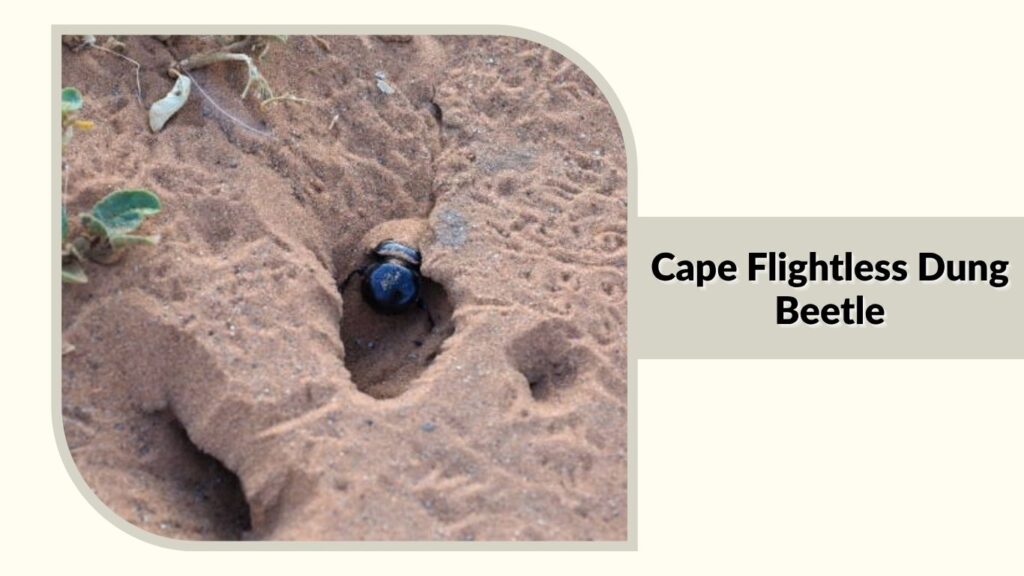
The Cape Flightless Dung Beetle is one of South Africa’s most remarkable dung beetles. Scientifically known as Circellium bacchus, it has completely lost the ability to fly and must walk between dung deposits. It is also unusually large for a dung beetle. The species is now restricted to limited parts of South Africa and is strongly associated with dung from large mammals such as elephants and buffalo.
Identification
- Common name: Cape Flightless Dung Beetle
- Scientific name: Circellium bacchus
- Family: Scarabaeidae
- Body: Large, broad, and robust
- Color: Usually dark black
- Wings: Flightless
- Movement: Walks across the ground
- Special feature: Enlarged space beneath the wing covers helps conserve water
Its inability to fly is particularly distinctive. The species can use the sealed cavity beneath its wing covers as part of an unusual respiratory system that reduces water loss.
Habitat and Distribution
The Cape Flightless Dung Beetle is endemic to South Africa and survives in a relatively small number of populations, particularly in the Eastern and southern Cape regions. Addo Elephant National Park is one of its best-known habitats.
It favors relatively dry landscapes inhabited by large herbivores.
Behavior and Diet
Adults mainly use mammal dung and show a strong association with elephant and buffalo dung. They form and move dung balls on foot before burying them.
Because they cannot fly, individuals must walk considerable distances while searching for suitable dung deposits. This makes them more dependent on continuous habitat and local mammal populations.
Lifespan and Life Cycle
Reproduction is unusually slow compared with many other dung beetles. Females prepare buried brood balls and lay eggs associated with these food supplies.
The developing larva feeds within the dung provision, pupates underground, and later emerges as an adult. Research indicates that this species has exceptionally low reproductive output, increasing its vulnerability to habitat fragmentation.
9. Popeye Dung Beetle
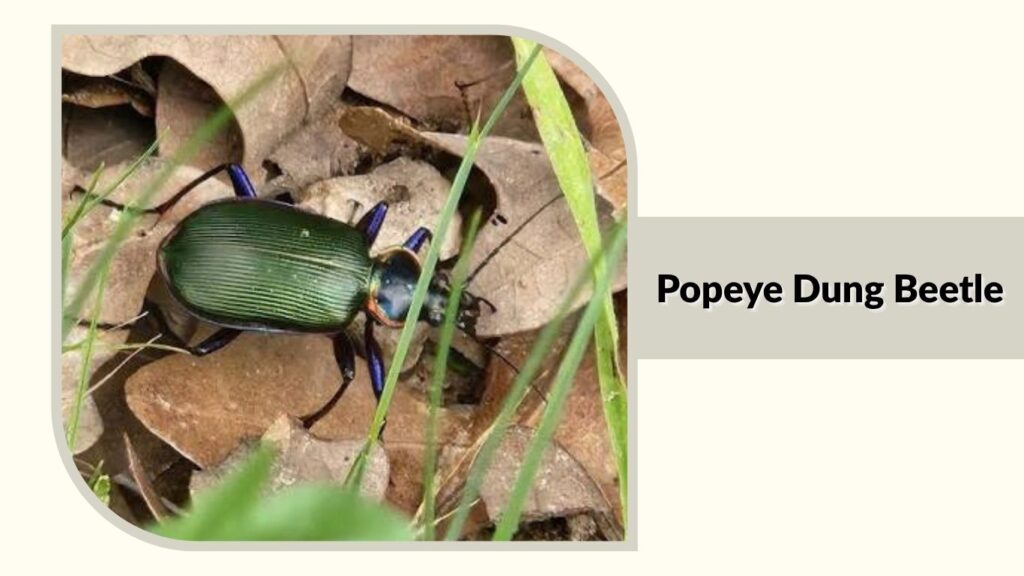
The Popeye Dung Beetle, Pachylomera femoralis, is a large African ball-rolling species distinguished by its extremely powerful legs. It is among the largest flying dung beetles and is well adapted to handling substantial quantities of dung. The species is particularly associated with savannas and woodlands where large mammals provide abundant manure.
Identification
- Common name: Popeye Dung Beetle
- Scientific name: Pachylomera femoralis
- Alternative name: Flattened Giant Dung Beetle
- Family: Scarabaeidae
- Color: Blackish gray
- Body: Large and flattened
- Legs: Exceptionally strong front legs
- Special feature: Rufous velvet-like patches on the front legs
Its muscular legs inspire the “Popeye” name because they appear disproportionately powerful compared with the rest of the body.
Habitat and Distribution
This species occurs widely in woodland and savanna habitats south of the equator in Africa. Records include South Africa, Botswana, Namibia, Zimbabwe, Mozambique, Tanzania, Angola, and the Democratic Republic of the Congo.
It is especially successful where elephants, buffalo, and other large mammals are present.
Behavior and Diet
Popeye Dung Beetles are ball rollers. Adults cut dung from a larger pile and shape it into a ball before rolling it away from competing beetles.
They show particular use of elephant and buffalo dung. Their enlarged front legs help manipulate large quantities of material, while the hind legs assist during rolling.
Lifespan and Life Cycle
For reproduction, a male may begin forming a dung ball, and a female can join him in transporting it. The pair eventually buries suitable dung underground.
An egg is associated with the buried food supply. The larva develops by consuming this provision, later pupates underground, and eventually emerges as an adult capable of continuing the dung-rolling cycle.
10. Spanish Dung Beetle
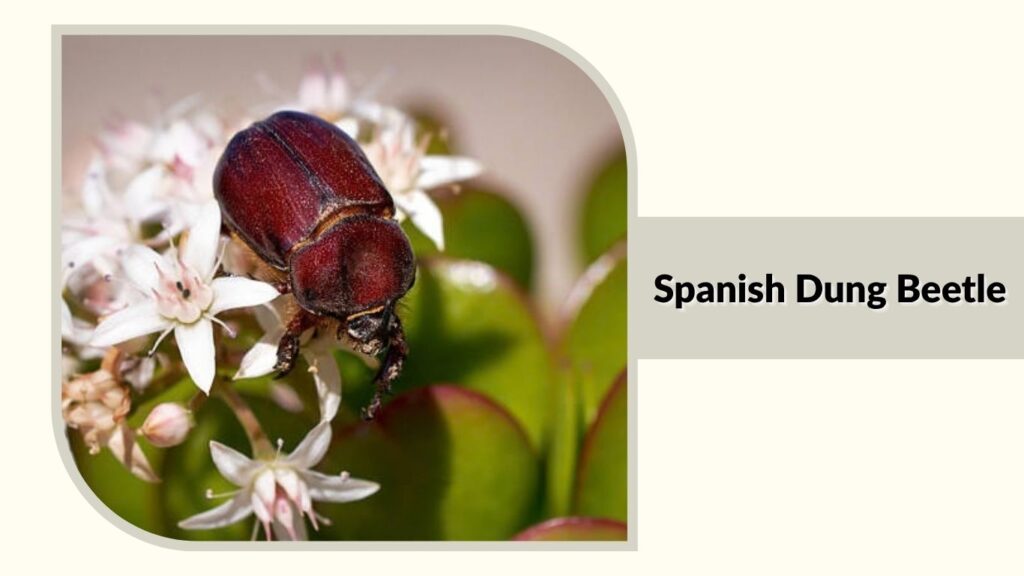
The Spanish Dung Beetle, Copris hispanus, is a large, shiny black tunneling dung beetle associated with warm Mediterranean landscapes. Males are especially recognizable because of the prominent curved horn on the head. Instead of rolling dung across the ground, this species buries portions beneath or near dung deposits, where the material becomes food for developing larvae.
Identification
- Common name: Spanish Dung Beetle
- Scientific name: Copris hispanus
- Size: About 16–26 mm
- Color: Shiny black
- Body: Thick and strongly built
- Male feature: Large curved head horn
- Female feature: Smaller pointed horn
- Family: Scarabaeidae
Its combination of glossy black coloration, heavy body, and prominent horn makes mature males relatively easy to recognize.
Habitat and Distribution
The Spanish Dung Beetle is a western Mediterranean species. It occurs particularly in warm, dry portions of the Iberian Peninsula and Mediterranean-type habitats.
Research in Spain shows that it favors warmer, drier areas, including open scrubland and grazing landscapes at relatively low elevations.
Behavior and Diet
This species is primarily a tunneler. Adults dig beneath dung pats and carry manure underground.
Its dependence on livestock and wild mammal dung makes traditional grazing landscapes an important habitat. By burying manure, the beetles help return nutrients to the soil and reduce waste remaining on the surface.
Lifespan and Life Cycle
Adults construct underground reproductive chambers containing dung. Females lay eggs beside carefully prepared food provisions.
Larvae hatch underground and consume the stored dung throughout their development. After passing through several larval stages, they pupate and eventually emerge as adults. Seasonal activity is strongest from autumn through late spring in some established populations.
11. Copper Dung Beetle
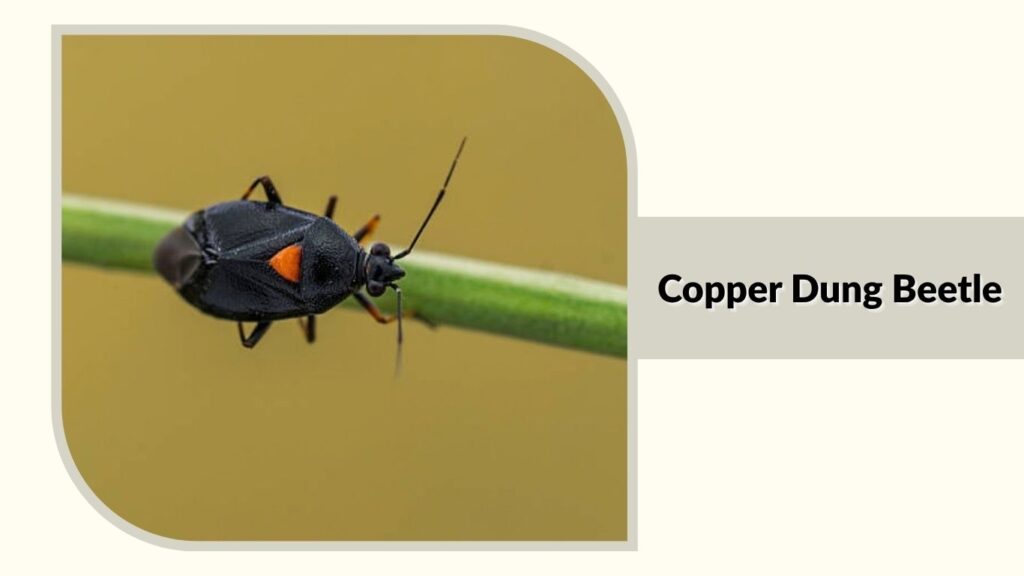
The Copper Dung Beetle, commonly referred to as the Diurnal Copper Dung Beetle, is Kheper nigroaeneus. This large African roller has a dark metallic appearance that may show greenish or copper tones. It is active mainly during daylight and uses strong legs to shape and roll dung balls across open ground before burying them for feeding or reproduction.
Identification
- Common name: Copper Dung Beetle
- Scientific name: Kheper nigroaeneus
- Family: Scarabaeidae
- Color: Dark with metallic copper or greenish tones
- Body: Large and robust
- Activity: Mainly diurnal
- Behavior: Ball-rolling dung beetle
- Habitat preference: Open environments
Its relatively large eyes are an adaptation associated with visual navigation while moving dung balls through open habitats.
Habitat and Distribution
Kheper nigroaeneus occurs in southern Africa, including parts of South Africa, Zimbabwe, and western Mozambique.
It favors warm, open habitats such as savannas where dung from large herbivores is readily available. Studies show that it forages much more frequently in open areas than in closed vegetation.
Behavior and Diet
Adults arrive at fresh dung, form portions into balls, and roll them away from competitors. The ball may be used directly for feeding or converted into a reproductive brood ball.
Their daytime activity makes visual orientation especially important. Once a suitable location is reached, the beetles bury their dung.
Lifespan and Life Cycle
This species shows unusually extensive parental care. A female can remain underground with a single developing offspring for approximately 12 weeks.
Adults commonly emerge after substantial spring rain. Reproductive activity is concentrated during warmer months, and adults enter periods of reproductive dormancy as conditions become less favorable.
12. Earth-Boring Dung Beetle
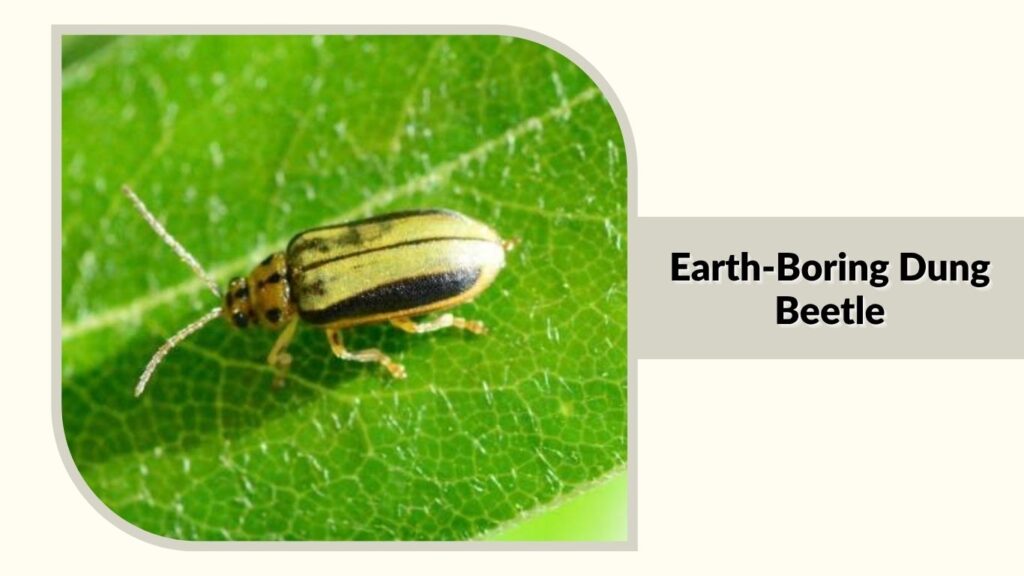
Earth-Boring Dung Beetles belong primarily to the family Geotrupidae. They are also commonly called dor beetles. Unlike classic dung rollers, these strong beetles specialize in digging deep tunnels beneath the ground. Some use dung, while others provision nests with decaying leaves, fungi, and other organic material. The Common Dor Beetle, Geotrupes stercorarius, is a familiar European representative of the group.
Identification
- Common name: Earth-Boring Dung Beetle
- Family: Geotrupidae
- Representative species: Geotrupes stercorarius
- Color: Usually black or very dark
- Body: Compact, thick, and strongly convex
- Legs: Powerful and spined for digging
- Antennae: Short with clubbed tips
- Special behavior: Deep underground burrowing
Some species also show blue, green, or violet metallic reflections on their underside.
Habitat and Distribution
Earth-boring dung beetles occur in many temperate regions, including Europe, Asia, and North America.
The Common Dor Beetle is widespread in Europe and can occur in pastures, woodland edges, and other areas where herbivore dung or decaying organic matter is available.
Behavior and Diet
These beetles are powerful excavators. Adults construct vertical or angled tunnels and carry organic material underground.
Depending on the species, they may feed on dung, decaying leaves, fungi, or mixed decomposing matter. Geotrupes stercorarius commonly uses herbivore droppings and shows a preference for horse dung.
Lifespan and Life Cycle
Females deposit eggs within underground chambers containing prepared food. Larvae remain protected below the surface and feed on the stored organic material.
After completing larval development, they pupate underground before emerging as adults. Some earth-boring dung beetles dig exceptionally deep tunnels, allowing offspring to develop in stable conditions.
13. Tumblebug
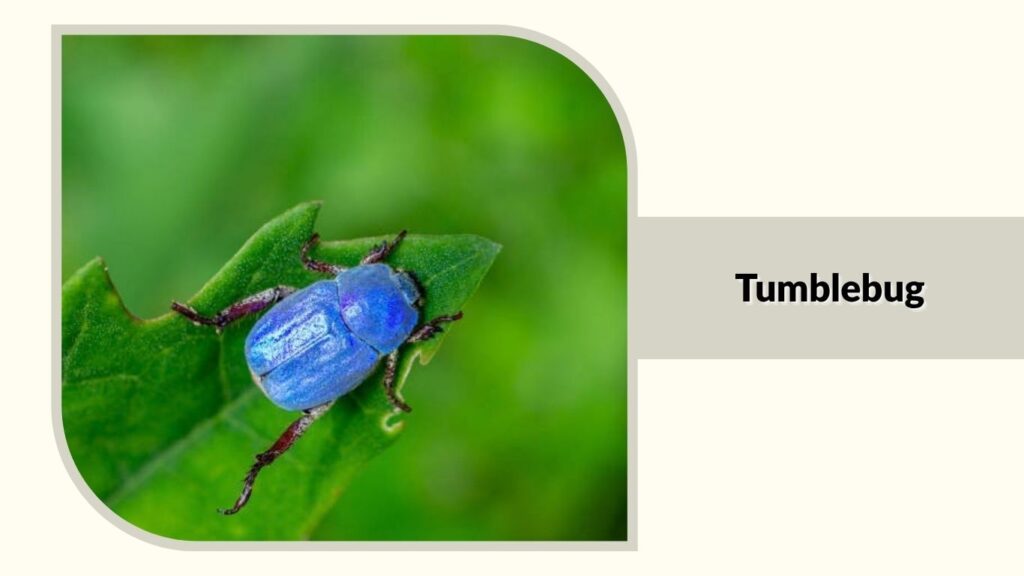
Tumblebugs are classic ball-rolling dung beetles, and Canthon pilularius is one of the best-known North American examples. Their name comes from the way adults roll rounded balls of dung across the ground. These balls are transported away from crowded dung deposits and later buried, either to provide food for adults or to create a protected food source for developing offspring.
Identification
- Common name: Tumblebug
- Representative species: Canthon pilularius
- Genus: Canthon
- Family: Scarabaeidae
- Body: Rounded and compact
- Color: Usually black
- Legs: Strong and adapted for digging and rolling
- Behavior: Rolls dung balls backward with the hind legs
North American Canthon species vary in size, and some may show metallic green, purple, or reddish reflections.
Habitat and Distribution
Tumblebugs occur in grasslands, pastures, prairies, farms, and other habitats where mammals regularly produce dung.
Canthon pilularius is particularly associated with open environments and readily uses the dung of cattle, horses, sheep, and historically bison.
Behavior and Diet
Adults remove a portion of fresh dung and shape it into a nearly round ball. The beetle then faces downward and pushes the ball backward using its powerful hind legs.
The ball is moved away from competitors and eventually buried. Adults may create food balls for themselves or brood balls for reproduction.
Lifespan and Life Cycle
For Canthon pilularius, adults can overwinter and become active again when conditions improve. A female lays a single egg in a cavity associated with a buried dung ball.
The larva feeds inside the protected dung supply, passes through several developmental stages, and pupates underground. In northern populations such as Canada, the species typically completes one generation per year.
14. Scooped Scarab
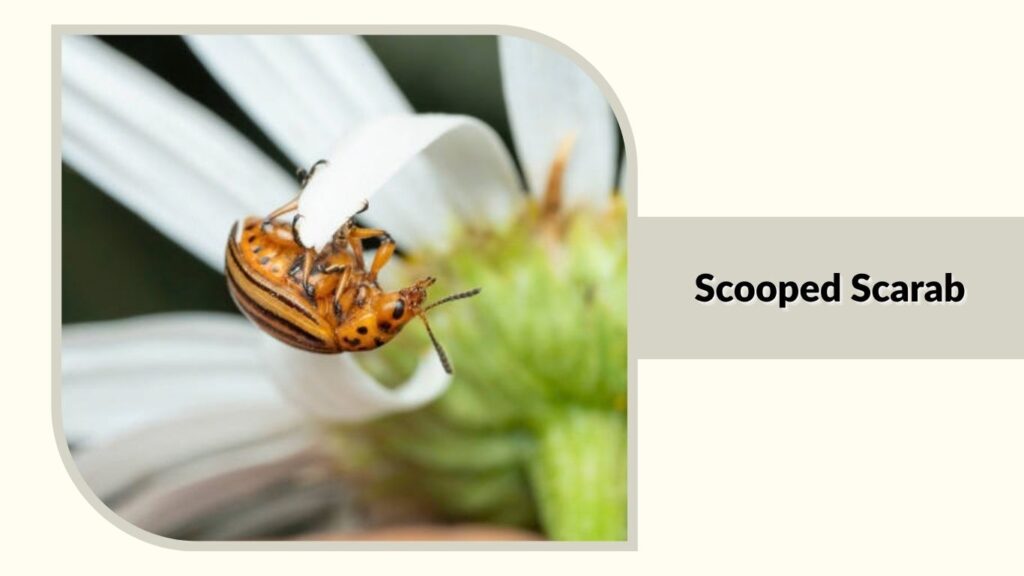
The Scooped Scarab, Onthophagus hecate, is a small black dung beetle known for its rough-textured body and unusual horn structure in larger males. It is a tunneling species that buries dung beneath the original deposit rather than rolling it away. Its feeding and nesting activities help break down animal waste and transfer organic nutrients into the soil.
Identification
- Common name: Scooped Scarab
- Scientific name: Onthophagus hecate
- Family: Scarabaeidae
- Size: About 5.2–9.5 mm
- Color: Dull black
- Body: Rough, with small bumps and pale hairs
- Male feature: Large males have a forward-projecting pronotal horn
- Female feature: Females lack the large horn
The combination of a rough, granulated body and the male’s distinctive horn helps separate this species from similar Onthophagus dung beetles.
Habitat and Distribution
The Scooped Scarab occurs across much of North America, excluding much of the Pacific Coast. Its recorded range extends from eastern Canada south to Florida and west toward Alberta and Arizona.
It can inhabit pastures, grasslands, farms, and woodland environments where mammal dung is available.
Behavior and Diet
Adults feed mainly on dung, although they may also use carrion and rotting fruit. They dig tunnels directly beneath dung deposits and transport pieces underground.
This behavior reduces manure left on the soil surface while making nutrients available deeper in the ground.
Lifespan and Life Cycle
Females construct underground brood chambers and provision them with dung. Eggs are deposited with the stored food, allowing newly hatched larvae to begin feeding immediately.
The larvae develop through several stages underground before pupating. New adults eventually emerge and search for fresh dung deposits.
15. Black Phanaeus
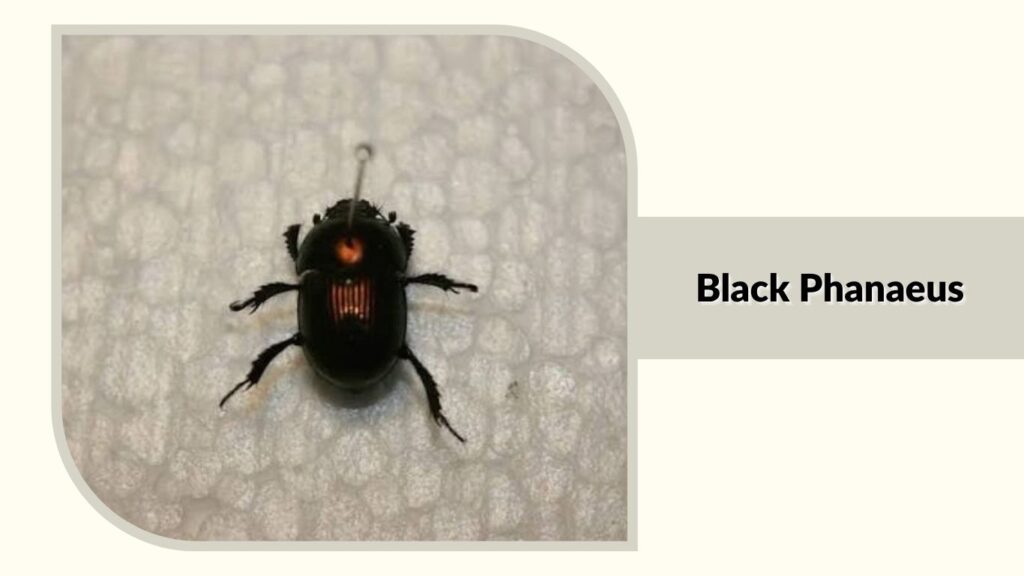
The Black Phanaeus, Phanaeus triangularis, is a North American true dung beetle distinguished by its predominantly black coloration. It belongs to the same genus as the brilliantly colored Rainbow Scarab, but it usually lacks the intense metallic coloration associated with that species. Black Phanaeus beetles are strong diggers that bury mammal dung beneath the soil for feeding and reproduction.
Identification
- Common name: Black Phanaeus
- Scientific name: Phanaeus triangularis
- Family: Scarabaeidae
- Color: Predominantly black
- Body: Heavy and strongly built
- Wing covers: Smooth with noticeable grooves
- Male feature: Prominent head horn in larger males
- Lifestyle: Tunneling dung beetle
Its dark coloration is especially useful for distinguishing it from the often metallic green or reddish Rainbow Scarab.
Habitat and Distribution
The Black Phanaeus is found mainly in the southeastern United States, with its range extending from eastern Texas toward Florida and Virginia and north or west into neighboring regions.
It occupies environments where mammal dung is regularly available, including pastures, open woodland, grazing areas, and wildlife habitat.
Behavior and Diet
Like other members of Phanaeus, this beetle primarily feeds on mammalian dung. Adults excavate tunnels beneath or near dung deposits and carry portions underground.
Males may use their horns when competing for access to females or nesting tunnels.
Lifespan and Life Cycle
A pair creates an underground nesting chamber and provisions it with dung. The female prepares individual brood masses, with an egg associated with each food supply.
Larvae remain underground while feeding on the dung, later pupating within the protected nest before emerging as adults.
16. Texas Black Phanaeus
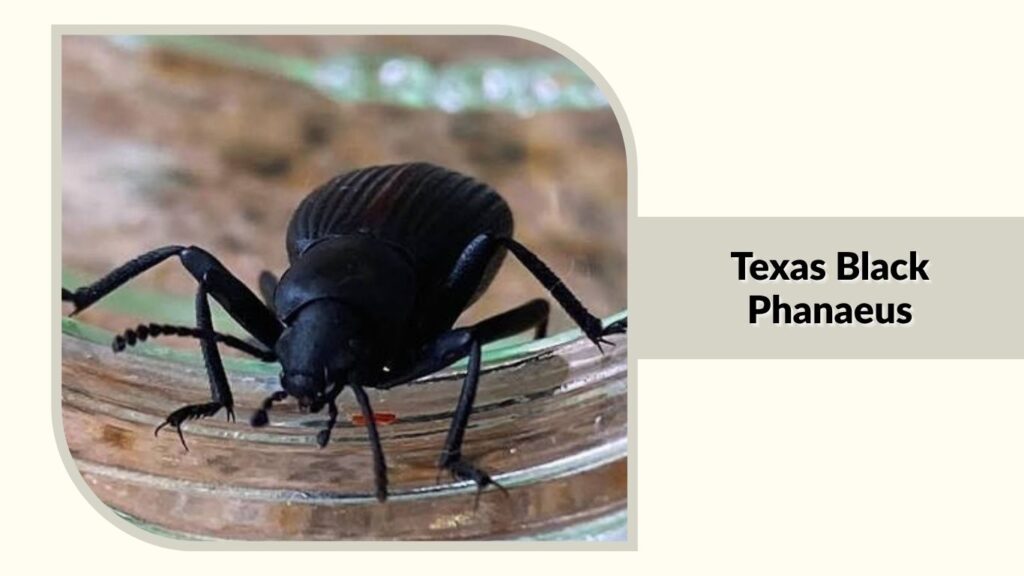
The Texas Black Phanaeus is a dark dung beetle associated particularly with Texas. It has historically been treated as Phanaeus triangularis texensis, although modern classifications may recognize it as the separate species Phanaeus texensis. Like other Phanaeus, it is a powerful tunneler and uses mammal dung as both adult food and a resource for developing offspring.
Identification
- Common name: Texas Black Phanaeus
- Scientific name: Phanaeus texensis
- Former classification: Phanaeus triangularis texensis
- Family: Scarabaeidae
- Color: Mostly black or very dark
- Body: Robust and strongly armored
- Male feature: Prominent horn
- Size: Some adults reach roughly 20–25 mm
The combination of geographic location, dark coloration, body structure, and horn development helps distinguish it from related Phanaeus species.
Habitat and Distribution
This beetle is principally associated with Texas, although records and older taxonomic treatments may include nearby regions. BugGuide lists P. texensis specifically from Texas.
It occurs in areas supporting mammals that provide suitable dung or occasionally other decomposing animal material.
Behavior and Diet
Adults are strong diggers. They locate nutrient-rich organic material and excavate underground chambers where food can be protected from competitors.
Members of Phanaeus generally prefer mammalian dung and are classed as tunneling, or paracoprid, dung beetles.
Lifespan and Life Cycle
Breeding adults bury dung in subterranean chambers. Females form brood provisions and lay eggs in association with the stored material.
Larvae remain underground throughout development, feeding on the prepared dung before pupating. New adults later dig to the surface and begin searching for feeding and breeding resources.
17. Brown Dung Beetle
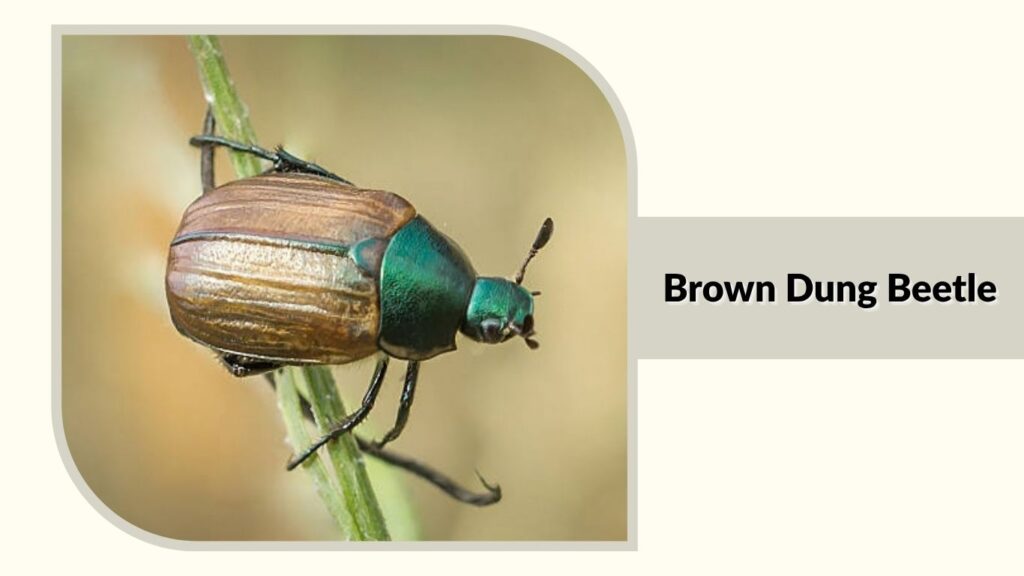
The Brown Dung Beetle is another common name for Digitonthophagus gazella, the same species covered earlier as the Gazelle Scarab. Rather than representing a separate species, this name emphasizes its generally brown coloration. It is an important tunneling dung beetle that has been deliberately introduced into several countries to accelerate livestock-manure breakdown in pastures.
Identification
- Common name: Brown Dung Beetle
- Other common name: Gazelle Scarab
- Scientific name: Digitonthophagus gazella
- Family: Scarabaeidae
- Color: Brown to dark brown
- Body: Compact and oval
- Male feature: Paired horn-like projections
- Lifestyle: Tunneling dung beetle
This is therefore not a different species from number 2 in the list; both names refer to Digitonthophagus gazella.
Habitat and Distribution
The species is native to Afro-Asian regions but has been introduced widely, including to Australia and the Americas.
Open pastures with cattle and other grazing mammals provide particularly favorable conditions because fresh dung is continuously available.
Behavior and Diet
Adults arrive quickly at fresh manure and tunnel beneath the dung pat. They move portions underground, reducing competition at the surface and creating food reserves.
Their activity helps accelerate dung decomposition and returns nutrients to the soil.
Lifespan and Life Cycle
Females construct underground brood masses from dung and deposit eggs with them. Larvae remain below ground and consume the stored manure as they grow.
After passing through their larval stages, they pupate and eventually emerge as adults. Warm temperatures can support rapid reproduction and multiple breeding periods.
18. Horned Dung Beetle
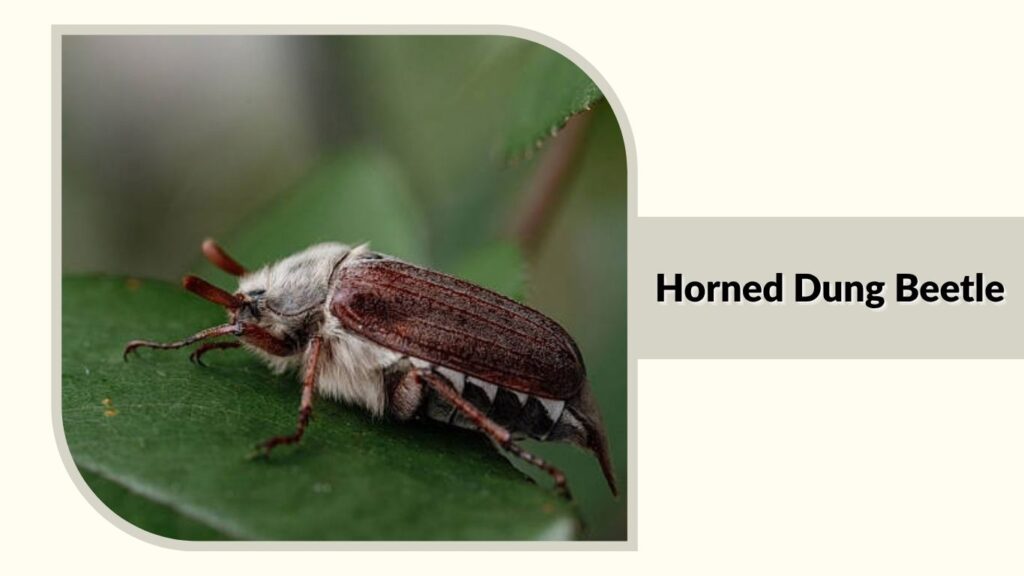
The Horned Dung Beetle, Copris lunaris, is a large tunneling scarab known for the prominent horn found on males. It has a particularly interesting reproductive system because adults cooperate in preparing underground nests, and females remain with the developing brood for an extended period. This combination of tunneling and parental care makes it one of the more behaviorally complex dung beetles.
Identification
- Common name: Horned Dung Beetle
- Scientific name: Copris lunaris
- Family: Scarabaeidae
- Color: Dark black
- Body: Thick, oval, and strongly built
- Male feature: Prominent curved horn
- Legs: Powerful and adapted for digging
- Lifestyle: Tunneler
The male’s horn is one of the easiest features to notice, although horn size can vary among individuals.
Habitat and Distribution
The species is associated with well-drained, unploughed pasture, especially where chalky or sandy soils make tunneling possible.
In Britain it was historically recorded from several southern and central areas, although old populations declined substantially. The species has a broader continental European distribution.
Behavior and Diet
Adults use mainly cow and horse dung. A pair excavates an underground tunnel beneath the dung, sometimes reaching approximately 10–20 cm deep.
Dung is transported into a terminal chamber and divided into several brood provisions.
Lifespan and Life Cycle
A female usually prepares several brood balls and lays one egg with each. Remarkably, she can remain underground guarding the brood until the young adults develop.
Development from egg to new adult can take around three to four months under suitable conditions.
19. Roller Dung Beetle
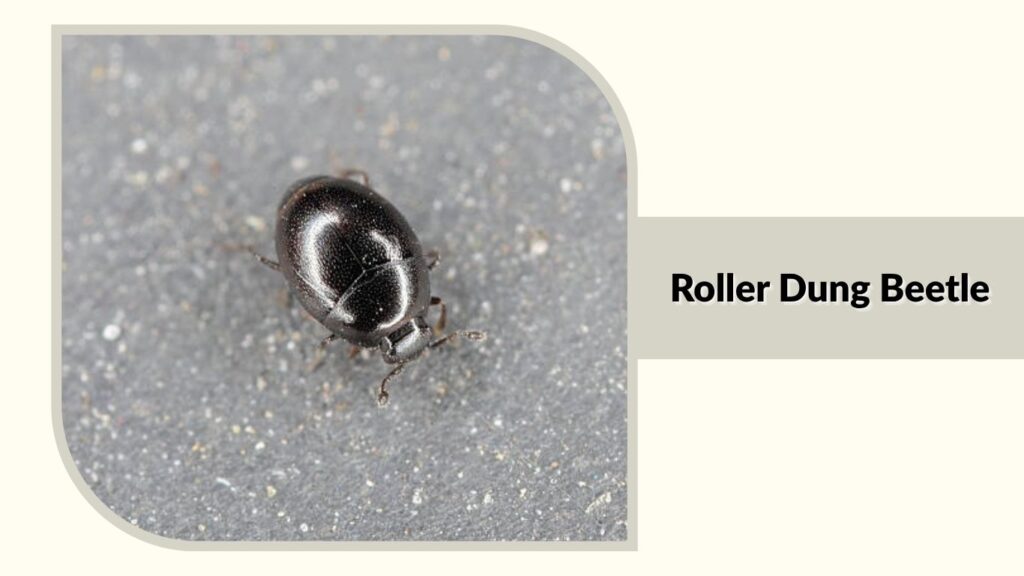
“Roller Dung Beetle” describes a behavioral group rather than one single species. A good example is Canthon pilularius, a North American tumblebug. Rollers remove dung from a fresh deposit, shape it into a ball, and transport it some distance before burying it. This behavior reduces competition while creating a protected food supply for either adults or their offspring.
Identification
- Common type: Roller Dung Beetle
- Representative species: Canthon pilularius
- Family: Scarabaeidae
- Body: Rounded and compact
- Legs: Strong hind legs adapted for rolling
- Color: Often dark or black
- Behavior: Forms and transports dung balls
- Ecological type: Telecoprid
The ball-rolling behavior is more useful for recognizing this group than any single color or body feature.
Habitat and Distribution
Roller dung beetles occur worldwide in suitable warm and temperate habitats.
Canthon pilularius favors open habitats in North America and readily uses dung from cattle, horses, sheep, and historically bison.
Behavior and Diet
Adults cut dung away from a larger deposit and shape it into a rounded ball. In C. pilularius, the ball may measure roughly 2–3 cm across.
It is rolled away and buried in a tunnel approximately 5–10 cm deep, reducing competition with other dung-feeding insects.
Lifespan and Life Cycle
A female deposits an egg with the buried dung ball. The larva consumes the dung throughout its development before pupating underground.
In Canadian populations of C. pilularius, adults overwinter and typically produce one generation per year.
20. Tunneling Dung Beetle
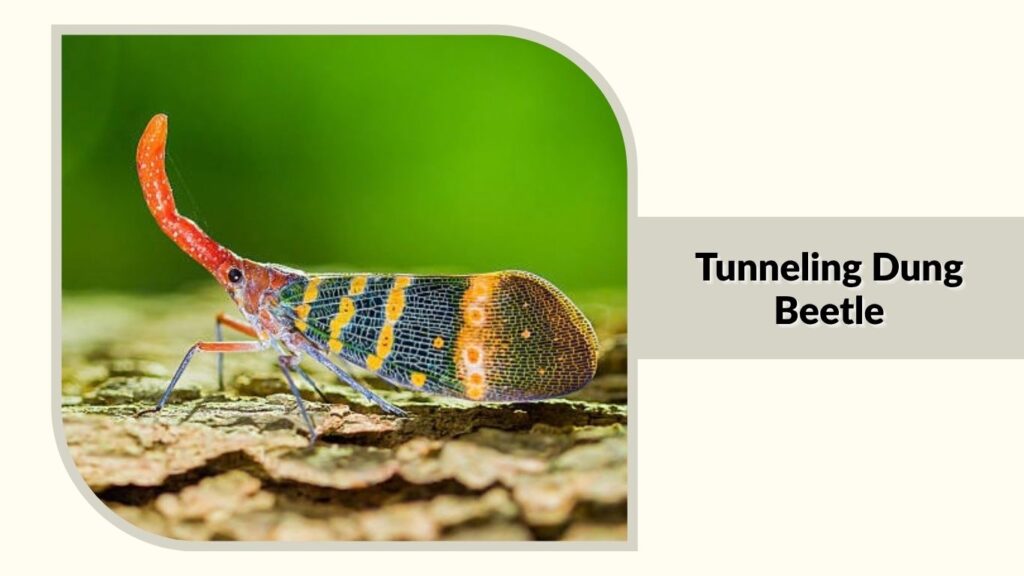
“Tunneling Dung Beetle” is also a behavioral category rather than a single species. Members of Onthophagus are classic examples. Instead of rolling dung away, these beetles excavate tunnels directly beneath a dung pat and move manure downward. This strategy protects their food from surface competitors and provides a stable underground environment where larvae can complete their development.
Identification
- Common type: Tunneling Dung Beetle
- Representative genus: Onthophagus
- Family: Scarabaeidae
- Body: Usually compact and oval
- Legs: Strong, spined digging legs
- Males: Many species develop horns
- Nesting behavior: Tunnels beneath dung
- Ecological type: Paracoprid
Because many species are tunnelers, exact identification requires examination of size, horns, body sculpture, and geographic range.
Habitat and Distribution
Tunneling dung beetles occur across much of the world. They can live in pastures, savannas, forests, farms, and wildlife habitats.
Many Onthophagus species depend heavily on herbivore dung and thrive wherever mammals provide a regular supply of fresh manure.
Behavior and Diet
Adults dig directly underneath dung and transport pieces into the tunnel. Depending on the species, tunnels can extend many centimeters beneath the soil.
The buried manure supplies adults with food and is shaped into brood balls for offspring. Their activity also improves nutrient movement and soil aeration.
Lifespan and Life Cycle
Females create oval brood balls underground and place a single egg inside each prepared chamber. The larva passes through three larval stages while feeding within the brood ball.
It then constructs a pupal chamber, pupates, and becomes an adult underground. After its outer skeleton hardens, the new beetle digs to the surface and searches for fresh dung.
21. Dweller Dung Beetle
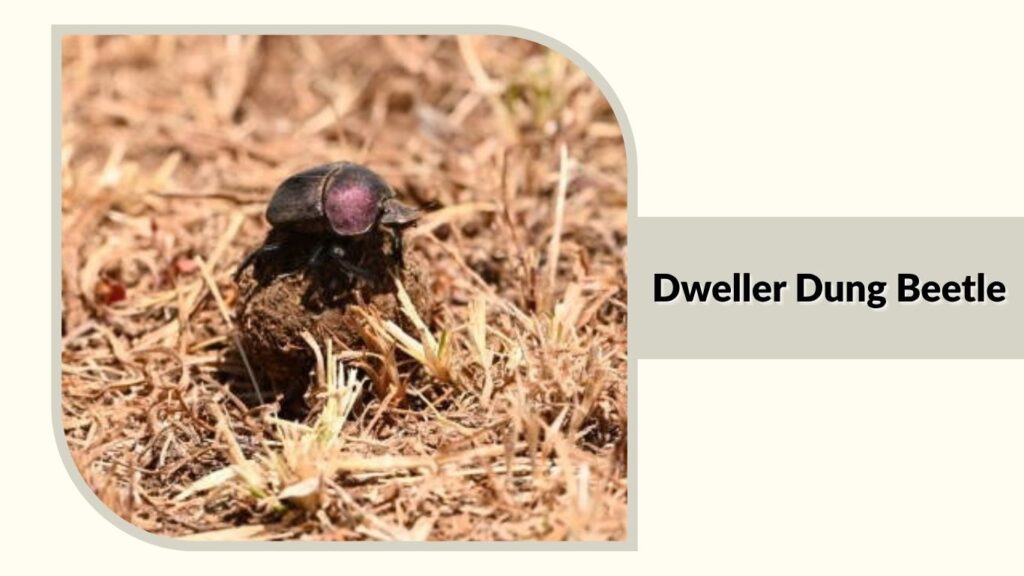
Dweller Dung Beetles represent a behavioral group rather than one individual species. Instead of rolling dung away or tunneling deeply beneath it, dwellers generally remain inside or immediately around a dung pat. Many belong to the Aphodiinae group. Their larvae develop directly within dung, helping break down manure even though they usually bury less material than tunneling or rolling species.
Identification
- Common type: Dweller Dung Beetle
- Typical group: Aphodiinae
- Representative species: Aphodius fimetarius
- Typical size: Usually relatively small
- Body: Oval to elongated
- Horns: Generally absent in many species
- Nesting type: Endocoprid, or dung dweller
- Main feature: Lives and breeds within or close to dung
Aphodius fimetarius, for example, measures about 7–9 mm and has a black head and thorax with reddish-brown wing covers.
Habitat and Distribution
Dung dwellers occur in pastures, farms, grasslands, and wildlife habitats throughout many parts of the world. They are particularly common wherever livestock or wild mammals regularly deposit dung.
Large numbers can sometimes occupy a single dung pat. Species composition varies substantially with climate, soil, livestock type, and geographic region.
Behavior and Diet
Adults enter fresh dung to feed, mate, and lay eggs. Unlike tunnelers, they generally do not carry large quantities deep underground.
Larvae feed directly within the dung, breaking it into smaller pieces and accelerating decomposition. Their activity also makes the dung more accessible to microorganisms and other decomposers.
Lifespan and Life Cycle
Females deposit eggs in fresh dung or its crust. Larvae hatch directly beside their food and remain in the dung while developing.
Depending on species, pupation may occur inside the dung or in nearby soil. Some dweller species can overwinter as eggs, larvae, pupae, or adults.
22. Spindly-Leg Dung Beetle
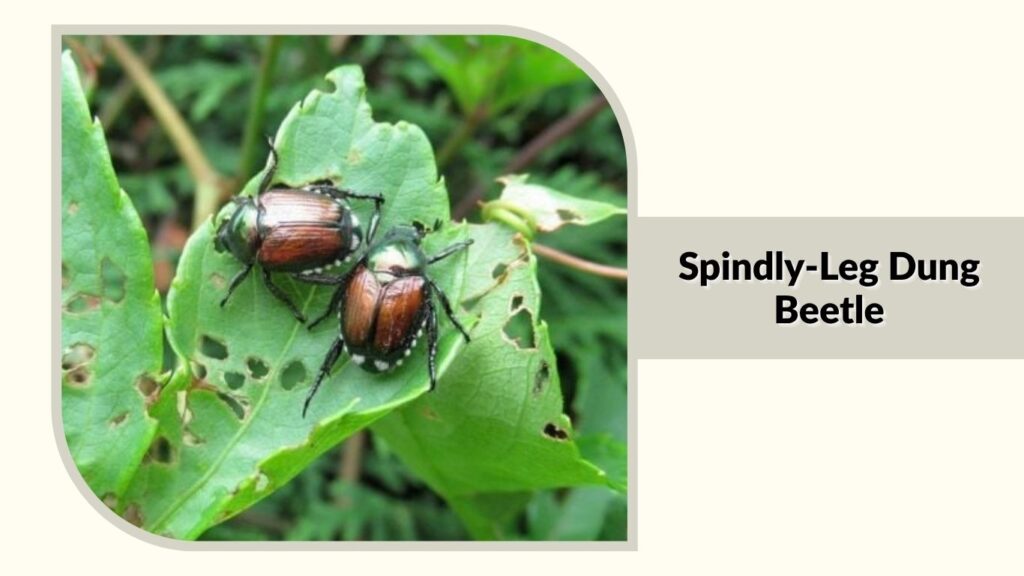
Spindly-Leg Dung Beetles belong mainly to the Sisyphini group and are recognized by their unusually long, thin middle and hind legs. Despite their delicate appearance, they are capable dung-ball rollers. Species such as Sisyphus rubrus use their long legs to manipulate and transport dung balls away from crowded feeding sites before burying them for reproduction.
Identification
- Common name: Spindly-Leg Dung Beetle
- Representative species: Sisyphus rubrus
- Family: Scarabaeidae
- Typical size: Small to medium
- Body: Compact and somewhat compressed
- Legs: Very long and slender
- Horns: Usually absent
- Behavior: Ball roller
Sisyphus rubrus measures roughly 6–8 mm and has a light- to medium-brown body with particularly long legs.
Habitat and Distribution
Members of the spindly-leg group occur across Africa and parts of Europe, Asia, Australia, and other regions. Some species prefer warm open grasslands and savannas.
Sisyphus rubrus originated in southern Africa and was among the dung beetles introduced into Australia to improve livestock-dung breakdown.
Behavior and Diet
These beetles cut portions from fresh dung and form them into small balls. A male and female may work together to transport a brood ball, with one individual pushing while the other assists.
Once away from competitors, the dung is buried or otherwise positioned for reproduction. Studies of Sisyphus species show that pairs can cooperate during brood-ball transport.
Lifespan and Life Cycle
A female lays an egg in a prepared dung ball. The larva consumes the dung after hatching and later pupates.
For Sisyphus rubrus, laboratory information indicates development can take approximately 5–16 weeks, while adults may live about 2–6 months under suitable conditions.
23. African Dung Beetle
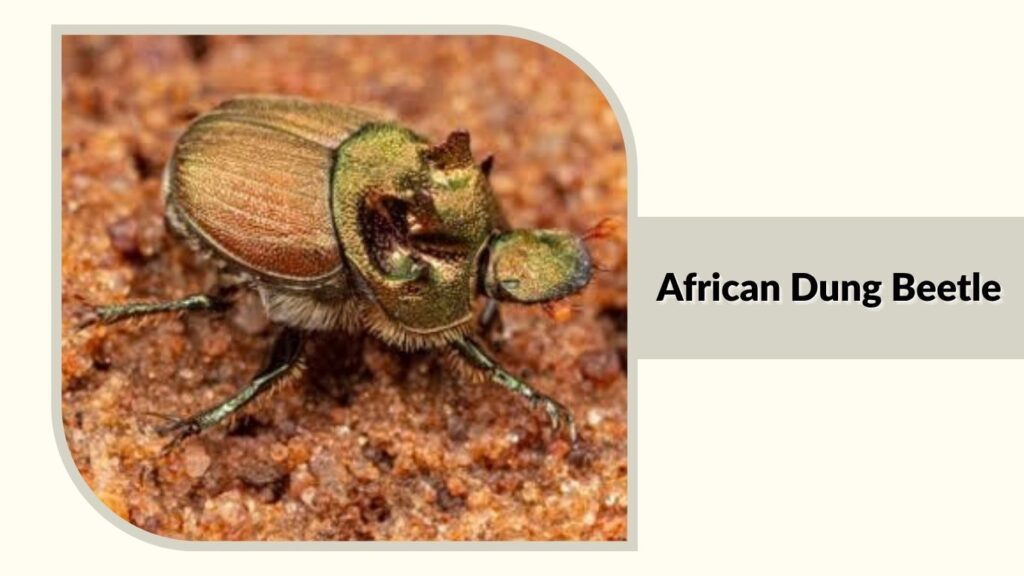
“African Dung Beetle” is a broad name covering hundreds of dung beetle species rather than one particular insect. Africa has an exceptionally diverse dung beetle fauna that includes rollers, tunnelers, and dwellers. Famous examples include species of Scarabaeus, Kheper, Sisyphus, and Heliocopris. Some African species are particularly well known for rolling dung balls and using celestial cues for navigation.
Identification
- Common name: African Dung Beetle
- Family: Primarily Scarabaeidae
- Body: Usually robust and oval
- Color: Black, brown, or metallic
- Legs: Strong and adapted for digging or rolling
- Head: Often broad and shovel-like
- Males: Horns occur in some species
- Feeding: Primarily mammal dung
Because the name includes many species, exact size and coloration vary greatly.
Habitat and Distribution
African dung beetles inhabit savannas, grasslands, forests, deserts, farmland, and wildlife reserves across the continent.
Species diversity is especially high in areas supporting large herbivorous mammals. Elephant, buffalo, antelope, zebra, cattle, and other animals provide important food resources.
Behavior and Diet
Most species feed on mammal dung. Rollers form balls and move them away, while tunnelers bury dung directly beneath the source.
One famous African species, Scarabaeus satyrus, has been shown to use the Milky Way as an orientation cue while rolling dung at night.
Lifespan and Life Cycle
Reproductive behavior differs between species, but females generally associate eggs with a supply of dung.
Larvae develop by consuming the prepared food, pass through several growth stages, and eventually pupate. Depending on species and environmental conditions, development may take from weeks to much longer periods.
24. Giant Dung Beetle
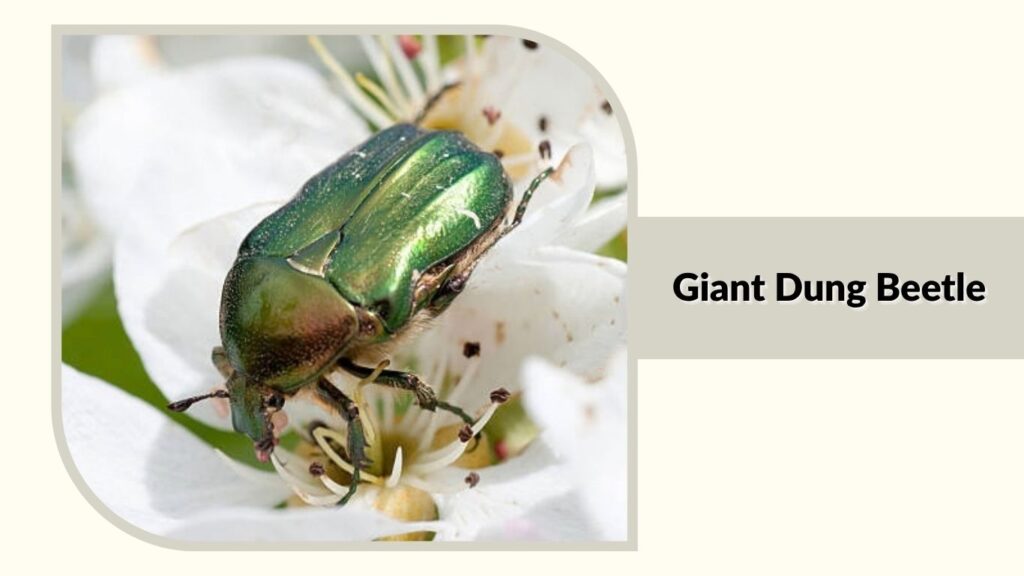
The Giant Dung Beetle is represented by several impressive species of Heliocopris. One especially well-studied example is Heliocopris dilloni, a huge African tunneler associated with elephant dung. In Kenya’s Tsavo region, it has historically been considered an important contributor to elephant-dung removal during rainy periods. Members of this genus include some of the largest dung beetles in the world.
Identification
- Common name: Giant Dung Beetle
- Representative species: Heliocopris dilloni
- Genus: Heliocopris
- Family: Scarabaeidae
- Body: Very large and heavy
- Color: Usually black or dark brown
- Male feature: Horns may occur
- Lifestyle: Powerful tunneler
Some Heliocopris species can approach about 70 mm in length, making them exceptional among dung beetles.
Habitat and Distribution
Most Heliocopris species occur in Africa, with additional species found in southern and Southeast Asia.
H. dilloni has been studied in Tsavo National Park, Kenya, where large mammals—particularly elephants—produce the substantial dung deposits needed by these enormous beetles.
Behavior and Diet
Adults are powerful diggers rather than classic long-distance ball rollers. They move large quantities of dung underground into deep burrows.
Elephant dung is especially important to H. dilloni. Its burial activity can remove substantial amounts of waste from the surface during favorable seasons.
Lifespan and Life Cycle
Females construct subterranean chambers containing dung provisions. Eggs are associated with these stored resources.
Larvae feed underground before pupating. Research suggests deep nesting may protect developing beetles from high surface temperatures and predators.
25. Flightless Dung Beetle
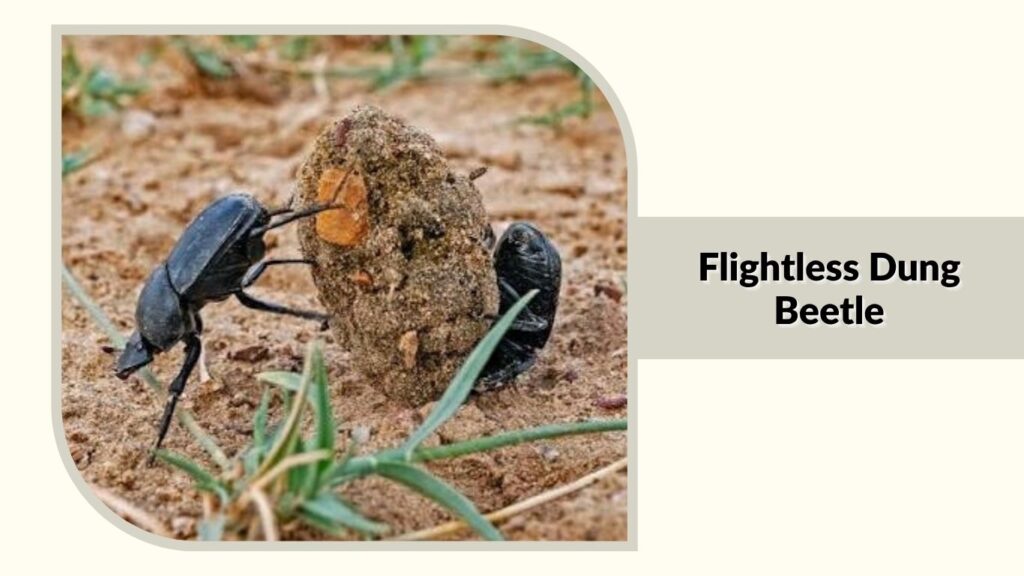
Flightlessness has evolved independently in several dung beetle groups. One species specifically known as the Flightless Dung Beetle is Aulacopris matthewsi from tropical northeastern Australia. Unlike flying species that can rapidly reach fresh dung, this beetle must move across the ground, making it particularly dependent on suitable habitat remaining connected around its limited range.
Identification
- Common name: Flightless Dung Beetle
- Scientific name: Aulacopris matthewsi
- Family: Scarabaeidae
- Flight ability: Flightless
- Movement: Travels along the ground
- Range: Extremely restricted
- Lifestyle: Dung-associated beetle
- Important trait: Reduced dispersal ability
Flightlessness separates it from the majority of dung beetles that can fly quickly to newly deposited dung.
Habitat and Distribution
Aulacopris matthewsi is known from a remarkably small area in northeastern Queensland, Australia.
Australian government information records it from only a few sites along the eastern ridges of Mount Sorrow near Cape Tribulation, with all known sites occurring within Daintree National Park.
Behavior and Diet
Like other dung-associated scarabs, the species depends on organic resources available within its habitat.
Its inability to fly means dispersal between isolated patches is much more difficult. This can make habitat continuity particularly important for maintaining populations.
Lifespan and Life Cycle
Detailed life-cycle information for A. matthewsi is limited compared with extensively studied agricultural dung beetles.
As with other dung beetles, development involves egg, larval, pupal, and adult stages. The immature stages are associated with nutrient-rich organic material, while adults eventually emerge to feed and reproduce.
26. Moonhorn Dung Beetle
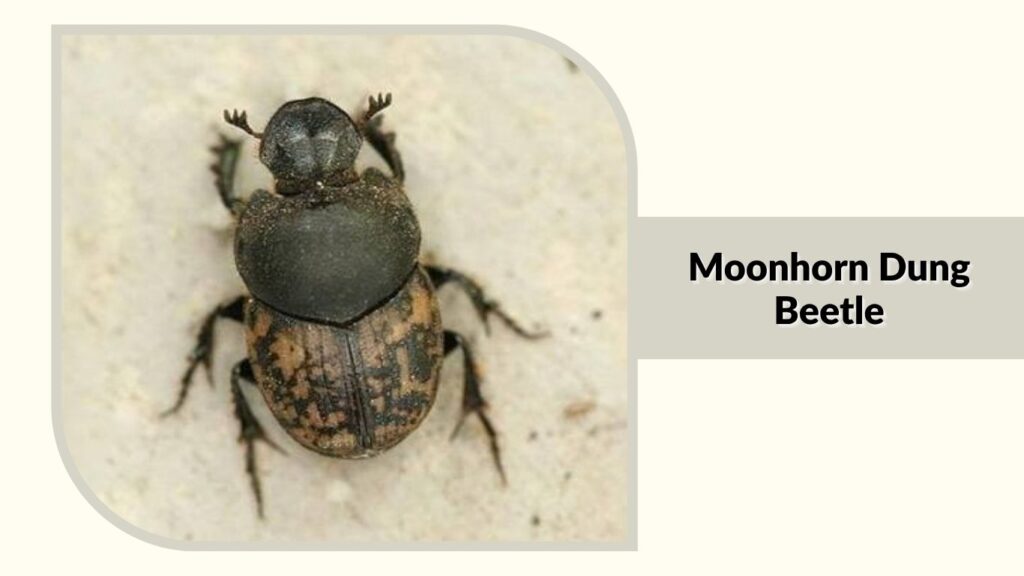
The Moonhorn Dung Beetle is another common name used for Copris lunaris. This means it overlaps with the Horned Dung Beetle already discussed earlier rather than representing a completely different species. It is a large black European tunneler whose males possess a prominent curved horn, producing the rhinoceros-like appearance behind the “moonhorn” name.
Identification
- Common name: Moonhorn Dung Beetle
- Other common name: Horned Dung Beetle
- Scientific name: Copris lunaris
- Family: Scarabaeidae
- Color: Glossy black
- Body: Heavy and rounded
- Male feature: Large curved horn
- Lifestyle: Tunneler
Females lack the dramatic male horn, making the sexes noticeably different in appearance.
Habitat and Distribution
Moonhorn beetles are associated with warm grasslands and grazing landscapes, particularly where soil is relatively easy to excavate.
In northern parts of their range, suitable sandy pasture can be especially important. Nature reserves in southern Sweden, for example, specifically identify the moonhorn beetle as a rare species associated with warm sandy grazing areas.
Behavior and Diet
Adults feed on animal dung and dig tunnels beneath or close to dung pats. They move manure underground, where it becomes both food and breeding material.
This behavior contributes to rapid nutrient recycling and manure decomposition.
Lifespan and Life Cycle
Pairs prepare subterranean brood chambers containing dung. Females construct brood provisions and lay eggs with them.
Larvae develop underground, eating the prepared dung before pupating. Adults eventually emerge and continue the cycle when suitable dung and temperatures are available.
27. Minotaur Beetle
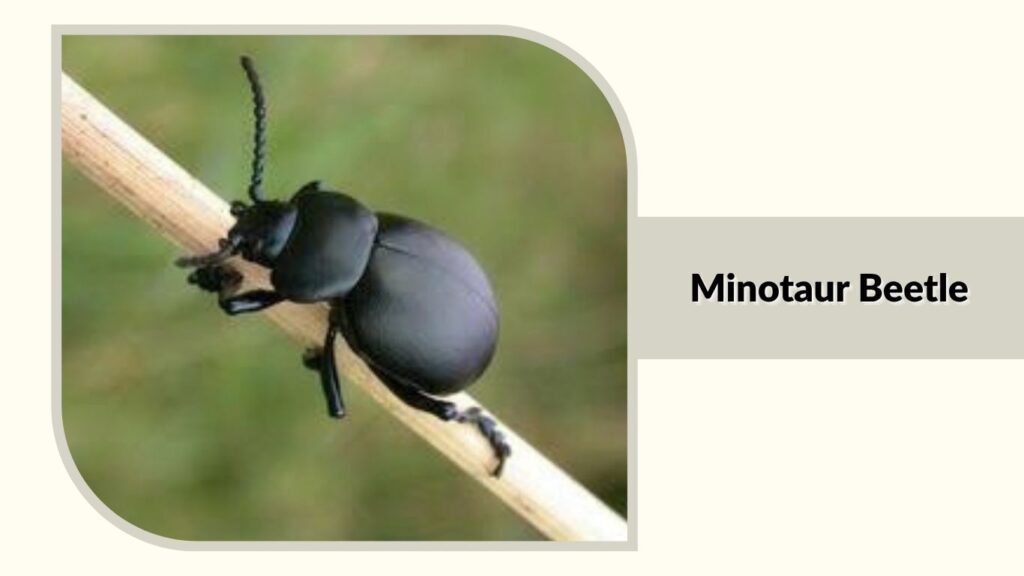
The Minotaur Beetle, Typhaeus typhoeus, is a distinctive European earth-boring dung beetle. Large males possess three spectacular forward-projecting horns, giving the insect its mythological name. Unlike many small dung dwellers, Minotaur Beetles construct exceptionally deep nesting tunnels and drag animal droppings underground for their larvae. They are particularly associated with sandy heathlands and grasslands.
Identification
- Common name: Minotaur Beetle
- Scientific name: Typhaeus typhoeus
- Family: Geotrupidae
- Length: About 15–24 mm
- Color: Glossy black
- Body: Stout and strongly domed
- Male feature: Three prominent horns
- Wing covers: Longitudinal grooves
Females lack the long horns but have pointed projections along the front of the pronotum.
Habitat and Distribution
The Minotaur Beetle is native to Europe. In Britain it occurs mainly in sandy grassland, heathland, moorland, farmland, and some coastal habitats.
It is widespread but relatively scarce across England and Wales. Rabbit-rich sandy areas can provide particularly suitable conditions.
Behavior and Diet
Adults feed on rabbit droppings and other mammal dung, often becoming active at night.
Using powerful front legs, they drag individual droppings into nesting burrows. Males use their horns to defend tunnels against rivals.
Lifespan and Life Cycle
Minotaur Beetles can dig tunnels as deep as approximately 1.5 meters. Adults provision these nests with dung before females lay eggs.
The larvae consume the stored material underground. Adults generally emerge in autumn, breed after a period of feeding, and complete their annual cycle by the following summer.
FAQs
1. What are the three main types of dung beetles?
Dung beetles are commonly divided into rollers, tunnelers, and dwellers based on how they use dung. Rollers move balls away, tunnelers bury dung beneath the deposit, and dwellers live and reproduce within the dung itself.
2. What is the largest type of dung beetle?
Species in the genus Heliocopris are among the world’s largest dung beetles. Some elephant-dung beetles in this group can reach approximately 70 mm in length.
3. Why do dung beetles roll dung balls?
Dung balls can provide food for adult beetles or serve as brood provisions. A female may lay an egg with a prepared ball so the larva has an immediate food supply after hatching.
4. Can dung beetles fly?
Many dung beetles are strong fliers and use flight to locate fresh dung. However, species such as the Cape Flightless Dung Beetle and Aulacopris matthewsi have lost the ability to fly.
5. Why are dung beetles important?
Dung beetles accelerate manure decomposition, recycle nutrients, improve soil conditions, bury organic material, and can reduce opportunities for pest flies to reproduce. Their activity makes them important contributors to grassland, pasture, and wildlife ecosystems.