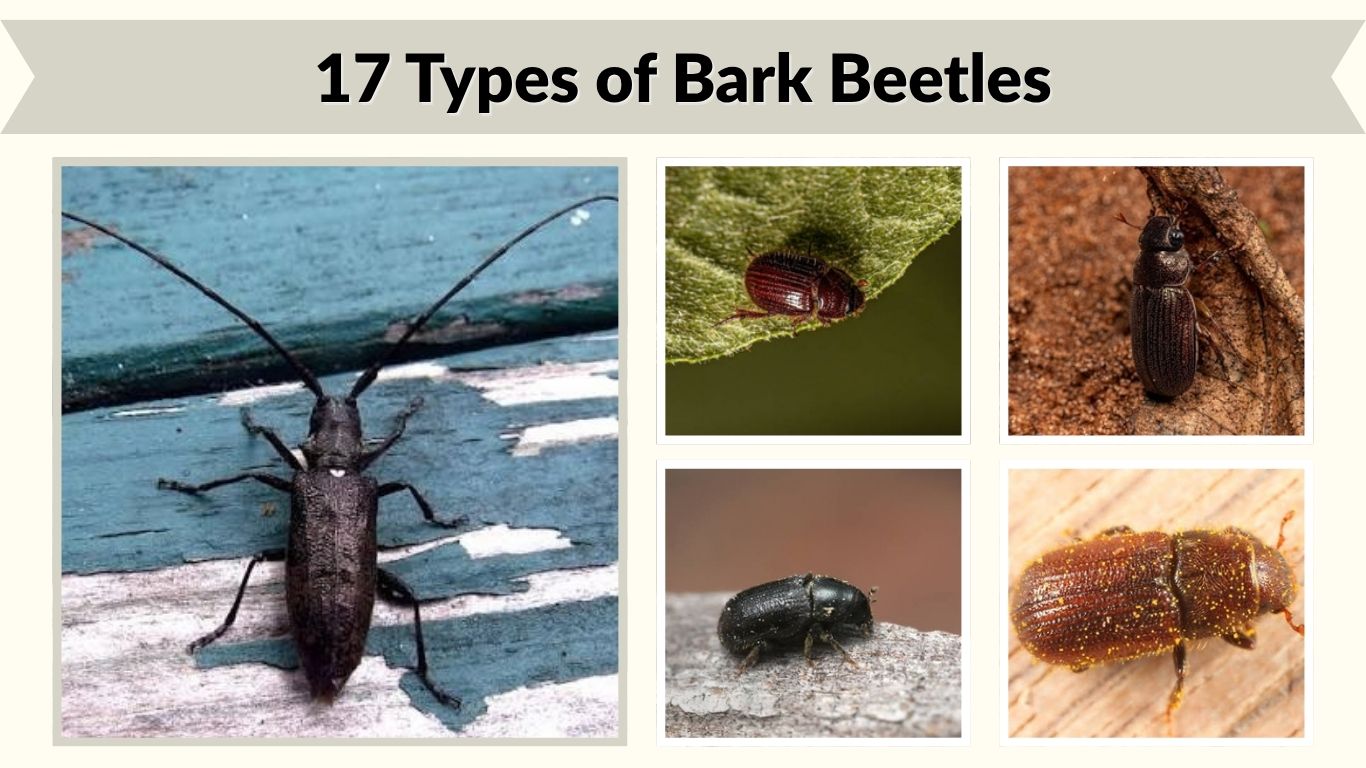
Bark beetles are small insects that live and reproduce beneath the bark of trees, where their feeding can affect vital plant tissues. Some species mainly attack weakened or dying trees, while others can become serious forest pests during large outbreaks. Different bark beetles specialize in pine, spruce, fir, larch, and other conifers. In this guide, you will discover 17 types of bark beetles, along with their identification features, habitat and distribution, behavior, diet, lifespan, and life cycle.
1. Mountain Pine Beetle
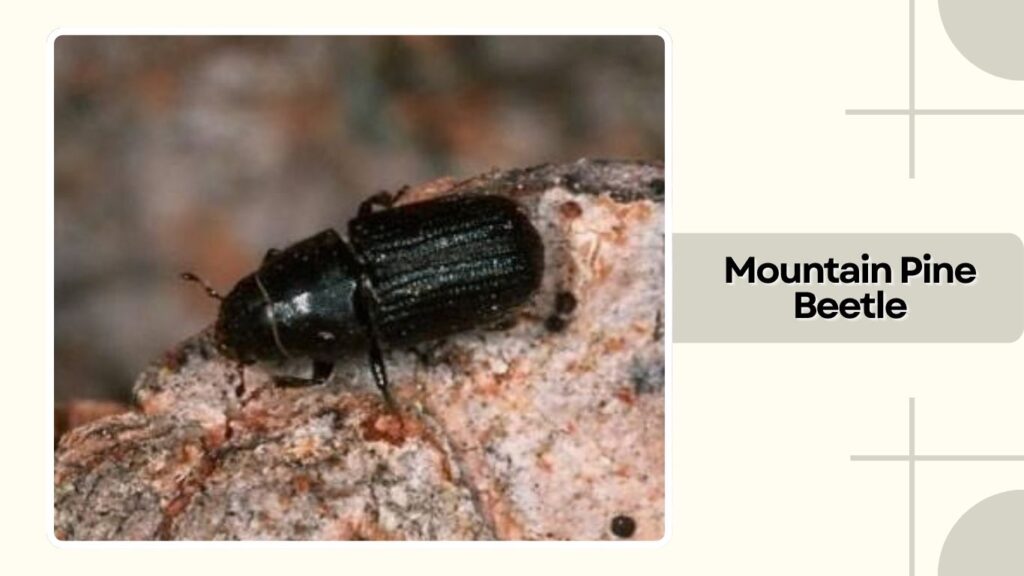
The Mountain Pine Beetle (Dendroctonus ponderosae) is one of the most destructive bark beetles affecting pine forests in western North America. Adults spend most of their lives beneath the bark, where they construct galleries, lay eggs, and introduce blue-stain fungi. Large outbreaks can kill extensive areas of lodgepole, ponderosa, whitebark, limber, and other pine species.
Identification
Mountain Pine Beetles are small and can easily remain unnoticed until symptoms appear on the host tree.
- Adult length: approximately 4–7.5 mm
- Dark brown to black body
- Cylindrical, compact shape
- Small head partly hidden when viewed from above
- Larvae are white, legless grubs
- Larvae have tan or light-brown head capsules
- Brown, pink, or white pitch tubes may appear on attacked trunks
- Fine boring dust can collect in bark crevices or around the tree base
Pitch tubes, galleries beneath the bark, and blue-stained sapwood are important signs of a successful infestation.
Habitat and Distribution
Mountain Pine Beetles occur primarily in western North America, where they inhabit forests containing suitable pine hosts. Lodgepole and ponderosa pine are particularly important hosts, although whitebark, limber, bristlecone, western white, and sugar pine may also be attacked. Outbreaks are more likely where stands contain many mature or large-diameter trees.
Behavior and Diet
Adults emerge from previously infested trees and fly in search of new hosts. Females bore through the bark and release chemical signals that can attract additional beetles, resulting in coordinated mass attacks. Adults and larvae feed within the inner bark, disrupting tissues that transport nutrients. The beetles also introduce blue-stain fungi, which colonize the sapwood and contribute to the decline of successfully attacked trees.
Lifespan and Life Cycle
In many areas, the Mountain Pine Beetle completes one generation per year. Females construct vertical egg galleries beneath the bark and may lay around 75 eggs. After hatching, larvae create feeding tunnels extending away from the main gallery. They usually overwinter beneath the bark, resume development in spring, and pupate during early summer. New adults commonly emerge from mid-summer through early fall and fly to new pine trees, beginning another generation.
2. Southern Pine Beetle
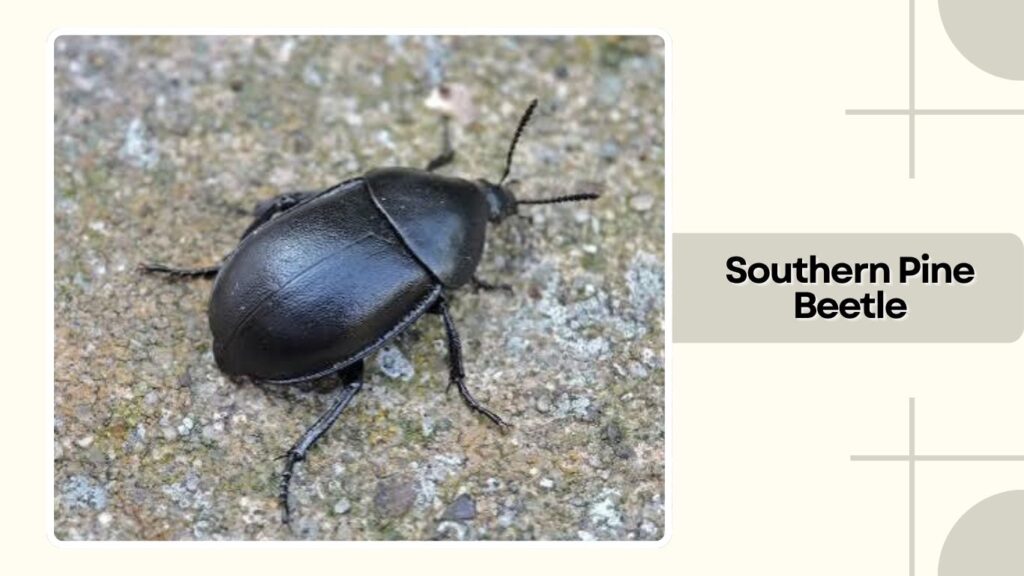
The Southern Pine Beetle (Dendroctonus frontalis) is a small but highly destructive bark beetle that attacks pine trees, particularly across the southeastern United States. During outbreaks, thousands of beetles can coordinate mass attacks that overwhelm a tree’s natural resin defenses. Their feeding beneath the bark and associated fungi disrupt the tree’s vital tissues and can cause rapid mortality.
Identification
- Adult length: approximately 2–4 mm
- Dark reddish-brown to black body
- Cylindrical shape
- Rounded rear end
- Head visible when viewed from above
- Larvae are white and crescent-shaped
- Larvae have reddish-brown heads
- S-shaped galleries beneath the bark
- Small white, yellow, or reddish pitch tubes may appear on attacked trees
The winding S-shaped egg galleries are one of the most useful signs for identifying an established infestation.
Habitat and Distribution
Southern Pine Beetles occur primarily in pine forests of the southeastern and south-central United States, although their range extends farther north in some areas. They attack several southern yellow pines, including loblolly, shortleaf, Virginia, and pitch pine. Infestations often begin in stressed trees before spreading to nearby healthy pines when beetle populations increase.
Behavior and Diet
Females initiate attacks by boring through the bark into the phloem. They release aggregation pheromones that attract additional males and females, allowing large numbers of beetles to attack simultaneously. Adults and larvae feed within the inner bark. Associated fungi also colonize the tissues, helping disrupt the tree’s nutrient and water transport systems.
Lifespan and Life Cycle
Females construct winding galleries and lay eggs along their sides. Larvae hatch and pass through four larval stages before pupating in the outer bark. New adults later emerge and attack additional trees. Development is highly temperature-dependent, and Southern Pine Beetles may produce one to several generations annually, with considerably more generations possible in warmer climates.
3. Western Pine Beetle
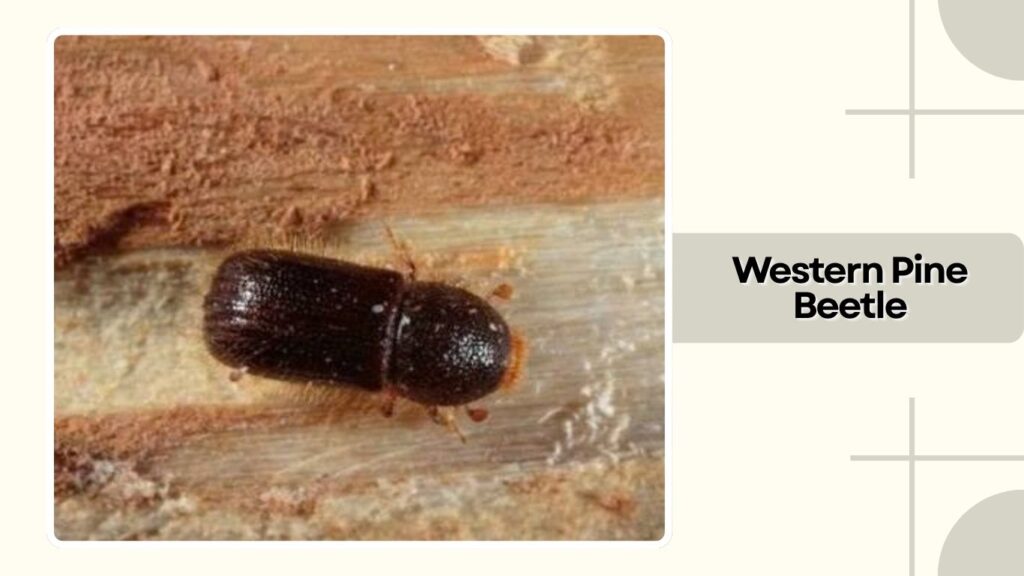
The Western Pine Beetle (Dendroctonus brevicomis) is an important bark beetle of ponderosa pine forests in western North America. Adults and larvae develop beneath the bark, where their galleries interrupt essential tissues. During favorable conditions, populations can increase rapidly and kill groups of mature trees, particularly those weakened by drought, overcrowding, fire injury, or other environmental stress.
Identification
- Adult length: approximately 3–5 mm
- Dark brown to black coloration
- Cylindrical body
- Small, compact appearance
- White, legless larvae
- Winding egg galleries beneath the bark
- Galleries often form a distinctive S-shaped pattern
- Reddish boring dust may collect in bark crevices
- Small pitch tubes can occur on attacked trunks
The long, winding gallery pattern beneath the bark is particularly useful for distinguishing this beetle from several other bark beetles.
Habitat and Distribution
Western Pine Beetles occur throughout much of western North America, especially where ponderosa pine grows. They are prominent in California, Oregon, Washington, and portions of the interior western United States. Mature and large-diameter ponderosa pines are important hosts, although stressed trees are often particularly vulnerable.
Behavior and Diet
Adult females bore into the inner bark and attract other beetles through chemical signals. Large numbers may attack a single tree, overwhelming its resin defenses. Both adults and larvae use the nutrient-rich phloem beneath the bark. Fungi carried by the beetles can colonize sapwood and further interfere with the tree’s physiological processes.
Lifespan and Life Cycle
Western Pine Beetles pass through egg, larval, pupal, and adult stages beneath the bark. Depending on temperature and location, their life cycle may require roughly two to ten months. Populations may produce one to four generations annually, with more generations generally occurring in warmer, lower-elevation areas. Larvae are the most common overwintering stage, although overlapping generations can result in other stages being present during winter.
4. Jeffrey Pine Beetle
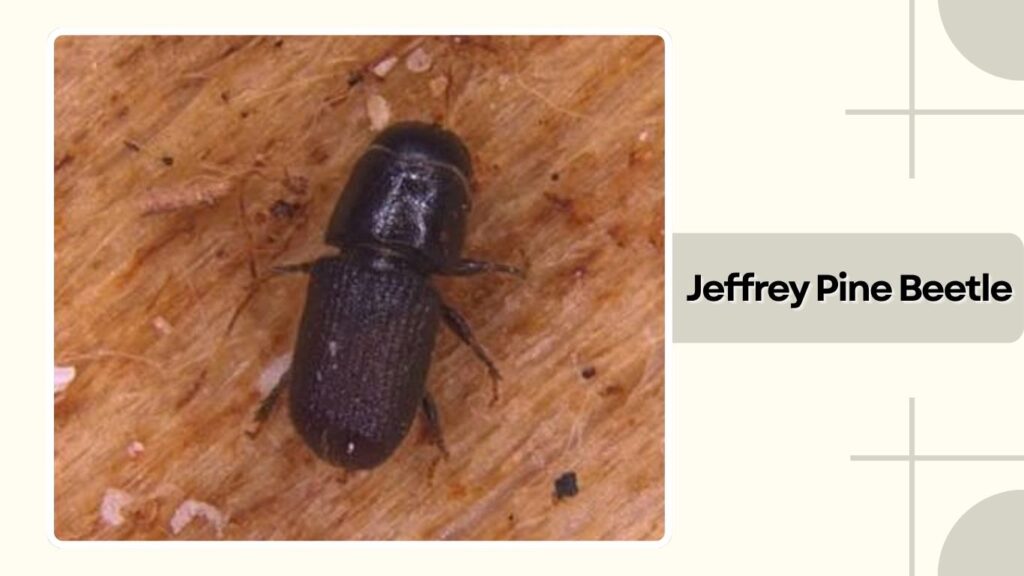
The Jeffrey Pine Beetle (Dendroctonus jeffreyi) is the principal bark beetle pest of Jeffrey pine. It closely resembles the Mountain Pine Beetle but is generally larger and highly specialized on Jeffrey pine. Infestations are particularly important in mature forests, where drought, disease, fire injury, or other stresses may increase the vulnerability of individual trees.
Identification
- Adult length: approximately 6–8 mm
- Blackish or very dark body
- Cylindrical shape
- Larger than the similar Mountain Pine Beetle
- White, legless larvae
- Long vertical egg galleries
- Egg gallery often has a slight J-shaped curve near the bottom
- Larval galleries extend sideways from the main gallery
- Reddish boring dust may accumulate in bark crevices
Blue-stained sapwood may also be present because attacking beetles can introduce associated fungi.
Habitat and Distribution
Jeffrey Pine Beetles occur essentially throughout the natural range of Jeffrey pine, including parts of California, southern Oregon, western Nevada, and nearby regions. They are particularly important in the Sierra Nevada and other western mountain ranges where mature Jeffrey pine forms a major component of the forest.
Behavior and Diet
Adults usually attack the trunk, particularly the middle and lower portions. Females construct long vertical galleries under the bark and lay eggs along the gallery walls. Larvae feed outward through the phloem. Large infestations can kill individual trees or groups of trees, although outbreaks are generally less extensive than those of some other major bark beetles.
Lifespan and Life Cycle
Eggs hatch beneath the bark, and larvae feed in galleries extending at right angles from the parent tunnel. After passing through their larval stages, they pupate within the inner bark. Adults later emerge through small exit holes and search for new Jeffrey pines. Development generally follows a yearly seasonal pattern, although timing can vary with elevation and temperature.
5. Douglas-fir Beetle
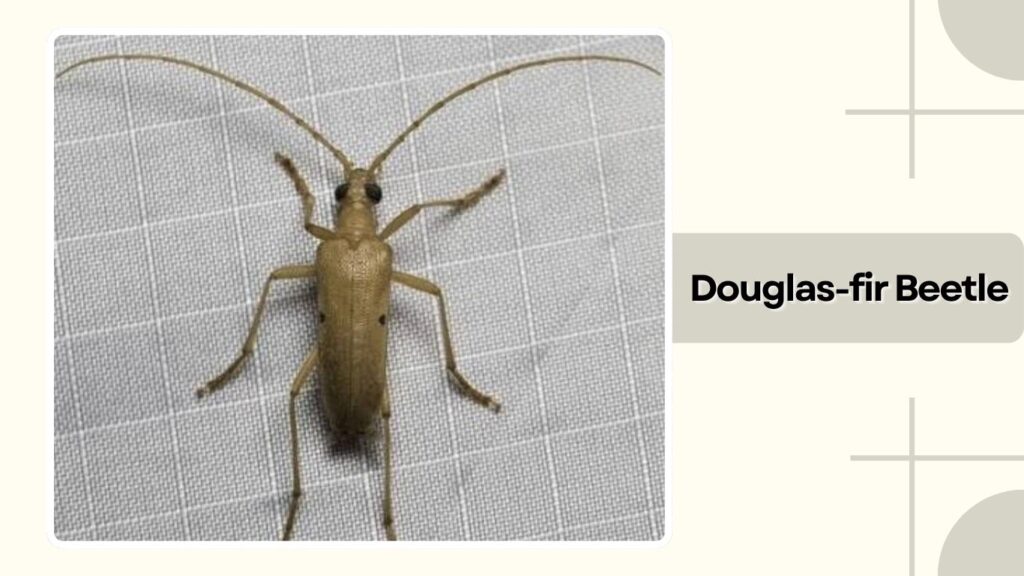
The Douglas-fir Beetle (Dendroctonus pseudotsugae) is an important native bark beetle that attacks Douglas-fir trees. Populations commonly increase after windstorms, wildfire, drought, or other disturbances that create weakened or recently fallen trees. When beetle numbers become sufficiently high, they can attack and kill standing trees over extensive areas.
Identification
- Adult length: about 6 mm
- Cylindrical body
- Black head and thorax
- Reddish-brown wing covers
- Eggs are white and approximately 1 mm long
- Larvae are white and legless
- Larvae have light-brown heads
- Reddish-orange boring dust may appear in bark crevices
- Vertical galleries occur beneath the bark
Pitch tubes are usually not prominent, although clear resin may sometimes stream down the trunk.
Habitat and Distribution
Douglas-fir Beetles occur throughout much of the western North American range of Douglas-fir. They are common in mountain forests where mature Douglas-fir trees are abundant. Windthrown trees, fire-scorched trees, root-diseased trees, and other weakened hosts are especially attractive breeding sites.
Behavior and Diet
Females bore through the bark and construct vertical galleries within the phloem. Adults and larvae feed on inner-bark tissues, disrupting nutrient movement. The beetles may also introduce fungi, yeasts, and associated microorganisms. When populations are low, they mostly colonize weakened trees; during outbreaks, healthier standing Douglas-fir may also be attacked.
Lifespan and Life Cycle
Douglas-fir Beetles generally complete one generation per year. Adults commonly emerge in mid- to late spring when temperatures become warm enough for flight. Females construct egg galleries about 13–30 cm long and lay groups of eggs along alternating sides. Eggs hatch within roughly one to three weeks, after which larvae mine outward and eventually form pupal chambers. The beetles can overwinter as larvae or adults.
6. Spruce Beetle
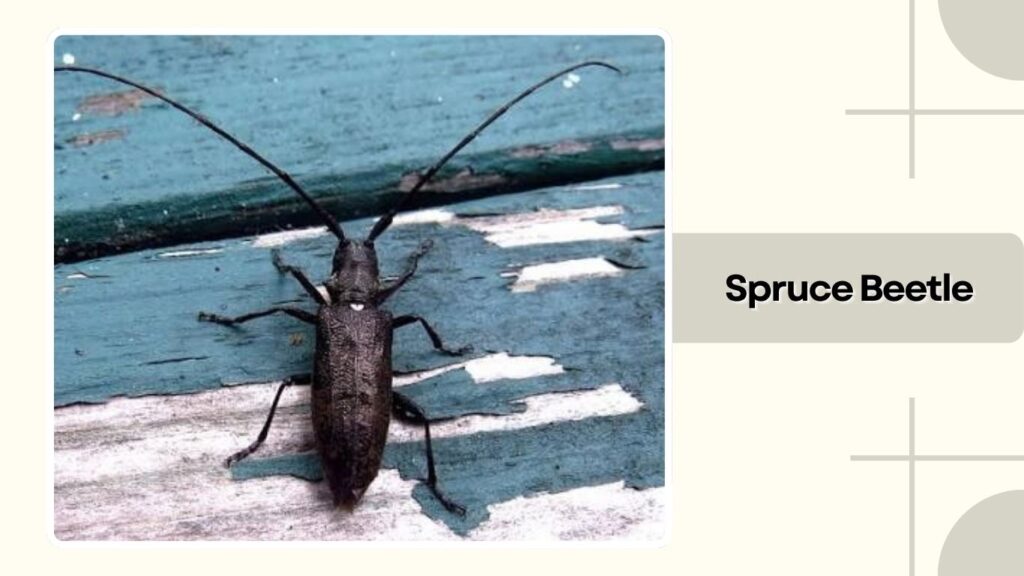
The Spruce Beetle (Dendroctonus rufipennis) is one of the most damaging bark beetles of mature spruce forests in North America. It commonly develops in windthrown, weakened, or overmature spruce, but populations can build until healthy standing trees are also attacked. Large outbreaks have caused extensive spruce mortality, particularly following storms, logging disturbances, and periods of unusually warm weather.
Identification
- Adult length: approximately 4–7 mm
- Cylindrical body
- Reddish-brown to almost black coloration
- Young adults may appear lighter brown
- White, legless larvae
- Brown head capsule on larvae
- Fine boring dust may occur around attacked bark
- Egg and larval galleries form beneath the bark
- Exit holes may appear after new adults emerge
Fading needles and loose bark can become visible as heavily infested trees decline.
Habitat and Distribution
Spruce Beetles occur throughout spruce forests across North America, including Alaska, Canada, the Rocky Mountains, and other western and northern regions. They attack several spruce species, with mature, large-diameter trees often providing particularly suitable habitat.
Behavior and Diet
Adults initially favor recently fallen, windthrown, weakened, or overmature spruce. Females tunnel through the bark and establish egg galleries. Newly hatched larvae may initially feed together before forming separate galleries as they mature. When beetle populations become large enough, mass attacks can overcome the defenses of living spruce trees.
Lifespan and Life Cycle
Spruce Beetles usually require about two years to complete one generation, although warmer conditions can allow development to finish within a single year. Larvae feed beneath the bark and later pupate at the ends of their galleries. Depending on developmental timing, they may overwinter as larvae or newly formed adults. Rising temperatures can shorten development and contribute to faster population growth.
7. Eastern Larch Beetle
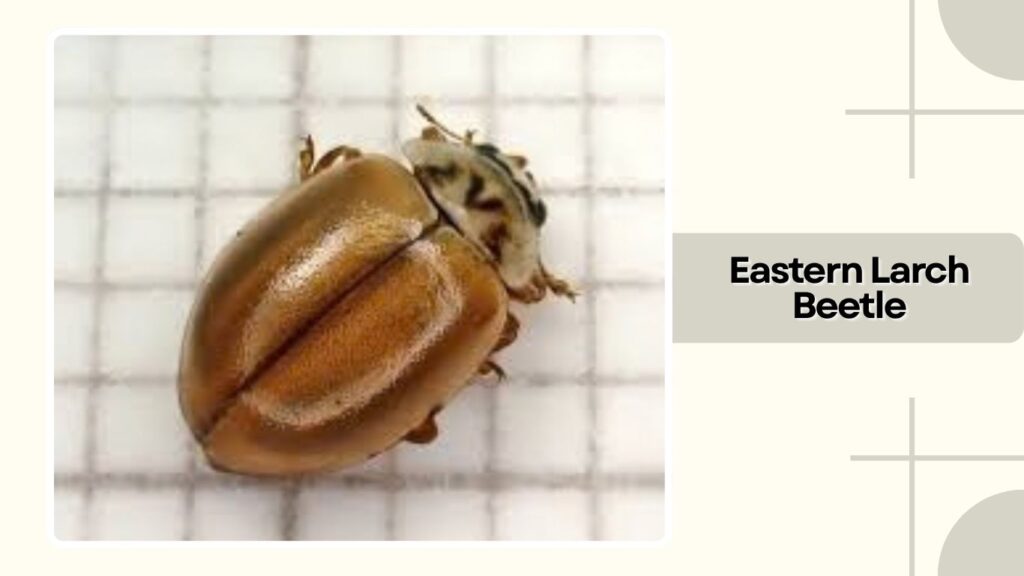
The Eastern Larch Beetle (Dendroctonus simplex) is a native North American bark beetle that primarily attacks tamarack, also called eastern larch. Historically associated mostly with weakened or dying trees, this species can cause significant mortality when populations increase. Adults and larvae tunnel beneath the bark, damaging the phloem and interfering with the movement of nutrients through the tree.
Identification
- Adult length: approximately 3.5–5 mm
- Light brown to nearly black body
- Reddish-brown wing covers
- Cylindrical body shape
- Larvae are white and legless
- Larvae have light-brown to orange head capsules
- Vertical egg galleries beneath the bark
- Numerous larval galleries extend sideways from the main tunnel
- Yellowing foliage may develop during summer
Woodpeckers frequently remove outer bark from infested trees, sometimes giving affected trunks a reddish appearance.
Habitat and Distribution
Eastern Larch Beetles occur throughout much of the natural range of tamarack across northern North America, including Canada, Alaska, the Great Lakes region, and northern portions of the United States. Tamarack growing in wet forests, peatlands, and cold northern environments provides its principal habitat.
Behavior and Diet
Adult females bore through the bark and begin vertical galleries in the nutrient-rich phloem. Chemical signals attract additional beetles to suitable hosts. Larvae hatch and feed beneath the bark, producing tunnels that extend away from the parent gallery. Heavy colonization disrupts the tree’s vascular tissues and can eventually kill the host.
Lifespan and Life Cycle
The species generally produces one generation per year, although overwintered adults may establish two or sometimes three separate broods during a season. Adults are the principal overwintering stage. They become active in spring, reproduce beneath the bark, and produce offspring that can reach adulthood before winter.
8. Red Turpentine Beetle
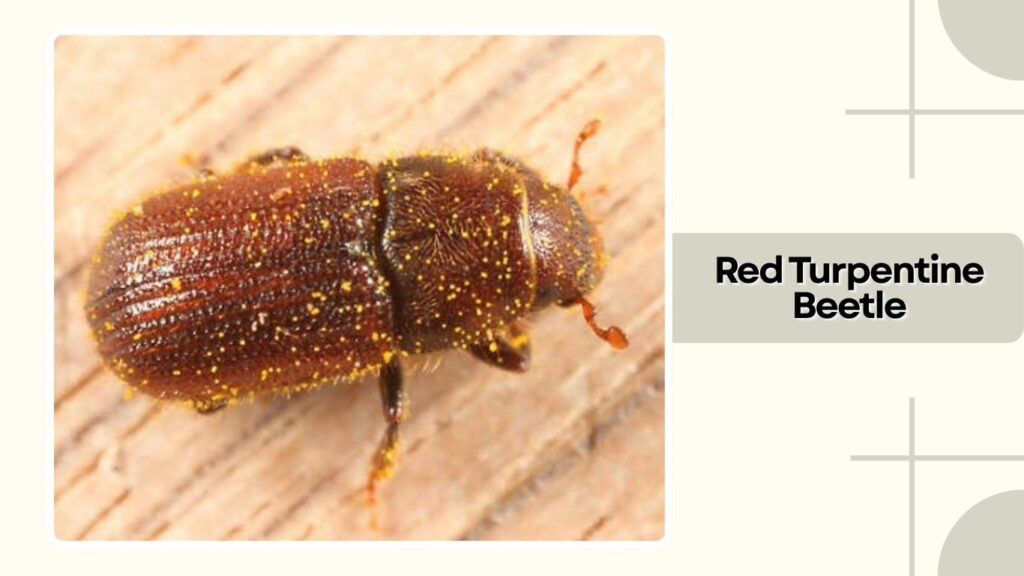
The Red Turpentine Beetle (Dendroctonus valens) is one of the largest and most widely distributed bark beetles in North America. It primarily attacks pine trees that have been weakened by fire, drought, logging, construction damage, disease, or other stresses. Infestations are usually concentrated around the lower trunk, root collar, exposed roots, or recently cut stumps.
Identification
- Adult length: approximately 6–10 mm
- Reddish-brown coloration
- Cylindrical, robust body
- Rounded rear end
- Clubbed antennae
- Larvae are creamy white and legless
- Large reddish or pinkish pitch tubes
- Attacks concentrated near the tree base
- Broad, fan-shaped larval galleries beneath bark
Its relatively large body and large pitch tubes around the lower trunk are particularly useful identification clues.
Habitat and Distribution
Red Turpentine Beetles have a remarkably broad native range across North and Central America. They occur from northern Canada southward through much of the United States and into Mexico and Central America. Nearly any pine species within their range can serve as a host, while a few other conifers may occasionally be attacked.
Behavior and Diet
Adults are strongly attracted to odors released by injured pine tissue and resin. Females enter the inner bark near the base of a tree and produce galleries where eggs are deposited. After hatching, larvae feed together rather than constructing completely separate tunnels. This communal feeding produces a broad, irregular gallery beneath the bark.
Lifespan and Life Cycle
Most adult flight and attack activity occurs from spring into early summer. Eggs generally hatch within one to three weeks during warm weather. Larvae feed collectively and expand their galleries as they grow before forming pupal chambers. Depending on climate and season, the beetle may overwinter as larvae, newly developed adults, or parent adults.
9. Black Turpentine Beetle
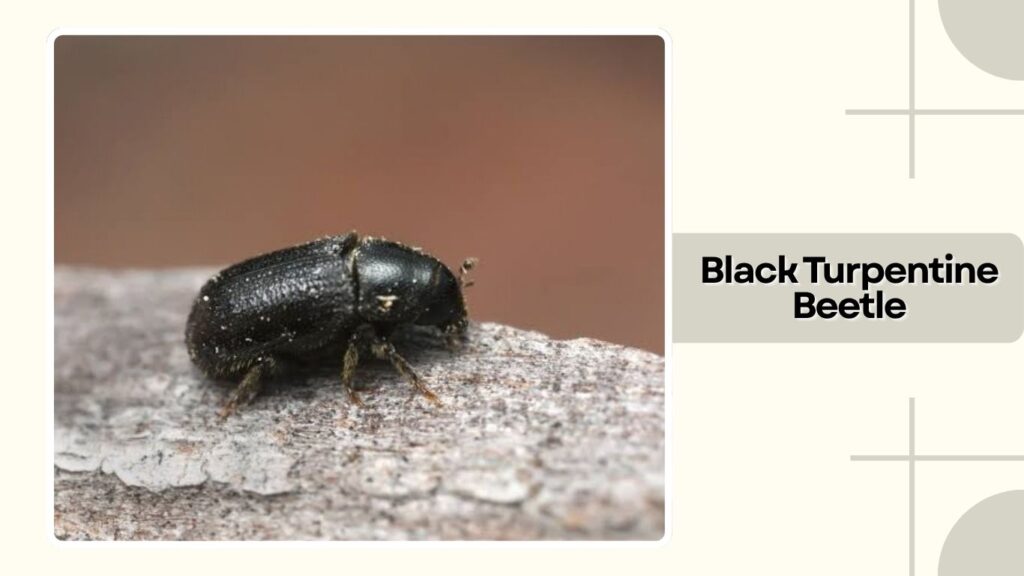
The Black Turpentine Beetle (Dendroctonus terebrans) is the largest native pine bark beetle commonly encountered in the southeastern United States. It usually colonizes stressed, damaged, or recently cut pines rather than vigorous trees. Attacks are concentrated around the lower portion of the trunk and large roots, where adults and larvae feed on phloem beneath the bark.
Identification
- Adult length: approximately 5–8 mm
- Dark reddish-brown to black coloration
- Cylindrical body
- Convex head
- Rounded rear end
- Larvae are creamy white and legless
- Larvae may reach approximately 12 mm
- Large resinous pitch tubes near the tree base
- Fan-shaped communal larval feeding areas
The large pitch tubes can reach several centimeters across and are generally concentrated on the lower trunk.
Habitat and Distribution
Black Turpentine Beetles occur throughout much of the eastern United States, from parts of New England south to Florida and westward toward Texas and Missouri. They attack many pine species, including loblolly, slash, shortleaf, pitch, and eastern white pine. Recently logged, burned, storm-damaged, or mechanically injured stands can be particularly attractive.
Behavior and Diet
Females generally attack the lower one to two meters of a tree and bore into the phloem. They construct galleries that often extend downward, sometimes below ground level. A female may deposit around 100 eggs. After hatching, the larvae feed side by side, creating a large communal feeding chamber rather than individual tunnels.
Lifespan and Life Cycle
Eggs typically hatch after about 10–14 days. Larvae feed communally before separating to construct pupal cells. New adults later emerge through the bark and search for suitable hosts. In warm southern areas, populations can have up to three overlapping generations per year, while development is slower toward the northern portion of their range.
10. Western Balsam Bark Beetle
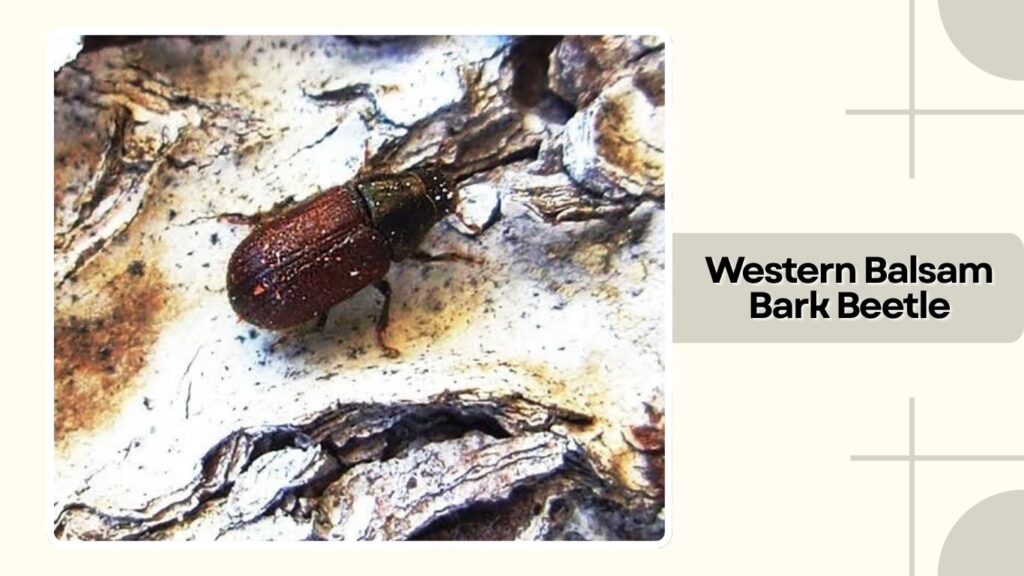
The Western Balsam Bark Beetle (Dryocoetes confusus) is an important bark beetle of high-elevation subalpine fir forests in western North America. Although individual outbreaks may appear scattered, repeated attacks can cause substantial cumulative tree mortality. Mature and weakened subalpine firs are particularly vulnerable, making this beetle an important natural disturbance agent in mountain forests.
Identification
- Adult length: approximately 3.4–4.3 mm
- Dark brown body
- Cylindrical shape
- Erect reddish-brown hairs
- Females have dense hairs on the front of the head
- Larvae are yellowish-white
- Larvae are curved and legless
- Fine boring dust and frass may collect in bark cracks
- Galleries radiate from a central chamber
Adults are small enough to be easily overlooked, so boring material and fading foliage are often more noticeable than the beetles themselves.
Habitat and Distribution
Western Balsam Bark Beetles occur through the mountainous regions of western North America, from British Columbia and Alberta south toward Arizona and New Mexico. Their primary host is subalpine fir, although other firs and occasionally some spruces can also be colonized.
Behavior and Diet
Adults bore through the bark and feed within the phloem. Males can participate in attracting other beetles to suitable hosts. The species often attacks older, slow-growing, or otherwise stressed subalpine fir. Adults may enter trees through bark surfaces, branch stubs, or favorable portions of fallen logs.
Lifespan and Life Cycle
The Western Balsam Bark Beetle normally requires about two years to complete its life cycle. Adults begin emerging around late May or June, with peak flight commonly occurring during early to mid-summer. Under particularly favorable climatic conditions, development may occasionally be completed within a single year.
11. Fir Engraver
The Fir Engraver (Scolytus ventralis) is an important bark beetle of true firs in western North America. It commonly attacks trees weakened by drought, root disease, defoliation, fire, or other stresses. Unlike some bark beetles that always kill the entire host, Fir Engravers can also cause partial damage, including dead branches, top kill, and localized patches of dead cambium.
Identification
- Adult length: approximately 4 mm
- Shiny black body
- Cylindrical appearance
- Distinctly concave rear portion of abdomen
- Rear may appear “sawed off” from the side
- Larvae are white and legless
- Larvae have brown heads
- Horizontal egg galleries beneath bark
- Larval galleries run vertically away from egg galleries
The gallery pattern is one of the best identification signs. Egg galleries usually run across the trunk and deeply score the sapwood.
Habitat and Distribution
Fir Engravers occur broadly across western North America, including British Columbia, the Pacific Northwest, California, the Rocky Mountains, Arizona, and New Mexico. Important hosts include white fir, grand fir, red fir, and other true firs. Trees suffering from drought or root disease are especially susceptible.
Behavior and Diet
Females bore into the cambial region and create a two-branched horizontal egg gallery. Larvae hatch and tunnel vertically through the phloem. The beetles also introduce a brown-stain fungus into the tree, which affects sapwood around the gallery and contributes to successful brood development.
Lifespan and Life Cycle
Fir Engravers usually complete one generation per year in much of their range. Adult flight generally occurs from June through August or September. Larvae commonly overwinter beneath the bark, resume feeding during spring, and then pupate. Pupation lasts roughly one to two weeks before new adults develop and later emerge to attack additional fir trees.
12. Pine Engraver
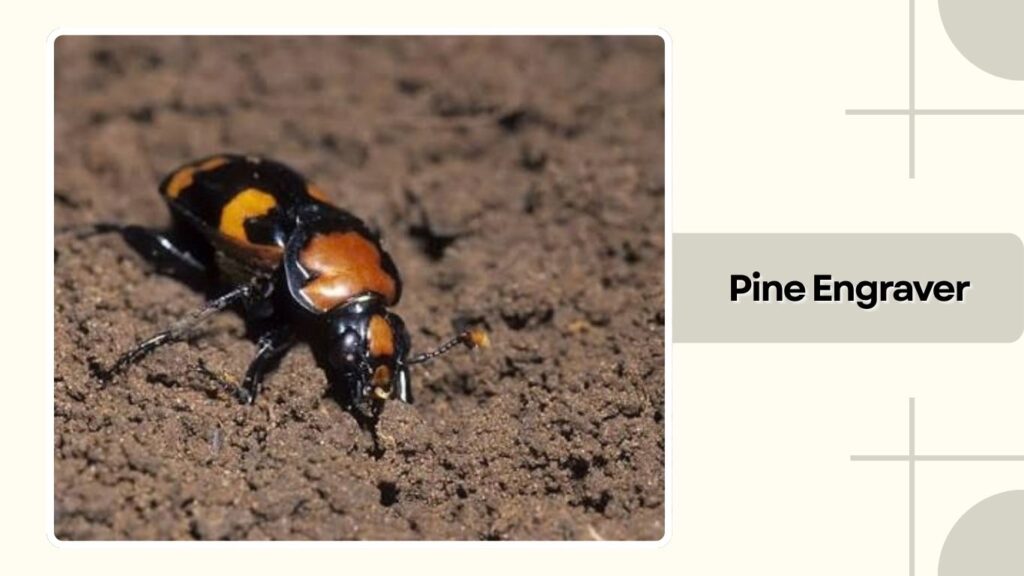
The Pine Engraver (Ips pini) is a widespread bark beetle that attacks many pine species across North America. It normally breeds in recently fallen trees, logging slash, broken branches, and weakened pines. However, drought or an abundance of fresh breeding material can allow populations to increase rapidly, resulting in attacks on standing trees.
Identification
- Adult length: approximately 3–5 mm
- Cylindrical body
- Reddish-brown to nearly black coloration
- Distinct depression at the rear of the wing covers
- Four spines along each side of the rear depression
- Larvae are small, white, and legless
- Larvae have brownish head capsules
- Y-, X-, H-, or star-shaped galleries beneath bark
- Fine reddish-brown boring dust around entrance holes
The spines at the rear of the adult are especially useful for distinguishing Ips engravers from Dendroctonus bark beetles, which have more smoothly rounded hind ends.
Habitat and Distribution
Pine Engravers are widely distributed across North America and inhabit forests containing suitable pine hosts. They frequently colonize freshly cut pine logs, storm-damaged branches, thinning debris, and the thin-barked portions of stressed trees. During outbreaks, groups of small or medium-sized pines can be killed.
Behavior and Diet
Male beetles usually begin an attack by boring into suitable bark and creating a central mating chamber. Pheromones attract females, and one male may mate with several females. Each female constructs an egg gallery extending from the central chamber. Larvae hatch and feed through the nutrient-rich phloem, creating tunnels that radiate away from the parent galleries.
Lifespan and Life Cycle
Adults emerge in spring once temperatures become sufficiently warm. The first generation can require roughly 40–55 days to develop. Depending on climate, two or more generations may occur during one year. Adults commonly overwinter beneath bark, within slash, or in forest litter and become active again the following spring.
13. Pinyon Ips
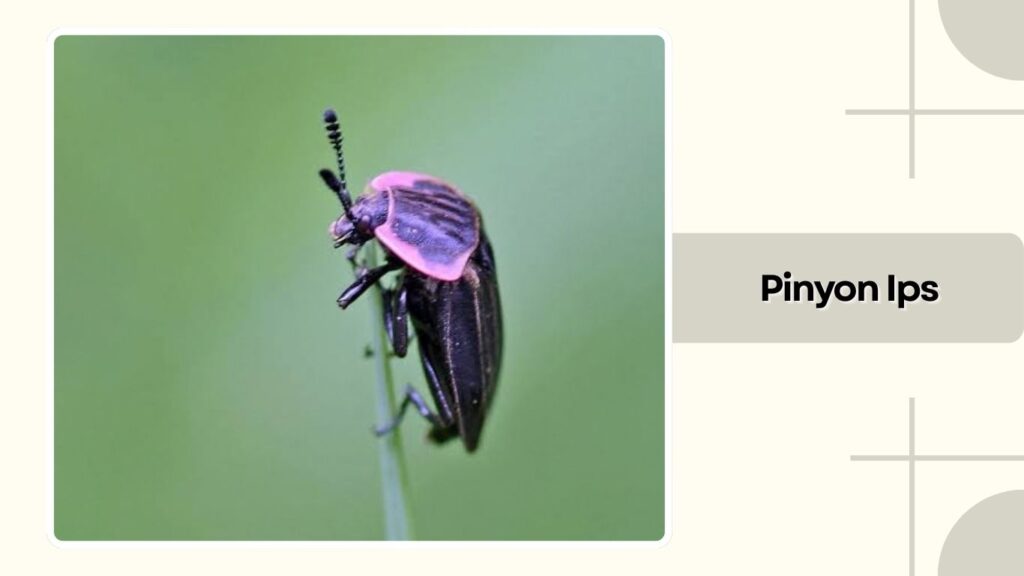
The Pinyon Ips (Ips confusus) is an important bark beetle associated primarily with pinyon pines in the western United States. Although it often colonizes weakened trees and recently cut material, severe drought can create favorable conditions for population growth. Large outbreaks may then contribute to extensive mortality of drought-stressed pinyon pine woodlands.
Identification
- Adult length: generally under 4.5 mm
- Cylindrical body
- Reddish-brown when young
- Dark brown to black when mature
- Five spines on each side of the rear wing-cover depression
- Third spine is generally rounded or blunt
- Clubbed antennae
- White, legless larvae
- Multi-branched galleries beneath bark
Close examination of the rear spines may be necessary because the Pinyon Ips strongly resembles several related Ips species.
Habitat and Distribution
Pinyon Ips occurs mainly in western North America, where pinyon-juniper woodlands provide abundant hosts. It is particularly important in areas of Arizona, New Mexico, Utah, Colorado, Nevada, and surrounding regions. Both singleleaf and two-needle pinyons can be attacked.
Behavior and Diet
Adults commonly colonize weakened pinyons, broken branches, recently cut wood, and fresh thinning slash. Populations can build rapidly in this material before moving into living trees. Males initiate galleries and attract females with aggregation pheromones. Larvae then feed beneath the bark, disrupting the tree’s phloem.
Lifespan and Life Cycle
The Pinyon Ips can produce multiple generations within a year, with development strongly controlled by temperature. Recent USDA Forest Service research found that warmer conditions can shorten generation time, potentially allowing additional generations during favorable years. Adults may emerge from slash piles and attack nearby living trees, which is why the timing of woodland thinning can influence infestation risk.
14. California Fivespined Ips
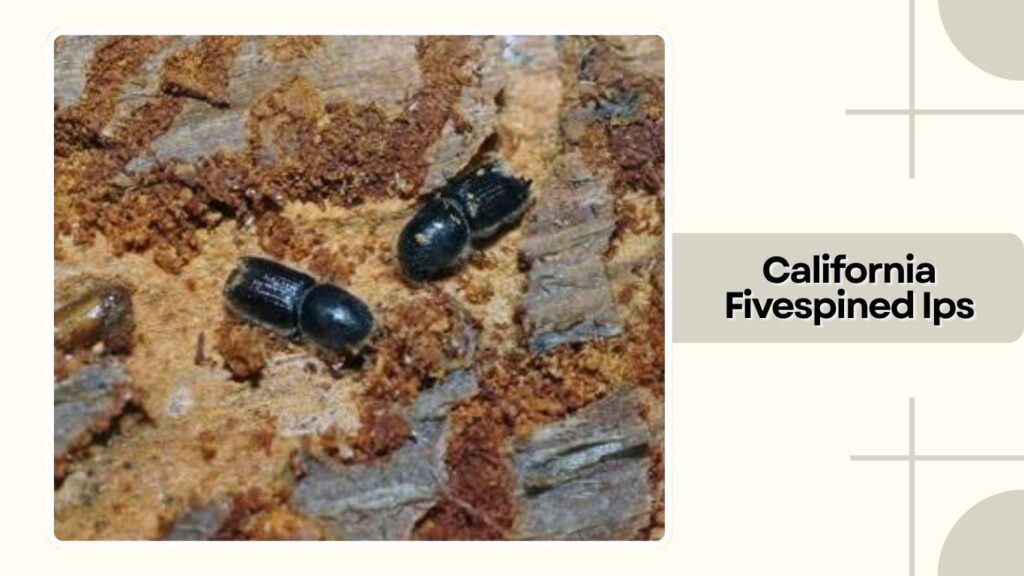
The California Fivespined Ips (Ips paraconfusus) is a western pine engraver known for the five small spines found along each side of the depression at the rear of its wing covers. It commonly develops in weakened pines and fresh woody debris. During drought or after disturbances that create abundant slash, populations can increase enough to attack standing trees.
Identification
- Adult length: less than 4.5 mm
- Cylindrical body
- Dark reddish-brown to black coloration
- Five spines on each side of the rear depression
- Males have a relatively pointed third spine
- Females have a less sharply pointed third spine
- Larvae are white and legless
- Larvae have brown heads
- Y-, H-, or star-shaped gallery patterns
Its five rear spines distinguish it from the Pine Engraver, Ips pini, which typically has four on each side.
Habitat and Distribution
California Fivespined Ips occurs primarily in western North America, particularly California, Oregon, and surrounding areas. It attacks several pine species and commonly uses saplings, pole-sized trees, thin-barked upper trunks, freshly cut logs, and logging debris.
Behavior and Diet
Males normally initiate attacks and excavate a central nuptial chamber beneath the bark. A male may attract and mate with three or four females. Each female creates her own egg gallery extending outward from the chamber. Larvae feed in the phloem before constructing pupal cells.
Lifespan and Life Cycle
In Oregon and Washington, the species may produce two to four generations per year, depending on climate. Adults can emerge approximately six to eight weeks after an attack. Development may repeat several times during warm seasons. Mature larvae, pupae, and adults can survive winter beneath bark before development resumes the following year.
15. Eastern Fivespined Ips
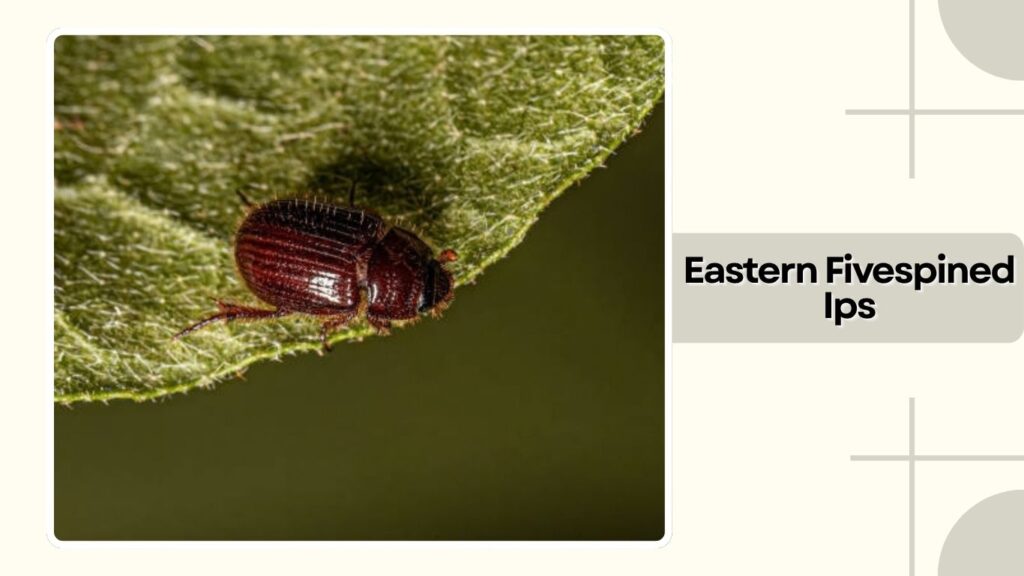
The Eastern Fivespined Ips (Ips grandicollis) is a common pine bark beetle of eastern North America. It normally attacks weakened, dying, recently felled, or storm-damaged pine trees. Large populations can occasionally colonize standing pines, particularly during drought or after storms and logging activities create large quantities of suitable breeding material.
Identification
- Adult length: approximately 4 mm
- Cylindrical body shape
- Light brown when newly emerged
- Dark brown to black when mature
- Five spines on each side of the rear depression
- White, legless larvae
- Orange-brown larval head
- Multi-branched egg galleries beneath bark
- Small round emergence holes on infested trees
Adults can be distinguished from many other bark beetles by examining the number and shape of spines surrounding the depressed rear portion of the wing covers.
Habitat and Distribution
Eastern Fivespined Ips occurs from Canada south to the Gulf Coast and is also found on some Caribbean islands. Populations introduced outside their native range have become established in parts of Australia. In standing pines, the beetles commonly infest the upper trunk and the lower portions of large branches.
Behavior and Diet
Adults favor fresh logging debris, recently felled trees, storm-damaged pines, and other weakened host material. Males begin gallery construction and attract females. Eggs are placed in niches along galleries, and larvae feed outward through the inner bark.
Lifespan and Life Cycle
Under favorable warm conditions, the Eastern Fivespined Ips can complete development in only 25–30 days. The beetle passes through egg, larval, pupal, and adult stages beneath the bark. Because development is rapid in warm weather, multiple overlapping generations can occur within a single growing season.
16. Northern Spruce Engraver
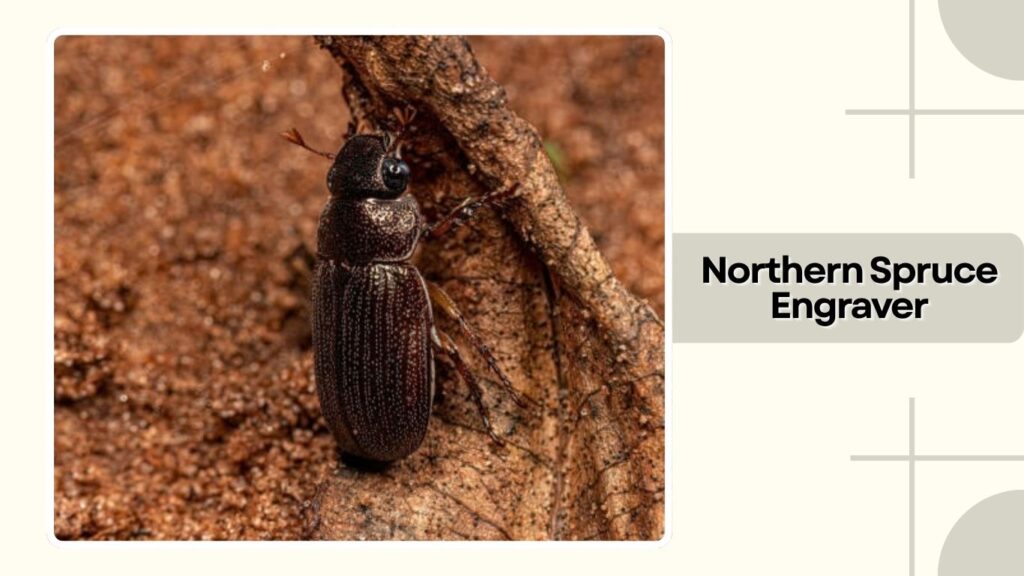
The Northern Spruce Engraver (Ips perturbatus) is an important bark beetle of spruce forests in northern North America. It often colonizes recently fallen, broken, or weakened spruce, but populations can increase following major disturbances and attack standing trees. Its characteristic gallery pattern and spined rear end help separate it from the larger Spruce Beetle.
Identification
- Adult length: approximately 4.0–4.8 mm
- Cylindrical body
- Reddish-brown to black coloration
- Four spines on each side of the rear depression
- Third spine has a sharp, pointed tip
- Head visible when viewed from above
- White, legless larvae
- Reddish-brown boring dust around attacks
- Distinctive tuning-fork-shaped galleries
The third rear spine has a characteristic pointed form that can help distinguish Ips perturbatus from other northern Ips species.
Habitat and Distribution
Northern Spruce Engravers occur across the boreal regions of North America, including Alaska, Canada, and northern portions of the United States. Spruce trees are their principal hosts, and fresh windthrow or storm-damaged spruce can provide abundant breeding material.
Behavior and Diet
Males begin attacks and construct central nuptial chambers beneath the bark. Each male may mate with as many as four females. Females create egg galleries radiating away from the chamber and deposit eggs along their walls. Larvae feed within the phloem while developing. A completed gallery system often resembles a tuning fork.
Lifespan and Life Cycle
Northern Spruce Engravers normally complete one generation per year throughout much of their range. Adults commonly overwinter in forest litter beneath or near brood trees. After emerging in spring, they locate fresh host material and reproduce. New adults can develop beneath bark by mid-summer, although emergence may occur later in the season depending on local conditions.
17. Six-Toothed Bark Beetle
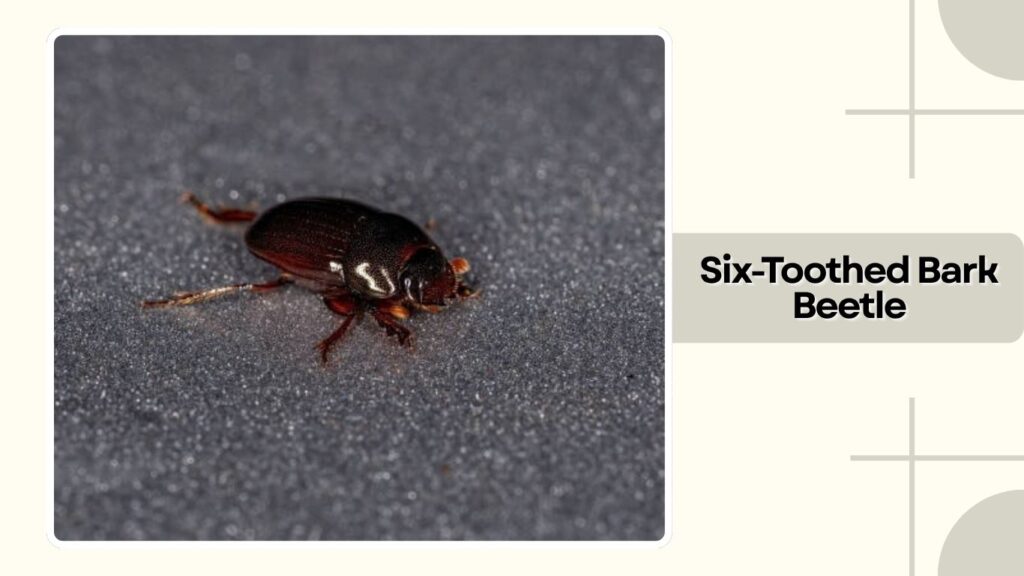
The Six-Toothed Bark Beetle (Ips sexdentatus) is one of the largest species in the genus Ips. It mainly attacks pine trees and is widely distributed across Europe and Asia. Like many bark beetles, it often takes advantage of weakened, recently damaged, or stressed conifers, but high populations can also contribute to the death of standing trees.
Identification
- Adult length: approximately 6–8 mm
- Cylindrical body shape
- Dark brown to black coloration
- Six spines on each side of the rear wing-cover depression
- Fourth spine is noticeably larger than the others
- Larvae are white and legless
- Larvae have a dark amber-colored head capsule
- Long maternal galleries occur beneath the bark
- Blue staining may develop in infested sapwood
The six prominent spines on each side of the elytral declivity are responsible for the beetle’s common name and are particularly useful for identification.
Habitat and Distribution
Six-Toothed Bark Beetles are widely distributed across Europe and large parts of Asia, including Russia, China, Japan, Mongolia, Korea, and several other countries. Pines are their main hosts. Scots pine is important in northern Europe, while maritime pine and black pine are among the additional hosts in central and southern Europe. Spruce, fir, and larch may occasionally be colonized.
Behavior and Diet
Male beetles usually initiate an attack by tunneling through the bark and constructing a mating chamber in the phloem. Aggregation pheromones attract additional beetles, and one male may be joined by several females. Each female constructs a separate maternal gallery and deposits eggs along it. The larvae then feed on phloem while creating individual tunnels extending away from the main gallery. The beetles can also carry blue-stain fungi that discolor wood and may contribute to tree decline.
Lifespan and Life Cycle
The number of generations varies dramatically with climate. Northern populations may have only one generation per year, while two generations are possible in central Eurasia and as many as five may occur in warmer Mediterranean areas. Adults commonly overwinter beneath bark, inside stump cracks, or in forest litter. Spring flight begins when temperatures become warm enough, after which adults locate new hosts and establish another generation.
FAQs
Bark beetles are small insects, but some species can have major effects on forests. Most spend much of their development hidden beneath tree bark, making early infestations difficult to notice. The following answers cover several common questions about their diet, tree damage, identification, and management.
1. What are bark beetles?
Bark beetles are small beetles in the weevil family Curculionidae, primarily within the subfamily Scolytinae. Many species live and reproduce beneath the bark of trees, where adults create galleries and larvae feed on inner-bark tissues.
2. What do bark beetles eat?
Most tree-attacking bark beetles feed primarily on phloem and other tissues beneath the bark. Larvae tunnel through these nutrient-rich tissues while developing. Different species specialize on particular trees, including pine, spruce, fir, Douglas-fir, and larch.
3. Can bark beetles kill healthy trees?
Many bark beetles normally prefer stressed, damaged, fallen, or dying trees. However, species capable of coordinated mass attacks can overwhelm the defenses of living trees when their populations become high. Drought, fire injury, overcrowding, root disease, and storm damage can increase tree susceptibility.
4. How can you tell if a tree has bark beetles?
Possible signs include small entrance or exit holes, boring dust, pitch tubes, fading foliage, galleries beneath loose bark, and blue-stained wood. The exact symptoms depend on the beetle species and host tree, so gallery patterns and adult characteristics are often important for identification.
5. How long is a bark beetle life cycle?
There is no single life-cycle length for all bark beetles. Some species can complete several generations in one warm season, while others may require one or even two years for a generation. Temperature, elevation, host condition, and beetle species all influence development. For example, Ips sexdentatus can range from one annual generation in cold northern areas to multiple generations in warmer climates.