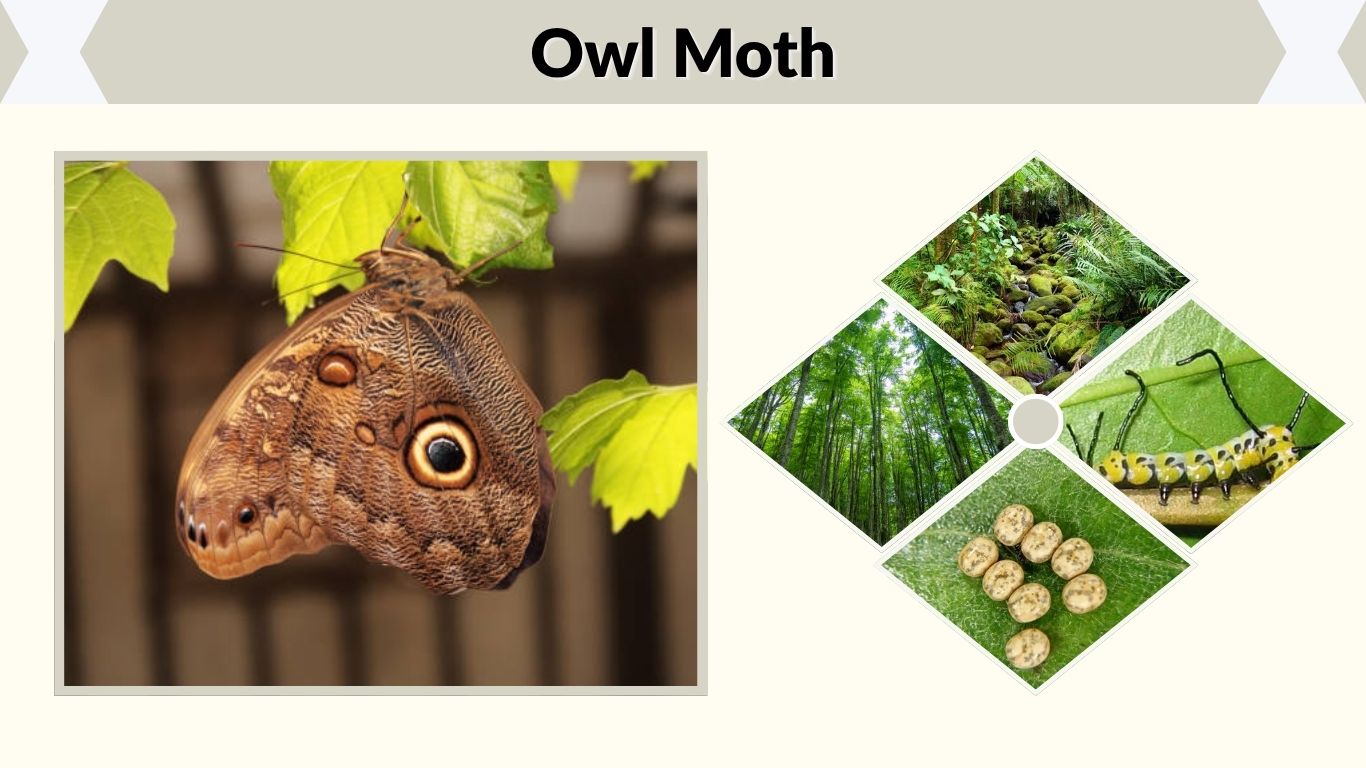
The owl moth is a striking nocturnal insect best known for dramatic wing patterns that can resemble large eyes or an owl-like face. However, “owl moth” is a common name used for several moth species rather than one single insect. Some of the best-known belong to the family Brahmaeidae, including Brahmaea wallichii and Brahmaea certhia. Their intricate markings, large wings, unusual caterpillars, and nighttime behavior make owl moths among the most visually impressive moths found in Asia and other parts of the world.
What Is an Owl Moth?
The name owl moth is used for several different moths, particularly members of the Brahmaeidae family. Species can differ considerably in size, distribution, and markings. One well-known example is Brahmaea wallichii, a large Brahmin moth occurring across parts of South and East Asia.
Owl Moth Identification
Depending on the species, an owl moth may show:
- Large, broad wings
- Complicated brown, black, cream, and gray patterns
- Eye-like markings on the wings
- Thick, furry-looking body
- Strongly patterned forewings
- Wavy or irregular lines resembling bark
- Large wingspan in some species
- Nocturnal activity
The elaborate markings help distinguish many Brahmaea owl moths from more uniformly colored moth species.
Scientific Classification
There is no single scientific name that covers every insect called an owl moth.
For example, Brahmaea certhia is officially listed with the common name owl moth, while Brahmaea wallichii is also widely known as an owl moth. Other unrelated moths, including Thysania zenobia, may also carry the same common name.
This is why scientific names are useful when identifying a particular owl moth.
Why Does an Owl Moth Look Like an Owl?
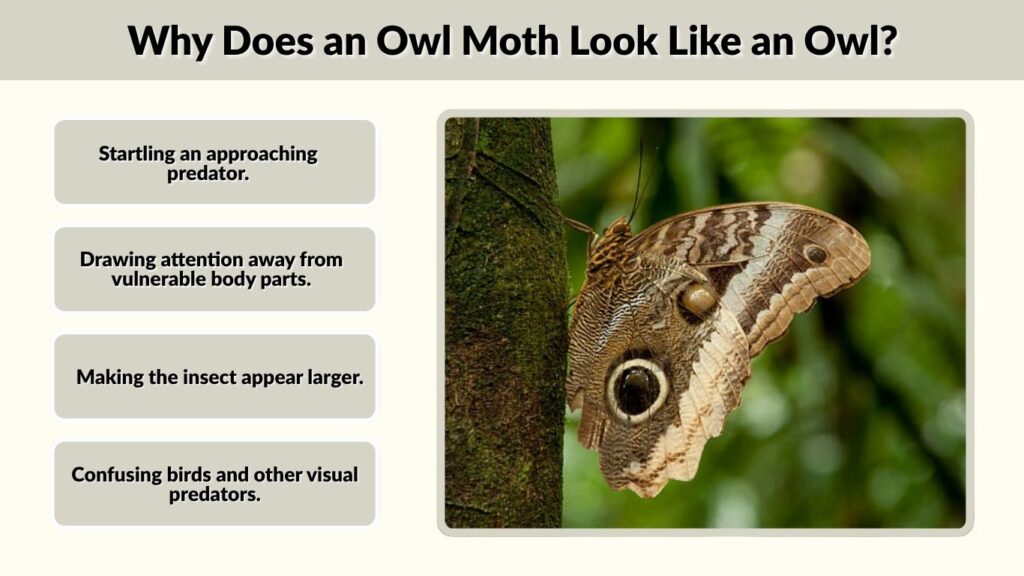
Some owl moths have bold markings that people interpret as eyes, faces, or other larger animals. These patterns may help confuse or discourage predators. Eyespots are widespread among butterflies and moths and can function as defensive markings by startling predators or making a small insect appear more threatening.
Moth With Owl Eyes on Its Wings
Large eye-like patterns can create the appearance of an owl staring outward when the wings are fully displayed.
These markings are not actual eyes. They are arrangements of scales in contrasting colors.
Potential advantages of such patterns can include:
- Startling an approaching predator
- Drawing attention away from vulnerable body parts
- Making the insect appear larger
- Confusing birds and other visual predators
- Breaking up the moth’s body outline
Not every owl moth has perfectly circular eyespots. Some create the owl-like appearance through complex lines and contrasting patches instead.
Are Owl Moth Pictures Fake?
Real owl moths can look surprisingly dramatic, but not every viral image labeled an “owl moth” represents an actual species accurately.
Photos can be digitally enhanced, misidentified, or confused with other moths and butterflies that have prominent eyespots.
Genuine Brahmaea moths already have highly detailed natural wing patterns, so their real appearance can be spectacular without digital alteration.
Owl Moth Size and Appearance
Owl moth size varies considerably because the common name applies to several species. Some are moderately sized, while others are very large. Brahmaea wallichii, for example, is one of the larger Brahmin moths and has been reported with a wingspan roughly in the 90–160 mm range.
Giant Owl Moth
Large owl moths can appear especially impressive when their wings are fully opened.
Typical visual features may include:
- Broad wings
- Heavy-looking thorax
- Brown and black coloration
- Cream or whitish bands
- Numerous wavy lines
- Eye-like markings
- Scalloped wing edges
The dark patterns help many species blend into bark and vegetation when resting with their wings folded or flattened.
Blue Owl Moth
A naturally bright blue owl moth is not representative of most well-known Brahmaea species. Their colors are typically dominated by brown, black, gray, cream, and pale markings.
Some photographs may show bluish tones because of lighting, camera processing, individual variation, or because the insect pictured belongs to another species.
Where Do Owl Moths Live?
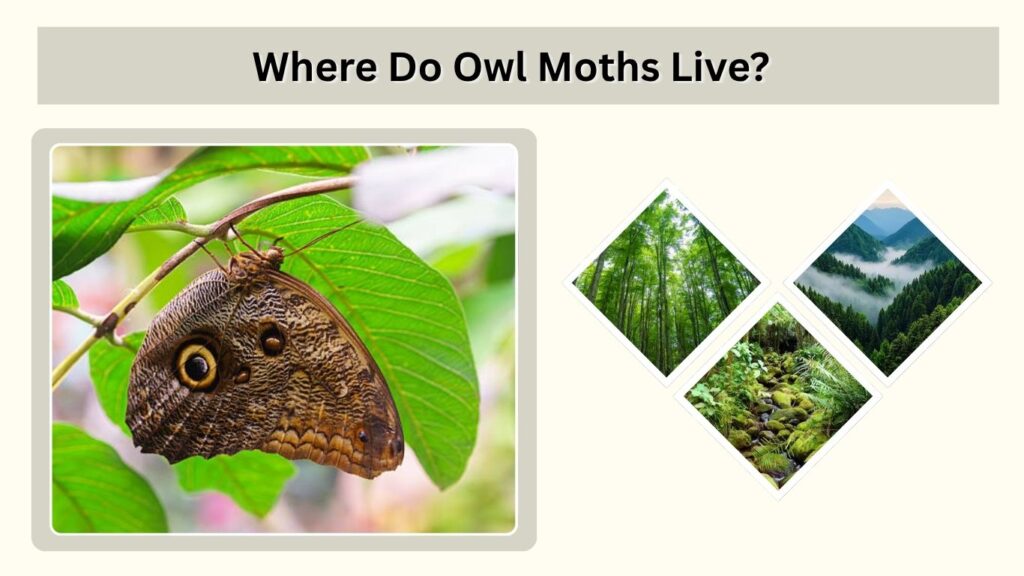
The habitat of an owl moth depends on the species. Many members of the genus Brahmaea occur in Asia. Brahmaea wallichii, for example, has been recorded from regions including India, Nepal, Bhutan, Myanmar, China, Taiwan, and Japan. Other owl moth species occur in Europe, Africa, and the Americas.
Typical Owl Moth Habitat
Suitable environments can include:
- Forests
- Mountain woodlands
- Tropical and subtropical vegetation
- Areas rich in host plants
- Shrublands
- Forest edges
- Gardens near suitable natural habitat
Adults are generally easier to notice at night because many owl moths are nocturnal.
European Owl Moth
The European owl moth, Brahmaea europaea, is particularly interesting because it has an extremely restricted distribution.
It occurs in southern Italy and represents the European member of a group whose other species are primarily associated with Asia.
Its limited geographic range makes it very different from widespread moth species that occur across several continents.
Owl Moth Caterpillar
The owl moth caterpillar can look almost as unusual as the adult. Caterpillar appearance varies according to species and developmental stage. Many Brahmaea larvae have elongated bodies and dramatic projections when young, making them look completely different from the patterned adult moth they eventually become.
What Does an Owl Moth Caterpillar Look Like?
Depending on the species and age, characteristics may include:
- Long cylindrical body
- Green, brown, or patterned coloration
- Long projections on younger caterpillars
- Prominent head
- Strong segmentation
- Changing appearance through successive molts
As caterpillars grow, their appearance can change considerably.
The caterpillar’s main job is feeding and accumulating enough energy to complete metamorphosis.
What Do Owl Moth Caterpillars Eat?
The exact host plants depend on the owl moth species. Caterpillars generally feed on the leaves of particular trees, shrubs, or other plants appropriate to their species.
This close relationship with host plants explains why some owl moths are restricted to particular regions. If their preferred plants disappear, suitable habitat for reproducing moth populations may disappear as well.
Owl Moth Life Cycle
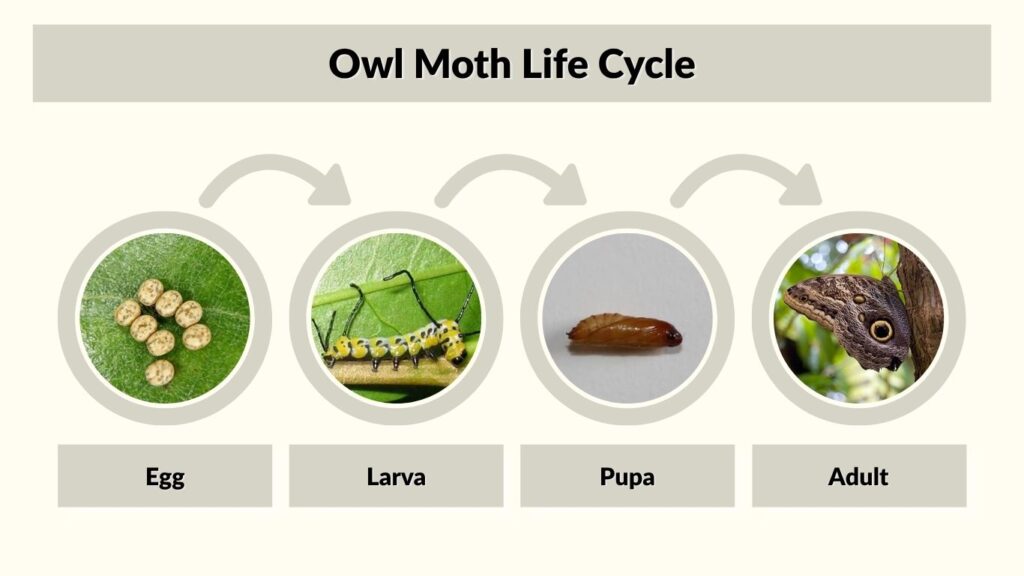
Like other moths, owl moths undergo complete metamorphosis. Their life cycle has four distinct stages: egg, larva, pupa, and adult. Most growth occurs during the caterpillar stage. Once the adult moth emerges, its priorities shift toward dispersal and reproduction.
Four Stages of Development
The life cycle includes:
- Egg: A female deposits eggs on or near suitable host vegetation.
- Caterpillar: Larvae hatch and feed heavily while growing through several molts.
- Pupa: The mature caterpillar enters a pupal stage in which its body is reorganized.
- Adult moth: A winged adult emerges, expands its wings, and begins the reproductive stage.
The length of each stage varies according to species, temperature, season, and environmental conditions.
Is an Owl Moth Dangerous?
Owl moths may look intimidating because of their large size and eye-like patterns, but adult moths are not dangerous to humans. They do not possess stingers, claws, or venomous fangs. Their dramatic markings are primarily visual rather than offensive weapons.
Can Owl Moths Bite?
Adult owl moths are not known as biting pests.
They do not behave like horse flies, mosquitoes, or other blood-feeding insects. If one lands on a wall, tree, or outdoor light, it can generally be left alone.
The safest approach is also to avoid unnecessary handling because moth wings are covered with delicate scales that can be damaged.
Owl Moth vs Owl Butterfly
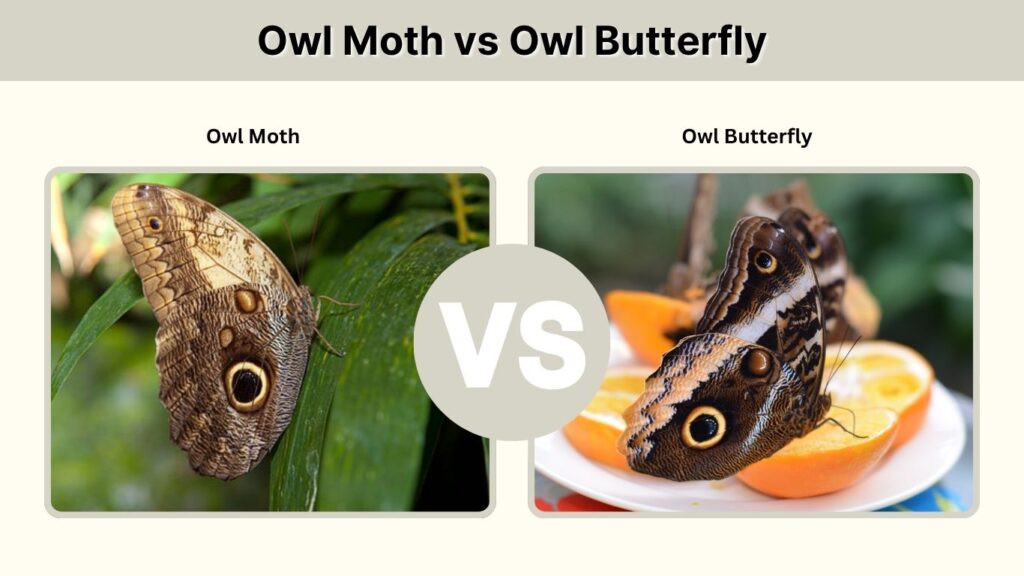
Owl moths are sometimes confused with owl butterflies because both names refer to insects with eye-like wing patterns. However, owl butterflies are generally species of Caligo from Central and South America. Their large hindwing eyespots are among the classic examples of false-eye markings in Lepidoptera.
Main Differences
| Feature | Owl Moth | Owl Butterfly |
| Insect type | Moth | Butterfly |
| Activity | Often nocturnal | Mostly daytime/crepuscular |
| Common examples | Brahmaea species | Caligo species |
| Wing pattern | Complex lines and eyespots | Large round hindwing eyespots |
| Resting behavior | Often active at night | Generally more visible by day |
Both demonstrate how striking wing patterns can help insects survive interactions with predators.
Interesting Owl Moth Facts
Owl moths are much more than simply moths with unusual markings. Their common name covers several distinct species, and their complex appearances demonstrate the remarkable variety found among moths.
Quick Facts
- “Owl moth” can refer to several different species.
- Many well-known owl moths belong to the family Brahmaeidae.
- Brahmaea certhia is known as the Sino-Korean owl moth.
- Brahmaea wallichii is one of the larger owl moths.
- Many species are primarily nocturnal.
- Wing markings can resemble eyes or animal faces.
- Caterpillars look dramatically different from adults.
- Owl moths are not dangerous to people.
- Some owl moth species have very restricted geographic ranges.
- They undergo complete metamorphosis.
FAQs
What is an owl moth?
An owl moth is a common name applied to several moth species, particularly members of the Brahmaeidae family. They are known for complex wing patterns and, in some species, eye-like markings.
What moth looks like an owl?
Several moths can appear owl-like because of large eyespots or facial-looking wing patterns. Species of Brahmaea are among those commonly called owl moths.
How big is an owl moth?
Size depends on species. Large species such as Brahmaea wallichii can have a wingspan reaching roughly 9–16 cm.
Are owl moths dangerous?
No. Owl moths are not considered dangerous to humans and do not sting or feed on human blood.
Where are owl moths found?
Different species occur in different regions. Many Brahmaea owl moths occur across Asia, while other moths called owl moths can be found in Europe, Africa, and the Americas.