
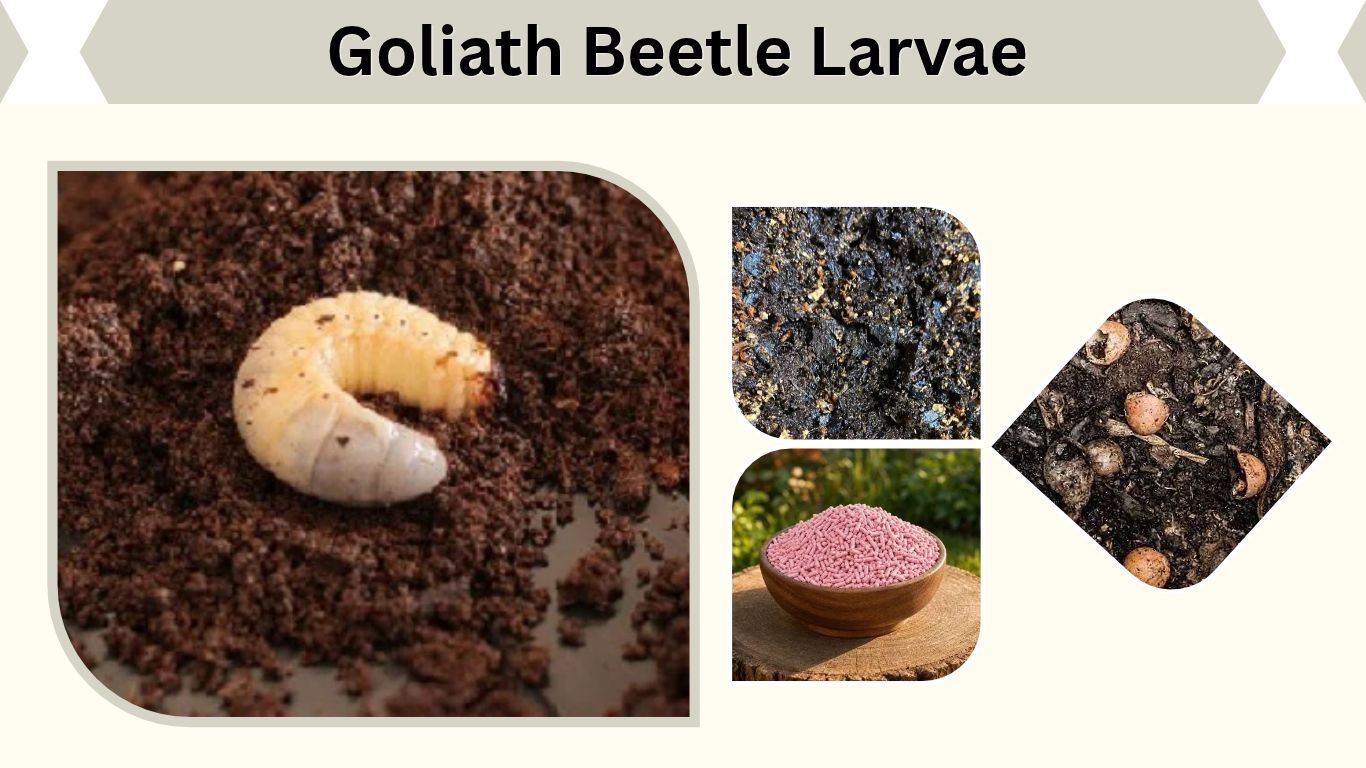
Goliath beetle larvae are among the most impressive insect grubs in the world, known for their enormous bodies, unusual feeding habits, and remarkable growth potential. These larvae develop into giant Goliath beetles, native to tropical Africa. Unlike many other scarab beetle grubs, they require protein-rich nutrition to grow successfully. Their size, appearance, feeding behavior, and development make them particularly interesting to insect enthusiasts and researchers. Understanding their natural diet, weight, life cycle, and care requirements helps explain how these giant beetles develop.
What Are Goliath Beetle Larvae?
Goliath beetle larvae are the immature stage of beetles belonging to the genus Goliathus. They are commonly called grubs because of their soft, curved bodies and thick appearance. These larvae spend most of their development feeding and growing before transforming into pupae and eventually emerging as adult beetles.
Goliath Beetle Larvae Appearance
Goliath beetle larvae have several recognizable physical characteristics that distinguish them from smaller scarab grubs.
- Body shape: Their bodies are thick, fleshy, and typically curved into a C-shape.
- Body color: Most have creamy-white or pale yellow bodies.
- Head: Their head capsule is relatively large and usually brown or reddish-brown.
- Mouthparts: Strong mandibles help them break down food and consume protein-rich materials.
- Legs: They have three pairs of small legs near the front of their bodies.
- Body segments: Their soft bodies contain several visible segments that expand as they grow.
Goliath Beetle Larvae Face and Anatomy
The face of a Goliath beetle larva is dominated by its strong head capsule and chewing mouthparts. Unlike adult beetles, larvae do not have wings or a hardened outer shell. Their powerful mandibles help them process food, while their sensory structures help them respond to their surroundings.
How Big Do Goliath Beetle Larvae Get?
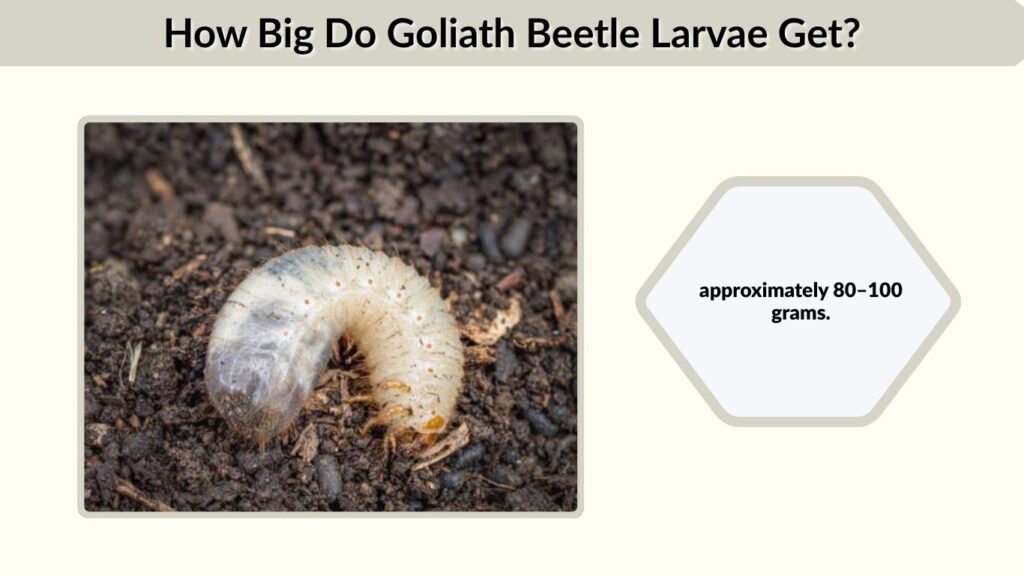
Goliath beetle larvae are famous for their enormous size compared with many other beetle grubs. Their bodies become increasingly thick as they progress through different developmental stages. However, their final size depends on species, nutrition, and environmental conditions. Well-fed larvae generally develop larger bodies than those receiving insufficient protein.
Goliath Beetle Larvae Size
The size of a mature Goliath beetle larva can be impressive, although measurements vary considerably between individuals.
- Newly hatched larvae: Small and relatively delicate compared with mature grubs.
- Young larvae: Gradually increase in length and thickness during their first developmental stages.
- Mature larvae: Develop large, heavy bodies with prominent segments.
- Fully grown males: Can become particularly massive when provided with suitable nutrition.
Goliath Beetle Larvae Weight
Goliath beetle larvae are sometimes reported to reach approximately 80–100 grams under favorable conditions, although such figures should not be treated as a standard weight for every individual.
A scientific study published in ZooKeys in 2016 examined the growth of Goliathus goliatus larvae. Well-nourished laboratory larvae reached an average maximum weight of approximately 28.7 grams during the third instar. The researchers also discussed commonly reported larger weights in captive breeding, highlighting how feeding conditions can influence growth.
What Do Goliath Beetle Larvae Eat?
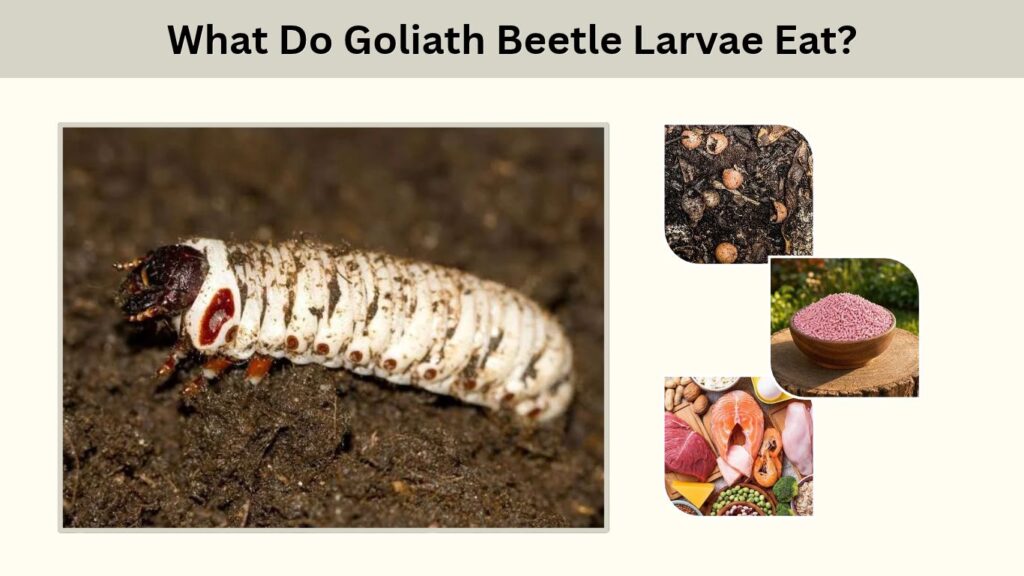
Goliath beetle larvae have unusual dietary requirements compared with many other scarab beetle larvae. Although decomposing organic materials provide part of their feeding environment, protein is particularly important for their growth. Research suggests that these larvae may have a predatory or strongly omnivorous feeding strategy, helping explain their remarkable development.
Natural Goliath Beetle Larvae Diet
Goliath beetle larvae do not primarily depend on living plants. Their feeding behavior is more complicated than that of typical plant-feeding grubs.
Their diet may include:
- Decaying organic matter: Decomposing leaves and other organic materials provide a suitable substrate.
- Protein-rich food: Animal-based protein supports their rapid growth.
- Other insect larvae: Captive observations show that they can consume the larvae of other beetles.
- Specialized food pellets: Protein-rich pellets are commonly used in captive breeding.
A scientific investigation found that protein supplementation significantly affected larval growth and survival. Starved larvae failed to complete development successfully, demonstrating the importance of adequate nutrition.
What Plants Do Goliath Beetle Larvae Eat?
Goliath beetle larvae are not specialized feeders on living plants. Instead, decaying leaves, decomposed wood, and other organic materials can form part of their substrate. Their need for additional protein distinguishes them from many other flower chafer larvae that develop successfully on decomposing plant material alone.
Goliath Beetle Larvae Life Cycle
Goliath beetle larvae develop through three larval instars before entering the pupal stage. During this period, they increase their body mass and undergo several changes in appearance. Their development depends on food availability, temperature, and other environmental conditions. Once they reach maturity, they prepare a protective chamber where metamorphosis takes place.
Egg and Early Larval Stages
The life cycle begins when a female lays eggs in a suitable environment. After hatching, the young larvae begin feeding and gradually increase in size.
During the first and second instars, they develop stronger mouthparts and larger bodies. They also shed their outer skin as they grow.
Third Instar and Pupation
The third instar is particularly important because much of the larva’s final body growth occurs during this stage. Once development is complete, the larva constructs a pupal chamber and prepares for metamorphosis.
Inside the chamber, its body transforms into the adult beetle, developing wings, legs, and the structures needed for its adult life.
How to Care for Goliath Beetle Larvae
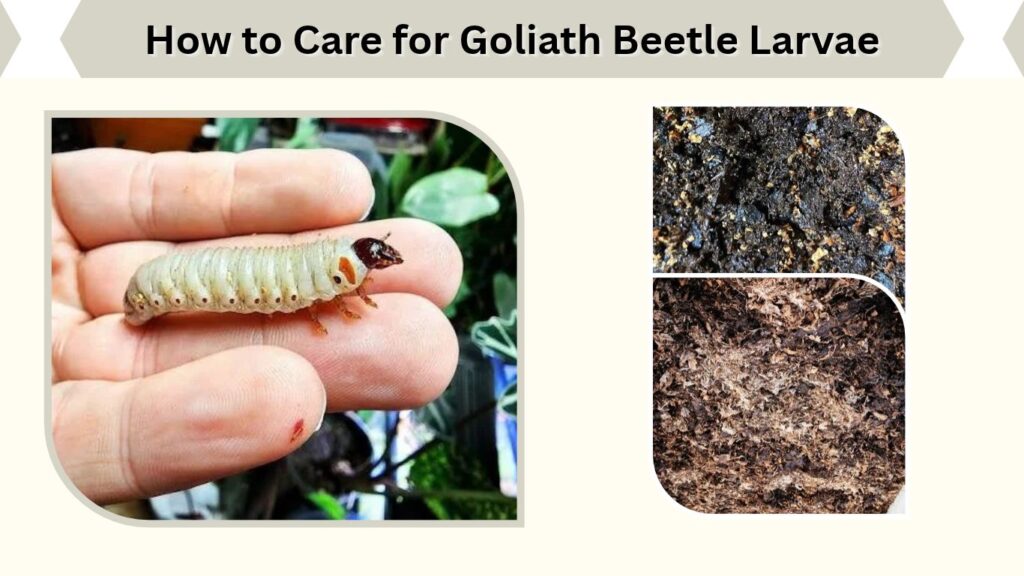
Raising Goliath beetle larvae requires careful attention to nutrition, substrate, moisture, and enclosure conditions. They are more demanding than many commonly kept beetle grubs because of their protein requirements. Successful captive breeding also requires monitoring their growth and preventing competition or aggression between individual larvae.
Goliath Beetle Larvae Care Requirements
Important considerations for keeping these larvae include:
- Enclosure: Use a spacious, secure container that provides sufficient room for growth.
- Substrate: Provide suitable decomposing organic material, such as decayed leaves and wood.
- Nutrition: Supplement their diet with appropriate protein-rich insect-rearing food.
- Moisture: Keep the substrate slightly moist without making it waterlogged.
- Ventilation: Ensure sufficient airflow to reduce mold and excessive moisture.
- Separation: House larvae individually when possible to reduce aggression and cannibalism.
Monitoring Larval Growth
Regularly monitor the larvae for changes in size, feeding activity, and development. Remove spoiled food and check the substrate for mold or excessive moisture. Avoid unnecessary handling because their soft bodies can be injured easily.
Do Goliath Beetle Larvae Bite?
Goliath beetle larvae have strong chewing mandibles that help them process food. Although they are not aggressive toward humans, they may pinch if handled or disturbed. Their mouthparts are designed primarily for feeding rather than attacking people. It is best to avoid handling them unnecessarily and use gentle methods when moving them between containers.
FAQs
1. How much do Goliath beetle larvae weigh?
Goliath beetle larval weight varies depending on their developmental stage and feeding conditions. Some large captive larvae are reported to approach 100 grams, but scientific laboratory measurements have recorded considerably lower weights. Nutrition is an important factor influencing their final body mass.
2. How long do Goliath beetle larvae take to grow?
Their development can take several months, depending on food quality and environmental conditions. A 2016 laboratory study found that well-nourished Goliathus goliatus larvae completed development in less than 200 days on average, although wild development may differ.
3. Do Goliath beetle larvae eat plants?
They can consume decomposing plant materials, including decaying leaves and wood, as part of their substrate. However, they also require protein-rich nutrition, making their feeding habits different from those of many other scarab beetle larvae.
4. Can Goliath beetle larvae bite humans?
Yes, their strong mandibles can pinch if they are handled roughly or feel disturbed. However, they are not venomous and do not actively hunt or attack humans. Gentle handling and minimal disturbance are recommended.
5. Can you keep Goliath beetle larvae as pets?
Yes, experienced insect enthusiasts can raise Goliath beetle larvae in captivity. However, they need suitable substrate, protein-rich food, proper moisture, and adequate ventilation. Keeping individual larvae separately can also help prevent injuries caused by aggressive feeding behavior.
