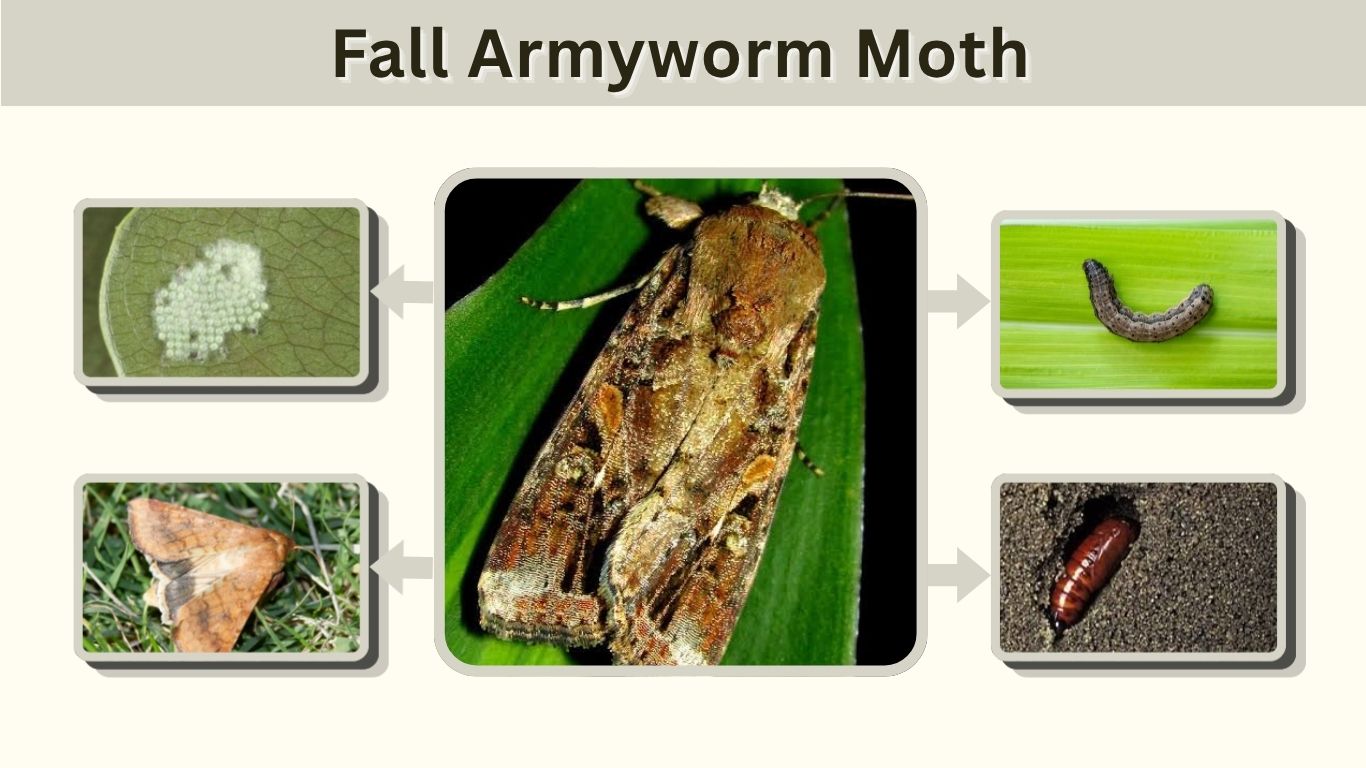
The fall armyworm moth (Spodoptera frugiperda) is the adult stage of one of the world’s most destructive agricultural pests. While the moth itself does not directly damage crops, its caterpillars can rapidly feed on corn, grasses, rice, sorghum, and many other plants. Recognizing the adult moth, eggs, and larvae can help growers detect infestations before serious damage occurs. This guide explains fall armyworm moth identification, appearance, life cycle, eggs, caterpillars, behavior, and the differences between males and females.
What Does the Fall Armyworm Moth Look Like?
Adult fall armyworm moths are medium-sized, grayish-brown moths with narrow forewings and lighter hindwings. They are nocturnal and usually remain hidden among vegetation during daylight hours. Their muted coloration provides excellent camouflage against tree bark, soil, and dried vegetation.
Fall Armyworm Moth Identification
Important identification features include:
- Adult length: Usually about 16–20 mm
- Wingspan: Approximately 32–40 mm
- Forewings: Gray, brown, or mottled
- Hindwings: Pale or whitish with darker margins
- Body: Grayish-brown and relatively slender
- Antennae: Long and threadlike
- Activity: Primarily active after sunset
- Resting position: Wings are usually folded over the body
Male moths normally have more obvious markings than females.
What Color Are Fall Armyworm Moth Eyes?
Adult fall armyworm moths have prominent compound eyes that usually appear dark brown to nearly black. Their large eyes are well adapted to detecting movement and light under low-light conditions.
Because these moths fly mainly at night, their eyesight helps them navigate, locate mates, and find suitable vegetation where females can deposit eggs.
Male vs Female Fall Armyworm Moth
Male and female fall armyworm moths are similar in overall size, but their wing patterns can help distinguish them.
Male Fall Armyworm Moth
Male moths generally have more strongly patterned forewings. They often display noticeable pale patches or triangular whitish markings near the tips and center of the wings.
The darker brown and gray areas create a contrasting appearance that makes males somewhat easier to recognize.
Female Fall Armyworm Moth
Female moths are normally more uniformly grayish or brownish. Their forewing markings tend to be less distinct than those of males.
Females are especially important in the pest’s spread because each can produce large numbers of eggs during her relatively short adult life.
Fall Armyworm Moth Eggs
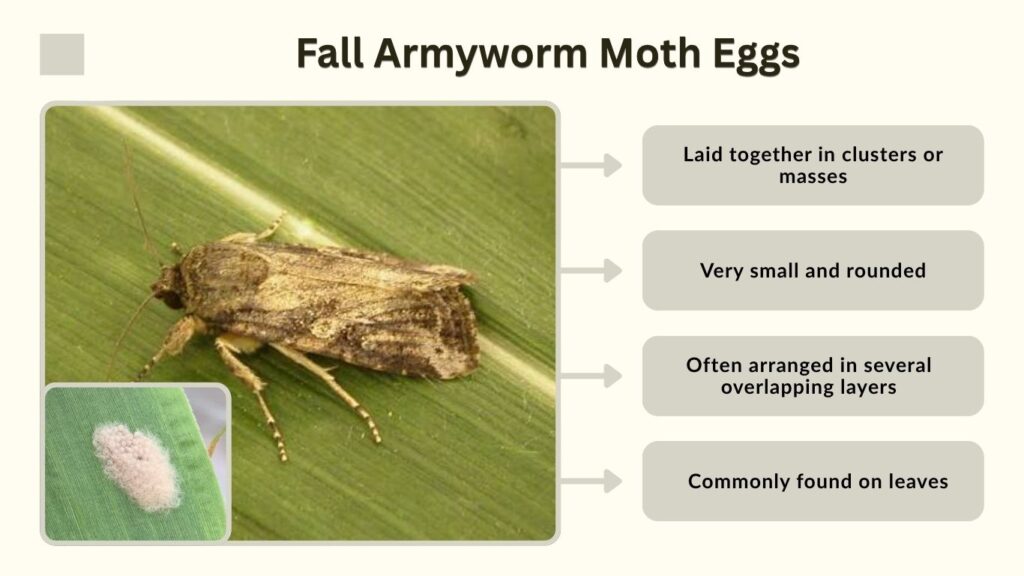
Female moths normally place their eggs in clusters on plants. Finding these masses is often one of the earliest signs that a fall armyworm infestation may develop.
What Do Fall Armyworm Eggs Look Like?
Fall armyworm moth eggs have several recognizable features:
- Laid together in clusters or masses
- Usually cream, pale green, or whitish when fresh
- Very small and rounded
- Often arranged in several overlapping layers
- Frequently covered with grayish scales or hairs
- Commonly found on leaves
The fuzzy material covering an egg mass comes from scales produced by the female moth.
Where Are Eggs Laid?
Females frequently lay eggs on the leaves of corn, grasses, sorghum, rice, and other host plants. However, eggs may occasionally occur on nearby vegetation or other surfaces.
After hatching, the tiny caterpillars begin feeding almost immediately.
Fall Armyworm Moth Caterpillar Identification
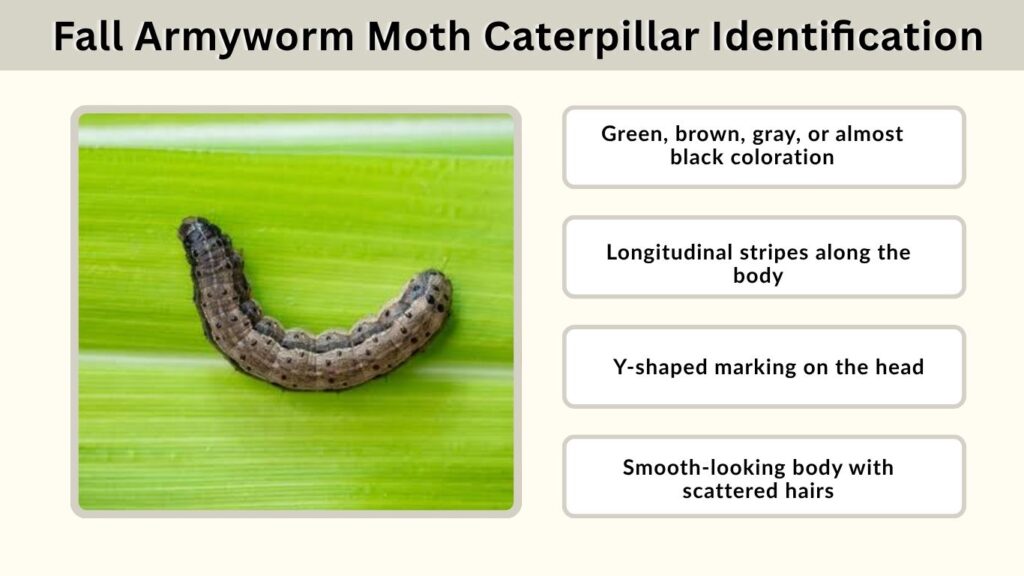
The caterpillar is the damaging stage of the fall armyworm. Young larvae initially produce small feeding marks, while older caterpillars can consume large sections of leaves.
How to Identify Fall Armyworm Larvae
Look for these characteristics:
- Green, brown, gray, or almost black coloration
- Longitudinal stripes along the body
- Several dark spots on each body segment
- An obvious pale, inverted Y-shaped marking on the head
- Four dark spots arranged roughly like a square near the rear of the body
- Smooth-looking body with scattered hairs
The inverted Y-shaped head marking is one of the most commonly used characteristics for identifying mature fall armyworm caterpillars.
How Large Do Fall Armyworm Caterpillars Get?
Fully developed larvae can grow to roughly 30–40 mm long.
Young caterpillars are much smaller and may initially be difficult to notice. As they mature, their feeding increases significantly, making early detection particularly important for crop management.
Fall Armyworm Moth Life Cycle
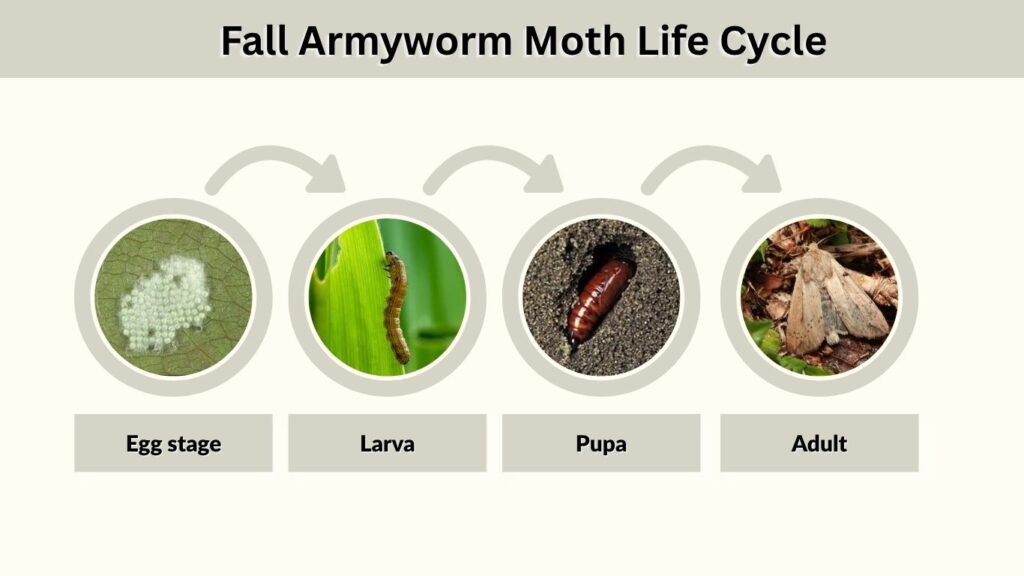
The fall armyworm undergoes complete metamorphosis. Its development consists of four distinct stages: egg, larva, pupa, and adult moth.
1. Egg Stage
Adult females deposit clusters containing numerous eggs on suitable surfaces.
Egg development is relatively rapid under warm conditions. Once the eggs hatch, tiny larvae move onto nearby leaves and begin feeding.
2. Larval Stage
The larval or caterpillar stage causes almost all economically significant plant damage.
Fall armyworm larvae pass through several growth stages called instars. Small larvae may scrape leaf surfaces, while larger caterpillars chew substantial holes and can feed deep inside plant whorls.
3. Pupal Stage
After completing larval development, mature caterpillars usually move toward the soil.
They form a small chamber beneath the surface and transform into reddish-brown pupae. Inside the pupa, the insect develops into its adult form.
4. Adult Moth Stage
The adult emerges from the soil and becomes active primarily at night.
Adults mate, and females begin searching for appropriate locations to lay their eggs. In warm climates, several generations can occur during a year.
Do Fall Armyworm Moths Fly?
Yes. Adult fall armyworm moths are strong fliers, and their ability to travel considerable distances is one reason the pest can spread rapidly into new agricultural areas.
Why Do They Fly Long Distances?
Adult moth movement helps them locate:
- Suitable host plants
- Egg-laying sites
- Mates
- Favorable environmental conditions
Wind currents can also help moths move across much larger distances than they could travel through normal powered flight alone.
Fall armyworms therefore may appear suddenly in areas where populations were previously low.
What Do Fall Armyworms Damage?
Although the adult moth primarily feeds on liquids such as nectar, its caterpillars consume plant tissue and attack a broad range of crops.
Common Host Plants
Important hosts include:
- Corn
- Sorghum
- Rice
- Wheat
- Millet
- Sugarcane
- Pasture grasses
- Bermuda grass
- Cotton
- Some vegetable crops
Corn is one of the crops most commonly associated with severe fall armyworm damage.
Signs of an Infestation
Early symptoms can include small transparent patches where young larvae have scraped leaves.
As caterpillars grow, damage may progress to larger irregular holes, shredded leaves, frass inside plant whorls, damaged growing points, and injured ears or developing reproductive structures.
Fall Armyworm Moths and Crop Monitoring
Monitoring adult moth populations can provide an early warning that egg laying may soon occur in nearby crops.
Pheromone Traps
Pheromone traps are commonly used to attract and capture male fall armyworm moths.
These traps help indicate adult activity but do not automatically mean damaging caterpillar populations are present. Crops should still be inspected directly for egg masses, larvae, and fresh feeding damage.
Inspecting Plants
When fall armyworm activity is suspected, examine:
- Young leaves
- Leaf undersides
- Plant whorls
- Growing points
- Egg masses
- Fresh feeding holes
- Caterpillar droppings
Finding young larvae early usually provides more management options than discovering large caterpillars after significant damage has already occurred.
Fall Armyworm Moth vs Corn Earworm Moth
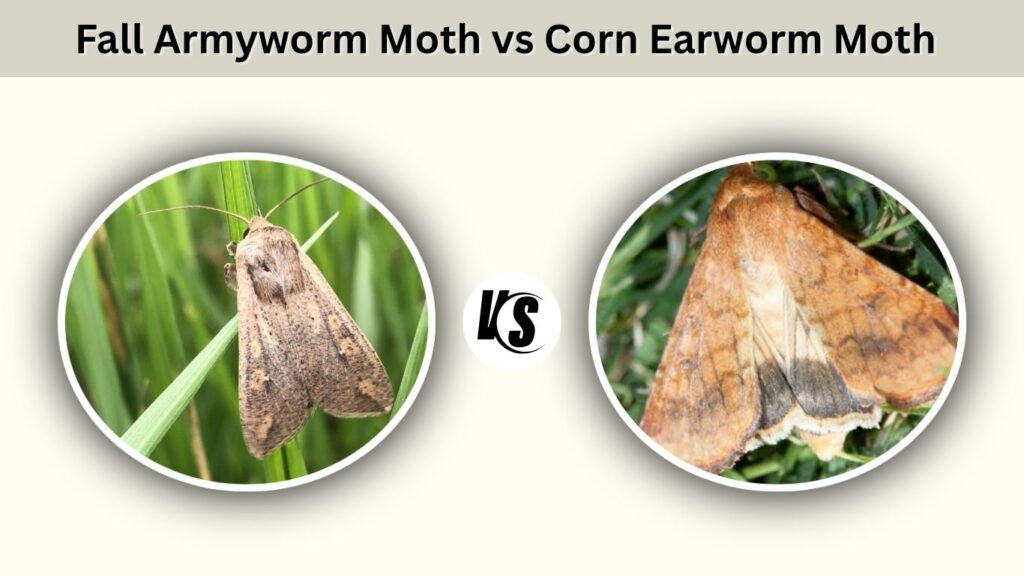
Fall armyworm and corn earworm moths can occur around the same agricultural crops, but they are different insects.
Major Differences
Fall armyworm adults tend to have grayish-brown mottled forewings, with males showing particularly distinctive pale markings. Corn earworm moths often appear more yellowish, tan, or olive-brown.
Their caterpillars also differ. Mature fall armyworm larvae commonly display the inverted Y-shaped head marking and four dark spots forming a square near the rear of the body.
Careful identification is useful because monitoring and control recommendations may differ between species.
FAQs
Are Fall Armyworm Moths Harmful to Humans?
Fall armyworm moths are not considered dangerous to people. They do not sting and are not known for attacking humans. Their primary importance comes from the agricultural damage caused by their caterpillars.
How Long Is an Adult Fall Armyworm Moth?
The body of an adult fall armyworm moth is generally around 16–20 mm long, while its wingspan commonly reaches approximately 32–40 mm. Exact size varies slightly between individuals.
What Does a Fall Armyworm Moth Caterpillar Look Like?
Mature caterpillars are usually greenish, brown, gray, or nearly black with stripes running lengthwise. A pale inverted Y-shaped mark on the head and four dark spots arranged in a square near the rear are useful identification features.
Do Fall Armyworm Moths Damage Plants?
Adult moths cause little direct plant damage because they mainly consume nectar and other liquids. The larvae are responsible for crop injury by chewing leaves, growing points, stems, and reproductive plant structures.
When Are Fall Armyworm Moths Most Active?
Adult fall armyworm moths are mainly nocturnal. They typically become active after sunset, when they fly, mate, search for food, and locate suitable host plants for egg laying.