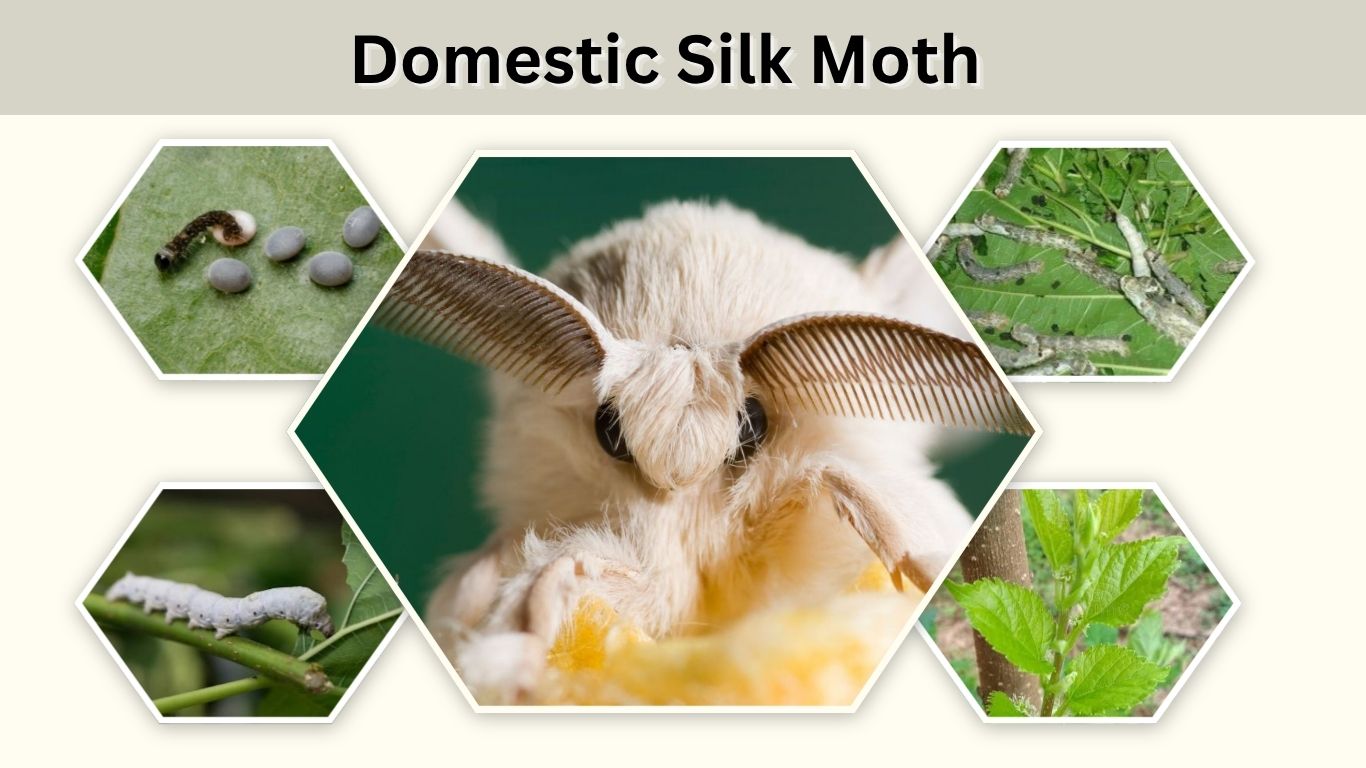
The domestic silk moth (Bombyx mori) is one of the most famous domesticated insects in the world. Humans have raised it for thousands of years because its caterpillars produce silk used to make fabric. Unlike many wild moths, adult domestic silk moths are poor fliers and depend heavily on human care. Their life cycle includes egg, larva, pupa, and adult stages. Understanding their appearance, diet, lifespan, cocoons, and domestication helps explain why these unusual moths are so different from their wild relatives.
What Is a Domestic Silk Moth?
The domestic silk moth is a fully domesticated moth primarily raised for silk production. Its caterpillar, commonly called a silkworm, produces a continuous silk fiber when forming its cocoon. Centuries of selective breeding have changed its appearance and behavior, leaving modern domestic silk moths highly dependent on people for food, reproduction, and survival.
Domestic Silk Moth Identification
Important characteristics include:
- Scientific name: Bombyx mori
- Adult color: Usually creamy white or pale beige
- Body: Thick and covered with fine hairs
- Wings: Broad, pale wings with faint brown markings
- Antennae: Large and feather-like, especially in males
- Caterpillar: Pale white or cream with a soft segmented body
- Cocoon: Usually white or yellowish
- Flight: Adults generally cannot fly effectively
Adult moths look soft and fuzzy, contributing to their reputation as unusually cute moths.
Domestic Silk Moth Size
Adult domestic silk moths generally have a wingspan of several centimeters, although size can vary with strain and growing conditions. Females are often heavier-bodied because they carry many eggs.
The caterpillars become considerably larger during development as they consume large amounts of leaves and prepare to produce their silk cocoons.
Domestic Silk Moth Life Cycle
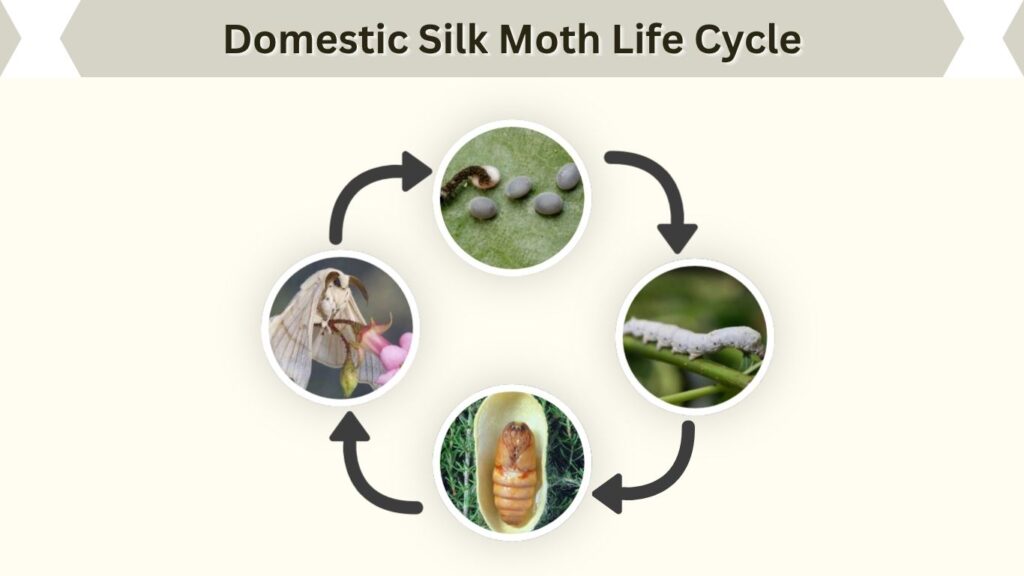
Domestic silk moths undergo complete metamorphosis. Their body changes dramatically between each developmental stage. The caterpillar stage is particularly important because this is when silk is produced. Temperature, food quality, genetics, and environmental conditions can affect how quickly the moth progresses through its life cycle.
Four Stages of the Life Cycle
The domestic silk moth develops through:
- Egg: Female moths lay hundreds of tiny eggs after mating.
- Larva: Silkworms hatch and begin feeding heavily on leaves.
- Pupa: Mature caterpillars spin cocoons and pupate inside.
- Adult: The adult moth emerges, mates, and produces another generation.
The entire cycle can be completed relatively quickly under suitable captive conditions.
Domestic Silk Moth Eggs
The eggs are extremely small and may initially appear pale yellow. Fertilized eggs often darken as the developing embryo matures.
A female can lay several hundred eggs. Depending on the strain and environmental conditions, eggs may hatch relatively soon or enter a dormant state before continuing development.
Domestic Silk Moth Cocoon
When fully grown, the silkworm begins producing silk from specialized glands. It moves its head repeatedly while wrapping the fine fiber around its body.
Eventually, the caterpillar becomes completely enclosed inside the cocoon and transforms into a pupa. This continuous silk strand is the primary reason humans domesticated the species.
What Do Domestic Silk Moths Eat?
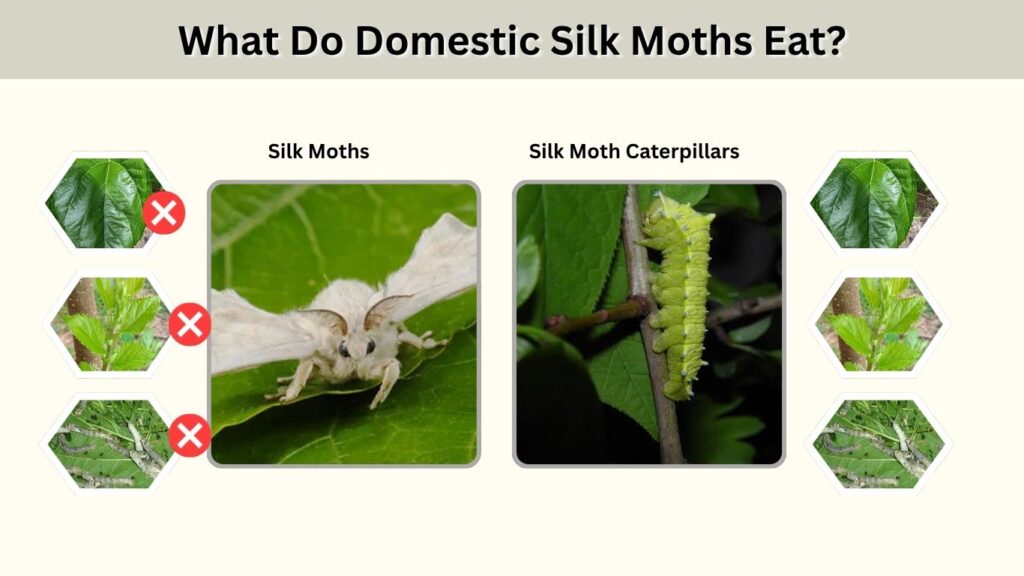
Diet varies dramatically between larvae and adults. Silkworm caterpillars are active feeders and require substantial amounts of suitable plant material. Adult domestic silk moths, however, have greatly reduced feeding structures and spend their short adult lives primarily mating and reproducing rather than searching for food.
What Do Domestic Silk Moth Caterpillars Eat?
Silkworms primarily eat:
- Mulberry leaves
- Fresh young mulberry foliage
- Prepared silkworm diets containing mulberry
- Commercial artificial silkworm food
Mulberry leaves are considered their traditional and preferred food source.
Caterpillars eat increasingly large quantities as they grow. Clean, fresh food is particularly important when domestic silkworms are being raised in captivity.
Do Adult Domestic Silk Moths Eat?
Adult domestic silk moths generally do not eat. Their mouthparts are reduced, and adults survive using energy stored during the caterpillar stage.
Their adult life is therefore focused almost entirely on reproduction. Males search for females, mating occurs, and females lay eggs before the adults eventually die.
Can Domestic Silk Moths Fly?
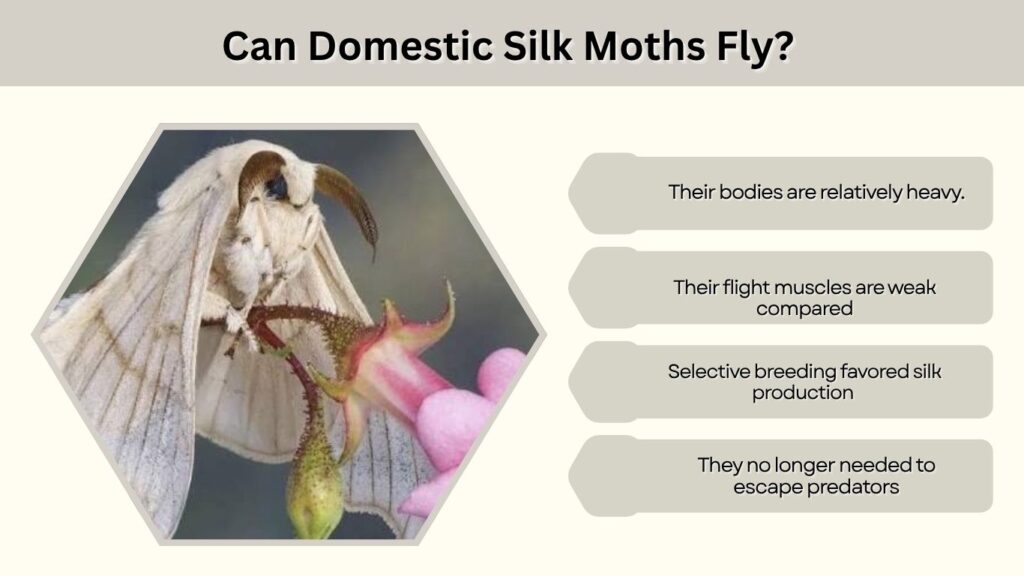
One of the most unusual characteristics of the domestic silk moth is its extremely limited ability to fly. Although adults have fully visible wings, generations of domestication have greatly reduced their flight capability. This makes them very different from their wild relatives, which depend much more heavily on flight for survival.
Why Can’t Domestic Silk Moths Fly?
Several factors contribute to their poor flight ability:
- Their bodies are relatively heavy.
- Their flight muscles are weak compared with wild moths.
- Selective breeding favored silk production rather than flight.
- Humans provided food, shelter, and breeding opportunities.
- They no longer needed to escape predators or travel long distances.
Some individuals may flutter or move their wings vigorously, but sustained normal flight is generally absent.
Domestic Silk Moth Wings
Their wings are usually cream-colored or off-white with subtle brownish lines. Even though the wings appear large enough for flight, their body structure and domestication prevent most adults from using them effectively.
The wings can still assist with limited movement and mating behavior.
Domestic Silk Moth Lifespan
Domestic silk moths spend much more time as growing larvae than as adults. Their exact lifespan varies with temperature, strain, diet, and breeding conditions. Once the adult moth emerges from its cocoon, its remaining life is relatively short because it does not need to feed.
How Long Do Domestic Silk Moths Live?
The adult stage commonly lasts only about one to two weeks. During this short period, the moths mate and females lay their eggs.
The complete lifespan from egg through adulthood is considerably longer, often spanning several weeks. Cooler temperatures or dormant eggs can extend the overall developmental period.
Domestic Silk Moth vs Wild Silk Moth
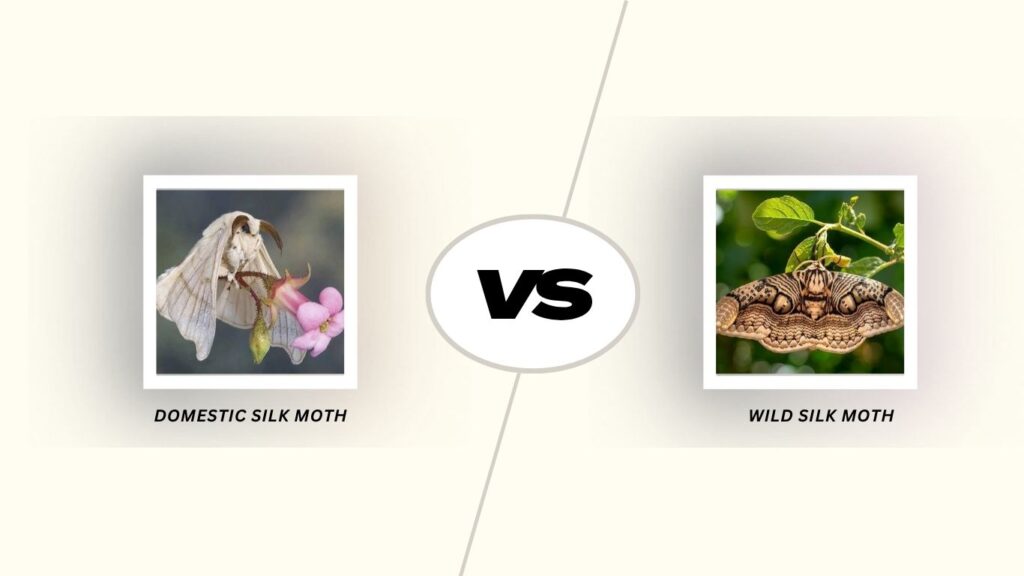
Domestic and wild silk moths share some biological similarities, but thousands of years of selective breeding have made Bombyx mori remarkably different from wild moth species. Domestic moths depend heavily on controlled environments, while wild silk moths must locate food, avoid predators, reproduce, and survive without human assistance.
Main Differences
Domestic silk moths differ from wild silk moths in several ways:
- Domestic silk moths generally cannot fly well.
- Wild moths usually retain strong flight abilities.
- Domestic silkworms depend heavily on human-provided food.
- Domestic moths are commonly pale or white.
- Wild species usually have stronger camouflage.
- Domestic strains have been selected for silk production.
- Wild species survive without human care.
Domestic silk moths are therefore poorly suited to permanent survival in natural environments.
When Were Silk Moths Domesticated?
Silkworm domestication began thousands of years ago in ancient China. People selectively bred caterpillars that produced desirable silk and were easier to raise.
Over many generations, this breeding process produced the modern domestic silk moth, which became increasingly different from its wild ancestors.
Raising Domestic Silk Moths
Domestic silk moths can be fascinating insects to observe, especially because their complete life cycle can be maintained in captivity. However, their caterpillars require consistent feeding and appropriate environmental conditions. Cleanliness is also important because crowded silkworm populations can be vulnerable to disease.
Basic Care Requirements
When raising domestic silk moths:
- Provide fresh mulberry leaves or suitable silkworm food.
- Keep caterpillars in a clean, ventilated container.
- Remove old food and waste regularly.
- Avoid excessive moisture.
- Provide enough space as larvae grow.
- Give mature larvae suitable areas for cocoon spinning.
- Protect adults because they cannot escape predators easily.
Adults need much less care because they do not normally eat.
Are Domestic Silk Moths Dangerous?
Domestic silk moths are harmless to people. Adults cannot sting and do not have functional biting mouthparts capable of injuring humans.
Silkworm caterpillars are also generally safe to handle carefully. Their domesticated nature and lack of defensive weapons make them very different from many insects people commonly consider pests.
FAQs
1. What is the scientific name of the domestic silk moth?
The scientific name of the domestic silk moth is Bombyx mori. It has been domesticated for thousands of years primarily for silk production. Its caterpillar, known as the silkworm, produces the valuable silk fiber used when constructing its cocoon.
2. Can domestic silk moths fly?
Domestic silk moths generally cannot fly effectively. Thousands of years of selective breeding have resulted in heavier bodies and reduced flight ability. Adults may flap their wings or move short distances, but they lack the sustained flight capability typical of many wild moth species.
3. What do domestic silk moths eat?
Domestic silk moth caterpillars primarily eat mulberry leaves or specially prepared silkworm food containing mulberry. Adult domestic silk moths generally do not eat because their mouthparts are reduced. Adults survive using stored energy accumulated while they were caterpillars.
4. How long do domestic silk moths live?
Adult domestic silk moths normally live for only about one to two weeks. Their complete development from egg to larva, pupa, and adult lasts much longer. Temperature, strain, food quality, and whether the eggs undergo dormancy can influence total lifespan.
5. Can you keep a domestic silk moth as a pet?
Yes. Domestic silk moths and silkworms can be raised for observation or educational purposes. Caterpillars require regular feeding, clean housing, ventilation, and suitable conditions for spinning cocoons. Adults are easier to maintain because they do not normally require food.