
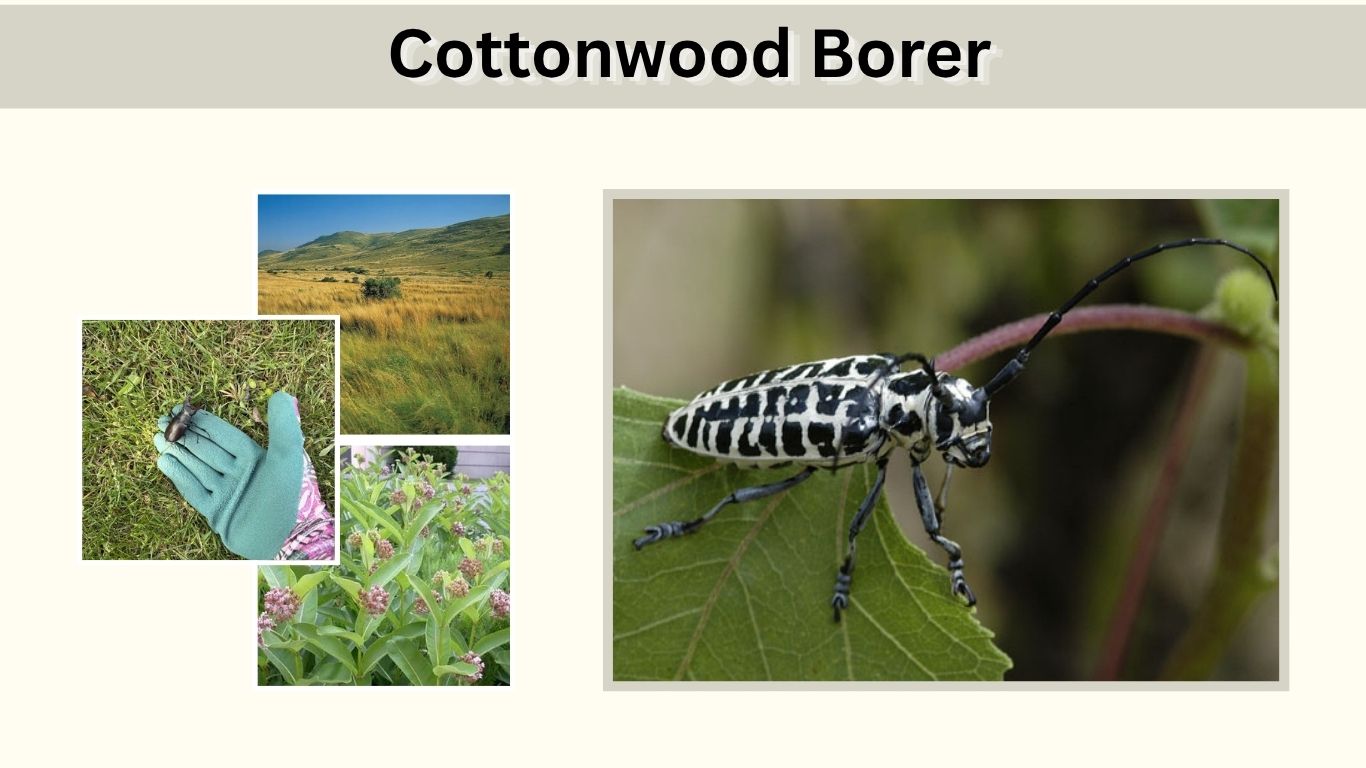
The cottonwood borer (Plectrodera scalator) is a large black and white beetle commonly found around cottonwood, poplar, and willow trees in North America. Known for its striking spotted appearance and exceptionally long antennae, this insect belongs to the longhorn beetle family. While adult beetles feed on tender shoots, their larvae tunnel into tree roots and lower trunks, sometimes causing serious damage. Understanding cottonwood borer identification, life cycle, feeding habits, and control methods can help homeowners recognize infestations and protect vulnerable trees.
What Is a Cottonwood Borer?
The cottonwood borer is a native North American wood-boring beetle belonging to the family Cerambycidae. Its scientific name is Plectrodera scalator, and it is one of the largest and most recognizable longhorn beetles found in the United States.
These beetles primarily inhabit areas where cottonwood, willow, and poplar trees grow. Adults are usually visible during late spring and summer, while their larvae develop inside roots and lower trunks.
Although cottonwood borers are not considered dangerous to humans, their underground feeding activities can seriously weaken young or already stressed trees.
Cottonwood Borer Beetle Identification
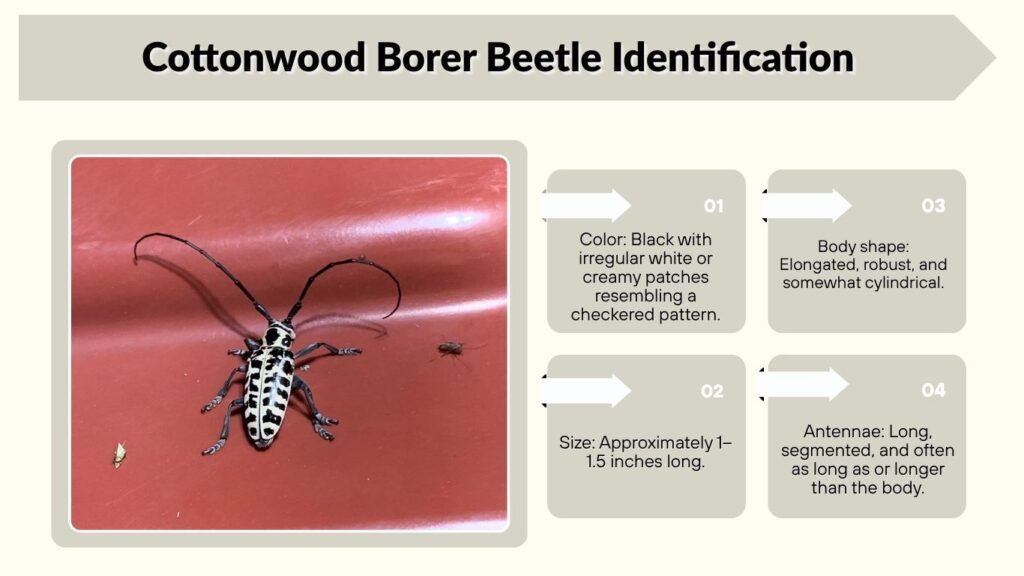
Cottonwood borer beetles are easily recognized by their large bodies, distinctive black and white markings, and unusually long antennae.
Physical Appearance
- Color: Black with irregular white or creamy patches resembling a checkered pattern.
- Size: Approximately 1–1.5 inches long.
- Body shape: Elongated, robust, and somewhat cylindrical.
- Antennae: Long, segmented, and often as long as or longer than the body.
- Legs: Six strong, dark-colored legs.
- Wing covers: Hard, patterned forewings protecting the flight wings underneath.
The white markings are formed by dense, light-colored hairs covering portions of the beetle’s body.
Adult cottonwood borers are sometimes mistaken for other spotted longhorn beetles, but their large size and distinctive pattern help distinguish them.
Where Do Cottonwood Borers Live?
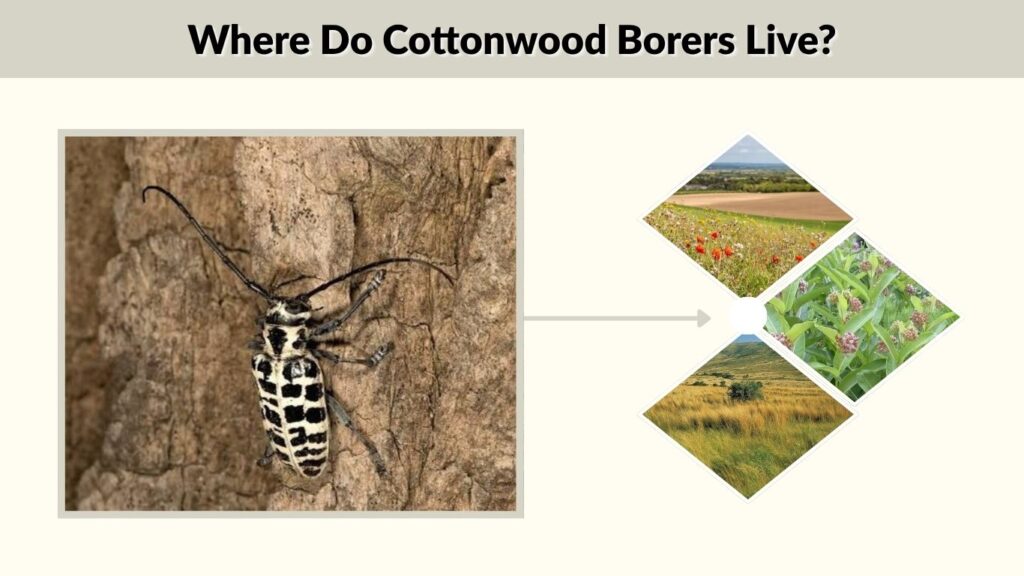
Cottonwood borers occur primarily in the central, southern, and parts of the eastern United States. They are particularly familiar insects in states such as Texas, Oklahoma, Kansas, and Louisiana.
Their distribution is closely associated with suitable host trees and their growing conditions.
Common habitats include:
- Riverbanks and floodplains.
- Cottonwood forests and woodland edges.
- Parks with mature cottonwood trees.
- Tree nurseries and young plantations.
- Residential landscapes containing poplars or willows.
Adult beetles are commonly seen resting or feeding on trunks and branches during warmer months.
What Do Cottonwood Borers Eat?
Cottonwood borers feed on living tree tissues, but their food preferences change as they develop.
Adult cottonwood borers consume tender bark, young twigs, and leaf stems. Their feeding can cause shoots to shrivel, wilt, or break.
Cottonwood borer larvae feed beneath the bark and inside the roots and lower trunks of host trees. They create tunnels through living tissues and surrounding wood as they grow.
Cottonwood is their primary host, although poplars and willows are also susceptible.
Larval feeding generally causes more serious damage than adult feeding because it affects the tree’s structural strength and essential tissues near the root collar.
Cottonwood Borer Life Cycle
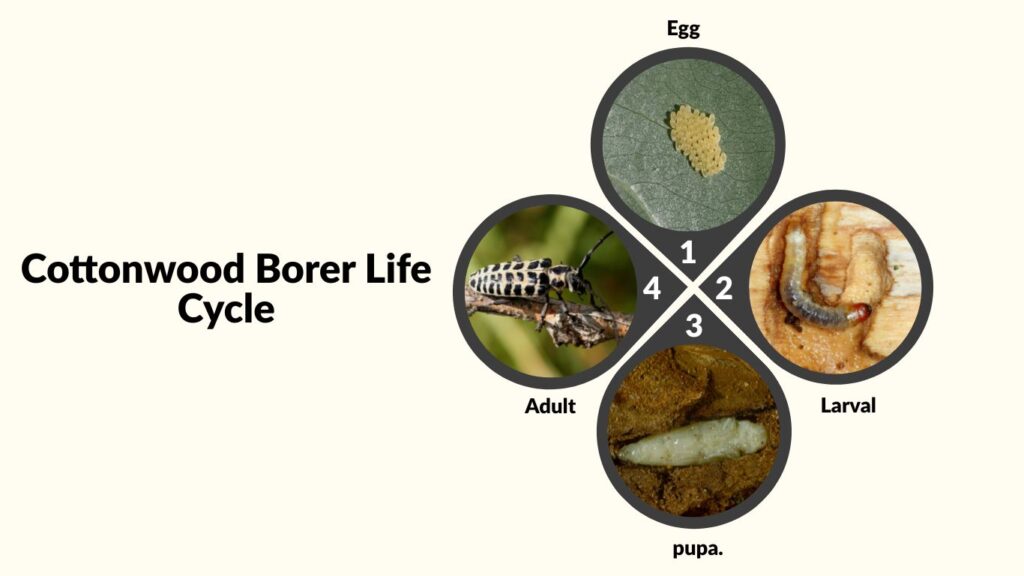
The cottonwood borer undergoes complete metamorphosis, developing through four stages: egg, larva, pupa, and adult.
Its life cycle commonly lasts approximately one to two years, depending on environmental conditions.
1. Egg Stage
Female cottonwood borers dig small openings around the base of host trees and chew niches into the bark. They deposit eggs near or slightly below the soil surface.
The eggs generally hatch within approximately two weeks, although timing varies with temperature.
2. Larval Stage
Newly hatched larvae tunnel into the inner bark and gradually move downward toward the roots.
The cream-colored, legless grubs feed inside woody tissues, creating galleries that may weaken the root collar.
They overwinter inside the tree and continue developing during subsequent growing seasons.
3. Pupal Stage
Mature larvae form pupal chambers within their galleries near the base of the tree. During this stage, they transform into adult beetles.
4. Adult Stage
Adults emerge during late spring or summer, chew on tender shoots, mate, and reproduce.
The next generation begins when females deposit eggs around suitable host trees.
Cottonwood Borer Damage to Trees
Cottonwood borer damage occurs primarily around tree bases and roots, where larvae tunnel through living wood.
Young cottonwood trees are especially vulnerable because even a small number of larvae can weaken their relatively narrow trunks.
Common Signs of Infestation
- Wilting shoots: Tender branches may turn brown or black after adult feeding.
- Sawdust-like material: Frass may collect around openings near the tree base.
- Root damage: Larval tunnels can weaken the root collar and major roots.
- Poor growth: Severely infested trees may show reduced vigor.
- Structural weakness: Trees may break near ground level during storms.
Heavy infestations can girdle young trees, interfering with the movement of nutrients and water.
Mature trees generally tolerate light or moderate infestations better, but extensive tunneling can still create structural hazards.
Are Cottonwood Borer Beetles Poisonous or Dangerous?
Cottonwood borer beetles are not known to be poisonous or venomous to humans. They do not possess a stinger and are not considered medically significant insects.
Their intimidating size and long antennae may make them appear threatening, but they generally avoid confrontation.
The primary danger associated with cottonwood borers involves damage to host trees rather than direct harm to people.
Do Cottonwood Borers Bite?
Cottonwood borers have strong chewing mouthparts and may deliver a defensive pinch or bite when roughly handled.
However, they do not seek out humans to bite, and their bites are not venomous.
If handled carelessly, a beetle may cause temporary discomfort or minor skin irritation. Washing the affected area with soap and water is usually sufficient for a minor superficial injury.
Avoid squeezing or provoking these beetles, especially when examining them closely.
How to Get Rid of Cottonwood Borer Beetles
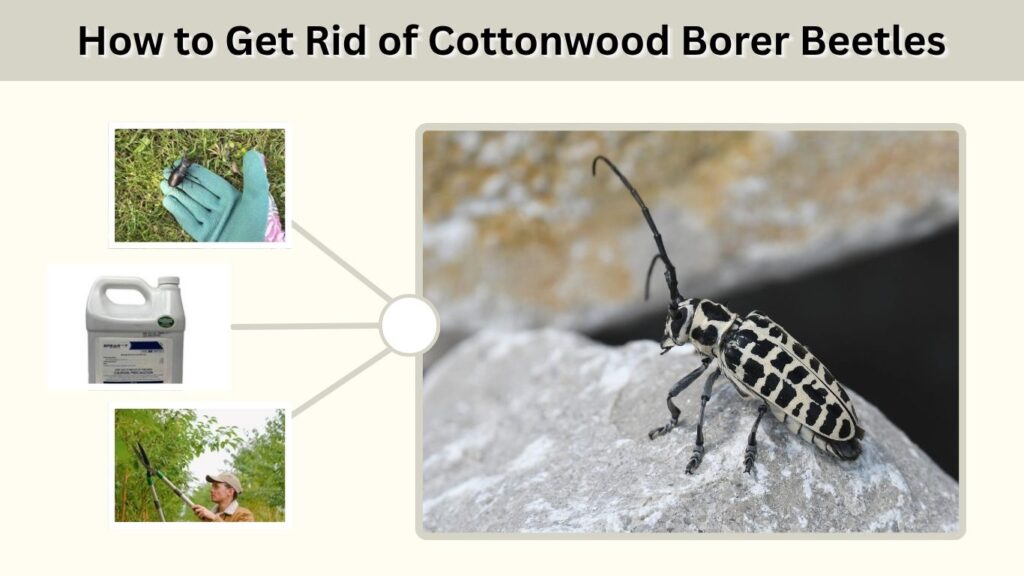
Effective cottonwood borer control focuses on protecting vulnerable trees and preventing females from laying eggs.
Because larvae live beneath bark and inside roots, established infestations can be difficult to treat.
1. Inspect Tree Bases
Examine the lower trunk, root collar, and surrounding soil for frass, damage, or signs of tunneling.
Early detection is particularly important for young cottonwood trees.
2. Maintain Healthy Trees
Provide adequate water during dry periods and reduce unnecessary injury to roots and bark.
Healthy trees growing in suitable soil conditions are generally better able to withstand insect damage.
3. Remove Adult Beetles
When adult beetles are actively feeding on small trees, they can be collected by hand while wearing protective gloves.
This may reduce local feeding but will not eliminate larvae already inside the tree.
4. Seek Professional Larval Treatment
For valuable young trees, a qualified arborist may assess accessible larval tunnels and determine whether careful physical removal is appropriate.
Improper cutting around the root collar can create additional damage, so avoid digging into healthy bark without professional guidance.
5. Consider Targeted Insecticide Treatment
Preventive insecticide applications may sometimes be recommended during adult egg-laying periods.
However, chemical treatments must be specifically labeled for the host tree, pest, and application site. Contact a local extension specialist or licensed professional before treatment.
Insecticides generally cannot reliably reach larvae already protected deep inside woody roots.
Cottonwood Borer Prevention Tips
Preventing infestations is usually easier than managing extensive underground damage.
Plant cottonwoods in suitable locations, avoid excessive soil compaction, and provide appropriate irrigation during establishment.
Inspect newly planted trees regularly, especially during spring and summer.
Avoid damaging lower trunks with landscaping equipment, and monitor trees that develop unexplained shoot dieback or structural weakness.
If a heavily damaged tree stands near a building or walkway, arrange a professional tree-risk assessment.
FAQs
1. Can cottonwood borer beetles fly?
Yes. Adult cottonwood borers possess functional wings beneath their hard wing covers and can fly between suitable host trees.
2. Are cottonwood borer beetles common in Texas?
Yes. Cottonwood borers are well-known in Texas, particularly where cottonwood, poplar, and willow trees grow.
3. Can cottonwood borers kill a tree?
Yes. Severe larval infestations can girdle or structurally weaken young trees. Mature trees usually tolerate lighter infestations more successfully.
4. What is the difference between a cottonwood borer and a cottonwood leaf beetle?
Cottonwood borers are large, black and white longhorn beetles whose larvae tunnel into roots. Cottonwood leaf beetles are much smaller, and their larvae primarily feed on foliage.
5. How long do cottonwood borers live?
Their complete life cycle commonly takes one to two years, with most of that time spent developing as larvae inside the host tree. Adult beetles live for a much shorter period.
