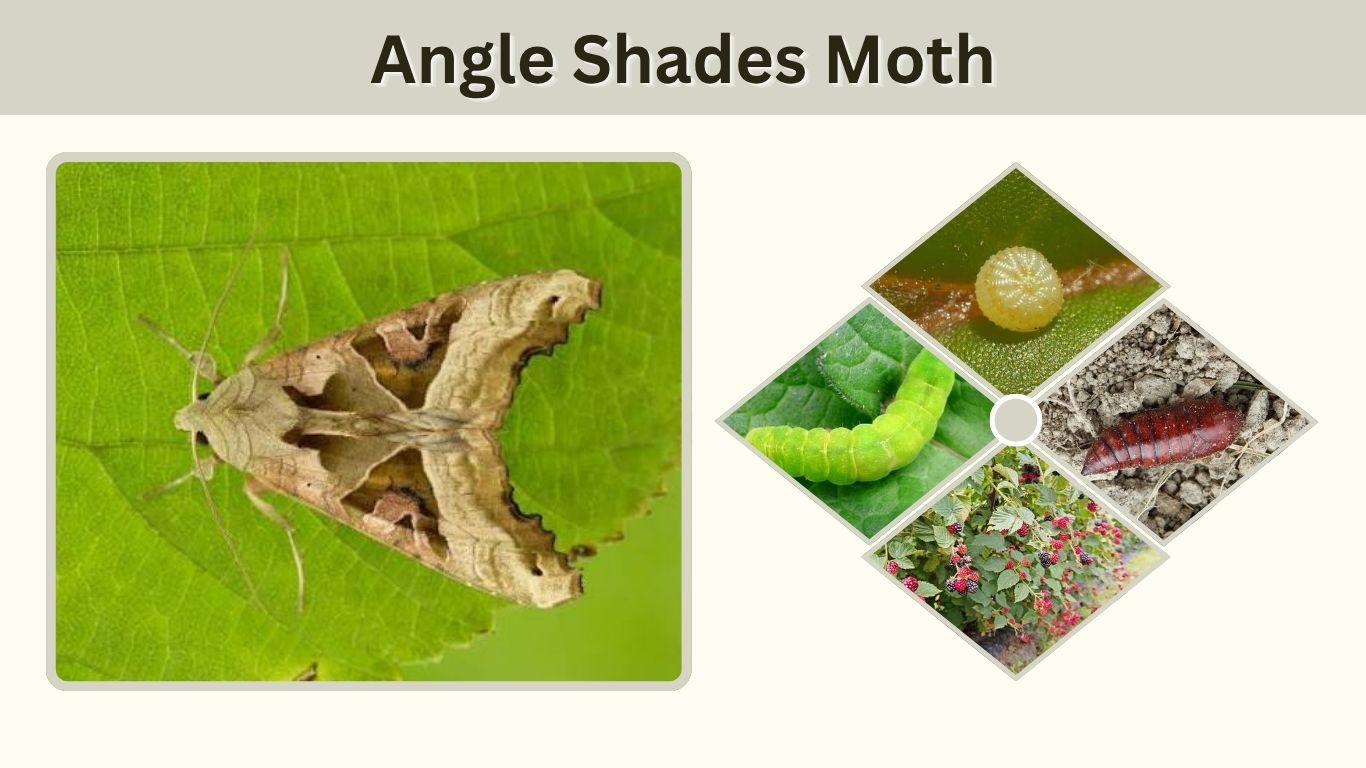
The Angle Shades moth (Phlogophora meticulosa) is a distinctive noctuid moth famous for its folded wings and remarkable resemblance to a dry, crumpled autumn leaf. It is widespread across Britain and occurs elsewhere in Europe, with migrating individuals sometimes appearing in large numbers. Its caterpillar may be green or brown and feeds on many different plants. From its unusual camouflage and adaptable diet to its winter caterpillar stage and underground cocoon, the Angle Shades has one of the more interesting life cycles among common garden moths.
What Is an Angle Shades Moth?
The Angle Shades moth belongs to the family Noctuidae and has the scientific name Phlogophora meticulosa. It is a medium-sized moth that is especially recognizable when resting.
Rather than holding its wings completely flat, it folds them lengthwise. Combined with angular markings and irregular wing edges, this creates the appearance of a dead or wilted leaf. This camouflage helps disguise the moth while it rests during daylight hours.
Angle Shades Moth Identification
Key identification features include:
- Scientific name: Phlogophora meticulosa
- Family: Noctuidae
- Wingspan: approximately 45–50 mm
- Forewings: angular and strongly patterned
- Colors: olive, brown, pinkish brown, cream and greenish shades
- Resting posture: wings folded lengthwise
- Appearance: resembles a dried or withered leaf
- Activity: primarily active at night
- Flight season: mainly May through October in Britain
Adults can sometimes be found resting openly on walls, fences, vegetation and other surfaces during the daytime.
Angle Shades Moth Caterpillar
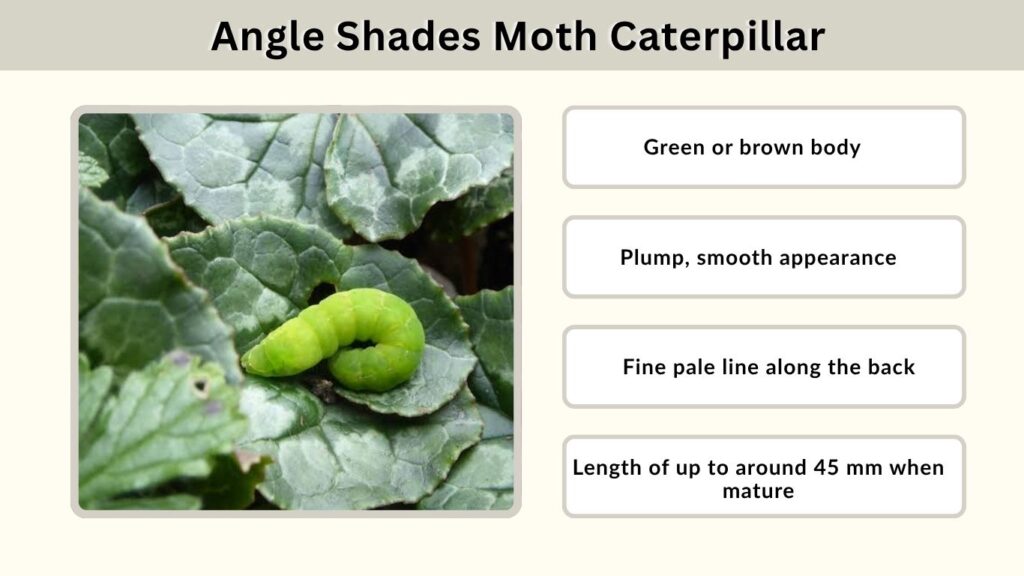
The Angle Shades moth caterpillar is much less dramatic in appearance than the adult. Larvae are relatively stout and may be green, yellowish green, brown or combinations of these colors.
They typically have faint longitudinal markings and pale lines along the body. Color can vary considerably, so green and brown caterpillars may both belong to the same species.
The mature caterpillar can reach approximately 4–4.5 cm in length.
How to Identify the Caterpillar
Look for:
- Green or brown body
- Plump, smooth appearance
- Fine pale line along the back
- Light-colored markings along the sides
- Faint diagonal or segment markings
- Length of up to around 45 mm when mature
Angle Shades caterpillars are frequently discovered by gardeners while moving plants, weeding or checking foliage.
What Do Angle Shades Moth Caterpillars Eat?
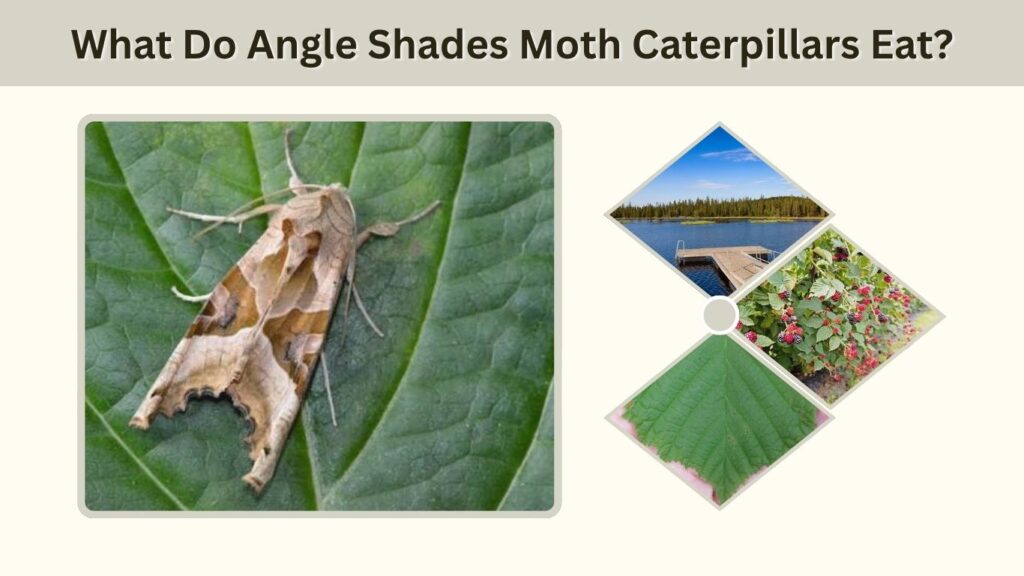
Angle Shades larvae have a very broad diet, which contributes to their success in gardens and natural habitats.
Common caterpillar food plants include:
- Stinging nettle
- Dock
- Bramble
- Hazel
- Red valerian
- Various grasses
- Herbaceous garden plants
- Shrubs
- Other broad-leaved plants
Because they can use many host plants, caterpillars may appear in vegetable patches, flower gardens, hedgerows and woodland vegetation.
Do Angle Shades Caterpillars Damage Plants?
They eat foliage and sometimes flower buds, so individual leaves can show feeding damage. However, the Angle Shades is generally treated as part of normal garden biodiversity rather than a major pest.
A few caterpillars usually cause limited damage to established plants. In most gardens, control is unnecessary.
What Do Adult Angle Shades Moths Eat?
Adult Angle Shades moths feed primarily on nectar from flowers.
They can visit flowering grasses and other nectar-producing plants at night. Ivy flowers may also provide an important autumn nectar source for Angle Shades and numerous other moth species.
Adults may also be attracted to artificial lights, which is why people sometimes find them around houses, porches, windows and outdoor lamps.
Angle Shades Moth Life Cycle
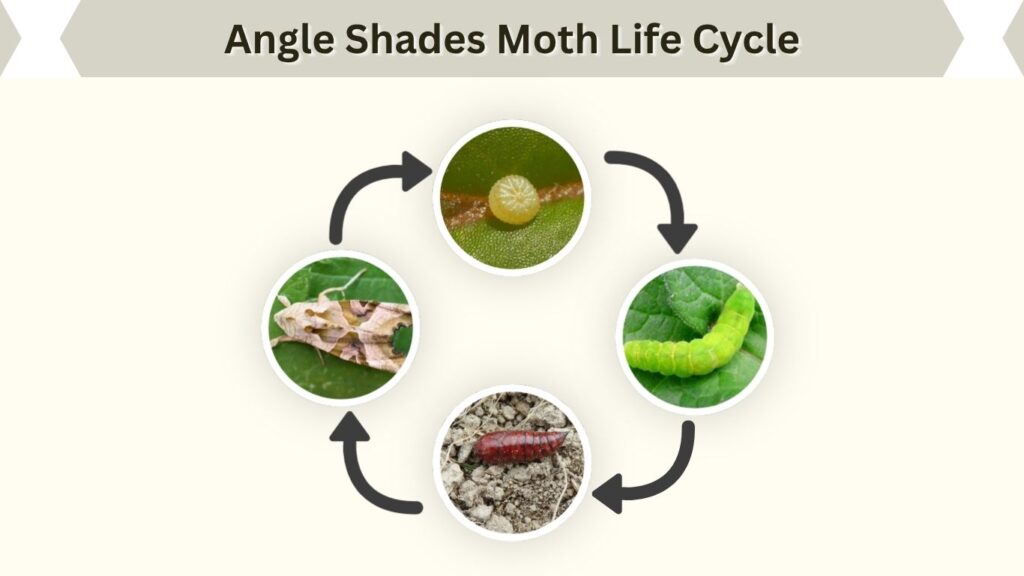
The Angle Shades moth life cycle follows the four stages typical of moths:
Egg → Caterpillar → Pupa → Adult
In Britain, there are generally at least two generations during the main season. Adults are most frequently encountered from May through October, although individuals have been recorded outside this period.
1. Eggs
Female moths lay eggs on or near suitable caterpillar food plants.
After development, small larvae emerge and begin feeding on leaves. Because the species uses numerous plant types, females have many potential places to lay their eggs.
2. Larvae
The caterpillar grows through several molts while feeding.
An especially interesting feature of the Angle Shades is its ability to overwinter as a caterpillar. Larvae can remain active and feed during periods of mild winter weather. As a result, caterpillars may potentially be encountered throughout the year.
3. Pupa and Cocoon
When fully grown, the caterpillar prepares to pupate.
The Angle Shades typically makes a cocoon just beneath the soil surface. Inside this protective structure, the caterpillar transforms into a pupa and eventually develops into an adult moth.
4. Adult Moth
The adult emerges from the pupal stage, expands its wings and becomes capable of flight.
Adults seek nectar and mates, after which females lay eggs and begin the next generation.
Angle Shades Moth Cocoon and Pupa
The terms cocoon, pupa and chrysalis are sometimes used interchangeably, but they describe slightly different things.
The pupa is the actual developmental stage in which the caterpillar transforms into an adult. A cocoon is the protective structure surrounding it.
Angle Shades larvae generally pupate inside a cocoon positioned just beneath the soil. Therefore, gardeners digging or moving soil may occasionally uncover a pupa or cocoon.
How Long Does the Cocoon Stage Last?
There is no single fixed period that applies to every individual. Development depends heavily on temperature, season and generation.
In warm conditions, development can proceed relatively quickly. Individuals entering an overwintering stage may take substantially longer before adults emerge.
For this reason, finding a pupa does not always allow an exact adult emergence date to be predicted.
Angle Shades Moth in the UK and Ireland
The Angle Shades moth is widespread throughout Britain and can be common, particularly in southern areas. It occurs in gardens, grassland, woodland edges, hedgerows, parks and many other habitats.
It also occurs in Ireland. Records from Northern Ireland describe the species as distinctive and document its distribution there.
Angle Shades are also migrants. Additional moths can arrive from continental Europe, sometimes producing noticeably higher numbers around coastal areas.
American Angle Shades vs Angle Shades Moth
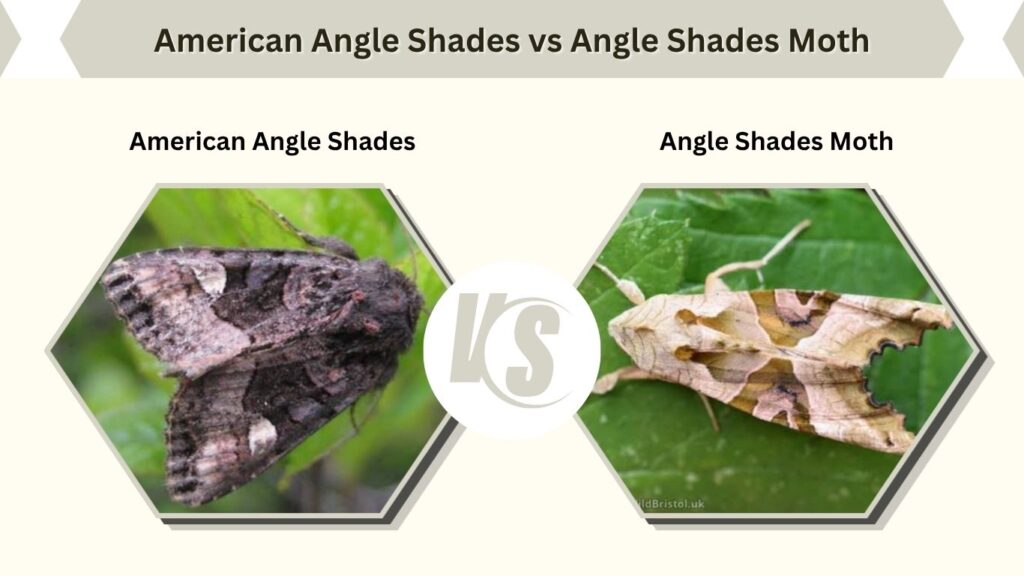
The American Angle Shades moth is not simply the American population of Phlogophora meticulosa. It is a different species.
The American Angle Shades is scientifically known as Euplexia benesimilis and occurs in North America. Its wingspan is approximately 28–36 mm, making it generally smaller than the European Angle Shades.
| Feature | Angle Shades | American Angle Shades |
| Scientific name | Phlogophora meticulosa | Euplexia benesimilis |
| Main range | Europe, including UK | North America |
| Wingspan | About 45–50 mm | About 28–36 mm |
| Family | Noctuidae | Noctuidae |
Therefore, a moth identified as an American Angle Shades in North America should not automatically be labeled Phlogophora meticulosa.
Small Angle Shades Moth
The Small Angle Shades is another separate species that can easily create confusion because of its similar common name.
Its scientific name is Euplexia lucipara. It is widespread across much of the British Isles and has a wingspan of approximately 27–32 mm.
As its name suggests, it is considerably smaller than the Angle Shades.
The Small Angle Shades also differs in its caterpillar food preferences. Its larvae commonly feed on bracken and other ferns as well as various low-growing plants and trees.
Brown Angle Shades Moth
Color variation can make Angle Shades appear strongly brown, particularly when its greenish or pink tones are less obvious.
However, the name Brown Angle Shades can also refer to a separate North American species, Phlogophora periculosa. Therefore, color alone should not be used to identify an Angle Shades moth.
Location, size, wing markings and resting posture provide better identification clues.
Are Angle Shades Moths Dangerous?
Angle Shades moths are harmless to humans. Adults do not sting, and they are not aggressive.
Their caterpillars are also not regarded as dangerous stinging caterpillars. Finding one in a garden normally requires no treatment or pest-control response.
The adult’s unusual appearance can sometimes make it look like a damaged leaf or even an unfamiliar insect when it rests with its wings folded.
FAQs
How big is an Angle Shades moth?
The adult Angle Shades usually has a wingspan of approximately 45–50 mm.
What does an Angle Shades caterpillar eat?
The caterpillar feeds on numerous plants, including nettles, docks, bramble, hazel and various garden plants.
Do Angle Shades caterpillars survive winter?
Yes. The species can overwinter as a caterpillar, with larvae sometimes feeding during mild winter weather.
Where does the Angle Shades moth make its cocoon?
The mature caterpillar generally forms its cocoon just beneath the soil surface, where it pupates before becoming an adult.
Is the American Angle Shades the same moth?
No. The European Angle Shades is Phlogophora meticulosa, while the American Angle Shades is a separate North American species called Euplexia benesimilis.