
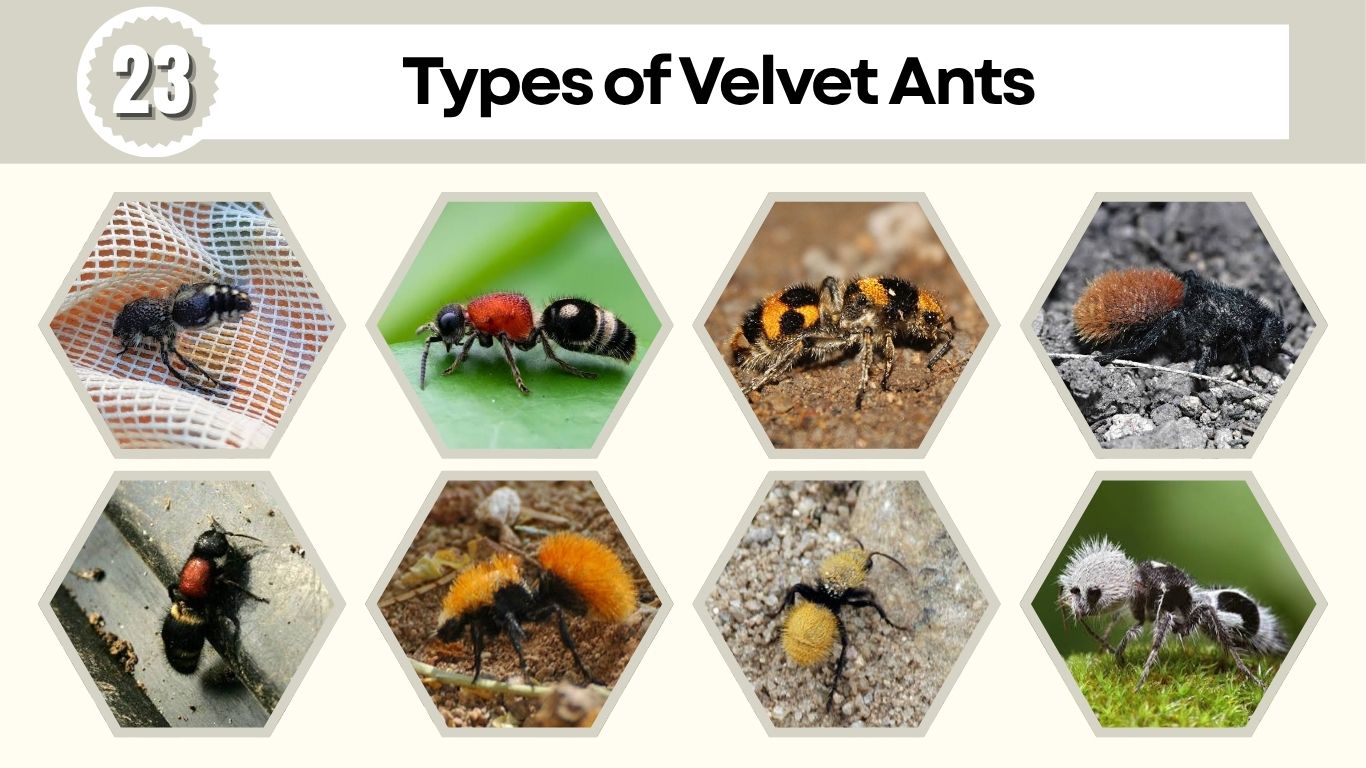
Velvet ants are fascinating insects known for their bright colors, fuzzy bodies, and powerful defensive stings. Despite their name, these insects are actually solitary wasps, not true ants. Found in deserts, grasslands, forests, and tropical regions, velvet ants display remarkable differences in size, appearance, and behavior. In this guide, we’ll explore 23 types of velvet ants, including their identification features, habitats, feeding habits, and life cycles.
1. Eastern Velvet Ant (Dasymutilla occidentalis)
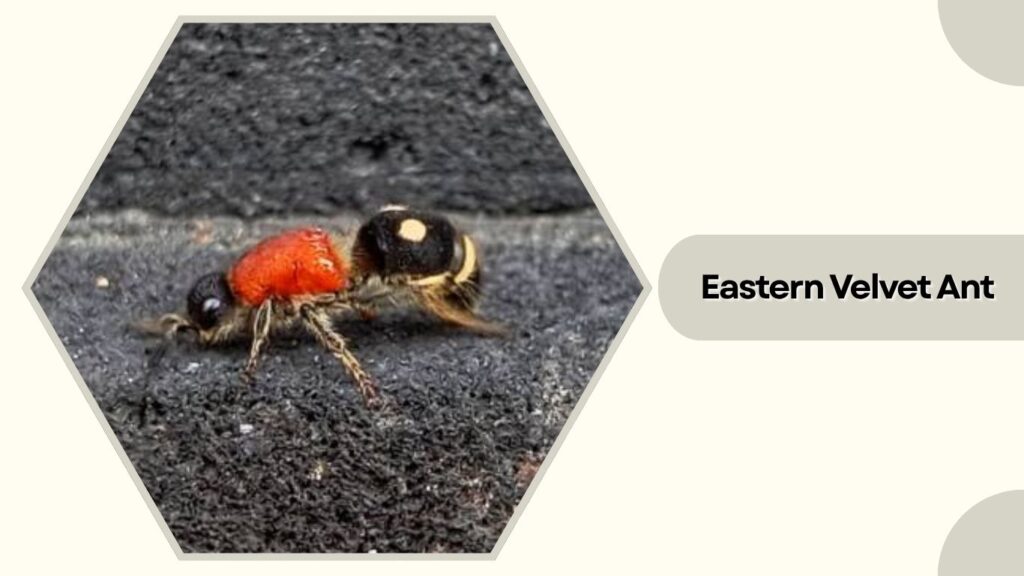
The Eastern Velvet Ant (Dasymutilla occidentalis) is a striking insect belonging to the family Mutillidae. Despite its name, this species is actually a solitary wasp rather than a true ant. Commonly known as the Cow Killer, it is famous for its extremely painful sting. Its bright red and black coloration, dense velvety hairs, and wingless females make it one of the most recognizable velvet ants in North America.
Identification
- Scientific Name: Dasymutilla occidentalis
- Family: Mutillidae
- Adult Size: Approximately 15–25 mm long.
- Body Color: Bright reddish-orange with contrasting black markings.
- Head: Rounded, covered with reddish-orange hairs.
- Body Texture: Dense, soft-looking, velvety hairs.
- Male Appearance: Winged, with dark wings and reddish-orange markings.
- Female Appearance: Wingless, with a robust body and powerful stinger.
- Distinctive Features: Bright warning coloration, black legs, and a painful defensive sting.
Habitat and Distribution
Eastern Velvet Ants inhabit grasslands, open fields, sandy landscapes, woodland edges, and residential gardens throughout the eastern and central United States. They prefer warm, sunny environments with loose soil. Females are frequently observed running across exposed ground while searching for suitable host nests.
Feeding Habits and Behavior
Adult Eastern Velvet Ants feed mainly on flower nectar. They are solitary insects and do not establish organized colonies. Females possess a powerful sting used for defense against predators. Although their sting is extremely painful, they are generally nonaggressive and prefer escaping when disturbed.
Life Cycle and Reproduction
Female Eastern Velvet Ants locate underground bumblebee nests and lay eggs near developing broods. After hatching, their larvae develop as parasitoids, consuming the host’s immature stages. They eventually pupate within the host nest before emerging as adults. Their development follows four stages: egg, larva, pupa, and adult.
2. Pacific Velvet Ant (Dasymutilla aureola)
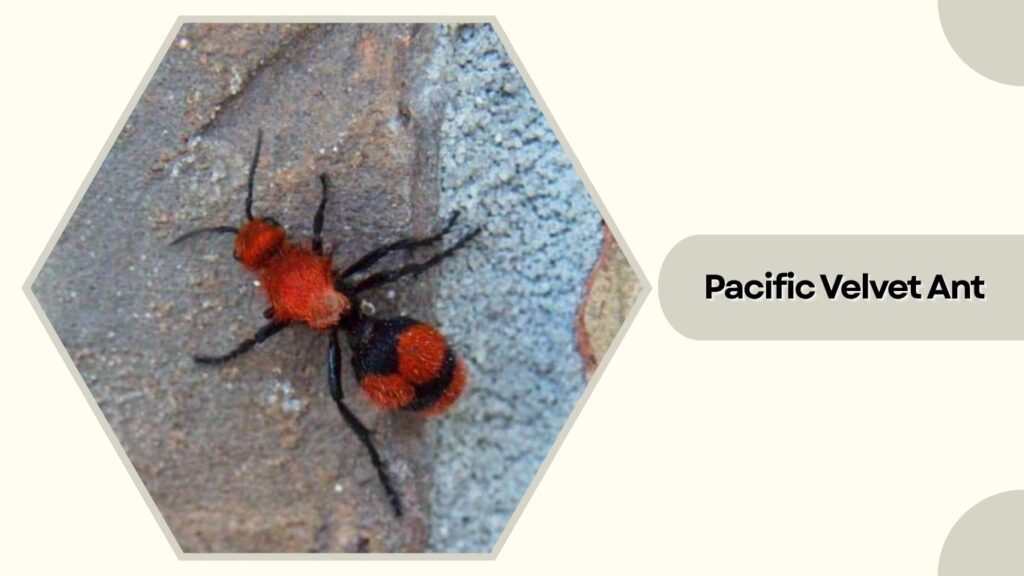
The Pacific Velvet Ant (Dasymutilla aureola) is a distinctive wasp belonging to the family Mutillidae. Found primarily along the Pacific coast of North America, this species is recognizable by its dense reddish-orange hairs and unusually broad head. Despite resembling a large, fuzzy ant, it is actually a solitary wasp. Females lack wings and possess a defensive stinger capable of delivering a painful sting.
Identification
- Scientific Name: Dasymutilla aureola
- Family: Mutillidae
- Adult Size: Approximately 12–15 mm long.
- Body Color: Reddish-orange to scarlet with dark underlying body segments.
- Head: Large, broad, and noticeably wider than the thorax in females.
- Body Texture: Covered with dense, soft-looking hairs.
- Male Appearance: Winged, with reddish hairs and a comparatively slender body.
- Female Appearance: Wingless, robust, and densely covered with reddish hairs.
- Distinctive Features: Broad head, short thorax, bright coloration, and ant-like movements.
Habitat and Distribution
Pacific Velvet Ants inhabit dry grasslands, coastal scrublands, open woodlands, and sandy landscapes along western North America. Their range includes California, Oregon, British Columbia, and Baja California. Females frequently move across exposed soil while searching for suitable nesting sites of other insects.
Feeding Habits and Behavior
Adult Pacific Velvet Ants feed primarily on nectar from flowering plants. Females spend much of their time walking across the ground, while winged males fly in search of mates. They are solitary and generally avoid confrontation, although females can deliver painful defensive stings when handled.
Life Cycle and Reproduction
Female Pacific Velvet Ants search for nests containing developing bees or wasps. Like other velvet ants, their larvae develop as parasitoids of immature host insects. After consuming their host, the larvae pupate and eventually emerge as adults. Their development includes four stages: egg, larva, pupa, and adult.
3. Thistledown Velvet Ant (Dasymutilla gloriosa)
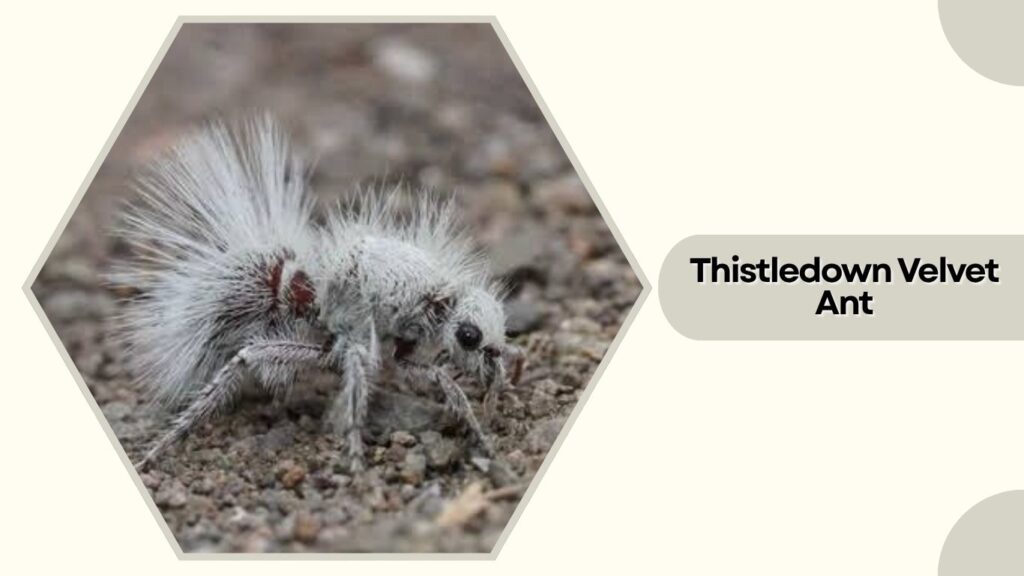
The Thistledown Velvet Ant (Dasymutilla gloriosa) is an unusual desert-dwelling wasp belonging to the family Mutillidae. Unlike many brightly colored velvet ants, this species has dense white or silvery hairs that give it a fluffy appearance. Its coloration resembles drifting thistledown and may help it blend into desert environments. This distinctive appearance makes it one of the most recognizable velvet ants in southwestern North America.
Identification
- Scientific Name: Dasymutilla gloriosa
- Family: Mutillidae
- Adult Size: Approximately 13–16 mm long.
- Body Color: White, silvery-gray, or pale cream.
- Head: Dark underneath dense, pale-colored hairs.
- Body Texture: Thick, fluffy hairs covering most of the body.
- Male Appearance: Winged, with a darker body and contrasting pale hairs.
- Female Appearance: Wingless, with exceptionally dense white hairs.
- Distinctive Features: Cotton-like appearance, pale coloration, and resemblance to creosote bush seed coverings.
Habitat and Distribution
Thistledown Velvet Ants inhabit deserts, arid grasslands, sandy plains, and open scrublands throughout the southwestern United States and northern Mexico. They occur in Arizona, California, Nevada, Utah, New Mexico, and Texas. They are particularly associated with desert environments containing creosote bushes and suitable ground-nesting insects.
Feeding Habits and Behavior
Adults primarily feed on flower nectar, while females spend considerable time searching for host nests. Their white coloration provides camouflage against pale desert vegetation and may help them avoid predators. Although females possess powerful defensive stingers, they are generally solitary and nonaggressive unless threatened or handled.
Life Cycle and Reproduction
Female Thistledown Velvet Ants locate suitable nests of other solitary bees or wasps and deposit eggs near developing host brood. After hatching, the larvae feed as parasitoids on immature hosts. They subsequently pupate within protected nesting chambers before emerging as adults. Their life cycle includes egg, larval, pupal, and adult stages.
4. Klug’s Velvet Ant (Dasymutilla klugii)
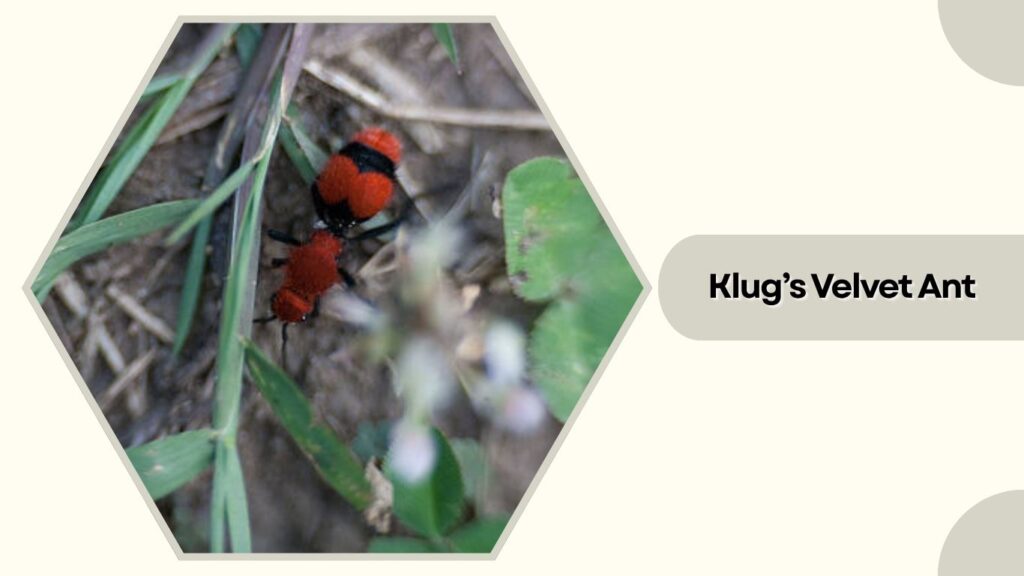
Klug’s Velvet Ant (Dasymutilla klugii) is a large, brightly colored wasp belonging to the family Mutillidae. Found throughout south-central North America, this species is particularly common in Texas and surrounding regions. Its dense reddish-orange hairs and robust body make it highly recognizable. Despite its ant-like appearance, it is a solitary wasp, and females possess a powerful defensive sting.
Identification
- Scientific Name: Dasymutilla klugii
- Family: Mutillidae
- Adult Size: Generally 13–25 mm long.
- Body Color: Black with dense reddish-orange hairs.
- Head: Dark, relatively narrow compared with the thorax.
- Body Texture: Covered with thick, velvety hairs.
- Male Appearance: Winged, with dark coloration and reddish markings.
- Female Appearance: Wingless, robust, and densely hairy.
- Distinctive Features: Large body, reddish-orange abdomen, narrow head, and extremely painful defensive sting.
Habitat and Distribution
Klug’s Velvet Ants inhabit deserts, dry grasslands, open woodlands, and sandy landscapes across the southwestern United States and Mexico. Their distribution extends from Utah and surrounding southwestern states into central Mexico. They frequently occur in Texas, particularly in areas containing abundant ground-nesting wasps.
Feeding Habits and Behavior
Adults primarily consume nectar from flowering plants. Wingless females actively search the ground for suitable host nests, while males fly in search of mates. Their bright coloration warns potential predators of their defensive capabilities. Although females can deliver exceptionally painful stings, they generally avoid confrontation and attempt to escape when disturbed.
Life Cycle and Reproduction
Female Klug’s Velvet Ants locate nests of solitary wasps, including certain cicada-killer wasps, and deposit eggs near developing host brood. After hatching, the larvae consume the immature host. They eventually pupate inside the protected nesting chamber before emerging as adults. Their development includes four stages: egg, larva, pupa, and adult.
5. Magnificent Velvet Ant (Dasymutilla magnifica)
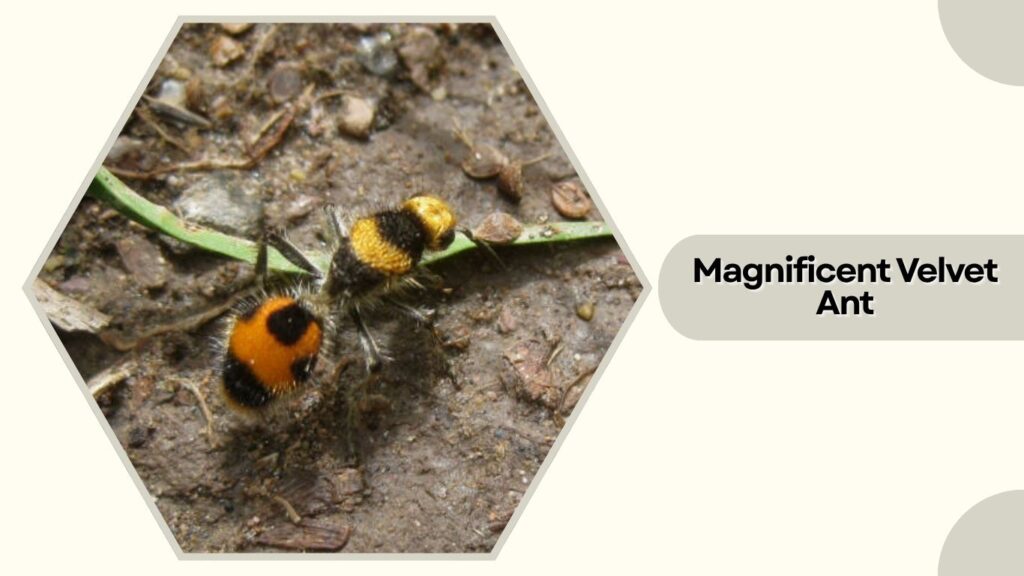
The Magnificent Velvet Ant (Dasymutilla magnifica) is a striking desert-dwelling wasp belonging to the family Mutillidae. This species is native to southwestern North America, where it inhabits dry desert landscapes and mountainous regions. Its bold reddish-orange and black coloration makes it visually similar to several related velvet ants, particularly Klug’s Velvet Ant. Females are wingless and possess powerful defensive stingers.
Identification
- Scientific Name: Dasymutilla magnifica
- Family: Mutillidae
- Adult Size: A large velvet ant, often around 15–25 mm long.
- Body Color: Black with prominent reddish-orange abdominal hairs.
- Head: Dark black and rounded.
- Body Texture: Dense, velvety hairs covering much of the abdomen.
- Male Appearance: Winged, with a darker body and contrasting markings.
- Female Appearance: Wingless, robust, and brightly colored.
- Distinctive Features: Reddish abdominal hairs, black head and thorax, and reddish hair bands underneath the abdomen.
Habitat and Distribution
Magnificent Velvet Ants inhabit desert scrublands, sandy plains, rocky landscapes, and dry woodland environments throughout the southwestern United States. They occur particularly in the Mojave and Sonoran deserts and mountainous regions of Arizona. Their distribution overlaps with several similarly colored velvet ant species.
Feeding Habits and Behavior
Adult Magnificent Velvet Ants primarily consume nectar from flowering desert plants. Females travel across the ground searching for suitable nests of other solitary wasps or bees. Their reddish coloration serves as a warning to potential predators. Although capable of delivering painful stings, these insects are not naturally aggressive toward humans.
Life Cycle and Reproduction
Like other members of the family Mutillidae, Magnificent Velvet Ants reproduce through a parasitoid life cycle. Females deposit eggs in suitable host nests, where the developing larvae consume immature host insects. After feeding, the larvae pupate within sheltered chambers and later emerge as adults. The exact seasonal timing of reproduction depends on local environmental conditions.
6. Four-Spotted Velvet Ant (Dasymutilla quadriguttata)
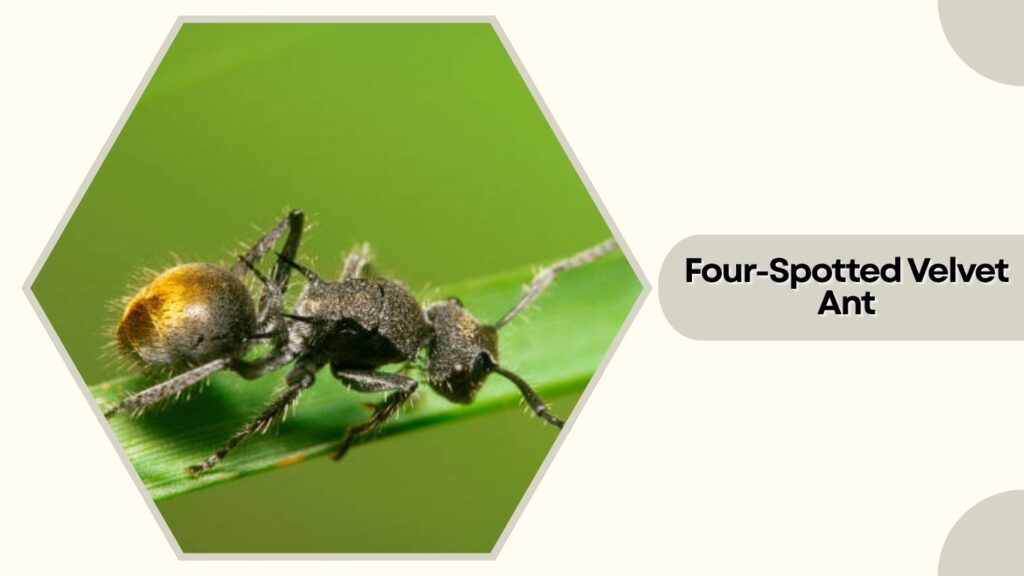
The Four-Spotted Velvet Ant (Dasymutilla quadriguttata) is a distinctive North American wasp belonging to the family Mutillidae. This species is known for its contrasting body coloration and pale abdominal spots. Despite its common name, the number and arrangement of spots can vary between individuals. Like other velvet ants, females lack wings and resemble hairy ants, while males possess wings and look more like conventional wasps.
Identification
- Scientific Name: Dasymutilla quadriguttata
- Family: Mutillidae
- Adult Size: Approximately 10–15 mm in many individuals.
- Body Color: Black with reddish-orange or yellowish markings.
- Head: Dark or reddish, depending on the individual.
- Body Texture: Covered with short, dense hairs.
- Male Appearance: Winged, mostly dark-colored, with contrasting abdominal markings.
- Female Appearance: Wingless, with a reddish thorax and spotted abdomen.
- Distinctive Features: Contrasting pale abdominal spots, variable coloration, and an ant-like appearance.
Habitat and Distribution
Four-Spotted Velvet Ants inhabit open grasslands, woodland edges, sandy landscapes, gardens, and fields throughout parts of North America. They are recorded across extensive regions of the United States, particularly in areas supporting ground-nesting solitary bees and wasps. Females are often observed walking across exposed soil during warm weather.
Feeding Habits and Behavior
Adults primarily feed on nectar and other available sugary food sources. Females spend considerable time searching for nests containing suitable host insects. Their contrasting colors can discourage predators, while their tough exoskeleton provides additional protection. Although females possess painful defensive stingers, they generally avoid humans unless disturbed or handled.
Life Cycle and Reproduction
Female Four-Spotted Velvet Ants deposit eggs in the nests of suitable host insects. Their larvae develop as parasitoids, consuming immature hosts before pupation. Adult males emerge with wings and search for females, while wingless females continue the reproductive cycle by locating new host nests. Their development includes egg, larval, pupal, and adult stages.
7. Sacken’s Velvet Ant (Dasymutilla sackenii)
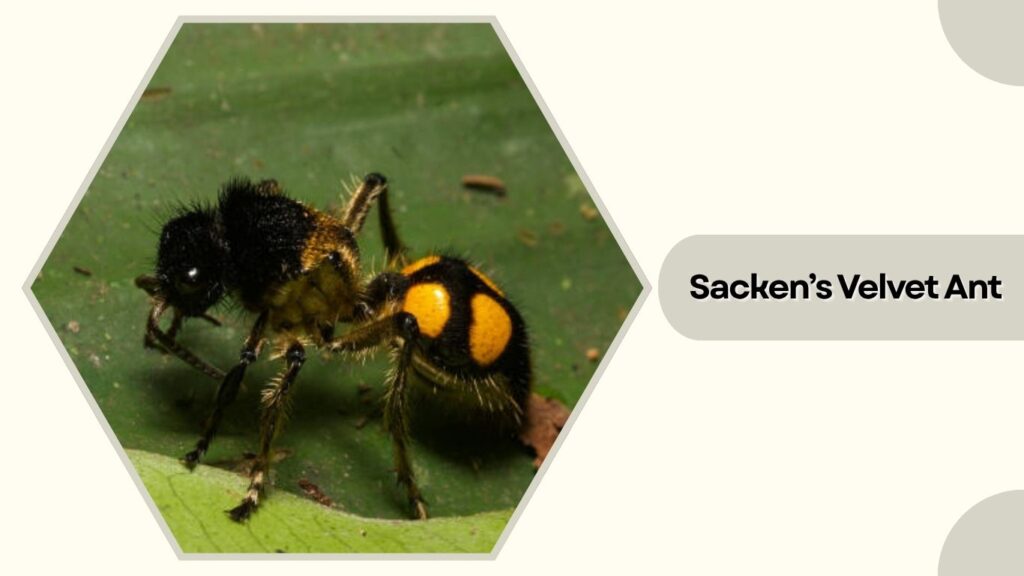
Sacken’s Velvet Ant (Dasymutilla sackenii) is a distinctive solitary wasp belonging to the family Mutillidae. Found primarily in western North America, this species is recognized by its dense, cream-colored or pale yellow hairs. Although it resembles a fuzzy ant, it is actually a wasp. Females lack wings and possess defensive stingers, while males have wings and can fly.
Identification
- Scientific Name: Dasymutilla sackenii
- Family: Mutillidae
- Adult Size: Approximately 15–16 mm in larger females.
- Body Color: Black with cream-white or pale golden hairs.
- Head: Dark, with pale hairs on the upper surface.
- Body Texture: Covered with long, dense, velvety hairs.
- Male Appearance: Winged, with contrasting dark and pale markings.
- Female Appearance: Wingless, with pale dorsal hairs and black legs.
- Distinctive Features: Thick, pale hairs covering the back and abdomen, contrasting with the black underside.
Habitat and Distribution
Sacken’s Velvet Ants inhabit dry grasslands, sandy landscapes, open woodlands, and scrublands throughout western North America. Their distribution includes California, Oregon, Nevada, and Baja California. They are frequently observed in warm, open environments where suitable ground-nesting insects are present.
Feeding Habits and Behavior
Adult Sacken’s Velvet Ants may feed on nectar and other sugary substances. Wingless females actively search the ground for suitable host nests, while winged males fly in search of mates. Their dense hairs create a thistledown-like appearance. Females can deliver painful defensive stings but generally avoid confrontation.
Life Cycle and Reproduction
Like other velvet ants, Sacken’s Velvet Ants reproduce through parasitoid development. Females locate suitable host nests and deposit eggs near immature insects. After hatching, their larvae consume the developing hosts before pupating within sheltered chambers. Adults eventually emerge to mate and continue the reproductive cycle.
8. Little Velvet Ant (Dasymutilla thetis)
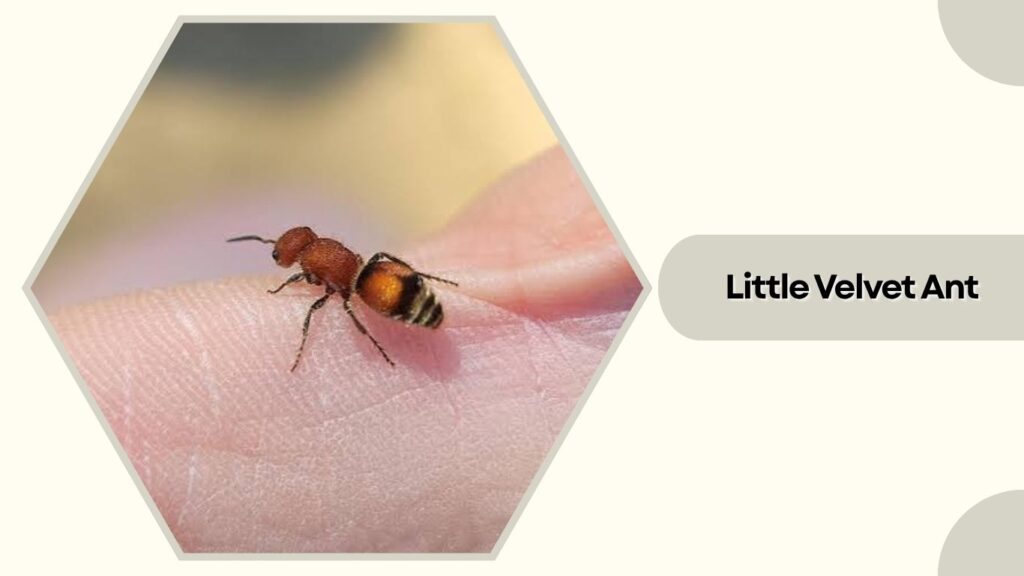
The Little Velvet Ant (Dasymutilla thetis), also called the Minute Thistledown Velvet Ant, is a small desert-dwelling wasp belonging to the family Mutillidae. This species is particularly remarkable for its tiny body and dense ivory-white hairs. Unlike many reddish velvet ants, its pale coloration creates a fluffy, cotton-like appearance. Females are wingless and spend much of their time moving across desert ground.
Identification
- Scientific Name: Dasymutilla thetis
- Family: Mutillidae
- Adult Size: Approximately 7 mm long.
- Body Color: Ivory-white or pale cream in females.
- Head: Small and densely covered with pale hairs.
- Body Texture: Soft-looking, with thick, white velvety hairs.
- Male Appearance: Winged, with a different body appearance from females.
- Female Appearance: Wingless, compact, and covered with ivory-white hairs.
- Distinctive Features: Exceptionally small size and almost entirely white, fluffy appearance.
Habitat and Distribution
Little Velvet Ants are known from Arizona in the southwestern United States. They inhabit hot desert environments containing sandy or exposed ground. Their small bodies and pale hairs help distinguish them from larger desert velvet ants. They are associated with habitats where suitable solitary insects establish nests.
Feeding Habits and Behavior
Adults likely consume nectar or other available sugary substances, as is common among velvet ants. Females move across the ground searching for host nesting sites. Their pale coloration resembles that of several other desert velvet ants, forming part of a shared warning-color pattern. Despite their small size, females possess defensive stingers.
Life Cycle and Reproduction
The Little Velvet Ant follows the parasitoid reproductive strategy characteristic of velvet ants. Females are expected to lay eggs in suitable insect host nests, allowing developing larvae to feed on immature hosts. After completing larval development, they pupate before emerging as adults. Specific host species and detailed seasonal development remain poorly documented.
9. Five-Spotted Velvet Ant (Mutilla quinquemaculata)
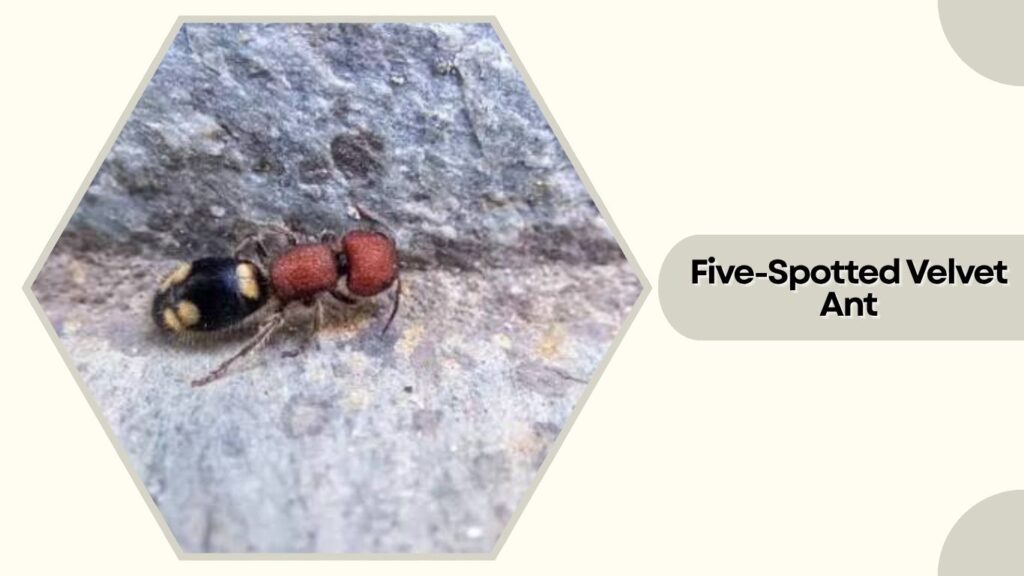
The Five-Spotted Velvet Ant (Mutilla quinquemaculata) is a distinctive solitary wasp belonging to the family Mutillidae. Found primarily throughout the Mediterranean region, this species is recognizable by its reddish head, dark abdomen, and contrasting pale markings. Like other velvet ants, females are wingless and resemble hairy ants. Its five pale abdominal markings help distinguish it from several related species.
Identification
- Scientific Name: Mutilla quinquemaculata
- Family: Mutillidae
- Adult Size: Approximately 10–16 mm long in females.
- Body Color: Reddish-brown with a dark abdomen.
- Head: Large, rounded, and rusty red.
- Body Texture: Covered with short, fine hairs.
- Male Appearance: Winged, with darker coloration than females.
- Female Appearance: Wingless, with a broad reddish head and pale abdominal markings.
- Distinctive Features: Five pale markings on the abdomen and an unusually broad head.
Habitat and Distribution
Five-Spotted Velvet Ants inhabit dry grasslands, scrublands, woodland edges, and sandy landscapes throughout the Mediterranean region. Their distribution includes Italy, Greece, Spain, France, and parts of North Africa and western Asia. They are frequently associated with warm, open habitats containing suitable nesting sites for other solitary insects.
Feeding Habits and Behavior
Adults may consume nectar and other available sugary substances. Females spend much of their time walking across exposed ground, searching for nests of potential host insects. Their contrasting coloration helps discourage predators. Although females possess defensive stingers, they generally attempt to escape rather than confront larger animals.
Life Cycle and Reproduction
Five-Spotted Velvet Ants reproduce through a parasitoid life cycle. Females enter suitable insect nests and deposit eggs associated with developing host brood. The emerging larvae consume their hosts before pupating inside protected nesting chambers. Adult males develop wings, while females remain wingless throughout their lives.
10. Large Velvet Ant (Mutilla europaea)
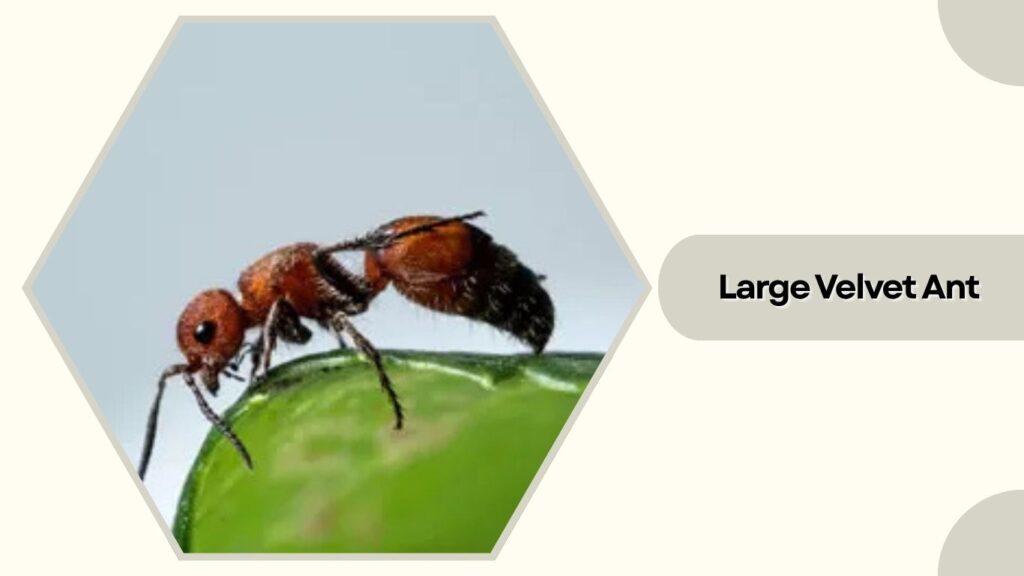
The Large Velvet Ant (Mutilla europaea) is a relatively large solitary wasp belonging to the family Mutillidae. This species occurs across Europe, parts of Asia, and North Africa. It is especially associated with bumblebee colonies, where its larvae develop as parasitoids. Its reddish and black body, thick hairs, and wingless females give it a distinctive ant-like appearance.
Identification
- Scientific Name: Mutilla europaea
- Family: Mutillidae
- Adult Size: Approximately 9–21 mm long.
- Body Color: Dark reddish-brown and black, with pale markings.
- Head: Usually black or dark brown in females.
- Body Texture: Covered with dense hairs, particularly around the abdomen.
- Male Appearance: Winged, usually with a dark head and reddish-brown thorax.
- Female Appearance: Wingless, with a robust, hairy body.
- Distinctive Features: Large body, reddish thorax, pale abdominal hair bands, and strong defensive sting.
Habitat and Distribution
Large Velvet Ants inhabit heathlands, moorlands, grasslands, woodland clearings, and sandy landscapes. They occur throughout several European countries and parts of Asia and North Africa. In Britain, the species is particularly associated with heathland and open environments supporting bumblebee colonies.
Feeding Habits and Behavior
Adult males occasionally visit flowers to consume nectar, while females can feed on sugary substances available in host nests. Females actively search for bumblebee colonies and may enter their nests without provoking immediate attacks. Both sexes can produce audible sounds when disturbed. Females possess painful defensive stingers and generally avoid unnecessary confrontation.
Life Cycle and Reproduction
Female Large Velvet Ants enter bumblebee nests and deposit eggs inside cocoons containing developing larvae or pupae. Their offspring consume the immature host before forming their own cocoons. After completing development, adults emerge from the host nests. Females can survive winter as adults, while males typically die before the following spring.
11. Panda Ant (Euspinolia militaris)
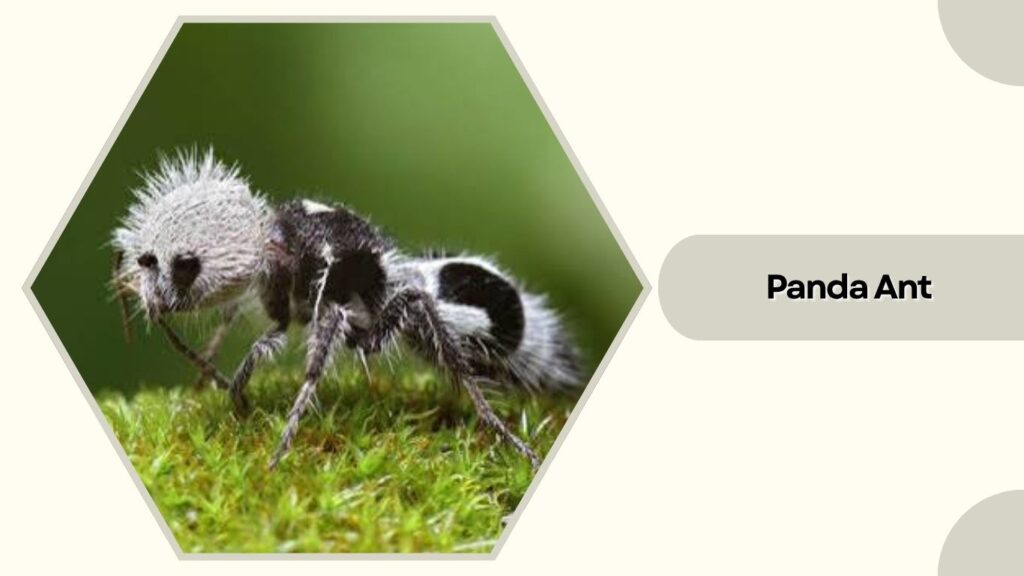
The Panda Ant (Euspinolia militaris) is an unusual solitary wasp belonging to the family Mutillidae. Despite its name and ant-like appearance, this species is not a true ant. It is famous for its striking black-and-white coloration, which resembles a giant panda. Native to Chile, the Panda Ant is particularly recognizable by its fluffy body, wingless females, and distinctive defensive behavior.
Identification
- Scientific Name: Euspinolia militaris
- Family: Mutillidae
- Adult Size: Up to approximately 8 mm long.
- Body Color: Black and white.
- Head: Rounded, with dense white hairs and contrasting dark eyes.
- Body Texture: Covered with short, dense, velvety hairs.
- Male Appearance: Winged, with a body shape different from females.
- Female Appearance: Wingless, compact, and panda-like.
- Distinctive Features: Black-and-white warning coloration, white head hairs, and a painful defensive sting in females.
Habitat and Distribution
Panda Ants are native to Chile in South America, where they inhabit dry forests, shrublands, and open landscapes. They are particularly associated with Mediterranean-type vegetation and sclerophyll forests. Wingless females move across the ground searching for suitable host nests, while males can fly between vegetation and open areas.
Feeding Habits and Behavior
Adult Panda Ants are solitary insects that may consume nectar and other sugary substances. Their contrasting black-and-white coloration acts as a warning signal to potential predators. When threatened, these insects can produce defensive sounds through stridulation. Females possess stingers and may deliver painful stings if handled.
Life Cycle and Reproduction
Female Panda Ants search for nests containing developing solitary bees or wasps. They deposit eggs associated with suitable immature hosts, allowing their larvae to develop as parasitoids. The larvae consume their hosts before pupating in protected chambers. After completing development, adult males emerge with wings, while adult females remain wingless.
12. Red Velvet Ant (Dasymutilla occidentalis)
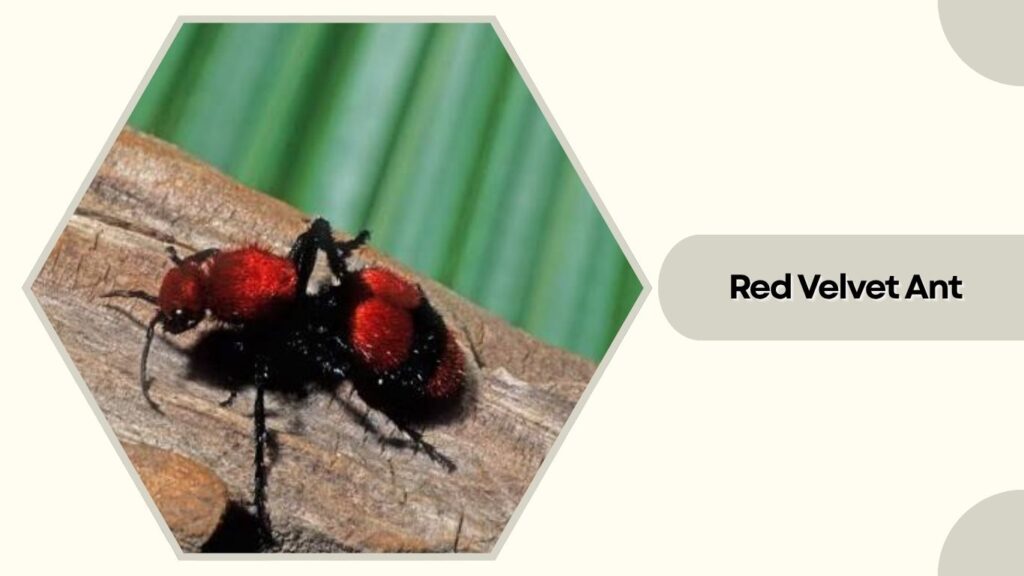
The Red Velvet Ant (Dasymutilla occidentalis) is a brightly colored solitary wasp belonging to the family Mutillidae. Commonly called the Cow Killer, this insect is famous for its painful defensive sting and striking reddish-orange hairs. Despite resembling a large ant, it is actually a wasp. This is the same species described earlier as the Eastern Velvet Ant, another established common name.
Identification
- Scientific Name: Dasymutilla occidentalis
- Family: Mutillidae
- Adult Size: Approximately 15–20 mm long.
- Body Color: Black with bright reddish-orange hairs.
- Head: Rounded, dark underneath reddish hairs.
- Body Texture: Covered with dense, velvety hairs.
- Male Appearance: Winged, with dark body markings and reddish hairs.
- Female Appearance: Wingless, robust, and equipped with a defensive stinger.
- Distinctive Features: Bright red-orange coloration, black legs, and a large ant-like appearance.
Habitat and Distribution
Red Velvet Ants inhabit open fields, grasslands, sandy meadows, woodland edges, and residential landscapes throughout the eastern and central United States. They are especially common in warm environments with well-drained soil. Females frequently move across exposed ground while searching for nests of solitary bees and wasps.
Feeding Habits and Behavior
Adult Red Velvet Ants primarily consume flower nectar and other sugary substances. Females actively explore the ground, while winged males fly in search of mates. Their bright coloration warns potential predators about their strong defensive capabilities. Although their sting can be extremely painful, these insects generally avoid humans and attempt to escape when disturbed.
Life Cycle and Reproduction
Female Red Velvet Ants locate suitable ground-nesting bees or wasps and deposit eggs associated with their developing brood. The emerging larvae feed as parasitoids on immature host insects. After completing development, the larvae pupate within protected host chambers. Adults eventually emerge, mate, and repeat the reproductive cycle.
13. White Velvet Ant (Dasymutilla pseudopappus)
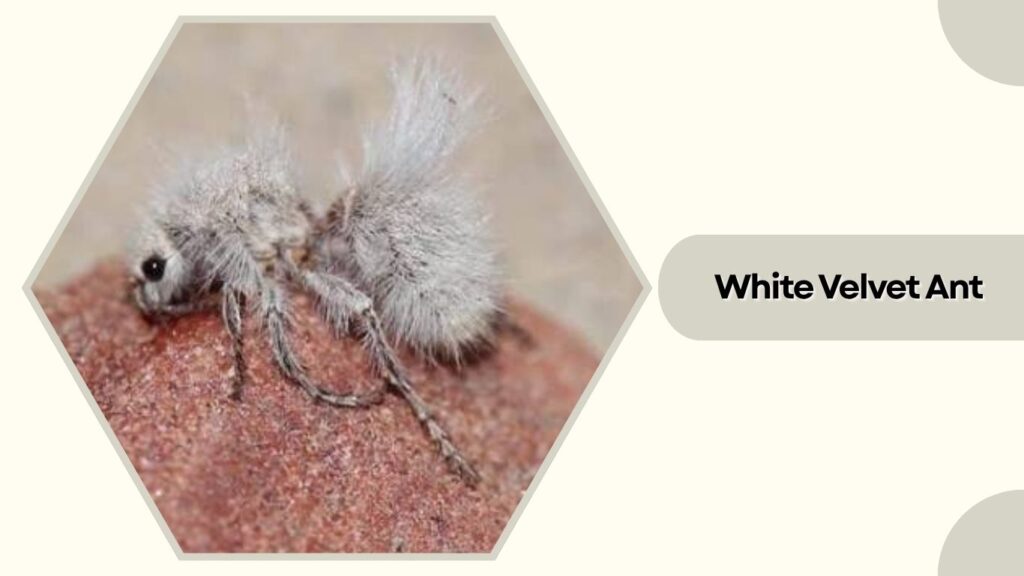
The White Velvet Ant (Dasymutilla pseudopappus) is a pale-colored solitary wasp belonging to the family Mutillidae. This species is one of several velvet ants described as white or thistledown velvet ants. Its dense white hairs give it a soft, cotton-like appearance, making it unusual among brightly colored relatives. Native to southwestern North America, it inhabits warm, dry environments where its wingless females move across exposed ground.
Identification
- Scientific Name: Dasymutilla pseudopappus
- Family: Mutillidae
- Adult Size: Small to medium-sized compared with larger velvet ants.
- Body Color: Predominantly white or pale cream.
- Head: Dark underneath dense, pale hairs.
- Body Texture: Covered with long, fluffy white hairs.
- Male Appearance: Winged, with a different appearance from females.
- Female Appearance: Wingless, with thick white hairs covering most of the body.
- Distinctive Features: Cotton-like appearance, black underlying body, and long, upright hairs.
Habitat and Distribution
White Velvet Ants inhabit desert scrublands, sandy plains, dry grasslands, and open woodlands throughout the southwestern United States. Dasymutilla pseudopappus occurs in Arizona, California, Colorado, New Mexico, Texas, and Utah. These insects are often associated with environments containing sparse vegetation and suitable ground-nesting host insects.
Feeding Habits and Behavior
Adults are associated with the nectar-feeding behavior typical of velvet ants. Females spend much of their time moving across the ground searching for host nests. Their pale coloration may provide protection through warning coloration and resemblance to other desert velvet ants. Females can deliver painful defensive stings but usually avoid confrontation.
Life Cycle and Reproduction
Female White Velvet Ants follow the parasitoid reproductive strategy characteristic of the family Mutillidae. They locate suitable insect nests and deposit eggs associated with immature hosts. After hatching, their larvae consume host tissues before pupating. Adults eventually emerge from protected chambers. Specific host associations and seasonal development remain incompletely documented for this species.
14. Black Velvet Ant (Dasymutilla nigripes)
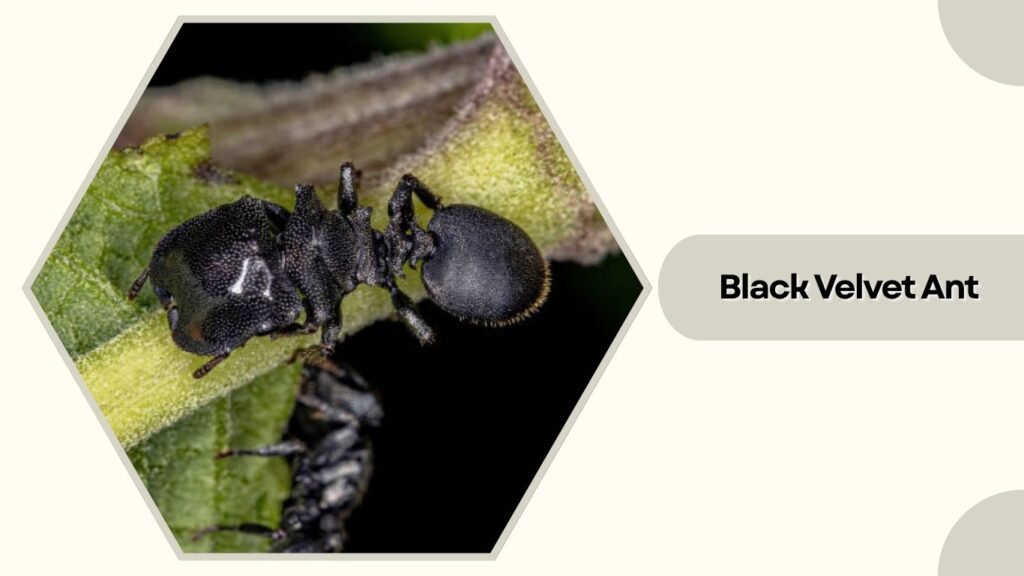
The Black Velvet Ant (Dasymutilla nigripes) is a solitary wasp belonging to the family Mutillidae. Native to North America, this species is one of several velvet ants that display dark body coloration. Its ant-like appearance comes from the wingless females and their characteristic ground-dwelling behavior. Although less conspicuously colored than some reddish velvet ants, it shares the family’s tough exoskeleton and defensive adaptations.
Identification
- Scientific Name: Dasymutilla nigripes
- Family: Mutillidae
- Adult Size: Small to medium-sized velvet ant.
- Body Color: Predominantly dark, with coloration varying between individuals.
- Head: Rounded, with strong jaws and prominent antennae.
- Body Texture: Covered with short, velvety hairs.
- Male Appearance: Winged, with a slender wasp-like body.
- Female Appearance: Wingless, compact, and ant-like.
- Distinctive Features: Dark coloration, black legs, and a robust body with a protective exoskeleton.
Habitat and Distribution
Black Velvet Ants occur throughout much of the United States and have also been recorded in Alberta, Canada. They inhabit areas containing suitable nesting sites for solitary bees and wasps. Open grasslands, woodland edges, and locations with exposed or sandy soil provide the types of environments commonly used by velvet ants.
Feeding Habits and Behavior
Adult Black Velvet Ants are solitary insects associated with nectar-feeding behavior. Females search the ground for suitable host nests, while males use their wings to locate potential mates. Their tough bodies provide protection against predators. Females possess defensive stingers and may sting when trapped or handled.
Life Cycle and Reproduction
The reproductive cycle follows the parasitoid development typical of velvet ants. Females search for nests containing developing insects and lay eggs associated with suitable hosts. The emerging larvae consume immature host insects before pupating. Adults eventually emerge to continue reproduction. Specific host relationships and developmental timing remain poorly documented for this species.
15. Orange Velvet Ant (Dasymutilla bioculata)
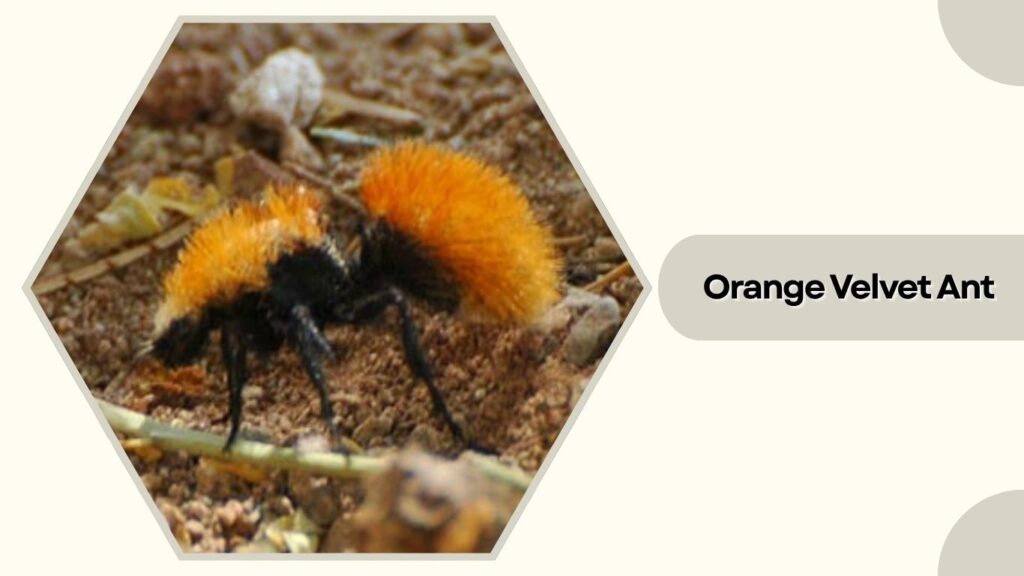
The Orange Velvet Ant is a descriptive name that can apply to several orange-colored velvet ant species. One representative is Dasymutilla bioculata, a solitary wasp belonging to the family Mutillidae. This North American species displays considerable variation in its orange and reddish coloration. Females are wingless, with dense hairs and strong defensive adaptations that help protect them from predators.
Identification
- Scientific Name: Dasymutilla bioculata
- Family: Mutillidae
- Adult Size: Medium-sized compared with other velvet ants.
- Body Color: Variable shades of orange, reddish-orange, and dark brown.
- Head: Dark or reddish, depending on coloration.
- Body Texture: Covered with dense, velvety hairs.
- Male Appearance: Winged, with a more conventional wasp-like body.
- Female Appearance: Wingless, compact, and brightly colored.
- Distinctive Features: Orange-colored hairs that may range from light golden-orange to dark reddish-orange.
Habitat and Distribution
Orange-colored individuals of Dasymutilla bioculata occur in western North America, including parts of Arizona and Utah. The species is associated with dry landscapes where suitable host insects establish nests. Open grasslands, desert margins, and areas with exposed soil provide opportunities for females to search for potential hosts.
Feeding Habits and Behavior
Adult Orange Velvet Ants primarily obtain energy from nectar and other sugary substances. Females move along the ground searching for host nests, while males fly in search of mates. Their orange coloration serves as a warning signal to predators. Research has documented substantial color variation within Dasymutilla bioculata, including light, medium, and dark orange forms.
Life Cycle and Reproduction
Females follow the parasitoid reproductive strategy typical of velvet ants. After locating suitable host nests, they deposit eggs associated with developing host insects. Their larvae feed on immature hosts before pupation. The emerging adults eventually reproduce and continue the life cycle. Specific host species and seasonal development require further documentation.
16. Yellow Velvet Ant (Dasymutilla vestita)
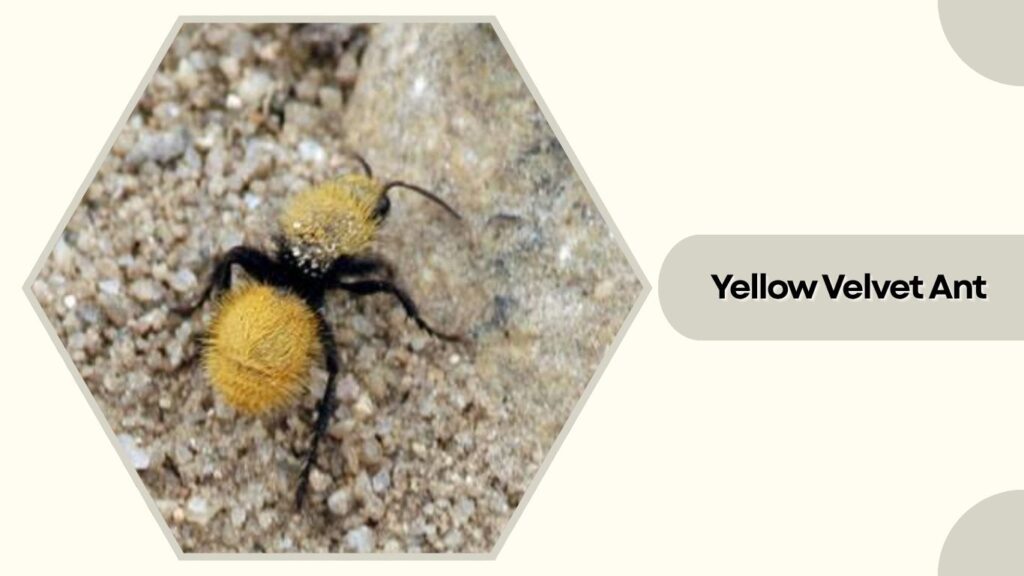
The Yellow Velvet Ant (Dasymutilla vestita) is a solitary wasp belonging to the family Mutillidae. This species is among the velvet ants referred to by yellow or golden-colored common names, although its coloration can also range toward orange and red. Found in western North America, it is recognizable by its dense body hairs and active ground movements. Like other velvet ants, females lack wings and possess defensive stingers.
Identification
- Scientific Name: Dasymutilla vestita
- Family: Mutillidae
- Adult Size: Approximately 12–13 mm in some recorded females.
- Body Color: Variable yellowish-orange, orange, or reddish hairs.
- Head: Rounded, with prominent antennae.
- Body Texture: Thick, velvety hairs covering much of the body.
- Male Appearance: Winged, with a relatively slender body.
- Female Appearance: Wingless, robust, and ant-like.
- Distinctive Features: Bright yellow-orange to reddish coloration, dense hairs, and quick ground movements.
Habitat and Distribution
Yellow Velvet Ants are associated with warm, dry landscapes throughout western North America. Dasymutilla vestita has been recorded in Arizona and parts of Mexico. These insects inhabit open scrublands, grasslands, rocky slopes, and areas with exposed soil. Suitable habitats typically provide nesting opportunities for the solitary bees and wasps used as hosts.
Feeding Habits and Behavior
Adult Yellow Velvet Ants feed primarily on nectar and other available sugary substances. Females explore the ground, rock surfaces, and small crevices while searching for suitable host nests. Their bright coloration may discourage predators. Although females possess painful defensive stingers, they generally attempt to escape when threatened.
Life Cycle and Reproduction
Female Yellow Velvet Ants reproduce through parasitoid development. They locate nests containing suitable immature insects and deposit eggs associated with the host brood. Their larvae consume the developing hosts before entering the pupal stage. Adults eventually emerge from protected chambers. The precise host species and generation timing are not well established for Dasymutilla vestita.
17. Golden Velvet Ant (Pseudomethoca propinqua)
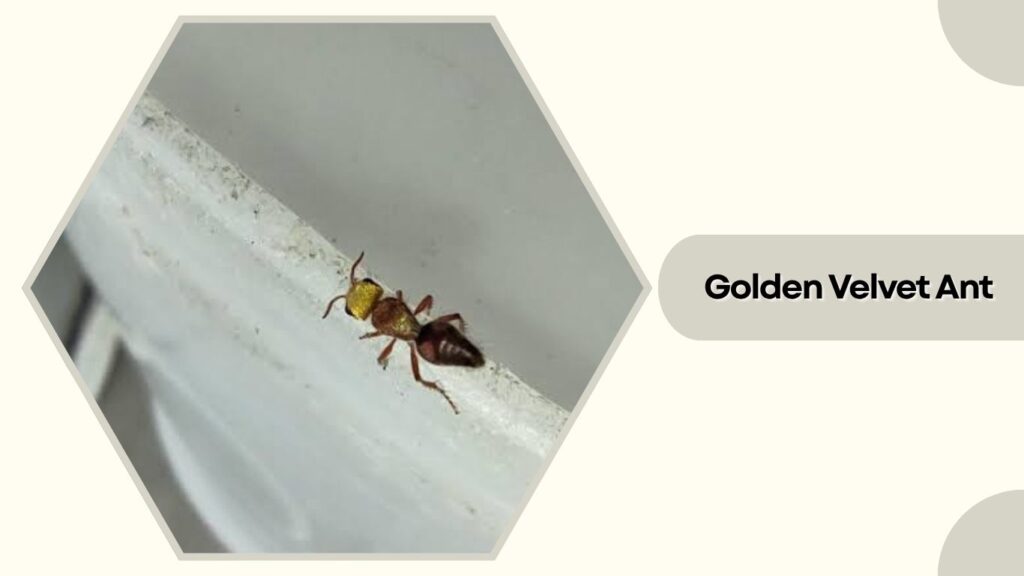
The Golden Velvet Ant (Pseudomethoca propinqua) is a solitary wasp belonging to the family Mutillidae. Although Golden Velvet Ant is a descriptive rather than standardized common name, this species has golden-colored hairs on parts of its body. Native to North America, it displays the characteristic differences between wingless females and winged males. Its small size and contrasting coloration distinguish it from many larger velvet ants.
Identification
- Scientific Name: Pseudomethoca propinqua
- Family: Mutillidae
- Adult Size: Approximately 8–12 mm in females.
- Body Color: Predominantly dark with golden-colored markings.
- Head: Dark with golden hairs on the upper surface.
- Body Texture: Covered with fine, dense hairs.
- Male Appearance: Winged, with dark wings and golden abdominal fringes.
- Female Appearance: Wingless, compact, and ant-like.
- Distinctive Features: Golden hairs along the head and abdominal segment margins.
Habitat and Distribution
Golden Velvet Ants occur across parts of North America, from southern Canada into the United States. Records extend from Alberta and California to Minnesota and Texas. They inhabit environments containing suitable host insects, including grasslands, open woodland areas, and places with exposed soil. Females spend considerable time searching for potential host nests.
Feeding Habits and Behavior
Adults are solitary and may obtain nourishment from nectar or other sugary substances. Wingless females move across the ground, while males fly between suitable habitats. Their golden markings distinguish them visually from darker velvet ants. Females possess defensive stingers and generally attempt to escape when disturbed.
Life Cycle and Reproduction
Like other velvet ants, Pseudomethoca propinqua develops as a parasitoid of immature insects. Females locate suitable host nests and deposit eggs associated with developing hosts. The larvae consume their hosts before entering the pupal stage. Adults subsequently emerge and begin searching for mates or new host nests.
18. Silver Velvet Ant (Dasymutilla monticola)
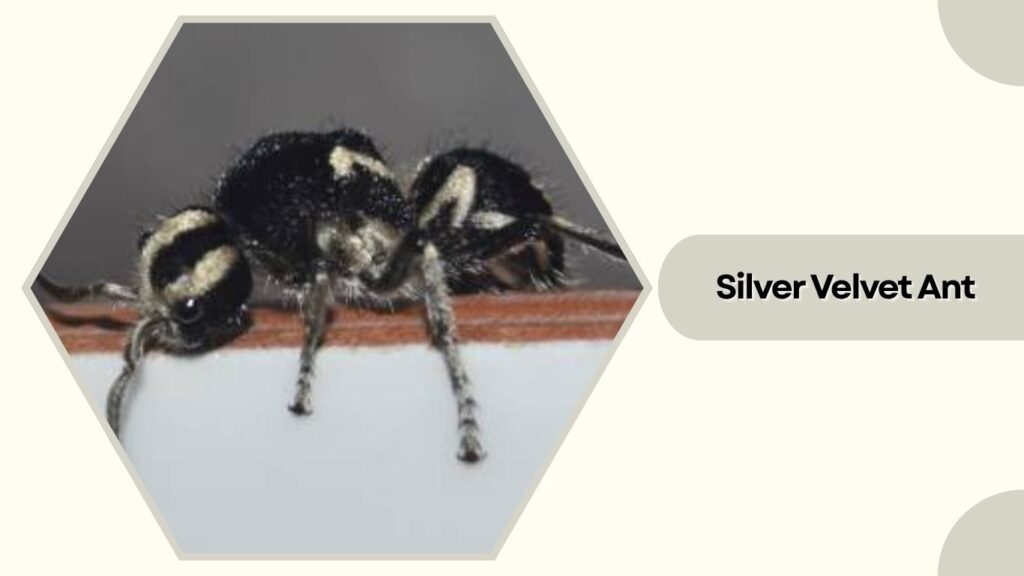
The Silver Velvet Ant (Dasymutilla monticola) is a solitary wasp belonging to the family Mutillidae. Silver Velvet Ant is an informal descriptive name rather than an established species-specific common name. Females of Dasymutilla monticola can display silvery hairs on the upper body, providing a useful example of this coloration. This North American species shares the characteristic wingless females, protective exoskeleton, and parasitoid development of other velvet ants.
Identification
- Scientific Name: Dasymutilla monticola
- Family: Mutillidae
- Adult Size: Variable, depending on the individual.
- Body Color: Dark with contrasting pale, reddish, or silvery markings.
- Head: Rounded, with prominent antennae.
- Body Texture: Covered with fine hairs that may have a silvery appearance.
- Male Appearance: Winged, with a body shape different from females.
- Female Appearance: Wingless, robust, and ant-like.
- Distinctive Features: Silvery hairs on the upper thorax and contrasting dark abdominal hair bands.
Habitat and Distribution
Silver-colored forms of Dasymutilla monticola occur in central and western North America. This species has been documented in regions containing dry grasslands, shrublands, and exposed soil suitable for ground-nesting insects. Females are generally associated with locations where potential host bees and wasps maintain underground nesting chambers.
Feeding Habits and Behavior
Adult Silver Velvet Ants follow the solitary lifestyle characteristic of velvet wasps. Females actively search for host nests, while males fly in search of mates. Their silvery body hairs may form contrasting patterns that help signal defensive capabilities to predators. They possess tough exoskeletons and females can deliver painful defensive stings.
Life Cycle and Reproduction
Females deposit eggs associated with developing host insects. After hatching, velvet ant larvae consume their hosts before pupating within sheltered nesting chambers. Adults emerge after completing development. The precise host range and seasonal generation patterns of Dasymutilla monticola are not fully documented.
19. Desert Velvet Ant (Dasymutilla arenivaga)
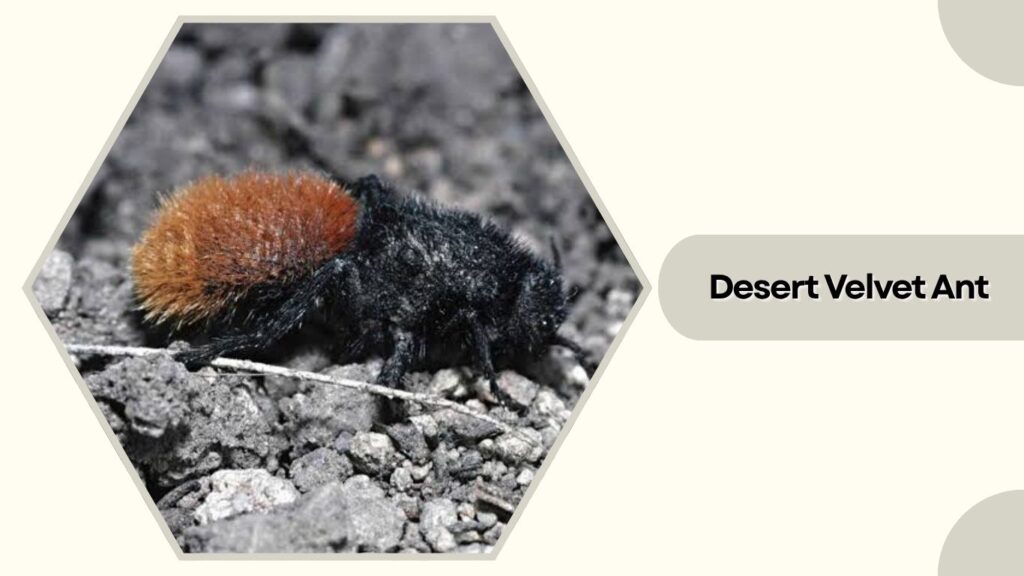
The Desert Velvet Ant (Dasymutilla arenivaga) is a solitary wasp belonging to the family Mutillidae. Native to southwestern North America, this species inhabits arid and semi-arid landscapes where sandy soils and sparse vegetation provide suitable habitat. Its hairy body, orange-and-black coloration, and wingless females make it recognizable among desert-dwelling velvet ants. Although it resembles an ant, it is actually a wasp.
Identification
- Scientific Name: Dasymutilla arenivaga
- Family: Mutillidae
- Adult Size: Approximately 16–18 mm long.
- Body Color: Orange and black.
- Head: Rounded and dark, with prominent antennae.
- Body Texture: Covered with dense, velvety hairs.
- Male Appearance: Winged, with a typical wasp-like body.
- Female Appearance: Wingless, robust, and ant-like.
- Distinctive Features: Contrasting orange-and-black hairs, strong legs, and rapid movements across sandy ground.
Habitat and Distribution
Desert Velvet Ants inhabit arid grasslands, desert scrublands, sandy plains, and open environments throughout the southwestern United States and northwestern Mexico. Mexican records include Baja California and Sonora. Females are particularly associated with exposed ground where suitable solitary bees and wasps construct nests.
Feeding Habits and Behavior
Adults may consume nectar and other sugary substances. Wingless females actively explore sandy surfaces, searching for suitable nesting sites of potential hosts. Their bright orange coloration can serve as a warning signal to predators. Females possess defensive stingers and tough exoskeletons, helping them survive encounters with insect-eating animals.
Life Cycle and Reproduction
Female Desert Velvet Ants reproduce through parasitoid development. They locate nests containing immature host insects and deposit eggs associated with the developing brood. After hatching, their larvae feed on the host before pupating within protected nesting chambers. Adults emerge after development, with seasonal activity influenced by desert temperatures and host availability.
20. Western Velvet Ant (Dasymutilla flammifera)
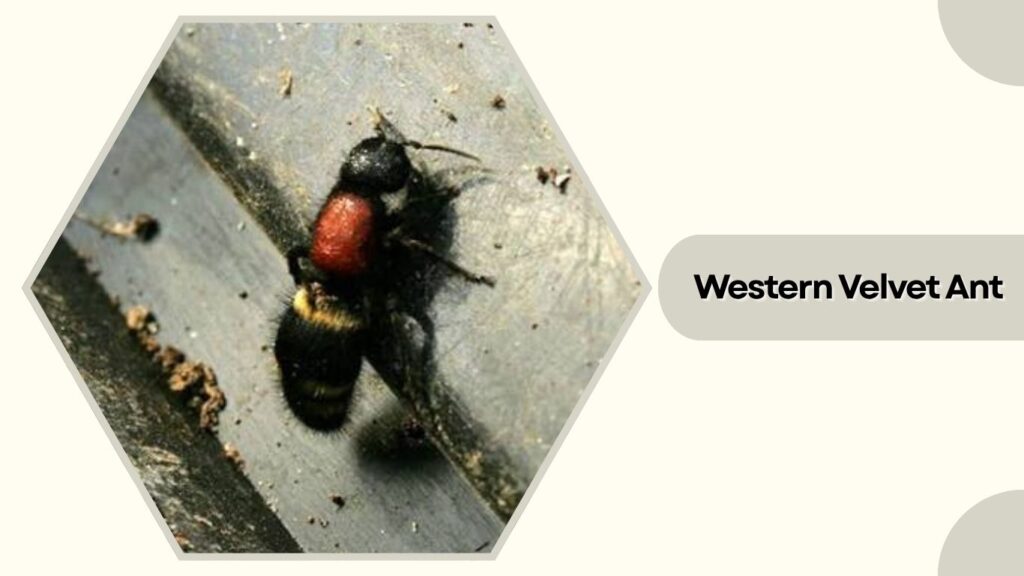
The Western Velvet Ant (Dasymutilla flammifera) is a brightly colored solitary wasp belonging to the family Mutillidae. The name Western Velvet Ant can describe several species, but Dasymutilla flammifera provides a representative example. Native to western North America, this species exhibits considerable color variation, ranging from brilliant scarlet to yellowish-orange. Females are wingless and frequently move across the ground while searching for suitable host nests.
Identification
- Scientific Name: Dasymutilla flammifera
- Family: Mutillidae
- Adult Size: Small to medium-sized velvet ant.
- Body Color: Scarlet red, orange, or pale ocher.
- Head: Rounded, with noticeable antennae.
- Body Texture: Covered with dense, velvety hairs.
- Male Appearance: Winged, with a slender wasp-like body.
- Female Appearance: Wingless, robust, and brightly colored.
- Distinctive Features: Highly variable body coloration, ranging from vivid scarlet to pale yellowish-orange.
Habitat and Distribution
Western Velvet Ants inhabit dry grasslands, chaparral, scrublands, and sandy landscapes in western North America. Dasymutilla flammifera has been recorded in California and Baja California, Mexico. Suitable habitats contain exposed soil and nesting locations for solitary bees and wasps. Females are frequently encountered during warm weather when host insects are active.
Feeding Habits and Behavior
Adults may consume nectar and other sugary substances, while females spend considerable time searching for host nests. Their bright coloration provides a visual warning to potential predators. Females are capable of delivering painful defensive stings but generally attempt to escape when threatened. Their strong legs allow them to move efficiently across uneven ground.
Life Cycle and Reproduction
Females locate nests of suitable host insects and lay eggs associated with immature broods. After hatching, velvet ant larvae develop as parasitoids, consuming their hosts before pupating. Adults eventually emerge from protected chambers. Their reproductive activity depends on environmental conditions and the availability of suitable host insects.
21. Tropical Velvet Ant (Dasymutilla pulchra)
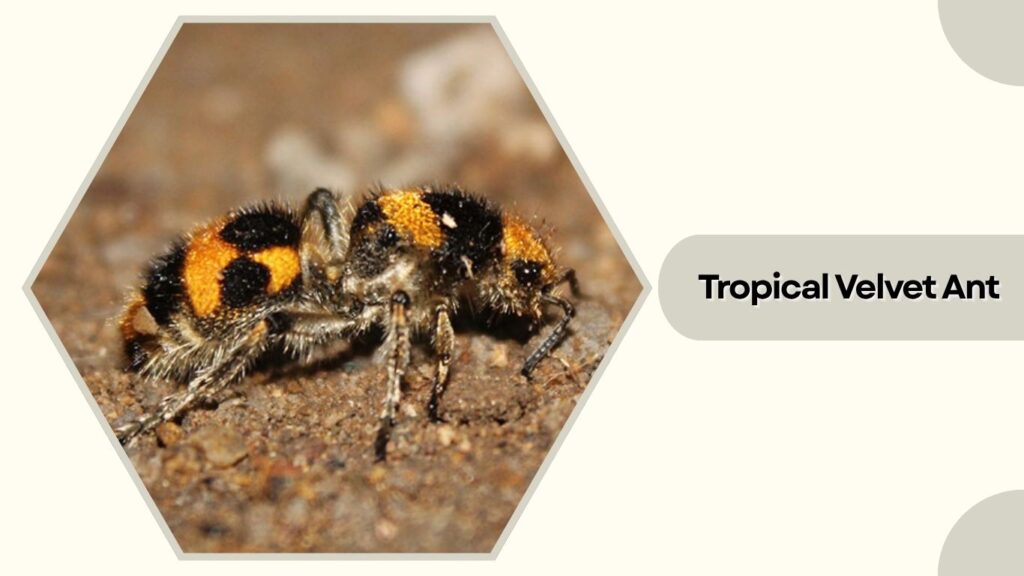
The Tropical Velvet Ant (Dasymutilla pulchra) is a distinctive solitary wasp belonging to the family Mutillidae. Found in tropical regions of the Americas, this species is recognized for its bold black-and-yellow markings. It belongs to a group of velvet ants that share similar warning coloration, helping protect them against predators. As with other velvet ants, females lack wings and resemble hairy ants, while males possess wings.
Identification
- Scientific Name: Dasymutilla pulchra
- Family: Mutillidae
- Adult Size: Small to medium-sized velvet ant.
- Body Color: Black with contrasting yellow markings.
- Head: Dark, with strong jaws and prominent antennae.
- Body Texture: Covered with short, dense hairs.
- Male Appearance: Winged, with a conventional wasp-like body.
- Female Appearance: Wingless, compact, and ant-like.
- Distinctive Features: Distinctive black-and-yellow warning coloration and dense body hairs.
Habitat and Distribution
Tropical Velvet Ants inhabit warm environments throughout Central America and parts of South America. Dasymutilla pulchra is associated with tropical landscapes containing suitable host insects. Open forest margins, dry tropical vegetation, and exposed ground provide habitats where females can search for nesting sites. Their distribution overlaps with other black-and-yellow velvet ant species.
Feeding Habits and Behavior
Adult Tropical Velvet Ants follow a solitary lifestyle and may consume nectar from flowering plants. Females move along the ground searching for suitable host nests. Their distinctive coloration is associated with Müllerian mimicry, in which multiple defended species share similar warning patterns. Females can deliver painful defensive stings but generally avoid confrontation.
Life Cycle and Reproduction
Like other members of the family Mutillidae, Dasymutilla pulchra develops as a parasitoid. Females locate suitable nesting chambers and deposit eggs associated with immature host insects. Their larvae feed on developing hosts before pupating. Adults eventually emerge to reproduce. Detailed information about this species’ specific hosts and generation timing remains limited.
22. Southern Velvet Ant (Dasymutilla vesta)
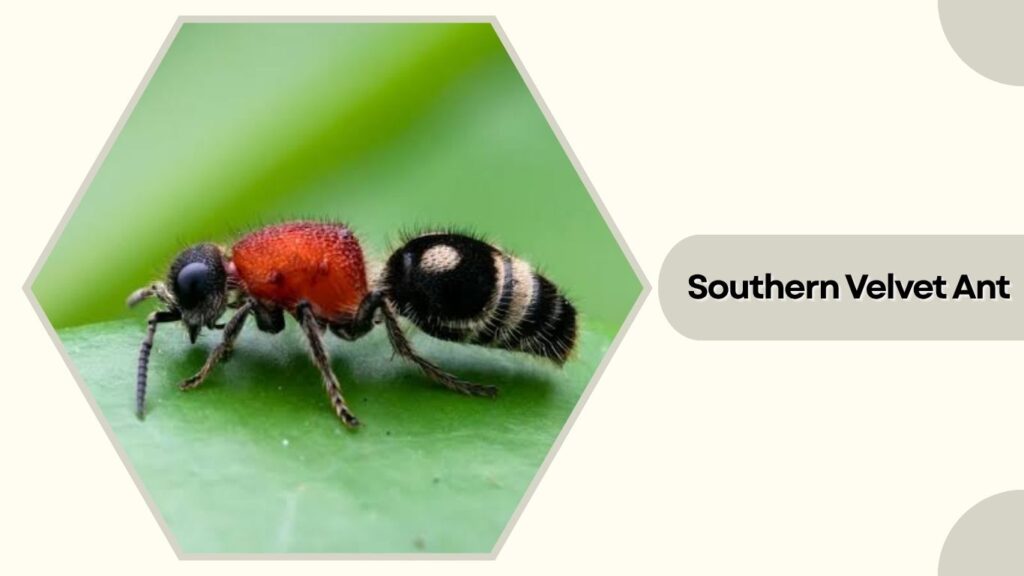
The Southern Velvet Ant (Dasymutilla vesta) is a small solitary wasp belonging to the family Mutillidae. Although Southern Velvet Ant is not a standardized species-specific common name, Dasymutilla vesta occurs in the southern United States and provides a suitable regional example. This species shares reddish coloration with several larger velvet ants but is generally smaller. Females are wingless and possess defensive stingers.
Identification
- Scientific Name: Dasymutilla vesta
- Family: Mutillidae
- Adult Size: Approximately 6–14 mm long.
- Body Color: Reddish-orange and black.
- Head: Rounded, with orange or reddish coloration in some individuals.
- Body Texture: Covered with fine, velvety hairs.
- Male Appearance: Winged, with a more slender body.
- Female Appearance: Wingless, compact, and ant-like.
- Distinctive Features: Small body size and reddish warning coloration resembling larger eastern velvet ants.
Habitat and Distribution
Southern Velvet Ants inhabit grasslands, woodland edges, sandy fields, and open landscapes throughout parts of eastern and southern North America. Dasymutilla vesta has a broad distribution extending beyond the southern states. Suitable habitats generally contain ground-nesting solitary bees and wasps, which provide potential hosts for developing velvet ant larvae.
Feeding Habits and Behavior
Adults may obtain nourishment from flower nectar and other sugary substances. Females actively search across the ground for suitable host nests, while winged males travel between habitats in search of mates. Their contrasting coloration discourages potential predators. Research has demonstrated that velvet ants, including Dasymutilla vesta, possess effective defenses against several insect-eating animals.
Life Cycle and Reproduction
Female Southern Velvet Ants locate nests containing developing host insects and deposit eggs associated with immature brood. Their larvae consume the hosts before pupating inside protected chambers. Adults subsequently emerge and begin reproductive activities. Their development follows the typical four-stage wasp life cycle: egg, larva, pupa, and adult.
23. Black-and-White Velvet Ant (Traumatomutilla bifurca)
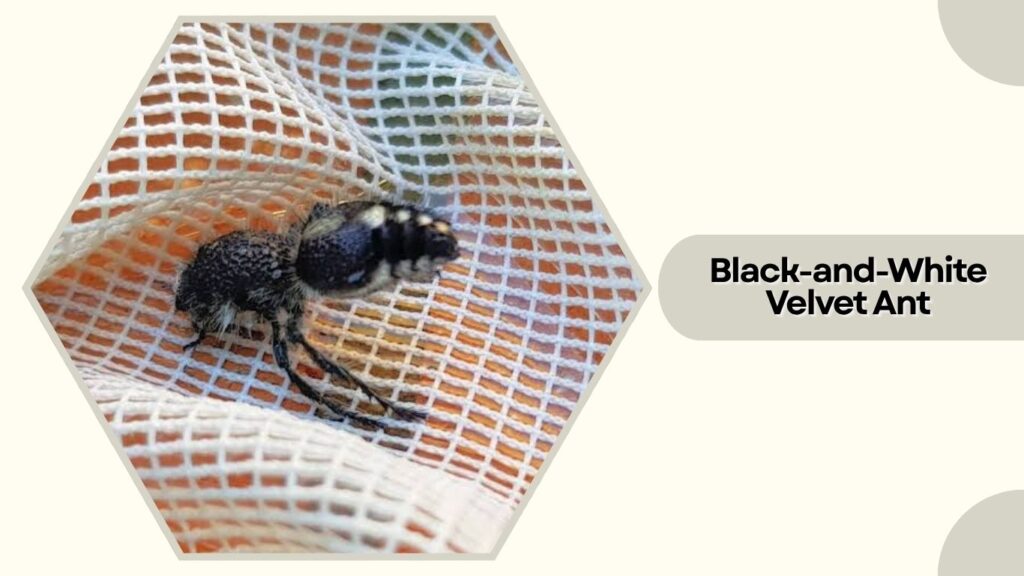
The Black-and-White Velvet Ant (Traumatomutilla bifurca) is a visually striking solitary wasp belonging to the family Mutillidae. Native to Brazil, this species is recognized by its contrasting black body and white hair markings. Researchers have identified exceptionally dark, light-absorbing cuticle in this species, making its black-and-white appearance especially distinctive. Wingless females actively move across exposed ground in search of potential host nests.
Identification
- Scientific Name: Traumatomutilla bifurca
- Family: Mutillidae
- Adult Size: Relatively small compared with larger velvet ant species.
- Body Color: Deep black with contrasting white markings.
- Head: Dark, with prominent antennae.
- Body Texture: Covered with short hairs in contrasting colors.
- Male Appearance: Winged, with a different body appearance from females.
- Female Appearance: Wingless, compact, and distinctly patterned.
- Distinctive Features: Strong black-and-white contrast and exceptionally light-absorbing black cuticle.
Habitat and Distribution
Black-and-White Velvet Ants inhabit regions of Brazil, particularly the Cerrado savanna and Caatinga drylands. Traumatomutilla bifurca has also been documented in forested habitats adjoining open landscapes. Females are frequently observed moving across sandy soil, especially in environments containing nesting bees.
Feeding Habits and Behavior
Females are active ground-dwelling insects that travel considerable distances searching for suitable hosts. Observations suggest that they may be particularly active during early morning and late afternoon. Their contrasting coloration forms part of their defensive appearance. Research has demonstrated that their exceptionally black cuticle absorbs substantial amounts of visible light, increasing the contrast with pale body markings.
Life Cycle and Reproduction
Like other velvet ants, Traumatomutilla bifurca reproduces through parasitoid development. Females locate suitable host nests and deposit eggs associated with immature insects. After hatching, larvae feed on their hosts before pupating inside protected chambers. Adults eventually emerge and continue the reproductive cycle. The species’ exact host relationships and generation timing require further research.
FAQs
1. What are the most common types of velvet ants?
Well-known velvet ants include the Eastern Velvet Ant, Pacific Velvet Ant, Thistledown Velvet Ant, Klug’s Velvet Ant, and Panda Ant. Different species vary in coloration, body size, geographical distribution, and habitat preferences.
2. Which type of velvet ant has the most painful sting?
Klug’s Velvet Ant (Dasymutilla klugii) is among the velvet ant species known for particularly painful stings. However, sting intensity varies between species, and not every velvet ant has the same pain level.
3. Are red, white, and black velvet ants different species?
Not necessarily. Red, white, and black describe body coloration rather than formal taxonomic classifications. Several unrelated velvet ant species share similar colors, making scientific names and distinctive physical characteristics important for accurate identification.
4. Where are different types of velvet ants commonly found?
Velvet ants occur in many regions worldwide, including North America, South America, Europe, Asia, and Africa. Many North American species prefer warm grasslands, deserts, and sandy areas, while tropical species inhabit forests, savannas, and other warm environments.
5. Can all types of velvet ants sting humans?
Female velvet ants possess defensive stingers, although the pain varies by species. Male velvet ants lack stingers and cannot sting. Velvet ants are generally solitary and nonaggressive, but handling females can result in painful stings.
