
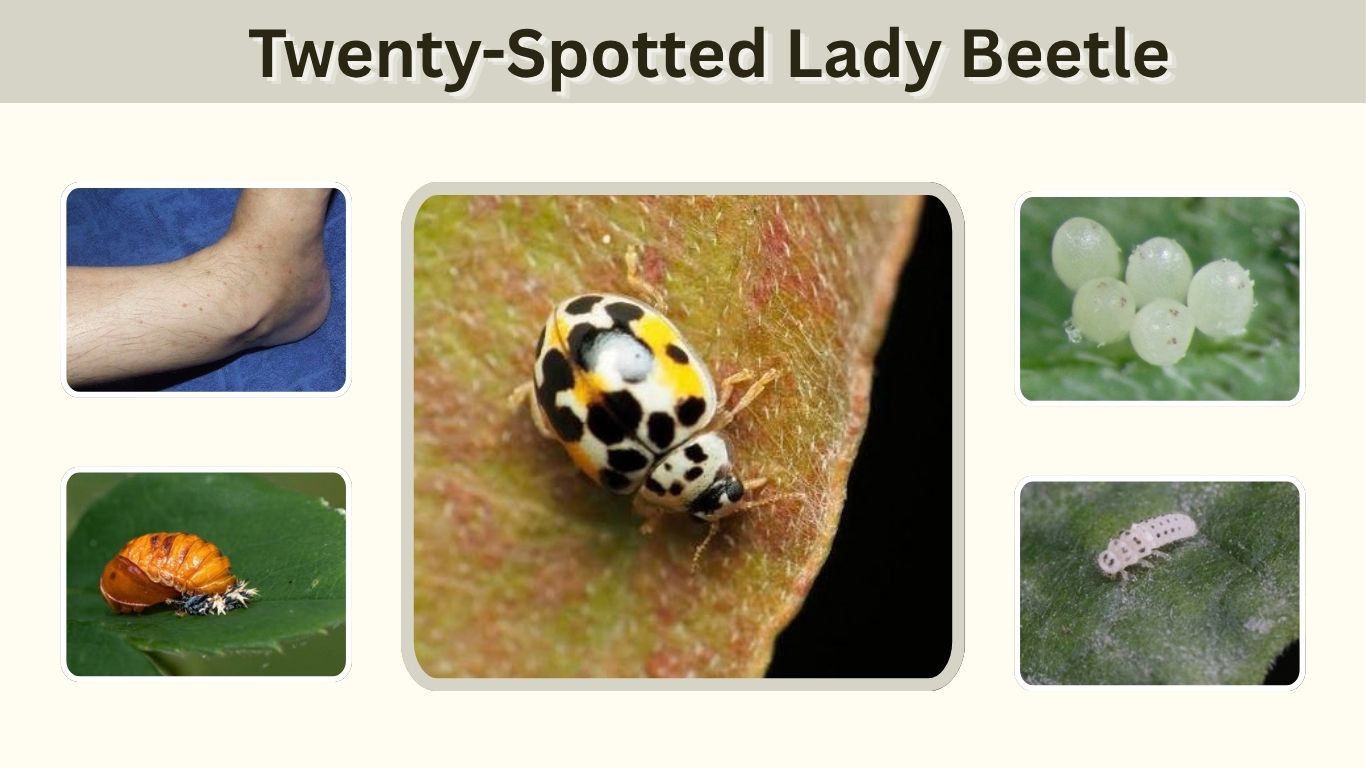
The twenty-spotted lady beetle (Psyllobora vigintimaculata) is a tiny native ladybug known for its pale body, dark markings, and unusual appetite for powdery mildew. Unlike familiar red ladybugs that hunt aphids, this species feeds primarily on fungi growing across plant leaves. It commonly appears in gardens, wooded areas, and occasionally homes, where its small size may cause confusion. Despite questions about bites, poison, and spiritual meaning, the beetle is generally harmless. This guide covers identification, larvae, habitat, behavior, indoor sightings, and its value to gardeners.
What Is a Twenty-Spotted Lady Beetle?
The twenty-spotted lady beetle is a small member of the lady beetle family, Coccinellidae. Its scientific name is Psyllobora vigintimaculata, and it is sometimes called the small ashy-gray lady beetle. Unlike most familiar ladybugs, this species specializes in eating fungi instead of insects. Its unusual diet makes it an interesting and beneficial inhabitant of North American gardens.
Twenty-Spotted Lady Beetle Identification
Several characteristics help distinguish this tiny beetle from other ladybugs.
- Scientific name: Psyllobora vigintimaculata
- Family: Coccinellidae
- Size: Approximately 1.75–3 mm long, although some references report individuals reaching 4 mm.
- Body shape: Small, rounded, and dome-shaped.
- Body color: Cream, pale yellow, whitish, or light gray.
- Spots: Numerous dark brown or black markings.
- Head: Usually pale with darker markings.
- Legs: Generally light orange or yellowish.
Why Is It Called Twenty-Spotted?
Its name refers to the numerous markings distributed across its body.
Typically, each wing cover has eight or nine dark spots, while the pronotum behind the head displays four or five additional markings.
However, the number and arrangement vary, and some spots merge into irregular patterns.
Therefore, individuals do not necessarily have exactly twenty separate spots.
Twenty-Spotted Lady Beetle Habitat and Distribution
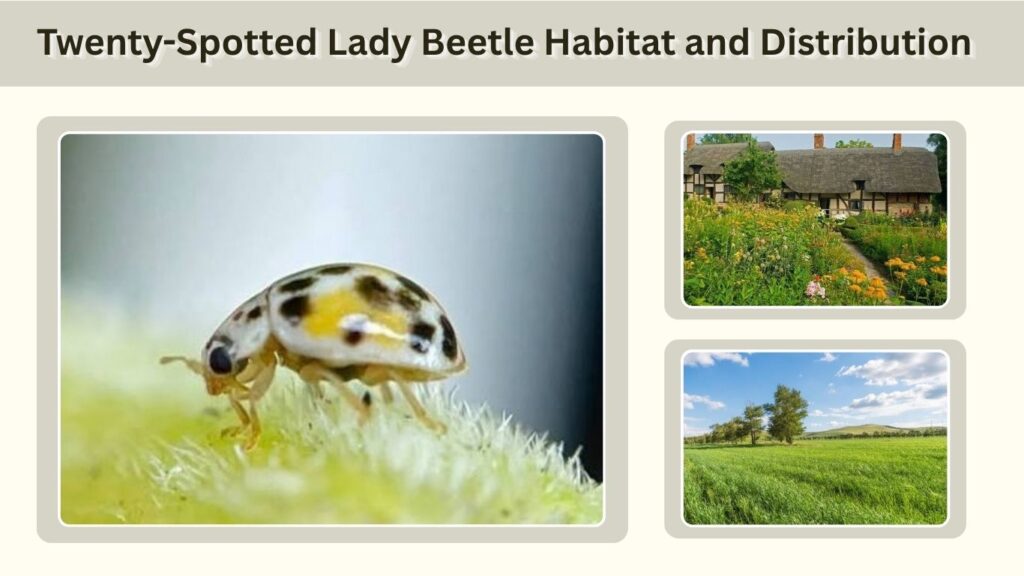
Twenty-spotted lady beetles inhabit areas where powdery mildew fungi grow on vegetation. Their distribution extends across much of North America, including the United States and Canada. They occupy gardens, forests, agricultural landscapes, and other plant-rich environments. Their presence is closely associated with suitable fungal food sources rather than any particular plant species or habitat type.
Where Do Twenty-Spotted Lady Beetles Live?
These beetles occur in several environments that provide suitable feeding opportunities.
- Gardens: Leaves affected by powdery mildew.
- Forests: Shrubs, trees, and other vegetation supporting fungal growth.
- Agricultural fields: Crops affected by mildew infections.
- Grasslands: Wild plants and vegetation with fungal growth.
- Parks: Ornamental shrubs and landscape plants.
- Woodland edges: Sheltered vegetation with suitable humidity and food.
Geographic Range and Seasonal Activity
The twenty-spotted lady beetle occurs across the contiguous United States, parts of Canada, and Alaska. Its broader range extends into Central America and northern South America.
Adults may be encountered during much of the growing season, particularly where powdery mildew is abundant.
In colder regions, adults overwinter in sheltered locations, including leaf litter, before becoming active again in spring.
Are Twenty-Spotted Lady Beetles Good or Bad?
Twenty-spotted lady beetles are generally considered beneficial insects because they feed on powdery mildew fungi. Unlike many ladybugs that consume aphids, these beetles specialize in fungal material growing on plant surfaces. Their feeding may reduce some visible mildew, although they cannot reliably eliminate an established infection. Understanding their ecological role helps gardeners avoid unnecessarily treating them as pests.
What Do Twenty-Spotted Lady Beetles Eat?
Both adult beetles and larvae consume powdery mildew fungi.
Their diet includes fungal spores, mycelium, and reproductive structures growing across leaf surfaces.
They move over infected vegetation, scraping and consuming the fungal material.
Unlike aphid-eating lady beetles, this species does not primarily hunt other insects.
Are They Beneficial to Gardens?
Yes. Twenty-spotted lady beetles help consume powdery mildew and contribute to natural fungal regulation.
However, their presence may also indicate that plants already have a fungal infection.
Gardeners should not rely on these beetles alone to control serious powdery mildew problems.
Appropriate plant spacing, airflow, and disease management remain important.
Twenty-Spotted Lady Beetle Larvae and Lifecycle
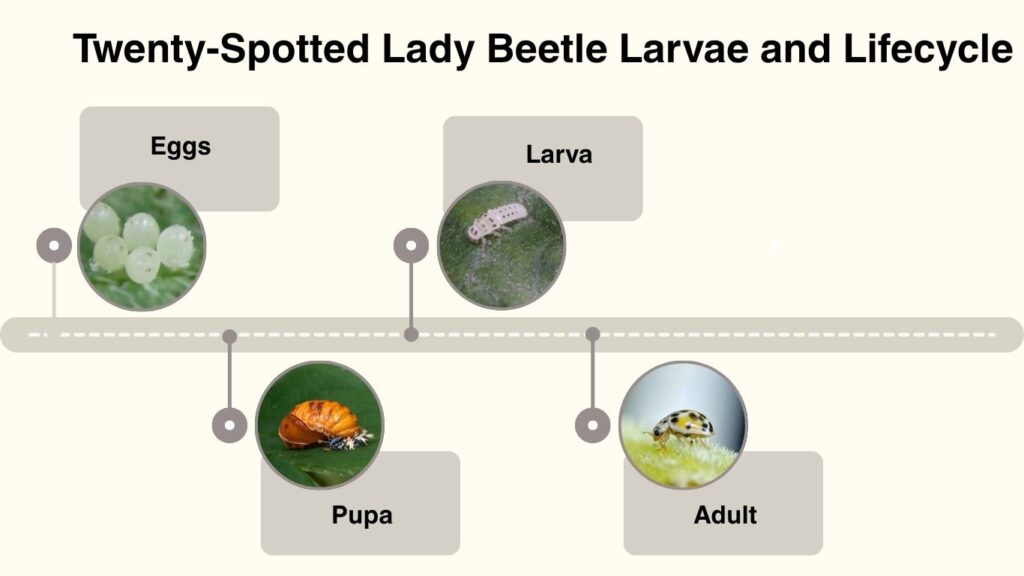
Like other lady beetles, Psyllobora vigintimaculata undergoes complete metamorphosis. Its lifecycle includes egg, larva, pupa, and adult stages. Females deposit eggs near fungal food sources, allowing newly hatched larvae to begin feeding almost immediately. Development depends on temperature and environmental conditions. Multiple generations may develop during a favorable growing season when powdery mildew remains available.
Four Stages of the Lifecycle
The twenty-spotted lady beetle develops through four stages.
- Egg: Females lay small, whitish eggs in groups, often beneath leaves affected by powdery mildew.
- Larva: Pale gray or whitish larvae emerge and begin consuming fungal material.
- Pupa: Mature larvae attach themselves to plant surfaces and transform inside the pupal stage.
- Adult: Fully developed beetles emerge and continue feeding on mildew.
Under favorable temperatures, development from egg to reproductive adult may take approximately three to four weeks.
What Do Twenty-Spotted Lady Beetle Larvae Look Like?
Young larvae are pale gray or whitish with darker markings that become more noticeable as they grow.
Newly hatched larvae measure approximately 0.8 mm, while mature larvae reach around 3.5 mm.
They have elongated bodies rather than the rounded appearance of adults.
Like adult beetles, the larvae feed primarily on powdery mildew.
Twenty-Spotted Lady Beetle in the House
Finding a twenty-spotted lady beetle indoors can be surprising because these insects normally live outdoors on vegetation. Their small size allows them to enter through open windows, doors, and structural gaps. However, they are not typical household pests and do not establish damaging indoor infestations. Most indoor encounters involve individuals that have accidentally wandered away from suitable outdoor habitats.
Why Are Twenty-Spotted Lady Beetles Inside?
These beetles may enter buildings accidentally while searching for shelter or moving between outdoor plants.
They may also arrive on houseplants or through open windows.
Since they depend on powdery mildew, ordinary indoor environments do not usually provide suitable feeding conditions.
How to Remove Them From Your House
If you discover a twenty-spotted lady beetle indoors, consider these simple steps:
- Capture gently: Use a small container and a piece of paper.
- Release outdoors: Place it near suitable vegetation.
- Inspect houseplants: Check leaves for powdery mildew.
- Seal openings: Repair damaged screens and unnecessary gaps.
- Avoid insecticides: Chemical treatment is generally unnecessary.
Are Twenty-Spotted Lady Beetles Poisonous?
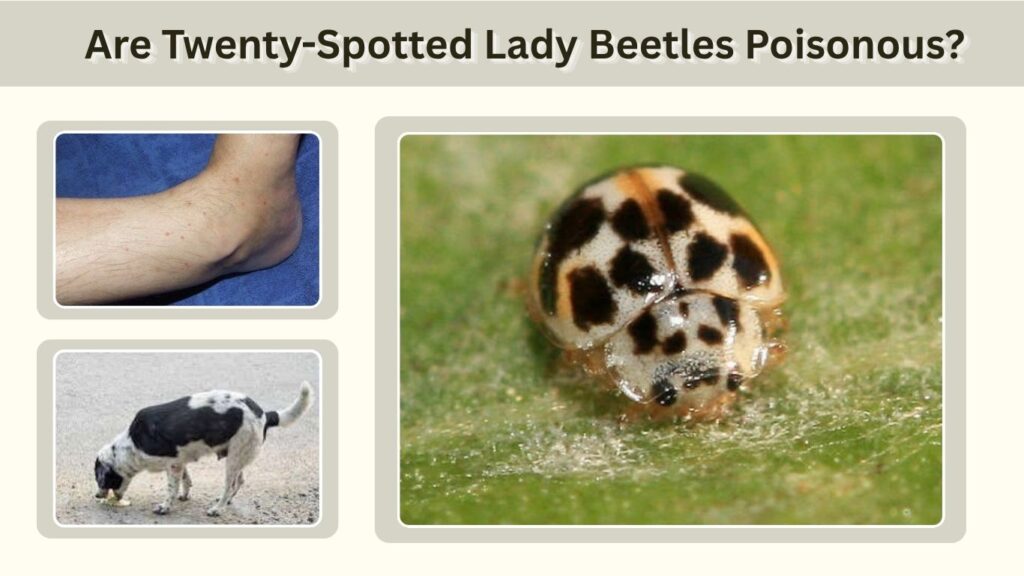
Twenty-spotted lady beetles are not considered dangerous to humans or pets during ordinary contact. Like other ladybugs, they may possess defensive substances that discourage predators. However, they are not venomous and do not have stingers. Because these beetles are small and rarely interact aggressively with humans, encounters generally pose little concern. Nevertheless, insects should not be deliberately swallowed or mishandled.
Can a Twenty-Spotted Lady Beetle Bite?
Lady beetles have chewing mouthparts, but the twenty-spotted species uses them primarily to consume fungal material.
Biting humans is not characteristic behavior, and documented harmful bites are uncommon.
It does not sting and is not known to transmit diseases through ordinary contact.
Are They Dangerous to Pets?
Twenty-spotted lady beetles are not recognized as a significant danger to household pets.
However, pets should be discouraged from eating insects because ingestion can occasionally cause irritation or digestive discomfort.
If a pet develops concerning symptoms after consuming an insect, consult a veterinarian.
Twenty-Spotted Lady Beetle Meaning and Symbolism
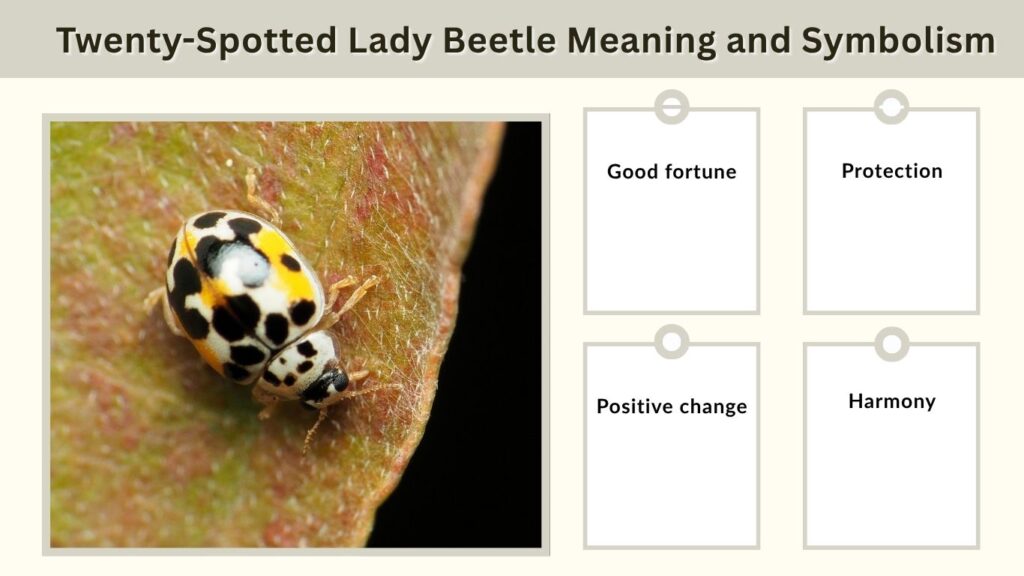
Ladybugs have long appeared in cultural traditions associated with good fortune, protection, and positive change. The twenty-spotted lady beetle sometimes attracts similar symbolic interpretations because of its unusual appearance. However, spiritual meanings are matters of personal or cultural belief rather than scientifically established characteristics. No widely recognized spiritual tradition assigns one universal meaning specifically to this species.
Twenty-Spotted Lady Beetle Spiritual Meaning
Some people interpret encounters with ladybugs as symbols of luck, harmony, renewal, or positive transformation.
These interpretations can also be personally applied to the twenty-spotted lady beetle.
However, its appearance does not scientifically predict future events or changes in someone’s life.
What Does Seeing One Mean?
From a biological perspective, seeing a twenty-spotted lady beetle usually indicates that suitable fungal food sources are present nearby.
It may also reflect favorable seasonal conditions.
Finding one in a garden is generally a positive sign of local insect biodiversity, even if the surrounding plants require mildew management.
FAQs
Twenty-spotted lady beetles generate questions because of their unusual feeding habits, pale coloration, and extremely small size. Gardeners often wonder whether these insects damage plants, while homeowners may question their safety indoors. Other common searches concern their availability and identification. The following answers address important questions about this distinctive native lady beetle.
1. Are Twenty-Spotted Lady Beetles Good or Bad?
Twenty-spotted lady beetles are beneficial because they feed on powdery mildew fungi. They do not normally damage healthy plants or feed on leaves.
2. How Big Is a Twenty-Spotted Lady Beetle?
Adults typically measure approximately 1.75–3 mm long, making them considerably smaller than many familiar red ladybugs.
3. Are Twenty-Spotted Lady Beetles Poisonous?
They are not considered poisonous to humans through ordinary contact. They also lack stingers and are not known for aggressive biting.
4. Can You Buy Twenty-Spotted Lady Beetles?
They are not commonly offered by commercial beneficial-insect suppliers. Gardeners can support natural populations by maintaining suitable habitats and avoiding unnecessary insecticides.
5. Do Twenty-Spotted Lady Beetles Eat Aphids?
No. Unlike many predatory ladybugs, twenty-spotted lady beetles specialize in eating powdery mildew fungi rather than aphids or other insects.
