
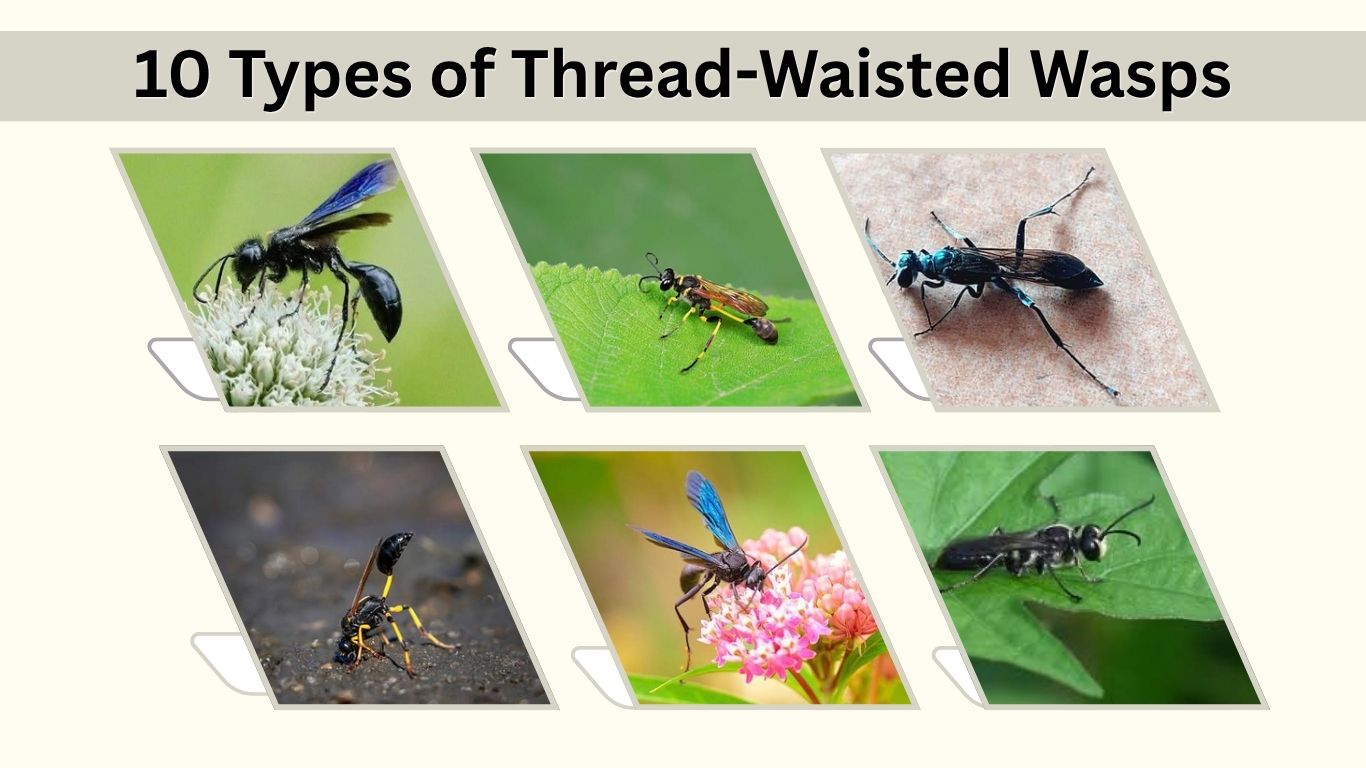
Thread-waisted wasps are fascinating solitary insects recognized by their slender bodies, narrow waists, and unique hunting behaviors. Found in gardens, grasslands, forests, and open fields, these wasps play an important role in controlling insect and spider populations. Some species build underground nests, while others construct mud chambers or use hollow plant stems. Despite their intimidating appearance, most are relatively harmless to humans. In this guide, we’ll explore 10 types of thread-waisted wasps, including their identification features, habitats, diets, behaviors, and life cycles.
1. Common Thread-Waisted Wasp (Ammophila procera)
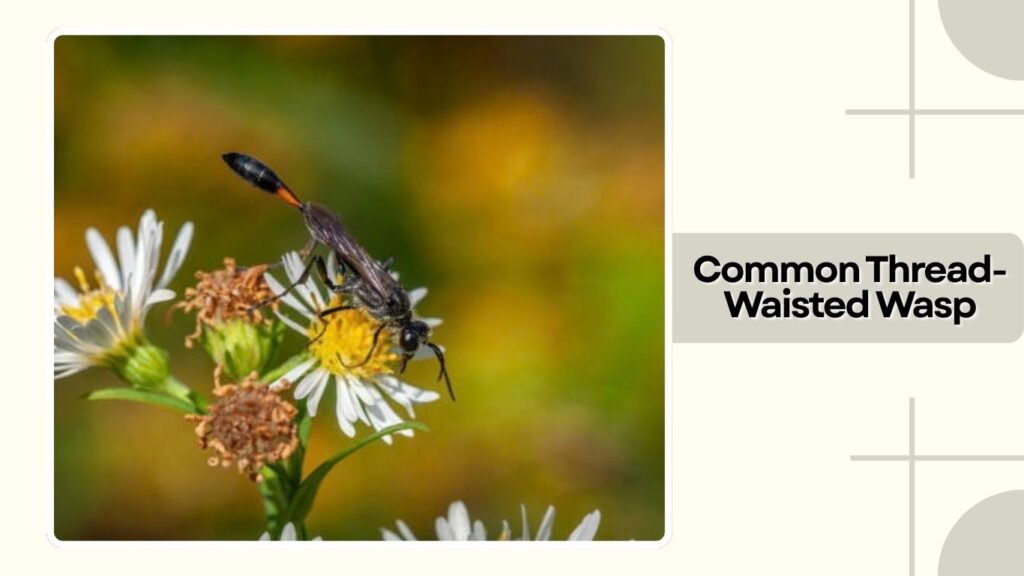
The Common Thread-Waisted Wasp (Ammophila procera) is a solitary wasp recognized by its extremely narrow waist, elongated body, and distinctive black and reddish-orange coloration. Belonging to the family Sphecidae, this species is commonly found in open habitats across North America. Unlike social wasps, it does not establish colonies. Instead, females construct individual underground nests and hunt caterpillars to provide food for their developing larvae.
Identification
- Scientific Name: Ammophila procera
- Family: Sphecidae
- Size: Approximately 15–35 mm long, depending on sex.
- Body Color: Predominantly black with reddish-orange markings on the abdomen.
- Waist: Exceptionally long, thin, and thread-like.
- Wings: Narrow, transparent to slightly smoky wings.
- Antennae: Long, slender, and usually black.
- Legs: Long, thin, and adapted for walking and carrying prey.
Habitat and Distribution
Common Thread-Waisted Wasps are widely distributed throughout the United States, southern Canada, Mexico, and parts of Central America. They prefer sunny, open environments such as grasslands, meadows, gardens, woodland edges, and sandy fields.
Females select areas with loose or sandy soil suitable for digging underground nests. Adults frequently visit flowering plants, especially goldenrod, milkweed, and other nectar-producing flowers.
Behavior and Diet
These wasps are solitary hunters and generally avoid confrontation with humans. Adults primarily consume flower nectar, while developing larvae feed on paralyzed caterpillars and occasionally sawfly larvae.
Females locate suitable prey, immobilize it with a venomous sting, and transport it into an underground burrow. Their hunting activity helps regulate populations of plant-feeding caterpillars.
Lifespan and Life Cycle
The Common Thread-Waisted Wasp undergoes complete metamorphosis through four stages: egg, larva, pupa, and adult.
After preparing a burrow, the female places a paralyzed caterpillar inside and lays a single egg on it. The egg generally hatches within approximately two days. The developing larva consumes the stored prey before pupating underground.
Eventually, a fully developed adult emerges to reproduce and continue the life cycle. Development time varies with environmental conditions, particularly temperature and food availability.
2. Spangled-Wing Thread-Waisted Wasp (Ammophila pictipennis)
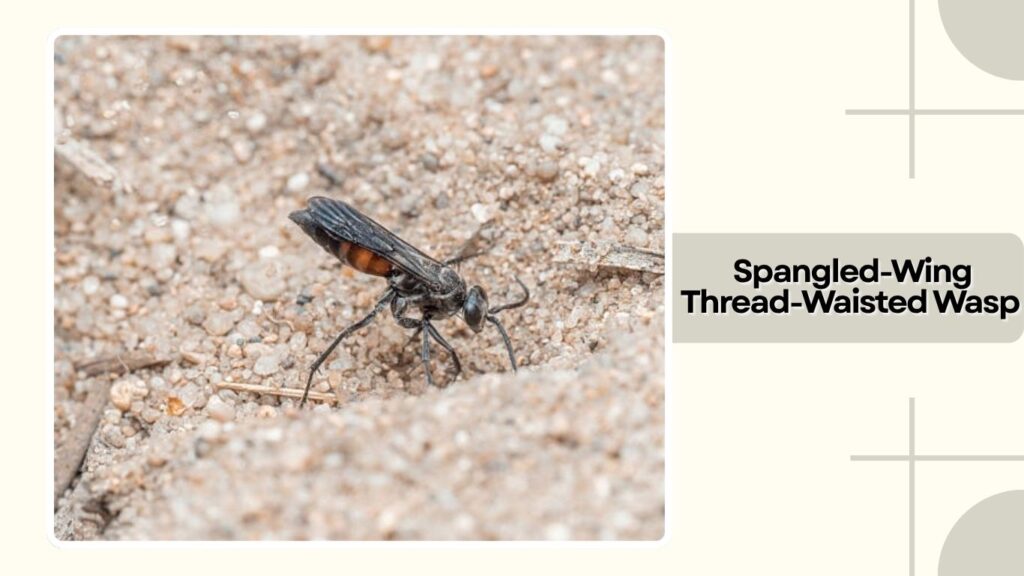
The Spangled-Wing Thread-Waisted Wasp (Ammophila pictipennis) is a solitary hunting wasp recognized by its slender body, narrow waist, and distinctive orange-tinted wings. This species belongs to the family Sphecidae and is commonly found in open habitats throughout eastern North America. Unlike social wasps, it does not form colonies. Females construct individual underground nests and capture caterpillars to provide food for their developing offspring.
Identification
- Scientific Name: Ammophila pictipennis
- Family: Sphecidae
- Size: Approximately 20–25 mm long.
- Body Color: Predominantly black with reddish-orange abdominal segments.
- Wings: Transparent to orange-tinted, with particularly noticeable orange pigmentation.
- Waist: Extremely thin and elongated.
- Legs: Long, slender, and black.
- Antennae: Narrow, segmented, and dark-colored.
Habitat and Distribution
Spangled-Wing Thread-Waisted Wasps occur primarily in the eastern United States, extending into southern Canada and Mexico. They inhabit sunny fields, grasslands, meadows, open woodlands, and roadside vegetation.
These wasps prefer locations with accessible soil where females can excavate nesting burrows. Sandy and well-drained ground is particularly suitable, although they can also nest in firmer soil.
Adults frequently visit flowering plants during warmer months to obtain nectar.
Behavior and Diet
Adult Spangled-Wing Thread-Waisted Wasps primarily feed on nectar, while their larvae consume caterpillars supplied by the mother.
Females actively search vegetation and ground surfaces for suitable prey, particularly cutworms and other moth caterpillars. After locating a caterpillar, the female immobilizes it with a sting and transports it to her underground nest.
These wasps are generally nonaggressive toward humans and typically sting only when threatened or handled.
Lifespan and Life Cycle
The life cycle includes four developmental stages: egg, larva, pupa, and adult.
Females excavate shallow underground nests containing individual brood chambers. A paralyzed caterpillar is placed inside a chamber, and a single egg is deposited on the prey.
After hatching, the larva feeds on the stored caterpillar before entering the pupal stage. Adult emergence depends on seasonal conditions and development.
The species is commonly observed from late spring through autumn, although its precise adult lifespan varies.
3. Great Golden Digger Wasp (Sphex ichneumoneus)
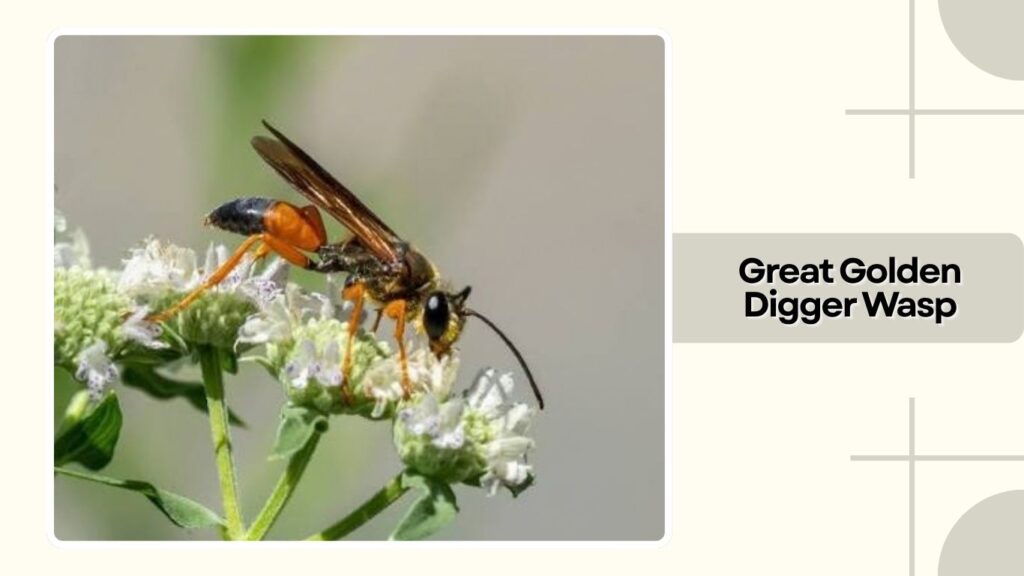
The Great Golden Digger Wasp (Sphex ichneumoneus) is a large, colorful solitary wasp belonging to the family Sphecidae. It is easily recognized by its golden hairs, reddish-orange legs, and elongated black-and-orange body. Native to North America and neighboring regions, this species is frequently observed visiting flowers during summer. Females are skilled hunters that capture katydids and related insects to nourish their developing larvae.
Identification
- Scientific Name: Sphex ichneumoneus
- Family: Sphecidae
- Size: Commonly about 20–35 mm long.
- Body Color: Black with reddish-orange abdominal segments.
- Thorax: Covered with noticeable golden-yellow hairs.
- Wings: Transparent to smoky, sometimes with darker pigmentation.
- Legs: Long and typically reddish-orange.
- Waist: Narrow and elongated, connecting the thorax and abdomen.
Habitat and Distribution
Great Golden Digger Wasps are widely distributed throughout North America, extending south into tropical regions.
They commonly inhabit gardens, meadows, grasslands, agricultural fields, woodland margins, and other sunny environments. Areas containing loose, well-drained soil are especially important because females need suitable ground for constructing nests.
Adults are frequently attracted to nectar-producing flowers, including milkweed, goldenrod, and mountain mint.
Behavior and Diet
Great Golden Digger Wasps are solitary hunters that primarily capture katydids and other long-horned orthopteran insects.
Females locate prey among grasses and vegetation, paralyze it with their venomous sting, and transport it to underground burrows. These insects remain available as food for developing larvae.
Although females build individual nests, several may nest close together when suitable conditions exist.
Adults primarily consume nectar and can contribute to flower pollination during their feeding activities.
Lifespan and Life Cycle
The female constructs an underground burrow containing multiple brood chambers. Each chamber receives paralyzed prey and a single egg.
After hatching, the larva consumes the stored insects and grows through several developmental stages before pupating.
Developing offspring may remain underground through winter, emerging as adults when seasonal conditions become favorable.
Great Golden Digger Wasps generally have one generation annually in much of their range. Adults are especially noticeable during summer when flowers are abundant and nesting activity increases.
4. Great Black Digger Wasp (Sphex pensylvanicus)
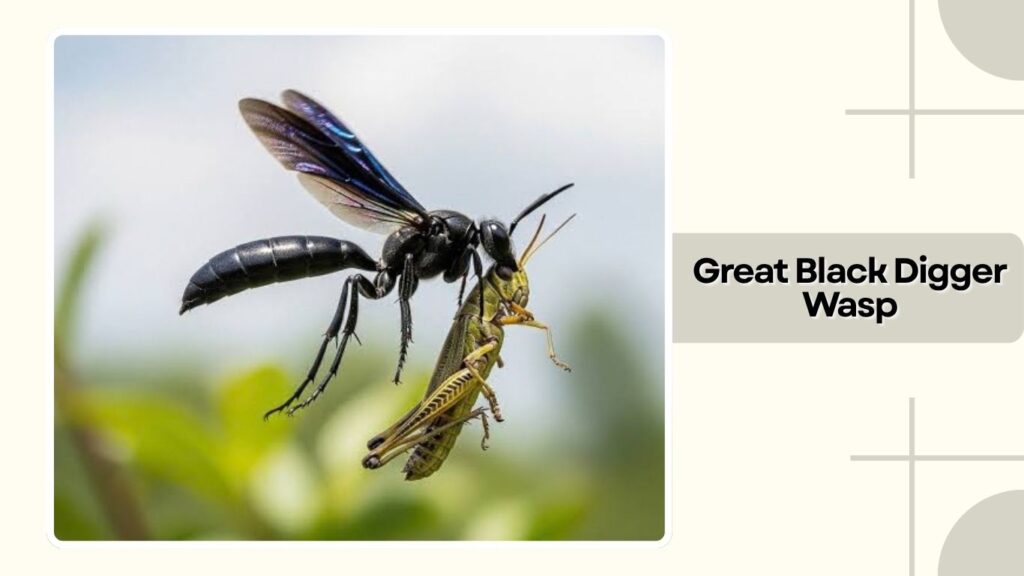
The Great Black Digger Wasp (Sphex pensylvanicus) is one of the most recognizable large solitary wasps in North America. Its entirely black body, dark iridescent wings, and powerful flying ability make it especially noticeable around gardens and flowering plants. Despite its intimidating appearance, this species is generally peaceful toward people. Females construct underground nests and hunt katydids, helping regulate populations of vegetation-feeding insects.
Identification
- Scientific Name: Sphex pensylvanicus
- Family: Sphecidae
- Size: Usually 22–35 mm long.
- Body Color: Entirely black, sometimes with a slight bluish sheen.
- Wings: Dark black with blue or violet iridescence.
- Waist: Narrow and elongated.
- Legs: Long, powerful, and black.
- Antennae: Black, segmented, and moderately long.
Habitat and Distribution
Great Black Digger Wasps inhabit much of the United States, southeastern Canada, and parts of Mexico.
They prefer open landscapes with abundant flowering plants and suitable nesting soil. Common habitats include gardens, prairies, meadows, agricultural fields, and woodland clearings.
Females frequently select loose or soft ground for excavating burrows. Gardens with native flowers and exposed soil can provide both feeding and nesting opportunities.
Adults are commonly observed during summer, particularly from July through September, depending on the region.
Behavior and Diet
Adult Great Black Digger Wasps obtain energy primarily from flower nectar. Females hunt katydids, which serve as food for their larvae.
After capturing a katydid, the female paralyzes it with a sting and carries it back to her underground burrow. Several prey insects may be placed inside an individual brood chamber.
Although these wasps have functional stingers, they are not naturally aggressive toward humans. Their hunting behavior helps control populations of certain plant-feeding insects.
Lifespan and Life Cycle
The life cycle consists of egg, larva, pupa, and adult stages. Females excavate underground nests with brood chambers and supply them with paralyzed katydids. After provisioning a chamber, the female deposits an egg and eventually seals the nest. The developing larva feeds on the stored prey before pupating underground.
Adult lifespan varies considerably. Field observations have documented some individuals surviving for several weeks, although many are observed for shorter periods.
New generations emerge when environmental conditions support adult activity and reproduction.
5. Golden-Reined Digger Wasp (Sphex habenus)
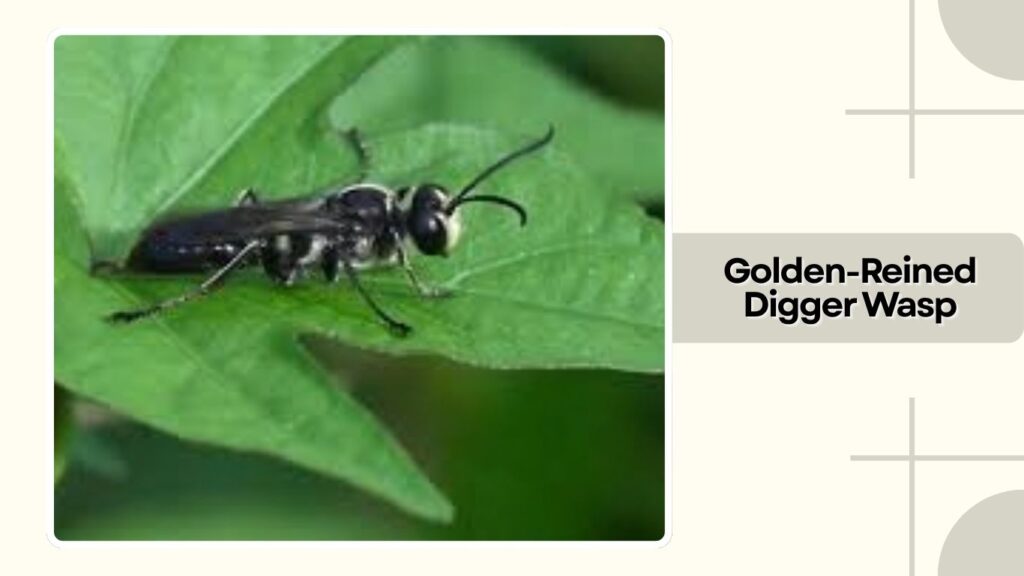
The Golden-Reined Digger Wasp (Sphex habenus) is a distinctive solitary wasp belonging to the family Sphecidae. It is particularly recognizable by the golden hairs covering portions of its thorax and its slender, elongated body. This species occurs mainly in central and eastern portions of North America, extending into Mexico. Like other digger wasps, females construct underground nests and capture katydids to provide nourishment for developing larvae.
Identification
- Scientific Name: Sphex habenus
- Family: Sphecidae
- Size: Approximately 25–29 mm on average.
- Body Color: Predominantly black, with abdominal coloration varying between sexes.
- Thorax: Covered with conspicuous golden hairs.
- Wings: Transparent to smoky or slightly darkened.
- Legs: Long, slender, and black.
- Waist: Narrow and elongated.
- Antennae: Dark-colored and segmented.
Habitat and Distribution
Golden-Reined Digger Wasps occur in parts of the eastern and central United States, with records extending south into northern Mexico.
Their habitats include grasslands, open fields, gardens, woodland edges, and other sunny locations with flowering vegetation.
These wasps are commonly associated with areas offering suitable ground for burrow construction. Loose soil can make excavation easier, while nearby vegetation provides habitat for katydids.
Adults frequently visit flowering plants to obtain nectar, making them noticeable around summer wildflowers.
Behavior and Diet
Adult Golden-Reined Digger Wasps primarily consume nectar, while developing larvae depend on insect prey.
Females hunt katydids, including meadow katydids, and immobilize them with their stings before transporting them to underground nests. The captured insects provide a protein-rich food supply for developing offspring.
These wasps are solitary, meaning individual females manage their own nesting activities rather than cooperating within organized colonies. They generally avoid human contact and are unlikely to sting unless threatened.
Lifespan and Life Cycle
Golden-Reined Digger Wasps undergo complete metamorphosis through egg, larval, pupal, and adult stages.
Females construct underground nests and provision brood chambers with paralyzed katydids. Eggs are deposited in these protected chambers, allowing the developing larvae access to food.
The larvae consume the stored prey before pupating and eventually developing into adults. The precise duration of development can vary with temperature and seasonal conditions.
Adult activity is most noticeable during warmer months, often extending from summer into early autumn. Their nesting habits contribute to the natural regulation of katydid populations.
6. Steel-Blue Cricket Hunter Wasp (Chlorion aerarium)
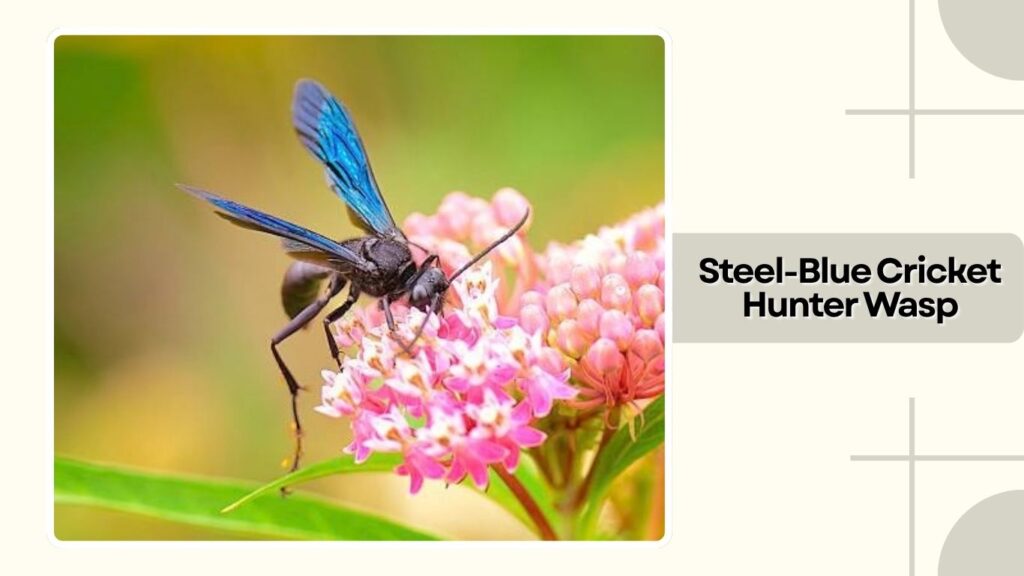
The Steel-Blue Cricket Hunter Wasp (Chlorion aerarium) is a striking solitary species recognized by its metallic blue body and dark, iridescent wings. It belongs to the family Sphecidae and is native to North America. This wasp specializes in capturing crickets to feed its developing larvae. Despite its formidable appearance, it is generally nonaggressive toward humans and plays an important ecological role as a predator of ground-dwelling insects.
Identification
- Scientific Name: Chlorion aerarium
- Family: Sphecidae
- Size: Approximately 20–25 mm long.
- Body Color: Metallic steel-blue to bluish-black.
- Wings: Dark with blue, purple, or violet iridescence.
- Waist: Slender and distinctly narrowed.
- Legs: Long, black, and relatively thin.
- Antennae: Dark-colored and elongated.
- Appearance: Smooth, shiny body with a noticeable metallic reflection.
Habitat and Distribution
Steel-Blue Cricket Hunter Wasps occur throughout portions of North America, including the United States, southern Canada, and Mexico.
They are commonly associated with open habitats such as meadows, grasslands, sandy fields, lawns, and coastal environments.
Females seek accessible underground nesting sites, sometimes using or extending burrows associated with other ground-nesting wasps.
Adults may also visit gardens and flowering plants where nectar is available.
Behavior and Diet
The Steel-Blue Cricket Hunter is a specialized insect predator that primarily hunts crickets.
Females search grassy areas and ground-level vegetation for suitable prey. Once a cricket is located, the wasp immobilizes it with a venomous sting and transports it to an underground nest. Several paralyzed crickets may be stored inside a brood chamber to provide food for a developing larva.
Adult wasps primarily consume flower nectar. These wasps are generally solitary and do not establish large defensive colonies.
Lifespan and Life Cycle
The life cycle includes egg, larva, pupa, and adult stages. A female prepares an underground brood chamber and supplies it with paralyzed crickets. She then deposits an egg, allowing the newly hatched larva to feed on the stored prey.
As development continues, the larva consumes the available insects before entering the pupal stage.
The developing wasp eventually emerges as an adult when environmental conditions are favorable.
The exact lifespan is influenced by temperature, food availability, and seasonal conditions. Adults are most frequently observed during warmer months when cricket populations and flowering plants are abundant.
7. Black-and-Yellow Mud Dauber (Sceliphron caementarium)
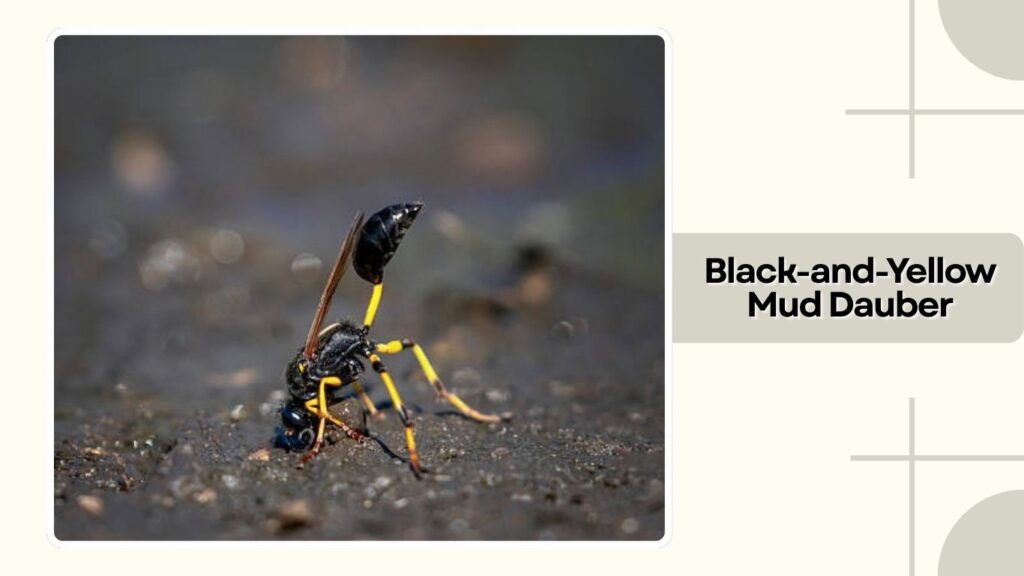
The Black-and-Yellow Mud Dauber (Sceliphron caementarium) is a solitary thread-waisted wasp recognized by its distinctive black and yellow coloration, extremely slender waist, and remarkable mud-building behavior. Belonging to the family Sphecidae, this species is widespread throughout North America and has been introduced to other regions. Unlike social wasps, it does not establish large colonies. Instead, females construct individual mud nests and capture spiders to feed their developing larvae.
Identification
- Scientific Name: Sceliphron caementarium
- Family: Sphecidae
- Size: Approximately 20–28 mm long.
- Body Color: Predominantly black with bright yellow markings.
- Waist: Exceptionally long, thin, and thread-like.
- Wings: Transparent to slightly smoky brown.
- Legs: Long, slender, and mostly yellow with darker sections.
- Antennae: Black, curved, and segmented.
- Nest Appearance: Elongated mud cells attached to sheltered surfaces.
Habitat and Distribution
Black-and-Yellow Mud Daubers are widely distributed across North America, from southern Canada through the United States and into Central America. Introduced populations also occur in other parts of the world.
They commonly inhabit gardens, meadows, woodland edges, agricultural areas, and residential environments.
These wasps frequently build mud nests beneath roof eaves, inside sheds, under bridges, and along protected walls. Females prefer sheltered locations that protect their nests from rain and direct disturbance.
Behavior and Diet
Adult Black-and-Yellow Mud Daubers primarily consume flower nectar, while their larvae feed on spiders.
Females collect moist soil and shape it into tubular mud chambers. After completing a chamber, the female hunts spiders, paralyzes them with her sting, and places them inside.
Once enough prey has been collected, she deposits an egg and seals the chamber with mud. These wasps are generally peaceful and rarely sting humans unless physically threatened.
Lifespan and Life Cycle
The Black-and-Yellow Mud Dauber undergoes complete metamorphosis through four stages: egg, larva, pupa, and adult.
After hatching, the larva consumes the stored spiders before spinning a cocoon and entering the pupal stage.
Development may continue for several weeks, while individuals in seasonal climates can overwinter inside their protected mud chambers. Adult activity typically occurs during warmer months, especially from late spring through summer.
8. Common Blue Mud Dauber (Chalybion californicum)
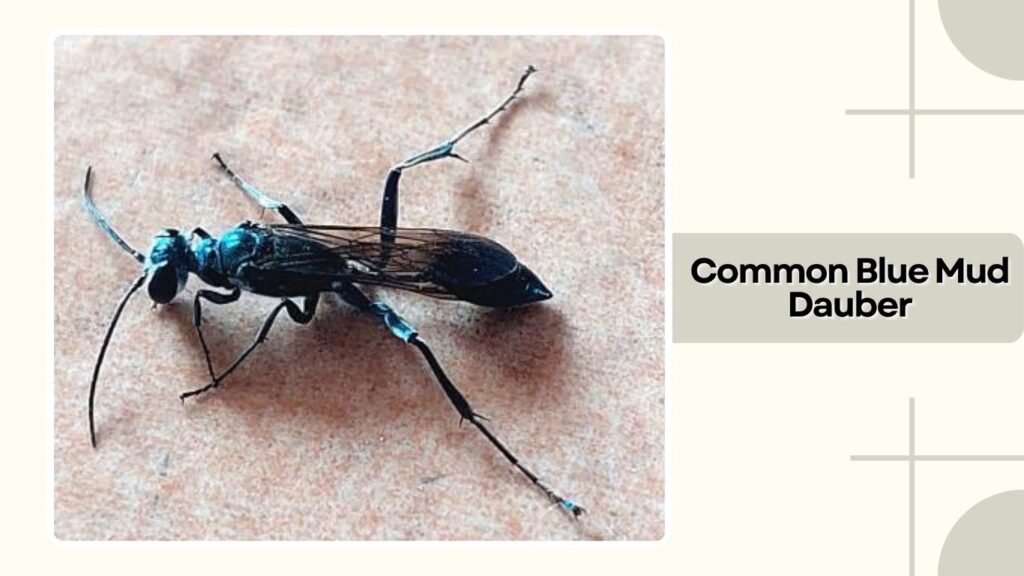
The Common Blue Mud Dauber (Chalybion californicum) is a striking solitary wasp known for its metallic blue-black body and iridescent wings. This species belongs to the family Sphecidae and occurs widely throughout North America. Unlike many other mud daubers, it often reuses abandoned nests constructed by other wasps. Females are specialized spider hunters and are particularly known for capturing black widow spiders to provide food for their developing offspring.
Identification
- Scientific Name: Chalybion californicum
- Family: Sphecidae
- Size: Approximately 19–25 mm long.
- Body Color: Metallic blue, blue-black, or dark violet.
- Wings: Dark, with noticeable blue or purple iridescence.
- Waist: Long, slender, and distinctly narrowed.
- Legs: Thin, black, and relatively long.
- Antennae: Dark-colored and moderately curved.
- Appearance: Smooth, shiny body with metallic reflections.
Habitat and Distribution
Common Blue Mud Daubers occur throughout much of the United States and southern Canada, extending into Mexico and neighboring regions.
They inhabit gardens, open woodlands, grasslands, agricultural landscapes, and suburban areas.
Unlike species that construct entirely new mud nests, these wasps frequently occupy abandoned nests made by Black-and-Yellow Mud Daubers.
Such nests are commonly found beneath building eaves, inside garages, along walls, and in other sheltered locations. Adults frequently visit flowering plants, particularly during summer.
Behavior and Diet
Adult Common Blue Mud Daubers feed mainly on flower nectar, while females capture spiders for their developing larvae.
Black widow spiders are among their notable prey, although they also hunt other spider species.
Females often renovate existing mud chambers by removing old materials and preparing the spaces for new offspring.
After capturing spiders, they immobilize them with venom and transport them into the nest. The wasps typically avoid confrontation with humans and are considered nonaggressive.
Lifespan and Life Cycle
The Common Blue Mud Dauber develops through egg, larva, pupa, and adult stages.
Females prepare suitable mud chambers and fill them with paralyzed spiders. A single egg is generally deposited within each provisioned chamber. After hatching, the larva consumes the stored spiders before spinning a protective cocoon.
The developing wasp eventually pupates and emerges as an adult when conditions become favorable.
In temperate regions, immature individuals may remain protected within their nests during winter. Adults are most commonly observed from late spring through summer.
9. Asian Mud Dauber (Sceliphron curvatum)
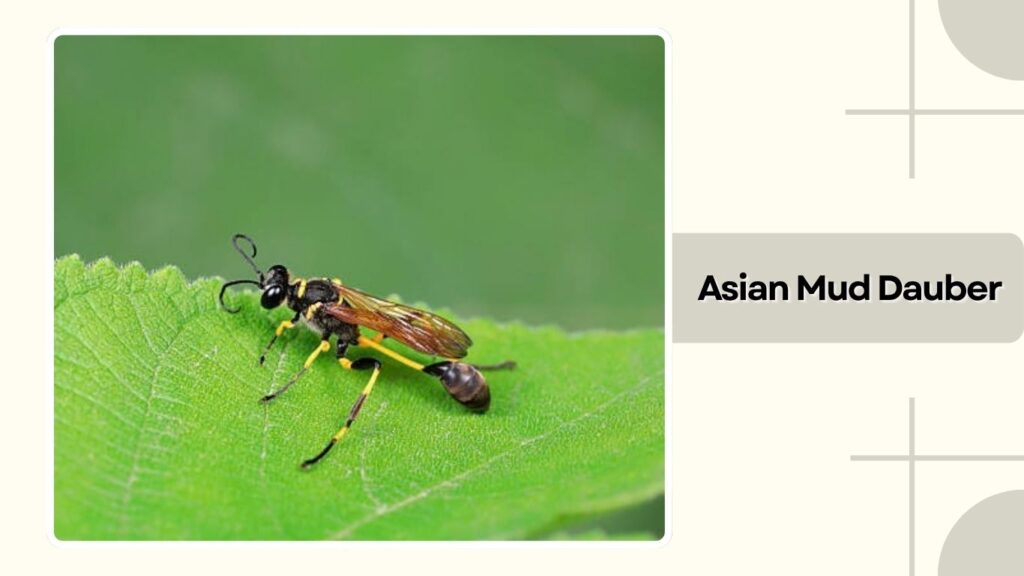
The Asian Mud Dauber (Sceliphron curvatum) is a solitary thread-waisted wasp recognized by its slender body, dark coloration, and distinctive mud nests. Native to parts of Asia, this species has expanded into numerous European countries through accidental introduction. Unlike some other mud daubers, females construct separate, pot-like mud cells rather than large clusters of connected tubes. These nests contain paralyzed spiders that provide nourishment for developing larvae.
Identification
- Scientific Name: Sceliphron curvatum
- Family: Sphecidae
- Size: Approximately 15–25 mm long.
- Body Color: Predominantly black with reddish-brown and yellow markings.
- Abdomen: Dark with narrow, pale bands.
- Waist: Extremely long and thread-like.
- Wings: Transparent to slightly smoky.
- Legs: Slender, with yellowish and reddish-brown sections.
- Nest Appearance: Individual elongated, pot-shaped mud cells.
Habitat and Distribution
Asian Mud Daubers are native to parts of South and Central Asia, including regions near the Himalayas.
The species was introduced to Europe during the late twentieth century and has since spread into countries such as Austria, Germany, France, Italy, and Hungary.
It has also been recorded occasionally in North America, although its establishment and exact distribution there remain uncertain.
These wasps commonly inhabit gardens, villages, agricultural areas, and residential neighborhoods.
Females often construct nests beneath sheltered roofs, along walls, inside storage rooms, and even on furniture or household objects.
Behavior and Diet
Adult Asian Mud Daubers primarily consume nectar, while their larvae depend on spiders captured by the mother.
Females gather moist soil and carefully construct individual mud cells. Each completed chamber is supplied with several paralyzed spiders.
After depositing an egg, the female seals the chamber, providing a protected environment for larval development. These wasps are solitary and generally avoid aggressive encounters with humans.
Their spider-hunting behavior contributes to the natural regulation of local spider populations.
Lifespan and Life Cycle
The Asian Mud Dauber undergoes complete metamorphosis through egg, larval, pupal, and adult stages.
After hatching, the larva feeds on the spiders stored inside its mud chamber. Once development is complete, it spins a protective cocoon and enters the pupal stage.
Depending on climate and seasonal conditions, developing wasps may overwinter inside their nests before emerging as adults.
Adult activity is most noticeable during warm weather, when females actively hunt spiders and construct new nesting chambers.
10. Mexican Grass-Carrying Wasp (Isodontia mexicana)
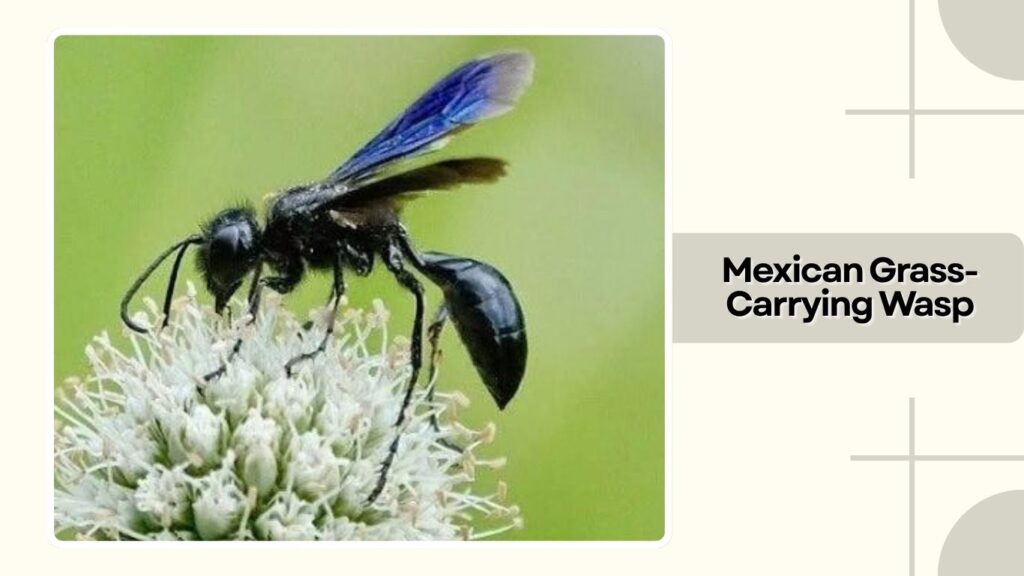
The Mexican Grass-Carrying Wasp (Isodontia mexicana) is a solitary thread-waisted wasp recognized by its slender black body, smoky wings, and unusual nesting behavior. Belonging to the family Sphecidae, this species is native to North America and has also become established in parts of Europe. Unlike mud daubers, females use dried grass and plant fibers to construct nests inside existing cavities. They hunt crickets and katydids to feed their developing larvae.
Identification
- Scientific Name: Isodontia mexicana
- Family: Sphecidae
- Size: Commonly around 16–20 mm long.
- Body Color: Predominantly black with subtle metallic reflections.
- Wings: Smoky brown to dark, sometimes showing bluish reflections.
- Waist: Slender, with a noticeably narrow connection to the abdomen.
- Legs: Long, thin, and black.
- Antennae: Dark, elongated, and segmented.
- Nest Appearance: Hollow cavities filled with dried grass and plant fibers.
Habitat and Distribution
Mexican Grass-Carrying Wasps occur throughout much of North America, particularly in the United States and Mexico.
Introduced populations have also become established in several European countries.
They inhabit gardens, grasslands, woodland edges, agricultural fields, and suburban environments.
Unlike ground-nesting digger wasps, this species commonly uses hollow plant stems, abandoned insect tunnels, wooden cavities, and artificial nesting structures.
Females may also establish nests inside window tracks, folded outdoor furniture, or other narrow protected spaces.
Behavior and Diet
Adult Mexican Grass-Carrying Wasps primarily feed on flower nectar. Females hunt tree crickets, katydids, and related insects to provide food for their developing larvae.
After locating suitable prey, the female immobilizes it with a venomous sting and transports it into an existing nesting cavity.
She then uses dried grass to divide or seal nesting spaces.
One distinctive behavior is carrying long blades of grass while flying, which gives this species its common name.
These wasps are solitary and generally nonaggressive toward humans.
Lifespan and Life Cycle
The Mexican Grass-Carrying Wasp undergoes complete metamorphosis through four stages: egg, larva, pupa, and adult.
Females construct nesting chambers using dried grass and provision them with paralyzed crickets or katydids.
After an egg hatches, the developing larva consumes the stored prey. The larva eventually spins a cocoon and enters the pupal stage.
In favorable climates, this species can produce two generations annually. Later-season offspring may overwinter inside their protected nesting cavities before emerging the following year.
FAQs
1. Are thread-waisted wasps dangerous to humans?
Thread-waisted wasps are generally not dangerous to humans. Most species are solitary and do not aggressively defend colonies like social wasps. Females can sting when trapped, handled, or threatened, but encounters rarely result in stings. Anyone with a serious allergy to insect venom should exercise additional caution.
2. What do thread-waisted wasps eat?
Adult thread-waisted wasps primarily consume nectar from flowering plants. However, their larvae require protein-rich food supplied by the mother. Depending on the species, females hunt caterpillars, spiders, crickets, katydids, and other insects. They immobilize prey with venom and store it inside protected nesting chambers.
3. Where do thread-waisted wasps build their nests?
Thread-waisted wasps construct different types of nests depending on the species. Some dig underground burrows in sandy or loose soil. Mud daubers build chambers from moist soil, often attaching them to buildings or sheltered surfaces. Grass-carrying wasps use dried vegetation to prepare nests inside hollow stems or existing cavities.
4. How long do thread-waisted wasps live?
The lifespan of thread-waisted wasps varies depending on species, climate, and seasonal conditions. Adults often remain active for several weeks, while immature stages may develop over longer periods. In temperate regions, some species overwinter as larvae or pupae inside protected nests before emerging as adults.
5. Are thread-waisted wasps beneficial to gardens?
Yes, thread-waisted wasps are generally beneficial garden insects. Many species help regulate populations of caterpillars, crickets, katydids, and other invertebrates by hunting them for their larvae. Adults also visit flowers for nectar and may contribute to pollination. Their presence supports biodiversity and the natural balance of garden ecosystems.
