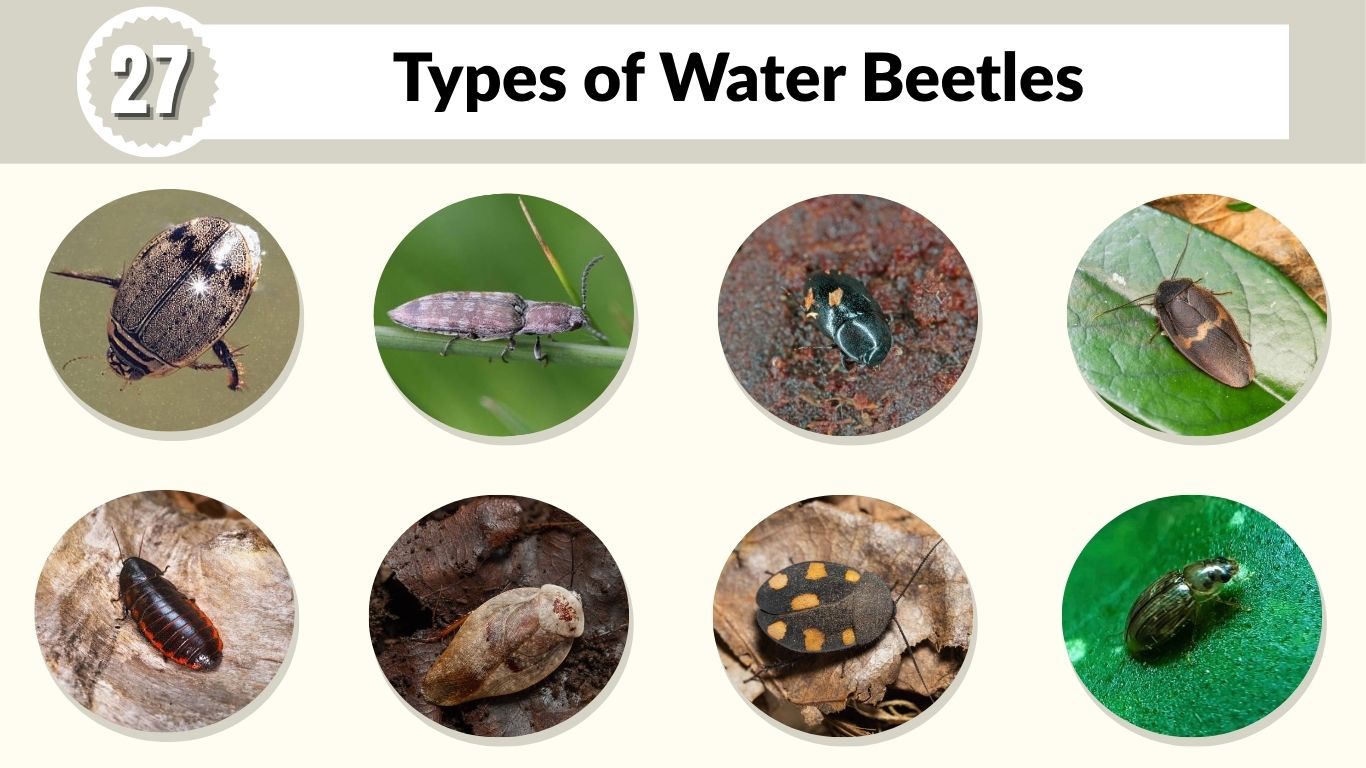
Water beetles are a diverse group of insects adapted to ponds, lakes, streams, marshes, and other freshwater habitats. Some are powerful predators, while others feed on algae, decaying plant material, or tiny aquatic organisms. Their bodies can be streamlined for swimming, flattened for clinging to rocks, or specialized for crawling through mud and vegetation. In this guide, you’ll discover 27 types of water beetles, including their identification features, habitat and distribution, feeding behavior, and life cycle.
1. Predaceous Diving Beetle
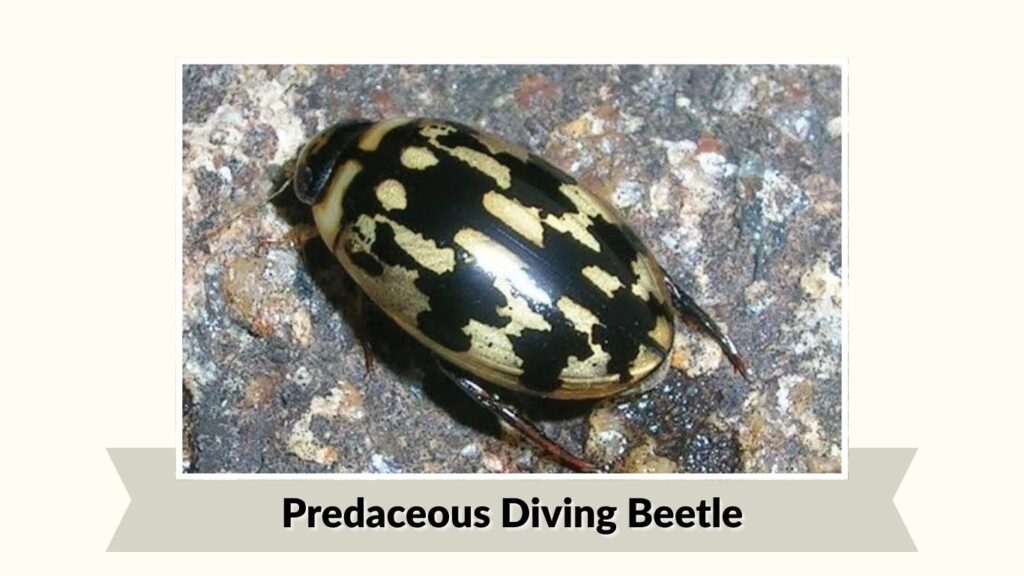
The Predaceous Diving Beetle belongs to the family Dytiscidae, a large group of aquatic beetles found in freshwater habitats worldwide. Both adults and larvae are active predators that feed on other small aquatic animals. Adults are strong swimmers and use their flattened, hair-fringed hind legs like paddles. They frequently rise to the water surface to renew the air supply carried beneath their wing covers.
Identification
- Common name: Predaceous Diving Beetle
- Family: Dytiscidae
- Size: About 1.2–40 mm, depending on species
- Body shape: Smooth, oval, and streamlined
- Color: Commonly dark brown, black, or olive
- Hind legs: Flattened and fringed with swimming hairs
- Movement: Both hind legs move together like oars
- Larvae: Elongated with strong, curved jaws
- Special feature: Adults carry an air supply while underwater
The streamlined body reduces resistance in water, while the powerful hind legs allow these beetles to swim rapidly after prey.
Habitat and Distribution
Predaceous Diving Beetles occur worldwide and inhabit many types of freshwater environments. They can be found in permanent and temporary ponds, pools, lakes, marshes, slow-moving streams, and occasionally rivers.
Many species prefer areas containing aquatic vegetation because plants provide hiding places and abundant prey. Members of the well-known genus Dytiscus commonly occur among vegetation in freshwater ponds and pools. Adults can also fly between bodies of water when habitat conditions change.
Behavior and Diet
Both adult diving beetles and their larvae are predators. They may feed on mosquito larvae, aquatic insects, worms, small crustaceans, and other invertebrates. Larger species may also attack tadpoles, fish larvae, and small amphibians.
Adults actively swim through the water searching for prey. They periodically rise to the surface and expose the rear of the body to obtain fresh air before diving again.
The larvae are sometimes called “water tigers” because of their aggressive predatory behavior and prominent jaws.
Lifespan and Life Cycle
The life cycle includes egg, larva, pupa, and adult stages. In species such as Dytiscus, females place eggs individually in underwater plant tissue.
After hatching, aquatic larvae pass through several growth stages while hunting prey. When fully developed, they leave the water and create a pupal chamber in moist soil near the shoreline.
The adult later emerges and returns to the water. Some Dytiscus species complete about one generation per year and overwinter as adults in permanent water.
2. Great Diving Beetle
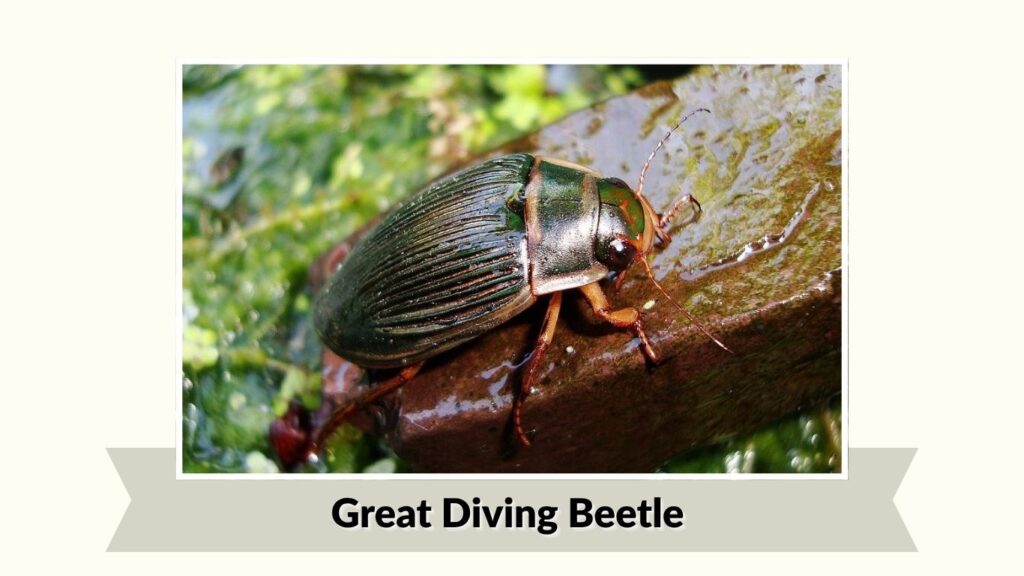
The Great Diving Beetle is one of the largest and most recognizable aquatic beetles in Europe. Scientifically known as Dytiscus marginalis, it has a streamlined body, powerful swimming legs, and yellowish borders around its dark body. Both adults and larvae are active freshwater predators capable of attacking aquatic insects, tadpoles, and other relatively small animals.
Identification
- Common name: Great Diving Beetle
- Scientific name: Dytiscus marginalis
- Family: Dytiscidae
- Adult size: About 27–35 mm
- Color: Dark olive-brown to nearly black
- Markings: Yellow margins around the pronotum and wing covers
- Hind legs: Flattened and fringed for swimming
- Female: Wing covers often distinctly grooved
- Male: Wing covers generally smooth
Its large oval body and yellow-edged appearance make it easier to identify than many smaller diving beetles.
Habitat and Distribution
Great Diving Beetles are native mainly to Europe and northern Asia. They inhabit ponds, lakes, slow-moving freshwater, and other permanent aquatic habitats, particularly where submerged vegetation provides cover.
Adults are also capable fliers and may travel at night to colonize newly available ponds.
Behavior and Diet
Adults and larvae are predators. They hunt aquatic insects, tadpoles, small fish, and other animals they can overpower.
Adults periodically rise to the surface to renew the air carried beneath their wing covers. Their paddle-like hind legs allow them to accelerate rapidly through the water when pursuing prey.
Lifespan and Life Cycle
Females insert eggs into submerged aquatic plant tissue. The larvae hatch after several weeks and become aggressive aquatic predators.
When fully grown, larvae leave the water and burrow into damp soil along the shoreline to pupate. New adults eventually emerge and return to freshwater habitats.
3. Harris’s Diving Beetle
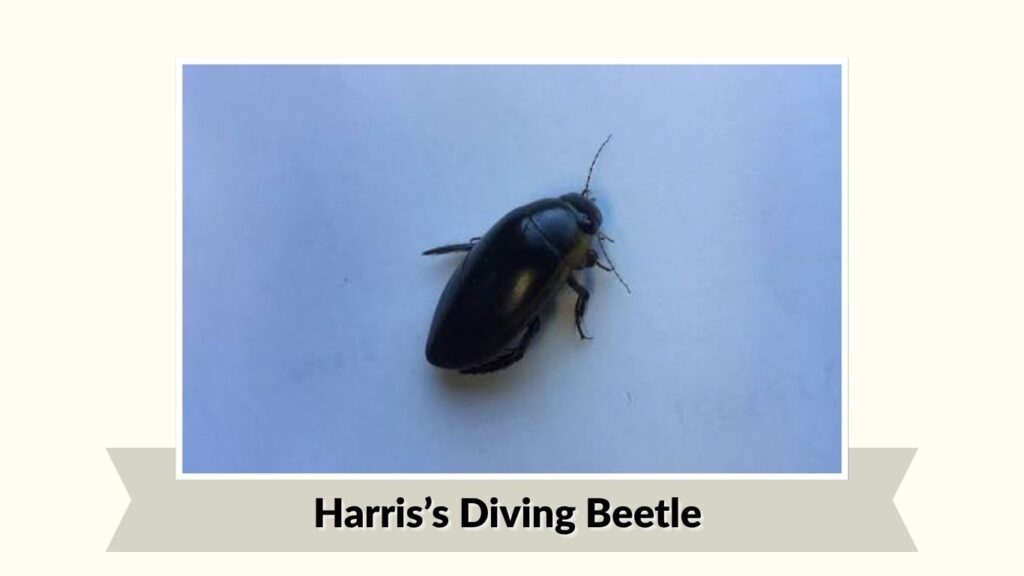
Harris’s Diving Beetle, Dytiscus harrisii, is a very large North American member of the predaceous diving beetle family. It is among the largest diving beetles on the continent and is especially associated with Canada and the northeastern United States. Like its relatives, it is an efficient underwater predator equipped with streamlined body proportions and strong swimming legs.
Identification
- Common name: Harris’s Diving Beetle
- Scientific name: Dytiscus harrisii
- Family: Dytiscidae
- Adult size: About 32–39 mm
- Body: Large, smooth, and streamlined
- Color: Generally very dark
- Underside: Mostly black to very dark brown
- Legs: Hind legs flattened for swimming
- Special feature: One of North America’s largest dytiscids
Careful examination of the underside and other structural features may be necessary to separate it from similar Dytiscus species.
Habitat and Distribution
Harris’s Diving Beetle occurs across Canada and extends into Alaska and the northeastern United States. It is particularly common in eastern Canada and around the Great Lakes region.
It inhabits freshwater environments and can occur in aquatic sites with at least some water movement as well as other suitable permanent freshwater habitats.
Behavior and Diet
Both adults and larvae are predators. They capture other aquatic organisms using strong jaws and rapid swimming movements.
Research on larvae indicates that they can prey heavily on aquatic insects, including caddisfly larvae. Like other diving beetles, adults must periodically replenish their underwater air supply at the surface.
Lifespan and Life Cycle
The life cycle follows complete metamorphosis: egg, larva, pupa, and adult. Eggs are associated with aquatic environments, and the larvae spend their development hunting underwater.
Mature larvae eventually leave the water and pupate in damp soil. Adults return to aquatic habitats after emergence and can fly between suitable bodies of water.
4. Vertical Diving Beetle
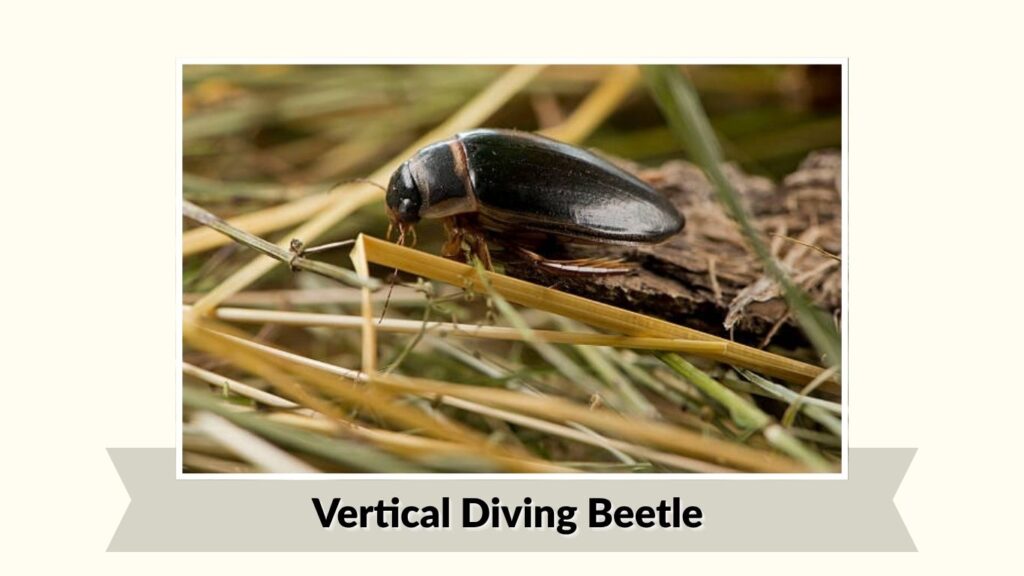
The Vertical Diving Beetle, Dytiscus verticalis, is another exceptionally large North American predaceous diving beetle. Adults can exceed 3 cm in length, while the larvae may grow to around 5 cm. It inhabits freshwater environments in northeastern North America and is a powerful predator both during its larval stage and as an adult.
Identification
- Common name: Vertical Diving Beetle
- Scientific name: Dytiscus verticalis
- Family: Dytiscidae
- Adult size: About 33–38 mm
- Larval size: Up to roughly 50 mm
- Body: Large, oval, and streamlined
- Pronotum: Yellow border mainly along the sides
- Wing covers: Yellow lateral margin extending toward the tip
- Hind legs: Adapted for powerful swimming
The restricted yellow border on the pronotum is one feature used to distinguish it from similar large Dytiscus species.
Habitat and Distribution
The Vertical Diving Beetle occurs in northeastern North America. Its range extends through parts of the northeastern United States and southeastern Canada, reaching from Nova Scotia westward toward Saskatchewan.
It uses freshwater habitats such as ponds, lakes, marshy areas, and other waters capable of supporting abundant aquatic prey.
Behavior and Diet
Vertical Diving Beetles are active predators. Adults swim through vegetation and open water searching for aquatic insects and other small animals.
The larvae are equally predatory. Research comparing D. verticalis and Harris’s Diving Beetle shows that their larvae actively select and attack aquatic prey.
Lifespan and Life Cycle
Females lay eggs associated with freshwater vegetation. Larvae hatch and spend their early development entirely underwater, growing through several larval stages.
Once mature, they leave the aquatic environment temporarily and pupate in damp soil. Adults later emerge, return to water, and can disperse by flight when necessary.
5. Fringed Diving Beetle
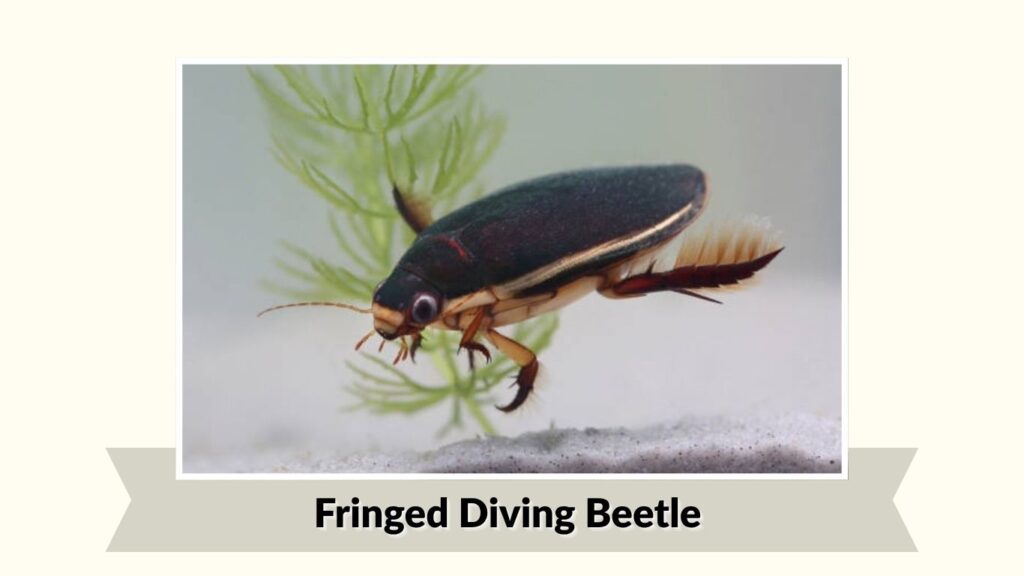
The Fringed Diving Beetle, Cybister fimbriolatus, is one of the larger predaceous diving beetles of North America. Its common name refers to the conspicuous swimming hairs along its legs. These fringes increase the surface area of each swimming stroke, allowing the beetle to move efficiently through ponds and ditches while pursuing aquatic prey.
Identification
- Common name: Fringed Diving Beetle
- Scientific name: Cybister fimbriolatus
- Family: Dytiscidae
- Adult size: About 26–33 mm
- Color: Brownish to black
- Body: Oval and streamlined
- Legs: Noticeably fringed with swimming hairs
- Body shape: Broadest behind the middle
- Flight: Adults are capable fliers
Its substantial size and broad swimming body help distinguish it from many smaller diving beetles.
Habitat and Distribution
The Fringed Diving Beetle occurs in North America and inhabits aquatic environments such as ponds and ditches.
It may favor deeper areas of freshwater habitats where it can swim freely while still using submerged structures and vegetation for cover. Adults sometimes fly to artificial lights at night.
Behavior and Diet
Both adult beetles and larvae are predators. They feed on aquatic insects and may capture other small aquatic animals, including small fish when conditions allow.
Powerful swimming legs give adults the speed necessary to chase prey. When underwater, they rely on stored atmospheric air and must periodically return to the surface.
Lifespan and Life Cycle
Fringed Diving Beetles undergo complete metamorphosis. Eggs hatch into predatory aquatic larvae, which pass through several stages while feeding and growing.
When development is complete, mature larvae leave the water to pupate in moist soil. Winged adults later emerge and can disperse to other freshwater habitats.
6. Two-Lined Diving Beetle
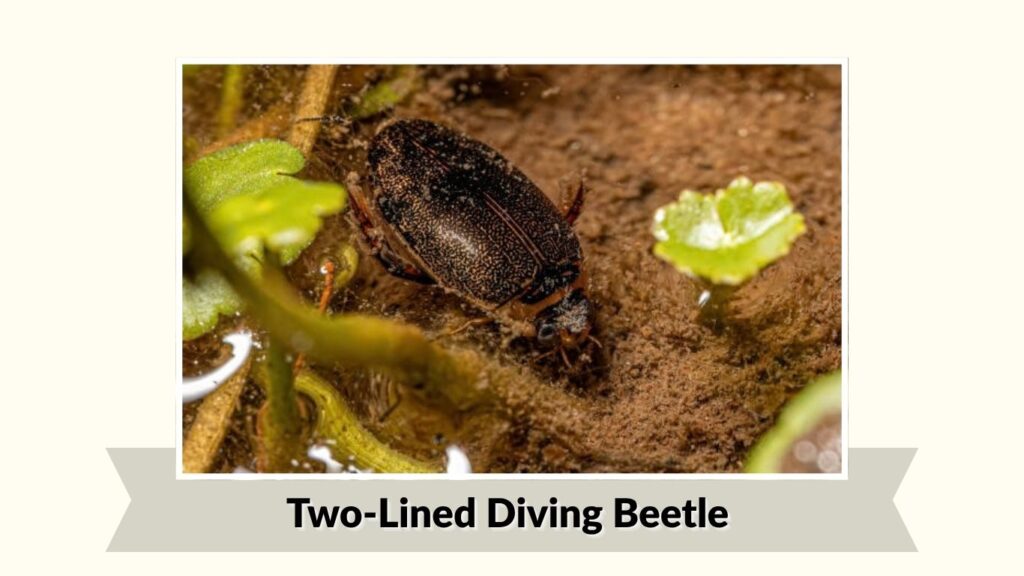
The Two-Lined Diving Beetle commonly refers to Graphoderus bilineatus, a medium-sized predaceous diving beetle associated with well-vegetated freshwater habitats. Its smooth, oval body is adapted for efficient swimming, while contrasting markings across the pronotum contribute to its “two-lined” appearance. Like other dytiscids, it is an aquatic predator throughout both its larval and adult stages.
Identification
- Common name: Two-Lined Diving Beetle
- Scientific name: Graphoderus bilineatus
- Family: Dytiscidae
- Size: Roughly 14–16 mm
- Body: Broad, smooth, and oval
- Color: Yellowish to brown with darker markings
- Pronotum: Distinctive dark transverse markings
- Hind legs: Flattened and fringed with hairs
- Lifestyle: Aquatic predator
Its smaller size separates it from large Dytiscus species such as the Great Diving Beetle.
Habitat and Distribution
This beetle is associated mainly with freshwater wetlands in Europe and parts of northern Eurasia. It prefers standing or slowly moving water with abundant aquatic vegetation.
Vegetated ponds, marshes, shallow lakes, and similar wetlands provide both shelter and hunting opportunities. Healthy, structurally diverse freshwater environments are particularly important for populations.
Behavior and Diet
Adults swim actively through submerged plants while hunting aquatic invertebrates. Larvae are also predators and use their strong jaws to capture small aquatic animals.
Adults obtain atmospheric oxygen by visiting the water surface and carrying air beneath the body or wing covers before diving again.
Lifespan and Life Cycle
Females lay eggs associated with aquatic vegetation. The larvae hatch underwater and develop through several predatory stages.
Mature larvae eventually crawl onto land near the water and create pupal chambers in moist soil. After pupation, new adults emerge and return to freshwater, completing the beetle’s four-stage life cycle.
7. Sunburst Diving Beetle
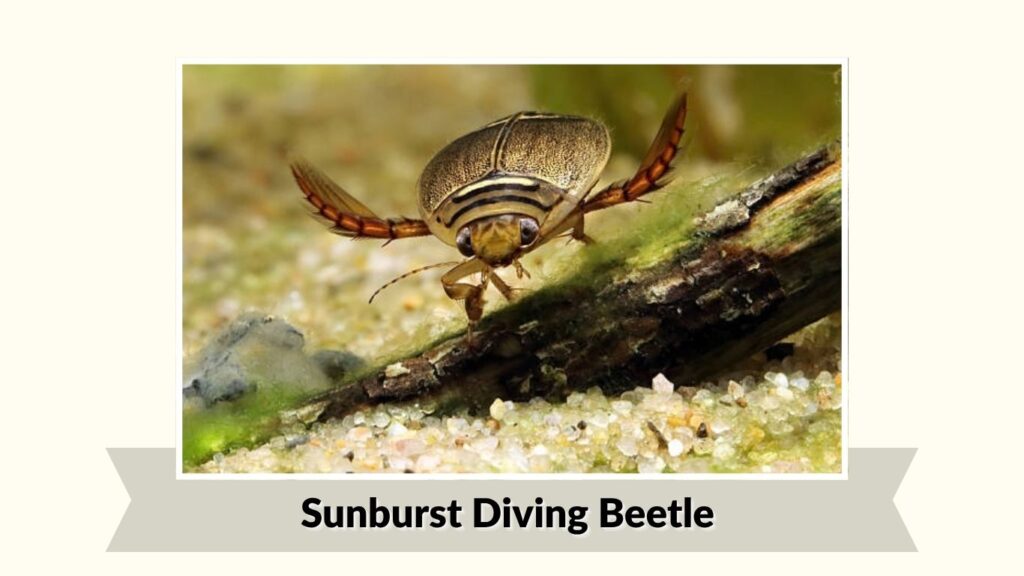
The Sunburst Diving Beetle, Thermonectus marmoratus, is a striking North American aquatic beetle known for its contrasting spotted pattern. Besides its attractive appearance, it has become especially interesting to scientists because its predatory larvae possess unusually sophisticated visual systems that help them judge prey at different distances. Adults remain active freshwater predators.
Identification
- Common name: Sunburst Diving Beetle
- Scientific name: Thermonectus marmoratus
- Other name: Spotted Diving Beetle
- Family: Dytiscidae
- Adult size: About 11.4–14 mm
- Body: Smooth, oval, and streamlined
- Pattern: Dark body with pale yellowish spots
- Hind legs: Flattened for swimming
- Larvae: Slender, predatory, with highly developed eyes
Its spotted pattern gives it a more decorative appearance than the mostly dark coloration of many other diving beetles.
Habitat and Distribution
Sunburst Diving Beetles occur primarily in southwestern North America and are especially associated with warm freshwater environments.
They may inhabit temporary or permanent pools, ponds, and other aquatic habitats suitable for predatory diving beetles. Their ability to fly allows adults to move when temporary waters begin drying.
Behavior and Diet
Both larvae and adults are predators that hunt small aquatic animals.
The larvae are particularly notable because their main eyes contain unusual optical adaptations. Research has shown that they can effectively focus on prey at different distances, helping them make precise attacks while hunting underwater.
Lifespan and Life Cycle
Sunburst Diving Beetles develop through egg, larval, pupal, and adult stages. The larval phase is aquatic and strongly predatory.
After completing their larval development, individuals leave the water and pupate in protected soil near the shoreline. Adults later emerge, return to suitable freshwater, and continue the feeding and reproductive cycle.
8. Whirligig Beetle
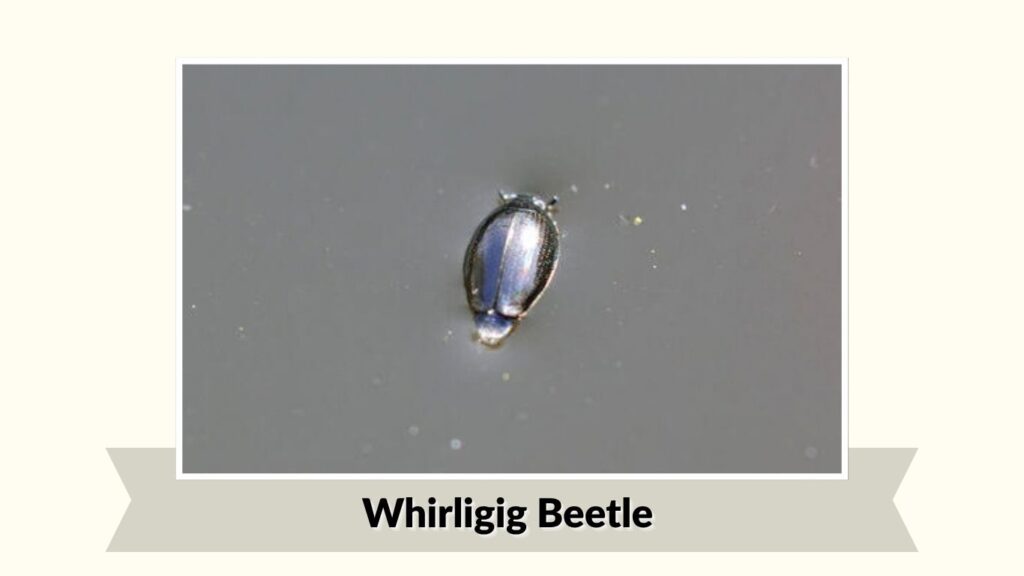
Whirligig Beetles belong to the family Gyrinidae and are among the easiest water beetles to recognize because they rapidly spin and circle across the water surface. They are specially adapted to life at the boundary between air and water. Their divided eyes allow them to observe activity both above and below the surface while swimming. Around 900 species occur worldwide.
Identification
- Common name: Whirligig Beetle
- Family: Gyrinidae
- Body: Smooth, oval, and streamlined
- Color: Usually dark brown, black, or metallic
- Eyes: Divided into upper and lower portions
- Legs: Middle and hind legs flattened for swimming
- Movement: Rapid circular or spinning motion
- Habitat: Water surface
Their unusual eye structure is one of their most distinctive adaptations.
Habitat and Distribution
Whirligig Beetles occur worldwide in freshwater habitats. They can be found on ponds, lakes, slow streams, and quiet sections of rivers.
Adults often gather in groups on open water. When disturbed, the entire group may rapidly scatter in different directions before gathering again.
Behavior and Diet
Adults spend much of their time swimming across the surface and feeding on small insects and other organic material found there. Their rapid movements help them capture prey and escape predators.
They can also dive underwater when threatened and may carry trapped air with them.
Lifespan and Life Cycle
Females lay eggs in or near aquatic vegetation. The larvae are aquatic predators and develop underwater through several stages.
Mature larvae eventually leave the water or move into protected shoreline areas to pupate. Adults later emerge and return to aquatic habitats.
9. Large Whirligig Beetle
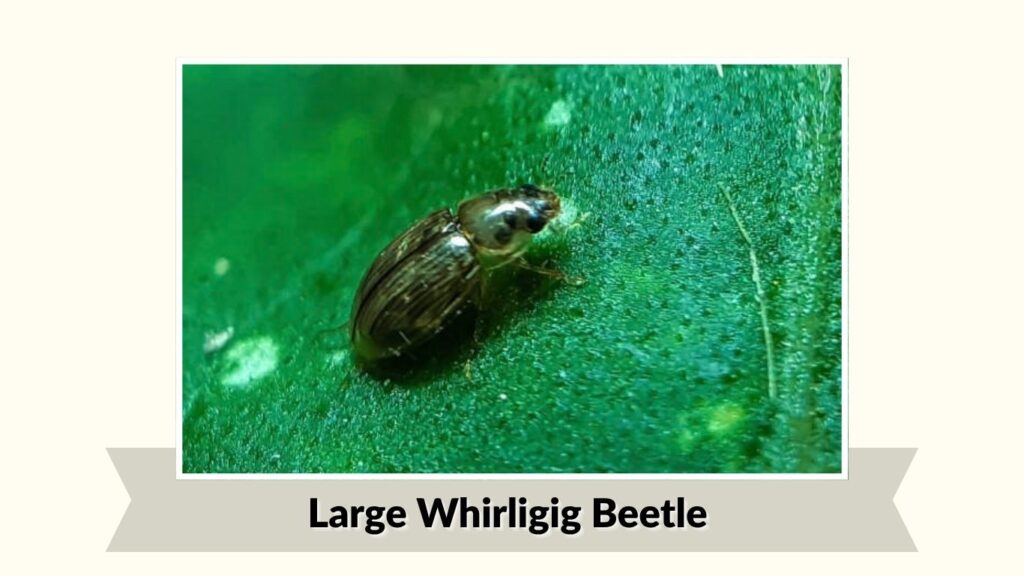
Large Whirligig Beetles commonly belong to the genus Dineutus. These beetles are noticeably larger than many other members of the whirligig family and form conspicuous groups on ponds, lakes, rivers, and streams. North American Dineutus generally measure around 9–15.5 mm long, making them the largest whirligigs in that region.
Identification
- Common name: Large Whirligig Beetle
- Representative genus: Dineutus
- Family: Gyrinidae
- Size: Roughly 9–15.5 mm
- Body: Broad, oval, and flattened
- Color: Usually dark or metallic
- Eyes: Divided for seeing above and below water
- Movement: Fast surface swimming
Their large size is especially useful for separating them from smaller whirligig genera.
Habitat and Distribution
Dineutus species occur in many parts of the world and are particularly diverse in warmer regions. They are widespread in North America.
Adults occupy the surfaces of streams, rivers, ponds, and lakes. Very large groups can sometimes form floating aggregations containing numerous individuals.
Behavior and Diet
Large Whirligig Beetles are active predators and scavengers. They detect struggling insects and other potential food at the water surface and quickly move toward them.
When threatened, they can dive beneath the surface. Some Dineutus species also release defensive chemicals with a noticeable odor.
Lifespan and Life Cycle
Eggs are laid near aquatic environments, and the larvae develop underwater. Larvae are elongated predators that hunt small aquatic animals.
When mature, they pupate in protected areas near the shoreline. Adults later emerge and return to the water surface, where they feed and reproduce.
10. Crawling Water Beetle
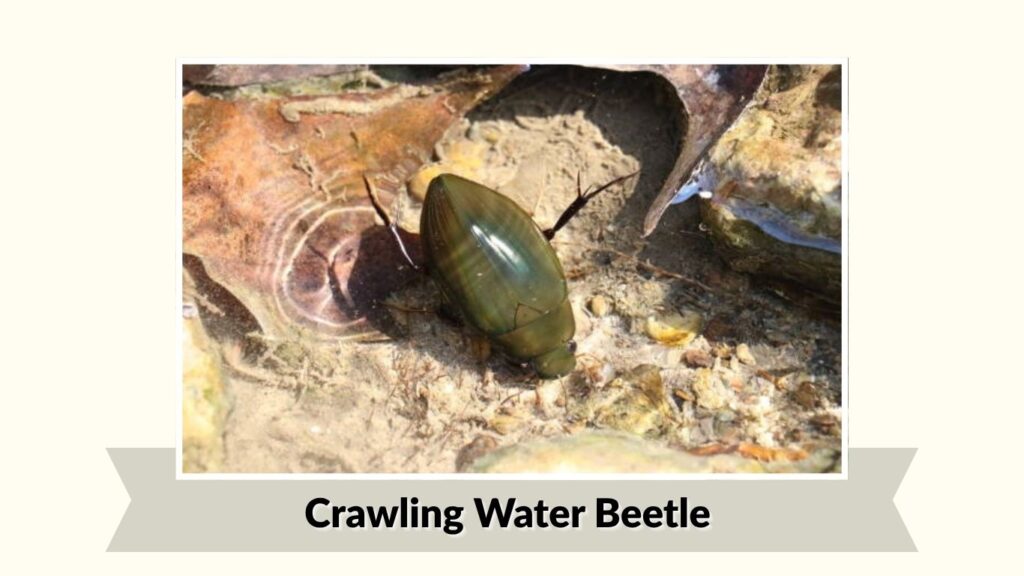
Crawling Water Beetles belong to the family Haliplidae. Unlike predaceous diving beetles, they are relatively slow swimmers and move their legs alternately instead of using both hind legs together like paddles. They are usually tiny beetles associated with algae and aquatic vegetation in freshwater ponds, lakes, pools, and slow backwaters.
Identification
- Common name: Crawling Water Beetle
- Family: Haliplidae
- Size: About 1.5–5 mm
- Body: Small, oval, and strongly convex
- Color: Yellowish, brown, or patterned
- Swimming: Slow and somewhat clumsy
- Leg movement: Alternating rather than synchronized
- Special feature: Enlarged hind coxal plates
Their small size and unusual hind-leg structures help distinguish them from diving beetles.
Habitat and Distribution
Crawling Water Beetles occur worldwide but are especially diverse in northern temperate regions. They generally prefer standing freshwater with abundant algae.
Adults and larvae are often found among aquatic plants near the margins of ponds and lakes. Members of Haliplus may also occur in backwaters of streams.
Behavior and Diet
The larvae primarily feed on algae, including filamentous forms. Their specialized mouthparts allow them to obtain food from algal cells.
Adults have a broader diet and may consume algae, small crustaceans, aquatic worms, hydrozoans, and insect eggs.
Lifespan and Life Cycle
Eggs develop into aquatic larvae, which are most commonly encountered during spring in temperate regions.
Adults can occur throughout the year and may overwinter in permanent standing water. They periodically visit the surface to obtain air, which is stored beneath the wings and body structures.
11. Burrowing Water Beetle
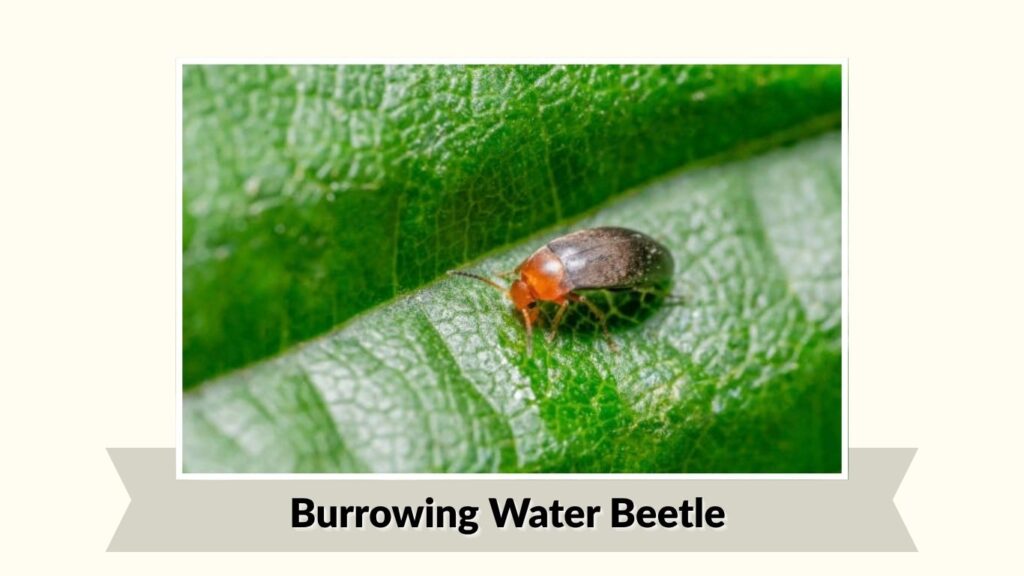
Burrowing Water Beetles belong to the family Noteridae. They are small aquatic beetles closely related to predaceous diving beetles and are particularly diverse in tropical climates. Their common name reflects their tendency to move among plant roots, algae, mud, and submerged vegetation rather than continuously swimming through open water. Approximately 260 species are known worldwide.
Identification
- Common name: Burrowing Water Beetle
- Family: Noteridae
- Body: Small, smooth, and oval
- Color: Usually brown, reddish brown, or black
- Legs: Adapted for swimming and moving through vegetation
- Habitat: Mainly standing freshwater
- Adults: Primarily predatory
- Larvae: May be omnivorous
Exact identification often requires close examination because these beetles can resemble small diving beetles.
Habitat and Distribution
Burrowing Water Beetles occur worldwide, although they are most diverse in warmer tropical and subtropical regions.
Most species inhabit standing water such as ponds, marshes, swamps, and vegetated pools. They are frequently associated with algae, aquatic plants, and plant roots.
Behavior and Diet
Adults are predators that hunt small aquatic organisms. Instead of spending all their time in open water, they commonly move through dense vegetation and material near the bottom.
Larvae have more varied feeding habits and may consume both animal and other available organic material.
Lifespan and Life Cycle
Females lay eggs in aquatic habitats, and the larvae spend their early development in the water.
Larvae pass through several stages before leaving the aquatic environment or entering protected shoreline material for pupation. Adults later emerge and return to freshwater.
12. Trout-Stream Beetle
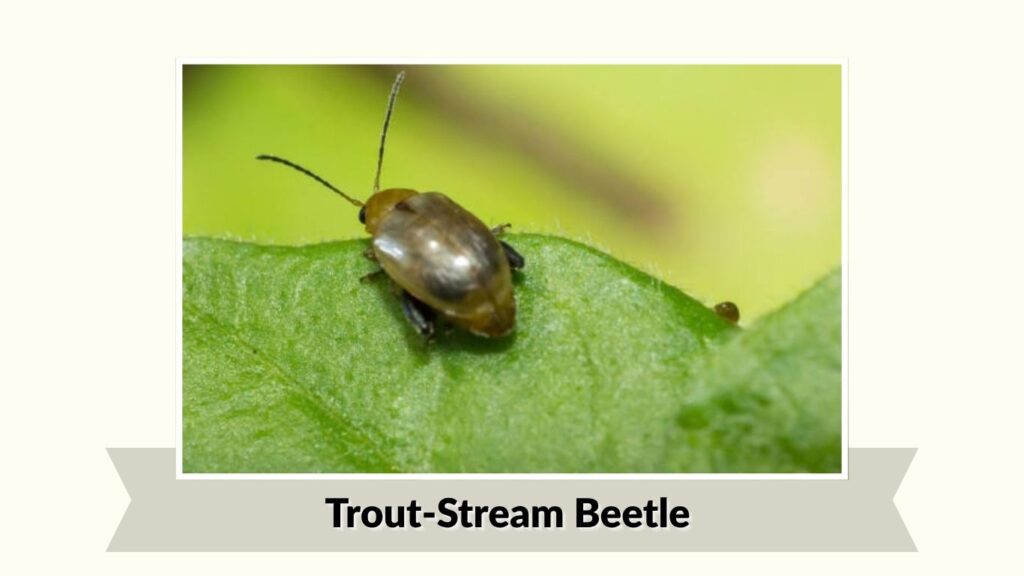
Trout-Stream Beetles belong to the family Amphizoidae and genus Amphizoa. They are unusual water beetles specially adapted to cold, clean, flowing mountain streams. Unlike diving beetles, they lack flattened swimming legs and usually crawl over submerged rocks, roots, and woody material rather than swimming efficiently. They occur in western North America and parts of eastern Asia.
Identification
- Common name: Trout-Stream Beetle
- Genus: Amphizoa
- Family: Amphizoidae
- Size: About 11–16 mm
- Color: Dull black to dark brown
- Body: Broad, oval, and slightly convex
- Legs: Not flattened for swimming
- Movement: Primarily crawling
- Preferred water: Cold, oxygen-rich streams
The absence of paddle-like swimming legs separates them from many other relatively large aquatic beetles.
Habitat and Distribution
Trout-Stream Beetles occur in western North America and eastern Asia. They are especially associated with cool mountain streams and rivers.
Adults and larvae usually remain close to stream margins, clinging to rocks, submerged wood, roots, and undercut banks. They favor clean, highly oxygenated water.
Behavior and Diet
Both adults and larvae are predators. Stonefly larvae are an important prey item, although other aquatic insects can also be consumed.
Adults are poor swimmers and generally crawl across submerged surfaces. Larvae also crawl rather than actively swimming.
Lifespan and Life Cycle
The life cycle is approximately one year in some studied populations. Aquatic larvae pass through three developmental stages while living in cold streams.
Specific details of egg laying and pupation remain less thoroughly documented than for many common pond beetles, but the immature stages are strongly dependent on cool, flowing freshwater habitats.
13. Water Scavenger Beetle
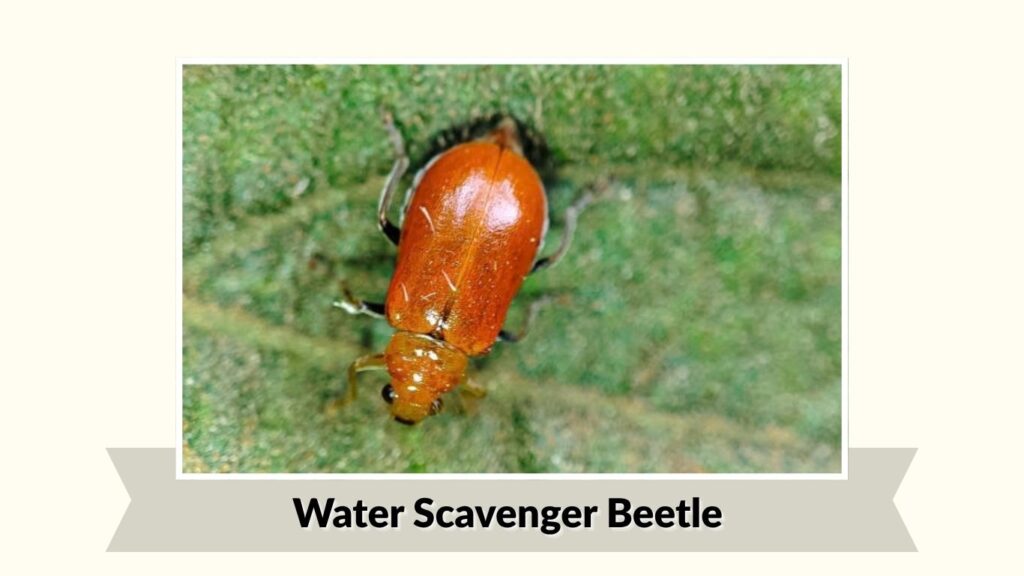
Water Scavenger Beetles belong to the large family Hydrophilidae, which contains thousands of species worldwide. Many aquatic adults feed on decaying plant and animal material, although some are predators. They may resemble predaceous diving beetles, but their antennae, swimming movements, and method of collecting air provide useful identification clues.
Identification
- Common name: Water Scavenger Beetle
- Family: Hydrophilidae
- Size: Approximately 1–40 mm in many species
- Body: Usually oval and streamlined
- Color: Commonly dark brown or black
- Antennae: Short and clubbed
- Swimming: Hind legs generally move alternately
- Breathing: Adults approach the surface head first
- Lifestyle: Aquatic in many species
Unlike predaceous diving beetles, water scavenger beetles usually come to the surface head first to obtain air.
Habitat and Distribution
Hydrophilidae occur worldwide and occupy a wide range of habitats. Aquatic species can be found in ponds, marshes, lakes, pools, drainage ditches, and slow-moving water.
Some family members are terrestrial and inhabit dung, compost, carrion, or other decomposing organic materials rather than open water.
Behavior and Diet
Many adults feed on decaying vegetation, algae, and dead animal material, which explains the name “water scavenger beetle.” Other species are more predatory.
Larvae of many aquatic species are predators equipped with strong jaws and capture insects, snails, and other small aquatic animals.
Lifespan and Life Cycle
Females of many water scavenger beetles produce protective egg cases. In large Hydrophilus species, a female may place numerous eggs inside a cocoon-like case.
Larvae develop in water before moving into moist soil to pupate. Depending on species and climate, one or more generations may occur annually, and some adults can live for more than a year.
14. Great Silver Water Beetle
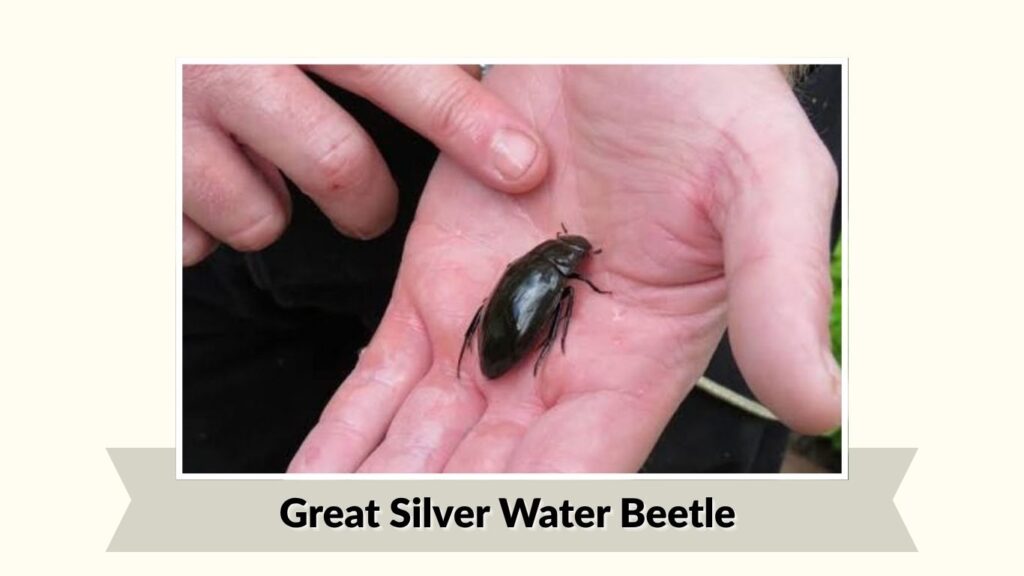
The Great Silver Water Beetle, Hydrophilus piceus, is one of Europe’s largest aquatic beetles. Despite its name, the upper surface is mainly glossy black; the “silver” appearance comes from a layer of air trapped against the underside of its body while underwater. It belongs to the water scavenger beetle family and favors still, vegetation-rich freshwater habitats.
Identification
- Common name: Great Silver Water Beetle
- Scientific name: Hydrophilus piceus
- Family: Hydrophilidae
- Size: Up to about 4.8–5 cm
- Color: Glossy black to dark olive
- Body: Large, oval, smooth, and convex
- Antennae: Short with clubbed tips
- Underside: Often appears silvery underwater
- Legs: Long hind legs with prominent spines
Its impressive size, clubbed antennae, and silvery underwater air film help distinguish it from large predaceous diving beetles.
Habitat and Distribution
The Great Silver Water Beetle occurs across parts of Europe and the broader Palearctic region. It typically inhabits freshwater ponds, marshes, reed-filled ditches, and other still or slowly moving waters with abundant vegetation.
In Britain, it is especially associated with wetland areas containing well-vegetated ditches and pools. Adults spend most of their time underwater but repeatedly visit the surface to renew their air supply.
Behavior and Diet
Adult Great Silver Water Beetles are largely scavenging or plant-feeding omnivores and may consume decaying vegetation and other organic material.
The larvae are much more predatory. They are known for attacking freshwater snails using powerful jaws. Adults are capable of flight and may leave one body of water to locate another suitable habitat.
Lifespan and Life Cycle
Females produce a silk-like floating egg case containing numerous eggs. After hatching, the larvae live in water and prey heavily on aquatic animals, especially snails.
Mature larvae eventually leave the water and pupate in damp soil. Adults can potentially survive for more than one year, although lifespan varies with environmental conditions.
15. Giant Water Scavenger Beetle
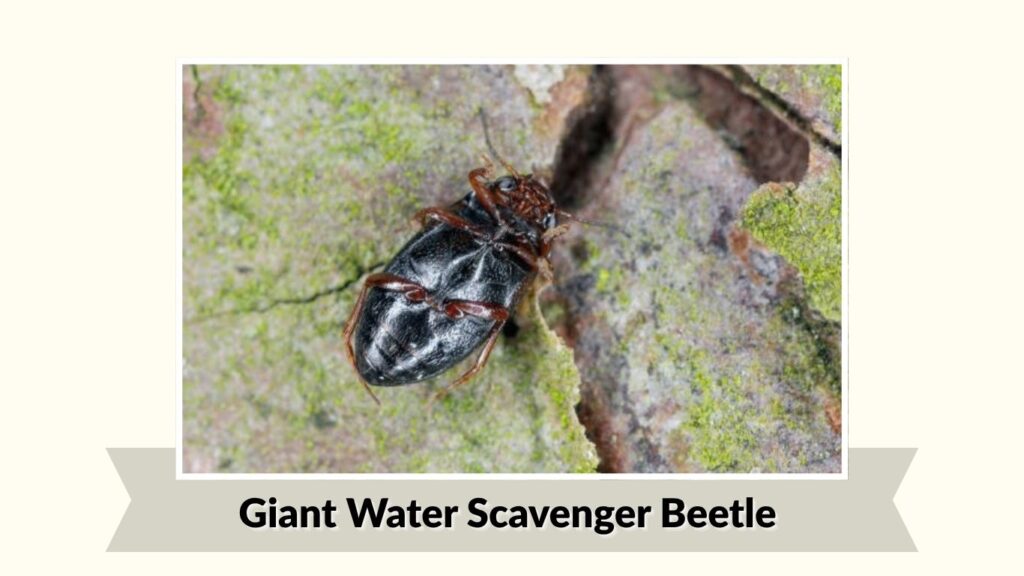
The Giant Water Scavenger Beetle commonly refers to large members of the genus Hydrophilus. In North America, Hydrophilus triangularis, also known as the Giant Black Water Beetle, is an excellent example. Adults can reach around 4 cm and inhabit marshy lakes, weedy ponds, slow streams, and drainage areas. Despite their bulky appearance, they are capable swimmers and strong fliers.
Identification
- Common name: Giant Water Scavenger Beetle
- Representative species: Hydrophilus triangularis
- Family: Hydrophilidae
- Size: About 32–40 mm
- Color: Usually glossy black
- Body: Large, oval, and streamlined
- Antennae: Short and clubbed
- Legs: Adapted for aquatic movement
- Flight: Adults can fly
The large black body makes it easy to mistake this beetle for a giant diving beetle, although its antennae and swimming behavior differ.
Habitat and Distribution
Hydrophilus triangularis occurs widely across North America, ranging through much of Canada and the United States into Mexico.
It inhabits marshy lakes, vegetated ponds, swales, streams, and similar freshwater habitats. Adults are sometimes found surprisingly far from water because they can fly and are attracted to artificial lights at night.
Behavior and Diet
Adult giant water scavenger beetles may consume plant material, decaying organic matter, and some animal food. Their larvae are stronger predators and possess large jaws for capturing aquatic prey.
Unlike diving beetles, adults commonly approach the surface head-first to collect air.
Lifespan and Life Cycle
Females of the genus Hydrophilus can produce cocoon-like egg cases containing many eggs. Some may contain up to approximately 140 eggs.
Larvae develop aquatically, but mature larvae eventually leave the water and pupate in moist soil. Depending on climate, there may be one or two generations annually, and some adults survive for more than a year.
16. Riffle Beetle
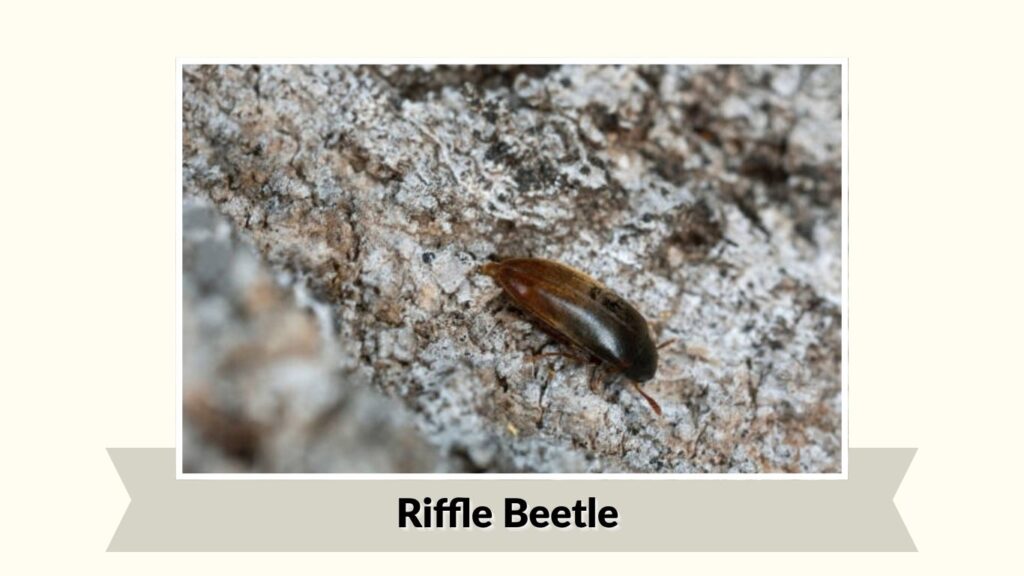
Riffle Beetles belong to the family Elmidae and are unusually specialized for living in flowing freshwater. Both larvae and most adults remain aquatic, often occupying cool, clean streams with strong currents. Instead of swimming rapidly like diving beetles, they cling to submerged rocks, wood, and vegetation. Their presence is often associated with well-oxygenated running water.
Identification
- Common name: Riffle Beetle
- Family: Elmidae
- Body: Small, elongated, and hard-bodied
- Color: Usually dark brown or black
- Legs: Strong for gripping submerged surfaces
- Movement: Primarily crawling rather than swimming
- Larvae: Elongated and aquatic
- Habitat: Running, oxygen-rich streams
- Special feature: Many adults remain permanently aquatic
Their compact bodies and gripping legs help them resist strong currents.
Habitat and Distribution
Riffle Beetles occur worldwide and are found throughout North America. They commonly inhabit cool, fast-flowing streams and rivers.
Adults and larvae can be discovered beneath stones, among gravel, on submerged logs, and around aquatic vegetation. Because many species require relatively clean, well-oxygenated water, riffle beetles are often important organisms in freshwater ecological studies.
Behavior and Diet
Most riffle beetles are scrapers or grazers rather than active predators. They feed on algae, microorganisms, and organic material growing on submerged surfaces.
Adults crawl slowly against currents and cling tightly to rocks or wood. Their adaptations allow them to remain submerged for long periods without repeatedly swimming to the surface.
Lifespan and Life Cycle
Life cycles vary among species. In the riffle beetle Stenelmis crenata, studies found a one-generation-per-year cycle, with larvae present throughout the year.
Larval growth continues through winter, pupation occurs in late spring, and adults begin appearing around late May. Adults can remain active into autumn.
17. Long-Toed Water Beetle
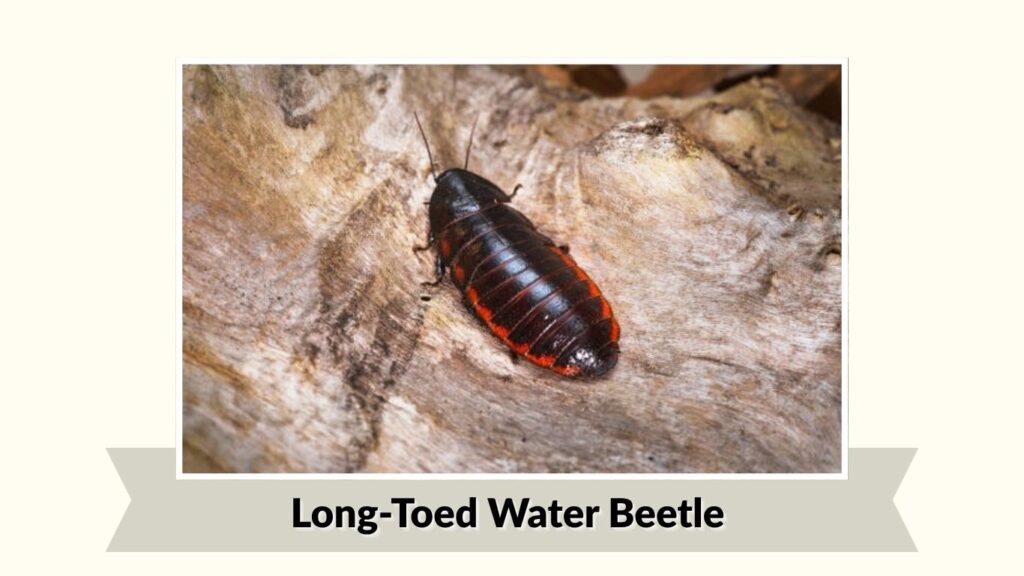
Long-Toed Water Beetles belong to the family Dryopidae. Their name refers to their relatively long feet and claws, which help adults grip rocks, plants, and other submerged surfaces. Most North American adults are aquatic, but unlike many water beetle groups, their larvae are primarily terrestrial. Both adults and larvae mainly feed on plant-related material.
Identification
- Common name: Long-Toed Water Beetle
- Family: Dryopidae
- Body: Small to medium and elongated
- Color: Usually brown or dark brown
- Legs: Relatively long with prominent claws
- Movement: Crawls over submerged surfaces
- Adults: Mostly aquatic in North America
- Larvae: Mainly terrestrial
- Diet: Primarily herbivorous
These beetles are generally better adapted for crawling and clinging than for rapid open-water swimming.
Habitat and Distribution
Long-Toed Water Beetles occur worldwide except in Australia and Antarctica and are widespread across North America.
Aquatic adults often occupy streams, rivers, and vegetated freshwater margins. Some species live around emergent vegetation in still water, while specialized forms can occupy highly unusual habitats. One Texas species, for example, is associated with subterranean water.
Behavior and Diet
Adults crawl along stones, submerged plants, roots, and woody material while feeding on algae or plant matter.
Their long claws provide a strong grip, especially in moving water. Unlike highly predatory diving beetles, long-toed water beetles are primarily herbivorous.
Lifespan and Life Cycle
Eggs are generally deposited in damp environments associated with suitable habitat. Larvae differ from adults by being largely terrestrial and developing in moist areas near water.
After completing their larval growth, they pupate before emerging as adults. The adults then move into aquatic or shoreline habitats, depending on the species.
18. Water Penny Beetle
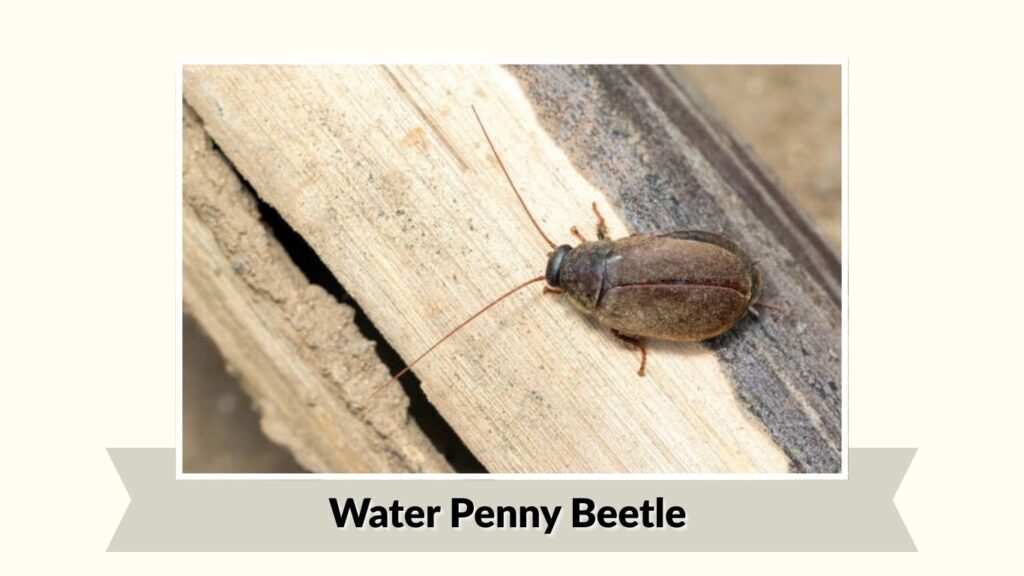
Water Penny Beetles belong to the family Psephenidae and are named for their remarkable larvae. These larvae are flattened, round to oval, and often resemble tiny coins stuck to submerged rocks. They are especially characteristic of clean, fast-flowing streams where they cling tightly to surfaces and graze on algae. Adult water penny beetles look much more like conventional small beetles.
Identification
- Common name: Water Penny Beetle
- Family: Psephenidae
- Adult size: Commonly about 3–7 mm
- Adult color: Usually dark
- Larval shape: Flat, broad, and coin-like
- Larval habitat: Attached to submerged rocks
- Movement: Larvae crawl firmly over hard surfaces
- Diet: Mainly algae and organic material
- Preferred water: Fast, clean streams
The larvae are far more frequently noticed than the adults and are among the most distinctive freshwater beetle larvae.
Habitat and Distribution
Water Penny Beetles occur in multiple regions worldwide and are particularly diverse in East Asia, although different groups occur in the Americas and elsewhere.
Their larvae typically inhabit the undersides or surfaces of rocks and submerged wood in fast-flowing streams. Adults are more often found on vegetation and rocks along stream banks.
Behavior and Diet
Larvae cling tightly to rocks, where their flattened bodies reduce the risk of being swept away.
They graze primarily on algae growing across submerged surfaces, although some species also consume detritus. Their feeding helps process biological material coating stream rocks.
Lifespan and Life Cycle
Water Penny Beetles undergo egg, larval, pupal, and adult stages. Larvae may remain in streams for an extended period and can overwinter.
When development is complete, pupation occurs under streamside substrates or sometimes in protected aquatic locations. Adults tend to be short-lived and are commonly observed during summer.
19. Skiff Beetle
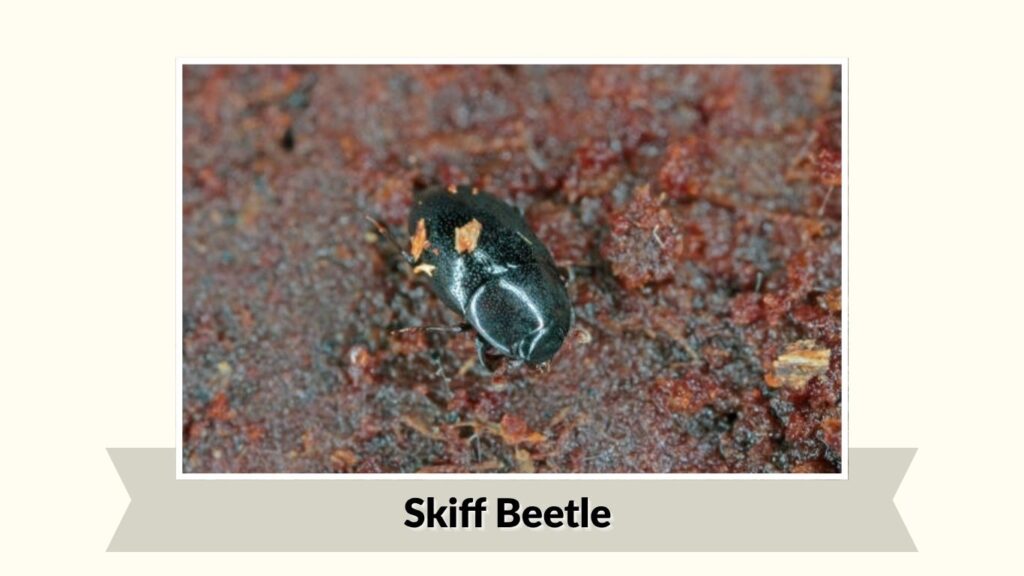
Skiff Beetles belong to the family Hydroscaphidae, a remarkable group of extremely tiny aquatic beetles. Many measure only around 1–2 mm. They typically live in thin films of moving water covering algae on rocks, stream edges, seepages, and similar wet surfaces. Both larvae and adults feed mainly on algae, making them very different from predatory diving beetles.
Identification
- Common name: Skiff Beetle
- Family: Hydroscaphidae
- Typical size: Around 0.9–2.7 mm
- Color: Tan to brown
- Body: Small and tapered
- Wing covers: Short, leaving part of the abdomen exposed
- Larvae: Narrow toward the rear
- Diet: Primarily algae
- Habitat: Thin films of flowing water over algal mats
The shortened wing covers are one of the most distinctive adult characteristics.
Habitat and Distribution
Skiff Beetles are found across much of the world and have been recorded on every continent except Antarctica.
They occupy specialized habitats known as hygropetric environments, where a thin layer of water moves over rocks or algal mats. Remarkably, some species tolerate extreme temperatures and have been recorded in both hot springs and icy snowmelt environments.
Behavior and Diet
Adults and larvae crawl among wet algae rather than swimming freely through deep water. Both stages mainly graze on filamentous algae.
Adults can retain an air supply beneath their wing covers, allowing them to stay submerged for extended periods.
Lifespan and Life Cycle
Their reproductive biology remains less well known than that of many larger water beetles. In studied species, females place a single relatively large egg on algal mats.
Larvae remain aquatic and continue feeding on algae. Pupation may occur within the last larval skin at the air-water interface, after which tiny adults emerge.
20. Minute Bog Beetle
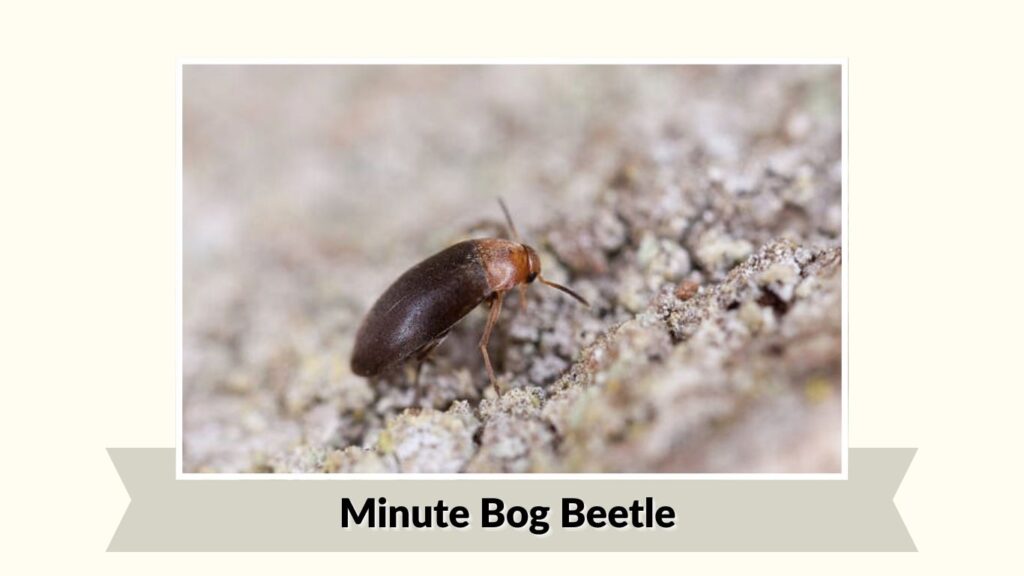
Minute Bog Beetles belong to the family Sphaeriusidae and are among the tiniest beetles associated with aquatic environments. Adults can measure little more than half a millimeter and are often overlooked completely. They inhabit damp substrates beside streams, ponds, bogs, and other freshwater areas rather than swimming conspicuously through open water. Their biology remains relatively poorly understood.
Identification
- Common name: Minute Bog Beetle
- Family: Sphaeriusidae
- Genus: Sphaerius
- Size: About 0.5–1.2 mm
- Color: Usually black
- Body: Tiny, rounded, and hemispherical
- Surface: Often shiny
- Habitat: Wet sand, mud, moss, or gravel
- Diet: Probably algae and microorganisms
Their minute size means magnification is often necessary for accurate identification.
Habitat and Distribution
Minute Bog Beetles occur in Europe, North and Central America, Africa, Australia, and additional regions.
They typically live along the edges of streams, rivers, pools, and stagnant water. Adults may hide beneath stones or among moist sand, gravel, plant roots, algae, and wet moss. Sphagnum moss in boggy environments can also support them.
Behavior and Diet
These beetles spend much of their lives moving through tiny spaces between grains of wet substrate and organic material.
Their feeding biology has not been studied extensively. Available observations indicate that at least some species feed on algae, while microorganisms and fine organic matter may also contribute to their diet.
Lifespan and Life Cycle
Minute Bog Beetles undergo complete metamorphosis, producing eggs, larvae, pupae, and adults. Both larvae and adults are closely associated with very wet environments.
Compared with common diving and scavenger beetles, relatively little is known about their seasonal development or total lifespan. Their extremely small size and concealed habitat make them difficult to observe in nature.
21. Minute Moss Beetle
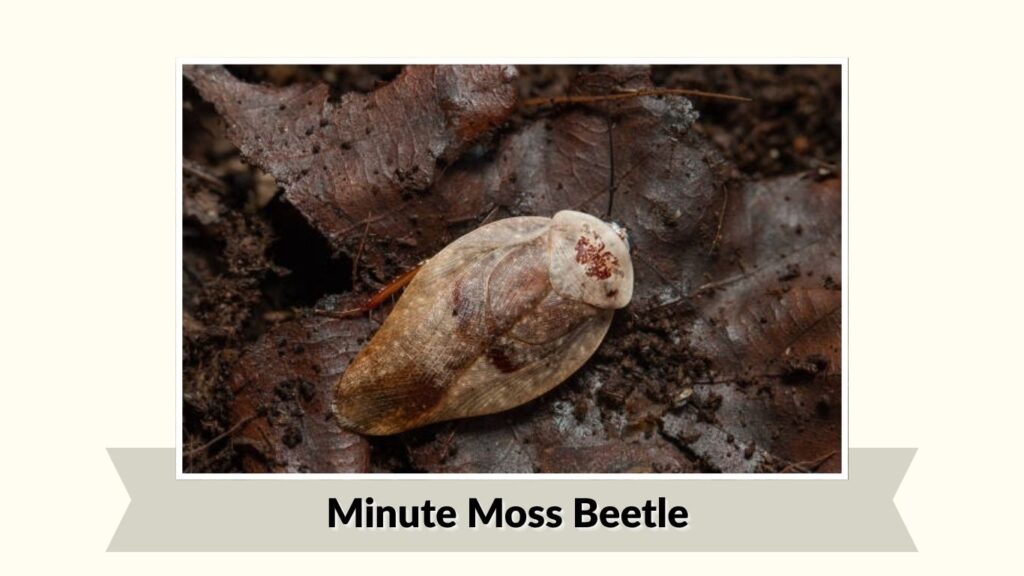
Minute Moss Beetles belong to the family Hydraenidae, a widespread group of extremely small aquatic and semiaquatic beetles. Most species measure only a few millimeters long and live around shallow freshwater margins. Unlike diving beetles, adults are generally poor swimmers and spend much of their time crawling over wet stones, moss, submerged leaves, and other surfaces while feeding on microscopic organic material.
Identification
- Common name: Minute Moss Beetle
- Family: Hydraenidae
- Size: Approximately 0.5–3 mm in many species
- Body: Tiny and generally elongated or oval
- Color: Usually brown or black
- Antennae: Distinctive segmented club
- Movement: Primarily crawls rather than swims
- Diet: Algae, microorganisms, and detritus
Their extremely small size means they can easily be overlooked during ordinary pond or stream observations.
Habitat and Distribution
Minute Moss Beetles occur worldwide and occupy an impressive range of aquatic habitats, from mountain streams and river margins to ponds and even coastal rock pools. Most favor very shallow water.
They frequently hide among moss, wet leaf litter, sand, stones, and vegetation near the waterline.
Behavior and Diet
Adults generally crawl over submerged surfaces rather than swimming through open water. They carry an air supply while submerged.
Both adults and larvae commonly consume algae, bacteria, protozoans, detritus, spores, and other microscopic material growing on wet surfaces.
Lifespan and Life Cycle
Eggs are deposited near water. In many species, larvae are more terrestrial or shoreline-associated than adults and develop in moist substrates.
Pupation usually takes place in damp soil or sand close to the water. The exact life cycle varies substantially because Hydraenidae contains thousands of species.
22. Marsh Beetle
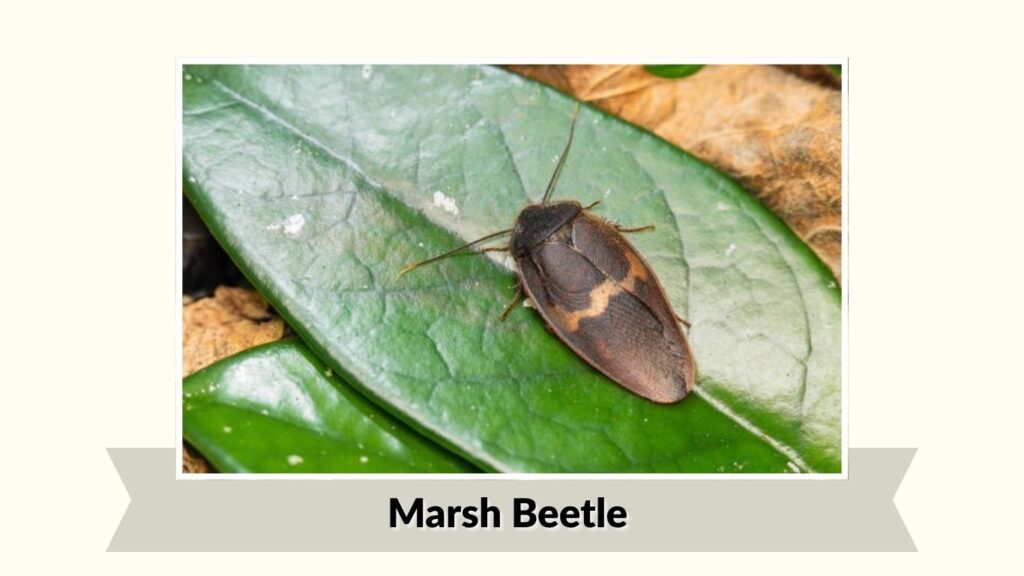
Marsh Beetles belong to the family Scirtidae. They are unusual among water-associated beetles because the larvae are primarily aquatic while the adults normally live on land. Their larvae occur in ponds, streams, wetlands, and waterlogged vegetation, particularly where decomposing leaves provide abundant organic material. Adults are commonly encountered on vegetation near freshwater.
Identification
- Common name: Marsh Beetle
- Family: Scirtidae
- Adult size: Roughly 1.5–12 mm across the family
- Adult body: Small, oval, and relatively soft
- Color: Commonly brown, yellowish, or dark
- Larvae: Aquatic with long multisegmented antennae
- Adult habitat: Vegetation near water
- Larval habitat: Ponds, streams, and wetlands
The unusually long, multisegmented larval antennae are particularly useful for recognizing Scirtidae.
Habitat and Distribution
Marsh Beetles occur worldwide and are especially diverse in temperate regions. Their larvae inhabit both stagnant and flowing freshwater.
Areas rich in decaying leaves and aquatic vegetation are particularly suitable because they provide shelter and food.
Behavior and Diet
Larvae generally feed on fine organic material associated with submerged surfaces. Comb-like mouthparts help them collect detritus and microorganisms.
Adults leave the water and may occur on flowers, leaves, or decomposing vegetation beside wetlands.
Lifespan and Life Cycle
Females place eggs in habitats suitable for aquatic larvae. After hatching, larvae may pass through numerous growth stages; some Scirtidae can have as many as 11 larval instars.
Mature larvae leave the aquatic habitat to pupate on land. The terrestrial adults later emerge and reproduce near freshwater.
23. Variegated Mud-Loving Beetle
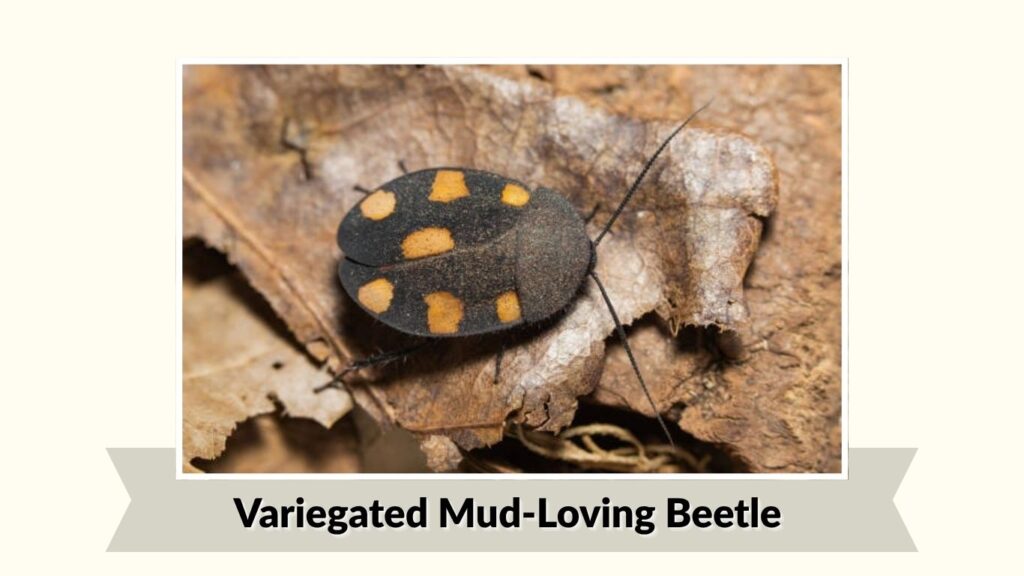
Variegated Mud-Loving Beetles belong to the family Heteroceridae. These small beetles live at the boundary between land and water, digging tunnels into wet sand or mud beside rivers, ponds, lakes, and brackish habitats. Both adults and larvae spend considerable time inside their galleries, where they feed on microorganisms and organic material contained within the sediment.
Identification
- Common name: Variegated Mud-Loving Beetle
- Family: Heteroceridae
- Size: About 1–8 mm
- Body: Elongated and slightly flattened
- Color: Usually patterned brown
- Front legs: Broad and strongly adapted for digging
- Tibiae: Equipped with conspicuous spines
- Antennae: Relatively short
Their powerful, spiny front legs function almost like small digging tools.
Habitat and Distribution
Heteroceridae occur worldwide except Antarctica. They inhabit wet sandy or muddy shorelines along freshwater and brackish environments.
Beetles excavate shallow tunnels that protect them from predators and changing surface conditions.
Behavior and Diet
Both adults and larvae spend much of their time burrowing. Their diet includes algae, microorganisms, bacteria, cyanobacteria, and decomposing organic particles in the sediment.
Adults can fly and may be strongly attracted to lights at night.
Lifespan and Life Cycle
Females lay small groups of eggs in underground breeding chambers. Larvae develop inside the damp substrate and pass through several instars.
Pupation also occurs within a protected mud chamber. Development can be relatively rapid, an adaptation that may help the insects survive shoreline habitats vulnerable to sudden flooding.
24. Travertine Beetle
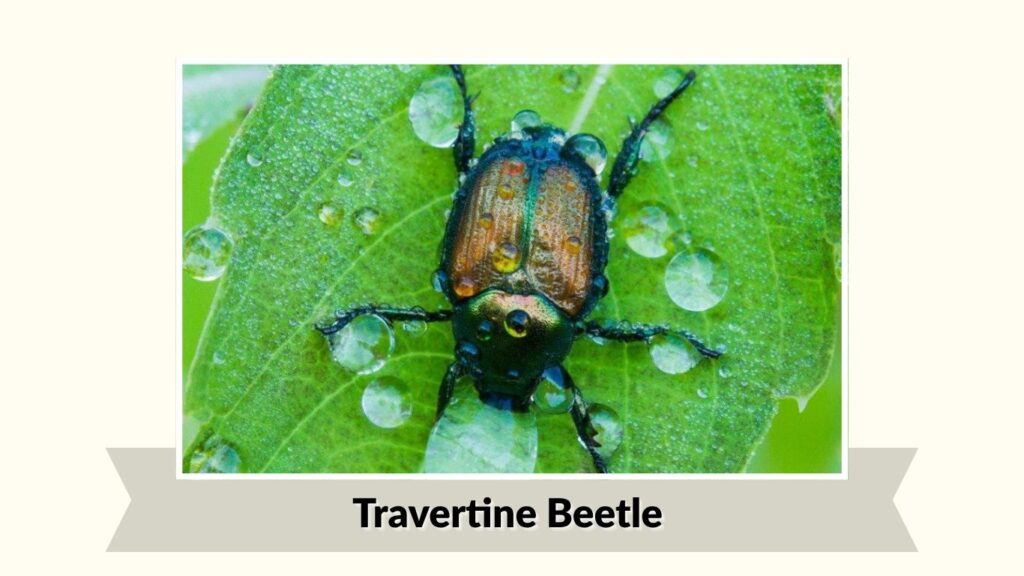
Travertine Beetles belong to the family Lutrochidae and the genus Lutrochus. They are small water-associated beetles found only in the Americas. Their name comes from the association of some species with mineral-rich streams where calcium carbonate forms travertine deposits. Adults and larvae typically occur on submerged wood, rocks, vegetation, and other surfaces in flowing water.
Identification
- Common name: Travertine Beetle
- Family: Lutrochidae
- Genus: Lutrochus
- Size: Roughly 2–6 mm
- Body: Oval and strongly convex
- Color: Often yellowish or brownish
- Surface: Frequently covered with fine hairs
- Habitat: Streams and rapids
Some adults living in hard-water streams can even become partly coated with mineral deposits.
Habitat and Distribution
Travertine Beetles occur from the United States south through Central and South America.
They are associated mainly with shallow, flowing streams. Some inhabit areas where travertine is actively forming, while others occur on submerged decaying wood and vegetation.
Behavior and Diet
Adults crawl across underwater substrates and can hold an air film against their body. They feed largely on algae and organic material.
Some larvae feed on or burrow into waterlogged wood.
Lifespan and Life Cycle
Larvae develop underwater and may remain there for an extended period. Some species appear to produce approximately one generation each year.
Mature larvae leave the water to pupate under nearby debris. Adults return to stream environments after emergence and may fly readily when disturbed.
25. Minute Marsh-Loving Beetle
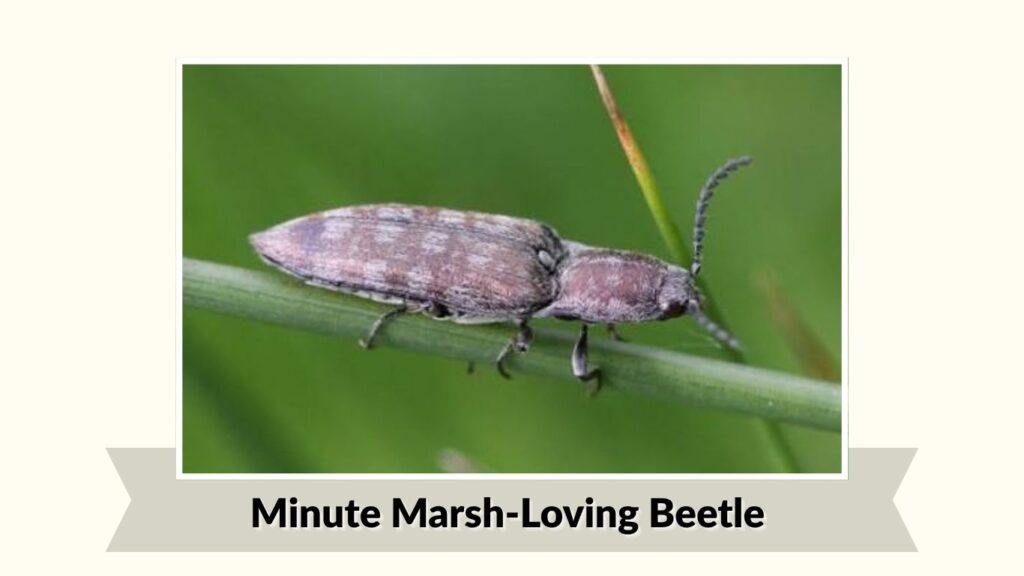
Minute Marsh-Loving Beetles belong to the family Limnichidae. These tiny beetles are generally associated with wet environments along streams, rivers, marshes, ponds, and coastal habitats. They are usually found among moist vegetation, moss, stones, leaf litter, or waterlogged wood rather than actively swimming through open water. More than 300 species are known worldwide.
Identification
- Common name: Minute Marsh-Loving Beetle
- Family: Limnichidae
- Body: Tiny, oval, and often convex
- Color: Brown to black
- Surface: Often finely hairy
- Typical habitat: Damp areas near water
- Movement: Mainly crawling
- Diet: Algae, moss, and organic material
Their minute size and concealed lifestyle make many species difficult to observe without close inspection.
Habitat and Distribution
Limnichidae occur worldwide, with particularly high diversity in tropical regions.
Most live near freshwater or other damp habitats. Some members of the genus Caccothryptus, for example, inhabit waterlogged dead wood beside small streams.
Behavior and Diet
These beetles usually crawl through damp substrates rather than behaving like active diving beetles.
Known species feed on algae, moss, biofilms, and related organic material. Adults may cling tightly to wet surfaces when disturbed.
Lifespan and Life Cycle
Detailed life histories remain poorly known for many Limnichidae. Larvae generally occupy moist or aquatic-associated habitats and feed on organic films.
Pupation typically occurs outside open water, often beneath damp debris. Adults later return to moist shoreline environments.
26. Grooved Diving Beetle
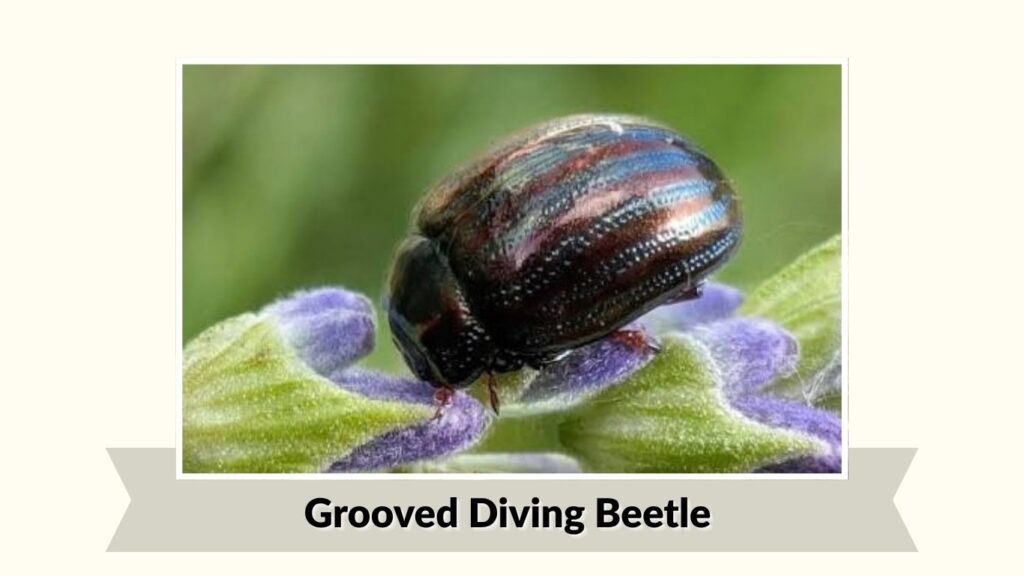
The Grooved Diving Beetle, Acilius sulcatus, is a fast-swimming predaceous diving beetle found across Europe and parts of Asia and North Africa. Its common name refers particularly to females, whose wing covers have conspicuous longitudinal grooves. Adults possess powerful paddle-like hind legs, while both adults and larvae are active hunters in freshwater habitats.
Identification
- Common name: Grooved Diving Beetle
- Scientific name: Acilius sulcatus
- Family: Dytiscidae
- Body: Broad, oval, and streamlined
- Color: Yellowish-brown with darker markings
- Female: Distinctly grooved wing covers
- Male: Smoother wing covers
- Hind legs: Flattened with swimming hairs
The pronounced grooves on females provide one of the easiest clues to the species.
Habitat and Distribution
Grooved Diving Beetles inhabit ponds, bogs, streams, marshes, and both temporary and permanent freshwater. They tolerate habitats with varying amounts of aquatic vegetation.
Adults can fly between water bodies, allowing them to colonize newly suitable habitats.
Behavior and Diet
Both larvae and adults are predators. They attack aquatic insects, crustaceans, and other suitably sized prey.
The larvae grasp prey with curved jaws and inject digestive fluids. Adults are extremely agile swimmers and actively chase prey.
Lifespan and Life Cycle
Females place eggs near water on vegetation. Eggs may hatch after roughly a week, followed by about a month of larval development under favorable conditions.
Mature larvae leave the water to pupate. Adults commonly overwinter in permanent bodies of water, and the species generally has one generation annually.
27. Broad Diving Beetle
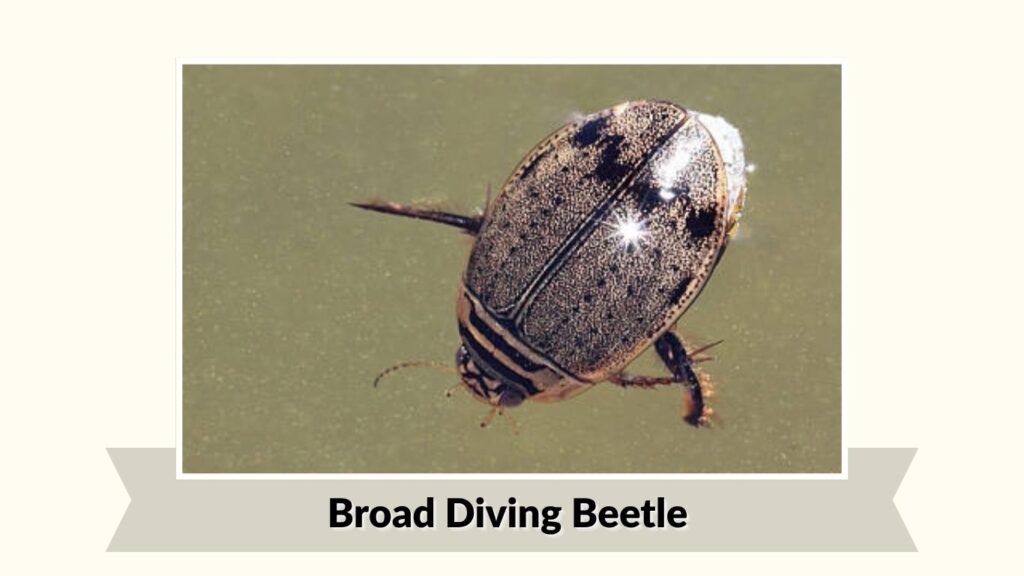
The Broad Diving Beetle, Dytiscus latissimus, is among the largest predaceous diving beetles in Europe. Its exceptionally wide, flattened body distinguishes it from many related species. It is a powerful freshwater predator but has become rare in several parts of its historic range. The species depends particularly on large, permanent water bodies with well-developed shoreline vegetation.
Identification
- Common name: Broad Diving Beetle
- Scientific name: Dytiscus latissimus
- Family: Dytiscidae
- Body: Exceptionally broad and oval
- Color: Dark brown to black
- Margins: Broad yellowish edging
- Legs: Powerful, flattened swimming legs
- Lifestyle: Aquatic predator
- Flight: Adults can fly
Its wide body is one of the main characteristics behind its common and scientific names.
Habitat and Distribution
The Broad Diving Beetle occurs mainly in northern and central Europe and extends eastward into parts of western Siberia.
It favors large permanent lakes, ponds, oxbows, and similar waters containing dense shoreline vegetation such as sedges. Suitable breeding waters generally need extensive shallow, vegetated zones.
Behavior and Diet
Adults prey on aquatic insects and other small animals.
The larvae are more specialized than many diving beetles. Research has shown that early larval stages strongly depend on case-building caddisfly larvae, making adequate prey availability particularly important.
Lifespan and Life Cycle
Mating generally occurs in autumn, while females lay eggs the following spring. Larvae develop in shallow vegetated water and pass through three larval stages.
After roughly six weeks, mature larvae leave the water and pupate in moist chambers on land. Adults emerge afterward and eventually overwinter in deeper water.
FAQs
1. What are the most common types of water beetles?
Common groups include predaceous diving beetles, water scavenger beetles, whirligig beetles, crawling water beetles, riffle beetles, marsh beetles, and minute moss beetles. Their swimming ability, diet, and preferred freshwater habitats vary considerably.
2. Can water beetles fly?
Many adult water beetles can fly. Diving and scavenger beetles frequently leave one pond or wetland and fly to another, particularly when their habitat dries or breeding conditions change. Flight is an important way freshwater beetles colonize isolated bodies of water.
3. Do water beetles bite people?
Most water beetles avoid humans. However, large predaceous diving beetles possess strong jaws and can deliver a painful defensive bite when handled. They do not normally seek people as prey.
4. What do water beetles eat?
Diet depends on the group. Diving beetles are mainly predators, while crawling water beetles, riffle beetles, minute moss beetles, and several other groups eat algae, biofilms, microorganisms, or decaying organic material.
5. Where do water beetles live?
Water beetles occupy ponds, lakes, rivers, streams, marshes, bogs, temporary pools, and wet shoreline habitats. Some specialize in fast-flowing streams, while others prefer still, heavily vegetated water. The family Dytiscidae alone occupies an exceptionally broad range of freshwater environments.