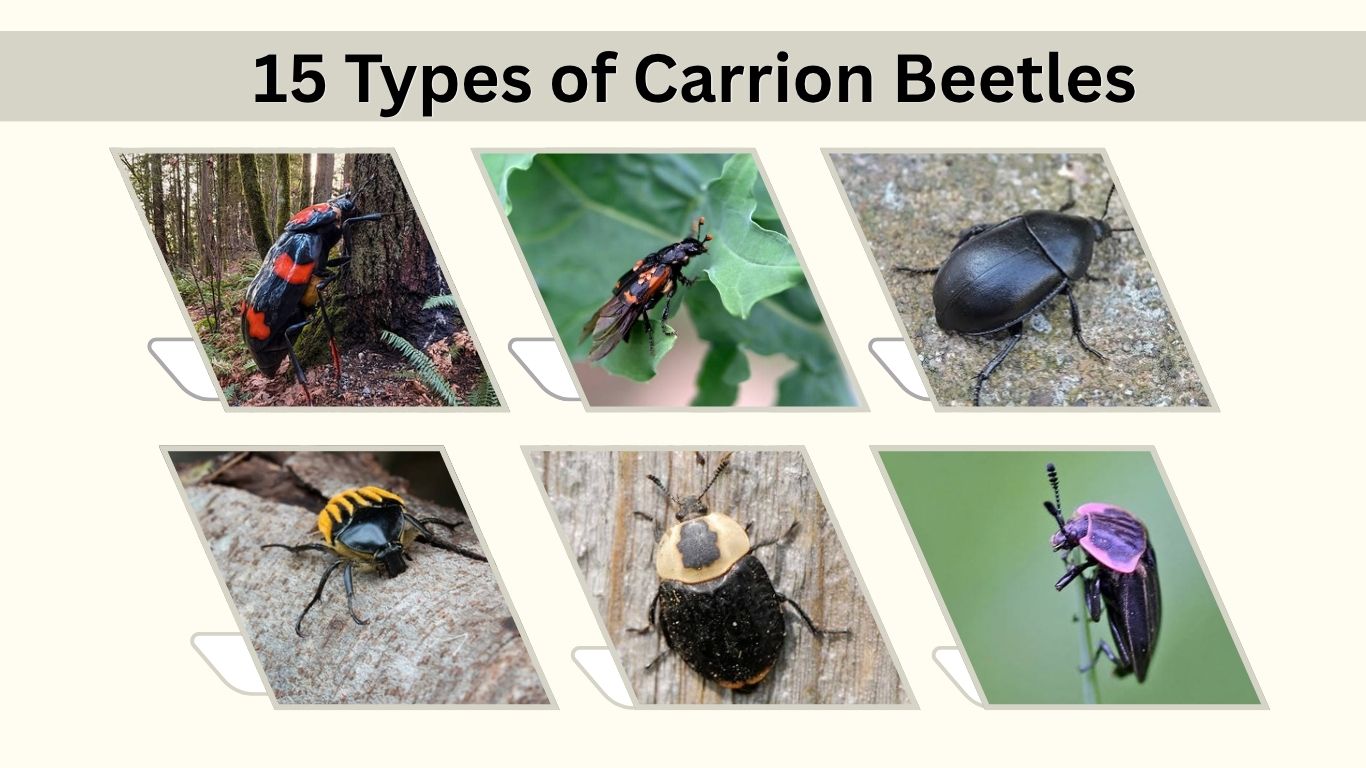
Carrion beetles are fascinating insects that play an important role in breaking down dead animals and recycling nutrients back into the environment. Many species feed directly on carrion, while others prey on fly larvae or bury small carcasses to provide food for their young. These beetles vary greatly in size, color, habitat, and behavior. In this guide, you will discover 15 types of carrion beetles, along with their identification features, habitat and distribution, diet, behavior, lifespan, and life cycle.
1. American Carrion Beetle
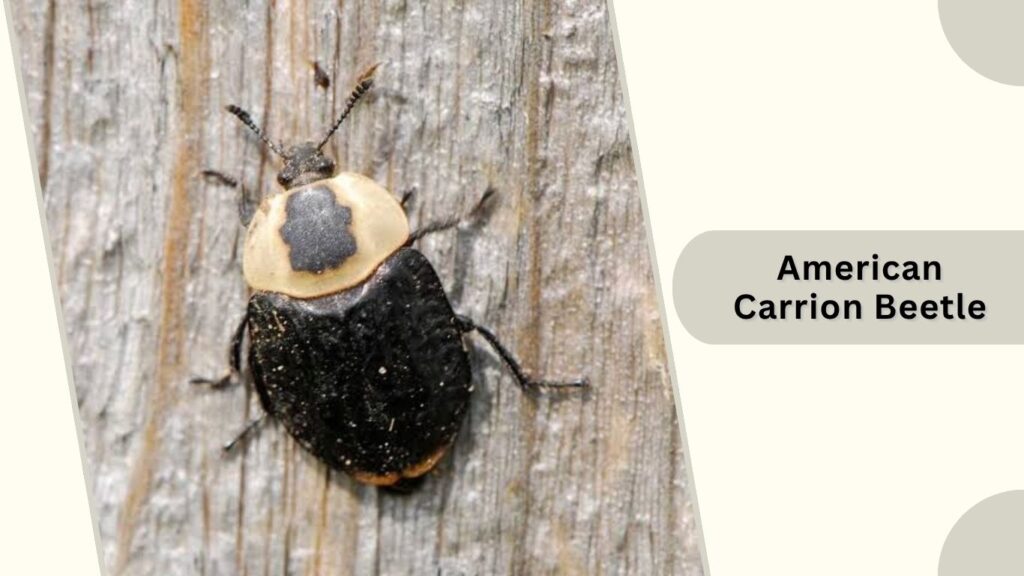
The American Carrion Beetle (Necrophila americana) is a distinctive member of the carrion beetle family Silphidae. It plays an important ecological role by helping break down dead animals and other decaying organic material. Adults and larvae also consume fly maggots and other insect larvae found around carrion, helping recycle nutrients back into the environment.
Identification
The American Carrion Beetle is relatively easy to recognize because of its contrasting yellow and black coloration.
- Adult size: approximately 13–20 mm long
- Broad, somewhat flattened body
- Mostly black wing covers
- Pale yellow or cream-colored pronotum behind the head
- Large irregular black marking in the center of the pronotum
- Rough-textured wing covers
- Larvae are dark, flattened, and somewhat sowbug-like
- Flying adults may resemble small bumblebees from a distance
The pale pronotum is one of the best features for distinguishing this species from similar carrion beetles.
Habitat and Distribution
American Carrion Beetles occur widely across eastern North America. They favor moist woodland, forest edges, fields, and other habitats where animal carcasses can be found. Adults may also appear around fungi, sap flows, compost, rotting fruit, and decomposing vegetation. They are generally active from spring through early fall, with activity often increasing during warm weather.
Behavior and Diet
Both adults and larvae are scavengers. They feed mainly on decomposing animal material, but adults also prey on fly maggots and other beetle larvae competing for the same carcass. Adults may additionally consume fungi and rotten fruit. This mixed scavenging and predatory behavior makes the species useful in decomposition and nutrient recycling.
Lifespan and Life Cycle
Females lay eggs on or close to carrion. The larvae hatch within several days and begin feeding before eventually leaving the carcass and burrowing into nearby soil to pupate. Development from larva to adult takes roughly 10–12 weeks to about three months. American Carrion Beetles generally produce one generation per year, and the adults overwinter before becoming active again the following spring.
2. American Burying Beetle
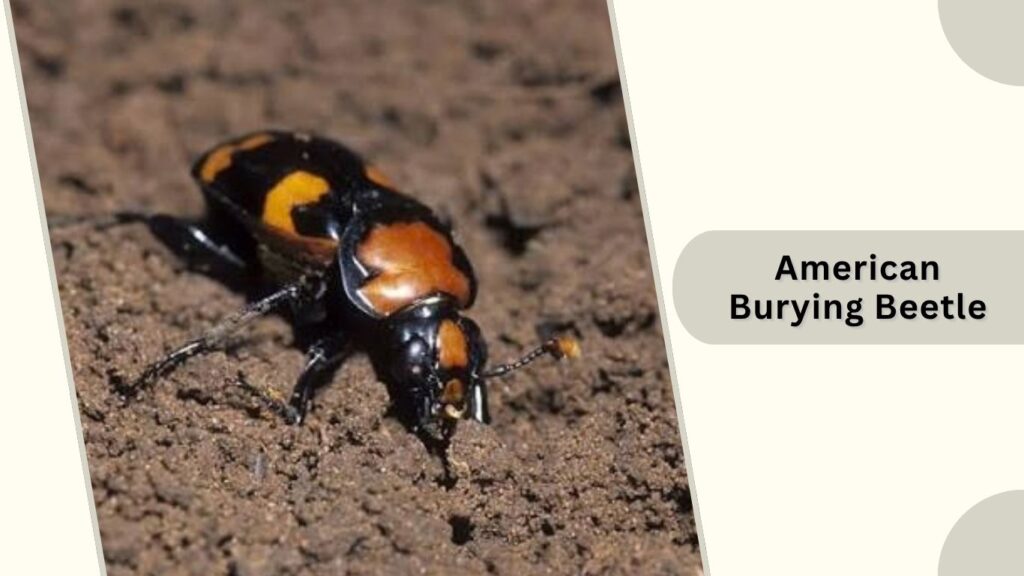
The American Burying Beetle (Nicrophorus americanus) is one of the largest carrion beetles in North America. This striking orange-and-black species has an unusual reproductive strategy in which a male and female work together to bury a small animal carcass and use it to raise their offspring. Both parents may provide care to developing larvae, a relatively uncommon behavior among beetles.
Identification
- Adult length: approximately 25–45 mm
- Mostly shiny black body
- Bright orange-red markings on the wing covers
- Orange-red marking on the pronotum
- Orange tips on the antennae
- Robust, oval-shaped body
- Strong legs adapted for digging
- One of North America’s largest carrion beetles
Its large size and distinctive orange markings usually make adults easier to identify than many other members of the family Silphidae.
Habitat and Distribution
Historically, American Burying Beetles occurred across much of eastern and central North America, although their present distribution is much smaller. Remaining populations occupy different habitats, including grasslands, open woodlands, shrublands, pastures, and forests. Suitable loose soil for burying carcasses and an adequate supply of small vertebrate carrion are especially important habitat requirements.
Behavior and Diet
Adults are mainly nocturnal and use their sensitive antennae to locate recently dead birds, mammals, and other small vertebrates. A breeding pair moves and buries a suitable carcass, removes fur or feathers, and prepares it as food for their larvae. Adults also feed on carrion themselves.
Lifespan and Life Cycle
Females lay eggs in soil close to the prepared carcass. The larvae hatch after several days and receive food from the parents while also feeding directly on the carcass. They later leave the carcass and pupate underground. New adults usually emerge during summer and overwinter in soil. The species generally lives for about one year and normally produces one generation annually.
3. Red-Lined Carrion Beetle
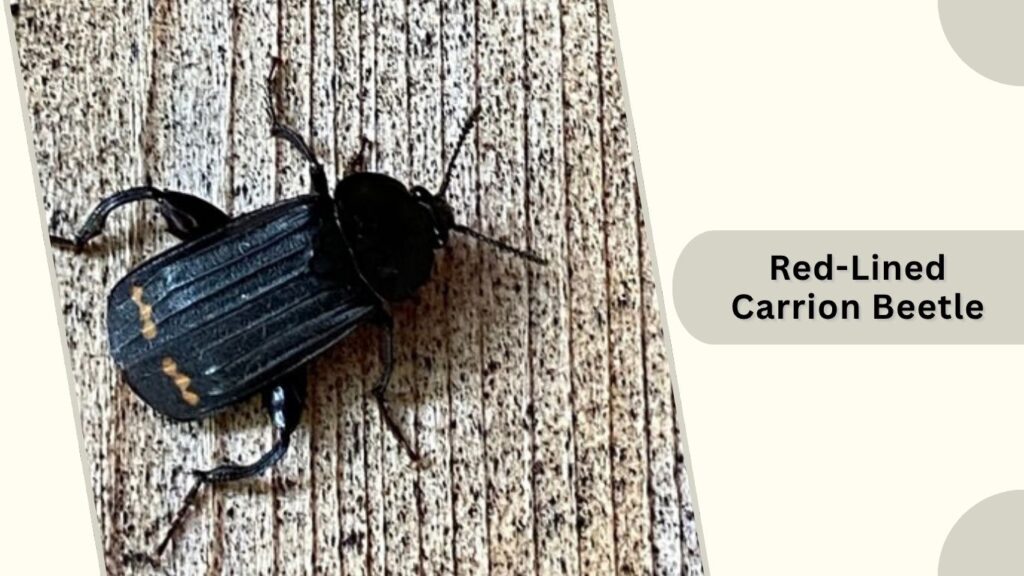
The Red-Lined Carrion Beetle (Necrodes surinamensis) is a large North American carrion beetle recognized by its dark body and reddish-orange markings. Unlike burying beetles that place small carcasses underground, this species often uses larger carcasses exposed above ground. Both adults and larvae can consume carrion as well as the abundant fly larvae that develop on decomposing animals.
Identification
- Adult length: approximately 12–25 mm
- Mostly black or dark-colored body
- Red, orange, or yellow markings on the wing covers
- Strong raised ridges along the elytra
- Relatively large eyes
- Broad and somewhat flattened body
- Males have enlarged hind femora
- Orange markings may vary considerably between individuals
The combination of a dark body, ridged wing covers, and reddish markings gives the species its common name.
Habitat and Distribution
Red-Lined Carrion Beetles are widespread across much of North America and are particularly common in eastern regions. They occur in numerous environments but are frequently associated with deciduous forests, fields, woodland edges, and other places where animal carcasses are available. Adults can be encountered from spring into autumn and occasionally come to lights at night.
Behavior and Diet
Adults locate decomposing animals and consume both carrion and fly maggots. Larvae are also effective predators of maggots and may gather in exceptionally large numbers on large carcasses. Research has documented aggregations capable of dramatically reducing blow fly maggot populations.
Lifespan and Life Cycle
Mating occurs on or close to carrion. Females deposit eggs in nearby soil, and newly hatched larvae move toward the carcass to feed. After passing through their larval stages, mature larvae leave the feeding site and pupate in soil or beneath debris. Adults can overwinter in protected locations before returning to carrion when conditions become favorable.
4. Margined Carrion Beetle
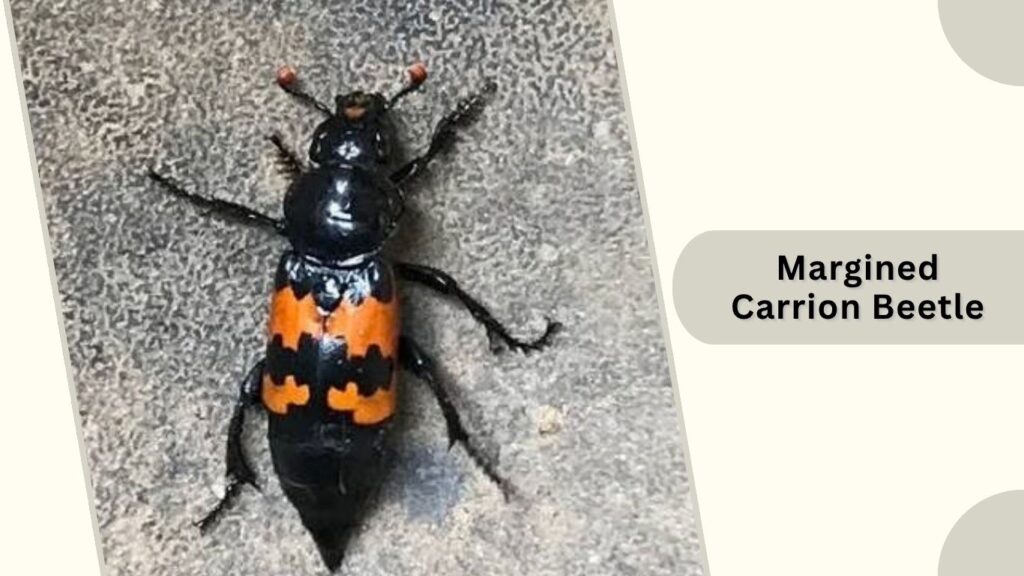
The Margined Carrion Beetle (Oiceoptoma noveboracense) is a distinctive eastern North American species named for the reddish or salmon-colored border surrounding its dark pronotum. It is an important decomposer that visits dead animals and contributes to the recycling of nutrients. Unlike many nocturnal carrion beetles, this species is primarily active during daylight hours.
Identification
- Adult length: approximately 10–13.5 mm
- Broad, flattened body
- Dark brown to black wing covers
- Salmon-red or orange margin around the pronotum
- Pronounced ridges on the wing covers
- Distinctive shoulder projections
- Larvae usually brownish or reddish
- Robust appearance compared with many small beetles
The colored pronotal margin is one of the easiest characteristics for separating it from the American Carrion Beetle.
Habitat and Distribution
Margined Carrion Beetles occur widely throughout eastern North America and across much of southern Canada. They show a strong association with deciduous woodland but can also occur in grasslands, fields, and occasionally marshy areas. Around residential properties, adults may appear near compost piles or outdoor garbage where decomposing material produces attractive odors.
Behavior and Diet
This species is largely diurnal and can be among the earlier beetles to reach a carcass. Adults feed on carrion and frequently consume fly larvae found on decomposing animals. Larvae primarily consume carrion but have also been reported feeding on decaying fungi and possibly maggots.
Lifespan and Life Cycle
Margined Carrion Beetles generally produce one generation each year. Reproduction starts during spring, with eggs placed at suitable carrion. Larvae hatch and feed on the decomposing material before moving into the soil to pupate. Depending on environmental temperature, development from mating through the emergence of new adults may take roughly 45 days.
5. Ridged Carrion Beetle
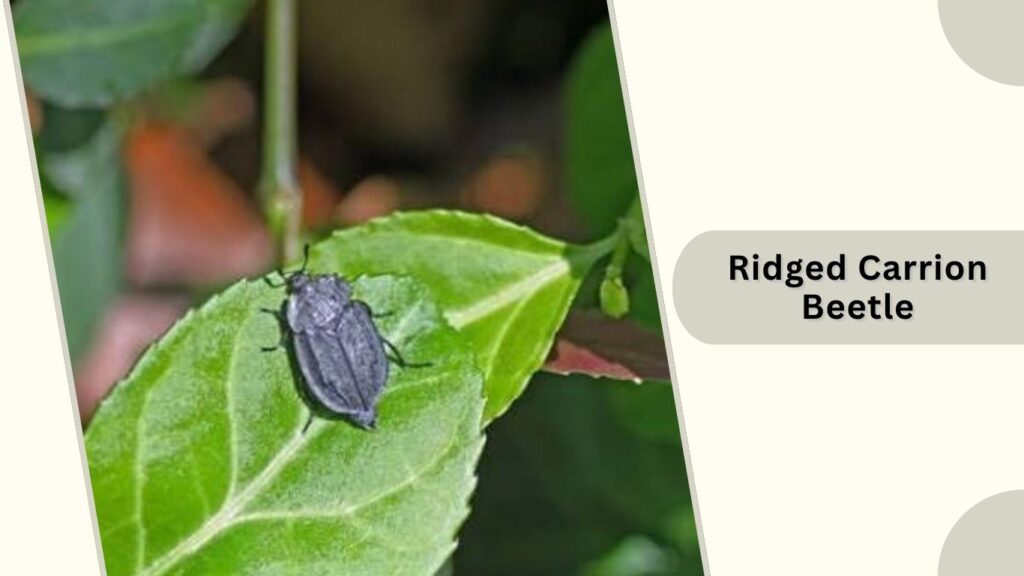
The Ridged Carrion Beetle (Oiceoptoma inaequale) is a dark North American carrion beetle easily recognized by the prominent longitudinal ridges running across its wing covers. Although less colorful than several related species, its strongly sculptured body makes it distinctive. Like other carrion beetles, it helps remove decomposing animal material while also preying on fly larvae competing for the same resource.
Identification
- Adult length: approximately 8.6–14.4 mm
- Almost entirely black coloration
- Strong raised ridges on the wing covers
- Broad, flattened body
- Metallic blue coloration beneath the elytra
- Dark head and pronotum
- Strong legs suited to moving around carrion
- Compact appearance compared with burying beetles
An unusual feature becomes visible during flight: the underside of the elytra can appear bright metallic blue before disappearing again when the beetle lands.
Habitat and Distribution
Ridged Carrion Beetles occur across eastern portions of North America, with records extending from Canada south through the United States. They are strongly associated with deciduous forests and are often encountered in woodland habitats near water. Adults can be found wherever dead vertebrates provide feeding and breeding opportunities.
Behavior and Diet
Adults are attracted to carrion, where they commonly prey upon fly larvae. This behavior allows them to obtain high-protein food while reducing competition around the carcass. The species has also been observed reproducing on reptile carcasses, demonstrating that it can use different types of dead vertebrates.
Lifespan and Life Cycle
The general development pattern includes egg, larva, pupa, and adult stages. Adults arrive at suitable carrion to feed and reproduce. Larvae develop around decomposing animal tissue, consuming available resources before eventually leaving the carcass and pupating in surrounding soil. New adults later emerge and continue searching for carrion, helping return nutrients from dead animals to the surrounding ecosystem.
6. Margined Burying Beetle
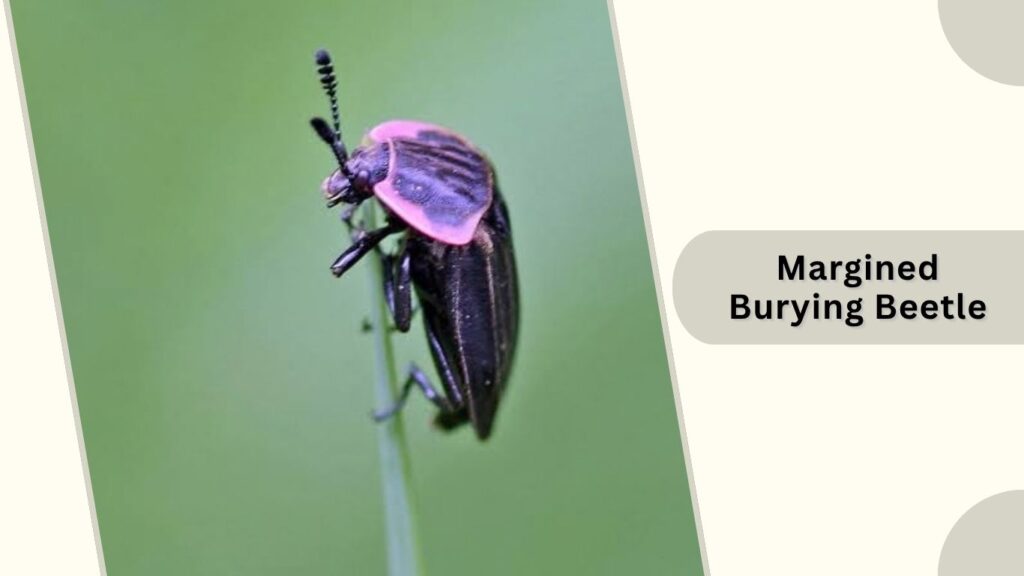
The Margined Burying Beetle (Nicrophorus marginatus) is a widespread North American burying beetle known for its contrasting orange-and-black markings. Its highly developed sense of smell helps it locate small dead animals. A male and female can then cooperate to bury and prepare the carcass as a protected food source for their developing larvae.
Identification
- Adult length: approximately 14–22 mm
- Shiny black body
- Broad orange-red bands on the wing covers
- Orange club at the end of each antenna
- Fully orange outer margin of the elytra
- Strong digging legs
- Large, powerful mandibles
- Compact, oval body typical of burying beetles
The fully orange antennal clubs and orange outer margins help distinguish it from several similar Nicrophorus species.
Habitat and Distribution
This is among the most widely distributed Nicrophorus species in North America. It occurs especially in open fields, meadows, prairies, grasslands, and other open habitats, although adults may travel considerable distances while searching for carrion. Records extend across much of the continent, with the species being less common in parts of the southeastern United States.
Behavior and Diet
Margined Burying Beetles locate small animal carcasses using chemical odors. Males may compete for possession of a carcass and can release pheromones to attract a female. A successful pair buries the carcass, helping protect it from other scavengers. Adults eat carrion and prepare softened food that can be supplied to their young.
Lifespan and Life Cycle
The female deposits eggs in soil near the buried carcass. After hatching, young larvae move toward the prepared food source. Both parents can participate in feeding and protecting the larvae until they become capable of feeding independently. Mature larvae eventually enter the soil and pupate. Adults overwinter and become active again when suitable temperatures return, continuing the annual reproductive cycle.
7. Tomentose Burying Beetle
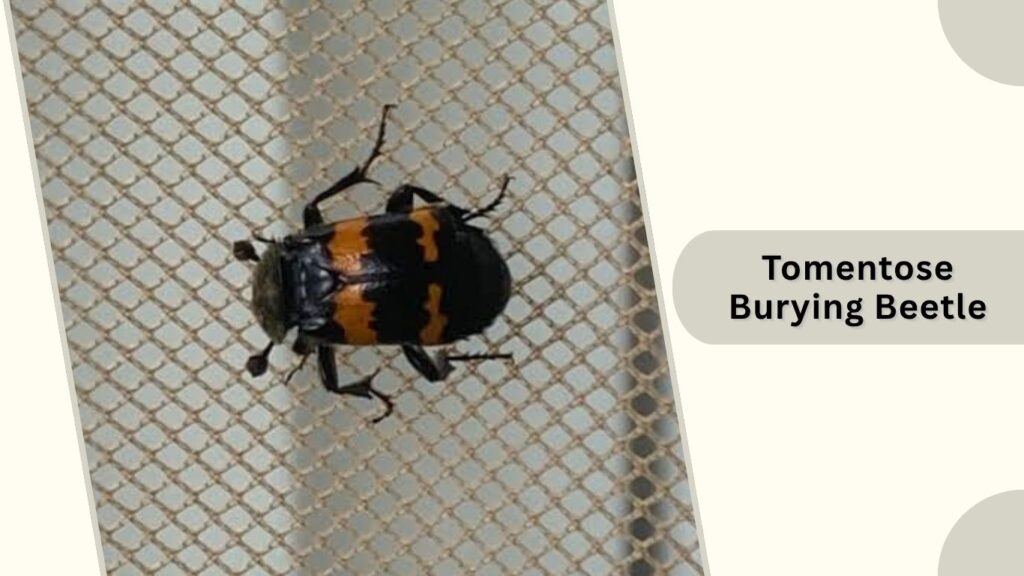
The Tomentose Burying Beetle (Nicrophorus tomentosus), also called the Gold-necked Carrion Beetle, is a distinctive North American member of the carrion beetle family. Unlike many related burying beetles, it generally does not completely bury a carcass. Instead, adults may place it in a shallow depression and cover it with leaf litter. Its densely hairy pronotum makes this species relatively easy to recognize.
Identification
- Adult length: approximately 11–19 mm
- Mostly black body
- Two orange markings on each wing cover
- Dense yellow or golden hairs covering the pronotum
- Orange-tipped, clubbed antennae
- Strong legs suited to working around soil and carrion
- Broad, oval body
- Often carries small phoretic mites
The thick yellow hairs behind the head are its most useful identification feature.
Habitat and Distribution
Tomentose Burying Beetles occur across much of eastern and central North America, extending westward into parts of the interior. They inhabit forests, woodland edges, shrublands, sandy prairies, and other locations where small dead vertebrates are available. Adults are most commonly observed from late spring through autumn, particularly during summer.
Behavior and Diet
Adults use sensitive antennae to detect the odor of dead birds, rodents, and other small animals. Instead of deeply burying carrion, they commonly dig a shallow depression beneath it and conceal it with leaves and debris. Adults feed on carrion and may also consume competing insects or fly larvae associated with decomposing material.
Lifespan and Life Cycle
After locating a suitable carcass, adults mate and females deposit eggs in nearby soil. Eggs may hatch after roughly four days. The larvae then move to the prepared carcass, where parents can feed them regurgitated carrion. Larval feeding lasts several days before the mature larvae leave the resource and continue development in the soil.
8. Roundneck Sexton Beetle
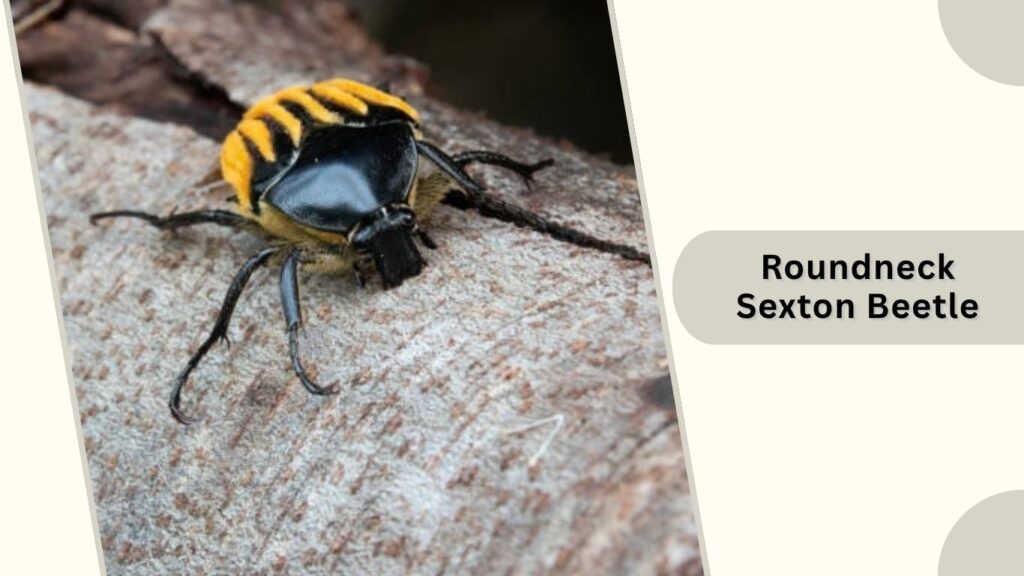
The Roundneck Sexton Beetle (Nicrophorus orbicollis) is a large burying beetle native to eastern North America. It is notable for its advanced parental behavior. A male and female can prepare a small vertebrate carcass as a nursery, defend it from competitors, and feed their developing larvae. Research shows that biparental care is especially common in this species.
Identification
- Adult length: approximately 15–23 mm
- Shiny black body
- Orange-red patches on the wing covers
- Orange clubbed antennae
- Rounded pronotum behind the head
- Long hairs on the wing covers
- Strong digging legs
- Broad and robust body
The rounded pronotum, orange antennal clubs, and long elytral hairs help distinguish this species from similar burying beetles.
Habitat and Distribution
Roundneck Sexton Beetles occur throughout much of eastern North America, from parts of Canada south into the United States. They are especially associated with deciduous forests but can also occupy grasslands. Adults visit many types of carrion and may occasionally occur around dung or rotting fruit.
Behavior and Diet
Adults search for small dead vertebrates that can be buried beneath soil. A breeding pair removes fur or feathers, prepares the carcass, and protects it from rival insects. Adults consume carrion and sometimes maggots. Both parents can provide larvae with regurgitated, partially digested carrion, and studies have found that pairs may raise more surviving offspring than single parents.
Lifespan and Life Cycle
Females begin laying eggs in soil after a carcass has been prepared. Larvae generally hatch several days later and move to the carcass. Parental feeding is particularly important in this species, and larvae may depend heavily on it for survival. Larval development around the carcass can last roughly a week before the young disperse into soil to pupate. Adults overwinter and become active again during the warmer months.
9. Boreal Carrion Beetle
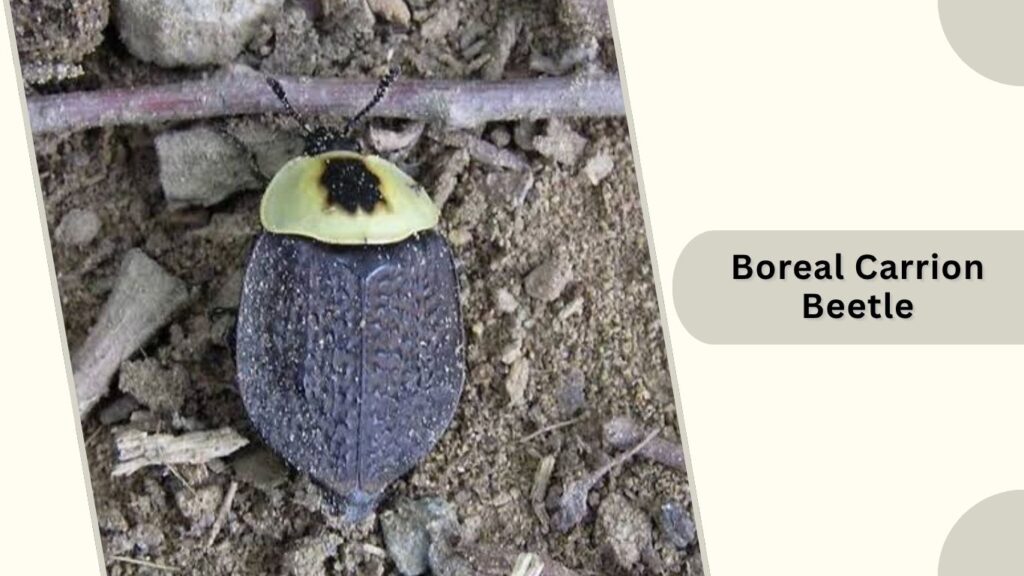
The Boreal Carrion Beetle (Nicrophorus vespilloides) is one of the smaller members of the burying beetle group. It occurs across northern regions of the Holarctic and is particularly associated with cool habitats. Like other Nicrophorus species, it relies on small vertebrate carcasses for breeding and displays unusually complex parental behavior for an insect.
Identification
- Adult length: approximately 12–16 mm
- Mainly black body
- Orange-red markings across the wing covers
- Clubbed antennae
- Compact oval body
- Shorter than many other burying beetles
- Strong legs designed for digging
- Elytra shorter than the abdomen
Its relatively small size can help separate it from many larger Nicrophorus species.
Habitat and Distribution
The species has a northern Holarctic distribution, occurring across northern Eurasia and parts of northwestern North America. Current taxonomy is important when interpreting North American records: many populations formerly called N. vespilloides in boreal wetlands are now treated as the closely related Nicrophorus hebes. True North American N. vespilloides is considered mainly associated with Alaska and adjacent northern Canada.
Behavior and Diet
Adults locate dead mice, birds, and other small vertebrates using their highly sensitive antennae. A pair can bury a carcass, remove fur or feathers, shape it into a compact food mass, and treat it with secretions before larvae arrive. Adults feed on carrion and protect the carcass from competing scavengers.
Lifespan and Life Cycle
Females deposit eggs in soil near the prepared carcass. After hatching, larvae crawl toward the food resource and consume carrion. Parents can remain at the brood chamber to maintain the carcass, defend the young, and provide food. After completing larval development, the offspring leave the carcass and pupate underground before emerging as adults. The timing of development varies substantially with temperature and other environmental conditions.
10. Pustulated Carrion Beetle
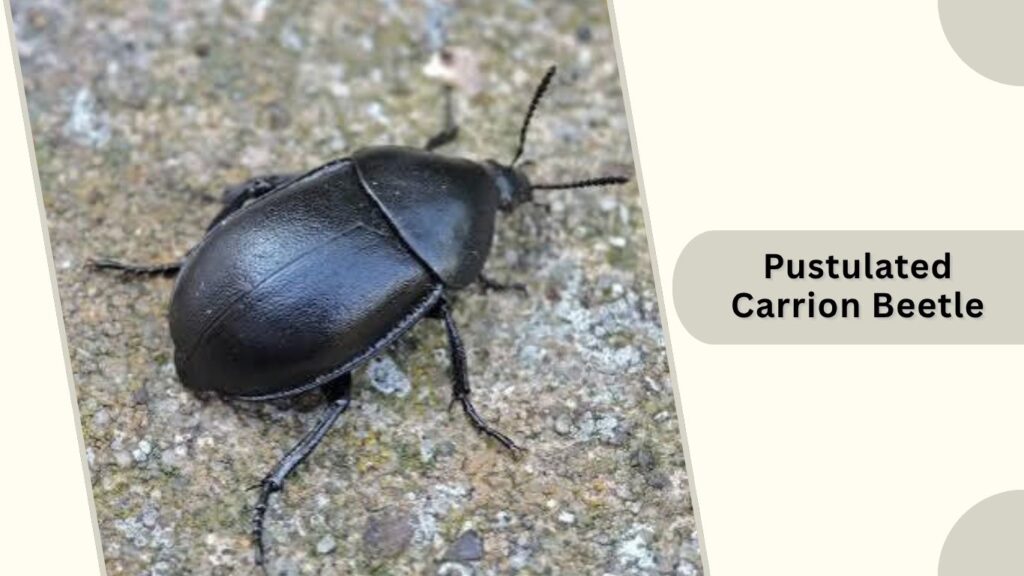
The Pustulated Carrion Beetle (Nicrophorus pustulatus) is one of the most unusual burying beetles in North America. While most relatives reproduce mainly on dead vertebrates, this species is also capable of using snake eggs as a breeding resource. Research suggests that this specialization represents an important evolutionary shift from the typical carrion-based reproductive strategy of burying beetles.
Identification
- Adult length: approximately 14–22 mm
- Predominantly shiny black body
- Small orange-red spots rather than broad bands
- Orange-tipped antennae
- Smooth wing covers without long hairs
- Abdomen extends beyond the elytra
- Strong digging legs
- Robust, elongated body
The small separated orange spots make it noticeably different from species with broad orange bands.
Habitat and Distribution
Pustulated Carrion Beetles occur through much of eastern North America, with the range extending northwest into portions of Canada. Adults are active mainly between spring and fall. Their exact breeding habitat can differ from that of other burying beetles because they may search for underground or concealed reptile nests as well as carrion.
Behavior and Diet
The species can feed and reproduce on carrion, but its most remarkable behavior is the exploitation of snake eggs. Experiments have shown that adults can successfully raise offspring using snake eggs and adjust brood size according to the amount of food available. Unlike carcasses, snake eggs are generally not moved or buried before use.
Lifespan and Life Cycle
Females lay eggs after discovering a suitable reproductive resource. Larvae hatch and consume either prepared carrion or the contents of vertebrate eggs. Laboratory research found larval broods developing on snake eggs within roughly 10–15 days before dispersing from the depleted resource. Interestingly, larvae of this species appear less dependent on direct parental feeding than those of some other burying beetles.
11. Banded Burying Beetle
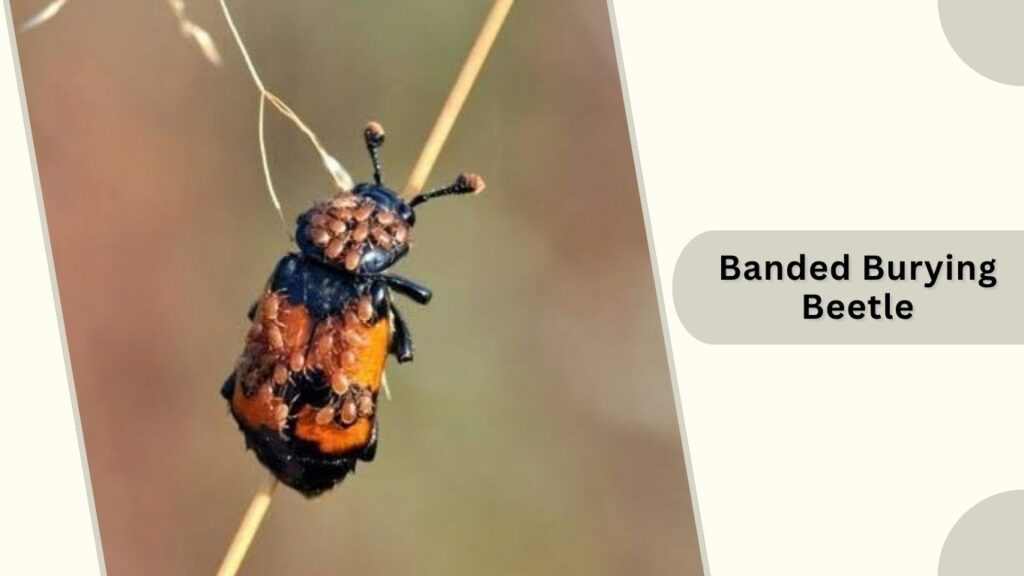
The Banded Burying Beetle (Nicrophorus investigator) is a widespread carrion beetle found across northern parts of North America and Eurasia. Its scientific name, investigator, appropriately refers to its searching habits as it travels through suitable habitats looking for carrion. Adults use small vertebrate carcasses for reproduction and may provide several days of parental care to their young.
Identification
- Adult length: approximately 15–25 mm
- Mostly black body
- Bold orange-red bands on the wing covers
- Orange clubbed antennae
- Straight hind tibiae
- Broad orange-red margins on parts of the elytra
- Sturdy legs adapted for digging
- Robust oval-shaped body
Details of the orange markings and hairs around the shoulders are useful for separating it from similar burying beetles.
Habitat and Distribution
Banded Burying Beetles have a broad Holarctic distribution. In North America they occur mainly across northern regions and southward along the Rocky Mountains. Typical habitats include boreal forests, aspen woodlands, meadows, prairies, and other open or semi-open environments. Adults are commonly active from May through October.
Behavior and Diet
Adults search for freshly dead small mammals, birds, and other vertebrates. A male-female pair may bury a carcass, remove its fur or feathers, shape it into a compact ball, and establish an underground brood chamber. Adults defend this limited food resource from other carrion beetles and provide developing larvae with predigested carrion.
Lifespan and Life Cycle
Females lay eggs in soil around the prepared carcass. The larvae hatch, enter the brood chamber, and feed on the carcass while receiving parental care for several days. Mature larvae eventually leave the carcass and create underground pupal cells. At least in studied European populations, the species can overwinter as prepupae, with adults emerging to reproduce during the following summer.
12. Boreal Burying Beetle
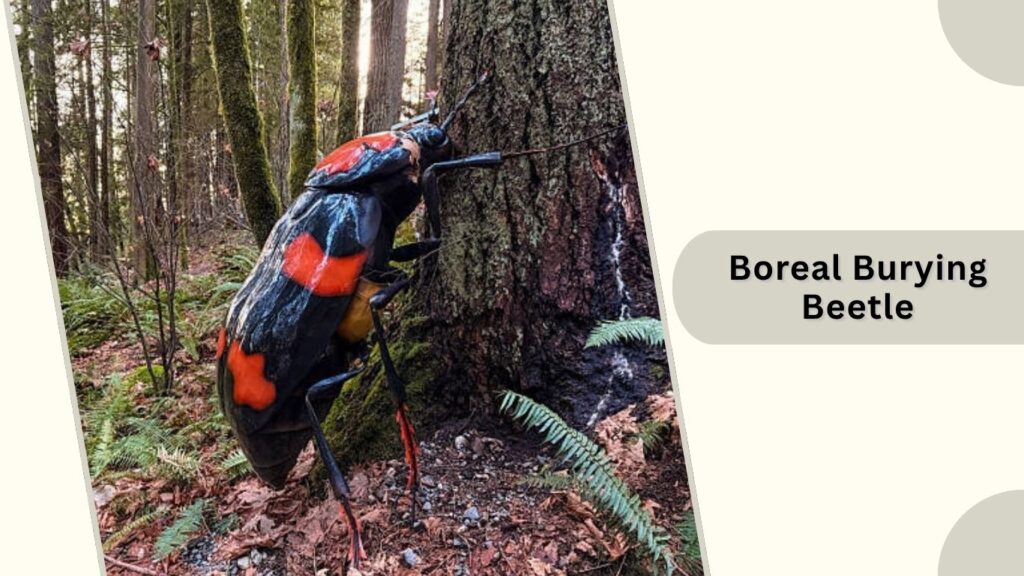
The Boreal Burying Beetle (Nicrophorus defodiens) is a northern North American carrion beetle known for using small animal carcasses as both food and a reproductive resource. Like other burying beetles, it can prepare carrion for its larvae, but it does not always completely bury a carcass. Sometimes the beetles conceal the resource beneath leaf litter or place it in only a shallow depression.
Identification
- Adult length: approximately 12–18 mm
- Predominantly shiny black body
- Orange or reddish markings on the wing covers
- Clubbed antennae
- Compact, oval body
- Strong legs adapted for digging
- Elytra shorter than the abdomen
- Smaller than several other North American burying beetles
Body markings can resemble those of related Nicrophorus species, so geographic location and finer anatomical characters may be needed for confident identification.
Habitat and Distribution
Boreal Burying Beetles occur widely across northern North America, from Newfoundland and northern Canada west to Alaska, with their range extending southward into portions of the United States. They occur in forested environments and other habitats where leaf litter, soil, and small vertebrate carcasses are available. Studies have recorded them across substantial elevational ranges as well.
Behavior and Diet
Adults locate dead birds, rodents, and other small vertebrates by detecting carrion odors. They are especially active around dusk in some woodland populations. Rather than always burying a carcass deeply, N. defodiens may hide it beneath leaves, which can be faster when competing with flies and other scavengers. Adults consume carrion and prepare the same resource for their offspring.
Lifespan and Life Cycle
After carcass preparation, eggs are laid in nearby soil. Laboratory studies indicate an embryonic period of roughly 2–4 days, followed by about 6–7 days from hatching until larvae disperse from the carcass. Development from dispersal until adult emergence can take another 25–37 days, although temperature strongly affects these timings.
13. Yellow-Bellied Burying Beetle
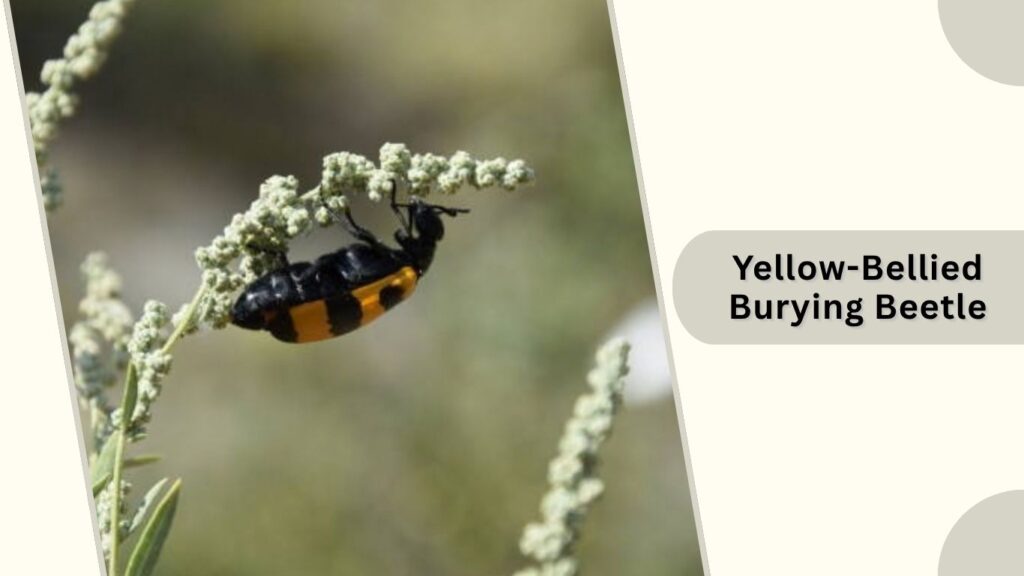
The Yellow-Bellied Burying Beetle (Nicrophorus guttula) is a western North American carrion beetle that uses small vertebrate carcasses for reproduction. Adults possess the characteristic strong legs, sensitive antennae, and parental behavior associated with burying beetles. A breeding pair can prepare a carcass underground and provide food and protection for their developing larvae.
Identification
- Adult length: approximately 12.2–20 mm
- Black body
- Orange-red markings on the wing covers
- Clubbed antennae
- Golden or yellowish hairs beneath parts of the body
- Sturdy legs adapted for digging
- Shortened wing covers exposing part of the abdomen
- Robust, oval body shape
Some individuals can be unusually dark, making the golden hairs on the underside useful for separating them from similar all-black species.
Habitat and Distribution
The Yellow-Bellied Burying Beetle is primarily a western North American species. Its distribution extends from Alaska and western Canada south through western portions of the United States, including California and areas toward western Texas. It occurs in a range of open and montane habitats, and studies in Colorado have recorded it across elevations of roughly 1,481–2,363 meters.
Behavior and Diet
Adults search for dead rodents, birds, and other small vertebrates. After locating a suitable carcass, competing beetles may fight for possession before a breeding pair prepares the resource. The adults can move or bury the carcass, remove fur or feathers, and shape the remains into a concentrated food source. Both parents may remain with the brood and feed larvae partially processed carrion.
Lifespan and Life Cycle
Females deposit eggs in soil close to the prepared carcass. Research summarizing N. guttula development reports an egg period of about 4–7 days, followed by approximately 7–14 days of larval development before dispersal. The period between larval dispersal and adult emergence can take approximately 29–40 additional days under laboratory conditions. Environmental temperature can substantially alter these development times.
14. Lapland Carrion Beetle
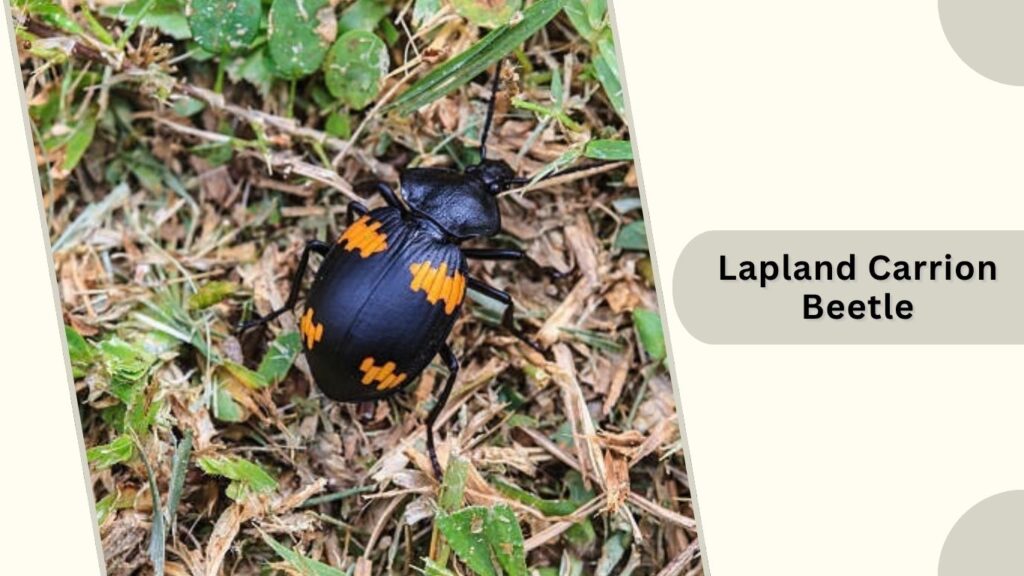
The Lapland Carrion Beetle (Thanatophilus lapponicus) is a cold-adapted carrion beetle distributed across northern North America and Eurasia. Unlike burying beetles in the genus Nicrophorus, it generally feeds and reproduces on exposed carrion rather than carefully burying a small carcass. Its ability to tolerate cold climates allows it to occupy Arctic, boreal, and high-elevation environments.
Identification
- Adult length: approximately 9–14 mm
- Mostly black coloration
- Broad, flattened body
- Pronotum may carry yellowish hairs
- Four raised ridges on each wing cover
- Small, wart-like bumps between the ridges
- Dark antennae
- Strong legs for moving through soil and carrion
The combination of prominent elytral ridges and numerous small bumps provides an especially useful identification characteristic.
Habitat and Distribution
Lapland Carrion Beetles occur across Canada, northern and western parts of the United States, and large portions of Eurasia. They are strongly associated with open, cool habitats and can be particularly abundant at high elevations. In northern Canada, records extend through Arctic, taiga, boreal, and Hudson Plains ecozones.
Behavior and Diet
Adults are strongly attracted to dead animals. They consume decomposing tissue and also prey on fly maggots developing on carcasses. Reports indicate that they can occur on many types of vertebrate remains, including frogs, toads, snakes, mammals, and other animals. Their feeding activity contributes to carcass decomposition while also reducing populations of competing fly larvae.
Lifespan and Life Cycle
Adults arrive at carcasses to feed and reproduce. Females lay eggs near suitable carrion, and larvae later feed on the decomposing material before moving away to pupate. The species can produce two generations per year, even in some temperate areas. Adults belonging to the later generation overwinter and become active again when conditions improve.
15. Black Carrion Beetle
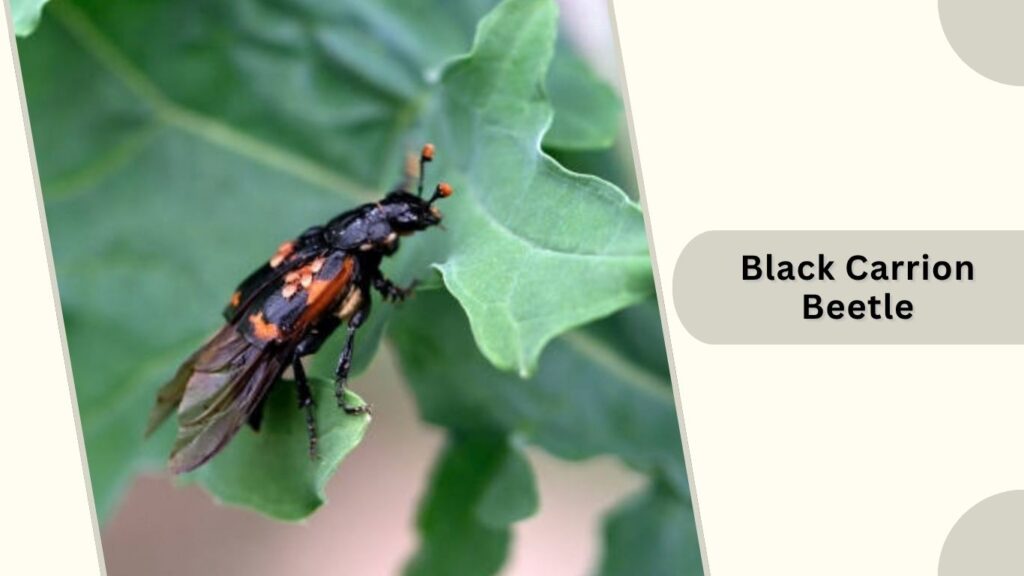
The Black Carrion Beetle (Phosphuga atrata), also widely known as the Black Snail Beetle, differs considerably from many other carrion beetles because it is primarily a predator. Both adults and larvae specialize in attacking snails, although they can also consume earthworms, insects, and carrion. Its narrow, elongated head is particularly well suited for reaching into snail shells.
Identification
- Adult length: approximately 10–15 mm
- Shiny black body when mature
- Flattened, oval shape
- Long, narrow head
- Pronounced longitudinal ridges on the wing covers
- Strong mandibles
- Newly emerged individuals may appear brownish
- Adults are flightless
The long head is one of its most recognizable features because it allows the beetle to reach farther inside the shells of its preferred prey.
Habitat and Distribution
Black Carrion Beetles are native and widespread across the Palearctic region, including much of Europe and temperate Asia. They are especially common in Britain. Suitable habitats include woodlands, gardens, grasslands, heathlands, coastal dunes, peat bogs, and other humid environments supporting snails. Adults commonly shelter under bark, logs, stones, moss, and woodland debris during daylight hours.
Behavior and Diet
This species is largely nocturnal. Adults search for snails and use their narrow heads to reach into shells. They may bite prey and apply digestive fluids that help break down the snail’s tissues before feeding. Larvae are also active predators of snails and may consume earthworms. Carrion and other small invertebrates can supplement the diet.
Lifespan and Life Cycle
Adults mate during summer and autumn before overwintering in protected places beneath bark, logs, or leaf litter. Egg laying occurs after overwintering, and larvae develop during the warmer part of the year before pupating. New adults can appear later in the season. Unlike many short-lived beetles, adult Black Carrion Beetles may survive for several years.
FAQs
Carrion beetles are an ecologically important group of insects that help process dead animals and recycle nutrients. Different species have surprisingly different lifestyles: some bury carcasses and raise their larvae on them, while others feed directly on exposed carrion or even specialize in hunting live prey.
1. What do carrion beetles eat?
Most carrion beetles consume dead animals, fly maggots, or other organisms associated with decomposition. Burying beetles use small vertebrate carcasses as food for themselves and their larvae. Some species have more specialized diets; for example, the Black Carrion Beetle primarily hunts snails.
2. Why do carrion beetles bury dead animals?
Burying beetles in the genus Nicrophorus bury or conceal small carcasses to create a protected food source for their offspring. Hiding the carcass also helps reduce competition from flies, ants, and other scavengers.
3. Do carrion beetles bite humans?
Carrion beetles are not considered human-biting pests. They possess functional jaws for feeding, hunting, or handling carrion, so individual beetles may defend themselves when roughly handled. They normally have no reason to attack people.
4. Are carrion beetles beneficial?
Yes. Carrion beetles help recycle nutrients from dead animals back into ecosystems. Some species also consume large numbers of fly larvae. By breaking down animal remains and competing with other scavengers, they form an important part of natural decomposition communities.
5. How long does a carrion beetle live?
Lifespan varies considerably among species. Many burying beetles complete their development within several weeks and overwinter as adults or immature stages. Other species live much longer. For example, adult Black Carrion Beetles have been reported to survive for several years.