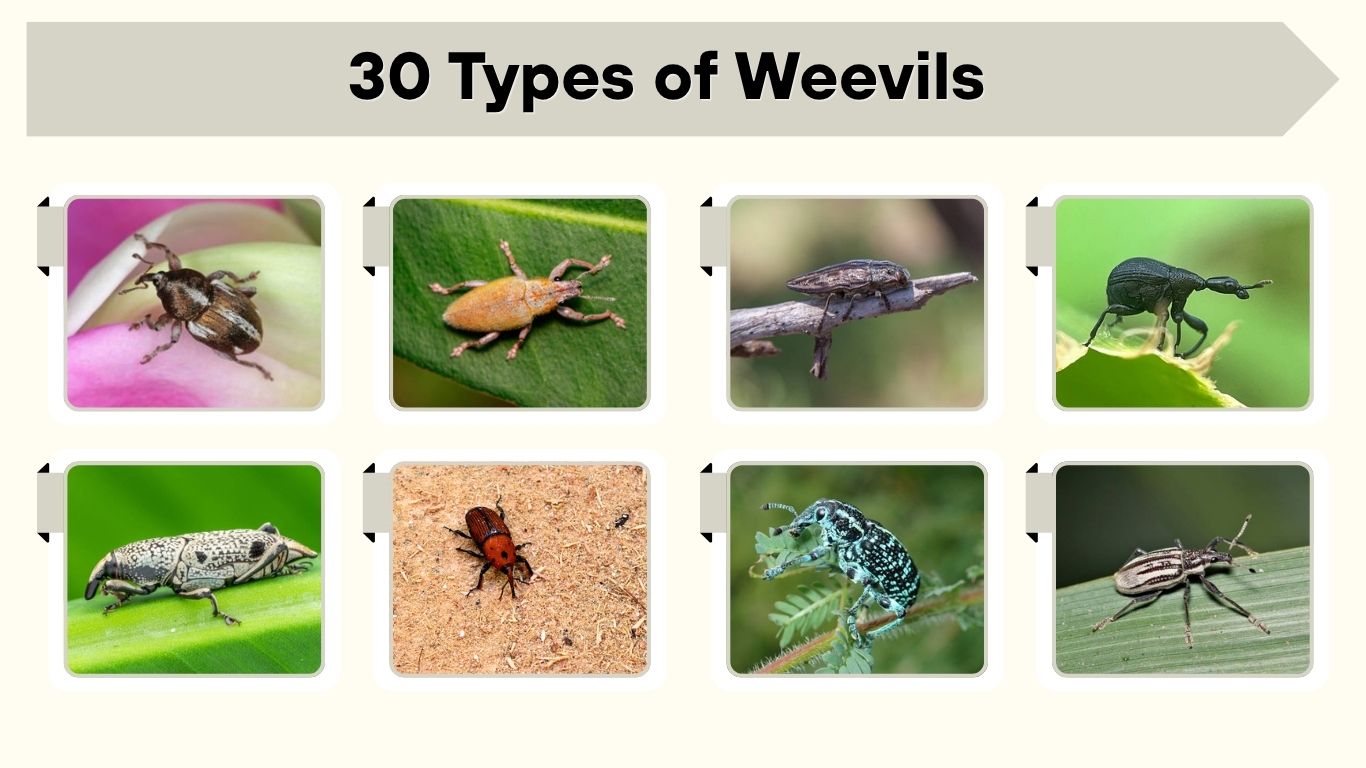
Weevils are a diverse group of snout beetles found in farms, gardens, forests, pantries, and stored-grain facilities around the world. Some species attack crops and ornamental plants, while others feed on seeds, nuts, roots, bark, or stored food. Their size, color, host plants, and behavior vary widely, but many share a distinctive elongated snout and elbowed antennae. In this guide, you will discover 30 types of weevils, including their identification features, habitat, diet, behavior, lifespan, and life cycle.
1. Boll Weevil
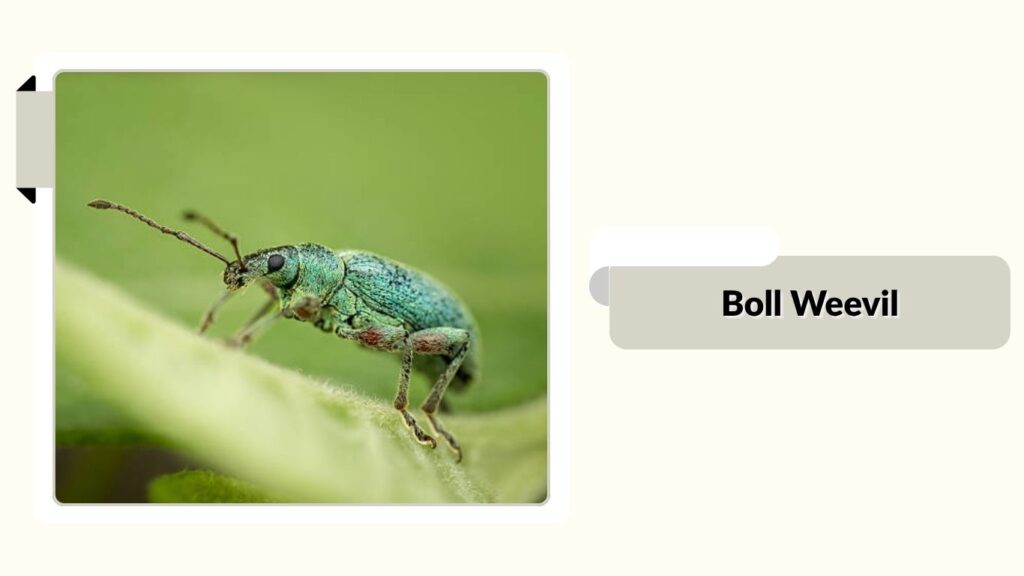
The boll weevil is a small snout beetle best known for its historic impact on cotton production. Native to Mexico and Central America, it spread through major cotton-growing regions of the United States during the late 19th and early 20th centuries. Adults damage cotton by feeding on buds and flowers, while larvae develop inside squares and bolls.
Identification
- Small grayish-brown to reddish-brown body
- Distinct curved snout
- Adults usually around 1/4 inch long
- Fine hairs covering much of the body
- Elbowed antennae attached near the snout
- Compact oval body shape
Habitat and Distribution
Boll weevils are strongly associated with cotton-growing regions. Historically, they were widespread across the southern United States, Mexico, and parts of Central and South America.
Large-scale eradication programs have eliminated or greatly reduced populations in many U.S. cotton-producing areas. Where they remain established, adults are usually found in and around cotton fields and nearby vegetation.
Behavior and Diet
Adults feed on cotton squares, flowers, and developing bolls. Females use their snouts to make cavities in plant tissue and then deposit eggs inside. Larvae remain protected within the cotton square or boll while feeding, which makes them difficult to reach with surface treatments. Heavy infestations can cause buds to fall prematurely and reduce cotton yield substantially.
Lifespan and Life Cycle
Females lay eggs inside cotton squares or bolls. Larvae hatch and feed internally, passing through several growth stages before pupating inside the same plant structure. Adults later emerge through small holes and continue feeding and reproducing. In warm climates, several generations may occur during one growing season. Adults may survive between cotton crops in protected vegetation or other sheltered areas.
2. Rice Weevil
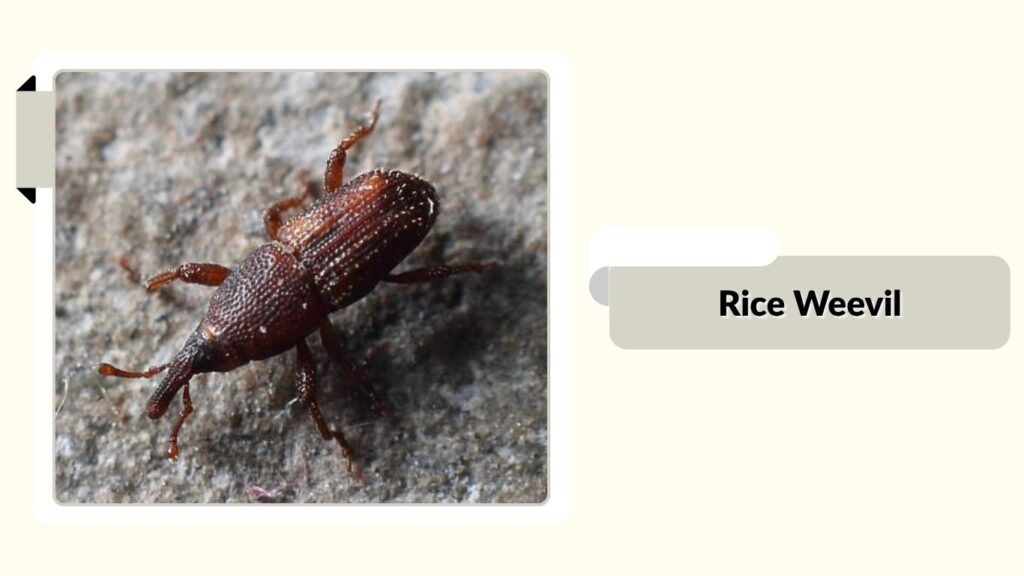
The rice weevil is a major stored-grain pest that attacks rice, wheat, corn, barley, and many other cereal products. Unlike some pantry pests, both adults and larvae damage food directly. Females place eggs inside individual kernels, allowing larvae to develop hidden within stored grain.
Identification
- Small reddish-brown to dark brown body
- Long narrow snout
- Four lighter reddish or yellowish spots on the wing covers
- Adults roughly 1/8 inch long
- Elbowed antennae
- Fully developed wings and capable of flight
Habitat and Distribution
Rice weevils occur worldwide wherever grain is stored. They are common in homes, warehouses, grain elevators, food-processing facilities, and agricultural storage sites.
Warm and humid conditions favor population growth, but infestations can occur indoors throughout the year. They are especially common in rice, corn, wheat, birdseed, and other dry grain products kept for long periods.
Behavior and Diet
Adults chew into whole kernels, while females drill holes and place eggs inside grain. The larvae remain hidden within kernels, feeding internally until development is nearly complete. This can make an infestation difficult to detect early. Infested grain may contain small round exit holes, powdery debris, and live adult weevils.
Lifespan and Life Cycle
A female typically deposits one egg inside a grain kernel and seals the opening. The larva develops completely inside the kernel before pupating there. A new adult then chews its way out. Development can occur rapidly under warm conditions, and several generations may develop in stored grain over the course of a year.
3. Granary Weevil
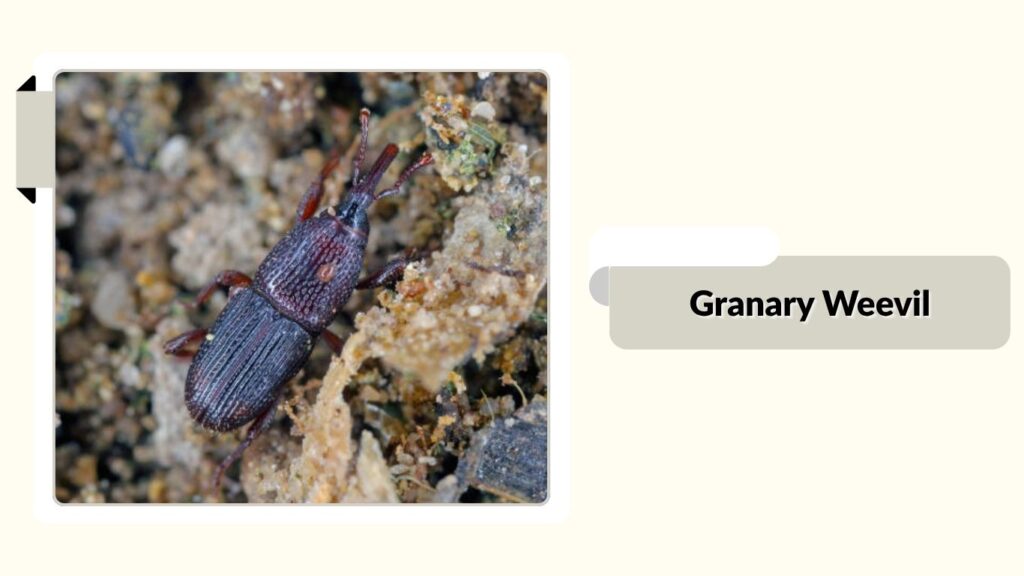
The granary weevil is another serious stored-grain pest and is closely related to the rice weevil. It commonly infests wheat, oats, barley, rye, and other whole grains. Unlike the rice weevil, the granary weevil cannot fly, so infestations usually spread through transported grain or contaminated stored products.
Identification
- Dark brown to nearly black body
- Long curved snout
- Adults about 1/8 to 3/16 inch long
- No obvious pale spots on the wing covers
- Elbowed antennae
- Wings are not functional for flight
Habitat and Distribution
Granary weevils are found worldwide in stored-grain environments. They occur in grain elevators, warehouses, mills, barns, silos, and household pantries. Because they cannot fly, they are usually introduced into new locations through infested grain or storage materials rather than by moving long distances on their own.
Behavior and Diet
Adults and larvae feed on whole cereal grains. Common hosts include wheat, barley, corn, oats, and rye. Females bore into kernels and deposit eggs inside. The larva remains hidden within the grain as it feeds. Infestations may lead to reduced grain weight, contamination, and increased heating or moisture in large storage systems.
Lifespan and Life Cycle
Eggs are laid singly inside kernels. The larva feeds internally and develops through several stages before pupating. Adults emerge by chewing a circular hole through the grain.
Under favorable indoor conditions, multiple generations can occur during the year. Cooler temperatures slow reproduction, but the insects may remain active in protected storage areas.
4. Maize Weevil
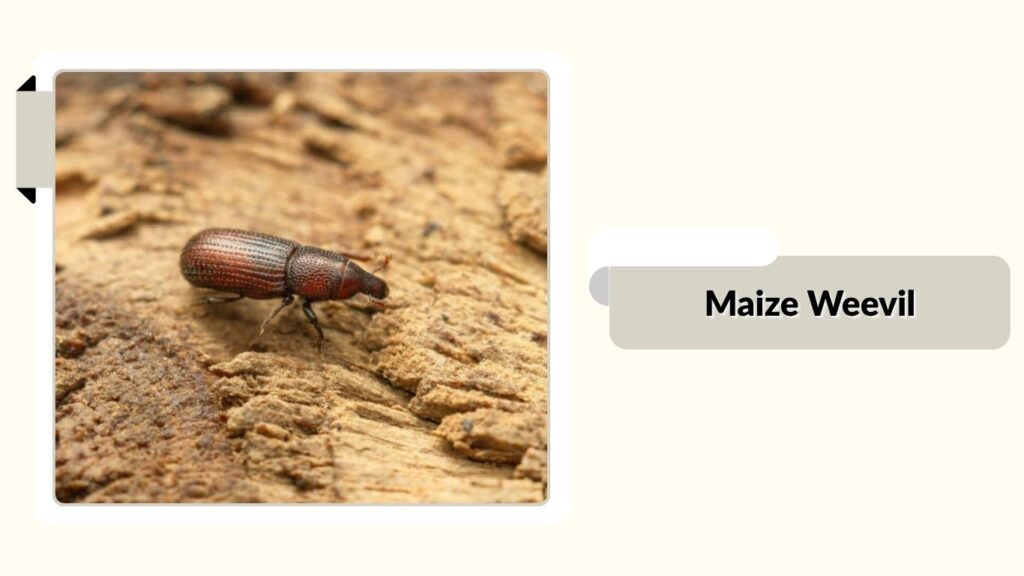
The maize weevil is a destructive stored-product pest closely related to the rice weevil. It is especially associated with corn but can also infest rice, wheat, sorghum, and other grains. Because adults can fly, they may move between storage areas and even infest grain before harvest.
Identification
- Dark reddish-brown to nearly black body
- Four lighter spots on the wing covers
- Long snout
- Adults about 1/8 inch long
- Elbowed antennae
- Capable of flight
Habitat and Distribution
Maize weevils are widely distributed in tropical and subtropical regions but also occur in temperate areas where grain is stored. They are commonly found in corn storage facilities, grain bins, warehouses, mills, and household food supplies. Their ability to fly allows them to move more readily than granary weevils.
Behavior and Diet
Corn is a major host, but maize weevils can also feed on wheat, rice, sorghum, and other whole grains. Adults feed externally, while larvae develop inside kernels. Infestations can begin in the field in some regions and continue after harvest during storage.
Lifespan and Life Cycle
Females make a cavity in a kernel and deposit one egg inside. The larva develops completely within the grain, consuming much of the interior before pupating. Adults eventually chew out of the kernel and begin feeding and reproducing. Warm storage conditions can support several overlapping generations throughout the year.
5. Black Vine Weevil
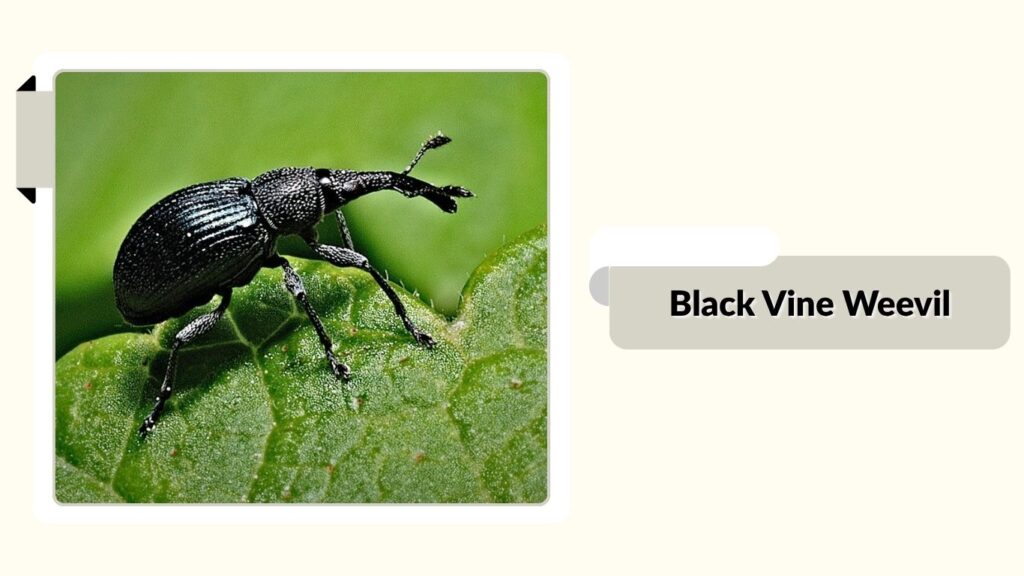
The black vine weevil is a common pest of ornamental plants, nursery stock, strawberries, and many container-grown plants. Adults feed mainly on leaves, while larvae live in soil and damage roots. Root feeding can be more serious than adult leaf damage, particularly for young or potted plants.
Identification
- Dark black to charcoal-colored body
- Pear-shaped or oval body form
- Short broad snout
- Adults about 3/8 inch long
- Wing covers with faint ridges
- Adults cannot fly
Habitat and Distribution
Black vine weevils are widespread in Europe and North America and have been introduced to other regions. They are common in nurseries, greenhouses, gardens, landscapes, and areas with container plants. They favor moist soil containing host roots and are especially troublesome in commercial ornamental production.
Behavior and Diet
Adults feed at night and chew distinctive semicircular notches from leaf margins. Common hosts include rhododendron, yew, strawberry, heuchera, cyclamen, and many other ornamentals. Larvae remain underground and feed on roots. Severe root damage can cause wilting, poor growth, and plant death.
Lifespan and Life Cycle
Females lay eggs in soil near host plants. Larvae hatch and begin feeding on fine roots. As they grow, they may attack larger roots and the crown of the plant. Larvae usually overwinter in the soil and resume feeding before pupating. Adults emerge later and often reproduce without males through parthenogenesis.
6. Strawberry Root Weevil
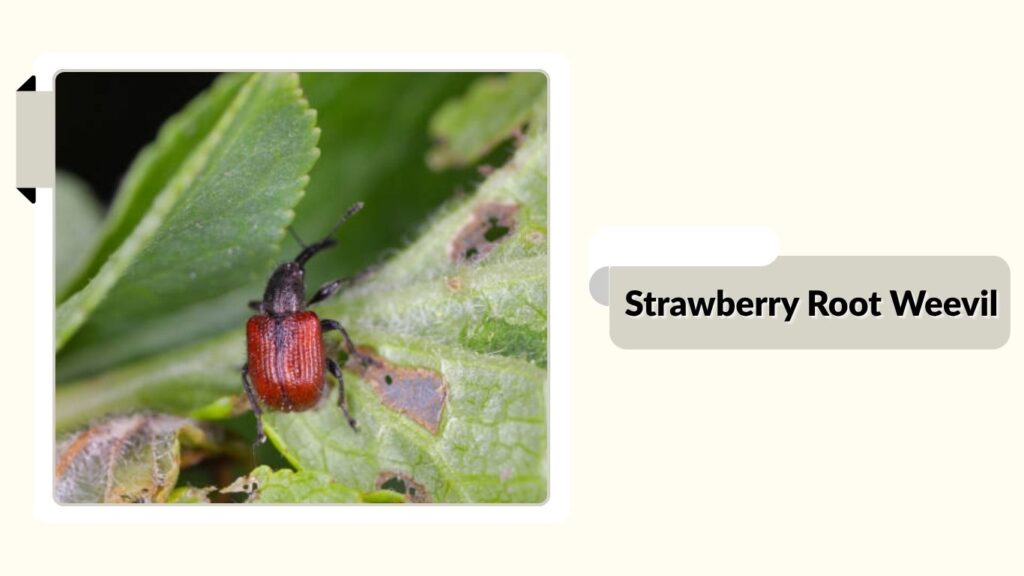
The strawberry root weevil is a small dark weevil associated with strawberries and many ornamental plants. Adults often wander indoors in summer, where they become nuisance insects but do not damage household materials. The larvae are more important agriculturally because they feed on plant roots underground.
Identification
- Small dark brown to black body
- Short broad snout
- Adults roughly 1/4 inch long
- Oval body
- Elbowed antennae
- Unable to fly
Habitat and Distribution
Strawberry root weevils are common across much of North America. They occur in strawberry fields, gardens, nurseries, lawns, and landscapes containing suitable host plants. Adults sometimes enter homes in large numbers, especially during hot, dry periods.
Behavior and Diet
Adults feed on leaves but usually cause only minor injury. Larvae feed on roots of strawberry, grasses, ornamental plants, and other vegetation. Root feeding can weaken young plants, although established plants may tolerate moderate damage. Indoors, adults do not reproduce or infest food and usually die without causing harm.
Lifespan and Life Cycle
Females lay eggs in soil near host plants. Larvae hatch and feed underground for an extended period, often overwintering in the soil. Pupation occurs below ground, and adults emerge during warmer months.One generation per year is common in many regions.
7. Fuller Rose Weevil
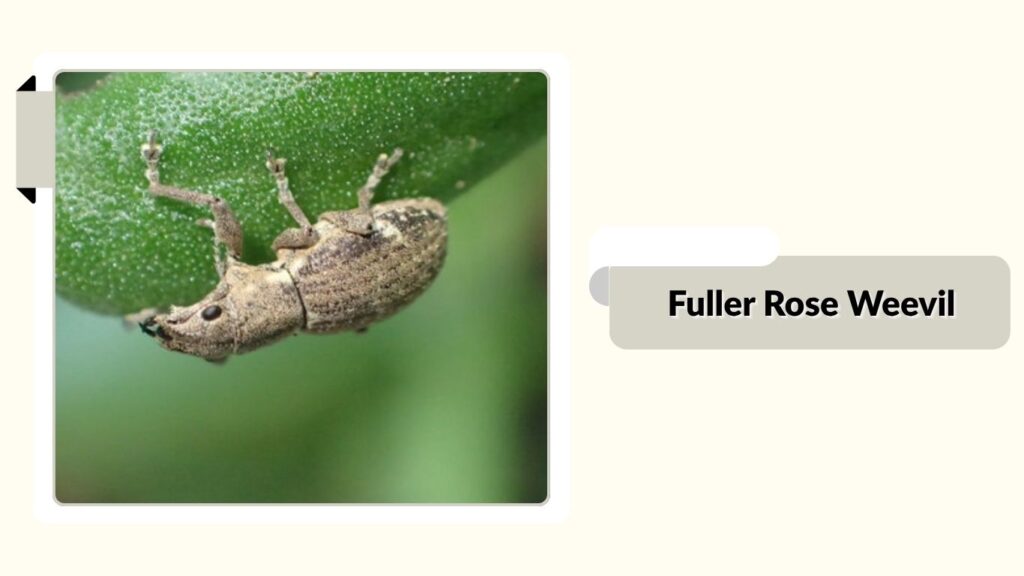
The Fuller rose weevil is a flightless weevil that feeds on a wide range of ornamental and agricultural plants. Adults chew leaves, while larvae feed on roots. It is also an important quarantine pest because eggs can be laid in hidden locations on plants and transported with nursery stock or fruit.
Identification
- Gray-brown body
- Broad short snout
- Adults roughly 1/3 inch long
- Elongated oval shape
- Pale scales covering the body
- Flightless adults
Habitat and Distribution
Fuller rose weevils occur in many warm regions worldwide, including parts of North America, Australia, and other subtropical areas. They are found in gardens, citrus orchards, nurseries, vineyards, and landscapes. Because they feed on many hosts, they can persist in a wide range of planted environments.
Behavior and Diet
Adults chew irregular notches around leaf margins. Host plants include roses, citrus, avocado, grape, and many ornamentals. Larvae live in soil and feed on roots, usually causing less visible damage than adult feeding. Females often hide eggs in cracks, bark crevices, or beneath plant structures.
Lifespan and Life Cycle
Eggs hatch into larvae that drop or move into the soil. Larvae feed on roots through several stages before pupating underground. Adults emerge and begin feeding on foliage. Females can reproduce without mating, helping populations establish from very small introductions.
8. Pecan Weevil
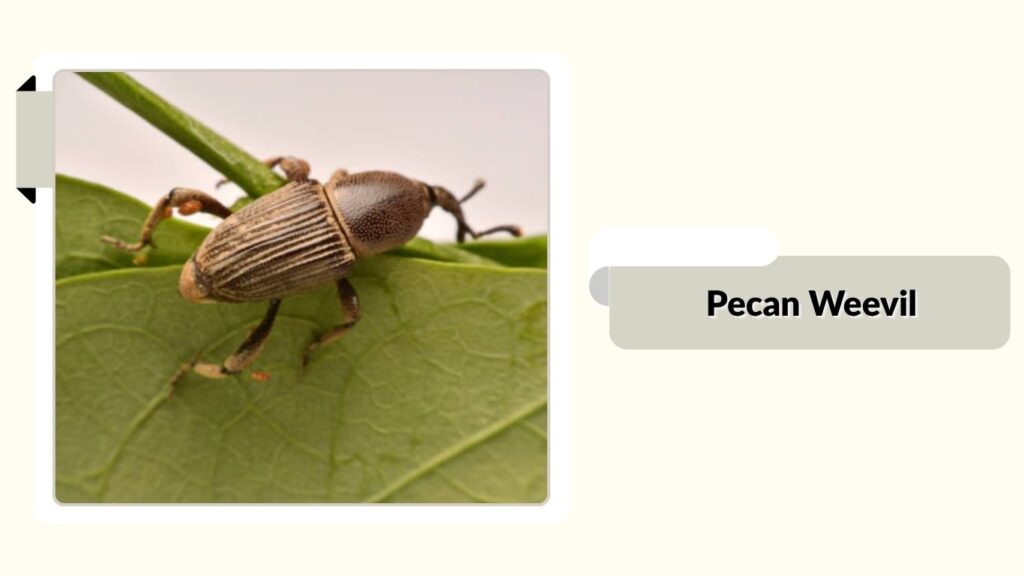
The pecan weevil is an important pest of pecans and hickory nuts. Adults damage developing nuts, while larvae develop inside mature kernels. Infested nuts may drop early or contain large cream-colored larvae when opened.
Identification
- Brown to grayish-brown body
- Very long slender snout
- Adults about 3/8 inch long
- Female snout often longer than male snout
- Elbowed antennae
- Robust oval body
Habitat and Distribution
Pecan weevils occur mainly in the southern and central United States where pecan trees are common. They are found in orchards, residential yards, and woodland areas containing pecan or hickory. Adults emerge from soil beneath host trees during summer.
Behavior and Diet
Adults puncture developing nuts to feed. Later in the season, females use their long snouts to drill through the shell and lay eggs inside. Larvae feed on the nut kernel and can destroy much of the edible portion. Damaged nuts may fall prematurely or remain on trees until larvae finish development.
Lifespan and Life Cycle
Eggs hatch inside nuts, and larvae feed on the kernel. When mature, larvae chew holes through the shell and drop to the ground. They burrow into soil, where they may remain for one or more years before pupating. Adults later emerge from soil to repeat the cycle.
9. Plum Curculio
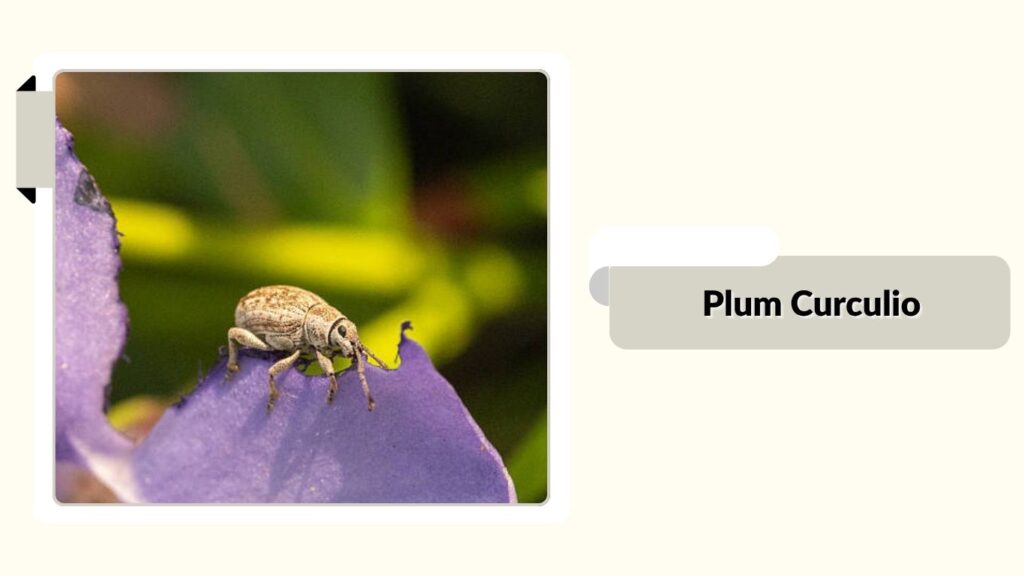
The plum curculio is a small snout beetle that attacks apples, plums, peaches, cherries, pears, and other tree fruits. Adults scar developing fruit, while larvae feed internally. One of the most recognizable signs is a crescent-shaped egg-laying scar on young fruit.
Identification
- Mottled brown, gray, and black body
- Short curved snout
- Adults about 1/4 inch long
- Rough, bumpy wing covers
- Four noticeable humps on the back
- Compact body
Habitat and Distribution
Plum curculios are native to North America and are especially common east of the Rocky Mountains.
They occur in orchards, home fruit gardens, woodland edges, and areas with wild fruit hosts.
Adults overwinter in leaf litter and protected ground cover near orchards.
Behavior and Diet
Adults feed on buds, blossoms, and developing fruit.
Females cut a distinctive crescent-shaped slit around the site where an egg is placed.
Larvae feed inside fruit, causing internal damage and premature fruit drop.
Apples, plums, peaches, nectarines, cherries, and pears are among common hosts.
Lifespan and Life Cycle
Adults emerge in spring and move to fruit trees after bloom.
Eggs are laid inside young fruit. Larvae develop within the fruit and eventually leave after it falls.
They pupate in soil, and new adults emerge later in the season.
One main generation per year is common in cooler areas, while warmer regions may support more.
10. Acorn Weevil
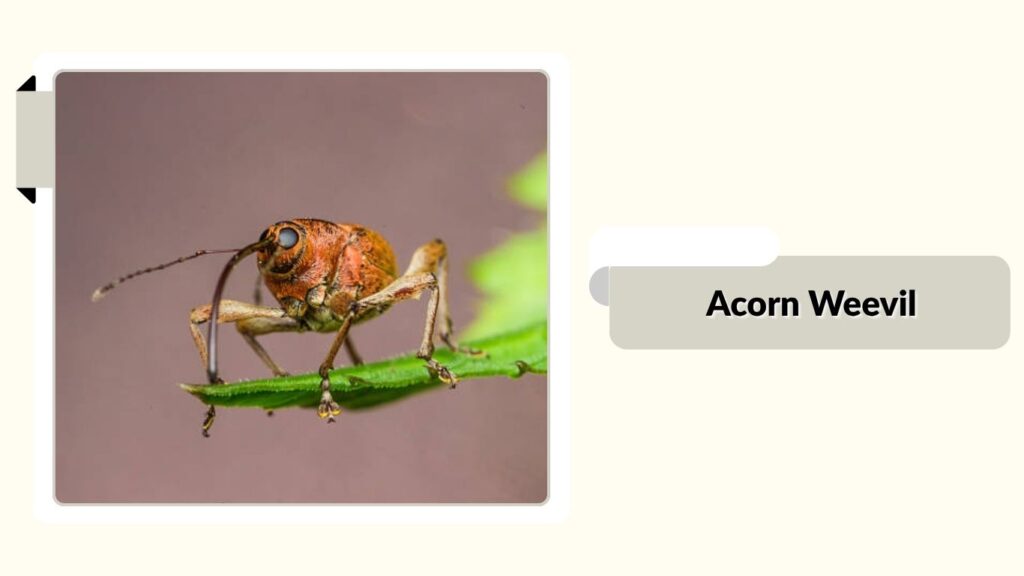
Acorn weevils are long-snouted beetles whose larvae develop inside acorns. Females use their extremely long snouts to bore through acorn shells and place eggs inside. Larvae consume the nut interior before chewing their way out and entering the soil.
Identification
- Brown to tan body
- Exceptionally long curved snout
- Adults generally 1/4 to 1/2 inch long
- Female snout often very long
- Elbowed antennae
- Rounded body
Habitat and Distribution
Acorn weevils are found in oak woodlands across North America, Europe, and other regions, depending on species.
They occur anywhere suitable oak trees produce acorns.
Adults are most noticeable in late summer and autumn when acorns are developing.
Behavior and Diet
Adults feed lightly on plant tissues, but the larval stage causes the most noticeable damage.
Females drill into developing acorns and deposit eggs inside.
The larvae feed on the nut tissue while protected by the shell.
Infested acorns may contain one or more larvae and may fail to germinate.
Lifespan and Life Cycle
Larvae mature inside acorns and later chew round exit holes.
They drop to the soil and burrow underground.
Many species remain in soil for months or even multiple years before pupating.
Adults emerge seasonally and return to oak trees to reproduce.
11. Chestnut Weevil
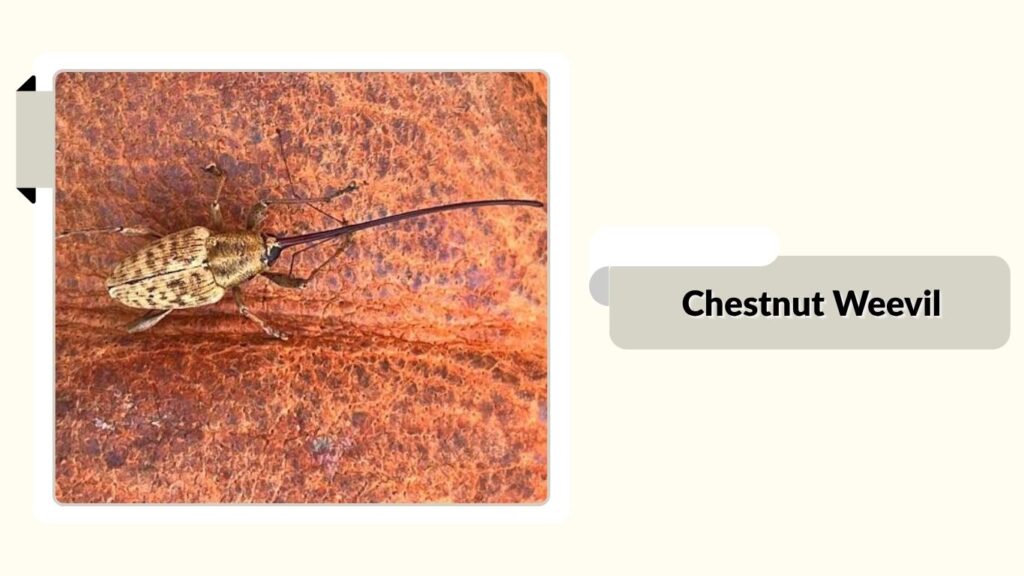
Chestnut weevils are serious pests of chestnuts because their larvae develop inside the nut and consume the edible kernel. Both lesser and greater chestnut weevils occur in some regions, and their damage can make harvested nuts unsuitable for consumption.
Identification
- Brown to grayish body
- Long slender snout
- Adults generally 1/4 to 1/2 inch long
- Female snout longer than male
- Elbowed antennae
- Oval body
Habitat and Distribution
Chestnut weevils occur where chestnut trees grow, including parts of North America, Europe, and Asia.
They are found in orchards, woodlands, and areas containing cultivated or wild chestnuts.
Adults usually become active as nuts develop in late summer.
Behavior and Diet
Females bore through developing chestnut shells and place eggs inside.
Larvae feed on the nut kernel, reducing quality and market value.
Externally, infested nuts may appear normal until larvae emerge.
Heavy infestations can affect a significant portion of a crop.
Lifespan and Life Cycle
Larvae complete development inside chestnuts.
After nuts fall, mature larvae chew exit holes and move into the soil.
They may remain underground for extended periods before pupating.
Adults emerge later, often timed with chestnut development.
12. Pea Leaf Weevil
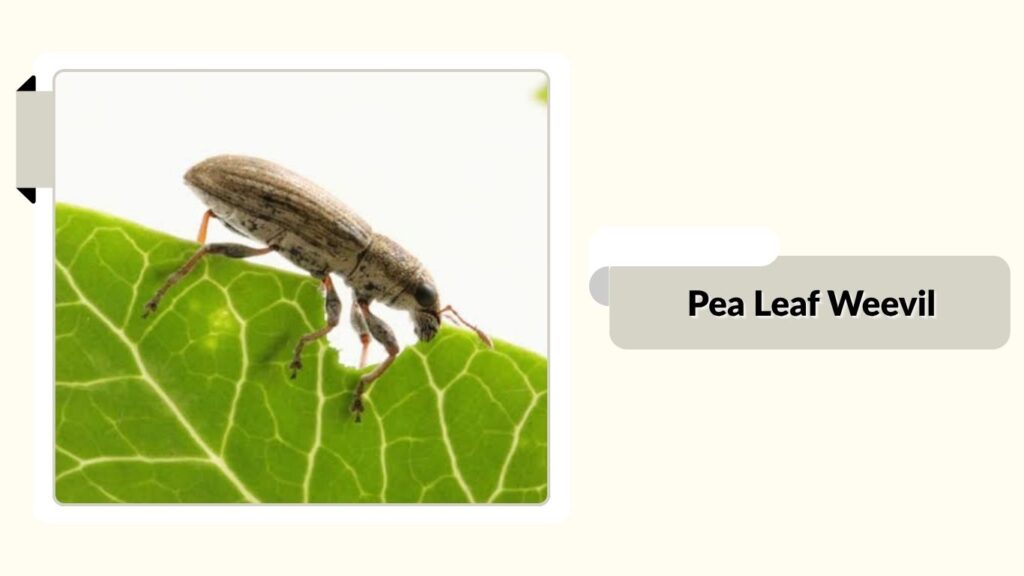
The pea leaf weevil is an agricultural pest of peas, fava beans, and other legumes. Adults chew distinctive scalloped notches along leaf edges, while larvae feed underground on root nodules that contain nitrogen-fixing bacteria.
Identification
- Gray-brown body
- Short broad snout
- Adults about 1/5 inch long
- Faint longitudinal stripes
- Oval elongated shape
- Fine scales on body
Habitat and Distribution
Pea leaf weevils occur across Europe, western Asia, and parts of North America where they have become established.
They are common in pea, lentil, and fava bean fields.
Adults often move between cultivated crops and nearby leguminous plants.
Behavior and Diet
Adults feed on leaf margins, creating characteristic U-shaped notches.
Larvae live underground and feed on nitrogen-fixing root nodules.
This can reduce the plant’s ability to obtain nitrogen naturally and may slow growth.
Young pea and bean plants are especially vulnerable.
Lifespan and Life Cycle
Adults overwinter in protected vegetation and move into legume fields in spring.
Females scatter eggs onto soil near host plants.
Larvae feed underground before pupating in soil.
New adults emerge later in the growing season and eventually seek overwintering sites.
13. Alfalfa Weevil
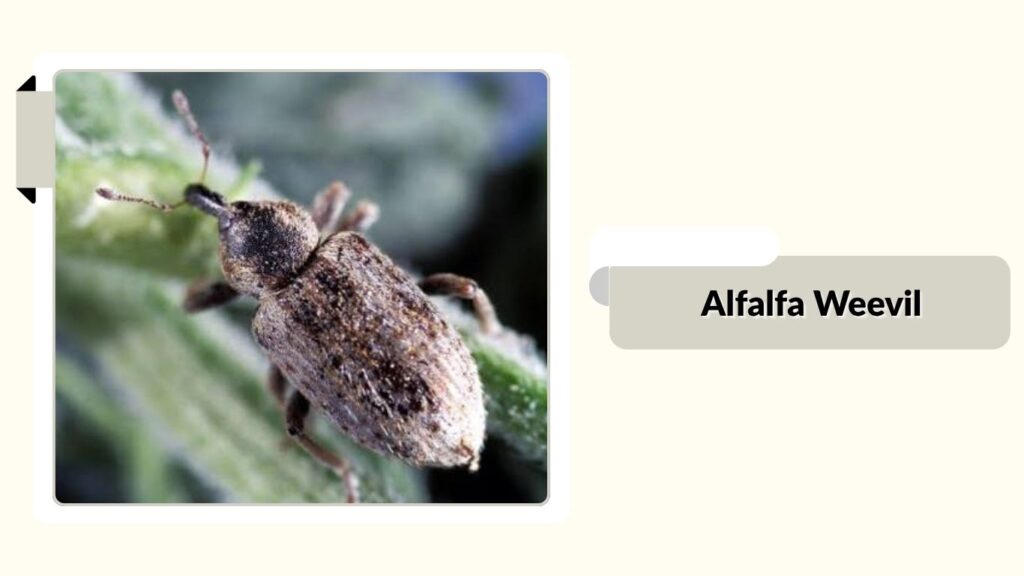
The alfalfa weevil is one of the most important pests of alfalfa in many agricultural regions. Larvae feed heavily on leaf buds and foliage, giving fields a gray or frosted appearance when populations are high.
Identification
- Brown body with a darker stripe along the back
- Short curved snout
- Adults roughly 1/4 inch long
- Oval shape
- Larvae are green with a white stripe down the back
- Larvae have a dark head
Habitat and Distribution
Alfalfa weevils are widespread in alfalfa-producing regions of North America, Europe, and Asia.
They are strongly associated with alfalfa fields but may also occur on related legumes.
Adults spend winter in field debris or protected vegetation.
Behavior and Diet
Larvae cause the greatest damage by feeding on developing leaves and buds.
Heavy feeding can reduce forage quality and yield.
Adults also feed on foliage, although their damage is usually less severe.
Infested fields may appear pale or gray from a distance.
Lifespan and Life Cycle
Adults become active in spring and lay eggs inside alfalfa stems.
Larvae hatch and feed through several stages.
Mature larvae spin loose cocoons on or near plants and pupate.
New adults emerge later and may enter a period of reduced summer activity before overwintering.
14. Clover Root Curculio
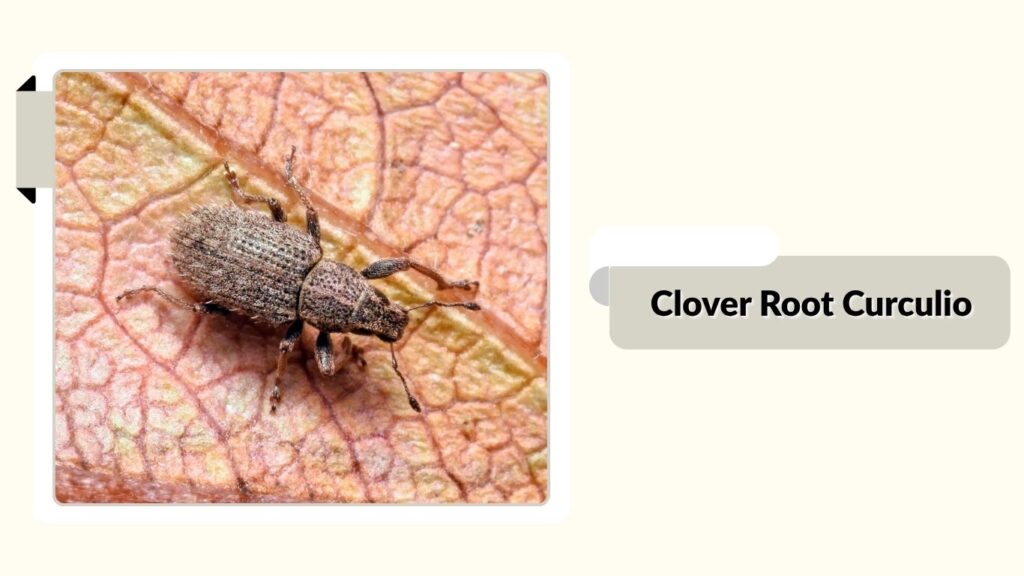
The clover root curculio is a small weevil that feeds on clover, alfalfa, and other legumes. Adults chew foliage, but larvae cause more important damage by feeding on roots and root nodules underground.
Identification
- Gray-brown to dark brown body
- Short snout
- Adults roughly 1/8 to 1/5 inch long
- Narrow oval body
- Fine scales covering the surface
- Elbowed antennae
Habitat and Distribution
Clover root curculios are widespread across temperate regions where clover and alfalfa are grown.
They occur in pastures, hay fields, lawns, and agricultural areas containing legumes.
Because larvae remain underground, infestations may be overlooked until plants begin declining.
Behavior and Diet
Adults chew small notches in clover and alfalfa leaves.
Larvae feed on roots, root hairs, and nitrogen-fixing nodules.
This feeding can weaken plants, reduce vigor, and increase susceptibility to drought or disease.
Damage is often most noticeable in stressed stands.
Lifespan and Life Cycle
Females lay eggs on or near the soil surface.
Larvae hatch and move underground to feed on roots.
They pupate in soil and later emerge as adults.
One generation per year is common in many areas, although development timing varies with climate.
15. Sweet Potato Weevil
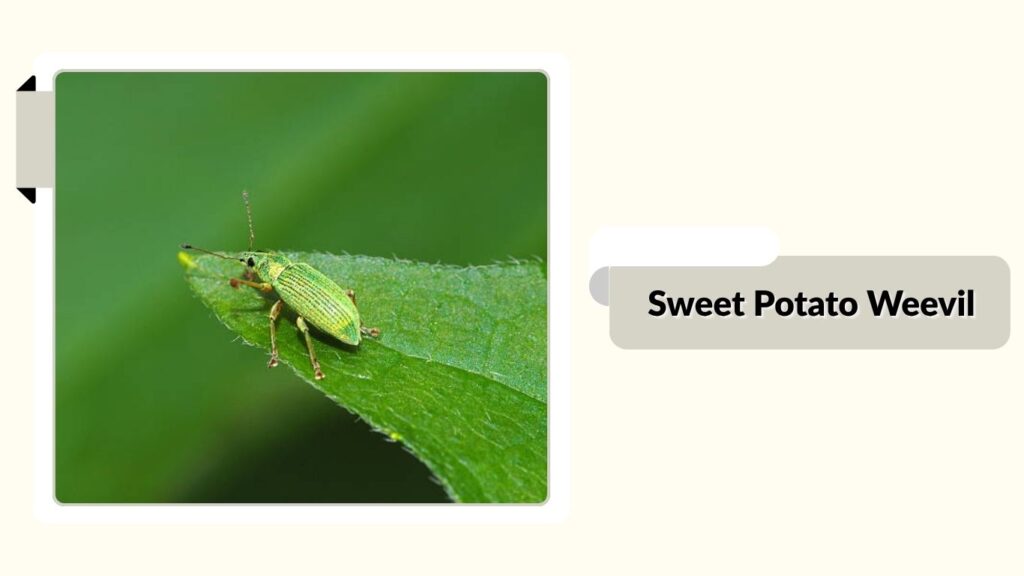
The sweet potato weevil is one of the most destructive pests of sweet potatoes worldwide. Adults feed on vines and storage roots, while larvae tunnel inside stems and roots. Even light infestations can make sweet potatoes bitter and unmarketable because damaged tissues produce defensive compounds.
Identification
- Slender ant-like body
- Long narrow snout
- Dark blue to black head and wing covers
- Reddish-orange thorax and legs
- Adults around 1/4 inch long
- Distinct narrow waist-like appearance
Habitat and Distribution
Sweet potato weevils are widespread in tropical and subtropical regions, including parts of Asia, Africa, the Americas, and the Pacific.
They are found in sweet potato fields, storage areas, and places where volunteer sweet potato plants persist.
Warm conditions favor continuous reproduction.
Behavior and Diet
Adults feed on leaves, stems, and exposed storage roots.
Females bore into stems or roots and deposit eggs inside.
Larvae tunnel through the plant tissue, causing extensive internal damage.
Infested roots may develop an unpleasant bitter taste and strong odor, making them unsuitable for consumption.
Lifespan and Life Cycle
Eggs hatch inside stems or storage roots.
Larvae remain protected within the plant while feeding and developing.
Pupation also occurs inside the damaged tissue.
Adults later emerge through small holes and begin feeding and reproducing.
In warm climates, multiple generations can occur throughout the year.
16. Pepper Weevil
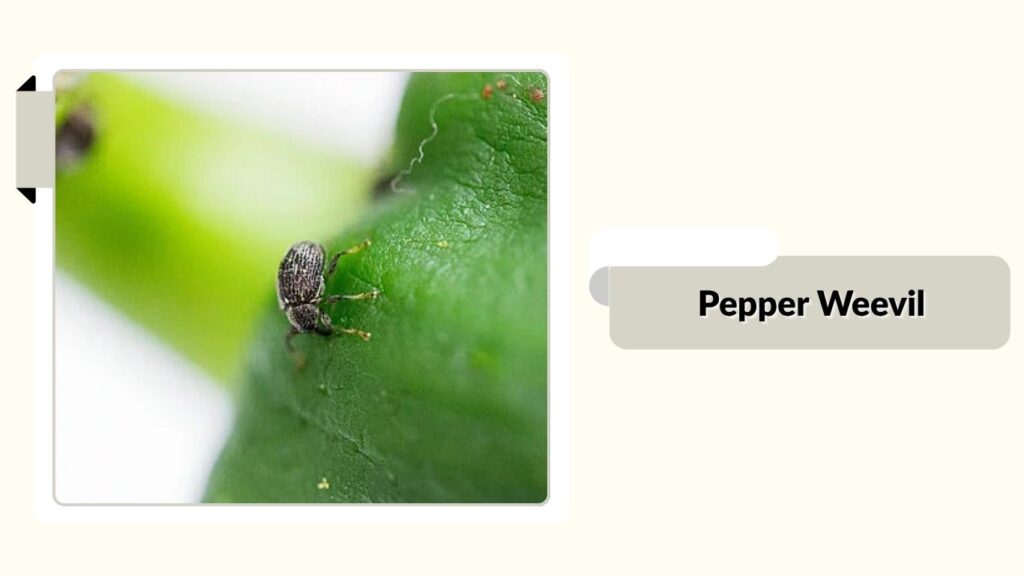
The pepper weevil is a small, dark snout beetle that attacks peppers and related plants. It is especially important in commercial pepper production because larvae develop inside flower buds and fruits, where they are protected from many surface treatments. Infested peppers may become misshapen, discolored, or drop prematurely.
Identification
- Small dark brown to black body
- Short curved snout
- Adults around 1/8 inch long
- Oval body shape
- Fine pale hairs or scales
- Elbowed antennae
- Larvae are pale, legless grubs
Habitat and Distribution
Pepper weevils occur mainly in warm regions where peppers can grow for long periods. They are especially important in Mexico, Central America, the southern United States, and other subtropical agricultural areas.
They are commonly found in pepper fields, greenhouses, vegetable gardens, and around wild plants in the nightshade family.
Behavior and Diet
Adults feed on pepper buds, flowers, leaves, and developing fruits. Females puncture plant tissue and insert eggs into buds or fruits.
Larvae remain hidden inside, feeding on internal tissue and seeds. Their concealed feeding can cause young fruits to yellow, deform, or fall.
Bell peppers and hot peppers are both vulnerable.
Lifespan and Life Cycle
Eggs hatch inside pepper tissue. Larvae pass through several stages while feeding internally before pupating within buds or fruits.
Adults later emerge through small exit holes.
In warm climates, several overlapping generations can develop during a growing season, which allows populations to increase rapidly when host plants remain available.
17. Carrot Weevil
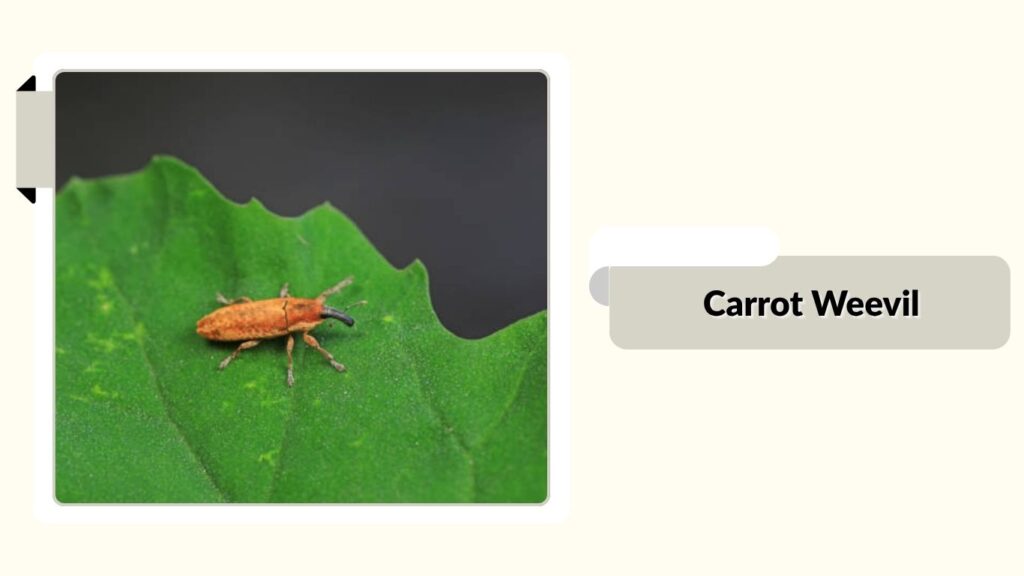
The carrot weevil is a small brown weevil whose larvae tunnel into the roots and crowns of carrots and related plants. It can also attack celery, parsley, and other members of the carrot family. Damage is often most serious in young plants because larval feeding can distort roots and reduce crop quality.
Identification
- Reddish-brown to dark brown body
- Short broad snout
- Adults about 1/4 inch long
- Oval body shape
- Fine grooves on wing covers
- Elbowed antennae
- Larvae are white, curved, and legless
Habitat and Distribution
Carrot weevils occur in parts of North America, particularly in regions where carrots and related crops are cultivated.
They are found in vegetable fields, gardens, and agricultural areas containing carrot-family plants.
Adults often shelter in soil, crop debris, or vegetation around fields.
Behavior and Diet
Adults may chew small holes in leaves and stems, but the larvae cause the more serious damage.
Females lay eggs in small cavities near the crown of host plants. Larvae hatch and tunnel downward into roots.
Carrot roots may develop dark scars, tunnels, or malformed areas, reducing their market value.
Lifespan and Life Cycle
Adults overwinter in protected locations and become active during spring.
Females lay eggs near the crown of host plants. Larvae feed internally through several stages before leaving the root and pupating in soil.
New adults emerge later in the season.
Depending on climate, one or more generations may occur each year.
18. Cabbage Seedpod Weevil
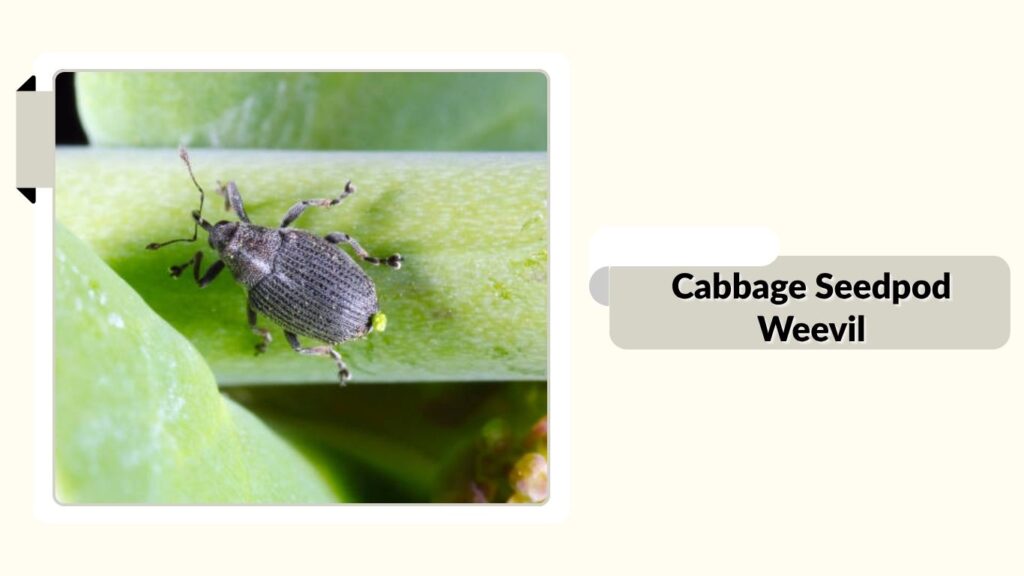
The cabbage seedpod weevil is a small gray weevil associated with canola, rapeseed, mustard, and related crops. Adults feed on flowers and pods, while larvae develop inside seedpods and consume developing seeds. It is an important agricultural pest in many canola-growing regions.
Identification
- Gray to grayish-black body
- Slender curved snout
- Adults about 1/8 inch long
- Oval body shape
- Fine gray scales
- Elbowed antennae
- Larvae are white and legless
Habitat and Distribution
Cabbage seedpod weevils are found across Europe and have become established in parts of North America.
They occur mainly in agricultural regions where canola, rapeseed, mustard, and other crucifer crops are grown.
Adults often move into fields as plants begin flowering.
Behavior and Diet
Adults feed on flowers, buds, and developing pods.
Females puncture young seedpods and place eggs inside. Larvae hatch within the pod and consume several developing seeds.
Heavy infestations can reduce seed yield and may also create openings that allow other pests to enter damaged pods.
Lifespan and Life Cycle
Larvae mature inside seedpods and eventually chew exit holes.
They drop to the ground and pupate in soil.
New adults emerge later in summer and feed briefly before seeking overwintering sites in leaf litter, field margins, or sheltered vegetation.
One generation per year is typical in many areas.
19. Blue-Green Citrus Root Weevil
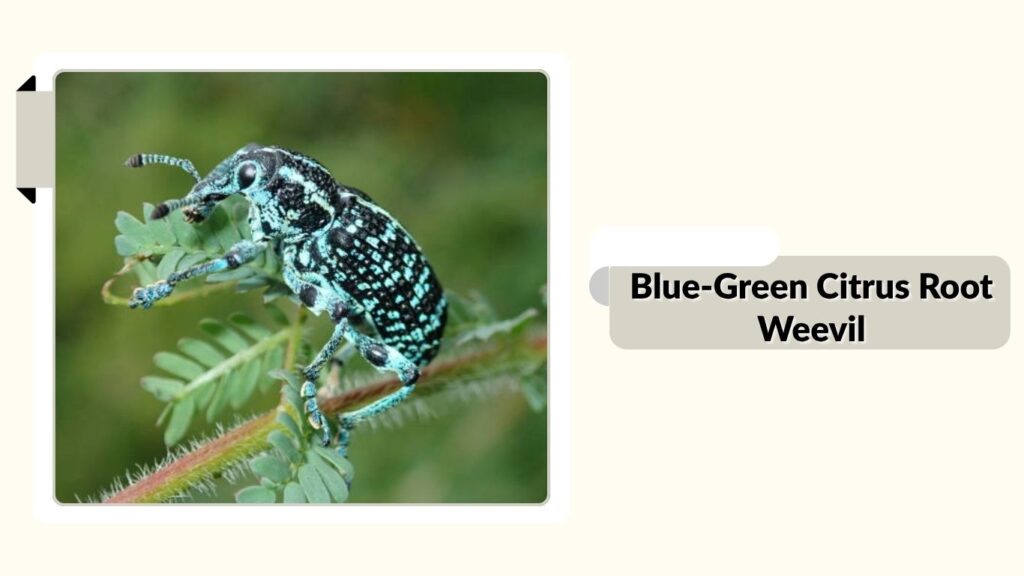
The blue-green citrus root weevil is a brightly colored pest of citrus and many ornamental plants. Adults feed on leaves, while larvae live underground and feed on roots. The root damage can be especially serious for young citrus trees because it reduces water and nutrient uptake.
Identification
- Blue-green to turquoise body
- Covered with colorful scales
- Broad short snout
- Adults roughly 1/2 inch long
- Oval robust body
- Elbowed antennae
- Larvae are white, curved grubs
Habitat and Distribution
This weevil is native to parts of the Caribbean but has become established in areas such as Florida.
It is found in citrus groves, nurseries, gardens, and landscapes containing suitable host plants.
Warm climates allow populations to remain active for much of the year.
Behavior and Diet
Adults chew irregular notches along leaf margins. Citrus is an important host, but the beetles may also feed on avocado and numerous ornamentals.
Larvae cause more serious damage by feeding on roots underground.
Repeated root injury can reduce tree vigor and make plants more vulnerable to drought and disease.
Lifespan and Life Cycle
Females lay eggs in protected sites on host plants, often between overlapping leaves or other surfaces.
Larvae fall to the soil after hatching and begin feeding on roots.
They pass through several stages underground before pupating.
Adults later emerge and return to foliage. Development may continue through much of the year in warm climates.
20. Diaprepes Root Weevil
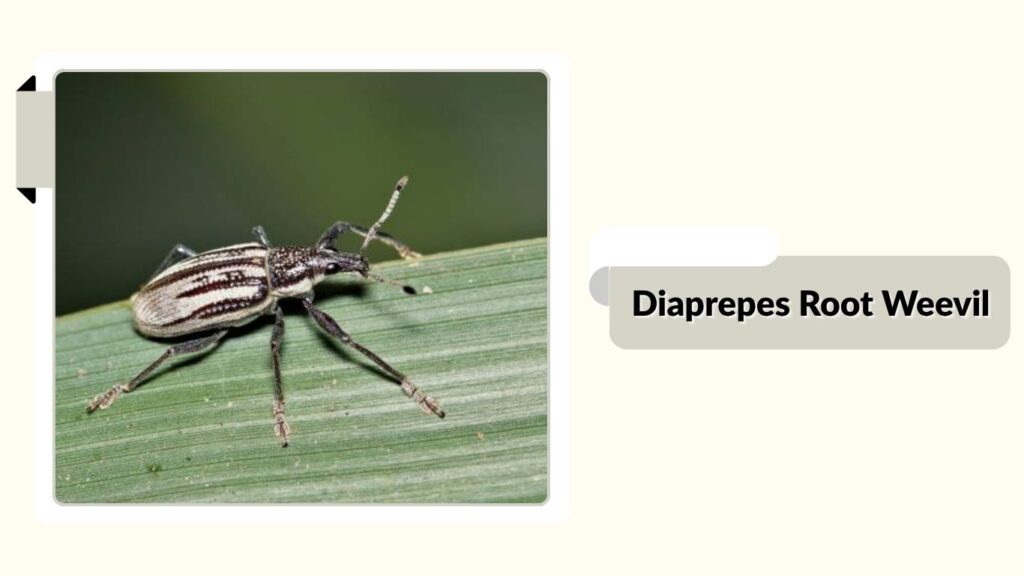
The Diaprepes root weevil is a large, colorful weevil that attacks citrus, sugarcane, ornamentals, and many other plants. Adults feed above ground, but larvae cause the most serious damage by feeding on roots. Severe root injury can weaken or even kill young trees.
Identification
- Black body with colorful yellow, orange, or white scales
- Broad snout
- Adults often about 1/2 to 3/4 inch long
- Distinct striped or mottled appearance
- Robust body
- Elbowed antennae
- Large white root-feeding larvae
Habitat and Distribution
The species is native to the Caribbean and has become established in parts of Florida and other warm regions.
It occurs in citrus groves, nurseries, sugarcane fields, gardens, and landscapes containing susceptible host plants.
Behavior and Diet
Adults chew leaf margins, creating distinctive notches.
The larvae live in soil and feed on roots, including large structural roots. Their feeding can create wounds that may also increase susceptibility to root diseases.
Because the species feeds on hundreds of plant types, it can persist in diverse landscapes.
Lifespan and Life Cycle
Females lay clusters of eggs between leaves or other tightly touching surfaces.
After hatching, larvae drop to the ground and burrow into soil.
They may remain underground for months while feeding and growing.
Pupation also occurs in the soil. Adults eventually emerge and return to host foliage.
21. Banana Root Borer Weevil
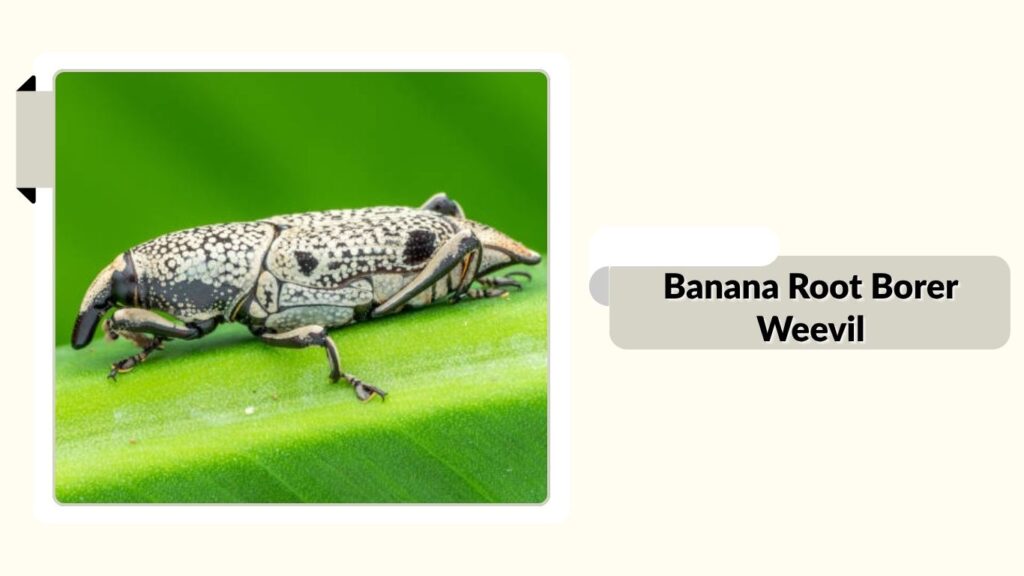
The banana root borer weevil is one of the most important pests of banana and plantain crops. Adults are dark and secretive, while larvae tunnel through the corm and lower stem. Heavy infestations weaken plants, reduce yields, and may cause plants to topple.
Identification
- Dark reddish-brown to black body
- Long curved snout
- Adults roughly 1/3 to 1/2 inch long
- Elongated body
- Strong wing covers
- Elbowed antennae
- Larvae are pale and legless
Habitat and Distribution
Banana root borer weevils occur throughout many tropical and subtropical banana-growing regions.
They are common in Africa, Asia, the Pacific, Latin America, and other areas where bananas and plantains are cultivated.
Adults spend much of their time near the base of plants or inside plant debris.
Behavior and Diet
Adults feed relatively little compared with larvae.
Females lay eggs in small cavities in the corm or lower stem. Larvae tunnel through the corm, interfering with water and nutrient movement.
Damaged plants may grow poorly, produce smaller bunches, or become unstable.
Lifespan and Life Cycle
Eggs hatch within the plant. Larvae feed internally and pass through several stages before pupating in the corm or nearby tissue.
Adults later emerge and may live for months.
Because adult weevils are long-lived and banana plants are available year-round in tropical climates, infestations can persist continuously.
22. Palm Weevil
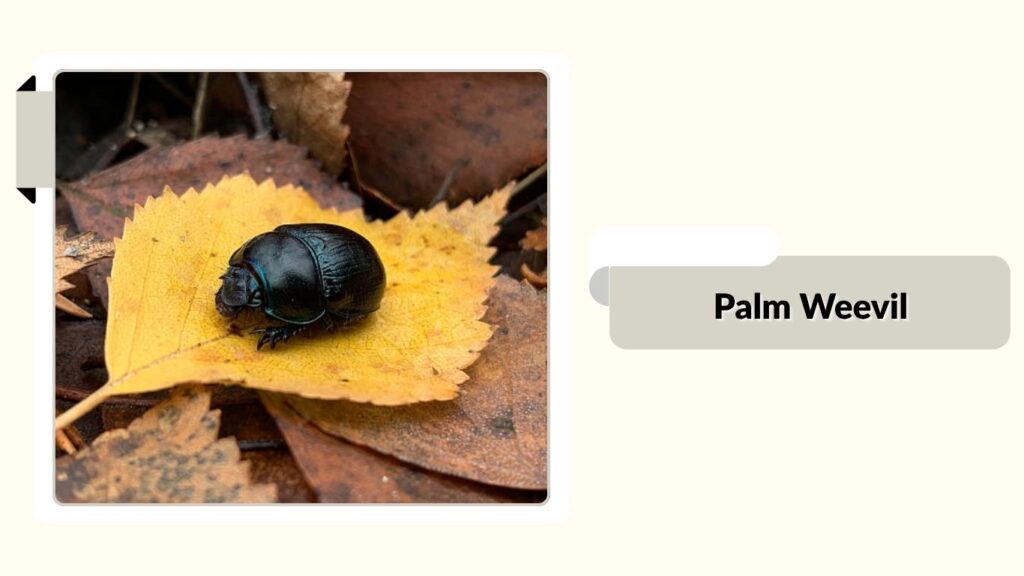
“Palm weevil” is a broad common name used for several large weevils that develop in palm trees. Many species belong to the genus Rhynchophorus. Adults are large, strong beetles, while larvae tunnel through soft internal palm tissue and may severely damage or kill infested trees.
Identification
- Large elongated body
- Prominent curved snout
- Usually reddish, brown, or black
- Strong legs
- Adults commonly 1 inch or more long
- Elbowed antennae
- Larvae are large, pale, and legless
Habitat and Distribution
Palm weevils occur mainly in tropical and subtropical regions where palms are abundant.
They inhabit coconut plantations, date palm groves, ornamental landscapes, and natural palm habitats.
Different species occur in Asia, Africa, the Americas, and other warm regions.
Behavior and Diet
Adults may feed on palm tissue, sap, or wounds.
Females often lay eggs in damaged or soft areas of palms. Larvae tunnel deeply into trunks, crowns, or growing points.
Because feeding occurs internally, severe infestations may remain unnoticed until the palm begins to wilt or collapse.
Lifespan and Life Cycle
Eggs hatch inside palm tissue.
Larvae feed and enlarge their tunnels as they grow. When mature, they create fibrous cocoons from palm material and pupate inside them.
Adults later emerge and may fly considerable distances in search of new host palms.
23. Red Palm Weevil
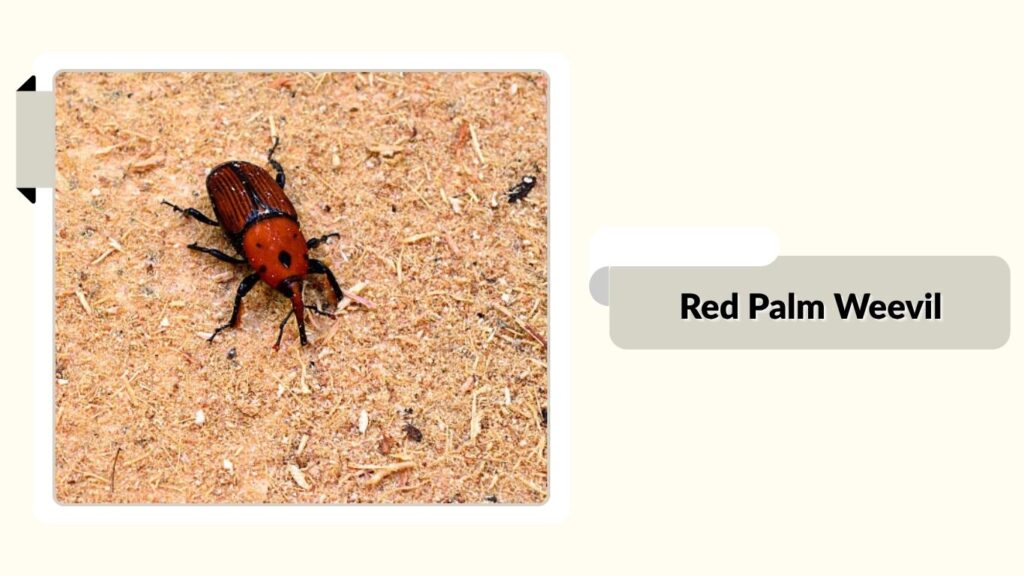
The red palm weevil is a highly destructive palm pest recognized by its reddish body and long snout. Its larvae tunnel inside palm trunks and crowns, often causing extensive damage before external symptoms become obvious. It is considered one of the world’s most serious palm pests.
Identification
- Reddish-brown to orange-red body
- Long curved snout
- Black markings on the thorax
- Adults around 1 to 1.5 inches long
- Strong wings and capable of flight
- Elbowed antennae
- Large creamy-white larvae
Habitat and Distribution
Red palm weevils originated in parts of South and Southeast Asia but have spread widely.
They now occur in portions of the Middle East, Africa, Europe, and other warm regions.
They attack date palms, coconut palms, ornamental palms, and several related species.
Behavior and Diet
Adults are attracted to damaged or stressed palms where females lay eggs.
Larvae bore through soft internal tissue and can destroy the growing point.
Early infestations are difficult to detect because most feeding occurs out of sight.
Heavy infestations may cause frond collapse, crown failure, and eventual tree death.
Lifespan and Life Cycle
Eggs hatch after being placed inside palm wounds or soft tissues.
Larvae feed internally for several weeks before constructing fibrous cocoons.
Pupation occurs inside the palm.
Adults emerge, mate, and search for additional hosts. Multiple overlapping generations may occur in warm climates.
24. Agave Snout Weevil
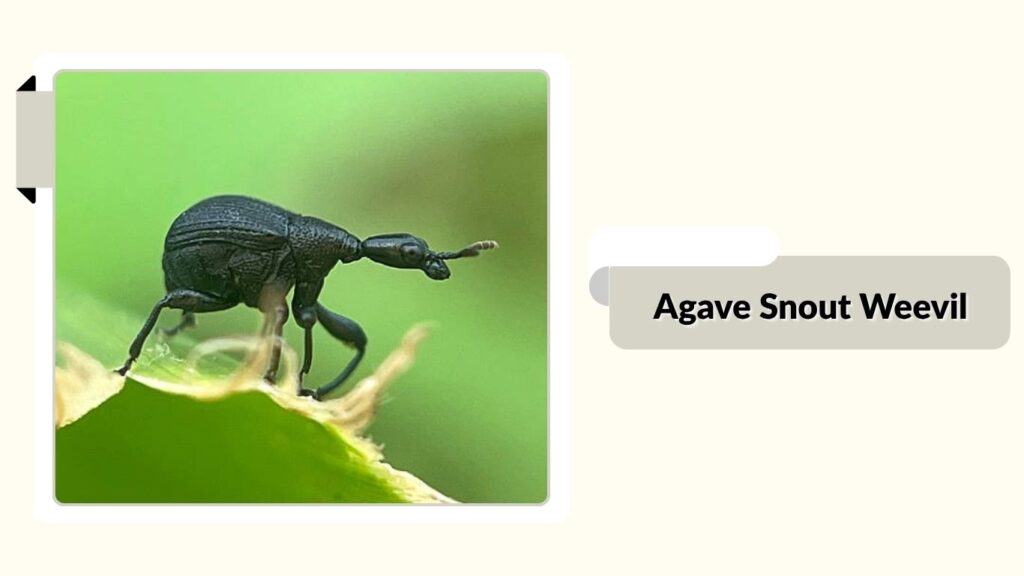
The agave snout weevil is a dark, robust weevil that attacks agaves and related succulents. Adults feed around the base or leaves, while larvae tunnel into the plant’s central tissues. Infested agaves may suddenly wilt and collapse once internal decay becomes severe.
Identification
- Dark brown to black body
- Long downward-curving snout
- Adults about 1/2 inch long
- Robust elongated shape
- Strong legs
- Elbowed antennae
- Larvae are pale and legless
Habitat and Distribution
Agave snout weevils occur in the southwestern United States, Mexico, and other warm regions where agaves grow naturally or ornamentally.
They are common in desert landscapes, xeriscape gardens, and areas planted with agave.
Behavior and Diet
Adults puncture agave tissue and females lay eggs in damaged areas.
Larvae feed inside the plant’s base and crown.
The feeding damage can encourage decay-causing microorganisms, which accelerates plant collapse.
Large mature agaves may appear healthy until damage is already extensive.
Lifespan and Life Cycle
Eggs hatch inside agave tissue.
Larvae feed internally before moving into protected areas to pupate.
Adults later emerge and seek new host plants.
Warm conditions allow activity over a long season, especially where agaves are continuously available.
25. Pine Weevil
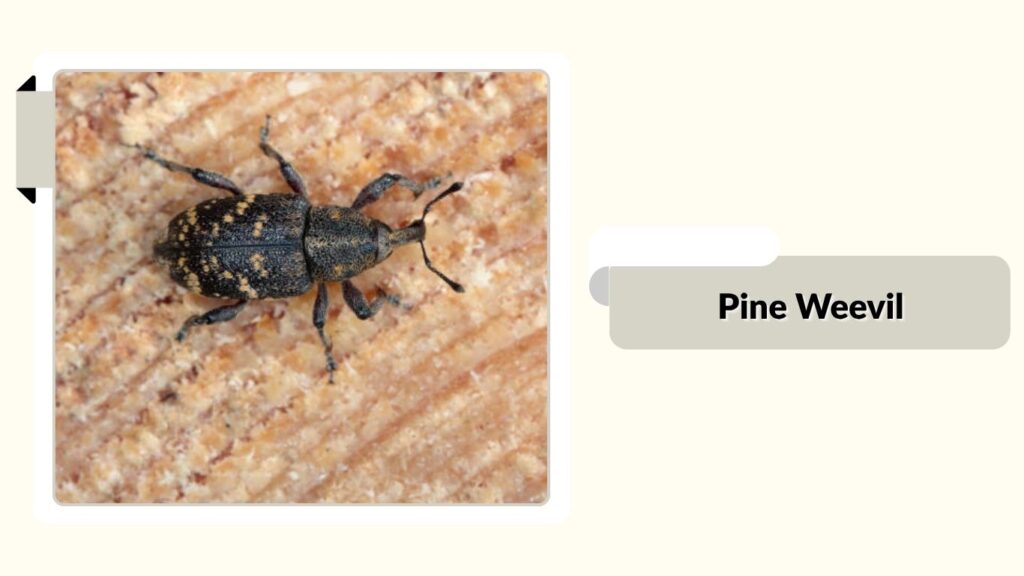
Pine weevil is a general name used for several weevils associated with conifers. Many species feed on bark, shoots, or roots. Young pine seedlings can be particularly vulnerable because adults may chew bark around the stem, sometimes girdling and killing newly planted trees.
Identification
- Brown to dark brown body
- Distinct snout
- Adults generally medium-sized
- Mottled or patterned wing covers
- Strong legs
- Elbowed antennae
- Larvae are pale, curved grubs
Habitat and Distribution
Pine weevils occur throughout many forested regions of the Northern Hemisphere.
They are commonly found in pine plantations, recently logged forests, nurseries, and areas where conifer stumps or roots provide larval habitat.
Behavior and Diet
Adults feed on bark, shoots, and stems of young conifers.
Damage can be severe when newly planted seedlings are attacked around the base.
Larvae usually develop in roots, stumps, or dead and dying conifer material.
Lifespan and Life Cycle
Females lay eggs in or near suitable conifer roots and stumps.
Larvae feed beneath bark or inside root tissue before pupating.
Adults emerge and may live for extended periods while feeding on young trees.
Development may take one or more years depending on species and climate.
26. White Pine Weevil
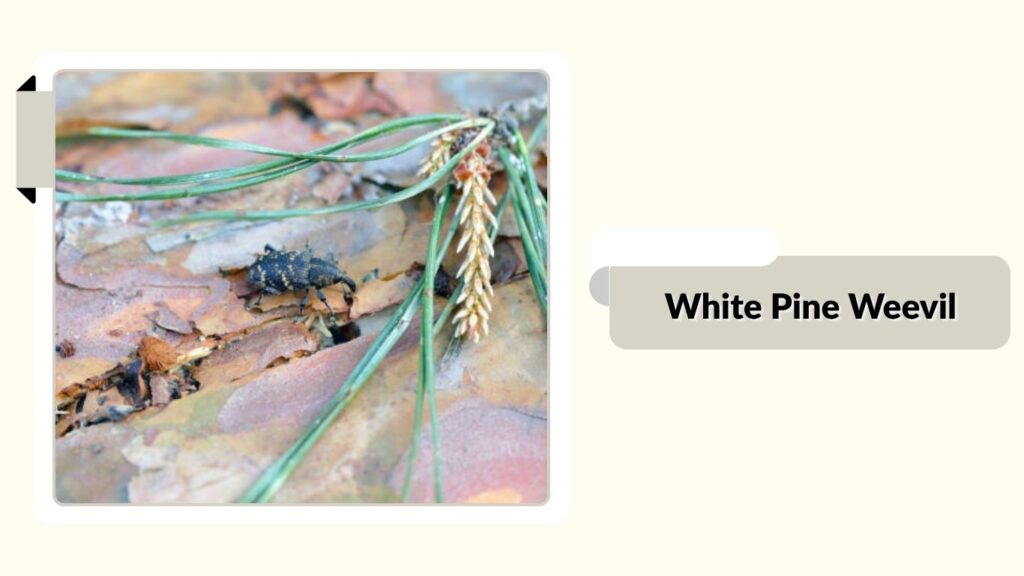
The white pine weevil is a major pest of white pine, spruce, and several other conifers in North America. Adults attack the terminal leader, and larvae develop beneath the bark. The resulting damage can kill the main shoot and cause trees to develop forked or crooked growth.
Identification
- Brown body with pale patches
- Long curved snout
- Adults about 1/4 inch long
- Mottled wing covers
- Elbowed antennae
- Compact body
- Larvae are white, legless grubs
Habitat and Distribution
White pine weevils are widely distributed across northern and eastern North America.
They occur in forests, Christmas tree plantations, nurseries, parks, and landscapes containing susceptible conifers.
Behavior and Diet
Adults feed and lay eggs near the terminal leader of host trees.
Larvae tunnel downward beneath the bark, disrupting water movement and killing the leader.
The dead terminal often bends into a characteristic shepherd’s-crook shape.
Trees usually survive, but repeated attacks can seriously distort their form.
Lifespan and Life Cycle
Adults overwinter in forest litter and become active during spring.
Females lay eggs in punctures made in the terminal shoot.
Larvae feed beneath bark, pupate within the damaged leader, and later emerge as adults.
One generation per year is typical.
27. Large Pine Weevil
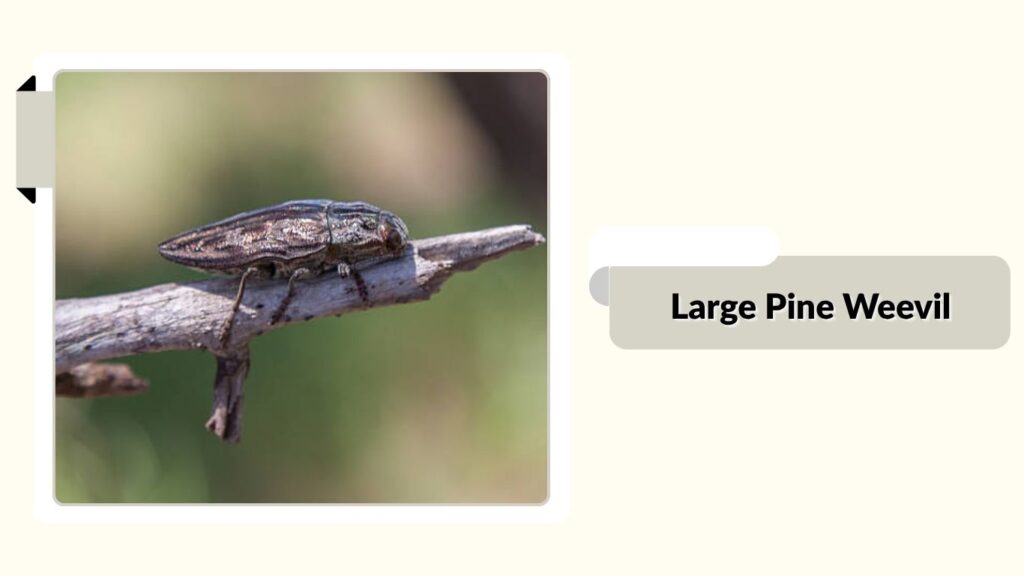
The large pine weevil is a major forestry pest in Europe. Adults feed on the bark of young conifer seedlings, sometimes girdling stems and killing newly planted trees. Larvae usually develop in the roots and stumps of recently felled conifers.
Identification
- Dark brown to black body
- Yellowish patches on wing covers
- Long broad snout
- Adults around 1/2 inch long
- Robust body
- Strong legs
- Elbowed antennae
Habitat and Distribution
Large pine weevils are widespread across Europe and parts of northern Asia.
They are especially abundant in recently clear-felled conifer forests where fresh stumps provide ideal breeding sites.
Newly replanted areas are often at greatest risk.
Behavior and Diet
Adults feed on the bark of young pine, spruce, and other conifer seedlings.
Bark removal around the stem can interrupt water movement and kill young trees.
Larvae develop mainly in roots and stumps of dead or recently cut conifers.
Lifespan and Life Cycle
Females lay eggs near conifer stumps or roots.
Larvae tunnel through root tissues and develop underground.
Pupation occurs in protected chambers.
Adults emerge and may continue feeding for a prolonged period before reproducing. Development can extend beyond one year in cooler climates.
28. Eucalyptus Snout Beetle
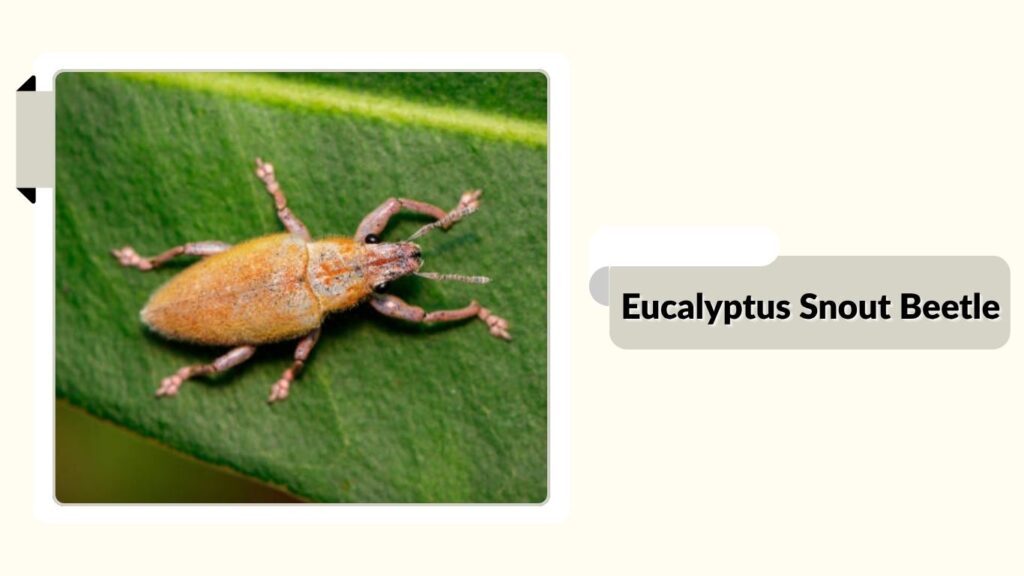
The eucalyptus snout beetle, also called a eucalyptus weevil, is a leaf-feeding beetle associated with eucalyptus trees. Adults and larvae consume foliage and can heavily defoliate susceptible trees. The species has spread beyond its native Australia through the international planting of eucalyptus.
Identification
- Gray-brown to reddish-brown body
- Short snout
- Adults around 1/3 inch long
- Mottled wing covers
- Rounded oval shape
- Elbowed antennae
- Larvae are yellow-green with dark markings
Habitat and Distribution
The eucalyptus snout beetle originated in Australia but has been introduced to other regions.
It now occurs in parts of Africa, Europe, the Americas, and elsewhere where eucalyptus trees are grown.
It is common in plantations, urban landscapes, parks, and gardens containing eucalyptus.
Behavior and Diet
Adults chew irregular notches around leaf margins.
Larvae feed more extensively on foliage and may strip young leaves.
Repeated defoliation can reduce tree growth and vigor, particularly in plantations.
Some eucalyptus species are more resistant than others.
Lifespan and Life Cycle
Females lay eggs in protective capsules attached to leaves.
Larvae hatch and feed openly on foliage.
When mature, they move to sheltered sites to pupate.
Adults later emerge and resume feeding. Several generations may occur in warm climates.
29. Hollyhock Weevil
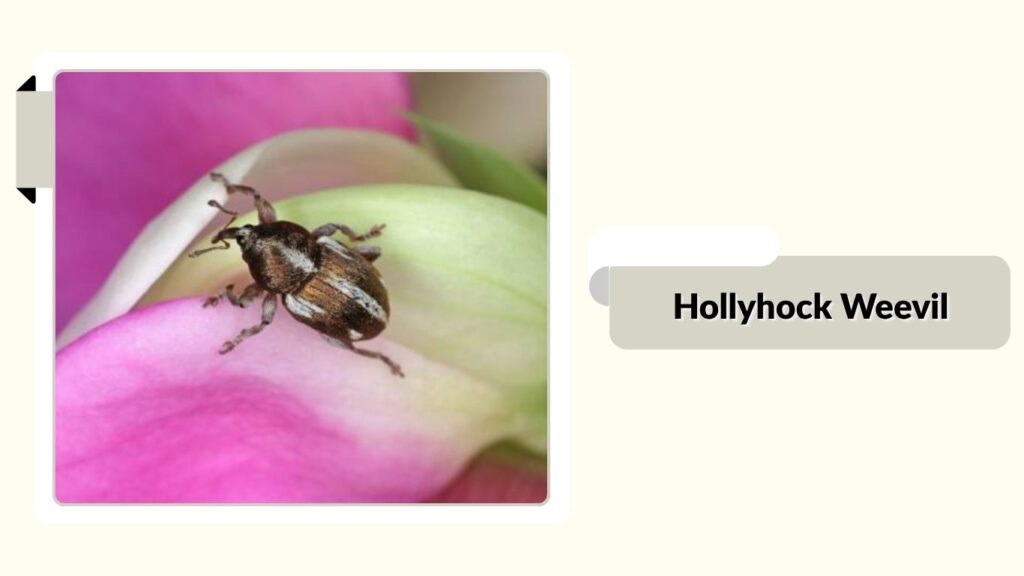
The hollyhock weevil is a small gray snout beetle commonly found on hollyhocks. Adults feed on leaves and flower buds, while females use their unusually long snouts to place eggs inside developing seeds. Larval feeding can greatly reduce seed production.
Identification
- Gray to grayish-brown body
- Very long slender snout
- Adults around 1/8 inch long
- Elbowed antennae
- Small compact body
- Females generally have longer snouts than males
- Often found directly on hollyhock flowers
Habitat and Distribution
Hollyhock weevils occur in many temperate regions where hollyhocks are grown.
They are common in home gardens, cottage gardens, flower beds, and around ornamental plantings.
Behavior and Diet
Adults chew small holes in hollyhock leaves and flower buds. Females use their long snouts to drill into developing seedpods and deposit eggs near the seeds. Larvae feed inside individual seeds, reducing the plant’s ability to reproduce. Established plants usually survive even when weevils are abundant.
Lifespan and Life Cycle
Eggs hatch within developing seed structures. Larvae feed inside seeds before leaving and moving into protected locations.Adults overwinter in plant debris or surrounding vegetation.They become active again when hollyhocks resume growth in spring.Usually one main generation occurs each year.
30. Rose Weevil
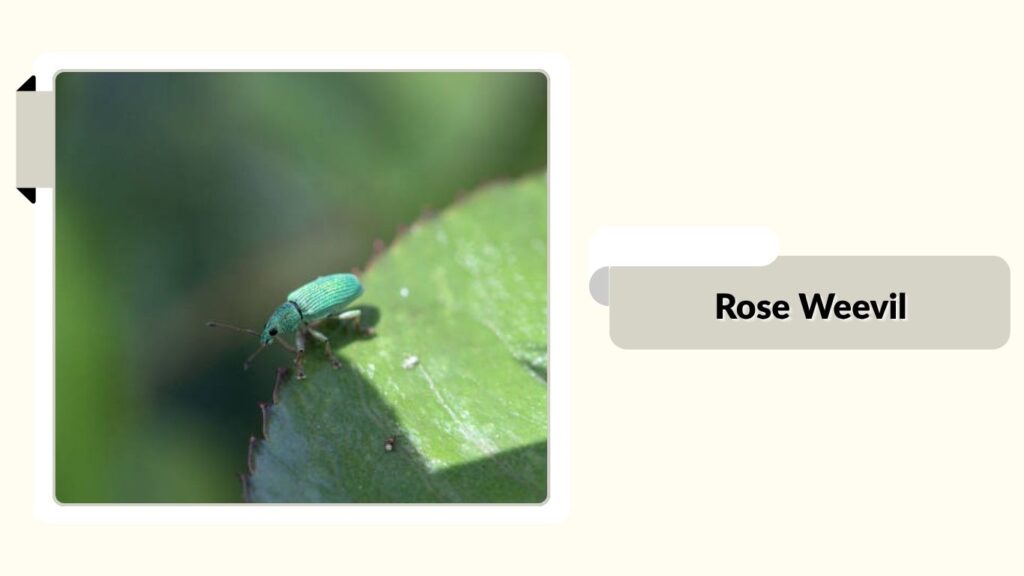
Rose weevil is a common name used for several snout beetles that attack roses and related plants. Adults may feed on flower buds, petals, and leaves, while larvae can develop inside buds, stems, or other plant tissues depending on the species.
Identification
- Small to medium-sized body
- Distinct elongated snout
- Usually brown, black, or reddish
- Oval body shape
- Elbowed antennae
- Strong chewing mouthparts
- Appearance varies by species
Habitat and Distribution
Rose weevils occur in many regions where roses grow.
They may be found in home gardens, nurseries, parks, landscaped areas, and wild habitats containing roses or related plants.
The exact range varies because “rose weevil” refers to several different species.
Behavior and Diet
Adults may puncture flower buds, chew petals, or feed along leaf edges.
Some species lay eggs inside flower buds, where developing larvae consume internal tissues.
Damaged buds may fail to open properly, become deformed, or drop from the plant.
Lifespan and Life Cycle
Females lay eggs in or near suitable rose tissue. Larvae develop within buds, stems, fruit, or soil depending on the species.After completing larval development, they pupate and eventually emerge as adults.
Many species complete one generation each year, although warmer climates may support additional activity.
FAQs
1. What is a weevil?
A weevil is a type of beetle, usually recognized by its elongated snout and elbowed antennae. Most belong to the superfamily Curculionoidea. Thousands of species exist worldwide, and many feed on plants, seeds, roots, wood, fruits, or stored grain.
2. Are weevils harmful to humans?
Most weevils do not bite, sting, or directly harm people. Their main importance comes from the damage they cause to crops, ornamental plants, stored food, timber, and trees. Rice, maize, and granary weevils can infest pantry foods, but they are not considered dangerous to touch.
3. Why do I have weevils in my house?
Indoor weevils are often stored-product species such as rice, maize, or granary weevils. They may arrive inside bags of rice, flour, grain, birdseed, or other dry foods. Occasionally, outdoor root weevils also wander inside accidentally but do not usually reproduce indoors.
4. How can I get rid of grain weevils?
Inspect dry foods and discard heavily infested products. Vacuum shelves and cracks, wipe storage areas clean, and keep replacement grains in tightly sealed containers. Because larvae can develop hidden inside kernels, simply removing visible adult weevils may not eliminate the infestation.
5. What plants do weevils attack?
Different weevils specialize in different plants. Some attack cotton, rice, corn, peppers, carrots, peas, alfalfa, sweet potatoes, citrus, bananas, palms, pines, eucalyptus, roses, and hollyhocks. Others feed on acorns, chestnuts, or stored grains. Correct identification is important because management methods depend heavily on the species.