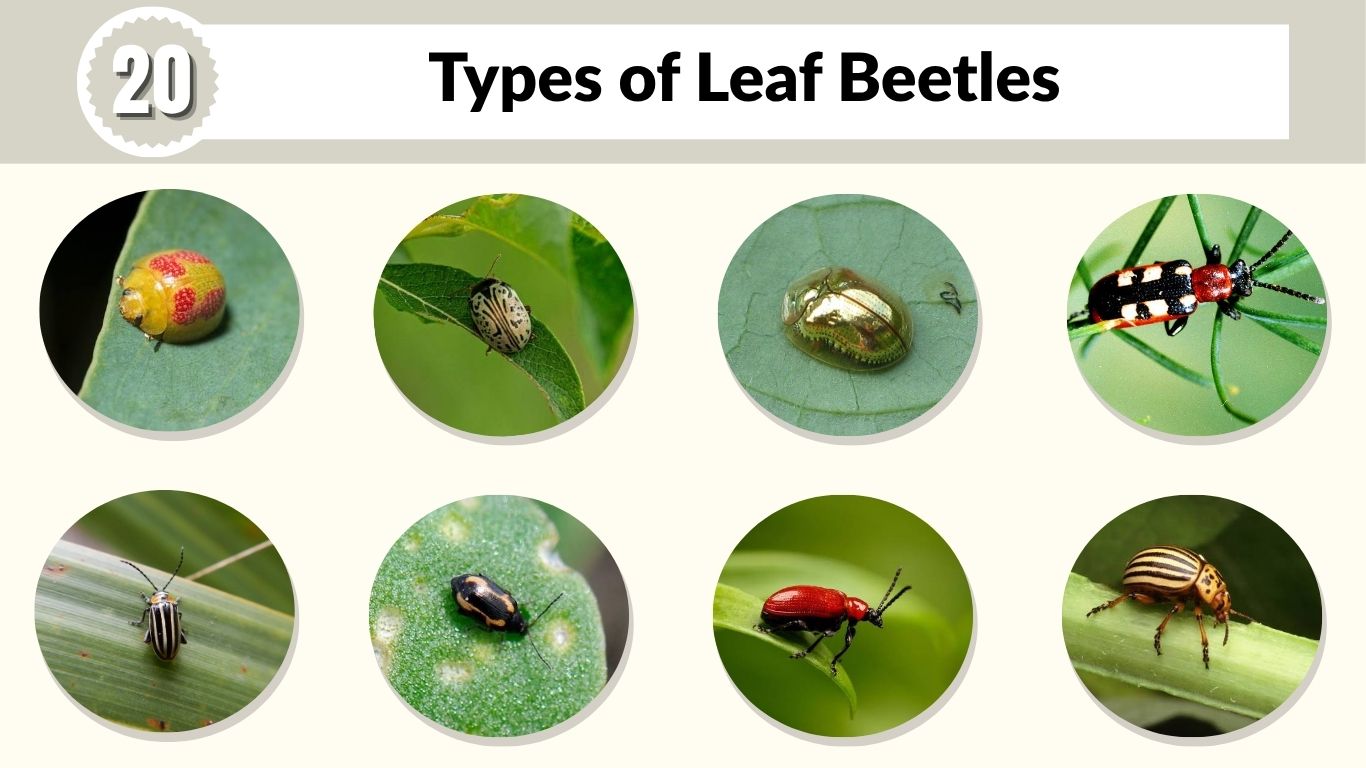
Leaf beetles are a diverse group of plant-feeding insects found in gardens, forests, farms, wetlands, and grasslands around the world. Some species are harmless and colorful, while others can become serious pests of vegetables, trees, and field crops. They vary widely in size, shape, color, diet, and behavior. In this guide, you will discover 20 types of leaf beetles, including their identification features, habitat and distribution, feeding behavior, lifespan, and life cycle to help you recognize them more easily.
1. Colorado Potato Beetle
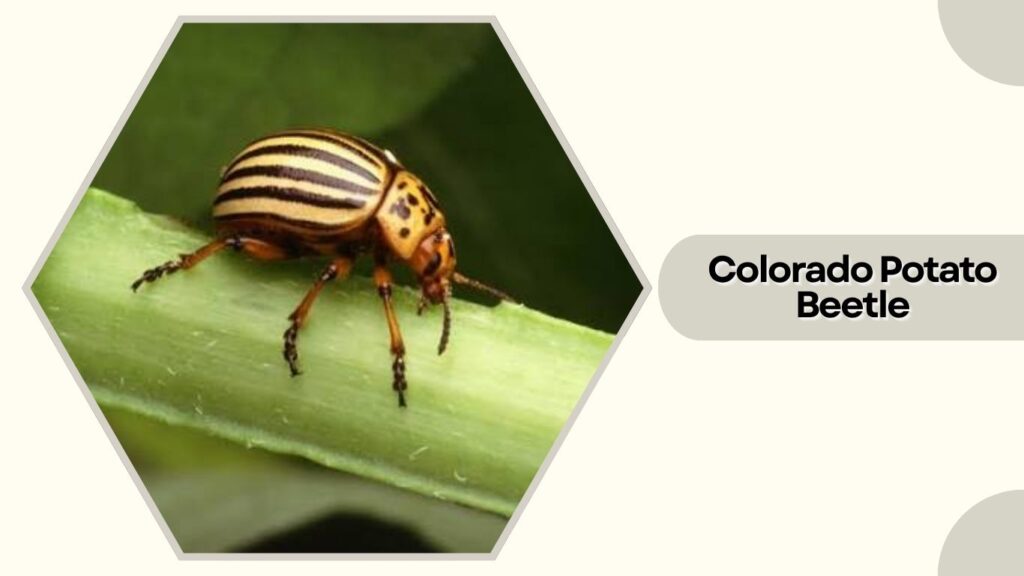
The Colorado potato beetle is one of the most recognizable leaf beetles because of its bold striped wing covers and strong association with potato plants. It is an important agricultural pest in many areas and can quickly damage plants when adults and larvae occur in large numbers. Both life stages feed heavily on foliage.
Identification
- Rounded, strongly convex body
- Yellow to orange coloration
- Ten black stripes across the wing covers
- Dark markings on the head and thorax
- Adults are about 3/8 inch long
- Larvae are reddish-orange with dark spots
Habitat and Distribution
Colorado potato beetles are widespread across much of North America and have also become established in parts of Europe and Asia. They are most commonly found in agricultural areas, vegetable gardens, and fields where potatoes or other nightshade-family plants are growing.
Adults often overwinter in soil or leaf litter near previous host crops. They emerge when temperatures rise and suitable plants become available.
Behavior and Diet
Potatoes are their best-known host, but these beetles may also feed on eggplant, tomato, and other plants in the nightshade family. Adults chew irregular holes in leaves, while larvae can consume large amounts of foliage very quickly.
Heavy infestations may leave plants nearly defoliated. Colorado potato beetles are also famous for developing resistance to many insecticides, which makes crop rotation and integrated pest management especially important.
Lifespan and Life Cycle
Females lay clusters of bright yellow-orange eggs on the undersides of leaves. The eggs hatch into soft-bodied larvae that feed through several growth stages before entering the soil to pupate.
New adults emerge and may produce additional generations in warm areas. Adults can survive through winter by entering diapause in protected soil, allowing the cycle to begin again the following growing season.
2. Cereal Leaf Beetle
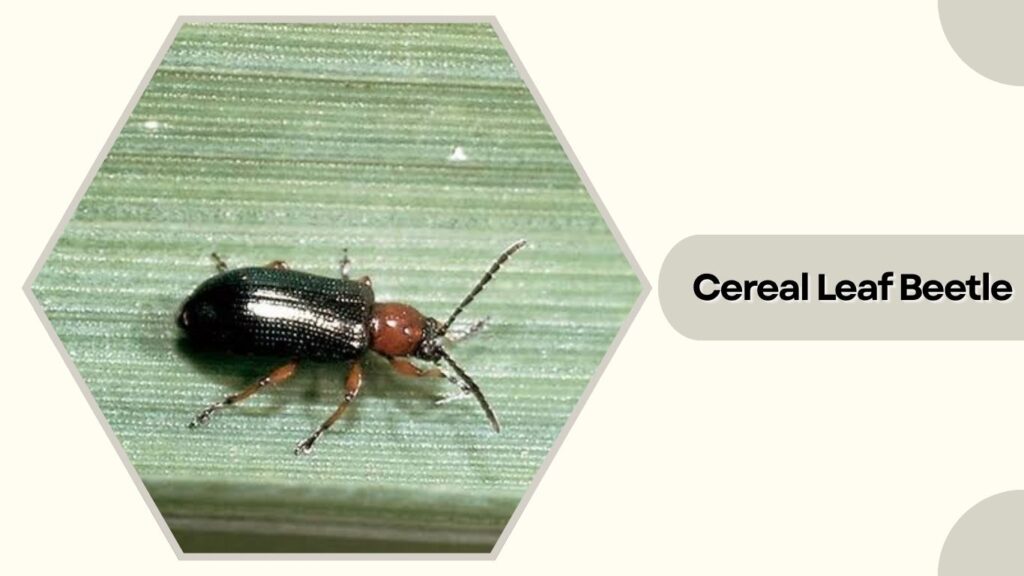
The cereal leaf beetle is a small but economically important leaf beetle associated with grasses and cereal crops. Both adults and larvae feed on leaves, creating characteristic strips of damaged tissue. Wheat, oats, barley, and related crops can be affected, especially when large populations develop during spring.
Identification
- Adults are small and elongated
- Metallic blue to bluish-black wing covers
- Orange-red thorax and legs
- Dark head
- Larvae are yellowish beneath a dark coating
- Adults usually measure about 1/4 inch long
Habitat and Distribution
Cereal leaf beetles are found in farmland, grasslands, and areas where cereal crops are grown. Originally native to parts of Europe and Asia, the species became established in North America and is now present across many agricultural regions.
They are particularly noticeable during the growing season when adults move into fields and begin laying eggs on cereal leaves.
Behavior and Diet
Adults and larvae feed primarily on grasses. Important hosts include wheat, barley, oats, rye, and several wild grass species.
Rather than chewing irregular holes, larvae often scrape the upper surface of leaves and leave long translucent strips. Heavy feeding can reduce photosynthesis and weaken plants.
Larvae are sometimes difficult to recognize because they cover themselves with a dark mixture of waste and mucus, giving them a slug-like appearance.
Lifespan and Life Cycle
Adult beetles overwinter in protected locations such as grass, plant debris, and field margins. In spring, they become active and move onto host plants.
Females lay eggs individually or in small groups on leaves. Larvae hatch, feed through several stages, and eventually move into the soil to pupate.
New adults emerge later in the season and feed before seeking overwintering sites. In many areas, cereal leaf beetles complete one generation each year.
3. Lily Leaf Beetle
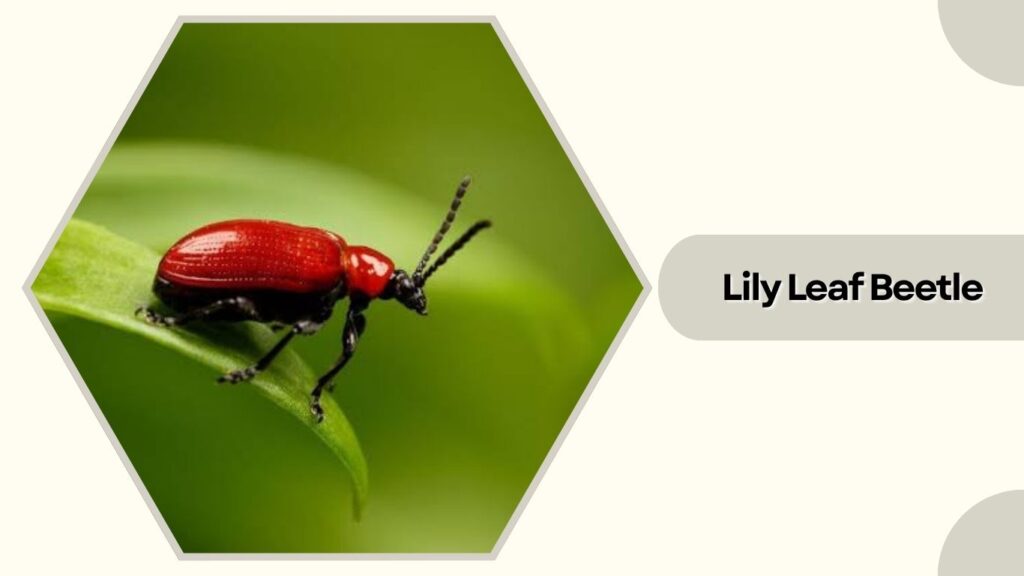
The lily leaf beetle is a bright red leaf beetle known for feeding aggressively on true lilies and related plants. Its brilliant coloration makes adults easy to notice, but larvae can be more difficult to recognize because they cover themselves with their own waste. Heavy infestations can strip lily plants of leaves.
Identification
- Bright scarlet-red wing covers
- Black head
- Black legs and antennae
- Elongated oval body
- Adults around 1/4 to 3/8 inch long
- Larvae appear soft-bodied and dark beneath waste material
Habitat and Distribution
Lily leaf beetles are commonly associated with gardens, nurseries, and landscapes where lilies are planted. They are native to Eurasia but have become established in parts of North America.
They are frequently found around ornamental lily beds and can spread from one planting to another when adults fly in search of host plants.
Behavior and Diet
Adults and larvae primarily feed on true lilies in the genus Lilium. They may also use fritillaries and some related plants.
Feeding damage begins as holes and notches in leaves, but serious infestations can remove most foliage and even damage buds and flowers.
Larvae often remain on the undersides of leaves. Their unusual waste covering may help protect them from predators and makes them less conspicuous than the bright red adults.
Lifespan and Life Cycle
Adults survive winter in soil, leaf litter, or other protected places. They emerge in spring when lilies begin growing.
Females place orange-red eggs in lines on leaf undersides. Larvae hatch and feed for several weeks before dropping to the soil to pupate.
New adults emerge later in summer and feed before entering overwintering sites. In many regions, the species produces one generation annually.
4. Scarlet Lily Beetle
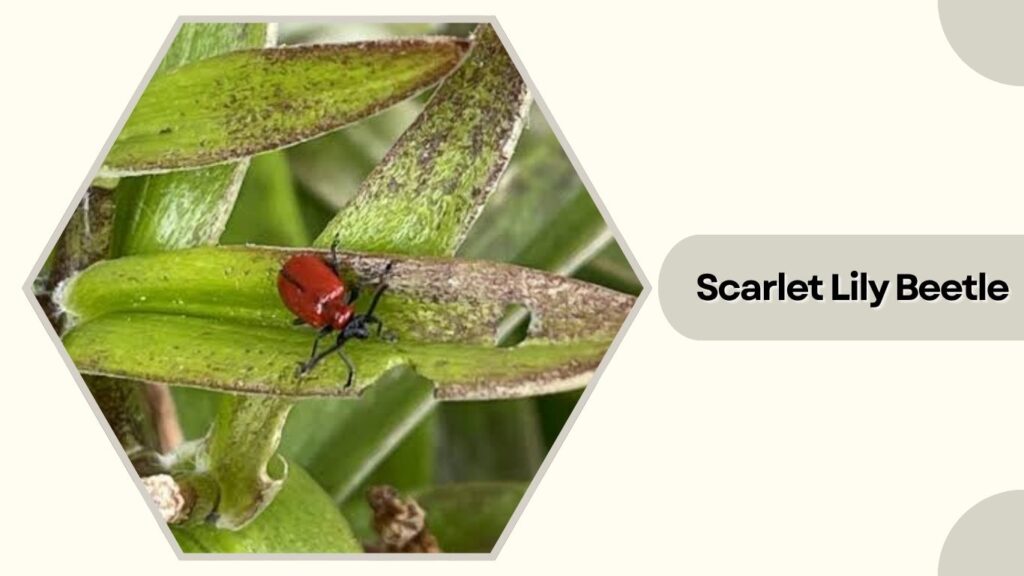
Scarlet lily beetle is another common name for the lily leaf beetle, Crioceris lilii. Therefore, it is not a separate species from the beetle described above. The name refers to the same striking red insect that attacks lilies and can cause extensive foliage damage in gardens.
Identification
- Brilliant scarlet-red wing covers
- Shiny black head
- Black underside
- Black legs and antennae
- Narrow, elongated body
- Larvae covered with dark fecal material
Habitat and Distribution
Scarlet lily beetles occur primarily where suitable lily hosts are available. They are frequently found in residential gardens, botanical gardens, nurseries, and landscaped areas.
The species originated in Eurasia but has expanded into other regions, including portions of North America. Adults are capable of flying between gardens, which helps new infestations become established.
Behavior and Diet
These beetles specialize largely on lilies and related plants. Both adults and larvae chew foliage, flower buds, and occasionally stems.
The larvae generally cause the greatest damage because they feed continuously while developing. A heavily infested lily may lose a substantial portion of its leaves.
Adults often drop from plants when disturbed, landing upside down on the ground where their dark underside makes them harder to see.
Lifespan and Life Cycle
Adults overwinter and become active during spring. After mating, females deposit rows of reddish-orange eggs on the undersides of lily leaves.
The larvae feed through several developmental stages before dropping into the soil. There they form pupal chambers and transform into adults.
The newly emerged adults feed during late summer before finding protected overwintering sites. Most populations complete approximately one generation per year, although timing depends on local climate.
5. Elm Leaf Beetle
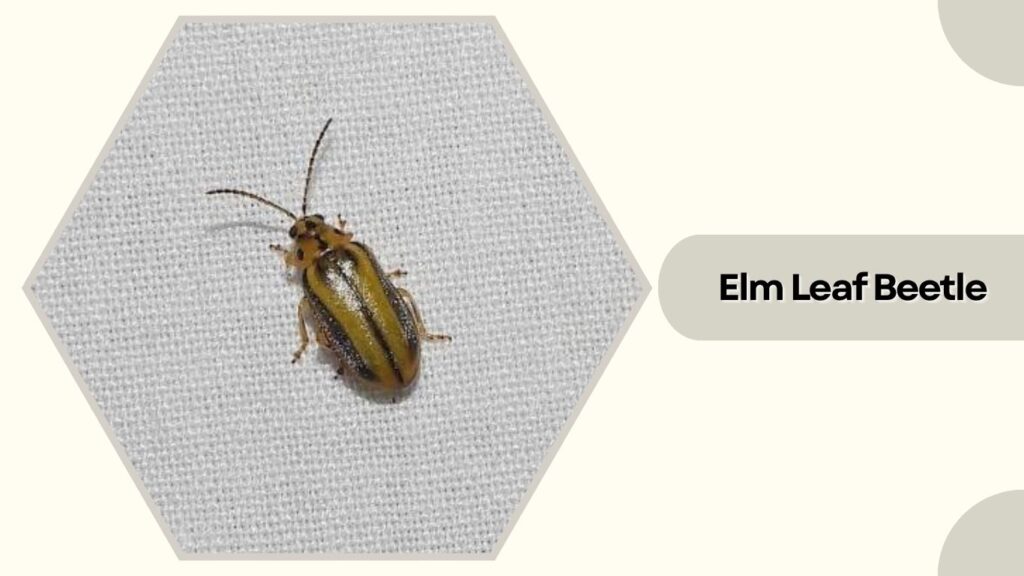
The elm leaf beetle is a yellowish to olive-brown leaf beetle that feeds almost exclusively on elm foliage. Both adults and larvae can damage trees, but larvae are often responsible for the characteristic skeletonized leaves seen during infestations. Repeated severe defoliation can weaken already stressed elm trees.
Identification
- Yellowish-green to olive body
- Dark stripe along each wing cover
- Dark spots behind the head
- Oval, slightly elongated shape
- Adults about 1/4 inch long
- Larvae are yellowish with dark markings
Habitat and Distribution
Elm leaf beetles are found wherever susceptible elm trees grow. They frequently occur in urban landscapes, parks, residential neighborhoods, and tree-lined streets.
Originally associated with Eurasia, the species has become established in several other parts of the world. Mature elm trees can support large populations when environmental conditions are favorable.
Behavior and Diet
Adults chew small holes through elm leaves. Larvae feed differently, removing soft tissue while leaving major veins behind.
This produces a skeletonized appearance and eventually causes damaged leaves to turn brown and fall early.
The beetles may also become nuisance pests when adults enter houses in autumn to search for protected overwintering locations. They do not normally damage furniture or stored food indoors.
Lifespan and Life Cycle
Adults overwinter inside buildings, beneath bark, or in sheltered outdoor sites. During spring they return to elm trees and begin feeding.
Females lay groups of yellow eggs on the undersides of leaves. Larvae hatch and feed before crawling down the trunk or dropping to the ground to pupate.
Adults emerge later and may produce additional generations in warmer climates. The exact number of generations varies with temperature and location.
6. Dogbane Beetle
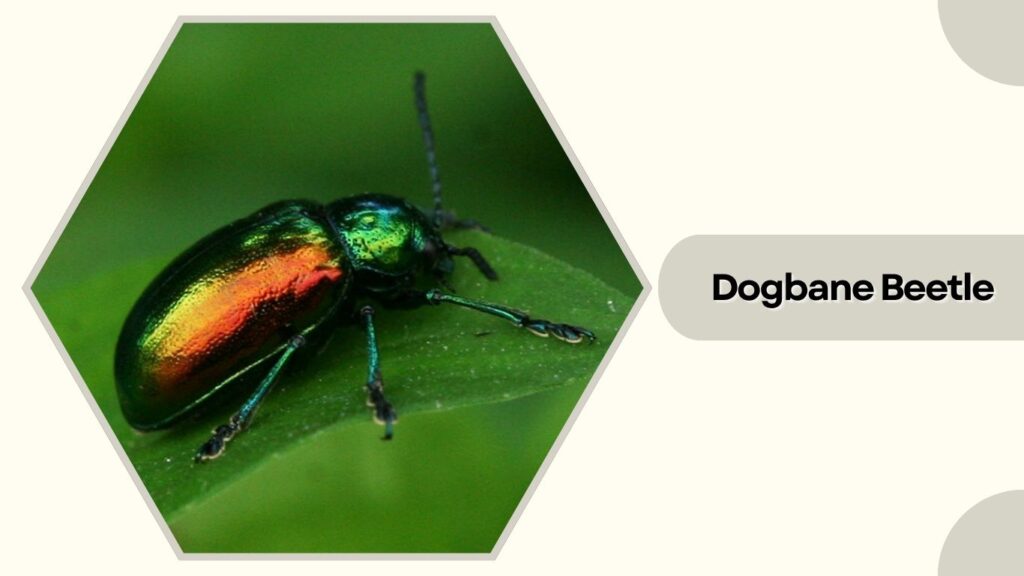
The dogbane beetle is one of North America’s most colorful leaf beetles. Its highly reflective body can appear blue, green, gold, copper, or purple depending on the angle of light. Adults are closely associated with dogbane plants and are often seen walking or feeding on their leaves during summer.
Identification
- Highly metallic body
- Colors shift from blue and green to copper or gold
- Rounded oval shape
- Short antennae
- Adults around 3/8 inch long
- Smooth, reflective wing covers
Habitat and Distribution
Dogbane beetles are widely distributed across much of eastern and central North America. They occur in fields, roadsides, meadows, woodland edges, and disturbed habitats where dogbane plants grow.
Because their host plants often form colonies, several beetles may be found in the same patch during warm summer weather.
Behavior and Diet
Adults feed mainly on dogbane leaves. Dogbane plants contain toxic cardiac glycosides and sticky latex, but the beetles are specially adapted to feed on them.
Their spectacular coloration is created largely through structural reflection rather than simple pigment. The layered surface of the exoskeleton reflects different wavelengths of light, producing an iridescent appearance.
When threatened, adults may drop from the plant or fly away. Their bright coloration may also warn predators that they are chemically defended.
Lifespan and Life Cycle
Females lay eggs near host plants. Unlike adults, larvae live underground and feed on dogbane roots.
The larval stage passes through several growth periods before pupation occurs in the soil. Adults eventually emerge above ground and begin feeding on leaves.
Most of their visible activity occurs during late spring and summer. Adults reproduce during the warm season, completing the cycle around patches of their host plant.
7. Bean Leaf Beetle
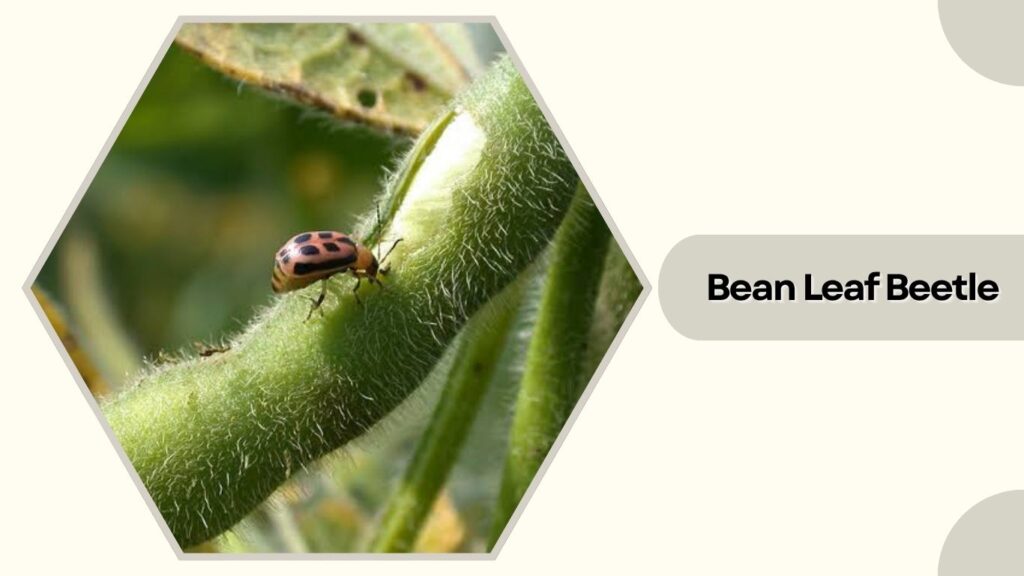
The bean leaf beetle is an important agricultural pest that feeds on beans and other legumes. Adults vary considerably in color, making them harder to identify than some other leaf beetles. They often chew rounded holes in leaves and can also damage pods, while larvae remain underground and feed on roots.
Identification
- Usually yellow, tan, orange, or reddish
- Often has four dark spots on the wing covers
- Dark border around wing covers
- Black triangular mark behind the head
- Adults about 1/4 inch long
- Some individuals lack obvious spots
Habitat and Distribution
Bean leaf beetles are widespread in North America, particularly in agricultural regions where soybeans, snap beans, and other legumes are grown.
They occur in crop fields, vegetable gardens, weedy field borders, and areas containing wild legumes.
Adults can move between wild hosts and cultivated crops as plants become available during the season.
Behavior and Diet
Adults feed on soybean, common bean, and various other legume leaves. Their feeding creates rounded holes scattered across the foliage.
They may also chew directly on pods, which can reduce crop quality and create entry points for pathogens.
Larvae live in the soil and feed on plant roots and underground nodules. Adults may also transmit certain plant diseases while moving between plants.
Lifespan and Life Cycle
Adults overwinter beneath leaves, grasses, and crop residue. They emerge during spring and begin feeding on early host plants.
Females lay eggs in soil close to the base of plants. Larvae develop underground and later pupate in earthen cells.
New adults emerge during the growing season. Depending on climate, bean leaf beetles may complete one or more generations annually before the final adults seek overwintering shelter.
8. Grape Flea Beetle
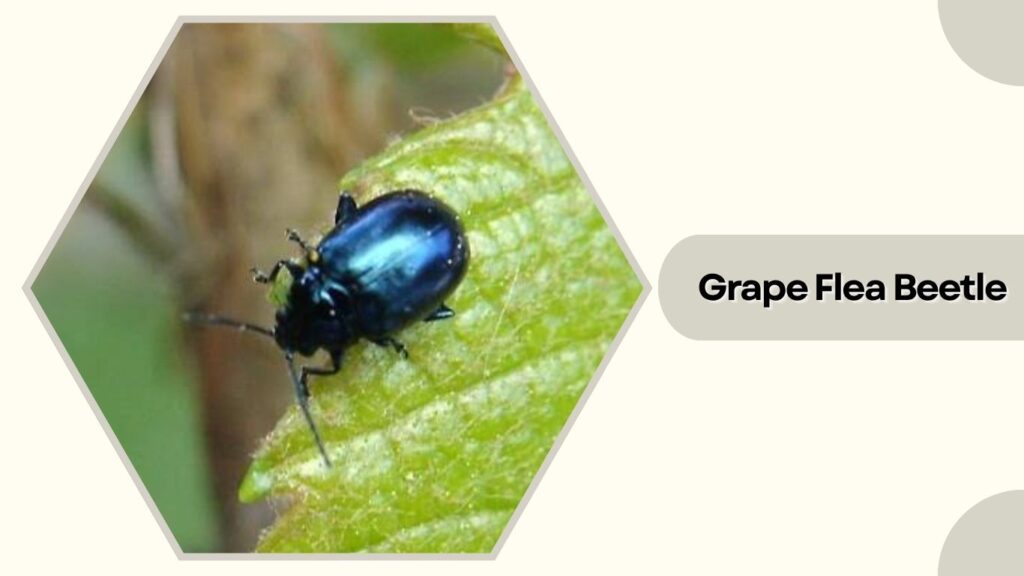
The grape flea beetle is a small metallic leaf beetle associated primarily with grapevines. It receives the name “flea beetle” because its enlarged hind legs allow it to jump suddenly when disturbed. Both adults and larvae can feed on grape plants, though early-season bud feeding by adults can be especially noticeable.
Identification
- Metallic blue, green, or blue-purple body
- Oval to slightly elongated shape
- Enlarged hind legs
- Adults approximately 1/5 inch long
- Capable of jumping rapidly
- Larvae are brownish and elongated
Habitat and Distribution
Grape flea beetles occur across much of eastern North America. They are commonly found in vineyards, gardens, woodland edges, and locations where cultivated or wild grapevines grow.
Adults usually remain close to grape-growing habitats because vines provide both food and reproduction sites.
Behavior and Diet
Adults become active early in spring and may feed on swelling grape buds. Damage at this stage can be important because destroying a developing bud may eliminate future shoots and fruit clusters.
Later in the season, adults also chew leaves.
Larvae feed mainly on grape foliage, creating holes or skeletonized areas. Despite this feeding, healthy vines can often tolerate limited populations without serious long-term injury.
Like other flea beetles, adults quickly jump when approached.
Lifespan and Life Cycle
Adult grape flea beetles overwinter in protected debris, wooded areas, or beneath loose bark. They emerge in spring as grape buds begin expanding.
Females lay eggs near vines, and larvae later feed on the developing foliage.
After completing the larval stages, they pupate in the soil. New adults emerge during summer and continue feeding before seeking overwintering locations.
The species usually completes one generation per year in much of its range.
9. Striped Flea Beetle
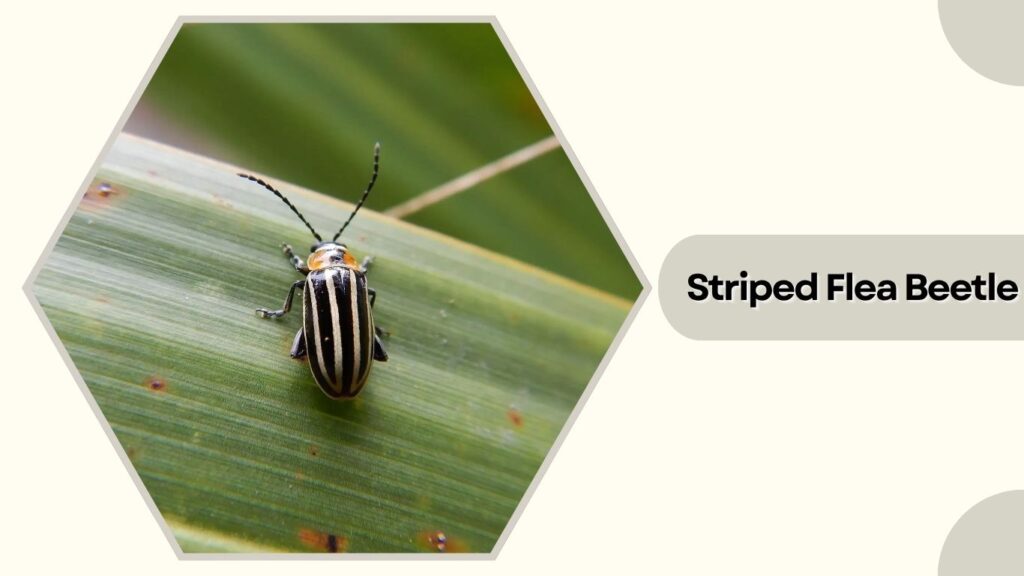
The striped flea beetle is a tiny leaf beetle recognized by its dark body and pale yellow stripes. Despite its small size, it can cause substantial damage to young vegetable seedlings. It is especially associated with crops in the cabbage and mustard family and can rapidly jump away when disturbed.
Identification
- Small shiny black body
- Yellowish stripe on each wing cover
- Enlarged hind legs
- Adults around 1/10 inch long
- Oval body shape
- Jumps when disturbed
Habitat and Distribution
Striped flea beetles are widespread throughout many parts of North America and Asia. They occur in vegetable gardens, commercial crop fields, nurseries, and areas containing wild mustard-family plants.
Populations are often particularly troublesome during spring when young seedlings are emerging and adults become active after overwintering.
Behavior and Diet
Adults feed primarily on plants in the mustard family, including cabbage, broccoli, radish, turnip, mustard, and canola.
Their feeding produces numerous tiny round holes, giving leaves a characteristic “shot-hole” appearance.
Mature plants often tolerate limited damage, but seedlings may be weakened or killed when beetles occur in large numbers.
Adults are highly mobile and can jump or fly between plants. Larvae usually remain in the soil and feed on roots, although adult leaf feeding tends to cause the most visible damage.
Lifespan and Life Cycle
Adults overwinter in leaf litter, weeds, field edges, and other protected locations. They emerge in spring and move onto suitable host plants.
Females lay eggs in soil near plant roots. The larvae hatch and feed underground before pupating in the soil.
New adults emerge later in the season and continue feeding. Depending on climate and location, one or several generations may occur before adults enter overwintering shelter.
10. Crucifer Flea Beetle
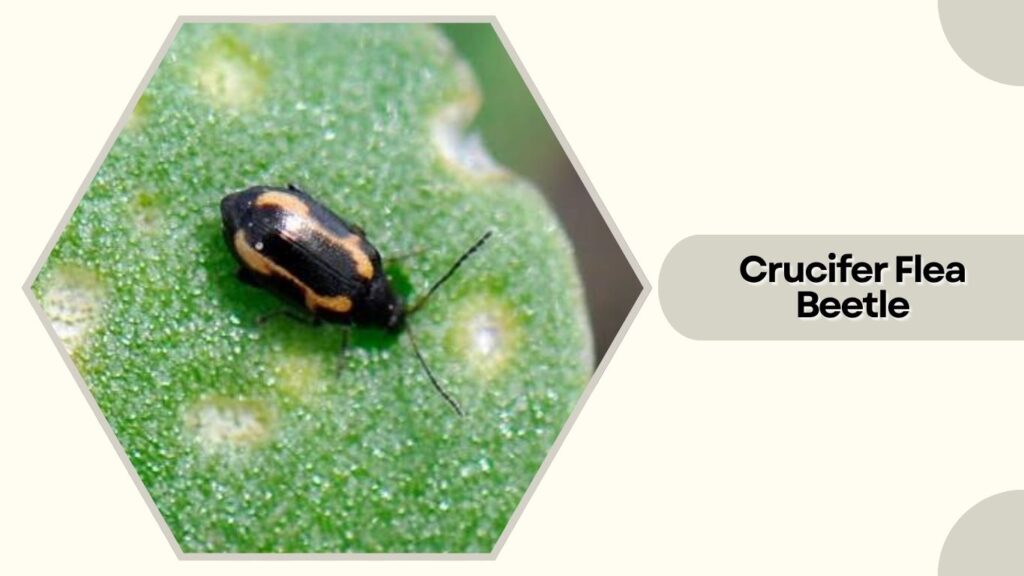
The crucifer flea beetle is another tiny jumping leaf beetle that attacks cabbage-family plants. Unlike the striped flea beetle, adults are usually uniformly dark without prominent yellow stripes. They can appear in large numbers on young crops and cause extensive shot-hole feeding, making them an important pest of canola and vegetables.
Identification
- Small shiny black or metallic body
- Usually lacks yellow wing stripes
- Enlarged hind legs for jumping
- Oval body shape
- Adults roughly 1/10 inch long
- Quickly jumps when disturbed
Habitat and Distribution
Crucifer flea beetles occur widely across agricultural areas of North America and other regions where crucifer crops are grown.
They are common in canola fields, vegetable farms, home gardens, and areas containing wild mustard plants.
Adults frequently build up along field margins before moving into crops, particularly during warm, dry spring weather.
Behavior and Diet
Adults feed on cabbage, broccoli, cauliflower, canola, mustard, radish, turnip, and other cruciferous plants.
Their feeding creates many small pits and holes across leaves. Young seedlings are particularly vulnerable because even modest feeding can remove a large percentage of their limited leaf area.
The beetles are very active in warm, sunny conditions and may jump repeatedly when plants are disturbed.
Larvae generally develop underground and feed on roots, but adult feeding is typically responsible for economically significant crop damage.
Lifespan and Life Cycle
Adults survive winter beneath plant debris, weeds, and sheltered field margins. During spring, they emerge and begin feeding before mating.
Females deposit eggs in soil close to host plants. Larvae hatch, feed around plant roots, and eventually pupate underground.
New adults appear later in the growing season and continue feeding before preparing for winter.
Their generation pattern varies geographically, but one main generation per year is common in many temperate agricultural regions.
11. Tobacco Flea Beetle
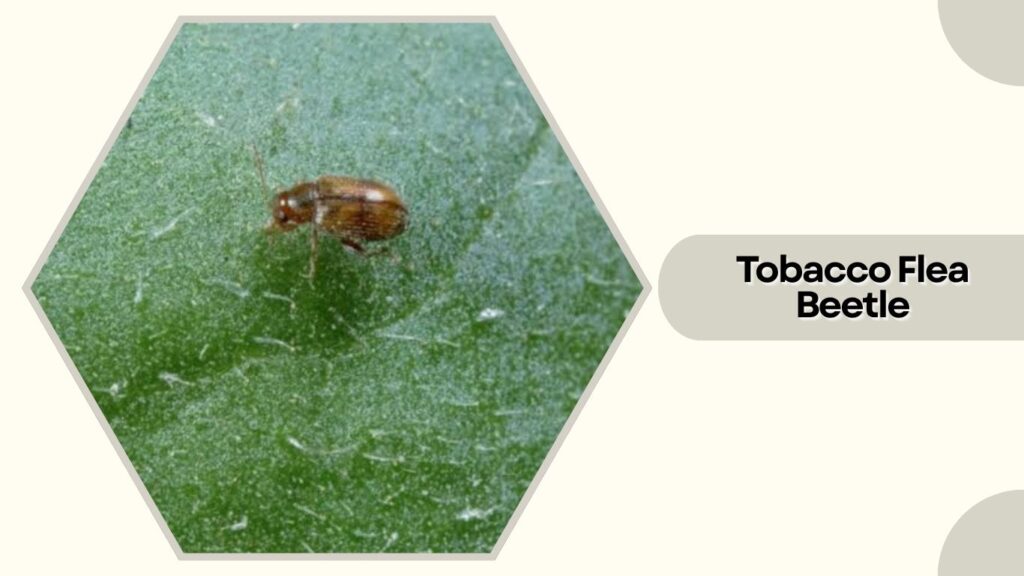
The tobacco flea beetle is a tiny, dark leaf beetle known for feeding on tobacco and several other plants in the nightshade family. Like other flea beetles, it has enlarged hind legs that allow it to jump quickly when disturbed. Although adults are very small, large populations can create numerous holes in leaves and significantly damage young plants.
Identification
- Very small oval body
- Usually brown to dark brown
- Enlarged hind legs
- Adults roughly 1/10 inch long
- Shiny wing covers
- Jumps rapidly when disturbed
- Larvae are small, pale, and soil-dwelling
Habitat and Distribution
Tobacco flea beetles occur widely across much of North America, particularly in agricultural regions where tobacco, tomato, eggplant, and related plants are grown.
They can be found in crop fields, vegetable gardens, nurseries, and weedy areas containing nightshade-family plants. Adults often spend winter under plant debris, weeds, and other protected material near fields.
Behavior and Diet
Adults chew many small holes in leaves, creating the characteristic shot-hole pattern associated with flea beetle feeding.
Tobacco is an important host, but they may also feed on eggplant, tomato, potato, pepper, and several wild nightshades.
Young seedlings are especially vulnerable because extensive feeding can reduce leaf area before plants become established. Older plants can usually tolerate moderate damage more easily.
Lifespan and Life Cycle
Adults overwinter in sheltered locations and become active during spring. Females lay eggs in soil close to suitable host plants.
The larvae hatch underground and feed mainly around plant roots. Once fully developed, they pupate in the soil.
New adults emerge and begin feeding on foliage. Depending on climate, more than one generation may occur during a growing season. The final generation eventually moves into protected sites to survive winter.
12. Corn Flea Beetle
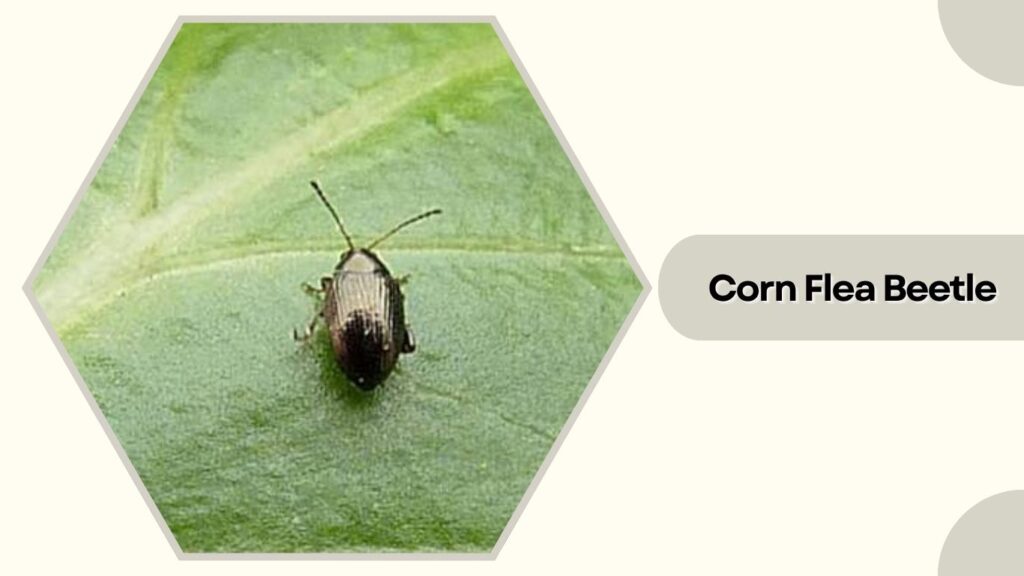
The corn flea beetle is a tiny, dark leaf beetle commonly associated with corn and other grasses. Although its feeding damage alone may be relatively small, it is important because adults can transmit Stewart’s wilt, a bacterial disease of corn. The beetle’s small size and jumping behavior can make it difficult to notice until plant symptoms appear.
Identification
- Tiny oval body
- Dark brown to nearly black coloration
- Enlarged hind legs
- Adults approximately 1/16 inch long
- Shiny appearance
- Jumps when disturbed
- Often difficult to see without close inspection
Habitat and Distribution
Corn flea beetles are found in agricultural regions where corn is grown, especially across eastern and central North America.
They occur in cornfields, grasslands, field edges, and areas containing wild grasses. Adults overwinter in grasses, crop debris, and protected vegetation near fields.
Populations tend to survive winter more successfully during mild conditions.
Behavior and Diet
Adults feed by scraping narrow lines along corn leaves. This damage may appear as pale streaks or small scars.
The greater concern is disease transmission. Some adults carry the bacterium responsible for Stewart’s wilt and can introduce it into plants while feeding.
Sweet corn and susceptible corn varieties may be especially affected. Adults also feed on other grasses when corn is unavailable.
Lifespan and Life Cycle
Overwintering adults become active early in spring and begin feeding on grasses or newly emerging corn.
Females lay eggs in soil near host plants. Larvae hatch and develop around grass and corn roots but usually cause relatively little visible damage.
After pupating underground, new adults emerge and continue feeding above ground. Several generations may develop during warm seasons.
Late-season adults eventually move into grassy or protected areas where they spend winter before beginning the cycle again.
13. Asparagus Beetle
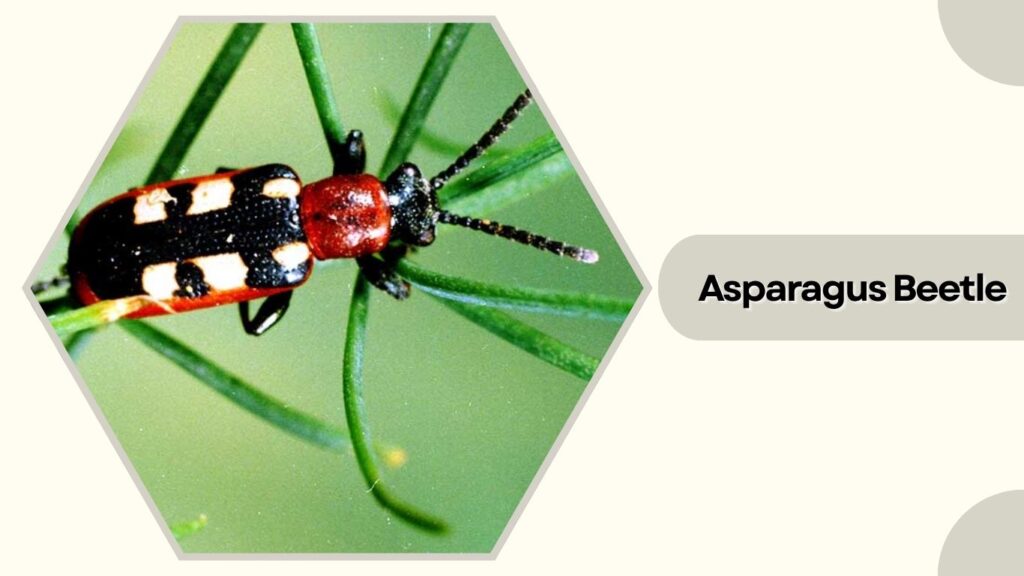
The common asparagus beetle is a colorful leaf beetle that feeds almost exclusively on asparagus. Both adults and larvae attack stems, foliage, and developing spears. Repeated feeding can reduce plant vigor and lower the amount of energy stored in asparagus crowns, making this species an important pest in home gardens and commercial fields.
Identification
- Dark blue to black body
- Cream or yellow rectangular markings
- Reddish-orange margins or thorax
- Adults about 1/4 inch long
- Elongated body shape
- Larvae are grayish-green and soft-bodied
- Eggs are dark and attached to asparagus plants
Habitat and Distribution
Common asparagus beetles are found wherever asparagus is widely cultivated. They occur throughout much of North America and parts of Europe.
They are usually found directly on asparagus plants in gardens, farms, and abandoned asparagus patches.
Adults can overwinter in plant debris, hollow stems, bark, or other protected locations close to previous asparagus plantings.
Behavior and Diet
Both adults and larvae feed on asparagus. Adults may chew emerging spears in spring, causing scarring and distortion.
Later, larvae feed on the feathery foliage and stems. Heavy feeding can weaken plants by reducing their ability to photosynthesize and store energy for future growth.
The beetles may drop from stems when disturbed, making them harder to collect by hand.
Lifespan and Life Cycle
Adults emerge in spring and begin feeding almost immediately. Females attach dark elongated eggs to asparagus stems and foliage.
Larvae hatch and feed for several weeks before moving into the soil to pupate.
New adults emerge and may reproduce again during the same growing season. Two or more generations can occur in warm regions.
The final adults seek sheltered places during autumn and remain there until asparagus growth begins the following spring.
14. Spotted Asparagus Beetle
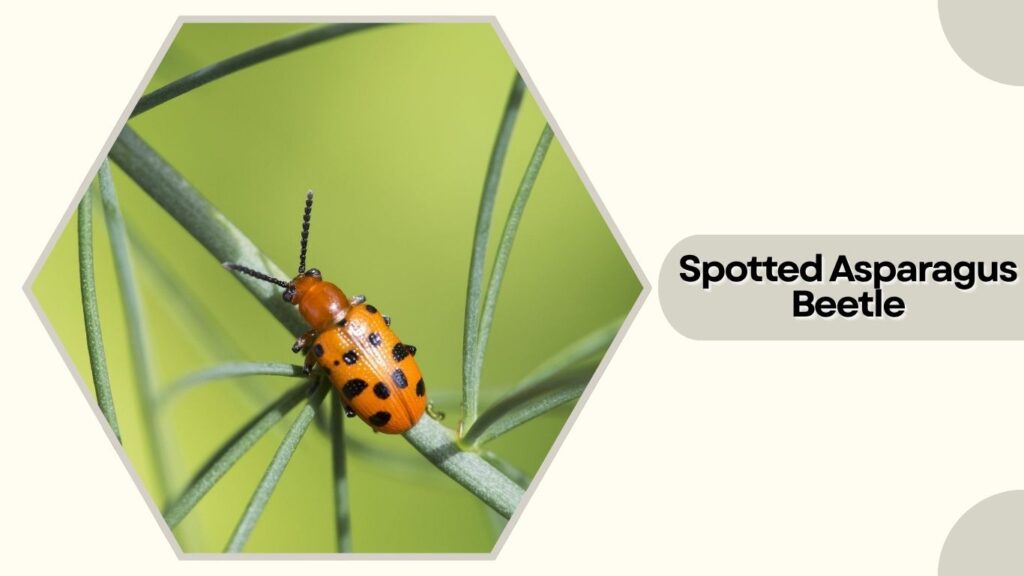
The spotted asparagus beetle is a close relative of the common asparagus beetle but differs noticeably in appearance and feeding habits. Adults are orange-red with distinct black spots. While they feed on asparagus foliage, the larvae primarily develop inside asparagus berries, making their damage different from that caused by common asparagus beetle larvae.
Identification
- Orange to reddish body
- Six black spots on each wing cover
- Black underside
- Adults about 1/4 inch long
- Rounded, slightly elongated body
- Larvae are yellowish and feed inside berries
Habitat and Distribution
Spotted asparagus beetles occur across much of North America and are associated almost entirely with asparagus.
They are commonly found in gardens, commercial asparagus fields, and areas where female asparagus plants produce berries.
Adults appear somewhat later in spring than common asparagus beetles and are particularly noticeable during the warmer part of the growing season.
Behavior and Diet
Adult spotted asparagus beetles chew asparagus foliage but usually cause less serious direct damage than common asparagus beetles.
Their larvae have a very different diet. Females lay eggs on developing asparagus berries, and the larvae feed inside the fruit.
This feeding can reduce seed production, but it usually has less impact on established asparagus plants grown primarily for edible spears.
Adults are active fliers and may quickly move between plants when disturbed.
Lifespan and Life Cycle
Adults overwinter in protected debris and emerge during spring.
Females place eggs on asparagus plants, particularly around developing fruits. After hatching, larvae enter the berries and feed on the interior.
Mature larvae eventually leave the berries and move into the soil to pupate.
New adults emerge later in summer and continue feeding before overwintering. The species generally completes one generation per year across much of its range, although development timing can vary with climate.
15. Tortoise Beetle
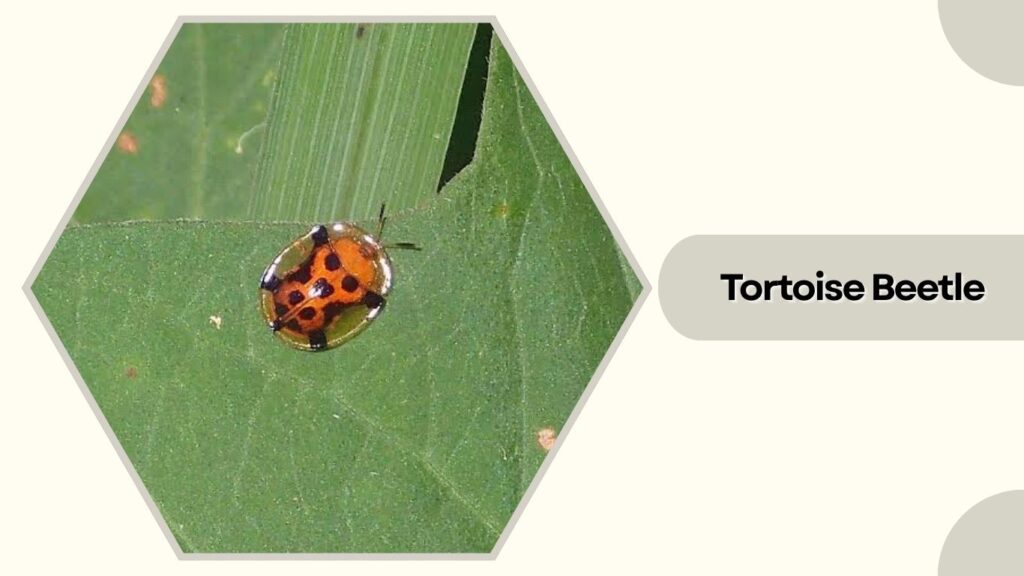
Tortoise beetles are a distinctive group of leaf beetles known for their flattened, rounded bodies and expanded edges that resemble a tiny turtle shell. Many species are green, gold, brown, or patterned. Their unusual appearance provides both camouflage and physical protection, while adults and larvae feed primarily on the leaves of particular host plants.
Identification
- Rounded or oval shield-shaped body
- Flattened appearance
- Expanded edges around the body
- Head partly hidden beneath the pronotum
- Green, gold, brown, or patterned coloration
- Adults generally small
- Larvae often have spines and unusual waste shields
Habitat and Distribution
Tortoise beetles occur worldwide, especially in warm and temperate regions. They can be found in gardens, grasslands, forests, wetlands, agricultural fields, and areas containing their host plants.
Different species specialize on different plants, so distribution varies considerably.
Many commonly encountered tortoise beetles live on morning glory, sweet potato, thistle, bindweed, and plants in related groups.
Behavior and Diet
Adults usually feed by chewing small to moderate holes in leaves. Their flattened margins allow them to press tightly against plant surfaces when threatened.
Larvae of many species carry a shield made partly from shed skins and fecal material. This structure may help conceal them or discourage predators.
Tortoise beetles are usually not serious pests unless populations become unusually high.
Lifespan and Life Cycle
Females lay eggs on or near suitable host plants. The larvae hatch and begin feeding on foliage.
After several growth stages, larvae attach themselves to leaves or stems and pupate.
Adults emerge and continue feeding before mating. Depending on species and climate, there may be one or multiple generations each year.
Some species overwinter as adults beneath leaves or plant debris, while others survive unfavorable seasons in different developmental stages.
16. Golden Tortoise Beetle
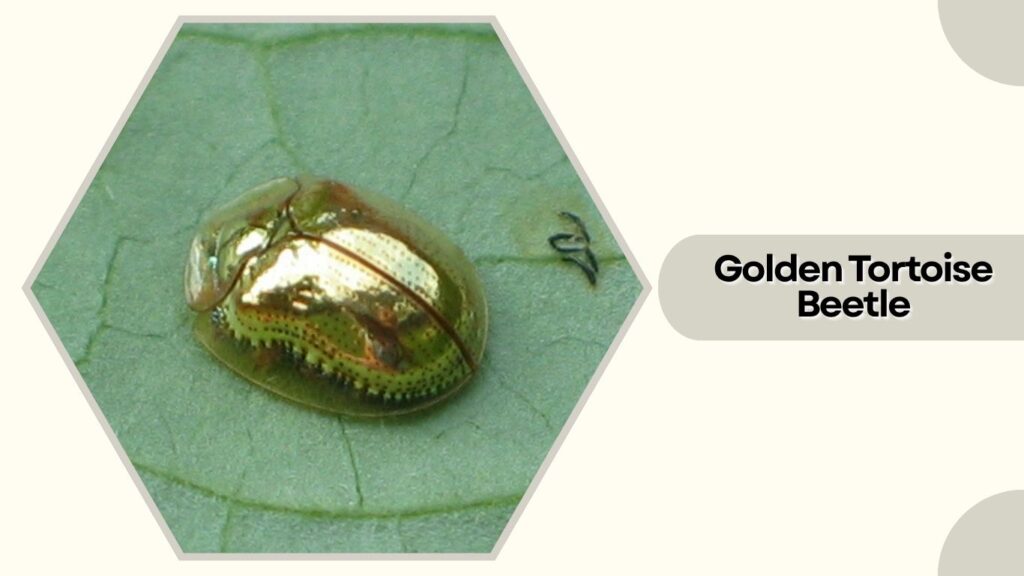
The golden tortoise beetle is one of the most eye-catching leaf beetles in North America. Adults can appear brilliant metallic gold, although their color may change when disturbed or after death. Their rounded shell-like bodies make them easy to recognize, and they are frequently found on morning glory, bindweed, and sweet potato plants.
Identification
- Brilliant metallic gold coloration
- Rounded shield-like body
- Transparent or expanded body margins
- Approximately 1/4 inch long
- Can change from gold to reddish or brownish tones
- Head largely hidden from above
- Larvae are spiny and carry a waste shield
Habitat and Distribution
Golden tortoise beetles are widely distributed across much of North America.
They commonly occur in gardens, fields, roadsides, and disturbed habitats where morning glory and bindweed grow. They may also appear in sweet potato plantings.
Adults are easiest to spot during warm weather while resting or feeding on the upper and lower surfaces of leaves.
Behavior and Diet
Adults and larvae feed mainly on plants in the morning glory family. Their chewing creates small round or irregular holes in foliage.
The beetles are rarely serious pests in ornamental gardens, although heavy populations can produce noticeable damage.
Their metallic appearance is created by structural properties of the outer body layers. When threatened, stressed, or dead, the shiny gold color may fade or change.
Larvae carry a defensive shield composed partly of waste and old skin.
Lifespan and Life Cycle
Females lay eggs on host leaves. Larvae emerge and feed through several stages while carrying their characteristic shield.
When mature, they attach themselves to foliage and form pupae.
Adults later emerge and resume feeding. In many regions, one or more generations can occur during the growing season.
Adults commonly overwinter beneath leaves, bark, or other sheltered material and become active again when host plants return in spring.
17. Eucalyptus Leaf Beetle
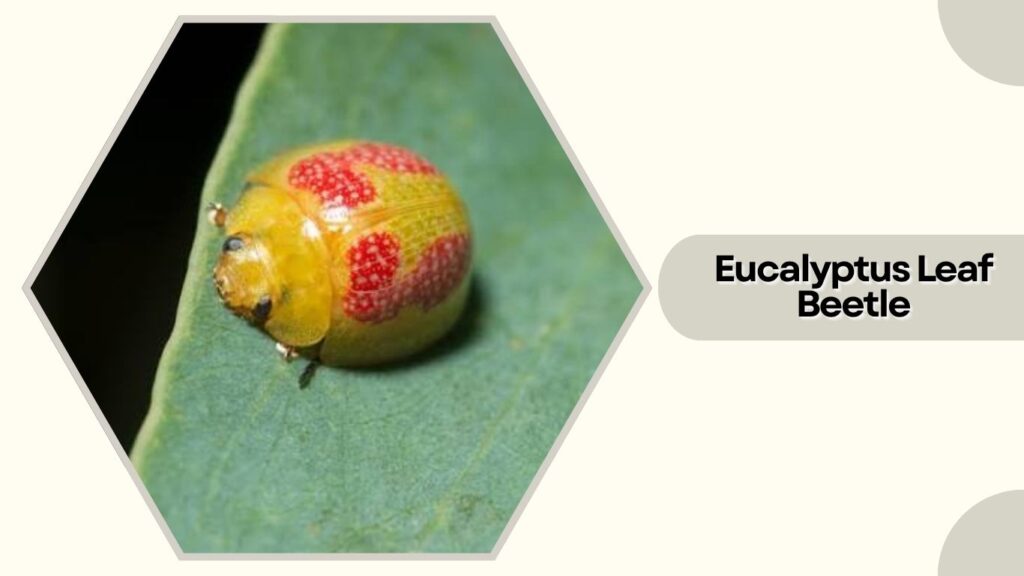
Eucalyptus leaf beetle is a common name used for several closely related leaf beetles that specialize on eucalyptus trees. These beetles can be serious defoliators when populations become high. Adults and larvae feed on young and mature leaves, sometimes leaving trees with thin, ragged crowns after repeated attacks.
Identification
- Rounded to oval body
- Often brown, reddish-brown, or mottled
- Strong convex shape
- Usually medium-sized for a leaf beetle
- Larvae are soft-bodied and feed openly on leaves
- Color varies considerably between species
Habitat and Distribution
Eucalyptus leaf beetles are most strongly associated with Australia, where eucalyptus trees originated.
Several species have been introduced elsewhere with eucalyptus plantings, including parts of New Zealand, Europe, Africa, and the Americas.
They are most common in eucalyptus forests, plantations, urban landscapes, parks, and gardens containing suitable host trees.
Behavior and Diet
Both adults and larvae feed almost entirely on eucalyptus foliage. They may chew irregular holes, consume leaf margins, or strip large portions of leaves.
Young leaves can be particularly attractive to some species.
Repeated defoliation can reduce tree growth and weaken stressed eucalyptus. However, mature healthy trees may tolerate moderate feeding without permanent damage.
The exact behavior varies because “eucalyptus leaf beetle” refers to several species rather than one single beetle.
Lifespan and Life Cycle
Females typically deposit eggs on eucalyptus foliage. Larvae hatch and begin feeding directly on leaves.
After passing through several larval stages, they eventually pupate either on vegetation or in soil, depending on species.
Adults emerge and return to feeding and reproduction.
In warm climates, some eucalyptus leaf beetles can produce multiple generations each year. Development may continue for much of the year where host foliage and favorable temperatures remain available.
18. Alder Leaf Beetle
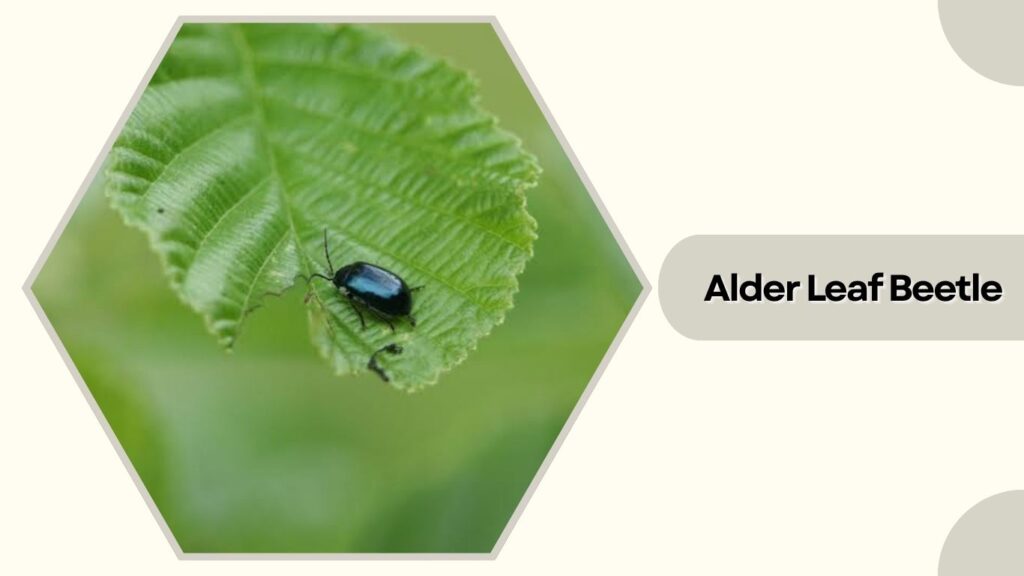
The alder leaf beetle is a shiny metallic beetle closely associated with alder trees. Adults and larvae both consume foliage and can sometimes occur in very large numbers. Heavy infestations may skeletonize leaves and make entire trees appear brown, although healthy mature alders can often recover from occasional defoliation.
Identification
- Shiny metallic blue to blue-black body
- Oval and strongly convex shape
- Adults around 1/4 inch long
- Dark antennae and legs
- Larvae are dark, elongated, and soft-bodied
- Often found in groups on alder foliage
Habitat and Distribution
Alder leaf beetles occur across much of Europe and parts of Asia, with related species found elsewhere.
They are closely associated with alder trees growing along rivers, wetlands, woodland edges, roadsides, and damp landscapes.
Because alder commonly grows near water, these beetles are often encountered in moist habitats where host trees are abundant.
Behavior and Diet
Adults chew holes in alder leaves, while larvae may remove much of the soft tissue between veins. When many larvae occur together, leaves may become skeletonized, dry, and brown.
Despite dramatic-looking damage, established alder trees can often survive occasional outbreaks.
Adults may drop from foliage when disturbed or fly to nearby trees. Both life stages generally stay closely associated with alder throughout the growing season.
Lifespan and Life Cycle
Adults usually overwinter beneath leaf litter, bark, or debris. They emerge in spring when alder foliage becomes available.
Females lay clusters of eggs on the undersides of leaves.
Larvae hatch and feed openly before eventually leaving the foliage to pupate, often in soil or sheltered areas.New adults emerge later in the season and feed before entering winter shelter.In many temperate areas, one generation occurs each year, although climate can influence development.
19. Willow Leaf Beetle
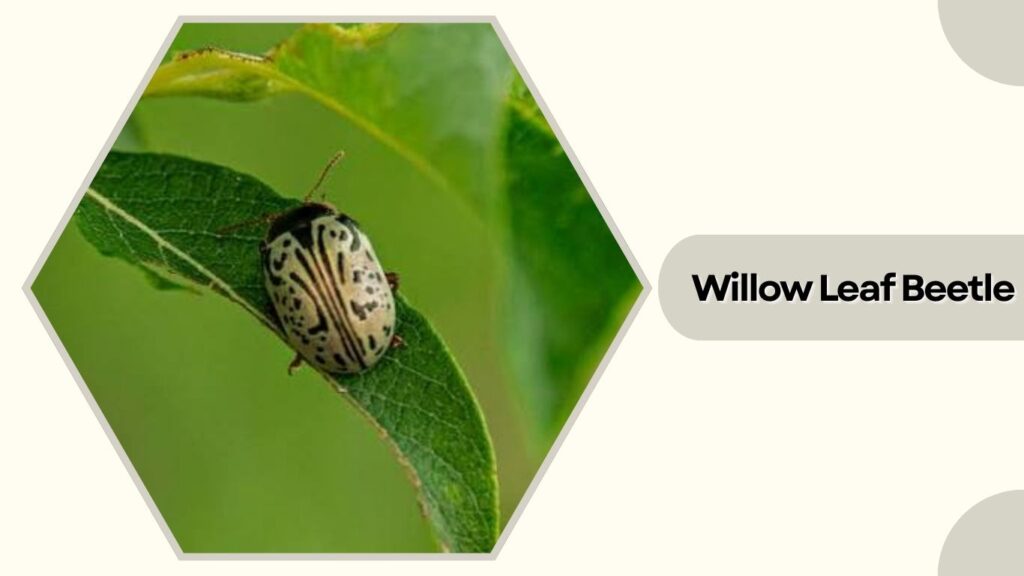
Willow leaf beetle is a common name applied to several leaf beetle species that feed primarily on willow trees. Adults are usually small, rounded, and metallic or dark-colored, while larvae feed openly in groups. Large populations can cause extensive leaf damage, particularly on young or repeatedly stressed willow trees.
Identification
- Small rounded to oval body
- Often metallic blue, green, bronze, or dark-colored
- Strongly convex wing covers
- Adults usually less than 1/3 inch long
- Larvae often dark and clustered on leaves
- Appearance varies by species
Habitat and Distribution
Willow leaf beetles occur in many regions of the world where willow trees grow.
They are common near rivers, ponds, wetlands, woodland edges, parks, and landscaped areas containing willows.
Because different species occur in different countries, the exact distribution depends on which willow leaf beetle is being discussed.
They are especially common where dense stands of young willow provide abundant fresh foliage.
Behavior and Diet
Both adults and larvae feed on willow leaves. Adults often chew holes or notches, while larvae may remove large areas of tissue between the veins.
Some species feed communally during the larval stage.
Heavy infestations can make foliage appear scorched or skeletonized, but mature healthy trees often produce new leaves later.
Repeated defoliation may be more serious for newly planted or environmentally stressed trees.
Lifespan and Life Cycle
Adults of many willow leaf beetle species overwinter in protected locations beneath bark, leaf litter, or nearby vegetation.They emerge in spring and begin feeding and mating.
Females lay eggs in clusters on willow foliage. Larvae hatch, feed through several stages, and eventually pupate either on the plant or in sheltered areas.
New adults appear later in the season. Depending on the species and local climate, one or several generations may develop each year.
20. Viburnum Leaf Beetle
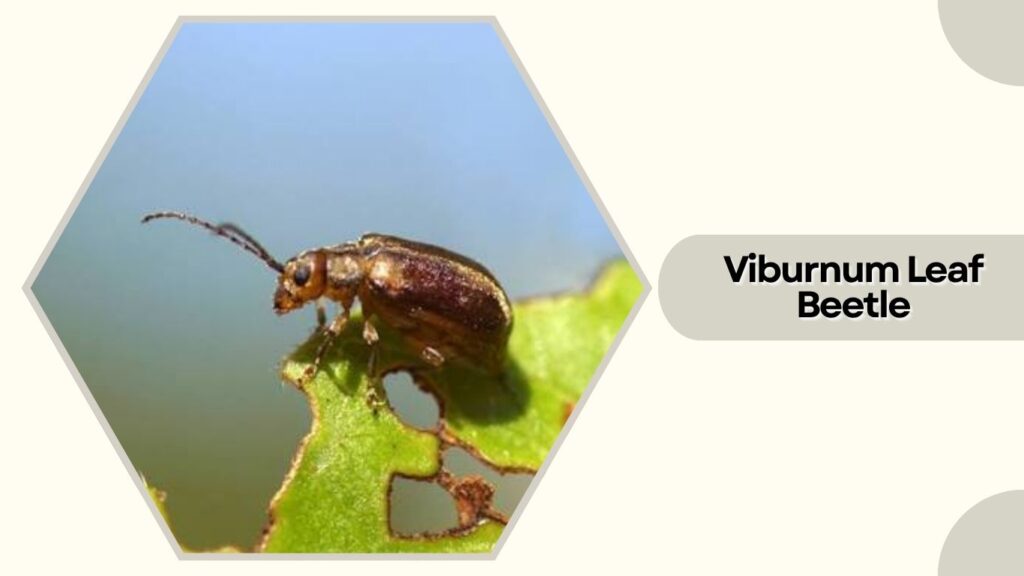
The viburnum leaf beetle is a destructive leaf beetle that specializes on viburnum shrubs. Both larvae and adults feed on foliage, often attacking the same plants twice in one season. Repeated heavy defoliation can seriously weaken susceptible viburnums and may eventually kill shrubs after several years of damage.
Identification
- Adults are yellowish-brown to light brown
- Approximately 1/4 inch long
- Elongated oval body
- Fine hairs on the wing covers
- Larvae are yellow-green with dark spots
- Larvae may reach around 1/3 inch long
Habitat and Distribution
Viburnum leaf beetles are native to Europe and parts of Asia but have become established in portions of North America.
They are found in gardens, parks, landscapes, woodland edges, and nurseries containing viburnum shrubs.
Some viburnum species are much more susceptible to attack than others, so infestations can be severe in landscapes containing preferred hosts.
Behavior and Diet
Larvae begin feeding in spring as viburnum leaves expand. They chew irregular holes and may skeletonize foliage when populations are high.
Later in the season, adults emerge and resume feeding, creating a second period of damage.
Adults may remain on the same shrubs for feeding and egg laying.
Repeated defoliation weakens plants because it reduces the leaf area available for photosynthesis. Severely stressed shrubs may eventually decline or die.
Lifespan and Life Cycle
Viburnum leaf beetles overwinter as eggs rather than adults. Females cut small cavities into young viburnum twigs and deposit eggs inside them, covering the openings with plant material.
Eggs hatch in spring. Larvae feed on leaves before moving into the soil to pupate.Adults emerge during summer and feed for several months.Females later lay overwintering eggs in twigs, completing a single generation each year.
FAQs
1. What is a leaf beetle?
Leaf beetles are members of the family Chrysomelidae, one of the largest beetle families. Most adults and larvae feed on living plant tissue. The group includes flea beetles, tortoise beetles, asparagus beetles, Colorado potato beetles, and thousands of other species.
2. Are leaf beetles harmful to plants?
Some leaf beetles cause little noticeable damage, while others are important agricultural or garden pests. Colorado potato beetles, crucifer flea beetles, cereal leaf beetles, and viburnum leaf beetles can cause significant damage when populations become high.
3. How can I identify a leaf beetle?
Look for a generally small to medium-sized beetle with a rounded or elongated body, visible antennae, and chewing damage on leaves. Color varies greatly between species. Host plant, feeding pattern, body shape, markings, and jumping behavior can all help narrow the identification.
4. Do leaf beetles bite humans?
Leaf beetles are plant feeders and generally do not bite people. They use chewing mouthparts mainly to consume leaves, flowers, stems, roots, or other plant material. They may crawl on people accidentally but are not considered biting pests.
5. How do you control leaf beetles in a garden?
Control depends on the species. Small infestations can often be managed by hand-picking adults or larvae and removing heavily infested leaves. Keeping plants healthy, removing crop debris, rotating susceptible crops, and protecting seedlings can also help. Severe agricultural infestations may require species-specific biological or chemical controls.