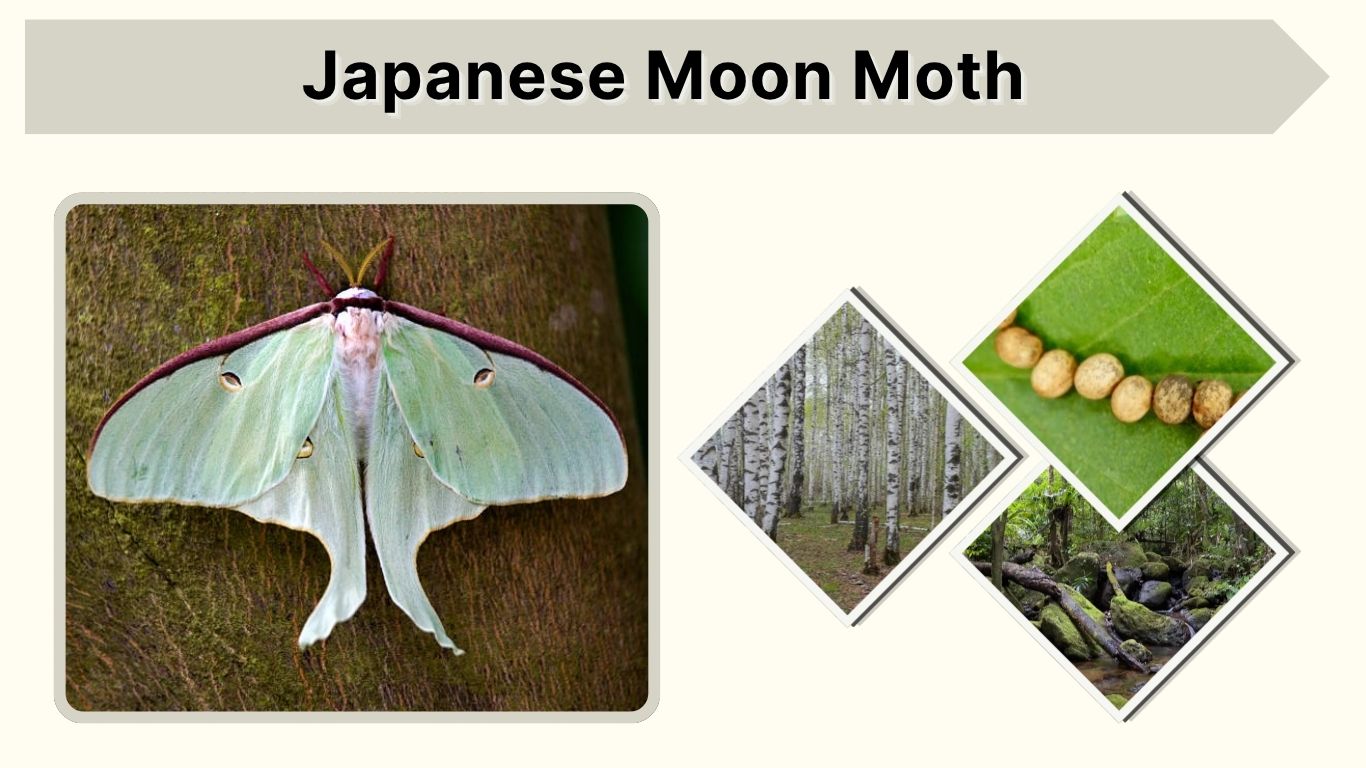
The Japanese moon moth (Actias gnoma) is a large, pale green silk moth known for its elegant hindwing tails, delicate eyespots, and soft blue-green coloration. Found mainly in Japan and parts of the Russian Far East and East Asia, this nocturnal moth belongs to the family Saturniidae. Adults live only briefly and do not feed, relying entirely on energy stored during the caterpillar stage. Its striking appearance often causes confusion with the closely related Japanese luna moth, but several features help separate them.
What Is a Japanese Moon Moth?
The Japanese moon moth is a giant silk moth scientifically known as Actias gnoma. It was described by Arthur Gardiner Butler in 1877 and belongs to the same genus as several other spectacular long-tailed moon moths.
Its Japanese name is Onaga-mizuao The moth is especially recognizable because of its large wings, pale green color, and long extensions on the hindwings.
Japanese Moon Moth Identification
- Scientific name: Actias gnoma
- Family: Saturniidae
- Pale green to bluish-green wings
- Small eyespots on all four wings
- Pinkish or reddish edging along the wings
- Long tail-like extensions on the hindwings
- White, hairy body
- Large, feathery antennae in males
- Caterpillars are large and green
- Adults are primarily nocturnal
Individuals can vary somewhat in coloration and wing shape, which can make identification challenging when compared with closely related Actias species.
How Big Is a Japanese Moon Moth?
The Japanese moon moth is a large species. Adults have forewings measuring roughly 45–55 mm, producing an overall wingspan of around 9–11 cm in many individuals.
Its elongated hindwing tails make the moth appear even larger.
Male and female moths also differ slightly in appearance. Males generally have broader, more feathered antennae for detecting female pheromones, while females tend to have larger bodies because they carry developing eggs.
Where Does the Japanese Moon Moth Live?
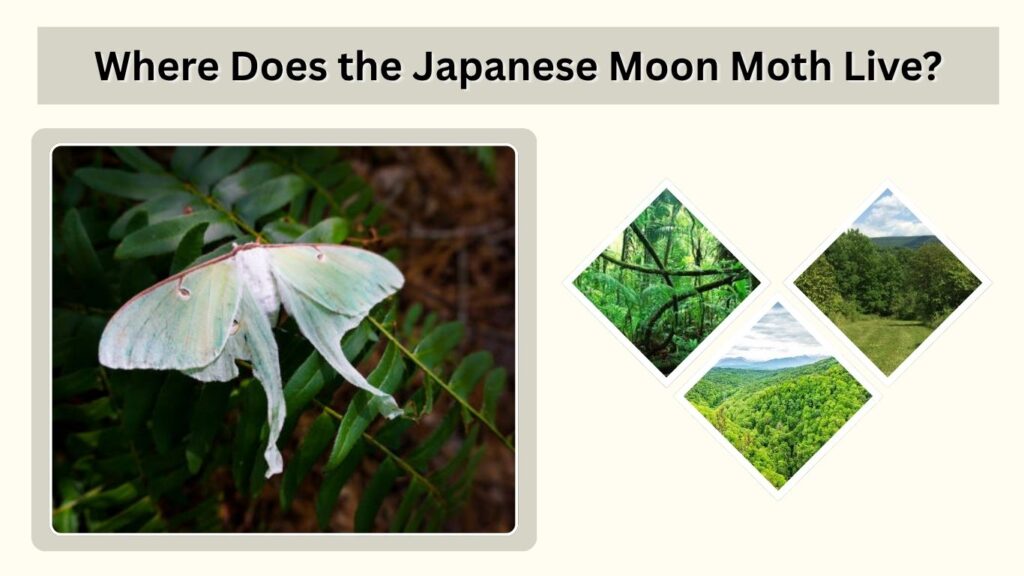
The Japanese moon moth occurs in Japan and parts of northeastern Asia, including areas of the Russian Far East and Korea. Sources also record the species from the Kuril region and Primorye.
Within Japan, different populations and subspecies occur in various regions.
Japanese Moon Moth Habitat
Typical habitats include:
- Temperate forests
- Moist woodlands
- Riverbank forests
- Lowland wooded areas
- Mountain forests
- Wet areas containing alder trees
In Japan, the species is particularly associated with habitats containing alder and related trees because these can serve as important caterpillar food plants.
Adults are nocturnal and may occasionally be found around artificial lights near wooded areas.
What Does a Japanese Moon Moth Eat?
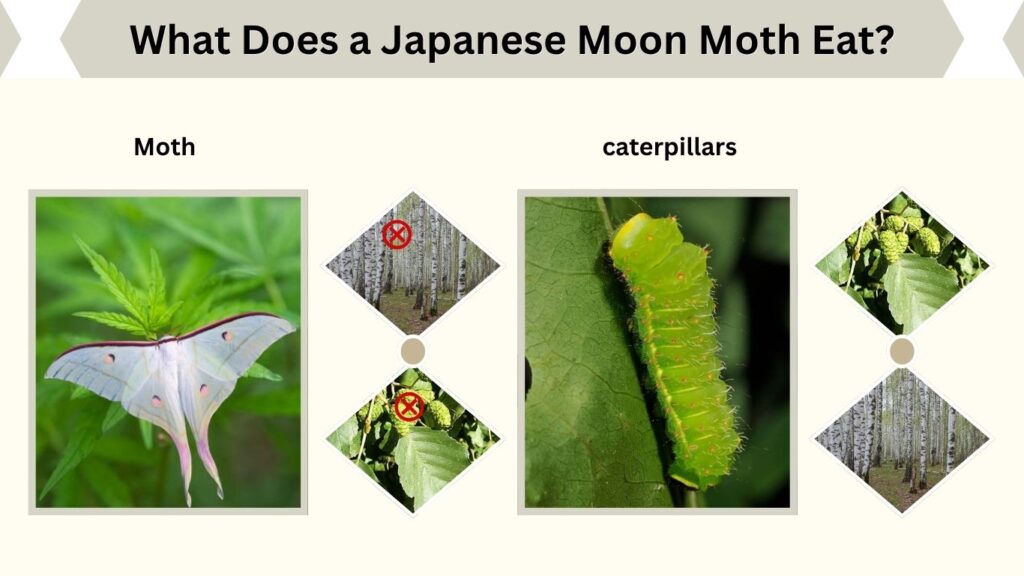
The answer depends on the moth’s life stage.
Caterpillar Diet
Japanese moon moth caterpillars feed heavily on plant leaves. Recorded host plants include:
- Alder
- Birch
- Walnut
- Willow
- Some oak species
Alder appears to be particularly important for Japanese populations.
The caterpillar must consume enough food to store energy for metamorphosis and the adult stage.
Do Adult Japanese Moon Moths Eat?
Adult moon moths do not feed.
Like many large Saturniid moths, adults have reduced or nonfunctional mouthparts. Once they emerge from their cocoons, they rely entirely on energy stored during the larval stage.
Their short adult life is therefore devoted almost entirely to reproduction.
Japanese Moon Moth Life Cycle
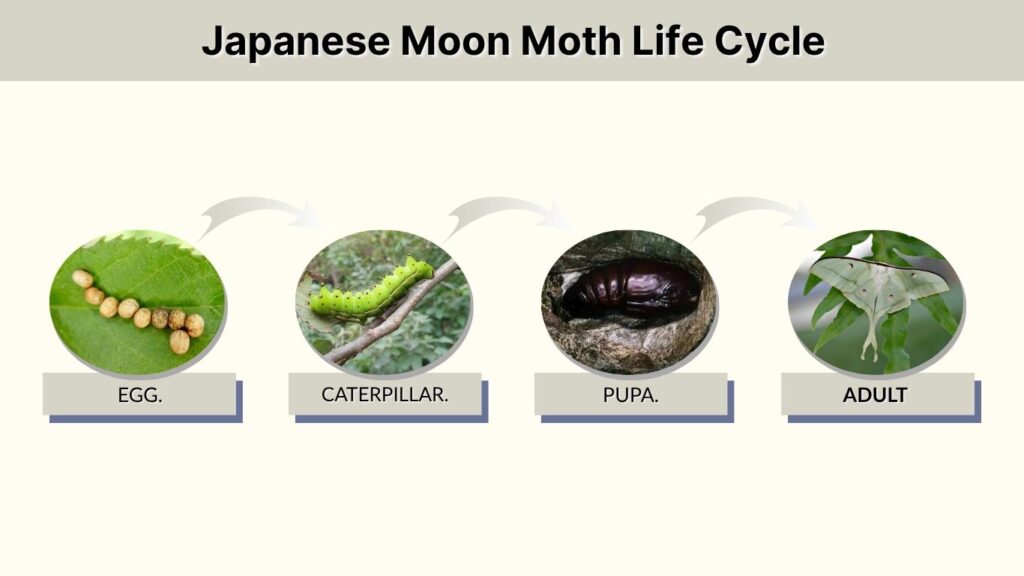
The Japanese moon moth undergoes complete metamorphosis through four stages: egg, caterpillar, pupa, and adult.
Eggs
After mating, the female lays eggs on or near appropriate host plants. One Japanese government source reports that females may produce several hundred eggs.
Caterpillar
After hatching, the larvae begin feeding on leaves.
Young caterpillars grow rapidly and molt several times. Mature larvae can reach approximately 75 mm in length and have green bodies with hairs and raised structures along their backs.
Cocoon and Pupa
When fully grown, the caterpillar spins a cocoon between leaves.
Inside, it transforms into a pupa. The species can overwinter in the pupal stage, allowing the developing moth to survive colder months.
Adult
The adult eventually emerges, expands its wings, and becomes active after dark.
In parts of Japan, there can be two generations per year, with adults appearing in spring and again during summer.
Why Does the Japanese Moon Moth Have Long Tails?
The long hindwing tails are one of the most distinctive features of moon moths.
In several long-tailed Saturniid moths, these extensions are thought to interfere with the echolocation used by hunting bats. A bat may strike toward the moving tail rather than the moth’s body, increasing the moth’s chance of escaping.
The Japanese moon moth’s tails are also helpful for distinguishing it from similar species.
Japanese Moon Moth vs. Japanese Luna Moth
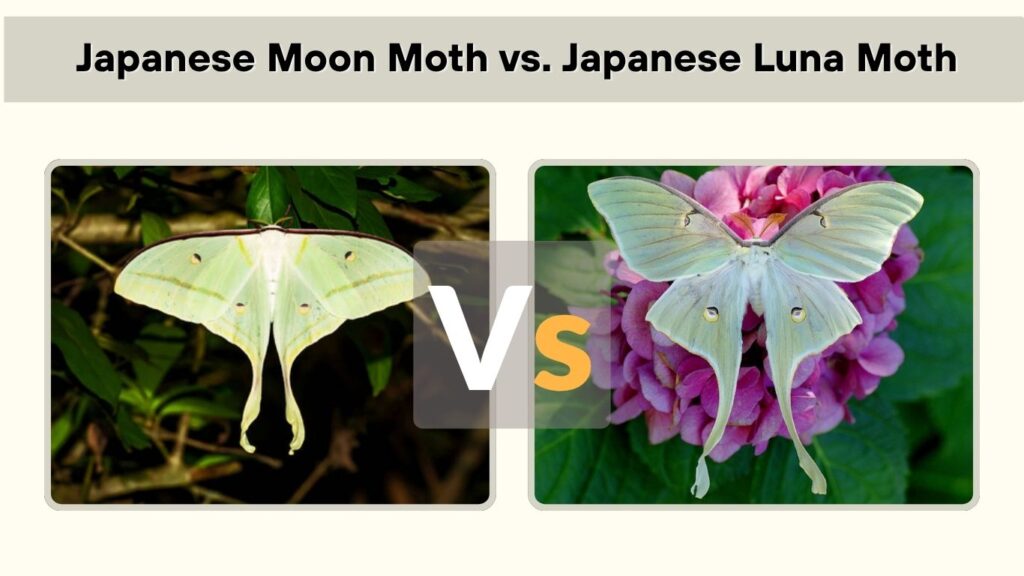
These names are frequently confused.
The Japanese moon moth commonly refers to Actias gnoma, while “Japanese luna moth” is sometimes applied to closely related moths such as Actias aliena or populations historically treated under Actias artemis.
Both can have pale green wings, small eyespots, and hindwing tails.
Main Differences
Actias gnoma generally has longer and more slender hindwing tails, while closely related Japanese Actias species may have somewhat shorter tails and differences in forewing shape and markings.
Because coloration and wing shape vary, accurate identification can sometimes require close examination.
Is the Japanese Moon Moth Rare?
The species is not equally common throughout its range. Some regional Japanese sources describe it as less abundant than similar Actias moths, and habitat availability strongly influences where it can be found.
Forest conservation is important because the caterpillars depend on specific host trees and adults require suitable woodland habitat for reproduction.
Interesting Japanese Moon Moth Facts
The Japanese moon moth is one of Japan’s most visually striking moths. Its combination of pale green wings, long tails, fuzzy white body, and tiny eyespots makes it easy to mistake for a tropical species.
Adult moths are attracted to lights at night, which is why they may occasionally appear near houses, parks, or forest facilities.
The caterpillar stage is far longer and more important for feeding than the adult stage. Once adulthood begins, the moth’s remaining energy is used almost entirely for finding a mate and reproducing.
FAQs
1. What is the scientific name of the Japanese moon moth?
The Japanese moon moth is Actias gnoma, a member of the giant silk moth family Saturniidae.
2. Where are Japanese moon moths found?
They occur in Japan and parts of northeastern Asia, including the Russian Far East and Korea.
3. What do Japanese moon moth caterpillars eat?
Their larvae feed on leaves of trees such as alder, willow, birch, walnut, and some oaks.
4. Do adult Japanese moon moths eat?
No. Adults have reduced mouthparts and survive on energy stored while they were caterpillars.
5. Is a Japanese moon moth the same as a luna moth?
Not exactly. It belongs to the same genus and strongly resembles other luna or moon moths, but Actias gnoma is a distinct species commonly called the Japanese moon moth.