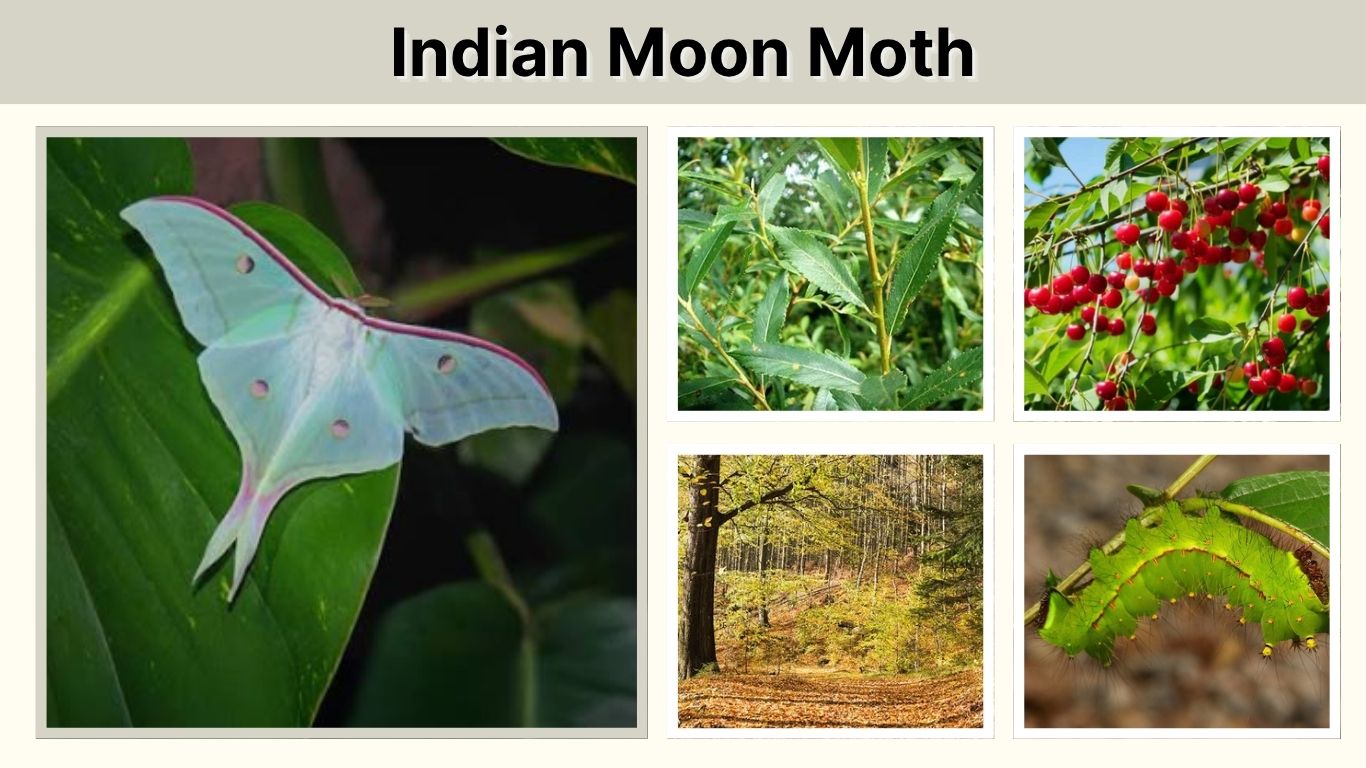
The Indian moon moth is a spectacular Asian silk moth recognized by its pale green wings, long sweeping hindwing tails, and distinctive eyespots. Scientifically known as Actias selene, it belongs to the Saturniidae family and occurs across a broad part of Asia. Its caterpillars feed heavily on the leaves of suitable host plants, while the short-lived adults do not eat and concentrate entirely on reproduction. From its colorful caterpillar stages to its elegant adult form, the Indian moon moth has one of the most fascinating life cycles among large moths.
What Is an Indian Moon Moth?
The Indian moon moth, sometimes called the Indian luna moth, is a large member of the genus Actias. It is primarily active at night and spends the adult portion of its life searching for mates. Its long tails, pale coloration, and prominent wing markings make it easy to distinguish from most ordinary moths found throughout its Asian range.
Indian Moon Moth Identification
Look for these characteristic features:
- Scientific name: Actias selene
- Family: Saturniidae
- Wing color: Pale green to yellowish-green
- Hindwings: Long, curved tails
- Eyespots: Present on the wings
- Body: Thick and hairy
- Antennae: Feather-like, particularly in males
- Activity: Mostly nocturnal
- Adult feeding: Adults do not feed
Its impressive size and long tails give the moth an almost butterfly-like appearance when it is resting with its wings spread.
Indian Moon Moth Size
The Indian moon moth is a large moth. Wingspan varies between individuals and sexes, with females generally being somewhat larger and heavier-bodied than males.
Published descriptions indicate considerable size variation across populations, which is expected for a species distributed over such a large geographic area.
Indian Moon Moth Habitat and Range
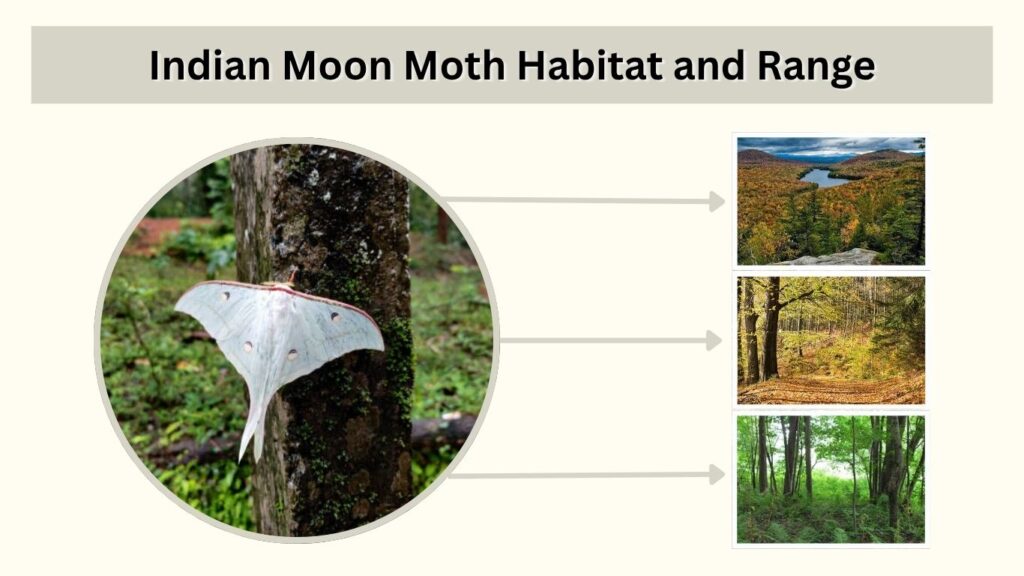
Indian moon moths inhabit parts of South, East, and Southeast Asia. Their distribution extends from the Indian subcontinent through portions of China and neighboring regions and southward into parts of Southeast Asia. They are associated particularly with forested environments where their caterpillars can find suitable host trees and shrubs.
Where Do Indian Moon Moths Live?
Indian moon moths occur across regions including India and other areas of Asia. Depending on location, they may occupy lowland forests, wooded landscapes, and other environments with abundant host vegetation.
Adults are nocturnal and may occasionally be noticed near artificial lights after dark. During daylight, they generally remain relatively inactive while resting on vegetation.
Indian Moon Moth Habitat Requirements
Suitable habitat depends heavily on the availability of larval food plants. Because caterpillars must consume large quantities of foliage before pupating, healthy vegetation is essential.
Adults need considerably less in terms of food resources because they emerge with stored energy accumulated during the caterpillar stage.
Indian Moon Moth Caterpillar
The Indian moon moth caterpillar undergoes dramatic changes as it develops. Newly hatched larvae do not immediately resemble the large green caterpillars seen later in development. Early stages can appear reddish, while later instars become green and develop prominent tubercles and hairs.
What Does an Indian Moon Moth Caterpillar Look Like?
A mature caterpillar typically has:
- Bright or apple-green coloration
- Yellowish lateral markings
- Raised tubercles along the body
- Fine hairs
- A thick cylindrical shape
- Small red or colored markings around some tubercles
- Powerful chewing mouthparts
Young larvae change appearance through successive molts before developing the familiar green coloration of later stages.
What Do Indian Moon Moth Caterpillars Eat?
The caterpillars are polyphagous, meaning they can feed on several kinds of plants. Recorded host plants include species belonging to genera such as Juglans, Prunus, Malus, Salix, Quercus, Rhododendron, and others. Different populations may use different plants depending on local availability.
Caterpillars spend much of their time eating because they must accumulate enough energy to complete metamorphosis and support the adult stage.
Indian Moon Moth Diet
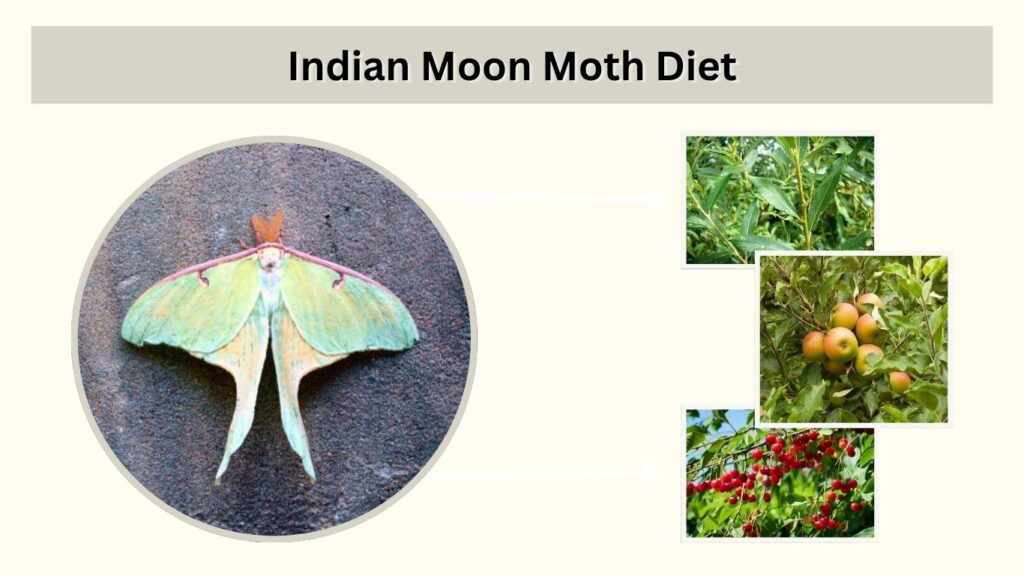
Diet changes dramatically throughout the moth’s development. Larvae are active feeders capable of consuming substantial quantities of leaves. Adult Indian moon moths, however, emerge without functional feeding behavior and survive using stored energy reserves. This pattern is common among many of the large silk moths in the Saturniidae family.
Indian Moon Moth Food Plants
Caterpillars may feed on foliage from plants such as:
- Walnut
- Willow
- Cherry and related Prunus species
- Apple and related Malus species
- Rhododendron
- Oak
- Sweetgum
- Other suitable broadleaf trees and shrubs
Not every caterpillar population necessarily uses every plant listed, so host preference can vary geographically.
What Do Adult Indian Moon Moths Eat?
Adult Indian moon moths do not eat. Their mouthparts are not functional for normal feeding.
Instead, adults depend on fat and energy accumulated during larval development. This explains both their intense feeding as caterpillars and their relatively short adult lifespan.
Indian Moon Moth Life Cycle
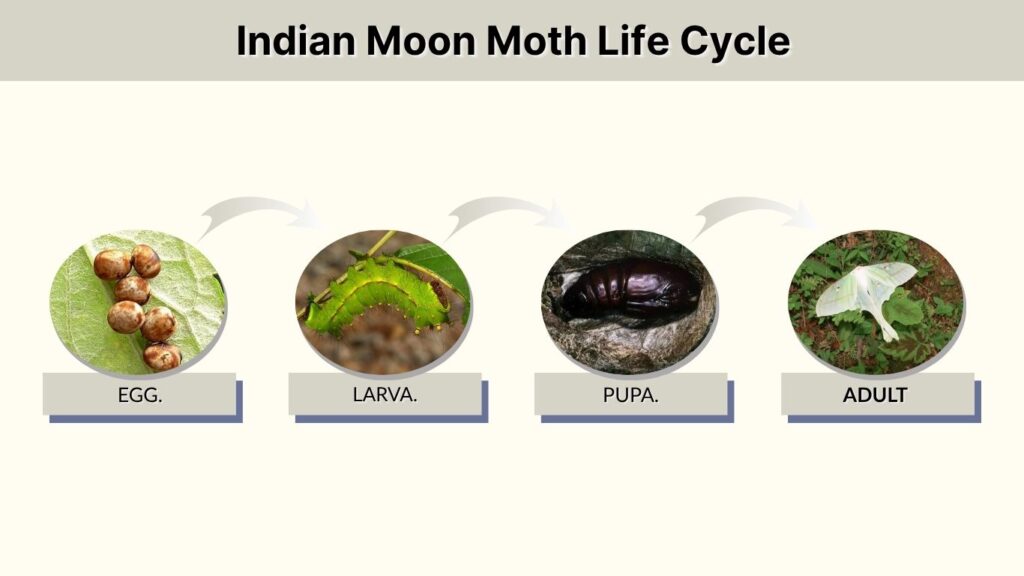
The Indian moon moth undergoes complete metamorphosis through four stages: egg, larva, pupa, and adult. Each stage looks entirely different from the one before it. Environmental conditions, season, temperature, humidity, and food quality can influence the time required to complete development.
Indian Moon Moth Eggs
Females lay eggs after mating, usually placing them where newly hatched larvae will have access to suitable vegetation.
The eggs are small and pale with darker mottling. Under suitable conditions, development inside the egg proceeds until tiny larvae emerge and begin feeding. Reports describe incubation at roughly a couple of weeks under some conditions.
Indian Moon Moth Larvae
After hatching, caterpillars pass through multiple instars. Each time the larva becomes too large for its existing outer skin, it molts.
Early larvae can be reddish, while later stages become increasingly green. Feeding intensifies as the caterpillars grow larger, enabling them to accumulate nutrients required for pupation.
Pupa and Cocoon
Once fully grown, the caterpillar stops feeding and prepares for pupation. It constructs a protective silk cocoon in which the transformation into an adult occurs.
The cocoon is generally brownish and oval. In some climates, the pupal period may become extended as the moth remains dormant through unfavorable seasonal conditions.
Adult Moth
The adult eventually emerges from the cocoon with soft, initially unexpanded wings. Fluid is pumped through the wing veins until the wings reach full size.
After the wings harden, the moth can fly. Adults then concentrate their remaining energy on mating and reproduction.
Indian Moon Moth Lifespan
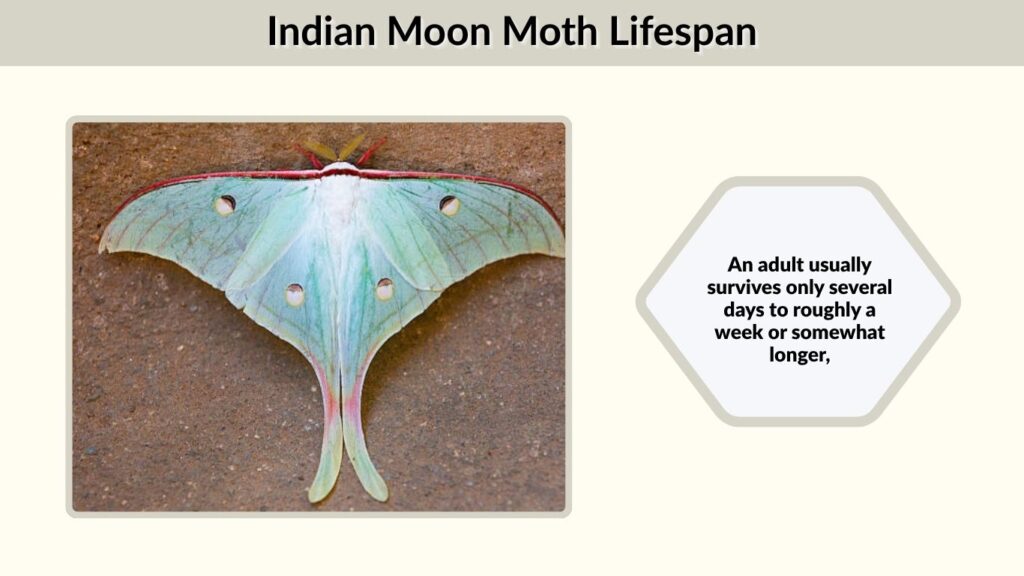
The adult Indian moon moth has a short life compared with its larval and pupal development. Because adults do not feed, they have only the energy accumulated earlier as caterpillars. Their adult lives therefore revolve around finding a mate and reproducing before their stored reserves are exhausted.
How Long Does an Indian Moon Moth Live?
An adult usually survives only several days to roughly a week or somewhat longer, depending on sex and environmental conditions.
The entire life cycle is much longer because the moth spends substantial time as a caterpillar and pupa. In some populations, pupae can remain dormant for extended periods before adult emergence.
Male vs. Female Indian Moon Moth
Male and female Indian moon moths share the same basic pale-green appearance and long hindwing tails. However, several features can help distinguish the sexes. Most differences are related to reproduction, particularly the male’s ability to locate females using chemical signals released into the air.
Male and Female Differences
Key differences include:
- Male: Usually has broader, more feathery antennae.
- Female: Generally has narrower antennae.
- Male: Usually has a slimmer abdomen.
- Female: Has a fuller abdomen containing eggs.
- Female: Often appears larger and heavier.
- Male: Typically spends more time actively flying in search of females.
Male antennae contain sensitive structures that allow them to detect female pheromones.
Indian Moon Moth vs. Luna Moth
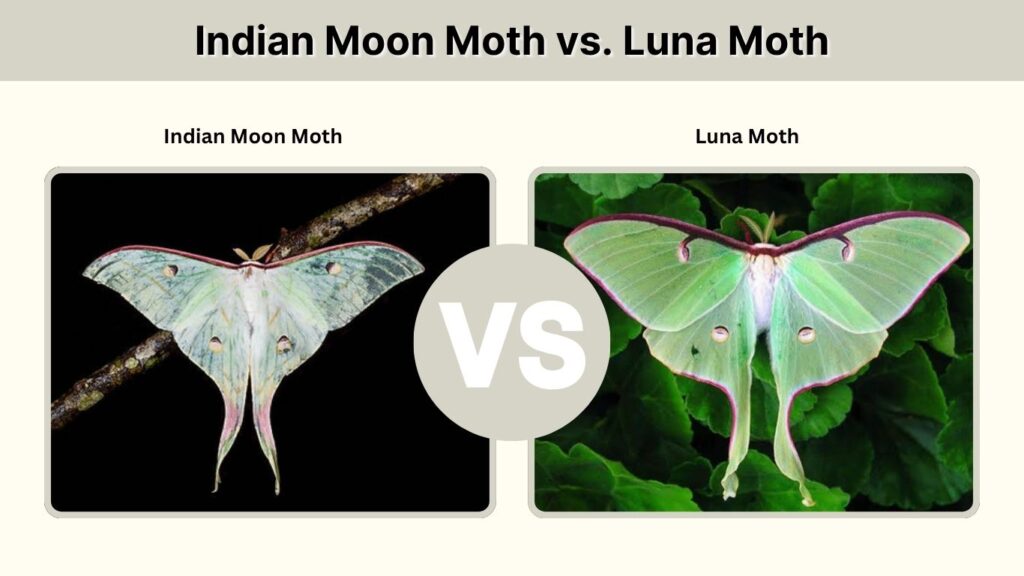
The Indian moon moth can easily remind observers of the North American luna moth because both belong to the genus Actias. Both have green wings, eyespots, and long hindwing tails, but they are distinct species occurring naturally on different continents.
Main Differences
The Indian moon moth is Actias selene and naturally occurs across parts of Asia. The luna moth is Actias luna and is native to North America.
Their wing patterns, tail shapes, markings, and coloration also differ when examined closely. Geographic location is therefore one of the easiest clues for distinguishing wild individuals.
Interesting Indian Moon Moth Facts
Indian moon moths are striking examples of how dramatically insects can transform during metamorphosis. A leaf-eating caterpillar eventually becomes a large winged adult that no longer feeds. Its long hindwing tails, enormous wing area, and delicate green coloration also make Actias selene especially popular among moth enthusiasts.
Indian Moon Moth Facts
- Its scientific name is Actias selene.
- It belongs to the Saturniidae family.
- Adults are mainly nocturnal.
- Adult moths do not eat.
- Caterpillars can feed on several host plants.
- Mature larvae are primarily green.
- Females are generally larger than males.
- Males have strongly feathered antennae.
- The moth forms a silk cocoon before adulthood.
- It is related to other moon moths in the genus Actias.
FAQs
Is an Indian moon moth the same as a luna moth?
No. They are closely related but different species. The Indian moon moth is Actias selene, while the North American luna moth is Actias luna.
What do Indian moon moths eat?
Caterpillars eat leaves from various suitable host trees and shrubs. Adult Indian moon moths do not feed and live on energy stored during the caterpillar stage.
How long does an Indian moon moth live?
The winged adult typically survives only several days to around a week or somewhat longer. Its complete life cycle is substantially longer.
Where do Indian moon moths live?
Indian moon moths occur across a broad part of Asia, including the Indian subcontinent and regions extending eastward and southeastward.
What does an Indian moon moth caterpillar look like?
Mature caterpillars are generally bright green with colored tubercles, fine hairs, and markings along the sides. Younger caterpillars may be reddish before changing to green as they develop.