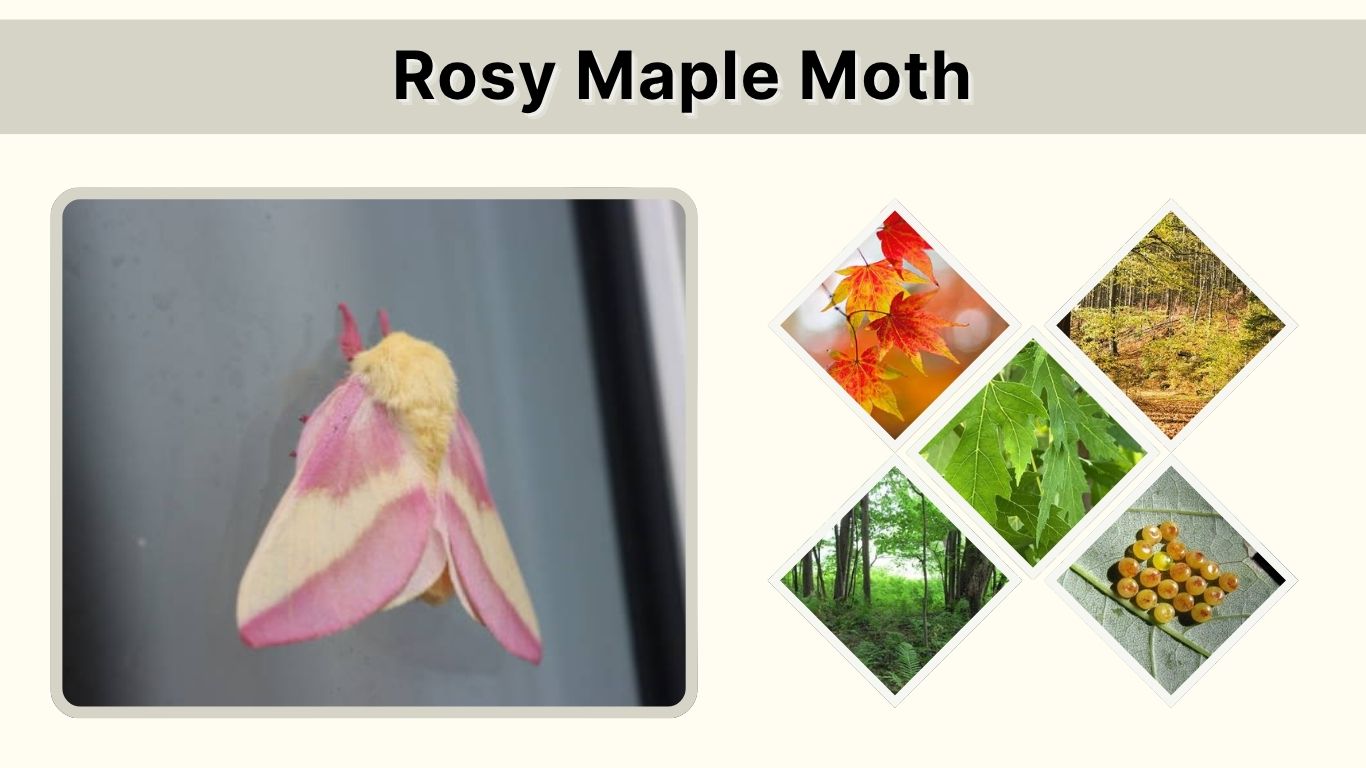
The rosy maple moth is one of North America’s most colorful moths, instantly recognizable by its soft pink and yellow wings. Scientifically known as Dryocampa rubicunda, this small silk moth is closely associated with maple trees, where its caterpillars feed and develop. Although its bright colors can make it look exotic or even dangerous, the rosy maple moth is harmless to people. Its unusual appearance, short adult lifespan, fascinating caterpillar stage, and seasonal life cycle make it an especially interesting moth to observe.
What Is a Rosy Maple Moth?
The rosy maple moth belongs to the giant silk moth family Saturniidae, although it is considerably smaller than famous relatives such as luna and cecropia moths. Its pink-and-yellow coloration varies among individuals, with some appearing intensely pink while others may be mostly yellow or cream. Adults are primarily concerned with mating and reproduction rather than feeding.
Rosy Maple Moth Identification
Important identification features include:
- Scientific name: Dryocampa rubicunda
- Family: Saturniidae
- Body color: Usually yellow, cream, or pink
- Wings: Yellow to cream with pink markings
- Legs: Often pink or reddish
- Body: Thick and fuzzy-looking
- Antennae: Feather-like, particularly in males
- Activity: Mostly nocturnal
- Host trees: Especially maple species
Color intensity can vary significantly, so not every individual has the same balance of pink and yellow.
Rosy Maple Moth Size and Wings
Rosy maple moths are relatively small compared with many other silk moths. Their wingspan commonly measures around 1.25 to 2 inches, although females are usually larger than males.
Their forewings often show large pink areas surrounding a yellow central region. The hindwings may appear more yellow with pink edges. Some individuals have very little pink, demonstrating considerable natural color variation.
Rosy Maple Moth Habitat and Range
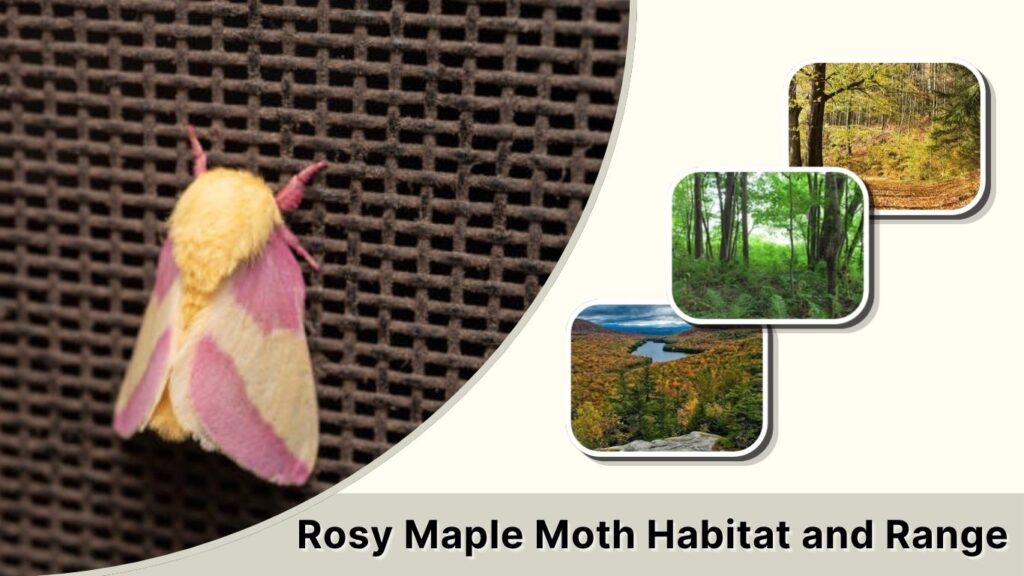
Rosy maple moths occur mainly in eastern North America wherever suitable host trees are available. Deciduous forests provide excellent habitat, but the moth can also appear in suburban neighborhoods, parks, gardens, and wooded residential areas. Because maple trees are widely planted, these moths may sometimes occur surprisingly close to homes.
Where Do Rosy Maple Moths Live?
Rosy maple moth habitat commonly includes:
- Deciduous forests
- Maple-dominated woodlands
- Mixed forests
- Suburban neighborhoods
- Parks and gardens
- Forest edges
- Areas containing mature host trees
Their range extends through much of eastern North America, including parts of the United States and southern Canada.
Where to Find a Rosy Maple Moth
Adults are most likely to be encountered during warmer months. Because they are nocturnal, they may rest quietly on vegetation during the day and become active after sunset.
Like many moths, rosy maple moths may approach artificial lights at night. People sometimes find adults resting near porches, garages, windows, or buildings in areas surrounded by suitable trees.
Rosy Maple Moth Caterpillar and Larvae
The caterpillar stage looks dramatically different from the colorful adult. Rosy maple moth caterpillars are commonly called green-striped mapleworms. They spend their larval stage feeding on tree leaves and storing the energy required for pupation and adulthood. Young larvae may remain together, while larger caterpillars become more independent as they continue developing.
What Does a Rosy Maple Moth Caterpillar Look Like?
Typical caterpillar characteristics include:
- Green body
- Pale longitudinal stripes
- Darker head
- Several rows of small spines
- Two prominent dark projections near the front
- Increasing body size through several molts
Color can change somewhat as the caterpillar matures. Fully developed larvae are much larger and easier to notice than newly hatched caterpillars.
What Do Rosy Maple Moth Caterpillars Eat?
The larvae primarily feed on leaves from trees in the maple family. Common host plants include red maple, silver maple, and sugar maple.
They may also use some related or alternative deciduous trees depending on local conditions. Caterpillars consume foliage continuously while growing because the adult moth does not rely on food in the same way.
Rosy Maple Moth Life Cycle
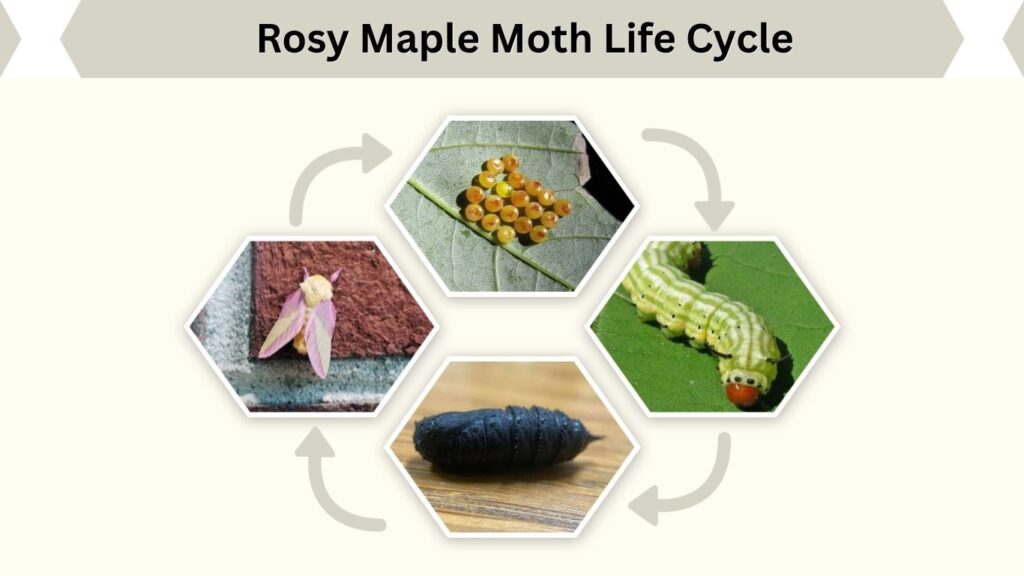
Like other moths, the rosy maple moth undergoes complete metamorphosis with four distinct stages: egg, larva, pupa, and adult. Timing varies with climate. Populations in warmer southern regions may produce more generations each year, while northern populations generally have a shorter reproductive season.
Rosy Maple Moth Eggs
Females generally place eggs on the undersides of host-tree leaves. The eggs are laid close to food so newly hatched caterpillars can begin feeding quickly.
They are:
- Small and oval
- Usually pale yellow or cream
- Laid in groups
- Attached directly to host leaves
- Difficult to notice without careful inspection
After developing inside the eggs, tiny larvae hatch and begin eating foliage.
Larva to Pupa
Caterpillars grow through several developmental stages known as instars. Between these stages, they molt and replace their outer skin.
Once fully grown, a larva leaves the host tree and moves toward the ground. Unlike some silk moths that create obvious silk cocoons attached to branches, rosy maple moths generally pupate in or near the soil and leaf litter.
Adult Rosy Maple Moth
When development is complete, the adult emerges from its pupa. Its wings are initially small and soft. The moth pumps fluid into them until they expand, then waits while they harden.
Adults become active primarily at night. Their main biological purpose at this stage is finding mates and producing the next generation.
Rosy Maple Moth Lifespan
The adult stage of a rosy maple moth is relatively brief. Much of the insect’s life is spent developing as an egg, caterpillar, or pupa rather than flying as the colorful adult most people recognize.
How Long Does a Rosy Maple Moth Live?
Adult rosy maple moths typically survive only for a relatively short period, often around several days to a couple of weeks. Their exact lifespan depends on environmental conditions and reproductive activity.
Adults do not have a functional feeding lifestyle comparable to caterpillars. Instead, energy accumulated during the larval stage supports adult activity.
The entire life cycle lasts much longer because pupae may remain dormant through cold periods before adults emerge during suitable weather.
Male vs. Female Rosy Maple Moth
Male and female rosy maple moths share the same characteristic coloration, making them difficult to distinguish at first glance. However, several physical differences can help with identification. These differences are related largely to reproduction and the male’s need to detect chemical signals released by females.
Male and Female Differences
Look for these characteristics:
- Females: Usually larger and heavier-bodied
- Males: Generally smaller
- Female antennae: Less strongly feathered
- Male antennae: Broader and more feather-like
- Females: Abdomen may appear fuller
- Males: Often more streamlined
The male’s larger, more elaborate antennae help detect female pheromones from a distance.
What Do Rosy Maple Moths Eat?
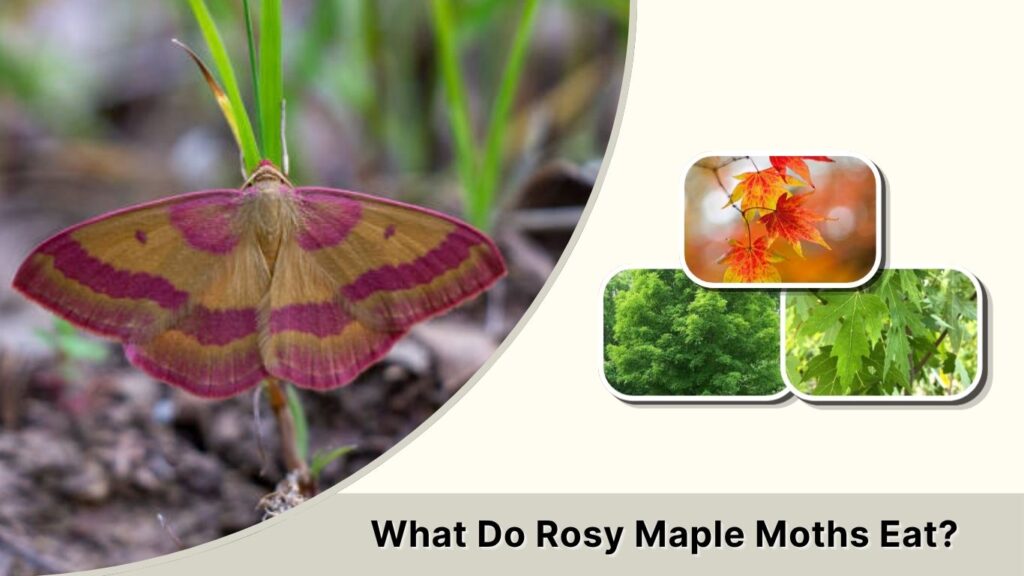
Diet changes completely between the larval and adult stages. Caterpillars are active plant feeders, while adults focus almost exclusively on reproduction. This difference explains why healthy host trees are especially important during larval development.
Rosy Maple Moth Diet
Caterpillars commonly consume:
- Maple leaves
- Red maple foliage
- Silver maple leaves
- Sugar maple foliage
- Leaves of other suitable host trees
Adult rosy maple moths generally do not feed. Their mouthparts are reduced, and they rely primarily on energy reserves accumulated during the caterpillar stage.
Are Rosy Maple Moths Poisonous?
Their bright pink and yellow appearance may lead people to assume rosy maple moths are toxic. However, the adults are not considered dangerous to humans. They do not possess venomous stingers and are not aggressive.
Are Rosy Maple Moth Caterpillars Poisonous?
Rosy maple moth caterpillars have noticeable spines, but they are not generally regarded as medically significant stinging caterpillars like puss caterpillars or some other moth larvae.
Nevertheless, handling wild caterpillars unnecessarily is best avoided. Their delicate bodies can be injured easily, and people with sensitive skin may experience irritation after contact with various insects or plants.
Are Rosy Maple Moths Rare?
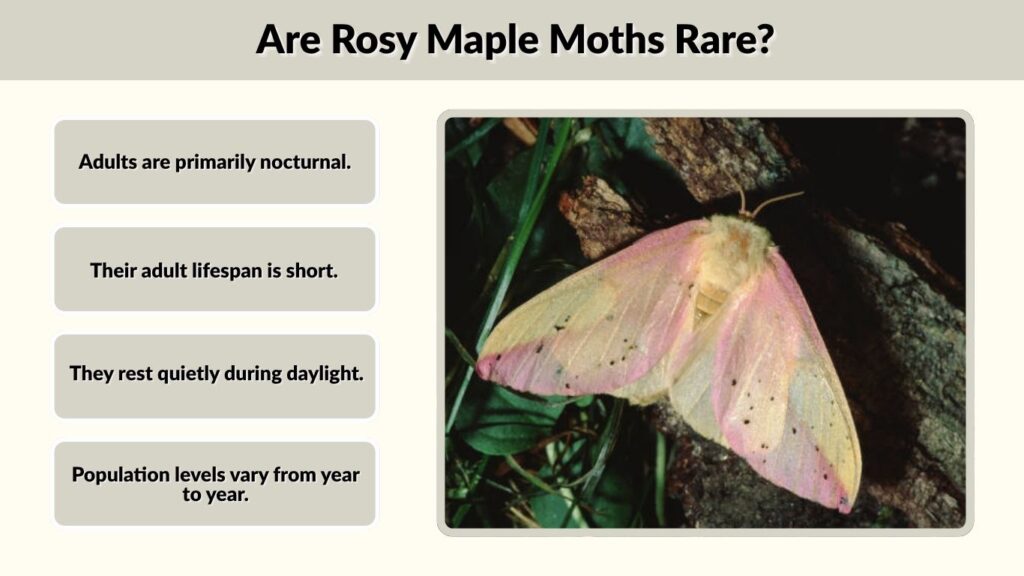
Their spectacular appearance can make rosy maple moths seem rare, particularly to people seeing one for the first time. However, they can be locally common where maple trees and suitable habitat are plentiful.
Why You May Rarely See One
Rosy maple moths can go unnoticed because:
- Adults are primarily nocturnal.
- Their adult lifespan is short.
- They rest quietly during daylight.
- Population levels vary from year to year.
- Adults may remain high in vegetation.
- They are seasonal rather than active year-round.
Finding one therefore does not necessarily indicate that the species itself is extremely rare.
Interesting Rosy Maple Moth Facts
The striking colors of this moth have made it popular among photographers, nature enthusiasts, artists, and insect lovers. Yet its biology is just as unusual as its appearance. From a caterpillar that feeds heavily on maple leaves to a beautiful adult that essentially stops eating, its transformation is remarkable.
Fun Facts About Rosy Maple Moths
- Their scientific name is Dryocampa rubicunda.
- Caterpillars are called green-striped mapleworms.
- Adults are mainly active at night.
- Females are generally larger than males.
- Males have strongly feathered antennae.
- Adults usually do not eat.
- Caterpillars primarily feed on maple leaves.
- They pupate close to or beneath the soil surface.
- Pink coloration varies greatly between individuals.
- They are harmless to humans.
FAQs
Is a rosy maple moth real?
Yes. The rosy maple moth is a real North American moth scientifically known as Dryocampa rubicunda. Its unusually bright pink and yellow colors are completely natural.
How long does a rosy maple moth live?
The adult moth generally lives only several days to a couple of weeks. Its complete life cycle is longer because it includes egg, caterpillar, and pupal development.
Are rosy maple moths poisonous?
No. Adult rosy maple moths are not poisonous or venomous and pose little threat to humans.
What does a rosy maple moth caterpillar eat?
The caterpillar primarily feeds on maple leaves, including foliage from red, silver, and sugar maple trees.
Can you keep a rosy maple moth as a pet?
Rosy maple moths are wild insects with short adult lives and specialized developmental needs. They are better observed in their natural habitat rather than kept as conventional pets.