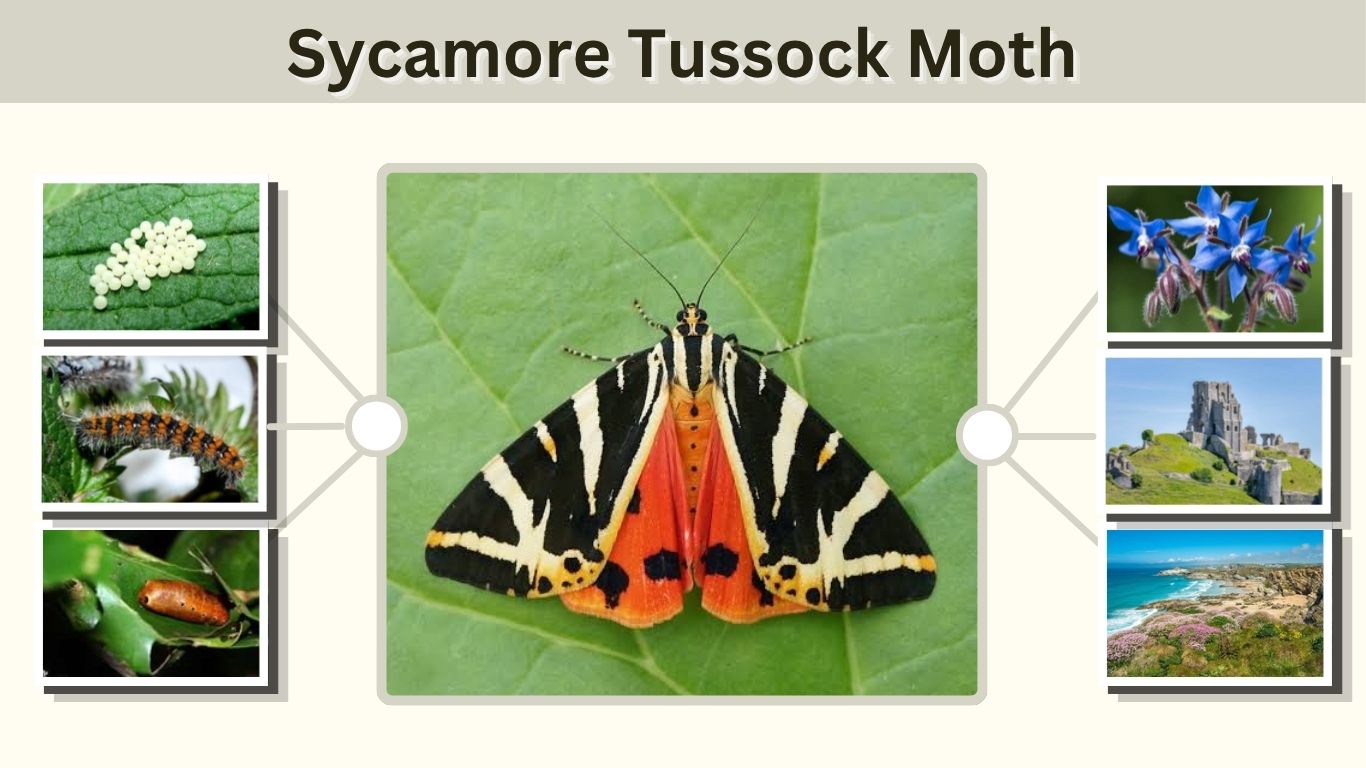
The Jersey Tiger Moth (Euplagia quadripunctaria) is a striking tiger moth recognized by bold black-and-cream forewings and brilliant orange or red hindwings. Although historically associated with the Channel Islands and southern England, it has expanded considerably across southern Britain and into new areas. Adults are unusual because they fly during both daytime and nighttime and often visit flowers. Its hairy caterpillars feed on several common plants, including nettles and brambles, before forming cocoons and emerging as colorful adults during summer.
What Does a Jersey Tiger Moth Look Like?
Few British moths combine such contrasting colors. When resting, the dark forewings with cream-colored stripes dominate its appearance. Once the moth takes flight, bright orange-red hindwings with dark spots suddenly become visible. This combination helps make the species relatively easy to identify and explains why people sometimes mistake this colorful day-flying moth for a butterfly.
Jersey Tiger Moth Identification
Key features include:
- Scientific name: Euplagia quadripunctaria
- Family group: tiger moths and allies
- Wingspan around 52–65 mm
- Black or very dark forewings
- Bold cream-white diagonal stripes
- Bright orange, red, or occasionally yellowish hindwings
- Large black spots on the hindwings
- Orange abdomen with dark markings
- Active during both day and night
- Often seen feeding on flowers during warm weather
Butterfly Conservation describes the species as particularly distinctive because it combines striped forewings with colorful hidden hindwings.
What Does the Underside Look Like?
The underside continues the dramatic black, cream, orange, and red coloration seen from above. When the moth is resting with its forewings closed over the body, much of the brighter hindwing coloration is concealed.
During flight, however, the orange-red hindwings become highly visible. This sudden change from striped camouflage to vivid coloration may help surprise or discourage potential predators.
Jersey Tiger Moth Caterpillar
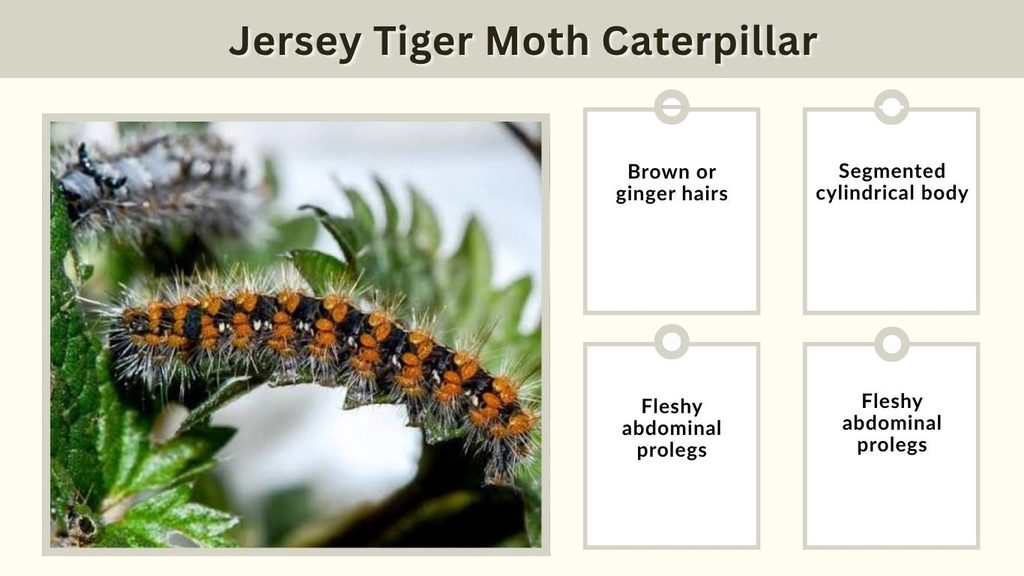
The caterpillar looks completely different from the adult. It is a hairy larva that changes considerably as it develops. Young larvae can be relatively pale, while older caterpillars become much darker and develop distinctive pale markings and brownish hairs. They remain caterpillars through winter, meaning the larval stage can be encountered for much more of the year than the adult moth.
What Does the Caterpillar Look Like?
As it develops, a Jersey Tiger caterpillar may show:
- Dark gray or black body
- Rows of cream-colored spots
- Brown or ginger hairs
- Numerous short and longer bristles
- Segmented cylindrical body
- Six true legs near the head
- Fleshy abdominal prolegs
- Strong chewing mouthparts
Freshly hatched caterpillars are paler. As they grow, they become darker with cream markings and bands of brownish hairs. After overwintering and feeding again in spring, their coloration can become grayer and their hairs more ginger-colored.
Is the Jersey Tiger Caterpillar Dangerous?
Jersey Tiger caterpillars are not generally considered dangerous stinging caterpillars. Their hairy appearance can make them look threatening, but they do not have the specialized venomous spines associated with caterpillars such as the Io moth.
Unnecessary handling is still best avoided. Caterpillar hairs can occasionally irritate sensitive skin, and gently observing the insect also prevents accidental injury to the caterpillar.
What Do Jersey Tiger Caterpillars Eat?
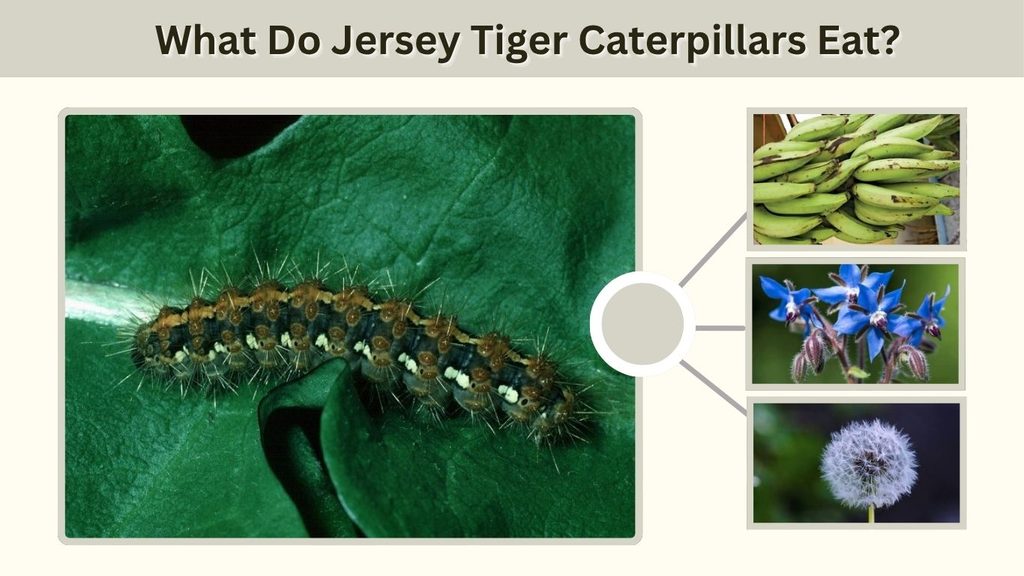
Jersey Tiger caterpillars are generalist feeders that use several widespread herbaceous plants. This flexible diet has probably helped the moth establish itself in gardens, hedgerows, disturbed ground, coastal habitats, and urban areas. Many of its most important food plants are species commonly considered weeds, meaning suitable caterpillar habitat can exist even inside towns and cities.
Jersey Tiger Caterpillar Food Plants
Recorded foods include:
- Common nettle
- Ground-ivy
- Bramble
- Hemp-agrimony
- White dead-nettle
- Borage
- Plantains
- Dandelion
- Other herbaceous plants
Nettles, ground-ivy, and bramble are particularly widespread, giving caterpillars plentiful feeding opportunities across much of their expanding British range.
What Do Adult Jersey Tiger Moths Eat?
Adults visit flowers and drink nectar.
Buddleia is one plant on which adults are commonly observed feeding, while other nectar-rich flowers can also attract them. Their tendency to visit flowers during warm days makes Jersey Tigers unusually visible compared with many moths that remain hidden until darkness.
Jersey Tiger Moth Life Cycle
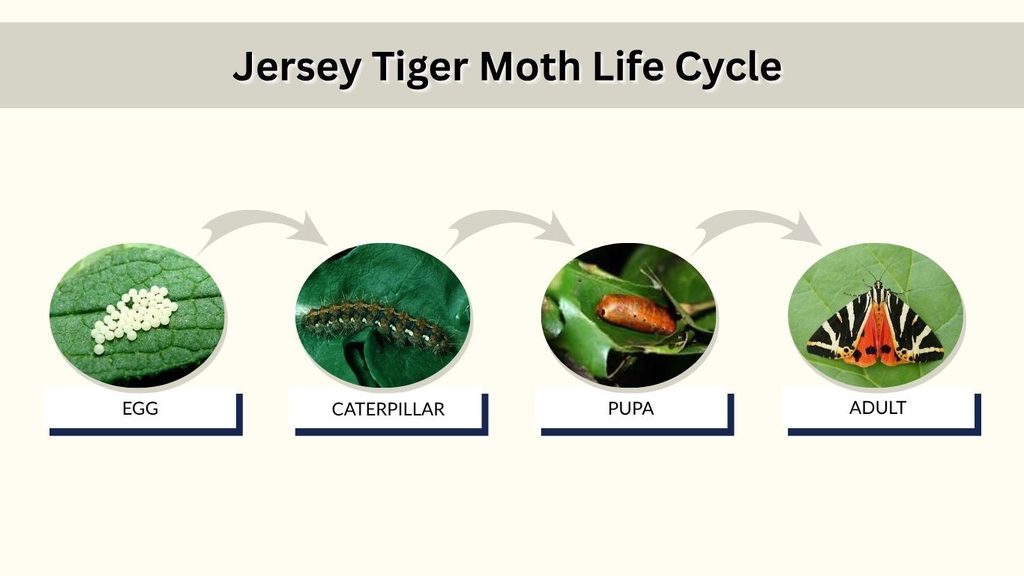
The Jersey Tiger has one main annual cycle in Britain. Females lay eggs during summer, and caterpillars hatch before autumn. Rather than pupating immediately, young caterpillars overwinter and continue developing the following spring. They eventually pupate in sheltered vegetation or leaf litter, producing adults that appear mainly from July through September.
Stages of the Life Cycle
The main stages are:
- Egg: Females deposit small eggs on suitable food plants.
- Young caterpillar: Eggs hatch after approximately 5–10 days.
- Overwintering caterpillar: Small larvae survive winter in sheltered locations.
- Spring feeding: Caterpillars resume active feeding and complete their growth.
- Pupa: Mature larvae create a silken cocoon among leaf litter.
- Adult: Moths emerge and fly mainly from July to September.
Butterfly Conservation reports that caterpillars can be found from September through the following May.
Jersey Tiger Moth Cocoon
When fully grown, the caterpillar moves into leaf litter or another sheltered location and produces a protective silk cocoon.
The transformation from caterpillar to adult occurs inside. Under typical conditions, the pupal period can last approximately four to six weeks before the adult Jersey Tiger emerges.
Where Do Jersey Tiger Moths Live?
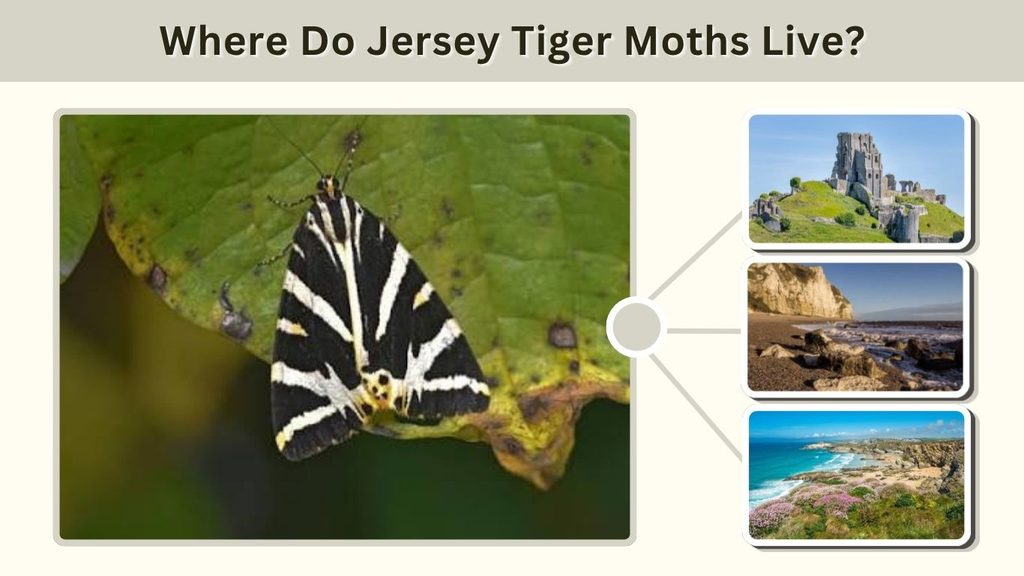
Jersey Tigers occupy much more than coastal habitats. Gardens, hedgerows, rough ground, disturbed areas, coastal cliffs, beaches, and other places containing caterpillar food plants can support them. Britain’s warming climate has coincided with substantial northward and eastward expansion, turning a formerly highly localized species into an increasingly familiar summer moth in southern regions.
Jersey Tiger Moth UK Distribution
Important British locations include:
- Devon
- Dorset
- Cornwall
- Isle of Wight
- Sussex
- Kent
- Greater London
- Surrey and surrounding counties
- Parts of the Midlands
- Parts of South Wales
Historically, the moth was much more restricted. Butterfly Conservation reported in 2025 that its range was continuing to spread northward into the Midlands and into southwest Wales.
Jersey Tiger Moths in London
London has become an important stronghold.
The species was discovered in southeast London in 2004 and subsequently spread across the city and neighboring counties. More than 1,000 Jersey Tigers were recorded in Greater London during the 2022 Big Butterfly Count alone.
Are Jersey Tiger Moths Rare?
The answer depends on location. Butterfly Conservation currently describes the Jersey Tiger as Nationally Scarce, yet its numbers and geographic distribution have been increasing dramatically. In some areas of southern England and London it can now be locally common, while farther north it may still be an unusual sighting.
Why Is Their Range Expanding?
The availability of larval food plants is unlikely to be a major restriction because nettles, ground-ivy, and bramble are widespread.
Butterfly Conservation has linked the species’ continuing British expansion with warmer climatic conditions. Earlier monitoring also found the Jersey Tiger among the larger moth species showing particularly strong increases in geographic distribution.
When Is the Best Time to See One?
Adults fly primarily from July to September, with the largest numbers generally observed in July and August.
They can be seen flying on warm sunny days, feeding at flowers, or resting on vegetation and buildings. Jersey Tigers are also active after dark and may appear at moth traps and outdoor lights.
Jersey Tiger Moths in Greece and Petaloudes
The species occurs beyond Britain across parts of Europe and is especially famous on the Greek island of Rhodes. At Petaloudes, widely known as the Valley of the Butterflies, huge seasonal gatherings of Jersey Tiger moths create one of Europe’s best-known moth spectacles. Despite the attraction’s name, these insects are moths rather than butterflies.
Jersey Tigers in the Valley of the Butterflies
A local form, Euplagia quadripunctaria rhodosensis, gathers in large numbers in the cool, humid Petaloudes valley during summer.
Thousands may rest on tree trunks, leaves, rocks, and shaded areas from roughly July through September while sheltering from hot conditions. The Oriental sweetgum trees and the valley’s cool microclimate are closely associated with these extraordinary seasonal aggregations.
Visitors should avoid deliberately disturbing resting moths because repeated forced flight causes them to use valuable stored energy.
Jersey Tiger Moth Meaning and Symbolism
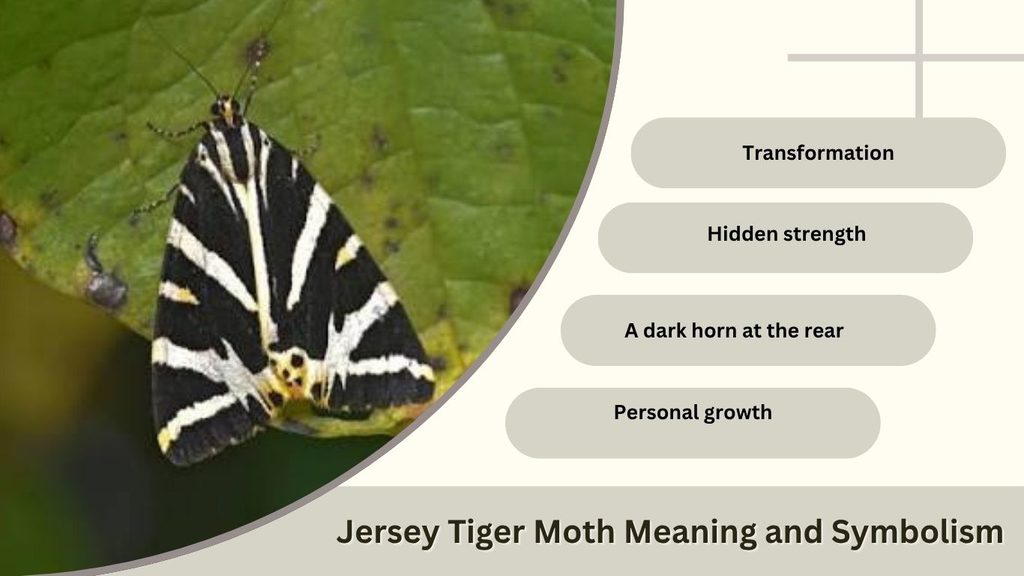
Because the Jersey Tiger hides brilliant orange-red hindwings beneath patterned forewings, people sometimes associate it with hidden beauty, transformation, confidence, or revealing one’s true personality. Its caterpillar-to-moth transformation also makes it an appealing symbol of personal growth and change.
Spiritual Meaning
There is no scientifically established or universal spiritual meaning for a Jersey Tiger Moth.
Modern personal interpretations may connect it with:
- Transformation
- Hidden strength
- Personal growth
- Confidence
- Change
- Creativity
These are symbolic interpretations rather than biological facts or traditional meanings shared by every culture.
FAQs
1. What is the scientific name of the Jersey Tiger Moth?
Its scientific name is Euplagia quadripunctaria. It is a tiger moth in the subfamily Arctiinae.
2. Are Jersey Tiger Moths rare?
They are still classified as Nationally Scarce in Britain, but their range is expanding rapidly and they can now be locally common in southern England and London.
3. What do Jersey Tiger caterpillars eat?
They eat nettles, ground-ivy, bramble, hemp-agrimony, white dead-nettle, plantain, borage, and other herbaceous plants.
4. Is a Jersey Tiger a butterfly or a moth?
It is a moth, even though its bright coloration and daytime flight frequently cause people to mistake it for a butterfly.
5. When do Jersey Tiger Moths fly in the UK?
Adults are mainly seen from July through September, with sightings peaking during midsummer. They are capable of flying during both daytime and nighttime.