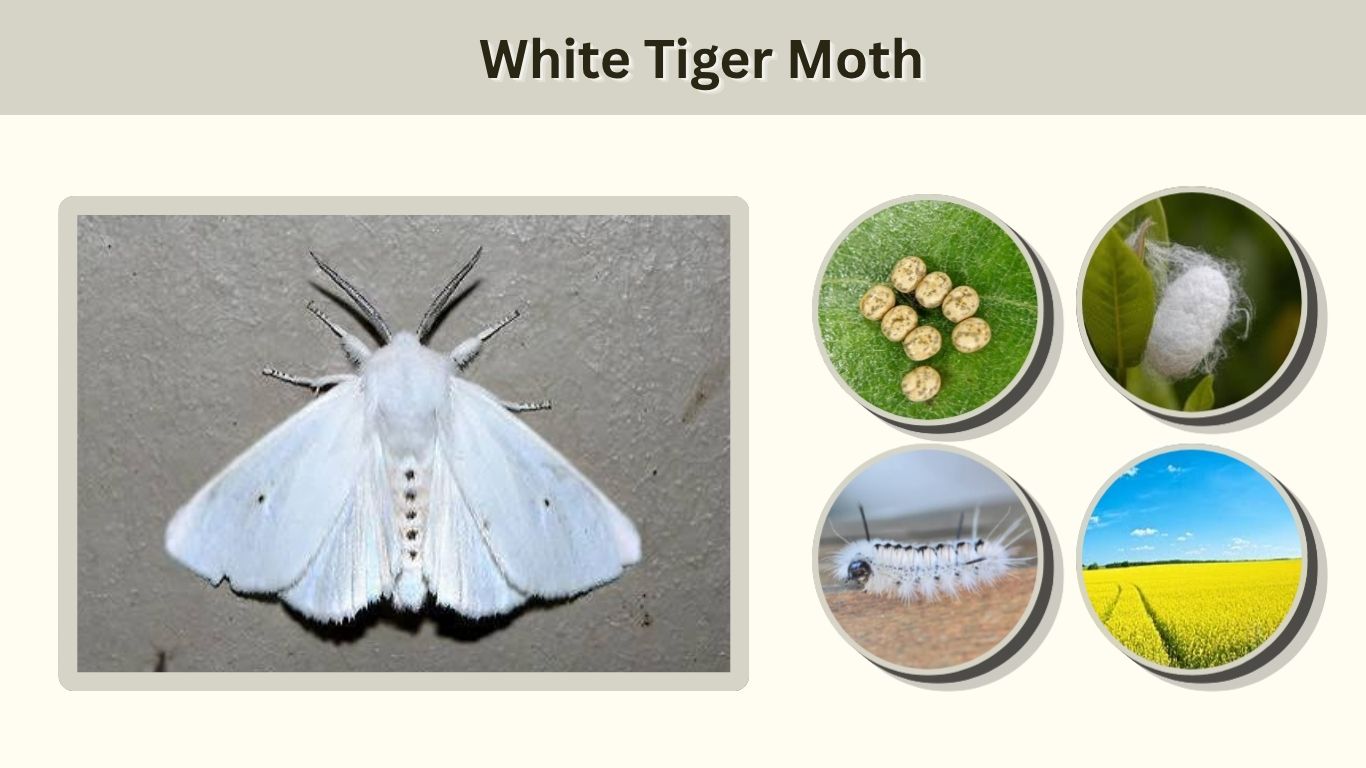
The white tiger moth, commonly associated with the Virginian Tiger Moth (Spilosoma virginica) in North America, is a pale, fuzzy moth with mostly white wings and small black markings. Its caterpillar is better known as the yellow woolly bear, although its color can range from creamy white and yellow to orange, reddish brown, or nearly black. This adaptable tiger moth occurs across much of North America and feeds on many garden plants, weeds, shrubs, and trees. Despite its hairy appearance, the caterpillar is not considered a stinging species.
What Does a White Tiger Moth Look Like?
Adult Virginian Tiger Moths are relatively simple compared with brightly colored tiger moth species. Their predominantly white appearance makes them easy to notice around porch lights at night. However, several closely related moths are also white, so identification should consider the abdomen, legs, wing markings, location, and caterpillar rather than relying on color alone.
White Tiger Moth Identification
Common features of Spilosoma virginica include:
- Scientific name: Spilosoma virginica
- Family: Erebidae
- Subfamily: Arctiinae
- Mostly white forewings and hindwings
- A few small black spots may occur on the wings
- White, furry thorax
- Yellow or orange coloration on parts of the abdomen
- Rows of dark abdominal spots
- Wingspan approximately 32–52 mm
- Nocturnal behavior
- Adults commonly attracted to lights
The amount of black spotting varies substantially. Some adults look almost completely white, while others have several clearly visible dark spots.
White Tiger Moth vs Agreeable Tiger Moth
The Agreeable Tiger Moth (Spilosoma congrua) can look extremely similar. One useful distinction is that S. virginica has yellow markings on the abdomen, while the abdomen of S. congrua is typically white.
Leg markings can provide additional identification clues, but separating these species from photographs may still be difficult.
White Tiger Moth Caterpillar
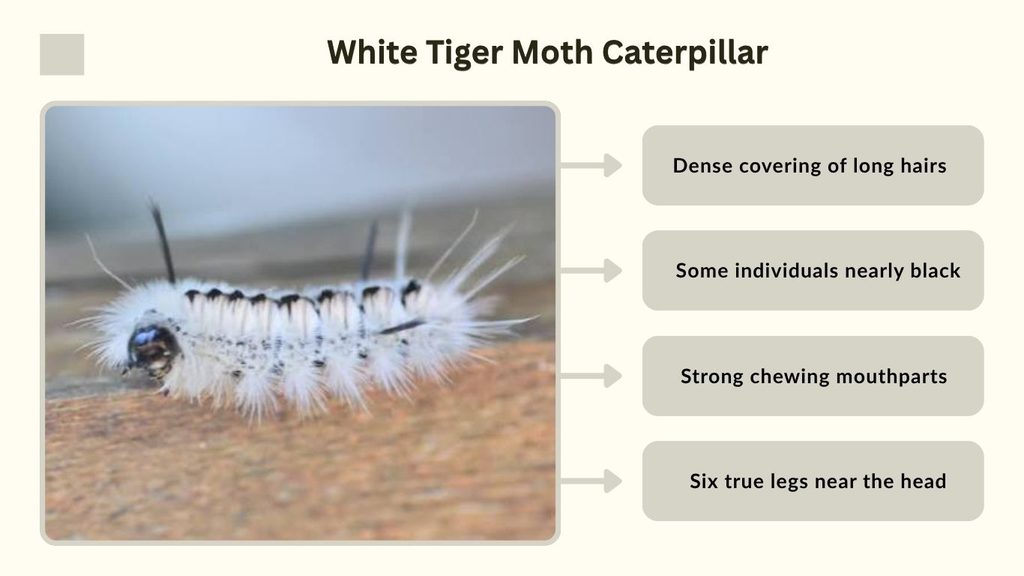
The caterpillar is much more variable in color than the adult. Known as the yellow woolly bear, it can actually be white, cream, yellow, orange, rust-colored, reddish brown, or almost black. Long soft hairs cover its body and give it the familiar fuzzy appearance. Mature caterpillars are frequently found crossing gardens, paths, fields, and other open areas.
What Does the Caterpillar Look Like?
Typical features include:
- Dense covering of long hairs
- White, cream, yellow, orange, or brown coloration
- Some individuals nearly black
- Several especially long hairs among shorter ones
- Pale or white spiracles along the body
- Strong chewing mouthparts
- Six true legs near the head
- Several pairs of fleshy abdominal prolegs
- Mature length approaching 50 mm
Color alone is unreliable because two caterpillars of the same species may look dramatically different.
Is the White Tiger Moth Caterpillar Poisonous?
The Virginian Tiger Moth caterpillar is not considered venomous and does not have specialized stinging hairs.
Its long setae are primarily protective rather than venom-delivering structures. However, hairy caterpillars can occasionally irritate sensitive skin through mechanical contact. An unfamiliar fuzzy caterpillar is therefore better observed without handling it unnecessarily.
The adult moth does not sting and is harmless to people.
What Do White Tiger Moth Caterpillars Eat?
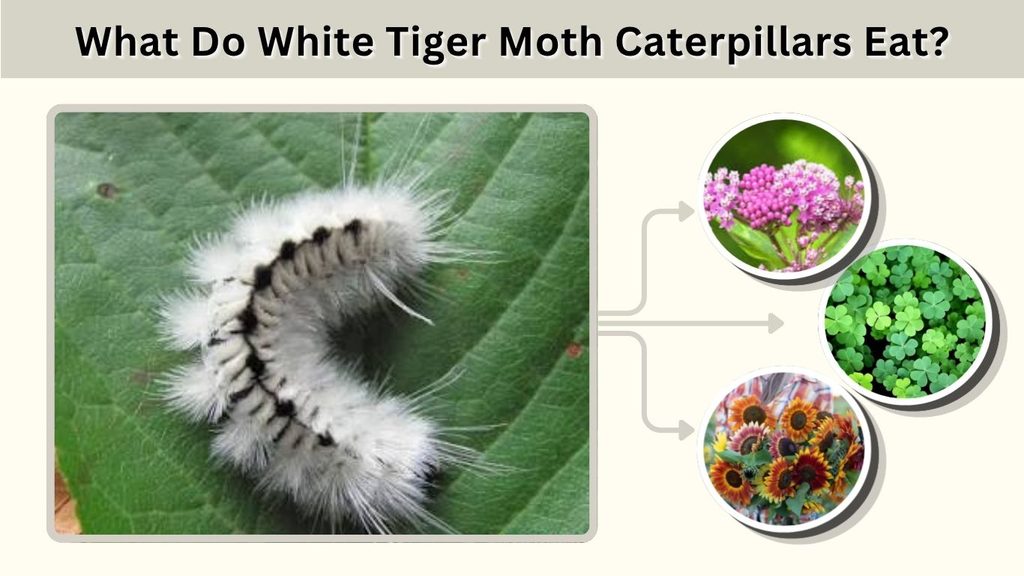
Virginian Tiger Moth caterpillars are generalist herbivores rather than specialists dependent on one host plant. This flexibility allows them to survive in gardens, fields, woodland edges, disturbed habitats, and agricultural areas. They commonly feed on low-growing plants but can also use shrubs and trees.
Common Food Plants
Their diet can include:
- Dandelion
- Plantain
- Clover
- Milkweed
- Sunflowers
- Garden vegetables
- Hemp
- Various weeds
- Herbaceous flowering plants
- Shrubs
- Leaves of some trees
Utah State University specifically lists field-grown hemp, numerous vegetable crops, and various weeds as hosts of the yellow woolly bear.
Are They Bad for Gardens?
Usually, a few caterpillars are not a serious problem.
Young larvae may feed together and create noticeable leaf damage, while older caterpillars disperse among different plants. High populations can skeletonize foliage and occasionally become minor crop pests.
In most home gardens, however, hand removal or simply tolerating a few caterpillars is sufficient unless valuable plants are being heavily defoliated.
White Tiger Moth Eggs and Life Cycle
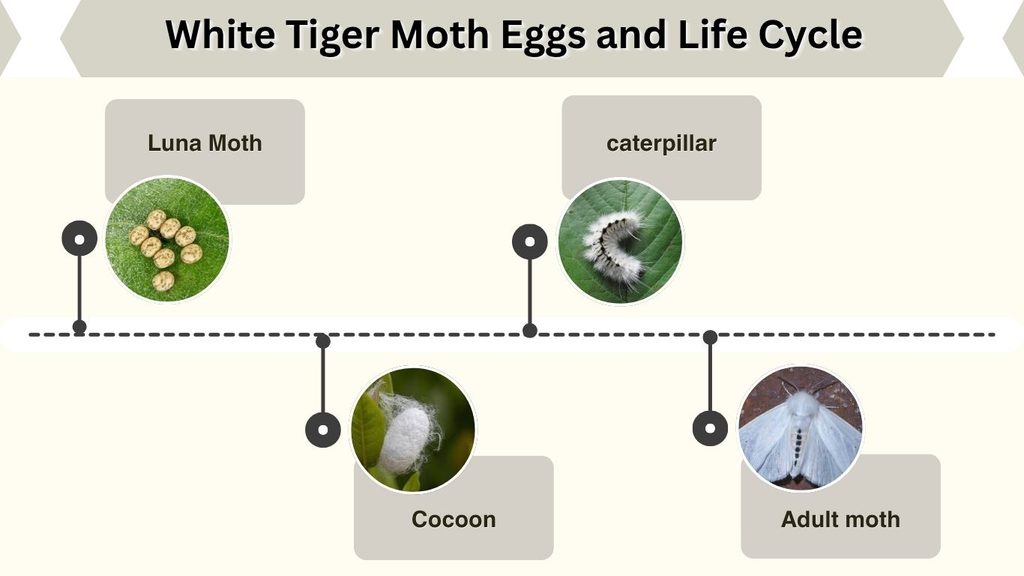
Like other moths, the Virginian Tiger Moth undergoes complete metamorphosis. The stages are egg, caterpillar, pupa, and adult. Multiple generations can occur during a warm growing season, while colder conditions interrupt development. In temperate regions, pupae commonly survive winter protected within cocoons among debris near the soil surface.
White Tiger Moth Life Cycle
The life cycle follows these stages:
- Egg: Females deposit clusters of small yellowish eggs on host leaves.
- Young caterpillar: Newly hatched larvae initially feed together.
- Mature caterpillar: Older larvae spread onto other host plants.
- Cocoon: The caterpillar combines silk with some of its own hairs.
- Pupa: Metamorphosis occurs inside the cocoon.
- Adult moth: The white moth emerges, mates, and starts another generation.
Utah State University reports two to three generations per growing season in suitable climates.
What Do the Eggs Look Like?
Eggs are small, yellowish, and generally deposited in groups on foliage.
Egg color can even help distinguish similar species. BugGuide notes that S. virginica egg masses are typically yellow, whereas Agreeable Tiger Moth eggs tend to be white and Fall Webworm eggs are very pale green.
White Tiger Moth Cocoon and Overwintering
Before becoming an adult, the mature woolly bear stops feeding and searches for a sheltered location. It then produces a cocoon using silk mixed with hairs shed from its body. Depending on season and climate, the pupa may produce an adult relatively quickly or remain dormant until warmer weather returns.
What Does the Cocoon Look Like?
The cocoon generally appears:
- Brown or grayish
- Loosely constructed
- Made from silk
- Mixed with larval hairs
- Hidden in plant litter or sheltered debris
BugGuide photographs document S. virginica cocoons containing visible caterpillar hairs.
A summer pupa may emerge within a few weeks. One documented captive individual emerged after about 16 days, although late-season pupae can instead overwinter.
How Does the Moth Survive Winter?
In colder regions, the species commonly overwinters as a pupa inside its cocoon.
The adult then emerges after temperatures warm. This seasonal strategy allows the new generation to coincide with abundant spring and summer vegetation.
Habitat and Range of the White Tiger Moth
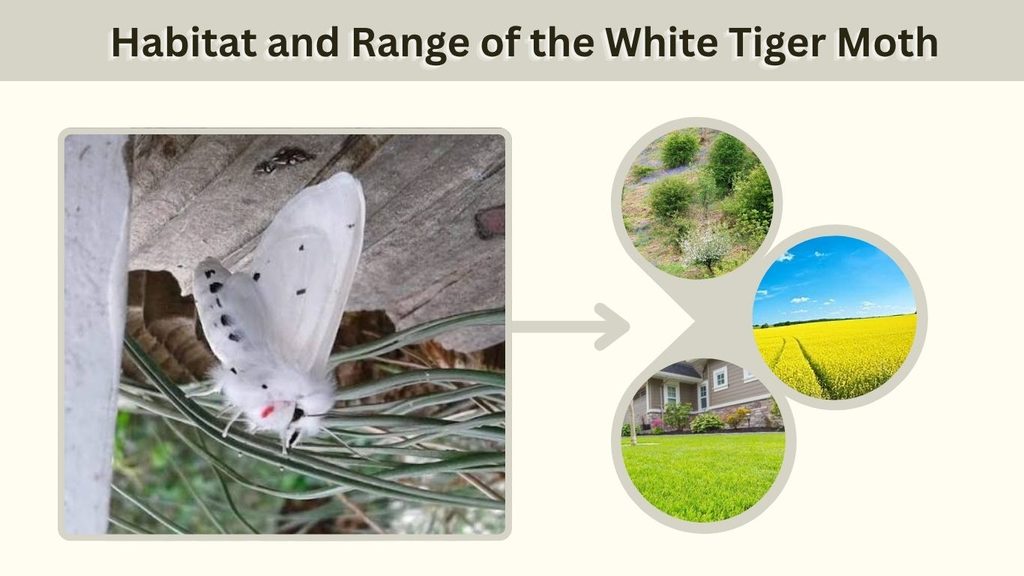
The Virginian Tiger Moth is widespread across much of North America and is particularly common toward the eastern part of the continent. It is frequently encountered in human-modified environments because its caterpillar can eat such a broad variety of plants. Gardens and yards can therefore provide both food for caterpillars and lights that attract adults.
Where Does It Live?
Typical habitats include gardens, yards, fields, woodland edges, bottomlands, open forests, roadsides, and other places supporting herbaceous vegetation.
The species occurs across much of the United States and parts of Canada. Records extend from eastern regions into western North America, although abundance varies geographically.
What About White Tiger Moths in the UK?
A white spotted moth in Britain should not automatically be identified as Spilosoma virginica.
The much more likely British species is the White Ermine (Spilosoma lubricipeda), another member of the tiger moth subfamily. It has white wings with variable black spots and is widespread and fairly common across Britain. Adults generally fly from May through July and have a wingspan of about 34–48 mm.
Black and White Tiger Moth Lookalikes
Several moths can resemble a white or black-and-white tiger moth. Because white wings with dark spots evolved in multiple related species, a photograph showing only the upper wings may not always provide enough information for species-level identification.
Common Lookalikes
The most relevant include the Agreeable Tiger Moth (Spilosoma congrua), Fall Webworm Moth (Hyphantria cunea), and, in Britain, the White Ermine (Spilosoma lubricipeda).
The Fall Webworm is especially important because adults can range from completely white to heavily spotted, while its caterpillars are associated with conspicuous communal webs on trees.
For difficult white moths, geographic location plus clear photographs of the wings, abdomen, and legs provide the best chance of accurate identification.
FAQs
1. What is the scientific name of the white tiger moth?
When the name refers to the North American Virginian Tiger Moth, the scientific name is Spilosoma virginica. “White tiger moth” itself is not a precise standardized species name.
2. Is the white tiger moth poisonous?
The adult Virginian Tiger Moth is not dangerous to people. Its caterpillar is not considered venomous or a true stinging caterpillar.
3. What does a white tiger moth caterpillar look like?
It is a hairy woolly bear that can be white, yellow, orange, reddish brown, or nearly black. Mature individuals may approach 50 mm long.
4. What do white tiger moth caterpillars eat?
They eat many low-growing plants, weeds, vegetables, shrubs, and some trees. Their broad diet is one reason they are common around gardens.
5. Is the white tiger moth found in the UK?
The North American Spilosoma virginica is not the typical British white moth. In the UK, a similar moth is more likely the White Ermine (Spilosoma lubricipeda), which is widespread across Britain.