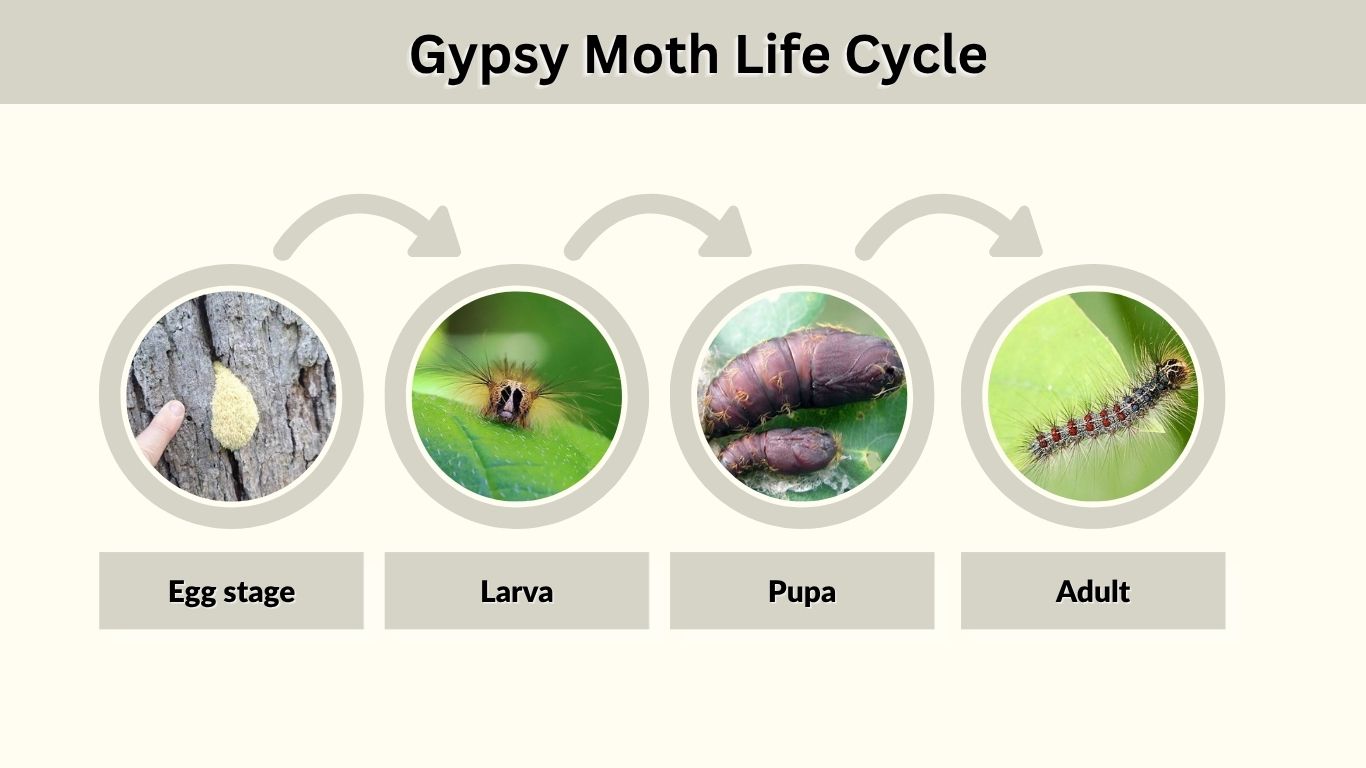
The gypsy moth, now officially called the spongy moth, completes four distinct life stages: egg, larva, pupa, and adult. Although adult moths survive for only about one week, the complete life cycle lasts approximately one year because the insect spends fall and winter inside its egg. Caterpillars hatch during spring and feed heavily on oak and other trees before pupating in early summer. Understanding this seasonal timeline helps property owners identify damaging caterpillars, remove egg masses, and select control methods at the most effective time.
What Are the Gypsy Moth Life Stages?
The spongy moth (Lymantria dispar dispar) undergoes complete metamorphosis. This means its immature stages look and behave entirely differently from the adult. The species generally produces one generation each year across its established North American range, although seasonal timing changes with temperature, latitude, elevation, and spring leaf development.
Four Stages of the Life Cycle
The four stages are:
- Egg: Remains dormant through fall and winter
- Larva: Hatches in spring and feeds on foliage
- Pupa: Transforms into an adult during early summer
- Adult: Mates and produces the next generation of eggs
The caterpillar is the only stage that feeds and damages trees. Adults do not eat and live mainly to reproduce.
Gypsy Moth Life Cycle Timeline
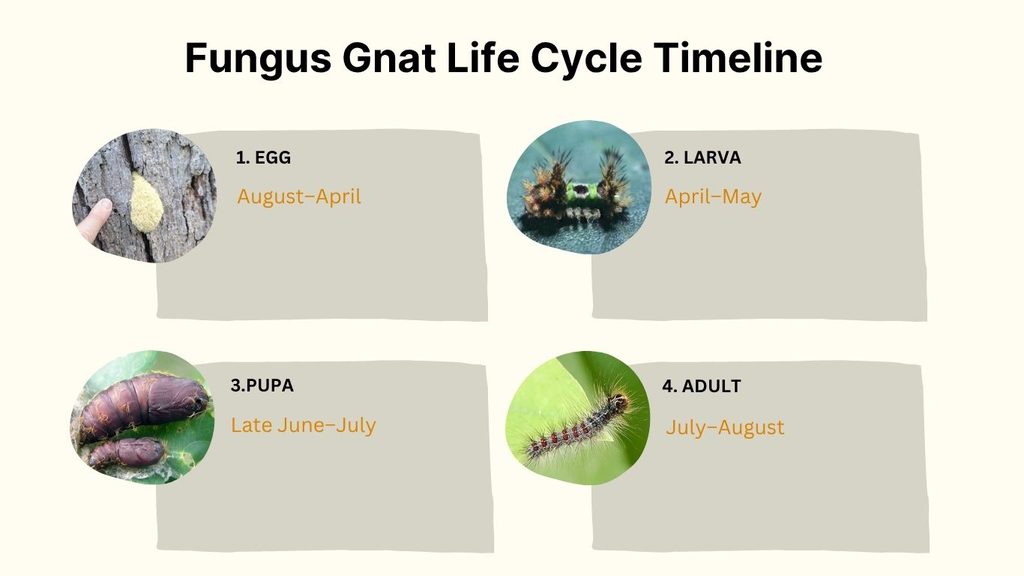
In New England, New York, Michigan, and other northern parts of the established range, the cycle generally begins with egg hatch in April or May. It ends when females deposit new egg masses during July or August.
| Approximate period | Primary life stage | Main activity |
| August–April | Egg | Embryo develops and remains dormant |
| April–May | Young larva | Eggs hatch and larvae disperse |
| May–June | Growing caterpillar | Larvae feed and molt |
| Late June–July | Pupa | Adult develops inside pupal case |
| July–August | Adult | Mating and egg laying occur |
Warm spring temperatures can produce earlier hatching, while cold weather may delay development. Southern populations generally begin earlier than those in northern New England, Canada, or high-elevation locations.
Life Cycle in Michigan
In Michigan, caterpillars commonly emerge from their egg masses during April and feed through late June. Pupation and adult activity follow during summer. The insects spend the remainder of the year as eggs.
The precise hatch date depends on local weather and tree development. Michigan officials recommend looking for tan, fuzzy egg masses before caterpillars emerge.
Life Cycle in New York and New England
In New York, Massachusetts, Connecticut, Rhode Island, and nearby states, caterpillar activity is most noticeable from spring through late June. Pupae and adults typically begin appearing in late June or early July.
A cool spring may extend caterpillar activity into July. Egg masses remain visible from late summer until the following spring, making autumn and winter useful times for inspection and removal.
Stage 1: Gypsy Moth Eggs
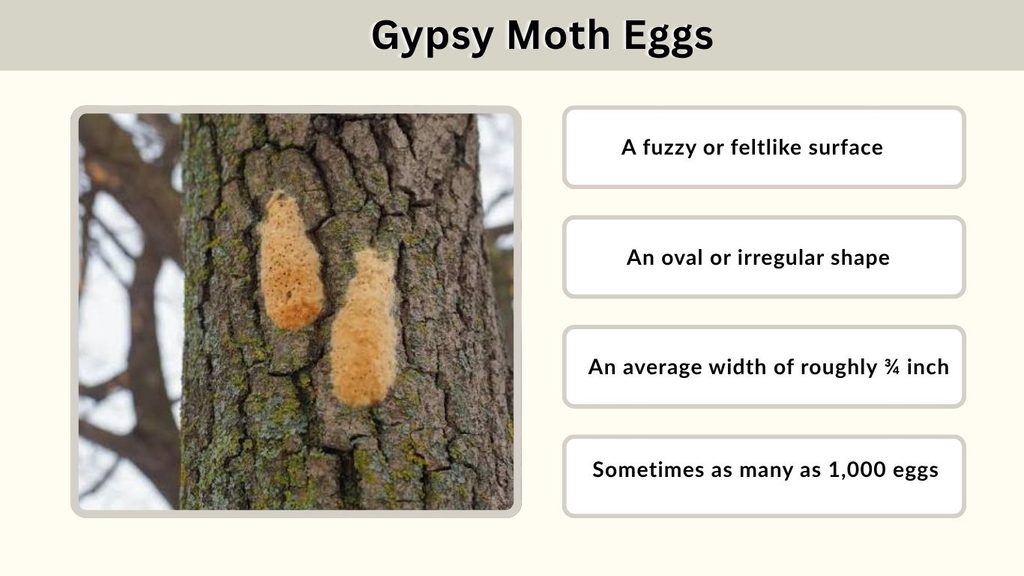
After mating, a female deposits one large egg mass on a tree or almost any protected outdoor surface. She covers the eggs with buff-colored hairs from her abdomen, giving the mass the spongelike texture responsible for the insect’s new common name.
What Do Egg Masses Look Like?
Spongy moth egg masses typically have:
- Buff, tan, or yellowish coloring
- A fuzzy or feltlike surface
- An oval or irregular shape
- An average length of approximately 1½ inches
- An average width of roughly ¾ inch
- Several hundred eggs inside
- Sometimes as many as 1,000 eggs
Egg masses gradually fade and may become dirty or weathered. Old masses can remain attached after hatching, so opening or examining the eggs may be necessary to determine whether they are viable.
Where Are Eggs Laid?
Females may attach egg masses to:
- Tree trunks and branches
- Spaces beneath loose bark
- Firewood and logs
- Rocks and stone walls
- House siding
- Fences and signs
- Vehicles and trailers
- Patio furniture
- Grills and lawn equipment
- Children’s outdoor toys
Placing eggs on movable objects helps the species spread beyond its natural range. Anyone moving from a regulated area should inspect outdoor belongings carefully.
What Happens Inside the Egg?
Embryos develop for several weeks after the eggs are laid. The fully developed larvae then remain inside their eggs in a dormant state called diapause.
This protected stage survives winter cold and changing moisture. Increasing spring temperatures end dormancy, and hatching usually coincides with the emergence of new leaves on host trees.
Stage 2: Gypsy Moth Caterpillar
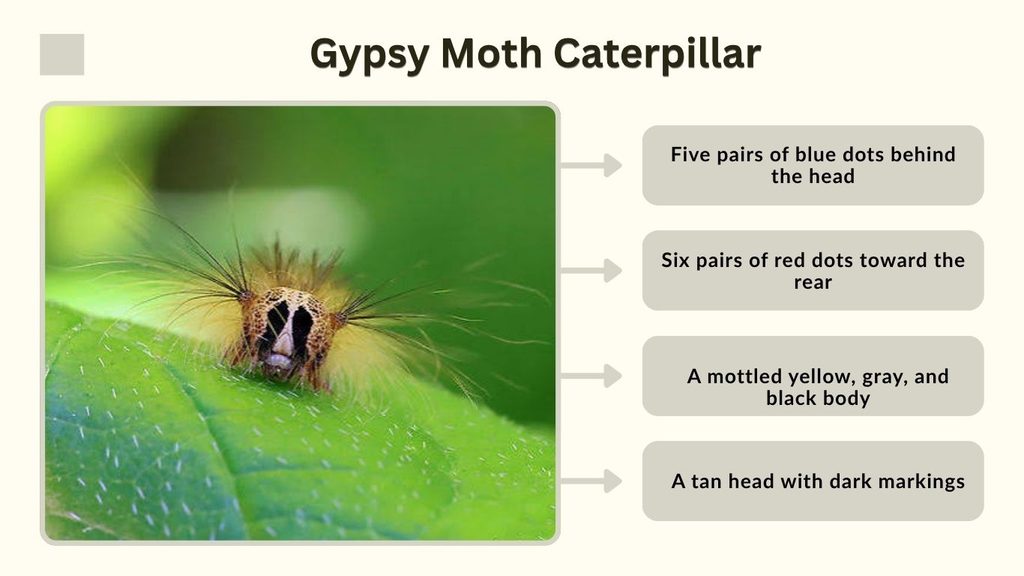
The larval stage lasts approximately six to eight weeks and causes all feeding damage. Caterpillars grow rapidly, repeatedly shed their skin, and consume increasingly large amounts of foliage as they mature.
Newly Hatched Caterpillars
New larvae are approximately ⅛ inch long, dark, and covered with fine hairs. After hatching, they climb upward and release silk threads.
Wind catches these threads and carries the tiny larvae to other trees, a dispersal process called ballooning. Larvae that land on a suitable host begin feeding on new leaves. Others may be blown to unsuitable locations and die.
Caterpillar Instars
The period between two molts is called an instar. European-form males usually complete five larval instars, while females typically complete six. Females require an additional stage to gain enough body mass for egg production.
Young caterpillars commonly feed during daylight. As they grow, they often feed at night and hide during the day beneath bark, burlap bands, outdoor objects, or other shaded surfaces.
Mature Caterpillar Identification
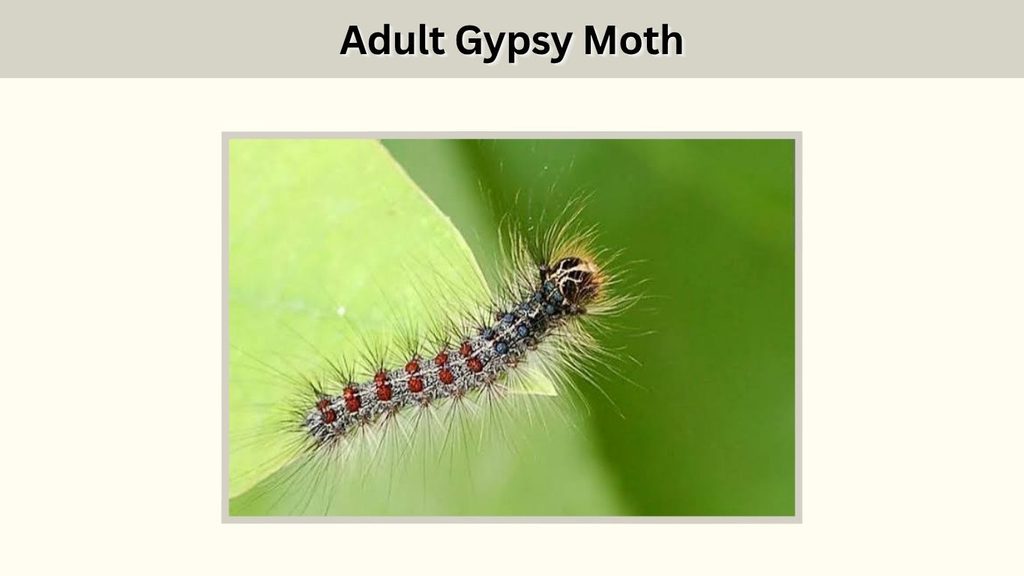
A mature caterpillar has:
- Five pairs of blue dots behind the head
- Six pairs of red dots toward the rear
- A mottled yellow, gray, and black body
- Numerous long, bristle-like hairs
- A tan head with dark markings
- A length of approximately 1½–2½ inches
The hairs can irritate sensitive skin. Wear gloves and protective clothing when handling caterpillars, pupae, shed skins, or objects covered with their hairs.
Feeding and Tree Damage
Young larvae create small holes in leaves, while older caterpillars may consume nearly everything except the main veins. Oaks are preferred, but larvae feed on hundreds of plant species.
A healthy deciduous tree can often survive one year of defoliation. Repeated leaf loss depletes its energy reserves and increases susceptibility to drought, diseases, and wood-boring insects. Conifers may suffer more severe consequences because they cannot replace completely lost foliage as readily.
Stage 3: Gypsy Moth Pupa
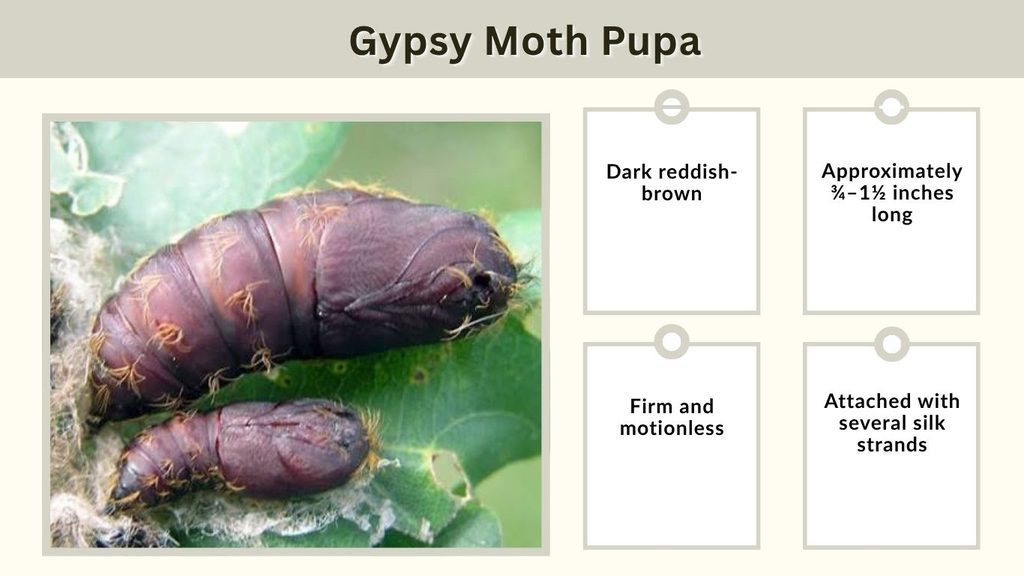
After completing its final larval stage, the caterpillar stops feeding and searches for a protected pupation location. It may choose a bark crevice, branch, stone wall, vehicle, fence, woodpile, building, or the underside of outdoor equipment.
What Does the Pupa Look Like?
The pupa is:
- Dark reddish-brown
- Approximately ¾–1½ inches long
- Firm and motionless
- Attached with several silk strands
- Frequently located in a sheltered crevice
- Sometimes surrounded by shed caterpillar hairs
Female pupae are generally larger than males. Inside, the caterpillar’s body is reorganized into the wings, antennae, reproductive organs, and other structures of an adult moth.
Does a Gypsy Moth Make a Cocoon?
No. The caterpillar may produce a small amount of silk to secure itself, but it does not build a fully enclosed cocoon.
The exposed brown pupal case is often mistakenly called a gypsy moth cocoon. Pupation usually lasts approximately 10–14 days, although temperature can shorten or lengthen the stage.
Stage 4: Adult Gypsy Moth
Adults emerge during summer, often from late June through August. Males generally emerge slightly before females, increasing the likelihood that a mate will be available when a female appears.
Male Adult Moth
The male is brown with dark wavy markings and large, feathery antennae. He flies rapidly during daylight in a zigzag pattern while following the female’s chemical pheromone.
His erratic flight may resemble a butterfly, but he is searching for females rather than visiting flowers. Adult spongy moths do not feed.
Female Adult Moth
The European-form female is larger, creamy white, and marked with dark zigzag lines. She has developed wings but cannot fly.
After emerging, she releases pheromones that attract males. Following mating, she deposits one egg mass close to the place where she pupated. She then dies, leaving the eggs to overwinter and begin the next generation.
Adult Lifespan
Adult moths commonly live for approximately one week. They rely on energy stored during the caterpillar stage because their adult mouthparts do not function for feeding. Their short adult life is dedicated almost entirely to mating and egg production.
How Long Is the Complete Gypsy Moth Life Cycle?
The complete cycle lasts approximately one year, with one generation produced annually. However, the insect spends most of that year inside the egg.
Its visibly active development—from spring egg hatch through summer adult reproduction—lasts only about two to three months. The adult stage is the shortest, while the overwintering egg stage is the longest.
Asian Gypsy Moth Life Cycle
The group previously called the Asian gypsy moth is now known as the flighted spongy moth complex. It also develops through egg, larva, pupa, and adult stages and generally produces one generation annually.
The most important difference is that adult females in the Asian complex can fly. They may travel from forests to illuminated ports and deposit egg masses on vessels, containers, and cargo. Exact seasonal timing varies across China, Japan, Korea, and far eastern Russia.
Natural Population Decline
Spongy moth numbers do not remain high every year. Outbreaks often increase for several seasons and then collapse because of limited food, predators, weather, and naturally occurring diseases.
The fungus Entomophaga maimaiga is especially effective during wet spring conditions. Infected caterpillars commonly die hanging head downward. A nucleopolyhedrosis virus spreads rapidly through dense populations and often leaves dead caterpillars hanging in an inverted V shape.
These natural controls do not eliminate the species, but they can dramatically reduce caterpillar numbers after a major outbreak.
FAQs
How many stages are in the gypsy moth life cycle?
There are four stages: egg, larva or caterpillar, pupa, and adult moth.
How long does a gypsy moth live?
The complete life cycle lasts about one year. The adult lives for roughly one week, while the insect spends most of its life inside the overwintering egg.
What month do gypsy moth caterpillars appear?
They usually hatch in April or May and feed through June in northern U.S. regions. Local weather may shift the dates.
Do gypsy moth caterpillars make cocoons?
No. They attach themselves with a few silk strands and form an exposed brown pupa rather than a complete cocoon.
What is the best stage for controlling gypsy moths?
Egg masses can be removed during fall and winter. Btk treatments are most effective against small, newly hatched caterpillars during spring.