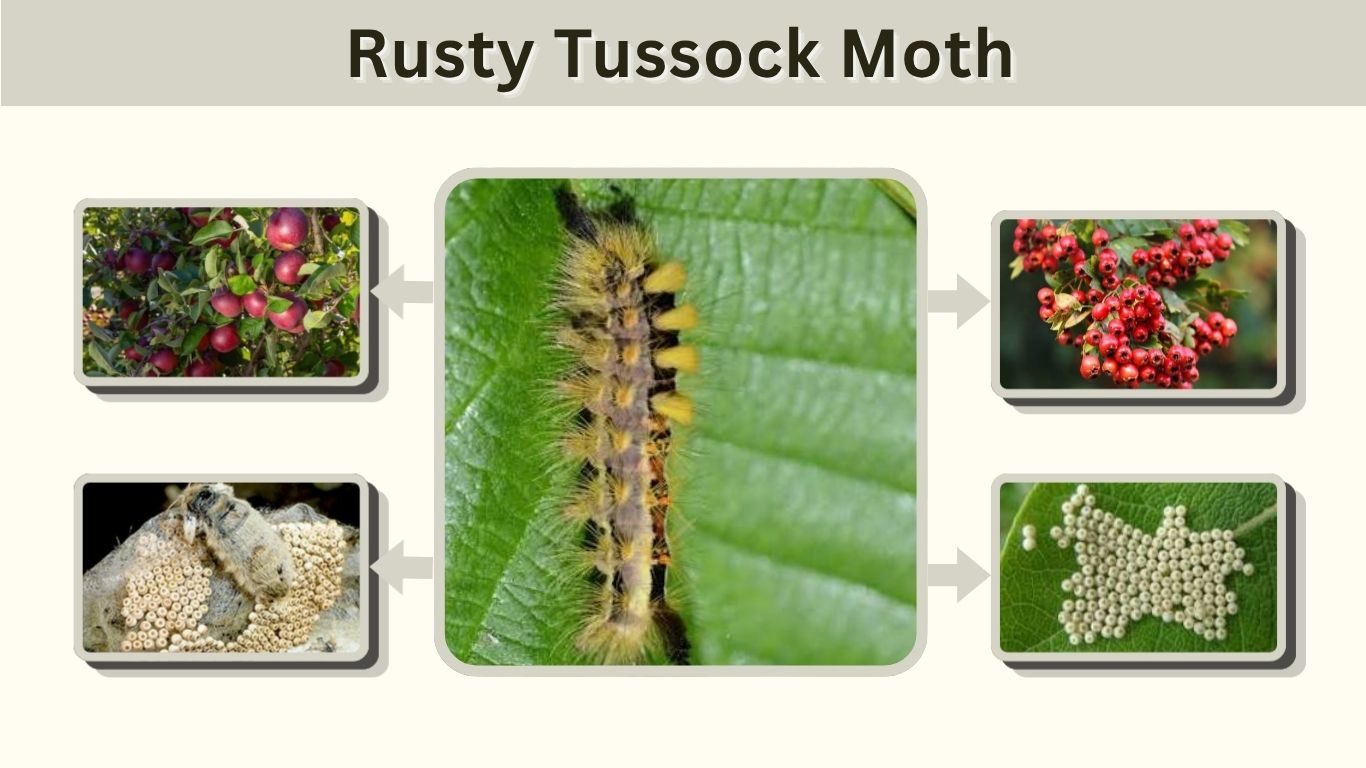
The rusty tussock moth (Orgyia antiqua) is a distinctive species found across the UK, Europe, parts of Asia, Canada, and the United States. It is also called the vapourer moth. Its colorful caterpillar has four brush-like tufts, long dark hairs, and bright red markings. Although these features may make it look dangerous, the caterpillar is not poisonous or venomous. However, its hairs may irritate sensitive skin, so handling it directly is not recommended.
What Is a Rusty Tussock Moth?
The rusty tussock moth belongs to the family Erebidae. It is best known for its unusually dramatic caterpillar and the major differences between adult males and females.
Adult males have fully developed wings and fly quickly while searching for mates. Adult females are almost completely wingless and spend their short adult lives on or near their cocoons.
“Rusty tussock moth” is commonly used in North America, while “vapourer moth” is the more familiar name in the UK. Both names refer to the same species, Orgyia antiqua.
Rusty Tussock Moth Identification
- Male wingspan: approximately 25–30 mm
- Male color: rusty orange, reddish brown, or chestnut brown
- Wing markings: one small white spot on each forewing
- Male antennae: large, broad, and feathery
- Female appearance: plump, grayish, and virtually wingless
- Caterpillar length: approximately 30–40 mm when mature
- Caterpillar features: four dorsal tufts, red bumps, and long dark hair pencils
The adult male’s uneven, zigzagging flight is often noticeable during daylight. It may resemble a falling brown leaf as it moves rapidly through gardens and wooded areas.
Rusty Tussock Moth Caterpillar
The rusty tussock moth caterpillar is much more colorful than the adult. Its body may display combinations of black, gray, yellow, white, red, and orange.
Four dense tufts run along the center of its back. These tufts look like small shaving brushes or toothbrushes and may be cream, yellow, gray, or brown. Long black hairs project near the head and rear, while red or orange spots often line the body.
A baby rusty tussock moth caterpillar is much smaller and usually has less prominent tufts. As it grows, it sheds its outer skin several times. Each developmental stage between molts is called an instar.
Coloration can vary between individuals, so identification should consider the arrangement of the tufts and hair pencils rather than color alone.
Are Rusty Tussock Moth Caterpillars Poisonous?
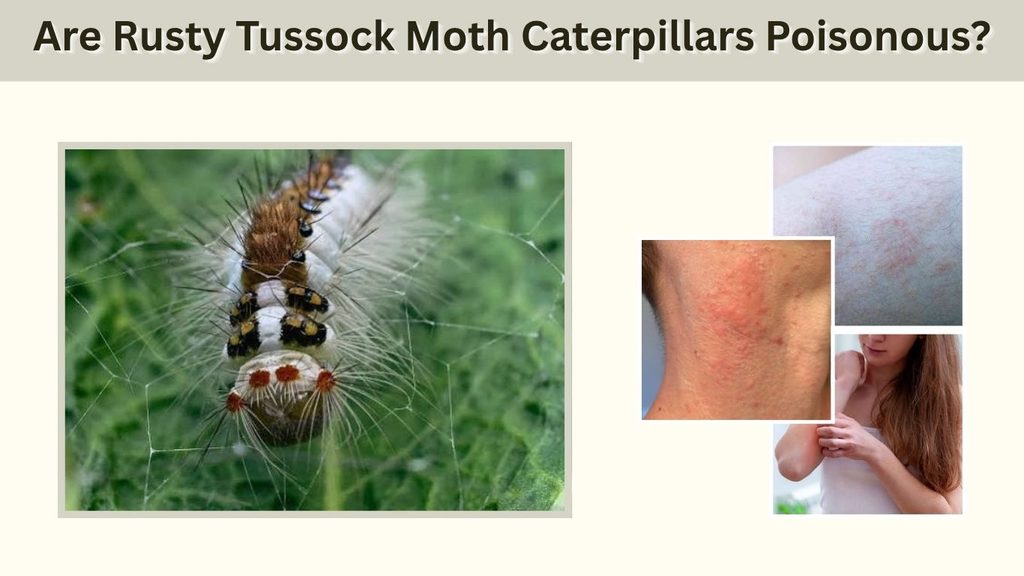
Rusty tussock moth caterpillars are not poisonous or venomous. They do not produce a toxin that poisons people through ordinary contact, and they do not have a stinger.
However, their numerous hairs can cause mechanical irritation or an allergic response in some individuals. A person may develop symptoms even though the caterpillar is not truly poisonous.
Possible reactions include:
- Itchy or prickling skin
- Localized redness
- Small raised bumps
- A mild burning sensation
- Watery or irritated eyes
- A temporary caterpillar rash
Children and people with sensitive skin may be more likely to experience discomfort. Reactions can also occur when loose hairs become trapped in clothing or are transferred from the hands to the face.
What to Do After Contact
Do not rub the affected area, as this can push hairs farther into the skin. Wash gently with soap and cool water. Sticky tape may help lift loose hairs from the surface before washing.
Change and wash any clothing that may contain caterpillar hairs. Seek medical attention if the reaction becomes severe, affects the eyes, spreads across the body, or causes facial swelling or breathing difficulty.
Can a Rusty Tussock Moth Caterpillar Sting?
The caterpillar cannot deliver a genuine sting because it has no stinger or venom-injecting spine. The prickling sensation sometimes described as a rusty tussock moth sting comes from its hairs contacting the skin.
It is better to observe the caterpillar without touching it. If one must be moved away from a doorway, play area, or valuable plant, wear gloves and use a leaf or container.
The adult moth cannot sting or bite people. Both male and female adults are harmless.
What Do Rusty Tussock Moth Caterpillars Eat?
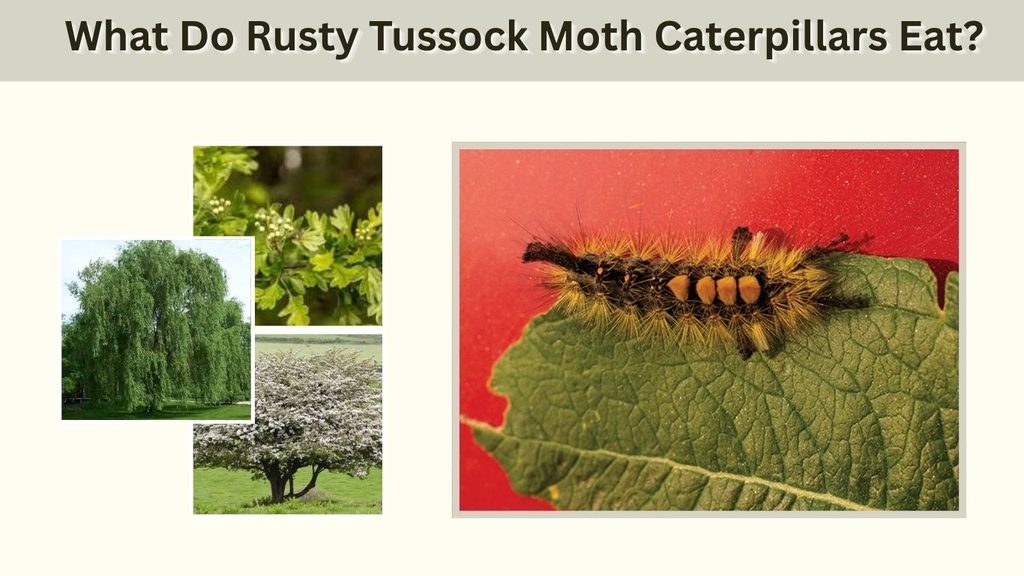
Rusty tussock moth caterpillars feed on many broadleaf trees, shrubs, fruit trees, and ornamental plants. They are generalist feeders rather than specialists dependent on one host.
Common food plants include:
- Oak
- Birch
- Willow
- Hawthorn
- Hazel
- Maple
- Alder
- Apple
- Pear
- Plum
- Cherry
- Rose
- Raspberry
- Wisteria
The larvae chew irregular holes in leaves and may eat around the edges. A few caterpillars normally cause only cosmetic damage. Larger groups may defoliate young trees or small ornamental shrubs.
Healthy, established trees generally recover from light or moderate feeding. Recently planted trees, fruit saplings, and container plants are more vulnerable and should be monitored.
Rusty Tussock Moth Life Cycle
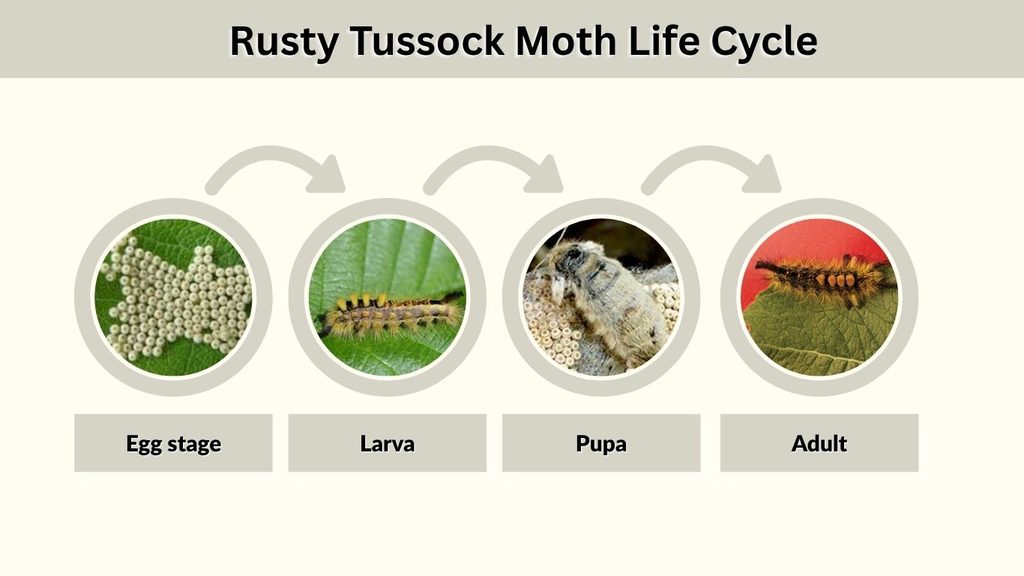
The rusty tussock moth develops through four stages: egg, caterpillar, pupa, and adult. Its life cycle is notable because the flightless female lays her eggs directly on her old cocoon.
Eggs
After mating, the female deposits a large cluster of pale, rounded eggs on or around the cocoon from which she emerged. The eggs usually remain there throughout winter.
Egg-covered cocoons may be attached to tree bark, branches, fences, walls, outdoor furniture, or plant supports. The eggs hatch when temperatures rise and fresh leaves become available.
Caterpillars
Newly hatched caterpillars begin feeding during spring. Some young larvae disperse by producing silk threads that allow the wind to carry them to nearby plants.
The caterpillars pass through several instars and become increasingly hairy with each molt. Mature larvae develop the characteristic four back tufts and long black hair pencils.
Cocoon and Pupa
Once fully grown, the caterpillar creates a loose silken cocoon. It often incorporates some of its body hairs into the silk, making the cocoon appear fuzzy.
Cocoons may be hidden between leaves, in bark crevices, on fences, or against buildings. The caterpillar transforms into a pupa inside before emerging as an adult moth.
Adult Moths
Adult males are generally active from summer into early autumn, although timing varies with climate. Warmer locations may support more than one generation in a year.
The adults do not live for long. Their primary purpose is reproduction, and they do little or no feeding.
Female Rusty Tussock Moth
The female rusty tussock moth looks very different from the flying male. She has a large grayish or yellow-brown abdomen, short legs, and greatly reduced wings that cannot support flight.
After emerging, she remains on her cocoon and releases pheromones into the air. Males detect these chemical signals with their feathery antennae and fly toward her.
After mating, the female lays her eggs directly on the cocoon. She normally dies shortly afterward, leaving the eggs to overwinter in the same location.
Where Are Rusty Tussock Moths Found?
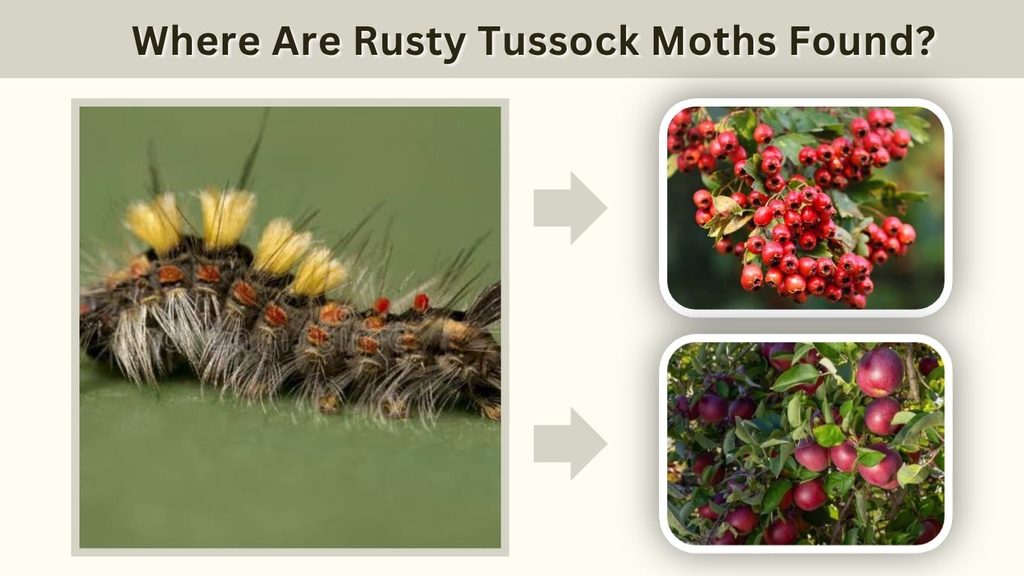
The rusty tussock moth occurs across much of Europe and Asia and has also become established across broad parts of North America. Suitable habitats include:
- Deciduous and mixed woodland
- Gardens and parks
- Orchards
- Hedgerows
- Urban areas with trees
- Coastal scrub
- Forest edges
In the UK, the species is widespread and commonly called the vapourer moth. It also occurs in many parts of Canada and the northern United States, including areas of Alaska and Washington State.
Populations may be reported in California and other western states, although their abundance varies considerably by region, elevation, available host plants, and local climate.
Rusty Tussock Moth Control
Control is unnecessary when only one or two caterpillars are present. These insects are part of the natural food chain and are eaten or parasitized by birds, predatory insects, and parasitoid wasps.
When numerous larvae threaten a small or valuable plant, the following methods may help:
- Inspect plants regularly during spring and early summer.
- Wear gloves and remove caterpillars by hand.
- Check branches and outdoor structures for egg-covered cocoons.
- Prune heavily infested shoots when appropriate.
- Encourage birds and beneficial insects in the garden.
- Avoid broad-spectrum pesticides that kill natural predators.
If treatment becomes necessary, select a product specifically labeled for caterpillar control on the affected plant. Young larvae are generally easier to manage than mature caterpillars.
FAQs
Is the rusty tussock moth dangerous to humans?
It is not considered dangerous or venomous. However, caterpillar hairs may cause itching, redness, or an allergic skin reaction in sensitive individuals.
Can rusty tussock moths harm cats?
The moth is not known to be poisonous to cats, but caterpillar hairs could irritate a cat’s mouth, eyes, or skin. Contact a veterinarian if significant drooling, swelling, vomiting, or breathing difficulty occurs.
What does a rusty tussock moth look like?
The male is a small rusty-brown moth with feathery antennae and white wing spots. The female is grayish and wingless, while the caterpillar has four brush-like back tufts and long black hairs.
Are rusty tussock moths and vapourer moths the same?
Yes. Rusty tussock moth and vapourer moth are two common names for Orgyia antiqua. Vapourer moth is used more frequently in the UK.
Should I remove rusty tussock moth caterpillars?
A small number can normally be left alone. Consider removing them when they are causing substantial damage to young trees, fruit plants, or valuable ornamental shrubs.