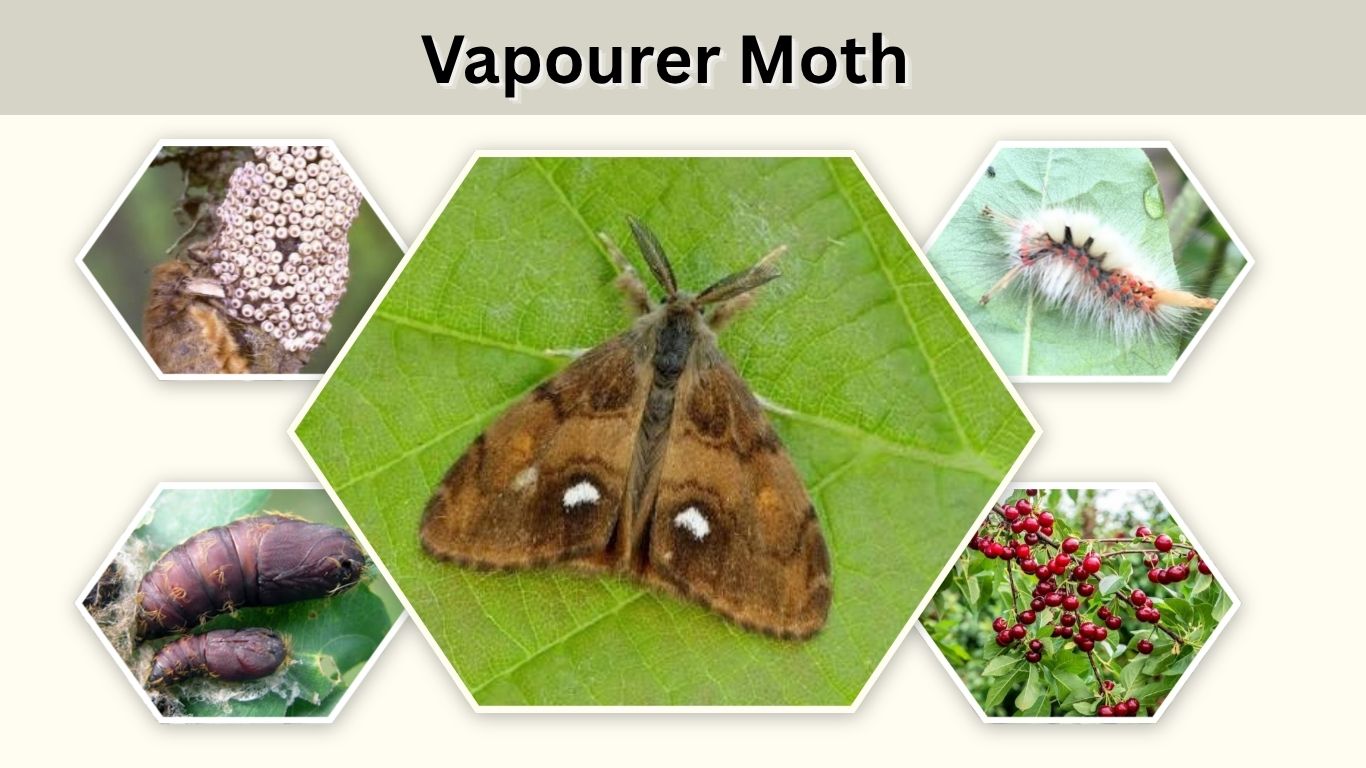
The vapourer moth (Orgyia antiqua), also called the rusty tussock moth, is known for its brightly colored, hairy caterpillar and unusual wingless female. It occurs throughout the UK and in many other parts of Europe, Asia, and North America. Although its dramatic appearance often raises concerns, the caterpillar is not considered poisonous. However, avoiding direct contact is sensible because hairy caterpillars may cause irritation in sensitive people.
What Is a Vapourer Moth?
The vapourer moth belongs to the tussock moth group. Its scientific name is Orgyia antiqua. The species is unusual because adult males and females look completely different.
Male vapourer moths fly actively during the day while searching for females. Females have extremely reduced wings and remain close to the cocoon from which they emerged.
Vapourer Moth Identification
- Male wingspan: approximately 25–30 mm
- Male color: rusty orange to reddish brown
- Wing markings: a noticeable white spot near the corner of each forewing
- Antennae: broad and feathery in males
- Female appearance: plump, grayish brown, and almost wingless
- Caterpillar length: usually up to 30–40 mm
- Caterpillar markings: four brush-like tufts along the back, red spots, and long dark hair pencils
The male’s rapid, zigzagging daytime flight can make it difficult to observe. Despite being a day-flying species, males may also visit artificial lights at night.
Vapourer Moth Caterpillar Identification
The vapourer moth caterpillar is one of the most distinctive hairy caterpillars found in British gardens. Its body combines red, black, yellow, gray, and white markings.
Four dense, toothbrush-like tufts normally appear along the middle of the back. These tufts may be creamy white, yellowish, brown, or gray. Longer black hair pencils project from the front and rear of the body. Small red or orange bumps may also be visible along its sides.
Young larvae look darker and less developed than mature caterpillars. Their colors and tufts become more noticeable as they pass through successive growth stages called instars.
Is the Vapourer Moth Caterpillar Poisonous?
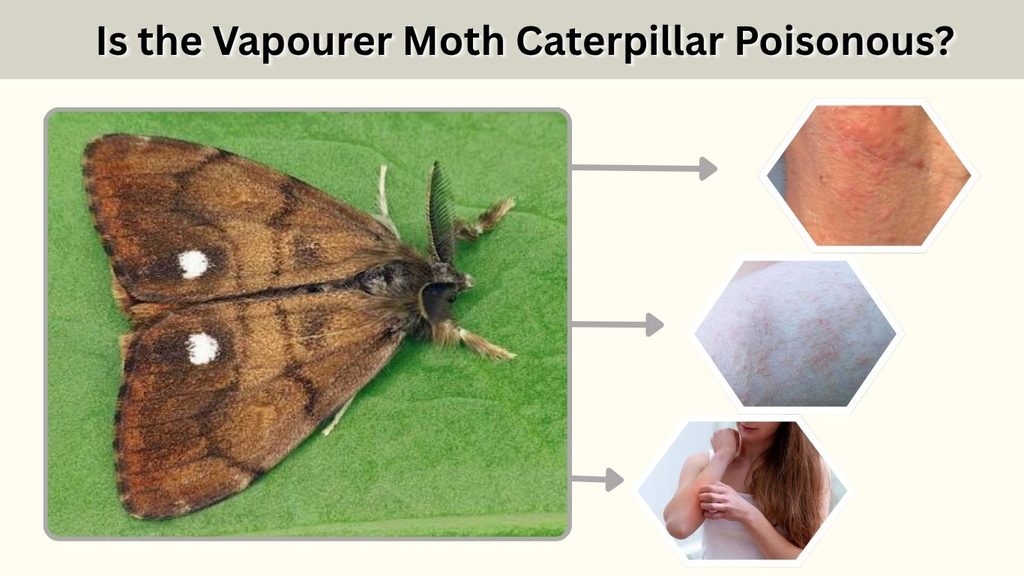
No, the vapourer moth caterpillar is not poisonous or venomous. It does not contain venom, and it cannot inject poison through a sting. The adult moth is also harmless to people.
According to the Royal Horticultural Society, its striking hairs do not usually cause irritation. Nevertheless, reactions can vary, and handling any hairy caterpillar unnecessarily should be avoided.
Can a Vapourer Caterpillar Sting?
The caterpillar does not possess a true stinger. Reports of a “vapourer moth caterpillar sting” generally refer to a prickling or itchy sensation caused by contact with its hairs.
Sensitive people may experience:
- Mild itching
- Temporary redness
- A small localized rash
- A prickling or burning sensation
- Irritation after touching the eyes or face
Wear gloves if you must move one. After accidental contact, wash the affected skin with soap and water and avoid rubbing it. Seek medical advice if swelling, breathing difficulty, severe eye irritation, or a spreading rash develops.
Children and pets should be discouraged from touching unfamiliar hairy caterpillars.
What Do Vapourer Moth Caterpillars Eat?
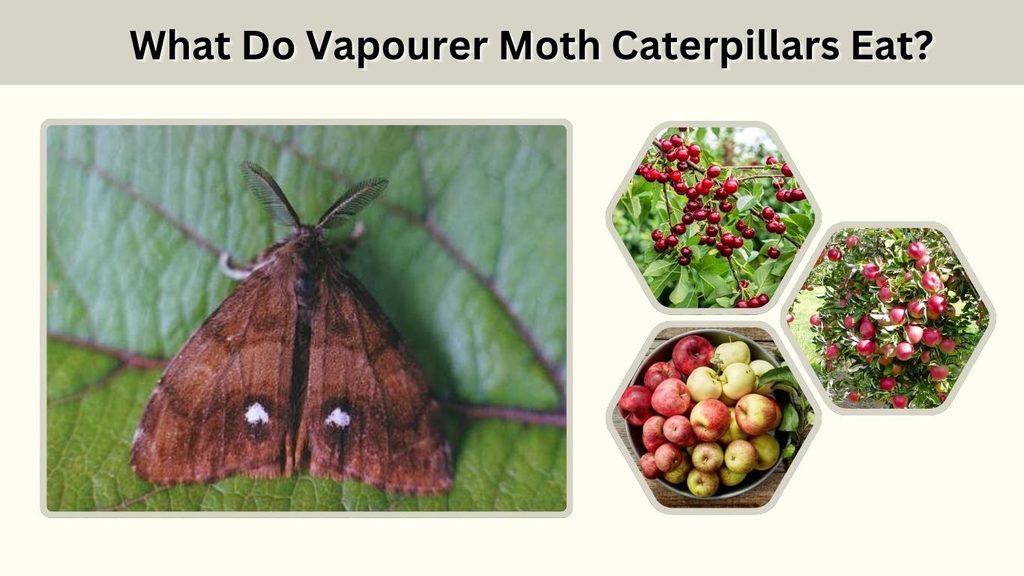
Vapourer moth larvae feed on the leaves of numerous deciduous trees, shrubs, and garden plants. They are polyphagous, meaning they are not dependent on a single food plant.
Common vapourer moth food plants include:
- Oak
- Hawthorn
- Birch
- Willow and sallow
- Hazel
- Blackthorn
- Apple
- Plum
- Cherry
- Rose
- Raspberry
- Wisteria
Caterpillars usually eat from leaf margins, creating irregular holes and missing sections. A large population may remove considerable foliage from a small plant. However, limited feeding on a healthy mature tree rarely causes permanent damage.
Wisteria is one plant on which vapourer moth caterpillars are regularly noticed around homes. Finding one on a plant does not necessarily mean the garden has a serious infestation.
Vapourer Moth Life Cycle
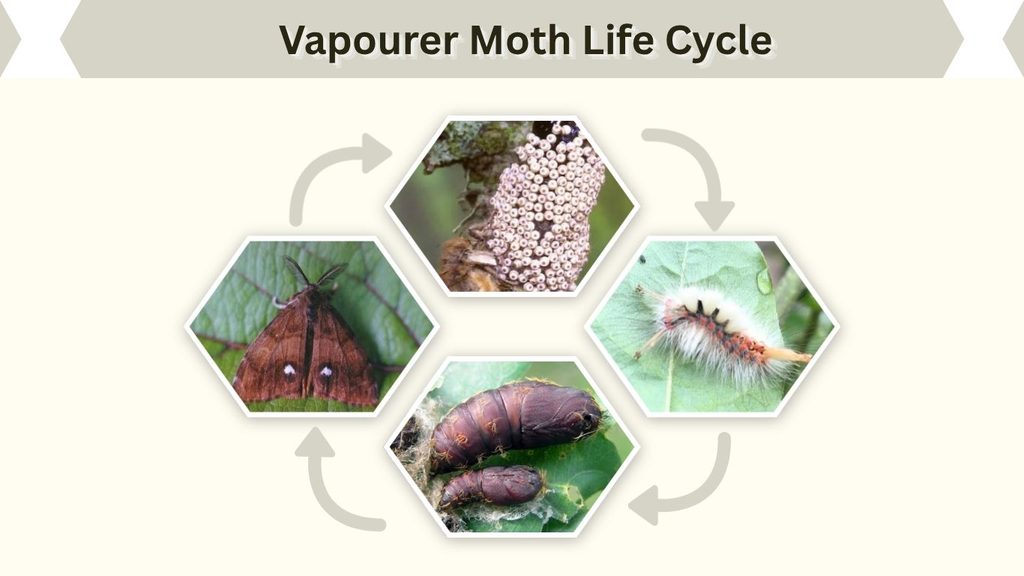
The vapourer moth undergoes complete metamorphosis through four stages: egg, larva, pupa, and adult. Its life cycle is especially interesting because the female remains near her cocoon after emerging.
Egg Stage
After mating, the female lays a large cluster of round eggs directly on or beside her empty cocoon. She may cover much of the cocoon’s surface with eggs.
The eggs commonly remain dormant through winter. Their exposed position makes them relatively easy to find on branches, fences, tree trunks, plant supports, and outdoor structures.
Caterpillar Stage
The eggs hatch during spring as new leaves become available. Newly hatched larvae are tiny and hairy. They may disperse to nearby plants by crawling or allowing wind to carry them on silk threads.
The larvae feed and molt several times. With each instar, they increase in size and develop more prominent back tufts and hair pencils. Caterpillars are generally most noticeable from late spring through summer.
Cocoon and Pupal Stage
A fully grown caterpillar spins a loose silken cocoon attached to bark, leaves, fences, walls, or other sheltered surfaces. Its own hairs are incorporated into the cocoon, giving it a rough, fuzzy appearance.
Inside, the caterpillar changes into a pupa. The adult eventually emerges, although development time depends on temperature, location, and generation.
Adult Stage
Male vapourer moths are commonly seen from July to September, sometimes continuing into October in warmer southern areas. They fly rapidly while following pheromones released by females. The male’s typical wingspan is approximately 25–30 mm, according to UKMoths.
A female cannot fly away after leaving her cocoon. She releases a powerful scent that attracts males, mates, lays her eggs on the cocoon, and dies soon afterward. Depending on climate, the species may produce one or more generations each year.
Female Vapourer Moth
The female vapourer moth looks so different from the male that it can easily be mistaken for another insect. She has a swollen gray or brown body, short legs, and only tiny wing remnants.
Because she cannot fly, the female spends her adult life on or immediately beside the cocoon. She does not need to search for a partner because her pheromones bring males to her.
Her limited movement also explains why egg clusters are found on old cocoons. Removing an egg-covered cocoon before spring can prevent numerous larvae from appearing on a valued garden plant.
How to Get Rid of Vapourer Moth Caterpillars
Vapourer moth control is usually unnecessary when only a few caterpillars are present. They provide food for birds and other wildlife and form part of a healthy garden ecosystem.
Control may be useful when larvae repeatedly damage young trees, ornamental shrubs, fruit plants, or recently planted specimens.
Safe Control Methods
Inspect plants regularly from spring onward, paying particular attention to young leaves and stems. Wear gloves and remove individual caterpillars by hand when practical. They can be relocated to a larger suitable tree away from vulnerable plants.
Look for fuzzy cocoons bearing clusters of eggs during autumn and winter. Carefully removing these before they hatch can reduce the following season’s population. Pruning a heavily affected shoot may also help when this can be done without harming the plant.
Encourage natural predators by providing diverse planting and avoiding unnecessary broad-spectrum insecticides. Birds, ground beetles, spiders, parasitoid wasps, and other predators can reduce caterpillar numbers.
Chemical treatment should be a last resort. If significant damage requires treatment, use only a product labeled for caterpillars on the particular plant and follow all local instructions.
Common Vapourer vs Scarce Vapourer Moth
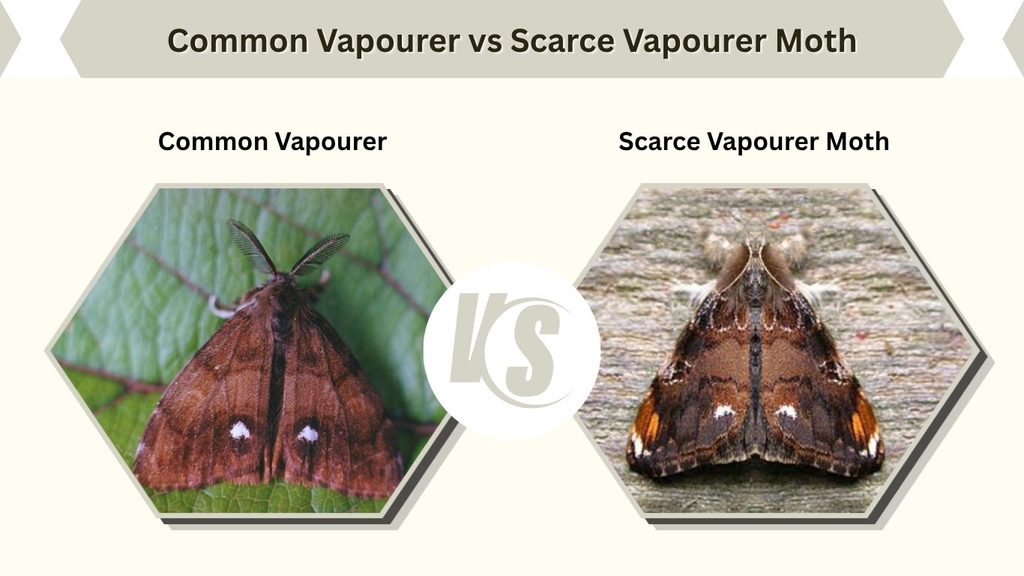
The scarce vapourer (Orgyia recens) is a separate species rather than an uncommon form of the ordinary vapourer. Both have wingless females and colorful, hairy larvae.
The male scarce vapourer is larger, with a wingspan of approximately 35–40 mm. In Britain, it is rare and restricted mainly to a small number of locations in eastern England. Adults generally appear during June and July.
Photographs can help with an initial comparison, but caterpillar color varies. Location, adult markings, size, and tuft arrangement should all be considered before confirming an identification.
FAQs
Are vapourer moths dangerous?
Vapourer moths are not dangerous. Adults do not bite or sting, and their caterpillars are not venomous. It is still sensible to avoid directly handling the hairy larvae.
Are vapourer moth caterpillars poisonous to dogs?
They are not generally considered poisonous, but their hairs may irritate a dog’s mouth, nose, or skin. Contact a veterinarian if a dog develops drooling, swelling, vomiting, breathing difficulty, or persistent discomfort.
Where are vapourer moths found in the UK?
They are widely distributed across the UK and may occur in gardens, parks, woodland, hedgerows, orchards, and areas containing deciduous trees and shrubs.
Why is the female vapourer moth wingless?
The female has evolved to invest most of her energy in producing eggs. She stays beside her cocoon and attracts flying males by releasing pheromones, so functional wings are unnecessary.
Do mercury vapour lamps attract vapourer moths?
Mercury vapour lamps can attract male vapourer moths at night, although males also fly during daylight. Such lamps are mainly used for observing moths and are not an effective method for controlling a garden infestation.