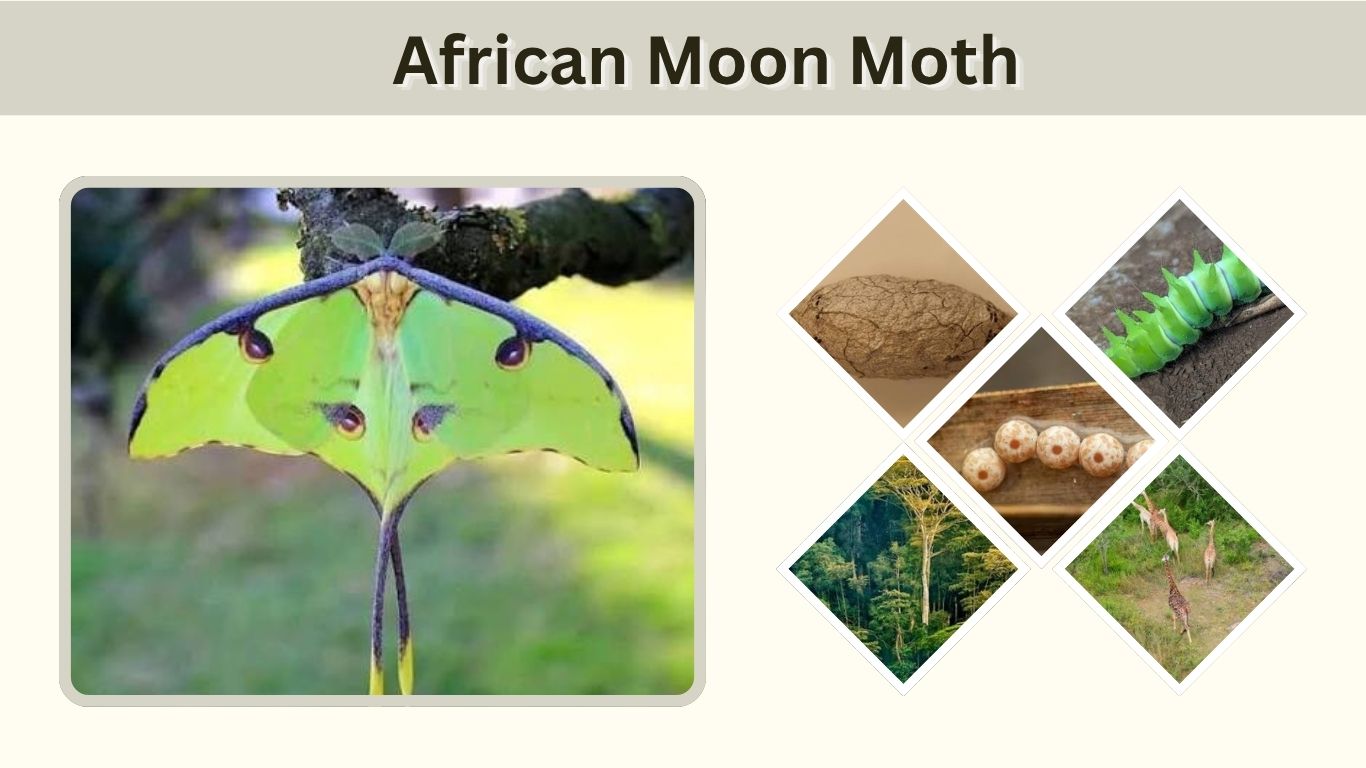
The African moon moth (Argema mimosae) is a spectacular giant silk moth native to eastern and southern Africa. Recognizable by its green wings, prominent eyespots, and extremely long hindwing tails, it is closely related to other giant silk moths in the family Saturniidae. Adults are nocturnal and live for only a short period because they have no functional feeding mouthparts. Most of the moth’s growth occurs during the caterpillar stage, when the larvae feed heavily on leaves and store the energy needed for adulthood.
What Is an African Moon Moth?
The African moon moth is a large night-flying moth belonging to the genus Argema. It is sometimes called the African lunar moth and is especially known for its elegant leaf-like appearance.
African Moon Moth Identification
Common features include:
- Bright green to yellow-green wings
- Long, narrow tails extending from the hindwings
- Distinctive eyespots on all four wings
- Dark edging along portions of the wings
- Large, fuzzy-looking body
- Broad forewings
- Feathery antennae, especially noticeable in males
- Overall leaf-like appearance when resting
Adults typically measure around 10–12 cm across the wings, while their total length from head to the end of the long tails can reach approximately 12–14 cm.
Is There a Blue African Moon Moth?
African moon moths are naturally green, yellow-green, or sometimes slightly bluish-green depending on lighting, age, and individual variation.
Photographs may make certain individuals appear blue or turquoise because of lighting, camera settings, or image processing. A strongly blue African moon moth is therefore not considered the typical natural coloration of Argema mimosae.
Where Do African Moon Moths Live?
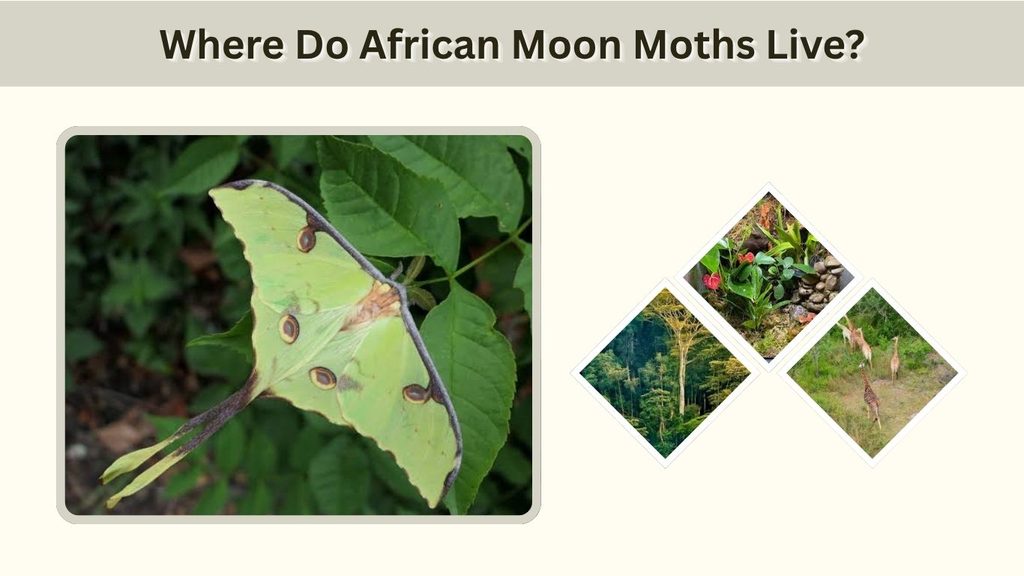
African moon moths occur naturally across parts of eastern and southern Africa.
African Moon Moth Habitat
They are associated particularly with subtropical woodland and bushveld habitats where suitable caterpillar food plants are available.
Recorded countries include:
- South Africa
- Mozambique
- Zimbabwe
- Zambia
- Tanzania
- Kenya
- Uganda
- Malawi
- Angola
- Namibia
- Democratic Republic of the Congo
- Ethiopia
Their distribution is fairly broad in eastern Africa and more localized in some southern regions.
African Moon Moth in the Wild
Adults are primarily nocturnal.
During daylight, they often remain still among vegetation, where their green wings and elongated tails can help them blend into surrounding foliage.
At night, males actively search for females, using their highly sensitive antennae to detect female pheromones.
African Moon Moth Caterpillar
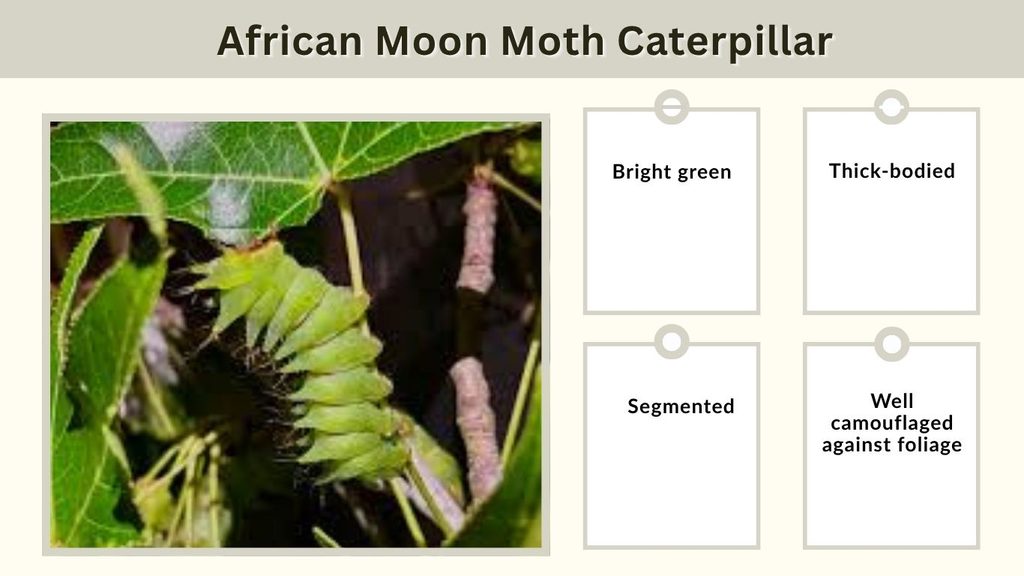
The caterpillar looks dramatically different from the delicate adult moth.
It is during this stage that the insect spends most of its time feeding and growing.
What Does an African Moon Moth Caterpillar Look Like?
The larvae are generally:
- Bright green
- Thick-bodied
- Segmented
- Marked with thin pale or whitish bands
- Equipped with raised projections or tubercles
- Well camouflaged against foliage
As they grow, the caterpillars molt several times before eventually becoming large enough to pupate.
What Do African Moon Moth Larvae Eat?
Unlike adults, African moon moth caterpillars have a strong appetite.
African Moon Moth Caterpillar Diet
Known host plants include:
- Marula (Sclerocarya birrea)
- Tamboti (Spirostachys africana)
- Corkwood species (Commiphora)
- Other suitable regional host plants
The caterpillar must consume enough plant material to build up energy reserves for pupation and adulthood.
What Do Adult African Moon Moths Eat?
Adult African moon moths do not eat.
They lack functional mouthparts and rely completely on energy stored while they were caterpillars.
This means their adult stage is devoted almost entirely to finding a mate and reproducing rather than feeding.
African Moon Moth Eggs
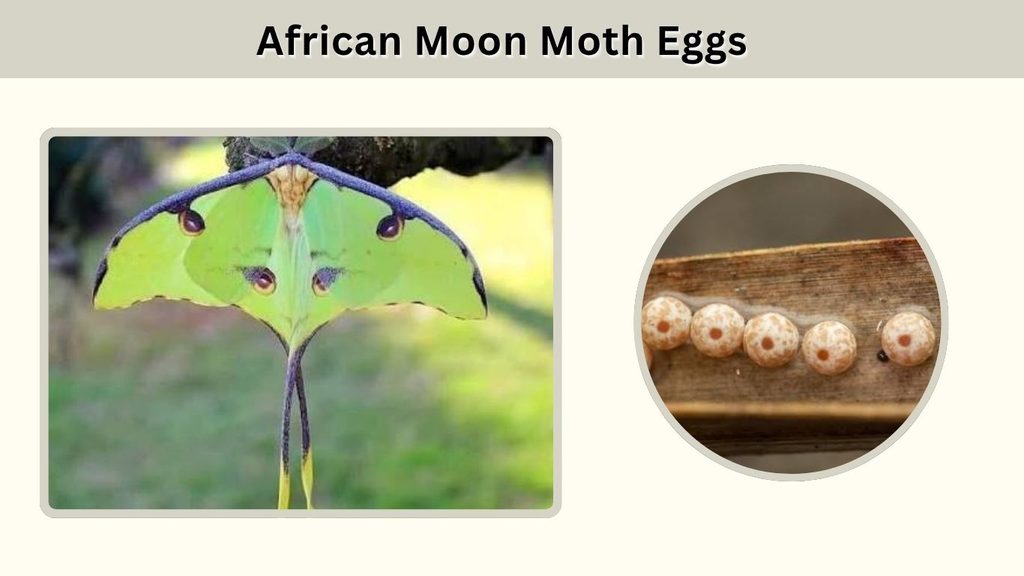
The life cycle begins when a female lays eggs after mating.
What Do the Eggs Look Like?
African moon moth eggs are relatively small compared with the adult moth.
Females generally place their eggs where newly hatched larvae have a reasonable chance of reaching suitable host plants.
Inside each egg, the embryo develops until a tiny caterpillar emerges and begins feeding.
The larva then passes through several growth stages before becoming mature enough to pupate.
African Moon Moth Cocoon
When fully developed, the caterpillar stops feeding and begins preparing for metamorphosis.
What Does the Cocoon Look Like?
African moon moth larvae produce a silk cocoon in which the pupal stage develops.
The cocoon is often described as:
- Silvery or pale
- Tough and fibrous
- Elongated or pouch-like
- Containing small openings or perforations
Inside the protective cocoon, the caterpillar transforms into a pupa and eventually becomes an adult moth.
African Moon Moth Life Cycle
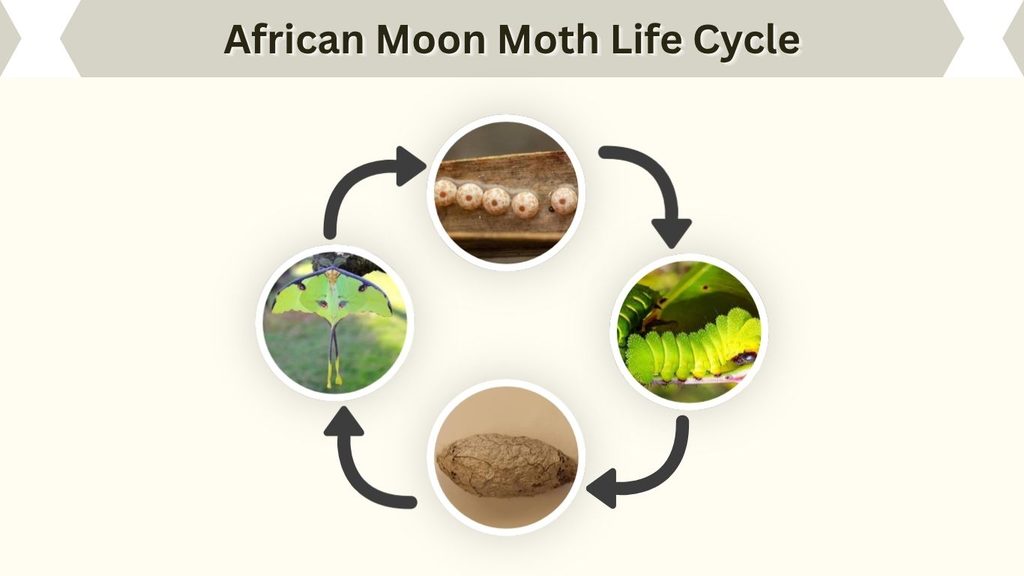
Like other moths, the African moon moth undergoes complete metamorphosis with four distinct stages.
1. Egg
A female lays eggs following mating. The developing caterpillars eventually hatch and search for suitable foliage.
2. Caterpillar
The caterpillar feeds heavily on leaves and repeatedly molts as it grows.
This is the main feeding stage of the insect’s life.
3. Pupa
Once fully grown, the caterpillar spins a cocoon and pupates inside.
Major physical changes occur during this stage as the larval body transforms into an adult moth.
4. Adult Moth
The adult emerges with soft wings that must expand and harden before it can fly.
Adults are nocturnal, do not feed, and use their remaining stored energy primarily for reproduction.
How Long Does an African Moon Moth Live?
The adult portion of the African moon moth’s life is surprisingly brief.
African Moon Moth Lifespan
Adults generally survive for about one week.
Their inability to feed means their lifespan depends on energy accumulated during the caterpillar stage. Once these reserves are exhausted, the adult dies naturally.
The entire life cycle is considerably longer because it also includes egg, caterpillar, and pupal development.
Do African Moon Moths Bite?
Despite their dramatic appearance and giant size, African moon moths are harmless to people.
Can an African Moon Moth Bite?
No. Adult African moon moths cannot bite humans.
Their mouthparts are nonfunctional, so adults cannot bite, sting, chew food, or drink nectar.
Are African Moon Moths Dangerous?
African moon moths are not considered dangerous.
They are:
- Nonvenomous
- Non-stinging
- Unable to bite
- Not aggressive toward people
A moth flying toward a person at night is generally reacting to light or trying to navigate rather than attempting to attack.
African Moon Moth vs Luna Moth
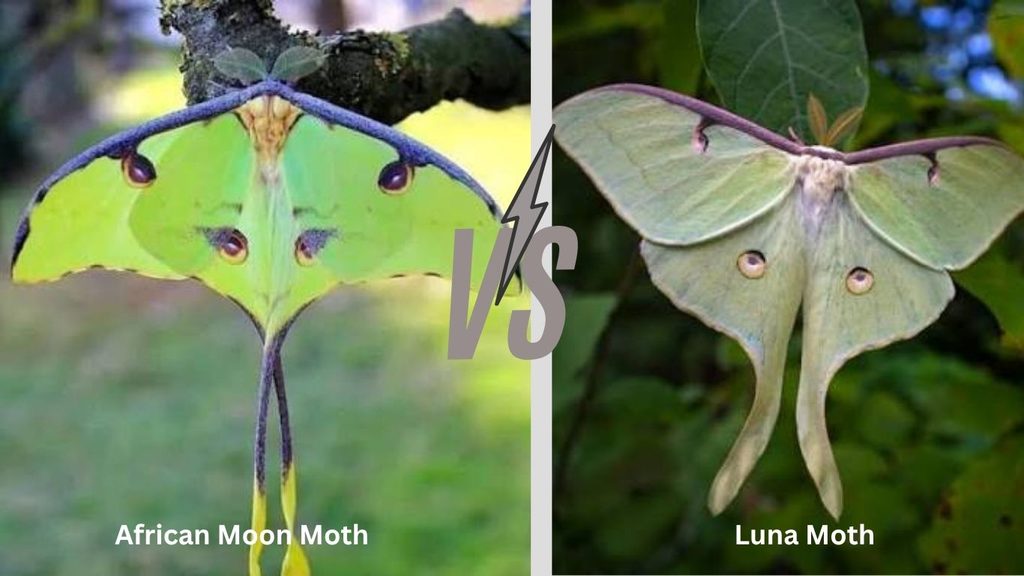
The African moon moth can easily remind people of the North American luna moth because both are large, green silk moths with long tails.
They are nevertheless different species.
Main Differences
The African moon moth is Argema mimosae, while the luna moth is Actias luna.
African moon moths occur naturally in Africa, whereas luna moths are native to North America.
Both have green wings and elongated hindwings, but the African species often develops dramatically long tails. Research comparing the two has found particularly long hindwing tails in Argema mimosae.
Their markings and overall wing shapes are also different.
Why Does the African Moon Moth Have Long Tails?
The beautiful tails are not simply decorative.
Protection Against Bats
Research on moon moths indicates that their elongated hindwing tails can interfere with attacks from echolocating bats.
The tails can redirect a bat’s attack toward the expendable hindwing extensions rather than the moth’s vital body.
Experiments involving African moon moths found that intact long-tailed individuals escaped bat attacks more successfully than moths whose tails had been shortened or removed.
This makes the spectacular tails an important survival adaptation.
Male vs Female African Moon Moth
Male and female African moon moths share the same general appearance but have several differences.
Male African Moon Moth
Males commonly have especially feathery antennae.
These structures help detect chemical signals released by females, allowing males to locate potential mates at night.
Female African Moon Moth
Females tend to have heavier, more robust bodies because they carry eggs.
They spend much of their brief adult life mating and laying eggs, continuing the next generation.
FAQs
What is the scientific name of the African moon moth?
The scientific name is Argema mimosae. It belongs to the giant silk moth family Saturniidae.
How big is an African moon moth?
Adults generally have a wingspan around 10–12 cm, while the distance from the head to the tips of the long tails can reach about 12–14 cm.
What does an African moon moth eat?
Adult African moon moths do not eat because they lack functional mouthparts. Caterpillars feed on plants including marula, tamboti, and corkwood species.
How long does an African moon moth live?
The adult moth generally lives for only about one week, surviving on energy stored during its caterpillar stage.
Is an African moon moth the same as a luna moth?
No. The African moon moth is Argema mimosae and is native to Africa, while the luna moth is Actias luna and is native to North America. They are related giant silk moths with similar green coloration and long hindwing tails.