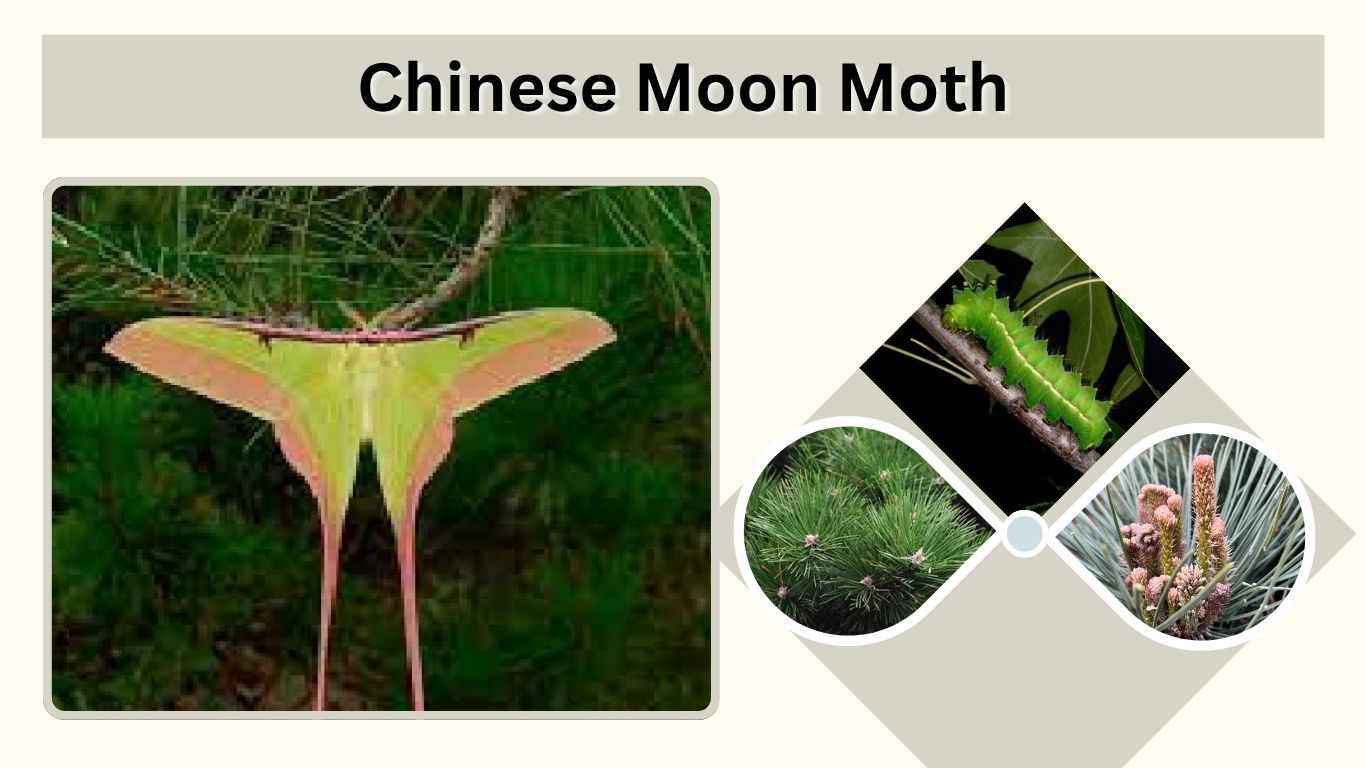
The Chinese moon moth (Actias dubernardi), also called the Chinese luna moth, is a spectacular giant silk moth native to China. Its pale green to yellow-green wings, pink margins, feathery antennae, and extraordinarily long hindwing tails make it one of the most distinctive moths in the world. Like other giant silk moths, adults live only briefly and do not spend their adult lives feeding. Most growth occurs during the caterpillar stage, when the larvae consume conifer foliage and store energy for metamorphosis and reproduction.
What Is a Chinese Moon Moth?
The Chinese moon moth belongs to the family Saturniidae, a group commonly called giant silk moths. Its scientific name is Actias dubernardi.
It is especially associated with cooler mountainous areas of China and can occur at elevations of roughly 1,000–2,500 meters.
Chinese Moon Moth Identification
Adults can be recognized by:
- Pale green, yellow-green, or yellowish wings
- Pink to reddish wing margins
- Extremely long pink hindwing tails
- Small eyespots on the wings
- Thick, furry-looking body
- Large feathery antennae
- Broad forewings
- Delicate pastel coloration
Males and females look similar at first glance, but their body proportions, antennae, and tail shapes can help distinguish them.
Chinese Moon Moth Size
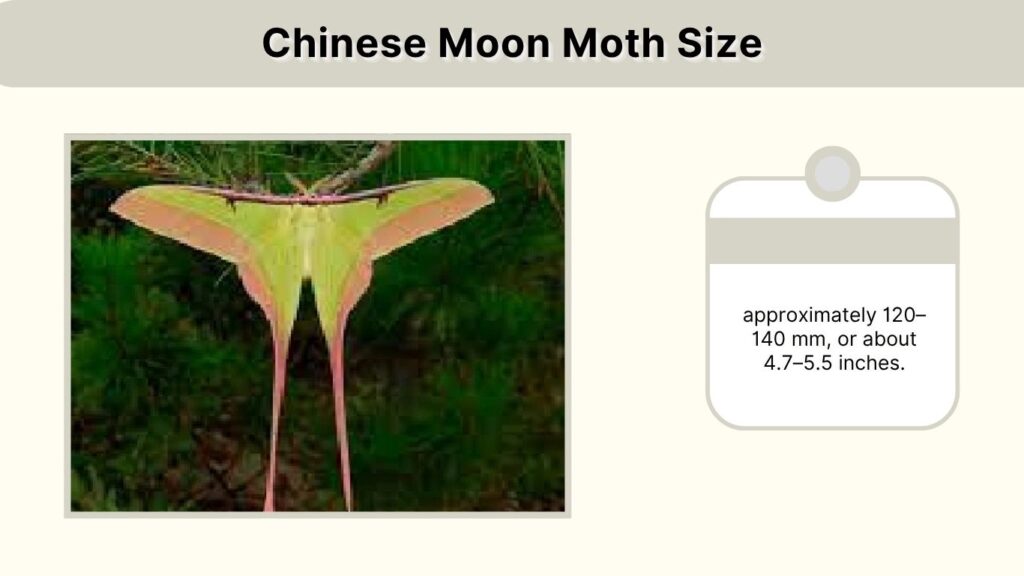
The Chinese moon moth is a large species, but its long tails make it look considerably larger than its wingspan alone suggests.
How Big Is a Chinese Moon Moth?
Adults generally have a wingspan of approximately 120–140 mm, or about 4.7–5.5 inches.
The long hindwing extensions can add dramatically to the moth’s overall length.
Males generally have especially long and narrow tails. Their impressive appearance has made the species popular among moth photographers and Saturniid enthusiasts.
Chinese Moon Moth Caterpillar
The caterpillar looks dramatically different from the pastel-colored adult.
Young larvae change color considerably as they grow.
What Does a Chinese Moon Moth Caterpillar Look Like?
Newly hatched caterpillars are dark and hairy. As they develop through successive stages, their appearance changes from black to reddish-brown and eventually to green.
Mature caterpillars typically have:
- Bright to dark green bodies
- Pale horizontal markings
- Metallic-looking silver or gold spots
- Hair-covered projections
- Thick cylindrical bodies
- Distinctive markings around the thorax
A fully developed caterpillar can reach approximately 60–75 mm long.
What Do Chinese Moon Moth Caterpillars Eat?
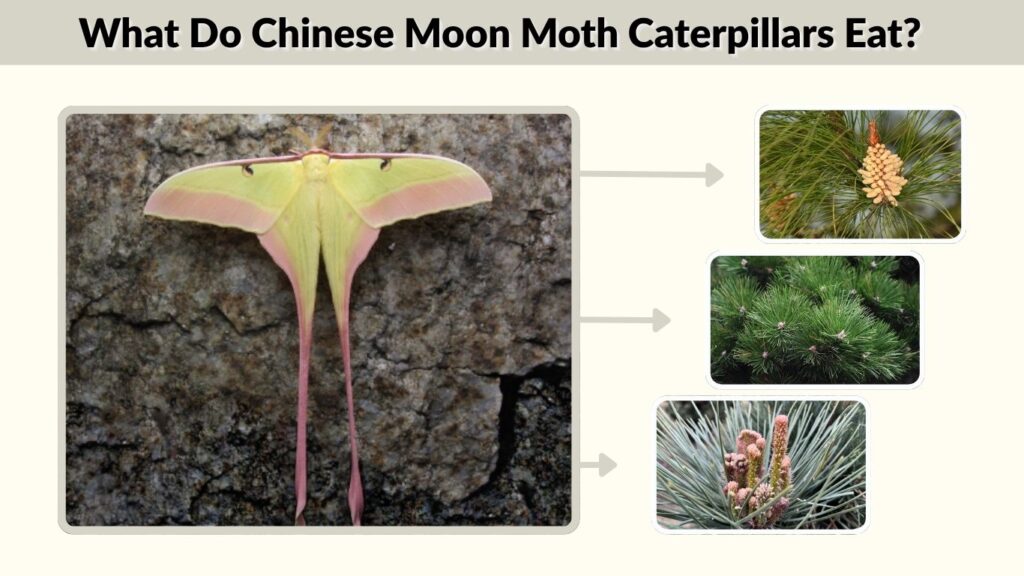
The caterpillar stage is the feeding period of the Chinese moon moth’s life.
Chinese Moon Moth Host Plants
The larvae primarily feed on conifers, particularly species of pine and larch.
Known host plants include:
- Masson’s pine
- Scots pine
- Black pine
- White pine
- Larch
- Certain firs
In the wild, Pinus massoniana is an important food plant.
Host-plant availability is particularly important because caterpillars must accumulate enough energy to complete metamorphosis and survive their non-feeding adult stage.
Chinese Moon Moth Eggs
Once mating is complete, a female’s major task is producing the next generation.
What Do the Eggs Look Like?
The eggs are relatively small, pale grayish or whitish, and oval or slightly flattened.
A female can produce around 100 or more eggs, with some reports noting totals of up to approximately 120.
The eggs are attached to suitable surfaces, and larvae generally hatch after roughly 10–14 days under favorable conditions.
After hatching, the tiny caterpillars begin feeding and pass through several larval stages before pupation.
Chinese Moon Moth Cocoon
Once a caterpillar reaches full size, it stops feeding and begins preparing for metamorphosis.
What Does the Cocoon Look Like?
The mature caterpillar spins a coarse brown silk cocoon, often among vegetation, moss, leaf litter, or pine needles near the ground.
Inside the cocoon, the caterpillar transforms into a pupa.
The pupal stage protects the developing insect while its body undergoes the extensive changes required to become a winged adult.
Adult emergence may occur after several weeks, although cool conditions can extend development.
Chinese Moon Moth Life Cycle
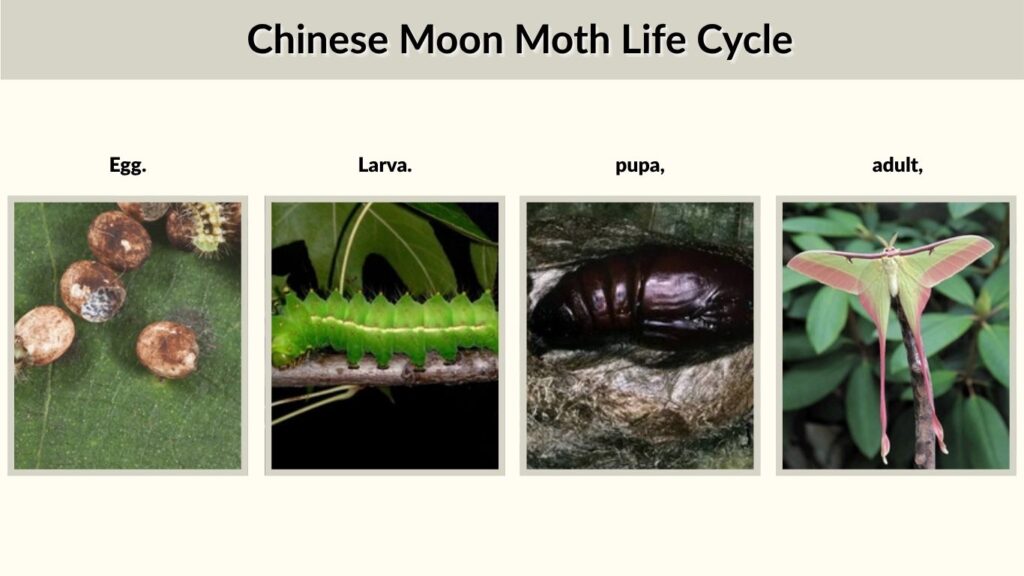
The Chinese moon moth undergoes complete metamorphosis and passes through four major stages.
1. Egg
Females lay eggs after mating. The eggs usually hatch within around two weeks when environmental conditions are suitable.
2. Larva
The caterpillar feeds heavily on suitable conifers.
It passes through several instars and changes dramatically in both color and size while developing.
3. Pupa
A mature caterpillar forms a silk cocoon and pupates.
Metamorphosis takes place within the protective cocoon.
4. Adult
The adult emerges, expands its wings, and becomes reproductively active.
Its remaining life is devoted primarily to finding a mate and producing eggs.
From egg to adult, development can take roughly 70–85 days under suitable conditions, although environmental factors can alter the timing.
Chinese Moon Moth Lifespan
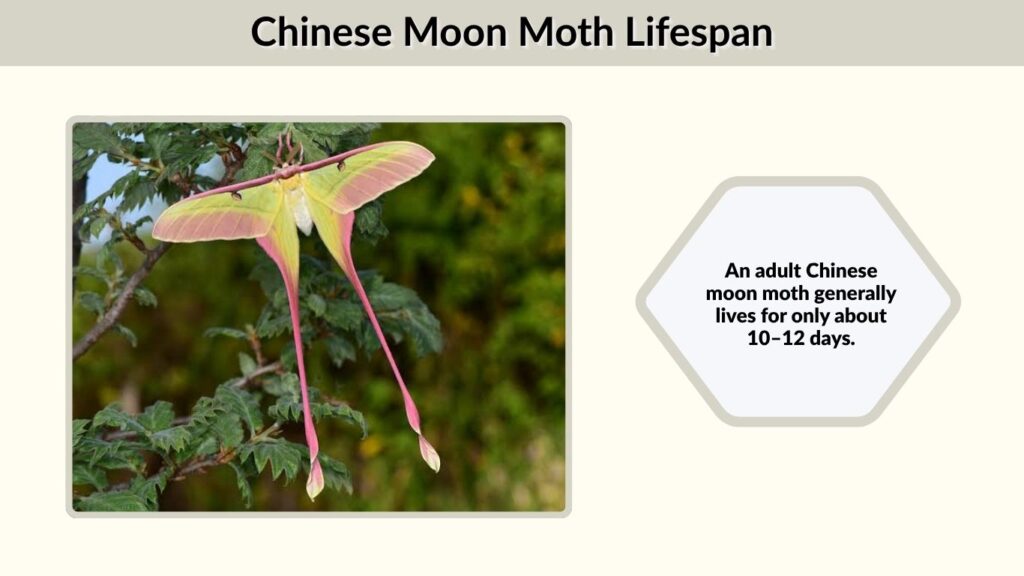
The striking adult stage is surprisingly short.
How Long Does a Chinese Moon Moth Live?
An adult Chinese moon moth generally lives for only about 10–12 days.
Most of the insect’s life is therefore spent developing as an egg, caterpillar, and pupa rather than flying as an adult.
Adult giant silk moths survive largely on energy accumulated during their larval stage, making reproduction their primary purpose.
Male vs Female Chinese Moon Moth
Sexual differences become easier to recognize once you know what to look for.
Male Chinese Moon Moth
Males typically have:
- Very large, feathery antennae
- Long, narrow hindwing tails
- Slimmer abdomen
- Strong response to female pheromones
- More active mate-searching behavior
The enlarged antennae allow males to detect chemical signals released by females.
Female Chinese Moon Moth
Females generally have:
- Larger, heavier abdomen
- Less dramatically feathered antennae
- Slightly different hindwing proportions
- Eggs filling much of the abdomen before laying
Females tend to remain relatively stationary while releasing pheromones that attract males.
Chinese Moon Moth vs Luna Moth
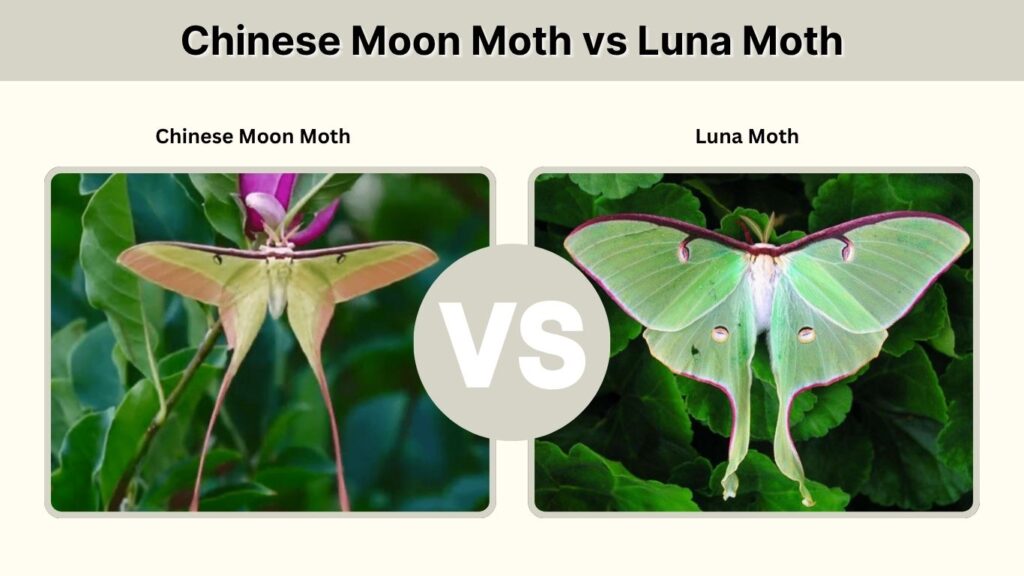
The Chinese moon moth and North American luna moth look related because they belong to the same genus, Actias, but they are separate species.
Main Differences
The Chinese moon moth is Actias dubernardi, while the luna moth is Actias luna.
The Chinese species typically has prominent pink or reddish coloration along its wing margins and extremely long pink hindwing tails.
The luna moth is generally lime green with purplish or reddish wing borders and has shorter, broader tails.
Their geographic ranges are also completely different: Chinese moon moths are native to Asia, while luna moths occur naturally in North America.
Their caterpillars also favor different plants. Chinese moon moth larvae are strongly associated with conifers, whereas luna moth caterpillars feed on broadleaf trees such as walnut, hickory, sweetgum, sumac, and persimmon.
Chinese Moon Moth Hybrid
Chinese moon moths have attracted interest from specialist breeders partly because closely related giant silk moths can occasionally produce hybrids under controlled conditions.
Chinese and Spanish Moon Moth Hybrid
Hybrids involving Actias dubernardi and the Spanish moon moth (Graellsia isabellae) have been documented in captive breeding.
Such hybrids are artificially produced and should not be viewed as a normal part of the Chinese moon moth’s natural life cycle.
Are Chinese Moon Moths Dangerous?
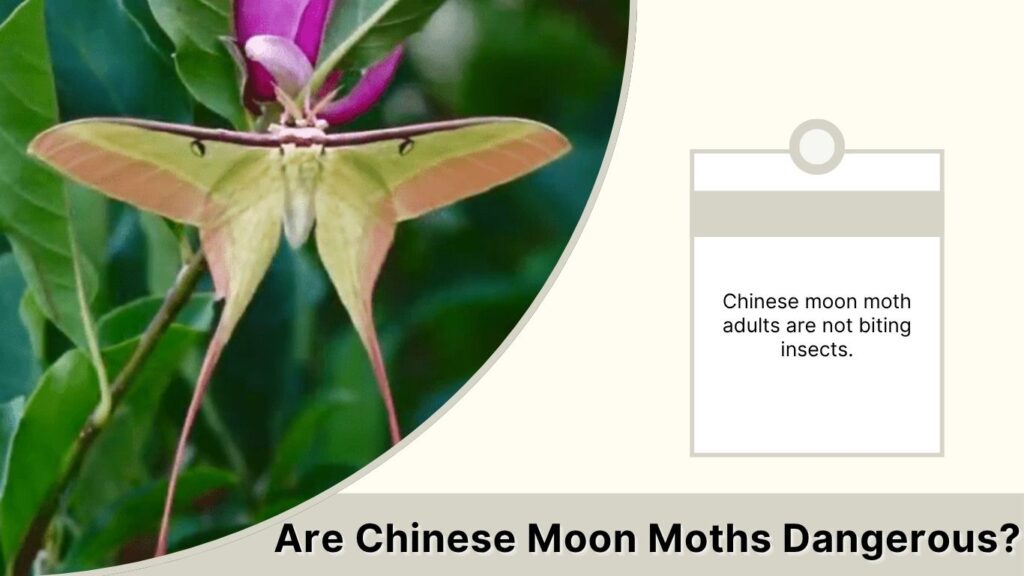
Their large size and unusual tails may appear intimidating, but Chinese moon moths pose little threat to people.
Do Chinese Moon Moths Bite?
Chinese moon moth adults are not biting insects.
They do not attack people, sting, or possess venom.
Their defensive strategy relies largely on camouflage, nighttime activity, and physical adaptations rather than aggression.
The long tails may also help divert attacks from predators away from the moth’s body.
Chinese Moon Moth Meaning
Because of its moon-like coloration and spectacular appearance, the Chinese moon moth is sometimes associated symbolically with transformation, renewal, beauty, and the temporary nature of life.
These interpretations are cultural or personal symbolism rather than biological characteristics.
Its genuine biological story nevertheless fits the idea of transformation remarkably well: a leaf-eating caterpillar disappears inside a silk cocoon before emerging as a dramatically different winged adult.
FAQs
What is the scientific name of the Chinese moon moth?
The Chinese moon moth is scientifically known as Actias dubernardi and belongs to the giant silk moth family Saturniidae.
How big is a Chinese moon moth?
Adults generally have a wingspan of approximately 120–140 mm, with long hindwing tails increasing their overall apparent size.
What do Chinese moon moth caterpillars eat?
The caterpillars primarily feed on conifers, including several species of pine and larch.
How long does a Chinese moon moth live?
The adult stage generally lasts only around 10–12 days, while the complete developmental period from egg to adult is much longer.
Is the Chinese moon moth the same as a luna moth?
No. The Chinese moon moth is Actias dubernardi from Asia, while the luna moth is Actias luna from North America. They are closely related but distinct species.