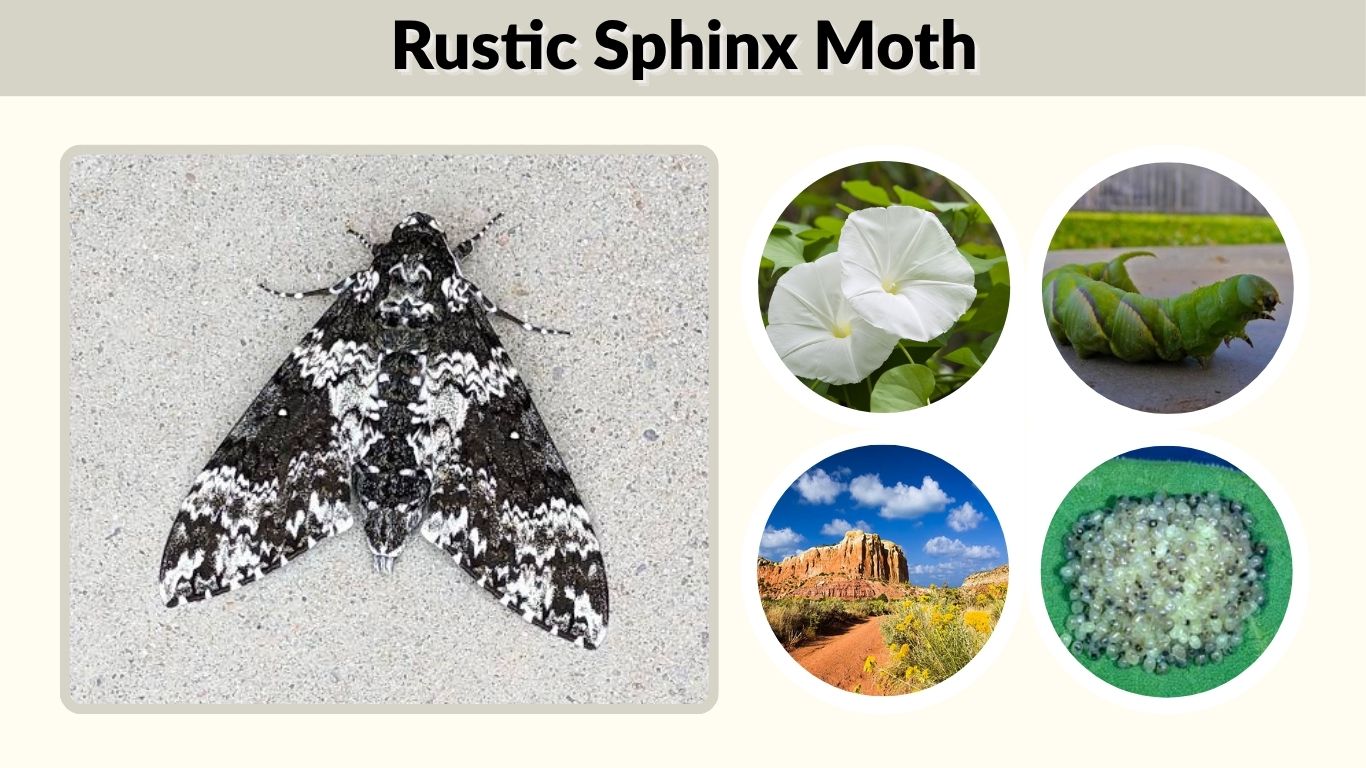
The rustic sphinx moth (Manduca rustica) is a large, fast-flying hawk moth known for its striking black, brown, and white markings. Found across much of the southern United States and through Central and South America, this nocturnal moth is often mistaken for a hummingbird when feeding at flowers. Its large horned caterpillar can look intimidating, but it is generally harmless to people. Here’s everything to know about rustic sphinx moth size, caterpillars, host plants, diet, life cycle, range, and symbolism.
What Is a Rustic Sphinx Moth?
The rustic sphinx moth belongs to the family Sphingidae, whose members are commonly called sphinx moths or hawk moths. Its scientific name is Manduca rustica. Adults are powerful nighttime flyers equipped with a long proboscis that allows them to reach nectar deep inside tubular flowers.
Rustic Sphinx Moth Identification
Several characteristics can help identify an adult rustic sphinx:
- Scientific name: Manduca rustica
- Family: Sphingidae
- Large, streamlined body
- Brown to chocolate-colored forewings
- White scales and black-and-white zigzag markings
- Three pairs of yellow spots along the abdomen
- Long proboscis for drinking flower nectar
- Powerful, rapid flight
The complex wing pattern provides excellent camouflage when the moth rests against tree bark during daylight hours.
Is It a Hummingbird Moth?
The rustic sphinx is sometimes informally compared with a hummingbird moth because of its flight style.
It can hover near flowers while extending its long proboscis into blossoms. Its rapid wingbeats, relatively large body, and ability to remain almost stationary in the air may cause someone seeing it briefly to mistake it for a tiny hummingbird.
Rustic Sphinx Moth Size
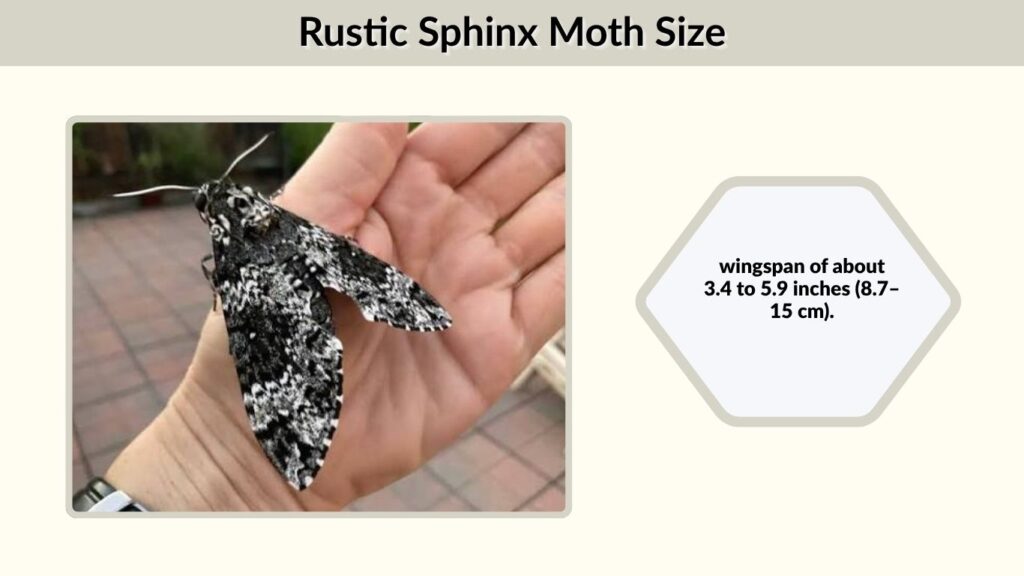
The rustic sphinx is among the larger sphinx moths found in North America. Its broad wings and thick, aerodynamic body give it an impressive appearance, especially when it flies around lights or flowers at night.
Despite its size, it is an agile insect capable of remarkably controlled flight.
How Big Is a Rustic Sphinx Moth?
Adult rustic sphinx moths generally have a wingspan of about 3.4 to 5.9 inches (8.7–15 cm).
Their bodies are much shorter than the wingspan suggests, but they are thick and muscular because powerful flight requires substantial wing muscles.
Females may appear particularly robust when carrying mature eggs.
Rustic Sphinx Caterpillar Size
Mature rustic sphinx caterpillars can become impressively large. Individual observations have recorded larvae around 4 inches long, although size varies according to developmental stage and conditions.
Their large body combined with a prominent rear horn often makes them look much more threatening than they actually are.
Rustic Sphinx Moth Caterpillar
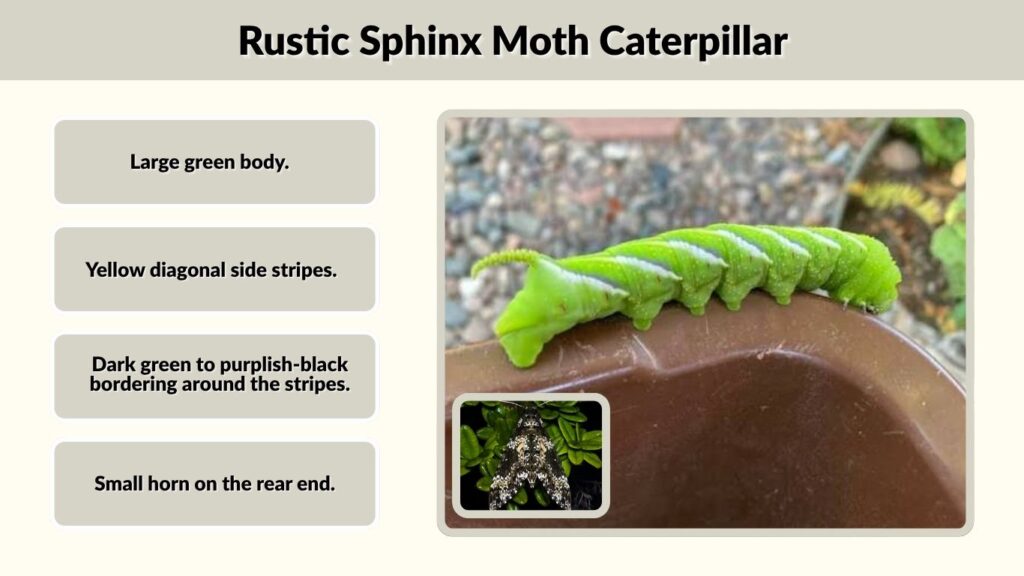
The caterpillar is a type of hornworm. Young and developing larvae are typically bright green, allowing them to blend among foliage while feeding.
Yellow diagonal markings along the body, darker borders, and a distinctive textured horn near the rear are useful identification features.
How to Identify the Caterpillar
Look for these common characteristics:
- Large green body
- Yellow diagonal side stripes
- Dark green to purplish-black bordering around the stripes
- Small horn on the rear end
- Noticeably granulated or rough-textured horn
- Thick cylindrical body
- Reddish-brown coloration before pupation
The granulated horn is particularly helpful for distinguishing the rustic sphinx larva from some related hornworms with smoother horns.
Rustic Sphinx Caterpillar Host Plants
Rustic sphinx larvae can feed on a surprisingly wide variety of plants.
Reported host plants include:
- Jasmine
- Fringe tree
- Ash
- Privet
- Lilac
- Lantana
- Gardenia
- Sunflower
- Crape myrtle
- Desert willow
- American beautyberry
- Bignonia
- Heliotrope
The caterpillars may consume substantial amounts of foliage as they mature, and heavy populations can sometimes noticeably defoliate ornamental plants.
What Does the Caterpillar Eat?
The caterpillar eats leaves from its host plants rather than hunting other insects.
Its primary job during this stage is to grow and store enough energy to complete metamorphosis. Consequently, older caterpillars can consume large quantities of vegetation within a relatively short period.
Is the Rustic Sphinx Moth Dangerous?
Finding a huge horned caterpillar or large moth can understandably cause concern. However, the intimidating appearance of Manduca rustica does not mean it poses a serious threat.
Neither the adult moth’s size nor the caterpillar’s horn should be interpreted as evidence of venom.
Are Rustic Sphinx Moths Poisonous?
Rustic sphinx moths are not considered poisonous or venomous to humans.
Their caterpillars also lack the venomous spines found on some genuinely stinging caterpillar species.
The horn on the caterpillar’s rear end is primarily an anatomical feature rather than a stinger.
Do Rustic Sphinx Moths Bite?
Adult rustic sphinx moths are not equipped to attack people. Their mouthparts are adapted for drinking nectar rather than biting.
The moth generally attempts to fly away when disturbed.
For this reason, there is normally no need to kill a rustic sphinx moth found around a home or garden.
Rustic Sphinx Moth Life Cycle
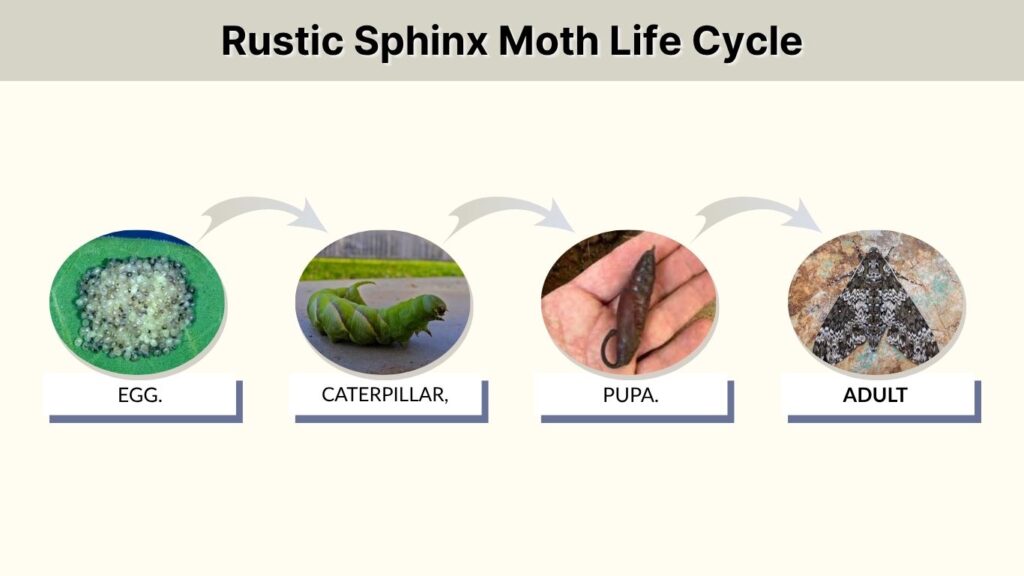
Like butterflies and other moths, the rustic sphinx undergoes complete metamorphosis through four major developmental stages.
Climate influences when adults are active and how quickly development occurs. Multiple generations can occur during the warmer months in suitable southern habitats.
1. Egg
Female moths deposit eggs on suitable host plants. When the eggs hatch, young caterpillars immediately have access to the foliage they need.
2. Caterpillar
Larvae spend this stage feeding, growing, and molting several times.
As the final larval stage approaches pupation, the caterpillar’s color can change from green to a reddish-brown shade.
3. Pupa
A mature caterpillar eventually leaves its host plant and travels toward the ground.
It burrows into soil and forms a pupation chamber, where the transformation into an adult takes place.
4. Adult Moth
After development is complete, the adult emerges and eventually searches for nectar and mates.
Its wings must expand and become functional before sustained flight is possible.
Rustic Sphinx Moth Diet and Behavior
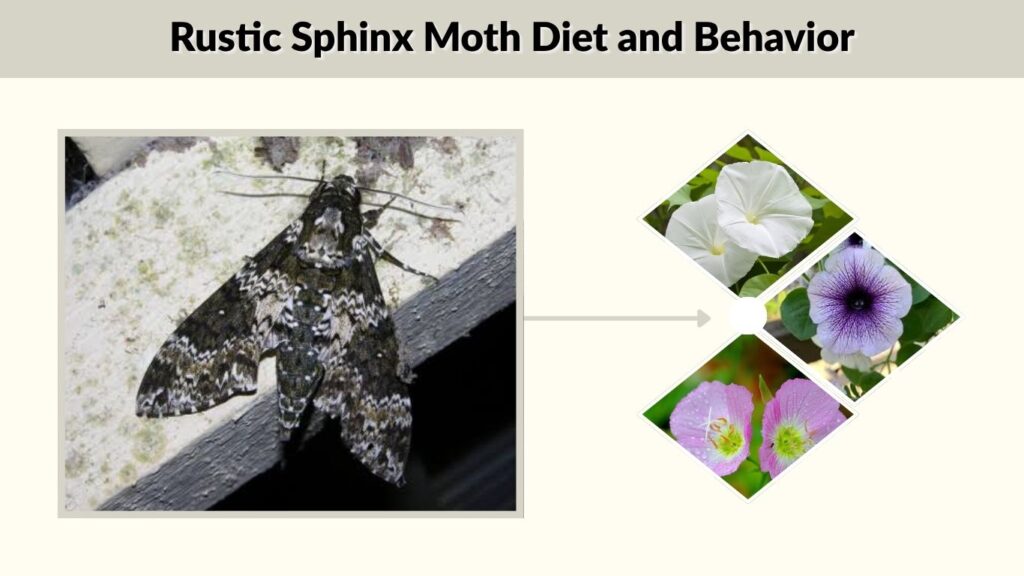
Adult rustic sphinx moths are mainly nocturnal. Rather than eating leaves like caterpillars, they visit flowers and drink nectar using their long proboscis.
Their feeding behavior can make them important nighttime pollinators.
What Do Adult Rustic Sphinx Moths Eat?
Adults commonly obtain nectar from deep-throated flowers, including plants such as:
- Moonflower
- Petunias
- Evening-blooming flowers
- Other tubular nectar-producing blossoms
Adults may begin actively feeding relatively late at night.
Are Rustic Sphinx Moths Beneficial?
Yes. Adult sphinx moths can contribute to pollination while moving between flowers.
Pollen sticks to parts of their bodies while they reach into flowers for nectar and may then be transferred to another blossom. Rustic sphinx moths and related hawk moths are particularly suited to pollinating flowers with deep nectar tubes.
Rustic Sphinx Moth Range and Habitat
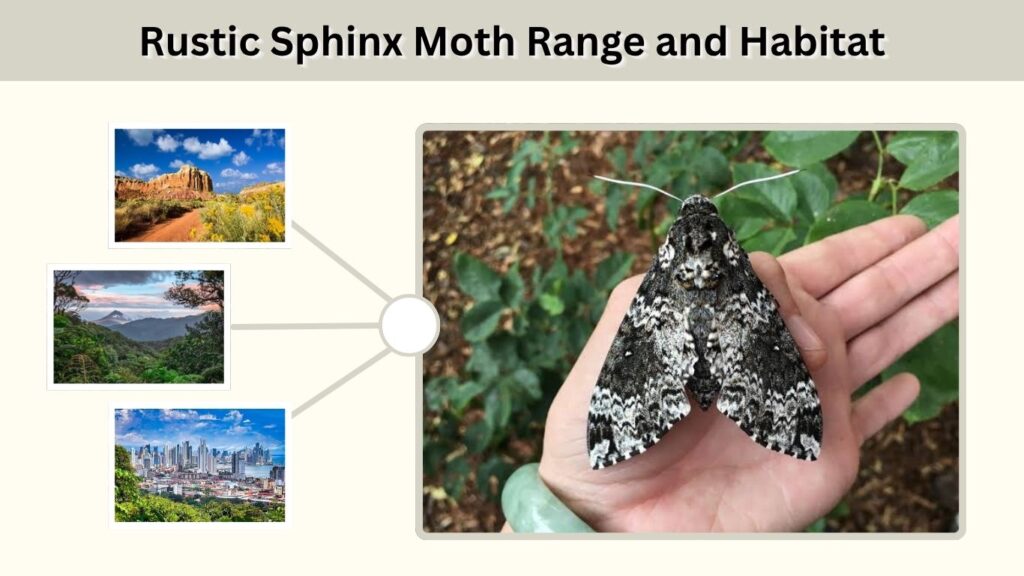
The rustic sphinx prefers warm temperate, subtropical, and tropical environments. It occurs in forests, second-growth vegetation, gardens, and other habitats containing suitable host plants and nectar-producing flowers.
Its geographical distribution is surprisingly extensive.
Where Are Rustic Sphinx Moths Found?
Their range includes:
- Southeastern United States
- Texas
- Arizona
- New Mexico
- Southern California
- Mexico
- Central America
- Parts of the Caribbean
- Much of South America
The species extends south through Central America and into South America, while occasional wandering individuals can occur farther north than their usual U.S. range.
Rustic Sphinx Moths in Arizona and Texas
Both Arizona and Texas are within the established range of the rustic sphinx.
Verified records continue to document the species in Arizona, including observations from counties such as Maricopa and Graham.
Is the Rustic Sphinx Moth Rare?
The rustic sphinx is not considered globally rare. However, how frequently people see one varies significantly by location.
It may be relatively familiar in suitable warm habitats while appearing unusual farther toward the edges of its range. Butterflies and Moths of North America describes the species as globally secure, although it can be uncommon in portions of its distribution.
Rustic Sphinx Moth Meaning and Symbolism
There is no scientifically established spiritual meaning for the rustic sphinx moth. However, people sometimes assign symbolic meanings to moth encounters based on the insect’s nocturnal behavior and dramatic metamorphosis.
These interpretations belong to personal or cultural symbolism rather than entomology.
Common Symbolic Interpretations
A rustic sphinx moth may be associated symbolically with:
- Transformation
- Personal growth
- Adaptability
- Mystery
- Intuition
- Persistence
- Moving through periods of change
Its transformation from caterpillar to winged adult naturally makes it an appealing symbol for change and renewal.
Rustic Sphinx Moth Spiritual Meaning
Some people interpret seeing a large sphinx moth as a reminder to accept change, trust personal instincts, or continue moving toward a goal despite uncertainty.
Such meanings are subjective. Seeing a rustic sphinx moth usually has a straightforward biological explanation: suitable habitat, host plants, flowers, weather, and seasonal moth activity are present nearby.
FAQs
Is a rustic sphinx moth poisonous?
No. Rustic sphinx moths are not considered poisonous or venomous to humans, and their large caterpillar horn is not a venomous stinger.
How big does a rustic sphinx moth get?
Adults can reach a wingspan of approximately 3.4 to 5.9 inches (8.7–15 cm), making them relatively large moths.
What does a rustic sphinx caterpillar eat?
The caterpillars eat leaves from host plants including jasmine, lantana, gardenia, privet, sunflower, crape myrtle, fringe tree, and desert willow.
Where do rustic sphinx moths live?
They occur across parts of the southern United States, Mexico, Central America, the Caribbean, and South America. Their U.S. range includes Texas, Arizona, New Mexico, Florida, and southern California.
What does a rustic sphinx moth symbolize?
Symbolically, moths are often associated with transformation, change, mystery, and personal growth. These are cultural or personal interpretations rather than scientifically established meanings.