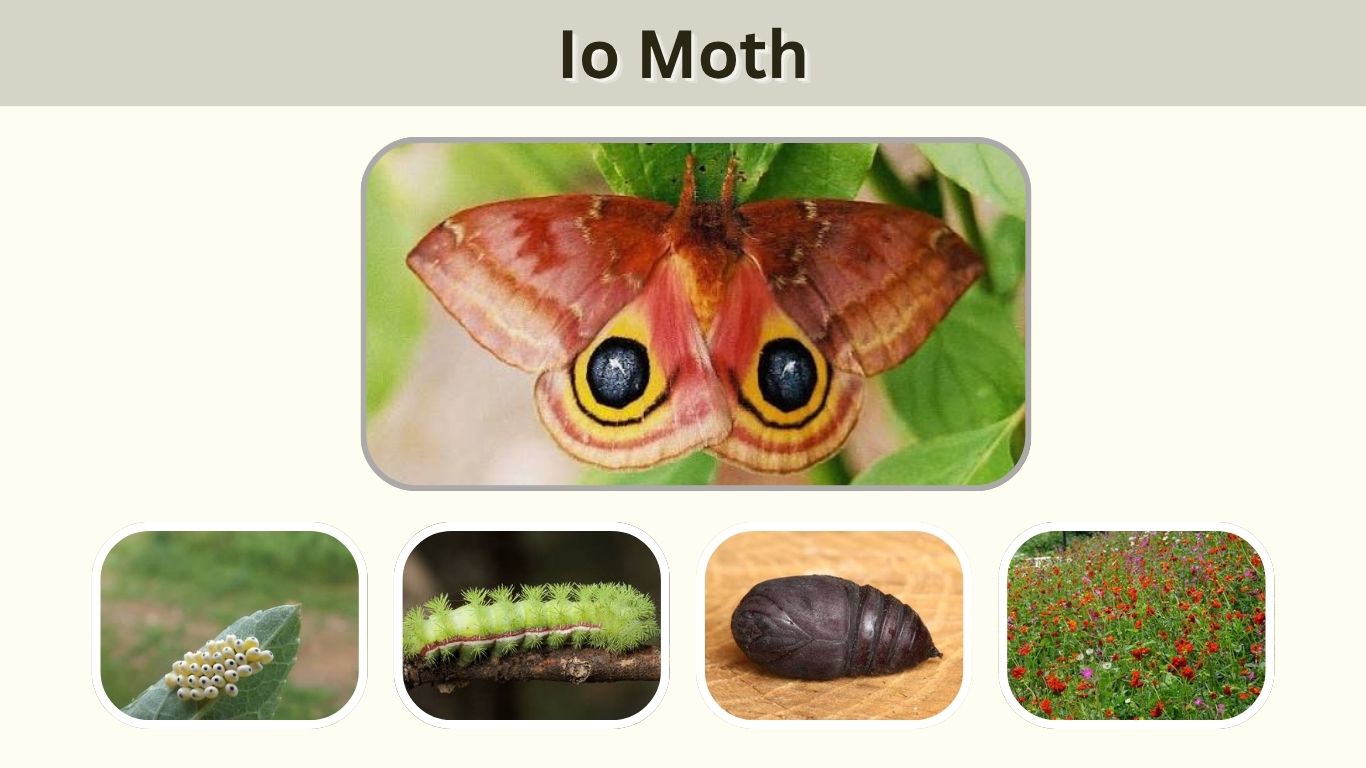
The Io moth (Automeris io) is a striking North American silk moth best known for its large eyespots and bright green, stinging caterpillar. Adults are harmless, but Io moth caterpillars have venomous spines that can cause painful skin irritation when touched. Male and female moths also look noticeably different, making this species easy to recognize once you know the key features. This guide covers Io moth identification, caterpillars, stings, host plants, life cycle, habitat, diet, and other fascinating facts.
What Is an Io Moth?
The Io moth is a member of the giant silk moth family, Saturniidae. It occurs across much of eastern and central North America and is often found near forests, gardens, and areas containing suitable host plants. Adults are famous for the dramatic eyespots on their hindwings, which may help startle predators when suddenly exposed.
Io Moth Identification
Important identification features include:
- Scientific name: Automeris io
- Family: Saturniidae
- Wingspan: Commonly around 2.5–3.5 inches
- Hindwings: Large black and blue eyespots
- Male color: Usually yellow
- Female color: Usually reddish-brown or brown
- Activity: Mostly nocturnal
- Caterpillar: Bright green with clusters of stinging spines
Io Moth Size
Adult Io moths are medium to large compared with common household moths. Their broad wings can span several inches, while females are generally larger and heavier-bodied than males.
The impressive eyespots make the moth appear even larger when its wings are spread. When resting, the forewings often conceal these markings until the moth feels threatened.
Are Adult Io Moths Poisonous?
Adult Io moths are not poisonous and cannot sting. They are harmless to people and pets when handled carefully.
The caterpillar is different. Io moth larvae possess specialized defensive spines capable of injecting irritating venom into the skin. For this reason, green caterpillars covered with branching spines should not be handled with bare hands.
Io Moth Caterpillar Identification and Sting
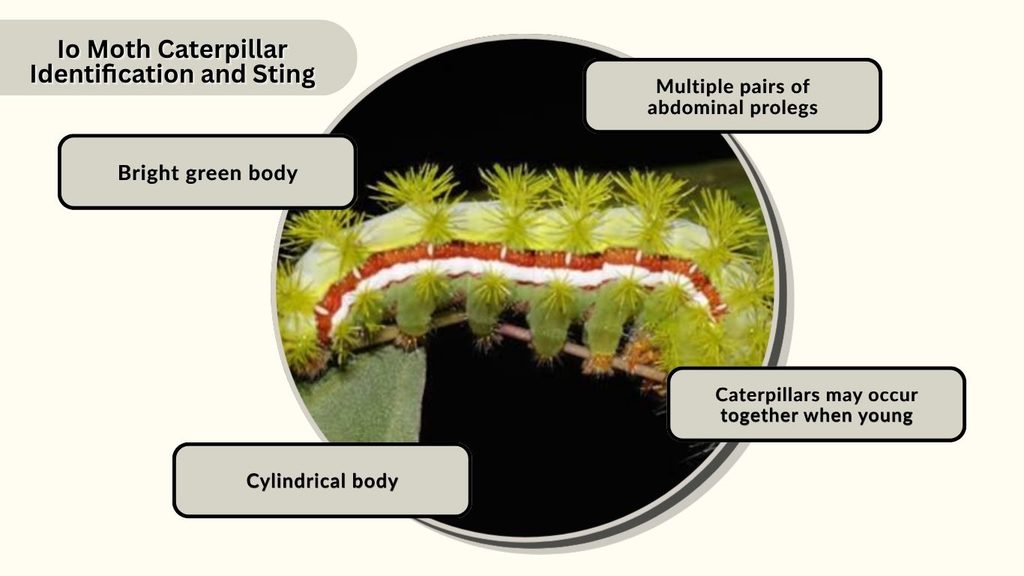
The Io moth caterpillar is perhaps even more recognizable than the adult. Mature caterpillars are bright green and covered with branching clusters of spines. These structures protect them from predators but can also cause painful reactions in people who accidentally brush against them while gardening or handling vegetation.
What Does an Io Moth Caterpillar Look Like?
Io moth caterpillars can be identified by several features:
- Bright green body
- Rows of branching, spine-covered structures
- Red-and-white or reddish stripes along the sides
- Cylindrical body
- Multiple pairs of abdominal prolegs
- Caterpillars may occur together when young
- Larger larvae often become more solitary
Young caterpillars can look somewhat different before developing their characteristic mature green coloration.
Can an Io Moth Caterpillar Sting?
Yes. Io moth caterpillars are capable of delivering a painful sting through their venomous spines.
Touching or brushing against the spines may produce immediate burning or stinging sensations. Skin reactions can vary from person to person, so avoiding direct contact is the safest approach.
The caterpillar does not deliberately attack people. Stings typically happen accidentally when someone touches a caterpillar hidden on leaves, branches, garden plants, or outdoor furniture.
Io Moth Caterpillar Sting Symptoms
Possible reactions can include:
- Immediate burning or stinging
- Redness
- Localized swelling
- Itching
- Tenderness
- Raised bumps or irritated skin
Most encounters are limited to the contact area, but anyone experiencing severe swelling, breathing difficulty, dizziness, or another serious reaction should seek urgent medical attention.
What to Do After an Io Caterpillar Sting
Avoid rubbing the affected area because broken spines may remain in the skin. Carefully removing visible spines, washing the area with soap and water, and using a cool compress may help with minor irritation.
Because individual reactions differ, persistent or severe symptoms should be evaluated by a healthcare professional.
Io Moth Male vs Female
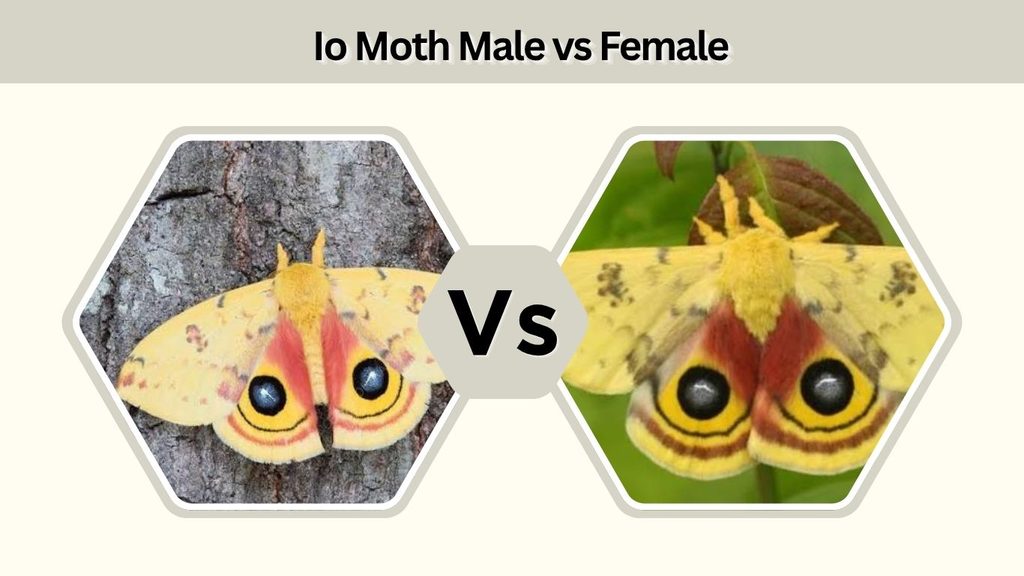
Male and female Io moths display strong sexual dimorphism, meaning the two sexes look noticeably different. Both possess spectacular eyespots on their hindwings, but their forewing colors are quite different. This makes identifying the sex of an adult Io moth easier than with many other moth species.
Male Io Moth
Male Io moths are usually yellow, sometimes ranging from pale yellow to deeper golden shades. Their antennae are also noticeably feathery because males use them to detect chemical signals released by females.
Males are generally smaller and more slender than females.
Female Io Moth
Female Io moths are typically brown, reddish-brown, or purplish-brown. Their darker coloration contrasts strongly with the yellow appearance of males.
Females also tend to have:
- Larger bodies
- Broader abdomens
- Less feathery antennae
- Brown or reddish forewings
- Large hindwing eyespots
- Greater body mass for producing eggs
Io Moth Male vs Female Differences
The easiest differences to remember are:
- Male: Usually yellow
- Female: Usually brown or reddish
- Males have more feather-like antennae.
- Females generally have larger bodies.
- Both sexes have prominent hindwing eyespots.
Io Moth Life Cycle
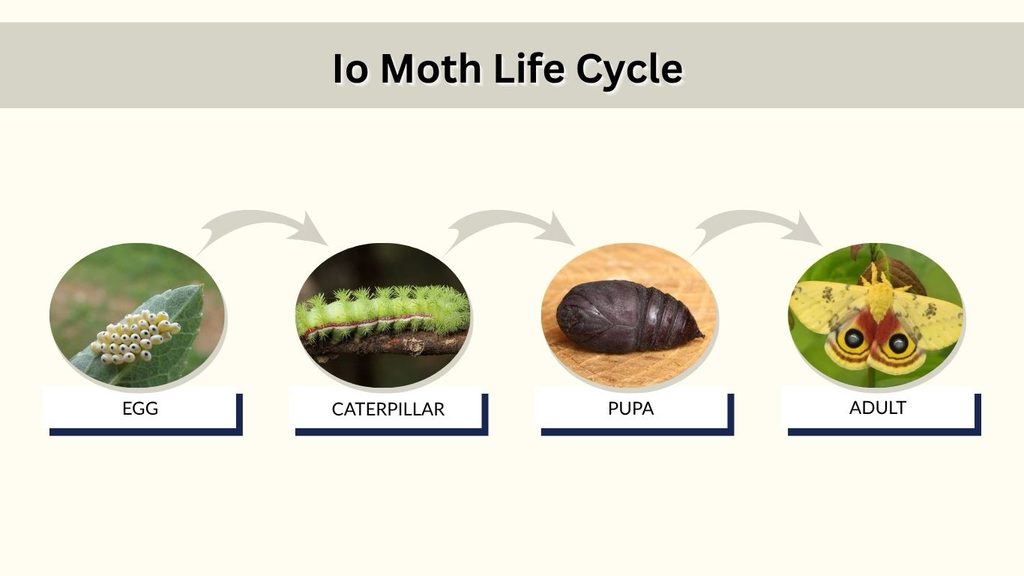
The Io moth undergoes complete metamorphosis, progressing through egg, larva, pupa, and adult stages. Most of its feeding and physical growth occur during the caterpillar stage. Adult moths focus primarily on reproduction and survive largely on energy stored during their larval development.
Io Moth Eggs
After mating, females lay groups of small eggs on suitable host plants. The eggs are often arranged in clusters rather than scattered individually.
Once they hatch, the tiny caterpillars initially remain together and begin feeding on the leaves surrounding them.
Io Moth Caterpillar Stages
Io caterpillars pass through several growth stages called instars. During each stage, they feed and increase in size before shedding their old skin.
Their development generally includes:
- Newly hatched larvae feeding together
- Several molts as the caterpillars grow
- Increasingly noticeable green coloration
- Development of prominent stinging spines
- Mature caterpillars eventually leaving feeding areas
- Preparation for pupation
Io Moth Cocoon and Pupa
When fully grown, the caterpillar stops feeding and forms a cocoon, often incorporating leaves and plant material around the pupa.
Inside the cocoon, the insect transforms into its adult form. Depending on climate and season, the pupa may remain dormant for an extended period before the adult moth emerges.
Adult Io Moth
After emerging, the adult expands and dries its wings before becoming capable of flight.
Like many giant silk moths, adult Io moths have reduced mouthparts and do not rely on feeding during their short adult lives. Their main purpose is to locate mates and reproduce.
Io Moth Host Plants and Caterpillar Diet
Io moth caterpillars can feed on an unusually wide range of plants. This flexibility helps explain why the species occurs in many different habitats. Trees, shrubs, and some other plants can all serve as caterpillar food sources, although available host plants vary geographically.
Common Io Moth Host Plants
Caterpillars may feed on plants such as:
- Oak
- Willow
- Maple
- Hackberry
- Elm
- Cherry
- Sassafras
- Redbud
- Blackberry
- Various other trees and shrubs
Because they have numerous host plants, Io moths can survive in forests, suburban gardens, parks, and other vegetated areas.
What Do Io Moth Caterpillars Eat?
Io moth caterpillars eat leaves. Newly hatched larvae often feed together and can consume sections of leaves as a group.
As they grow larger, their feeding increases substantially. Mature caterpillars may eventually separate and feed individually before leaving the plant to pupate.
What Do Adult Io Moths Eat?
Adult Io moths generally do not eat. Their mouthparts are reduced, and the energy required for adult activity comes from nutritional reserves accumulated during the caterpillar stage.
This is one reason the adult stage is relatively short compared with the larval development period.
Io Moth Habitat and Range
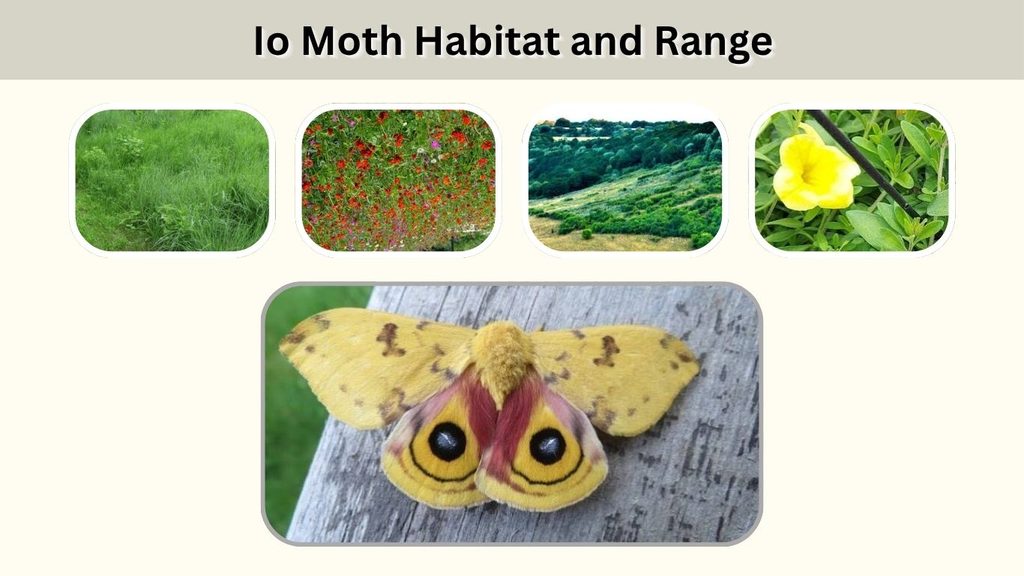
Io moths live primarily in North America, especially throughout the eastern and central United States. Their ability to use many different caterpillar host plants allows them to occupy diverse environments ranging from forests to residential landscapes. They are most likely to be noticed during warmer months when adults are flying and caterpillars are actively feeding.
Where Are Io Moths Found?
Io moths may occur in:
- Deciduous forests
- Woodland edges
- Fields
- Gardens
- Parks
- Suburban areas
- Areas with abundant host plants
Their range extends through a large portion of the eastern United States and into some surrounding regions.
Io Moth in Florida
Florida’s warm climate provides suitable conditions for Io moths and their host plants. Caterpillars may be encountered on trees or shrubs in gardens and wooded environments.
People working around vegetation should avoid handling unfamiliar spiny caterpillars because several species besides the Io moth also possess irritating or venomous spines.
Interesting Io Moth Facts
The Io moth stands out among North American moths because both its adult and caterpillar stages have impressive defensive adaptations. Adults rely heavily on visual deception, while larvae use physical and chemical defenses. These traits make the species fascinating to observe while also emphasizing why caterpillars should be viewed rather than touched.
Quick Io Moth Facts
- Its scientific name is Automeris io.
- It belongs to the giant silk moth family.
- Adult males are typically yellow.
- Females are usually brown or reddish-brown.
- Both sexes have dramatic hindwing eyespots.
- Adult moths are harmless.
- Caterpillars have venomous stinging spines.
- Caterpillars eat many different host plants.
- Adults generally do not feed.
- The species is primarily active at night.
FAQs
1. Is the Io moth poisonous?
Adult Io moths are harmless and are not poisonous. However, their caterpillars have venomous spines that can cause painful skin irritation.
2. What happens if an Io moth caterpillar stings you?
Contact can cause immediate burning, redness, itching, swelling, or localized pain. Severe reactions require prompt medical attention.
3. What do Io moth caterpillars eat?
They eat leaves from numerous trees and shrubs, including oak, willow, maple, hackberry, cherry, and other suitable host plants.
4. How can you tell a male Io moth from a female?
Male Io moths are generally yellow with feathery antennae, while females are larger and typically brown or reddish-brown.
5. How long does an Io moth live?
Most of the moth’s development occurs during the egg, caterpillar, and pupal stages. The adult stage is comparatively short and is primarily devoted to mating and reproduction.