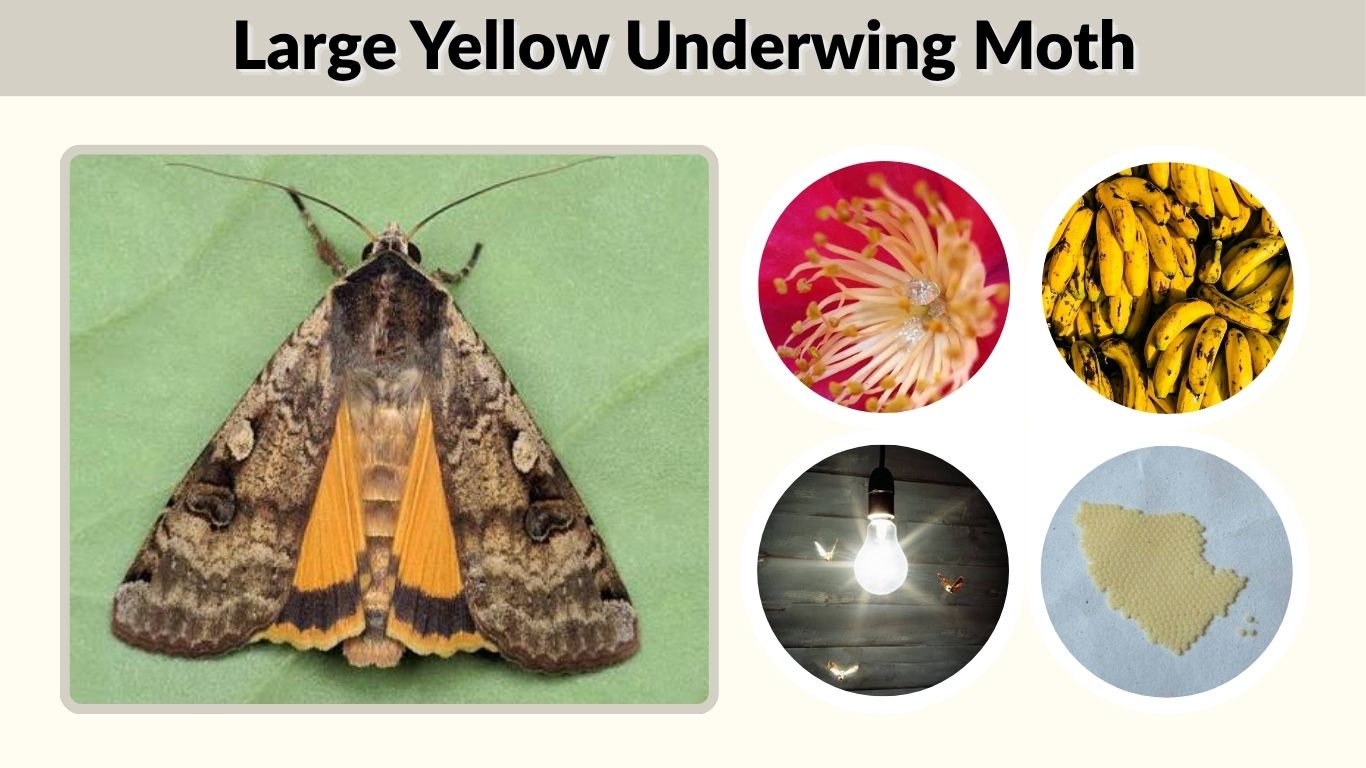
The large yellow underwing (Noctua pronuba) is a widespread nocturnal moth recognized by its brown forewings and striking yellow-orange hindwings marked with a dark border. Its caterpillars are often called cutworms because they feed close to the ground on grasses, vegetables, and other plants. Native to Europe and nearby regions, the species has also become established in North America. This guide covers large yellow underwing identification, caterpillars, diet, habitat, life cycle, eggs, pupae, and whether the caterpillars are poisonous.
What Is a Large Yellow Underwing?
The large yellow underwing is a moth in the family Noctuidae. Its scientific name is Noctua pronuba. Adults are primarily active at night and often remain hidden during daylight. Although their dull brown forewings provide excellent camouflage, the bright hindwings become immediately noticeable when the moth takes flight.
Large Yellow Underwing Identification
Look for these typical features:
- Brown, reddish-brown, or grayish forewings
- Bright yellow-orange hindwings
- Broad dark band near the hindwing edge
- Stout, furry-looking body
- Wingspan commonly around 50–60 mm
- Two darker markings often visible on each forewing
- Wings held flat or slightly roof-like while resting
- Strong nighttime flight
Forewing coloration varies considerably, so the yellow hindwings are often the most reliable identifying feature.
Why Does It Have Yellow Underwings?
The bright yellow hindwings remain hidden underneath the dull forewings when the moth rests.
When disturbed, the moth suddenly opens its wings and exposes the contrasting yellow and black pattern. This flash of color may briefly confuse a predator.
After landing, the moth closes its wings again, and the yellow disappears beneath its camouflaged forewings.
Large Yellow Underwing Caterpillar
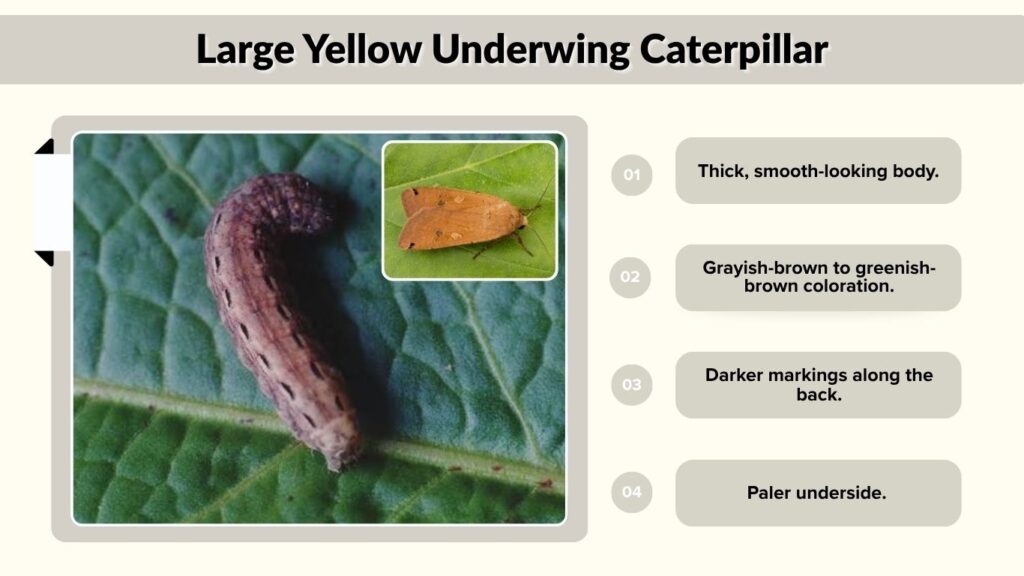
Large yellow underwing caterpillars are ground-dwelling cutworms that usually feed at night. During daylight hours, they commonly hide beneath soil, fallen leaves, stones, or vegetation. Their dull coloration makes them difficult to notice, but gardeners may discover them while digging or investigating mysteriously damaged seedlings.
Large Yellow Underwing Caterpillar Identification
Typical characteristics include:
- Thick, smooth-looking body
- Grayish-brown to greenish-brown coloration
- Darker markings along the back
- Paler underside
- Small dark spots on body segments
- Caterpillars may reach around 4–5 cm long
- Often curl into a C-shape when disturbed
- Usually found close to ground level
Color can vary, so location, size, markings, and behavior should all be considered during identification.
Are Large Yellow Underwing Caterpillars Poisonous?
Large yellow underwing caterpillars are not considered poisonous or dangerously venomous to humans.
They lack the prominent stinging spines found on some medically important caterpillars. Handling caterpillars is still unnecessary, and people with sensitive skin may prefer to use gloves when gardening.
Their main importance is as plant feeders rather than as a direct threat to people or pets.
What Do Large Yellow Underwing Caterpillars Eat?
The larvae feed on a broad range of low-growing vegetation. Their flexible diet helps explain why the species can thrive in gardens, farmland, grasslands, and disturbed habitats. Young larvae may feed on leaves, while larger caterpillars can damage seedlings by feeding near the base of plants.
Common Caterpillar Foods
Large yellow underwing caterpillars may feed on:
- Grasses
- Lettuce
- Cabbage-family plants
- Spinach
- Dock
- Dandelion
- Chickweed
- Plantain
- Clover
- Various garden vegetables
- Seedlings
- Other herbaceous plants
Because their diet is broad, they may be found in both cultivated and wild vegetation.
Why Are They Called Cutworms?
The caterpillars are commonly grouped with cutworms because larger larvae may feed close to the soil surface.
They sometimes chew through tender stems near ground level, causing young seedlings to collapse suddenly. Other caterpillars climb plants at night and consume leaves.
During daylight they often retreat into the soil, which can make it difficult to identify the cause of plant damage without nighttime inspection.
What Do Adult Large Yellow Underwing Moths Eat?
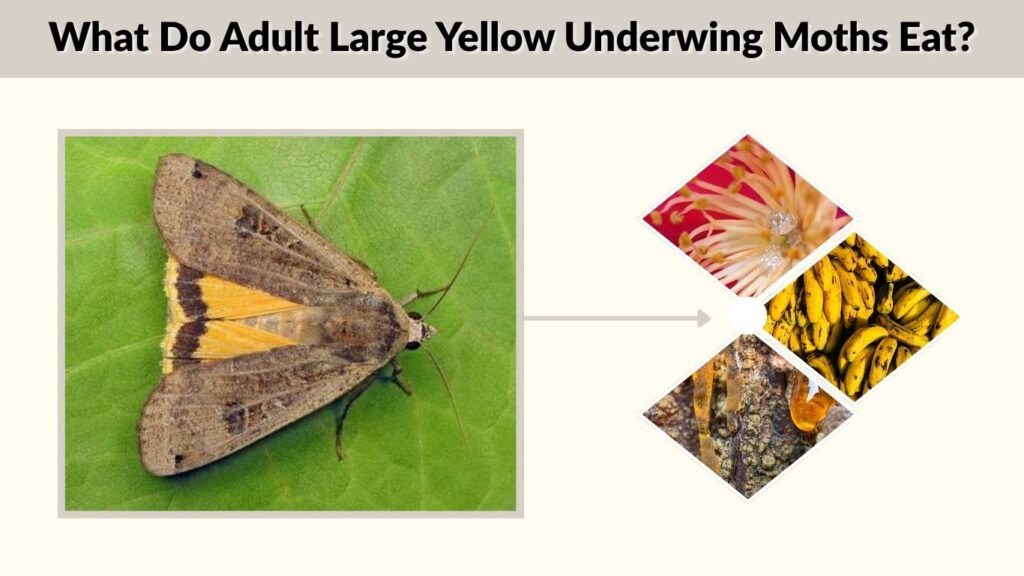
Adult large yellow underwings no longer eat leaves like their caterpillars. Instead, they seek liquid foods that provide energy for flying, mating, and egg production. They are mostly nocturnal feeders and may visit flowers or other sugary food sources after sunset.
Adult Large Yellow Underwing Diet
Adults may obtain food from:
- Flower nectar
- Overripe fruit juices
- Tree sap
- Other naturally occurring sugary liquids
Night-blooming and strongly scented flowers can provide suitable nectar.
Adults may also come to artificial light, although attraction to light is separate from feeding behavior.
Large Yellow Underwing Life Cycle
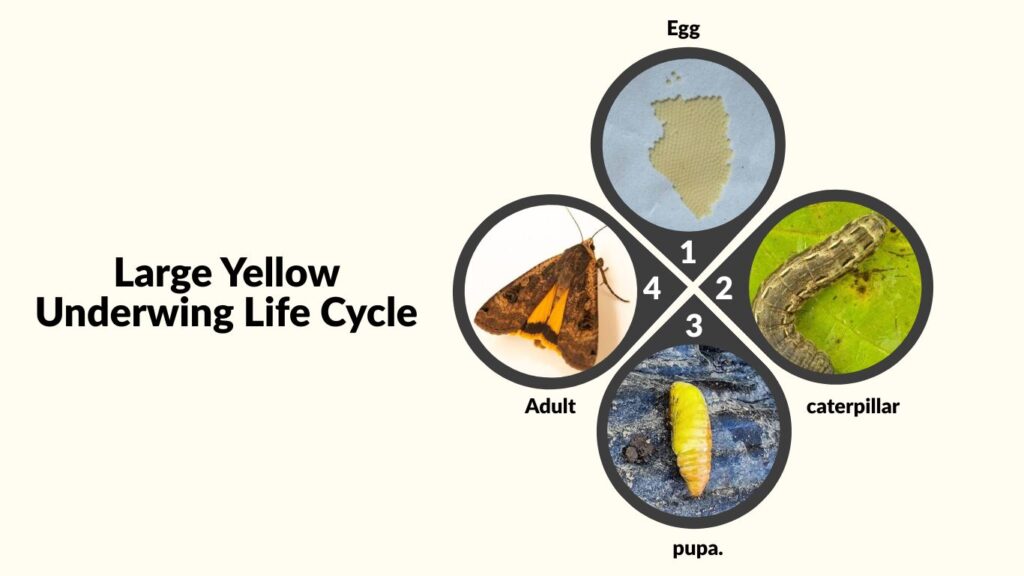
Like other moths, the large yellow underwing undergoes complete metamorphosis. Its development includes egg, caterpillar, pupa, and adult stages. Seasonal timing varies with climate, but the caterpillar stage often occupies a substantial part of the life cycle, including colder periods in many regions.
Four Life Cycle Stages
The development process includes:
- Egg: Females deposit groups of eggs on suitable vegetation.
- Larva: Caterpillars hatch and begin feeding on plants.
- Pupa: Mature larvae enter the soil and pupate.
- Adult: The moth emerges, mates, and produces another generation.
The species commonly passes the colder season mainly as a larva.
Large Yellow Underwing Eggs
Female moths can lay large batches of small eggs on leaves, stems, or other suitable surfaces.
Fresh eggs are generally pale and may become darker as development progresses.
Once the caterpillars hatch, they initially feed on nearby vegetation. As they grow, they increasingly hide near ground level during daylight and become more active after dark.
Large Yellow Underwing Pupa
When fully grown, the caterpillar usually moves into the soil and creates a protected space in which to pupate.
The pupa is brownish and relatively smooth.
People sometimes search for a “large yellow underwing cocoon,” but this species typically pupates underground rather than forming the conspicuous silk cocoon associated with many silk moths.
Eventually, the adult moth emerges from the pupa and makes its way to the surface.
Large Yellow Underwing Habitat and Distribution
Large yellow underwings are adaptable and occupy many open or semi-open environments where suitable larval food plants grow. Their ability to eat numerous plants allows them to survive in highly modified landscapes as well as more natural habitats.
Common Habitats
They may occur in:
- Gardens
- Grasslands
- Meadows
- Agricultural fields
- Parks
- Woodland edges
- Roadside vegetation
- Urban areas
- Waste ground
- Residential yards
Adults often rest during the day in sheltered locations such as dense plants, walls, sheds, fences, or beneath vegetation.
Large Yellow Underwing in the UK
The large yellow underwing is a familiar moth in the UK and can be encountered in gardens and countryside habitats.
Adults are particularly noticeable during the warmer months and frequently come to outdoor lights.
Because their caterpillars feed on many common plants, suitable breeding habitat is widespread.
Large Yellow Underwing in North America
The species originated outside North America but has become established across extensive parts of the continent.
Its adaptable feeding habits, strong flight, and ability to use common grasses and garden plants have contributed to its spread.
In areas where it has been introduced, larvae may occasionally become pests of lawns, gardens, and agricultural plants.
Large Yellow Underwing in the House
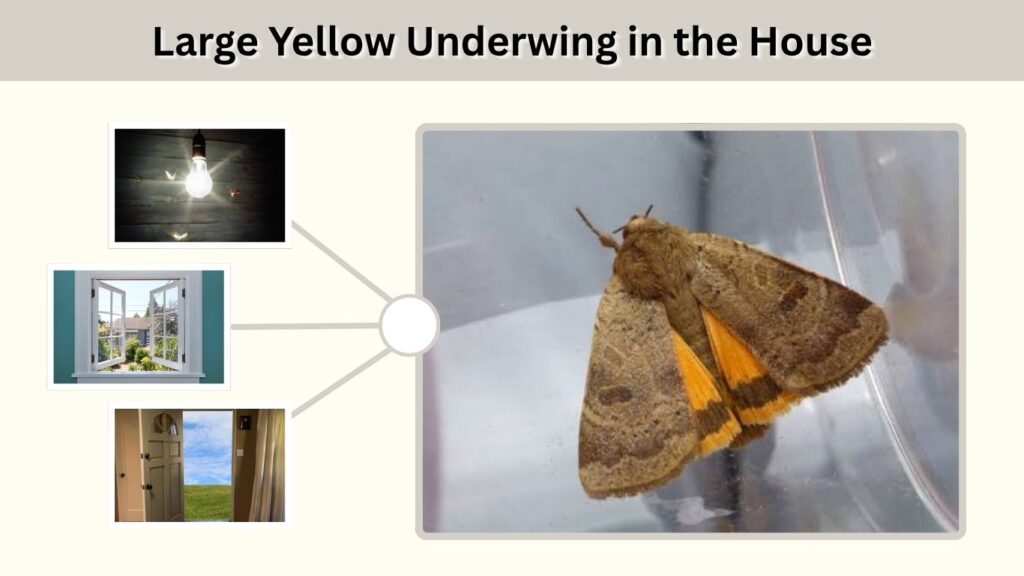
An adult large yellow underwing may occasionally enter a home through an open window or door, particularly at night when indoor lights are visible. Finding one indoors generally does not indicate an infestation.
Why They Enter Houses
Indoor encounters commonly happen because moths:
- Fly toward artificial lights
- Enter through open windows
- Come through open doors
- Rest in garages or sheds
- Accidentally become trapped indoors
They do not normally establish colonies inside houses.
If you find one, gently capture it with a container and release it outdoors.
Male vs Female Large Yellow Underwing
Male and female large yellow underwing moths look quite similar, making casual identification of sex difficult. Both show the characteristic brown forewings and yellow-orange hindwings.
Differences Between Males and Females
Possible differences include:
- Females may have fuller abdomens when carrying eggs.
- Males tend to have slimmer abdomens.
- Size can overlap considerably.
- Wing color is highly variable in both sexes.
- Reliable sexing may require closer examination.
The color of the forewings alone is therefore not a reliable way to determine whether a moth is male or female.
FAQs
1. Is the large yellow underwing moth dangerous?
No. Large yellow underwing moths are not dangerous to humans. Adults do not sting, and the caterpillars are not considered poisonous. Their main negative impact occurs when larvae feed on garden plants, seedlings, grasses, and agricultural crops.
2. What do large yellow underwing caterpillars eat?
The caterpillars eat many low-growing plants, including grasses, lettuce, dock, dandelion, clover, plantain, chickweed, and various vegetables. Because they are generalist feeders, they can survive on numerous wild and cultivated plants and may occasionally damage garden seedlings.
3. What do adult large yellow underwing moths eat?
Adults mainly obtain energy from liquid foods such as flower nectar, fruit juices, tree sap, and other sugary substances. Unlike their caterpillars, adult moths do not normally feed on leaves. They are primarily active and feed during nighttime hours.
4. Is the large yellow underwing invasive?
The large yellow underwing is native to Europe and nearby regions but has been introduced and established in North America. In introduced areas it can be considered a non-native or invasive species, especially where its larvae affect gardens, lawns, or crops.
5. Where do large yellow underwing moths pupate?
Mature caterpillars usually pupate underground. They move into the soil and create a protected chamber where transformation takes place. The brown pupa remains there until the adult moth develops and emerges. Unlike many silk moths, the species does not normally produce a large visible silk cocoon.