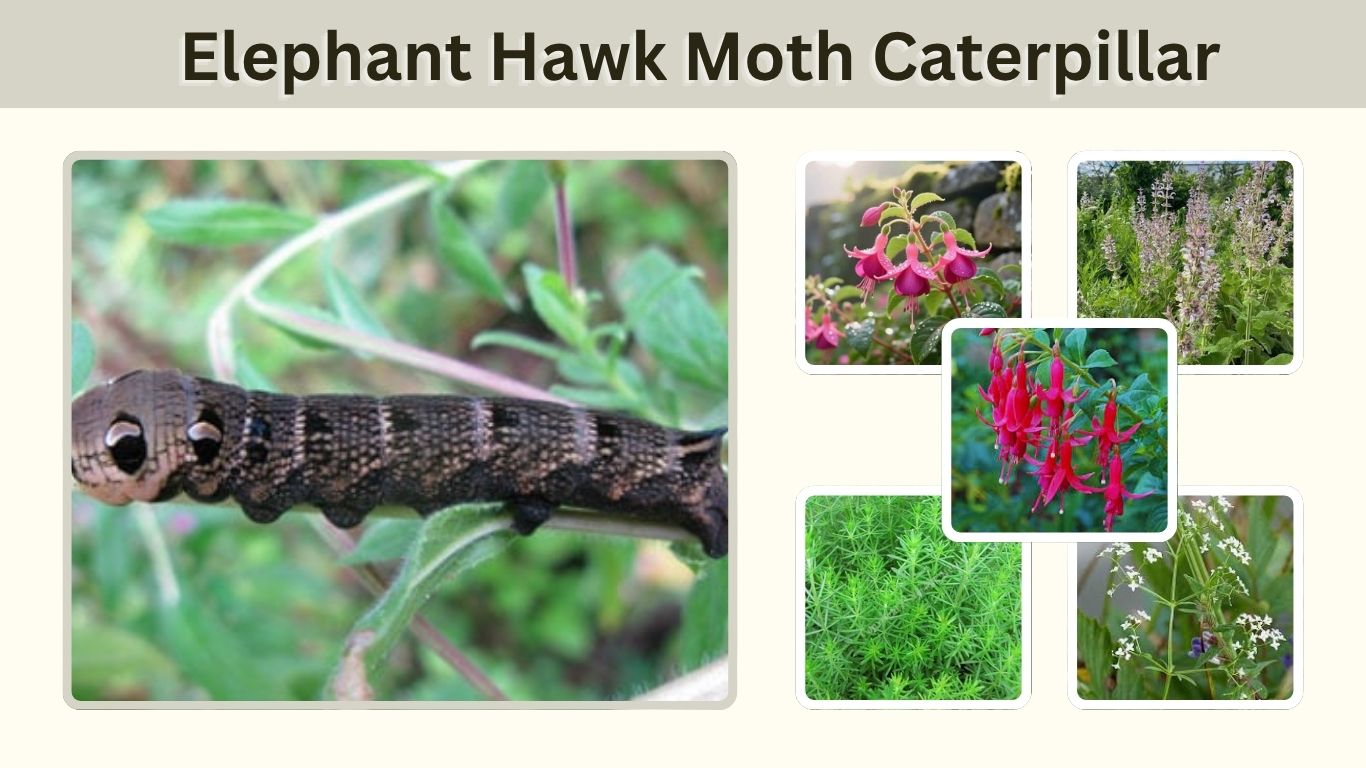
The Elephant Hawk Moth caterpillar (Deilephila elpenor) is one of the most distinctive large caterpillars found in gardens. Usually brown or green, it has prominent false eyespots near its head and a small horn at the rear. When threatened, the caterpillar pulls its head inward and creates a snake-like appearance that can discourage predators. Fully grown larvae may reach around 8–8.5 cm long. They commonly feed on willowherbs, bedstraws, and fuchsias before leaving their food plant to find a suitable place to pupate.
Elephant Hawk Moth Caterpillar Quick Facts
The Elephant Hawk Moth belongs to the hawk moth family, Sphingidae. Although the adult moth is famous for its pink and olive-green coloration, gardeners often encounter the caterpillar first. Mature larvae are especially noticeable in late summer when they leave their host plants and wander across lawns, paths, or gardens while searching for somewhere to pupate.
| Feature | Elephant Hawk Moth Caterpillar |
| Scientific name | Deilephila elpenor |
| Family | Sphingidae |
| Maximum size | About 8–8.5 cm |
| Common colors | Brown or green |
| Main food | Willowherbs, bedstraws, fuchsia |
| Rear horn | Yes, small |
| Poisonous | Not a stinging caterpillar |
| Main season | Late summer to early autumn |
| Adult moth | Pink and olive green |
What Does an Elephant Hawk Moth Caterpillar Look Like?
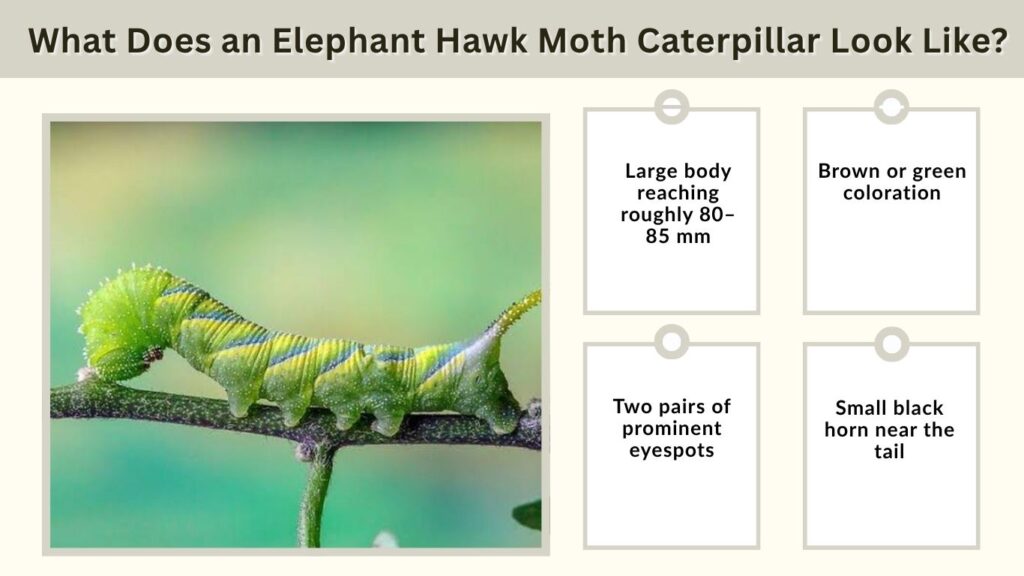
A mature Elephant Hawk Moth caterpillar has a thick body that is usually brown but can also be green. The front of the body is narrower than the abdomen, while two pairs of conspicuous eyespots create the appearance of a much larger head. A small dark horn is present near the rear.
Elephant Hawk Moth Caterpillar Identification
Look for these characteristics:
- Large body reaching roughly 80–85 mm
- Brown or green coloration
- Two pairs of prominent eyespots
- Pink and black coloration around the eyespots
- Narrow head and front body section
- Thick rear portion of the body
- Small black horn near the tail
- Smooth body without dense hairs
- Snake-like appearance when disturbed
The combination of large eyespots and a short rear horn is particularly useful when identifying a mature caterpillar.
Green vs Brown Elephant Hawk Moth Caterpillar
Both green and brown Elephant Hawk Moth caterpillars occur naturally. Brown larvae are frequently encountered, but green individuals are also well documented. The different colors do not represent separate species.
Color can therefore be misleading if used alone for identification. The eyespots, rear horn, body shape, host plant, and behavior provide stronger clues.
Why Does the Caterpillar Look Like a Snake?
The snake-like appearance is one of the caterpillar’s most interesting defensive adaptations. When it feels threatened, the caterpillar retracts its head into the broader thorax. This makes the front of the body swell and causes the false eyespots to become much more noticeable.
How Snake Mimicry Protects It
The enlarged front end can resemble a small snake’s head. A bird or another predator approaching what appeared to be an ordinary caterpillar may suddenly encounter what looks like a much larger animal.
The eyespots are not real eyes. The caterpillar’s true head is considerably smaller and can partly disappear into the front of the body when the animal adopts its defensive posture.
This type of visual deception can give the caterpillar an opportunity to avoid being eaten without needing venom, stinging hairs, or an aggressive defense.
How Big Does an Elephant Hawk Moth Caterpillar Get?
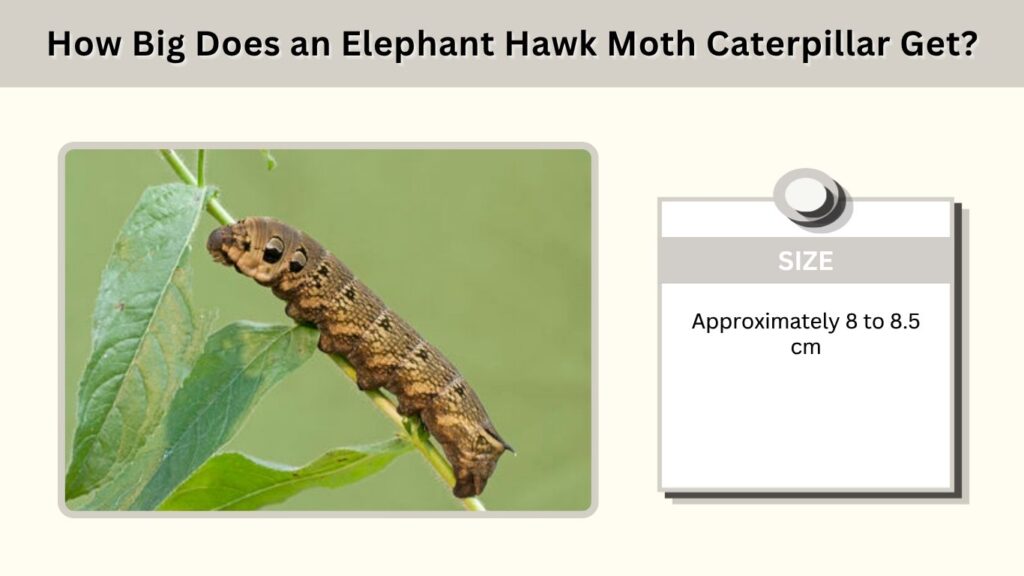
A fully grown Elephant Hawk Moth caterpillar can reach approximately 8 to 8.5 cm, or a little over 3 inches, in length. This makes it one of the more impressive caterpillars commonly encountered in British gardens.
Small vs Fully Grown Caterpillars
Young larvae start much smaller and become increasingly thick as they feed and molt.
By the final stage, the caterpillar can be roughly finger-sized. Its large size often surprises people who discover one crawling across a garden path.
A very large caterpillar walking away from plants may already be fully fed and looking for somewhere to pupate rather than searching for additional food.
What Does an Elephant Hawk Moth Caterpillar Eat?
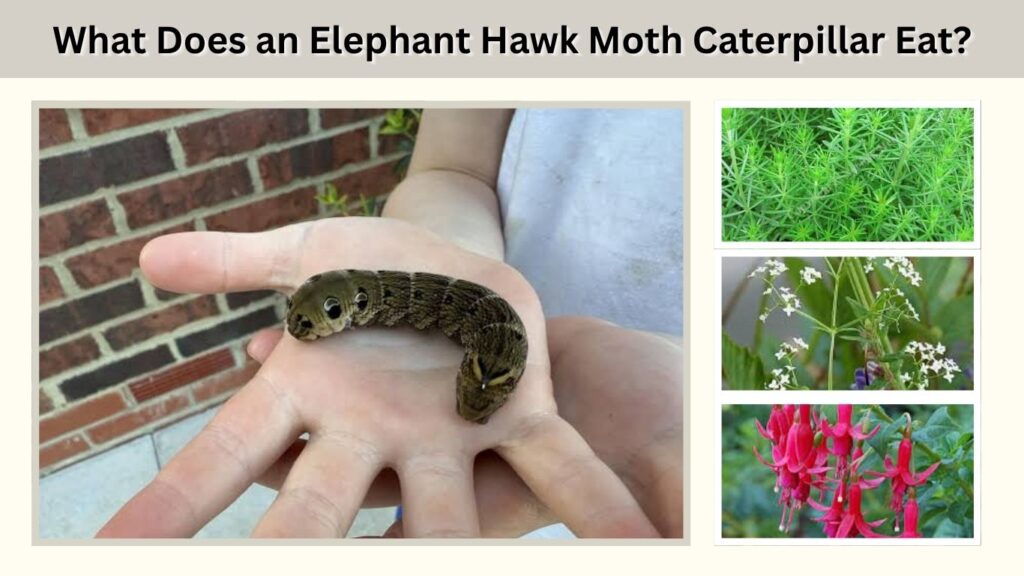
The caterpillar is a plant eater. Rosebay willowherb is one of its principal food plants, but it also feeds on other willowherbs, bedstraws, Himalayan balsam, and fuchsia. Gardens containing fuchsias are common places to encounter the larvae.
Elephant Hawk Moth Caterpillar Food Plants
Common food plants include:
- Rosebay willowherb
- Other willowherbs
- Bedstraws
- Fuchsia
- Himalayan balsam
- Enchanter’s nightshade
Caterpillars generally remain on suitable host plants while growing. Despite their large size and appetite, RHS notes that extensive damage to garden plants is uncommon.
Do They Damage Fuchsia Plants?
Elephant Hawk Moth caterpillars can eat noticeable amounts of fuchsia foliage, particularly when a large larva is present.
However, serious or widespread damage is uncommon, and control is generally unnecessary. If a caterpillar must be moved because significant plant damage is occurring, RHS suggests transferring it to a suitable wild host such as rosebay willowherb.
Is an Elephant Hawk Moth Caterpillar Poisonous?
The intimidating eyespots and rear horn sometimes lead people to assume the caterpillar is poisonous or capable of stinging. However, its horn is not a venomous stinger.
The species relies mainly on camouflage and its snake-like defensive display rather than a stinging defense.
Can an Elephant Hawk Moth Caterpillar Sting?
No bee-like stinger is present. The small projection at the back is characteristic of many hawk moth caterpillars and should not be mistaken for a weapon.
If you need to move a caterpillar, gentle handling is preferable, although leaving healthy wildlife undisturbed is usually best.
Is It Poisonous to Dogs or Cats?
The Elephant Hawk Moth caterpillar is not known as a stinging caterpillar, but pets should still be discouraged from chewing or swallowing wild insects.
If a dog or cat eats a caterpillar and then develops vomiting, excessive drooling, mouth irritation, weakness, or other unusual symptoms, contact a veterinarian for advice. Avoid giving home treatments unless directed by a veterinary professional.
Elephant Hawk Moth Caterpillar Life Cycle
The Elephant Hawk Moth goes through complete metamorphosis: egg, caterpillar, pupa, and adult moth. The caterpillar spends its growing period feeding before eventually leaving the host plant and searching for an appropriate pupation site.
From Egg to Caterpillar
After eggs hatch on or near suitable host plants, the larvae begin feeding and pass through several growth stages.
As they become larger, their distinctive eyespots and body shape become easier to recognize. Caterpillars are particularly noticeable during late summer and early autumn.
Elephant Hawk Moth Caterpillar Pupating
A fully fed larva eventually stops eating and wanders away from its food plant.
It searches near ground level, where it can bury itself or shelter among loose plant debris. Finding a large caterpillar crossing a lawn or path can therefore be a sign that it is ready to pupate rather than lost.
Elephant Hawk Moth Chrysalis or Cocoon
The correct developmental stage is technically a pupa. The species forms a relatively fragile cocoon around its pupa in loose plant litter or close to the soil surface.
The insect then remains inside while its body transforms from caterpillar to adult moth.
What Happens During Winter?
In Britain, the Elephant Hawk Moth normally overwinters as a pupa. The adult eventually emerges the following spring, with RHS noting emergence around May.
The resulting moth looks dramatically different from its caterpillar. Adults have attractive pink and olive-green coloration and are primarily active at dusk and during the night.
How to Care for an Elephant Hawk Moth Caterpillar
If you find one outdoors, the simplest approach is usually to leave it where it is unless it faces immediate danger. Caterpillars found feeding on plants already have access to the food they require.
Caring for One Temporarily
If temporary care is necessary, provide fresh leaves from the same host plant on which the caterpillar was found and maintain good ventilation.
Avoid changing to an unidentified plant, since caterpillars are adapted to particular host plants.
A mature caterpillar that stops feeding and begins wandering may be preparing to pupate. At this point it needs an appropriate sheltered substrate rather than being repeatedly offered more food.
For long-term wildlife benefit, allowing the caterpillar to complete its development naturally outdoors is generally preferable.
Elephant Hawk Moth Caterpillar Habitat
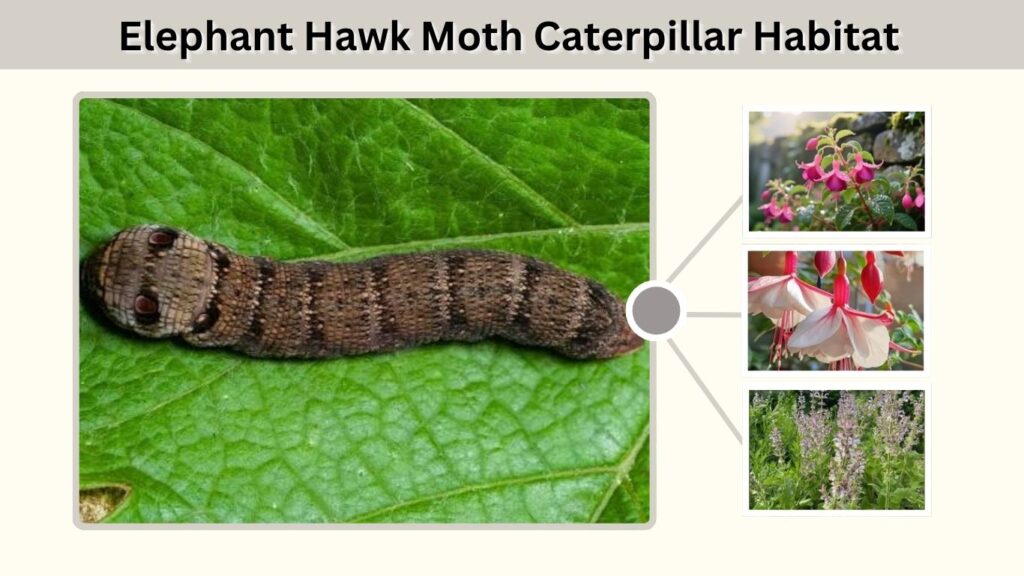
Elephant Hawk Moths occur in a variety of habitats where their food plants grow. Gardens are especially useful habitats because fuchsias and other suitable plants may support developing larvae.
Adult moths are nocturnal and visit tubular flowers such as honeysuckle for nectar.
Is the Elephant Hawk Moth Caterpillar Rare?
In Britain, the Elephant Hawk Moth is considered common rather than rare. Caterpillars are frequently encountered in gardens, particularly later in summer when mature individuals begin wandering away from their host plants.
In other countries, similar-looking hawk moth caterpillars can occur, so sightings in places such as Australia, Texas, or elsewhere should be identified using local species information rather than appearance alone.
FAQs
What does an Elephant Hawk Moth caterpillar look like?
It is a large brown or green caterpillar with prominent black-and-pink eyespots, a thick body, and a small horn near the rear. Mature larvae can reach around 8–8.5 cm long.
Is an Elephant Hawk Moth caterpillar poisonous?
It is not a stinging caterpillar, and the horn at its rear is not a venomous stinger. Its main defensive strategy involves making itself appear snake-like when threatened.
Why does the Elephant Hawk Moth caterpillar look like a snake?
When threatened, it retracts its head and swells the front of its body. This makes its large false eyespots more visible and creates the appearance of a small snake’s head, potentially frightening predators.
What should I feed an Elephant Hawk Moth caterpillar?
Its main food plants include rosebay willowherb, other willowherbs, bedstraws, and fuchsia. If one is already feeding on a suitable plant, keeping it on that same plant is usually the safest approach.
What happens when an Elephant Hawk Moth caterpillar is fully grown?
It stops feeding, leaves its host plant, and searches for somewhere near the ground to pupate. The species overwinters as a pupa before eventually emerging as the distinctive pink-and-olive adult moth.