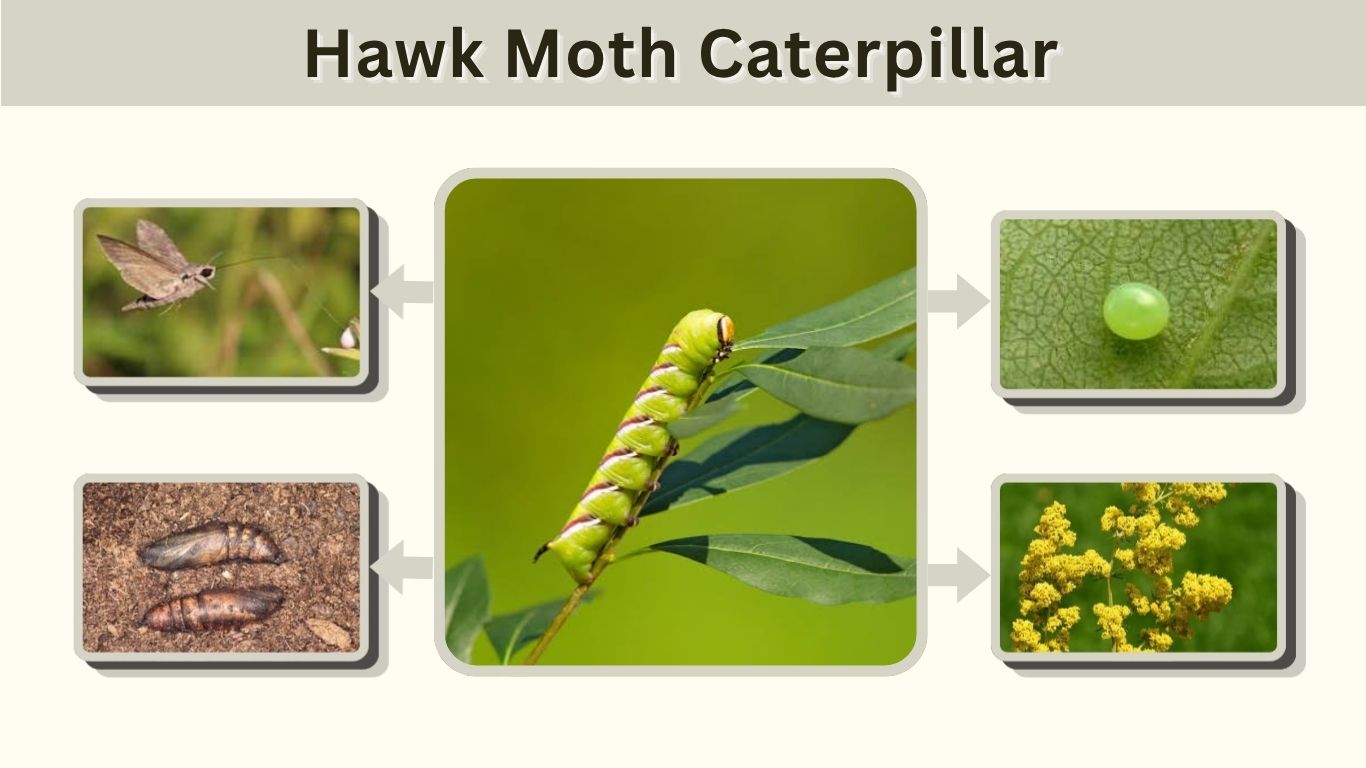
A hawk moth caterpillar is the larval stage of a moth in the family Sphingidae, a group also known as sphinx moths. These caterpillars are often large, smooth-bodied, and recognized by a horn-like projection near the rear. Depending on the species, they may be green, brown, yellow, black, or brightly patterned. Some, including the Elephant Hawk Moth caterpillar, can even resemble a snake when threatened. Most are plant feeders, and their exact food plants, size, markings, and behavior provide useful clues for identification.
What Does a Hawk Moth Caterpillar Look Like?
Hawk moth caterpillars vary considerably between species, but many share the classic “hornworm” appearance. They tend to have thick bodies, relatively little hair, and a horn or spike near the rear. Butterfly Conservation notes that hawk-moth caterpillars are generally larger than average caterpillars and that most possess a characteristic rear horn.
Hawk Moth Caterpillar Identification
Look for a combination of these features:
- Large, thick caterpillar body
- Usually smooth rather than densely hairy
- Rear horn or tail-like projection
- Green, brown, black, yellow, or mixed coloration
- Diagonal stripes or spots on many species
- Large false eyespots on some species
- Powerful gripping legs and prolegs
- Noticeable changes in color before pupation
The host plant is another important identification clue because different hawk moth species prefer different groups of plants.
Why Do Hawk Moth Caterpillars Have a Horn?
The spike at the rear is one of the most recognizable hawk moth caterpillar characteristics. It gives many species the common name hornworm.
Despite its threatening appearance, the structure is not used like a bee or wasp stinger. Its size, shape, and color vary considerably. Some species have black horns, others blue, red, yellow, or orange, and a few lose the prominent horn as they mature.
Elephant Hawk Moth Caterpillar
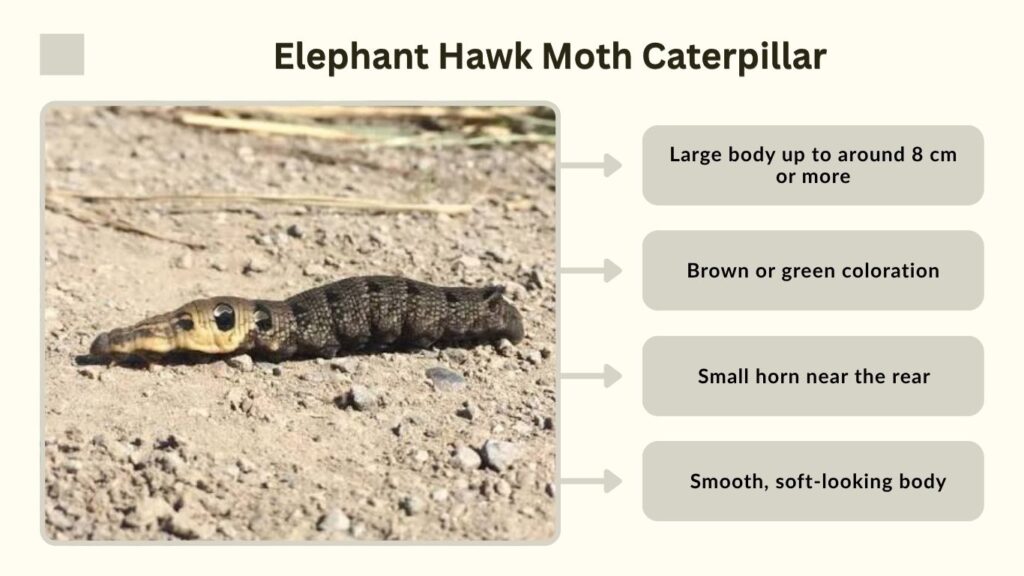
The Elephant Hawk Moth caterpillar (Deilephila elpenor) is one of the most recognizable hawk moth larvae. Large individuals can reach approximately 8–8.5 cm and may be either green or brown. They have distinctive eyespots behind the head and a small rear horn.
Elephant Hawk Moth Caterpillar Identification
Its main characteristics include:
- Large body up to around 8 cm or more
- Brown or green coloration
- Two pairs of prominent eyespots
- Small horn near the rear
- Thickened front portion when threatened
- Smooth, soft-looking body
- Often found on willowherb or fuchsia
The caterpillar feeds mainly on rosebay willowherb but can also use bedstraw and garden plants such as fuchsia.
Why Does It Look Like a Snake?
When threatened, an Elephant Hawk Moth caterpillar pulls its head inward and enlarges the front of its body. Its large false eyespots then become much more prominent.
The result resembles the head of a small snake. This is a defensive form of mimicry that may make a predator hesitate before attacking. Butterfly Conservation specifically describes the caterpillar swelling into a snake-like shape when threatened.
Are Hawk Moth Caterpillars Poisonous?
Most familiar hawk moth caterpillars are not stinging caterpillars. Their rear horn may look dangerous, but it should not be confused with a venomous spine.
The Elephant Hawk Moth caterpillar, for example, is described as harmless to humans and pets despite its intimidating size and false eyespots.
Can a Hawk Moth Caterpillar Sting?
Typical sphinx or hawk moth caterpillars do not have a bee-like stinger.
However, “hawk moth caterpillar” covers many species worldwide, and identification is still important before handling any unfamiliar caterpillar. Some caterpillars from completely different moth families possess irritating hairs or venomous spines and can superficially resemble other large larvae.
When identification is uncertain, observing rather than handling is the safest approach.
What Does a Hawk Moth Caterpillar Eat?
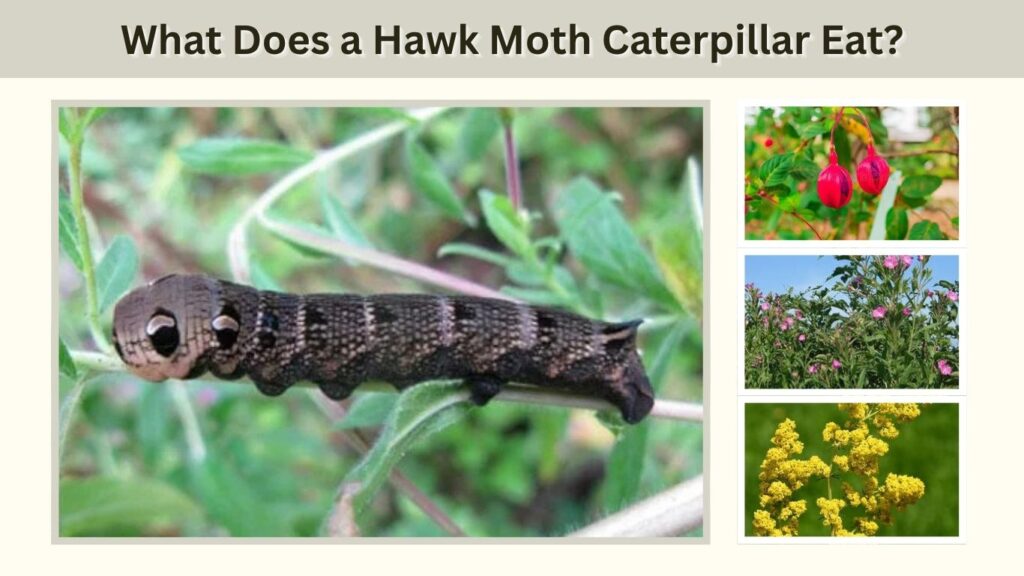
Hawk moth caterpillars eat plant material, but there is no single food that suits every species. Individual hawk moth species frequently have preferred host plants on which females lay eggs and their larvae develop.
Some feed primarily on shrubs and trees, while others specialize on wildflowers, vines, or vegetables.
Common Hawk Moth Caterpillar Food Plants
Examples include:
| Hawk Moth | Common Caterpillar Food Plants |
| Elephant Hawk Moth | Willowherb, fuchsia, bedstraw |
| Hummingbird Hawk Moth | Bedstraw |
| Privet Hawk Moth | Privet, lilac, ash |
| Poplar Hawk Moth | Poplar, aspen, willow |
| Eyed Hawk Moth | Willow, sallow, apple |
| Tomato/Five-Spotted Hawk Moth | Tomato and related nightshades |
| Death’s-Head Hawk Moth | Nightshade-family plants |
Butterfly Conservation identifies privet, lilac, and ash for Privet Hawk Moth larvae, while Poplar Hawk Moth caterpillars feed on poplar, aspen, and willow.
Green Hawk Moth Caterpillars
Green is one of the most common colors among hawk moth caterpillars because it provides excellent camouflage among leaves.
However, color alone is rarely enough to determine the exact species. Look at the horn color, stripes, spots, host plant, body texture, and geographic location.
Common Green Species
Several familiar examples include Privet Hawk Moth, Lime Hawk Moth, Eyed Hawk Moth, tomato hornworm, and some Elephant Hawk Moth caterpillars.
The Privet Hawk Moth caterpillar is particularly striking, with a bright green body, white-and-purple diagonal stripes, and a dark curved horn.
The Lime Hawk Moth caterpillar is also green but has yellow striping and a blue rear horn.
Brown Hawk Moth Caterpillars
Some species naturally have both green and brown forms, while others change color as they approach pupation.
A brown caterpillar is therefore not necessarily a different species from a green individual found nearby.
Why Does a Hawk Moth Caterpillar Turn Brown?
Color changes can occur as a caterpillar matures and prepares to pupate. At this stage, many larvae stop feeding and begin wandering away from their host plants.
This behavior often leads people to find large hawk moth caterpillars crossing patios, paths, gardens, or lawns rather than sitting on leaves.
If a previously green caterpillar becomes dull or brown and begins wandering, pupation may be approaching.
Other Common Hawk Moth Caterpillars
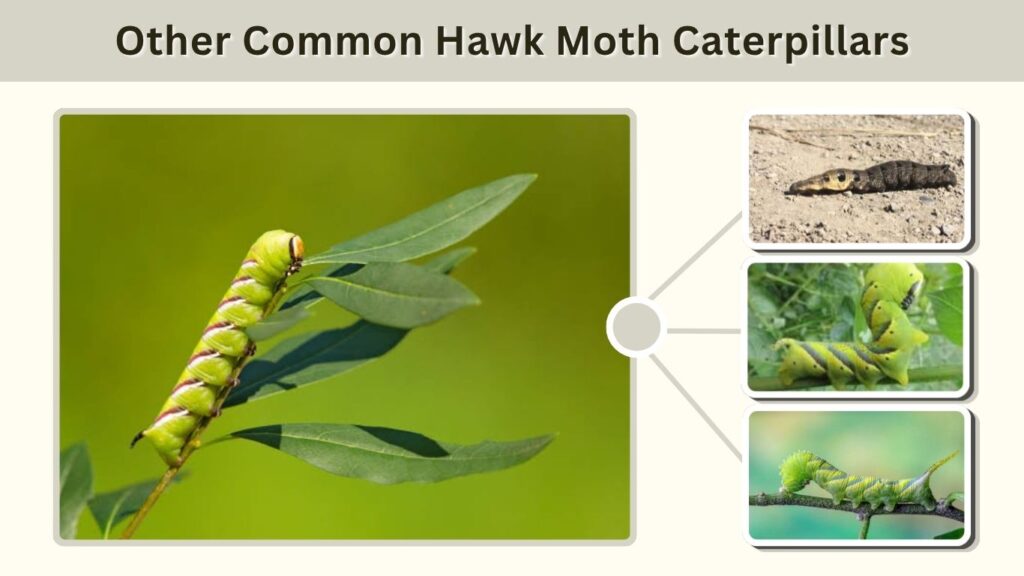
The Sphingidae family contains many distinctive caterpillars. Size, coloration, horn shape, and host plant make some relatively easy to identify.
Death’s-Head Hawk Moth Caterpillar
The Death’s-Head Hawk Moth produces a very large caterpillar that may be yellow-green with diagonal markings and a distinctive curved rear horn.
Its larvae often feed on plants in the nightshade family, including potato. They eventually leave their host plant and pupate underground.
Hummingbird Hawk Moth Caterpillar
Hummingbird Hawk Moth caterpillars are generally green with fine markings and a rear horn. Bedstraw is an important food plant.
The adult is particularly distinctive because it flies during the day and hovers at flowers much like a hummingbird.
Eyed Hawk Moth Caterpillar
Eyed Hawk Moth caterpillars are green and can resemble Poplar Hawk Moth caterpillars.
One useful clue is the rear spike: Butterfly Conservation notes that the Eyed Hawk Moth caterpillar has a bluish-colored spike.
Bedstraw Hawk Moth Caterpillar
The Bedstraw Hawk Moth caterpillar can have a dark brownish-green body with conspicuous yellow spots and a red horn near the rear.
Its appearance is quite different from the more uniformly green hornworms.
Hawk Moth Caterpillar Life Cycle
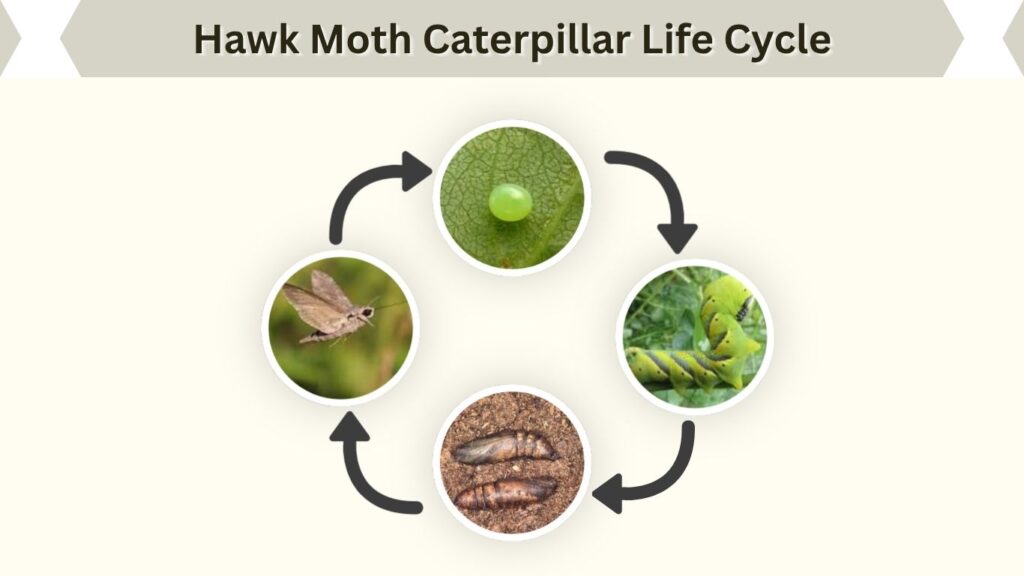
Like other moths, hawk moths undergo complete metamorphosis through four main stages: egg, caterpillar, pupa, and adult moth.
The caterpillar is the primary feeding and growing stage.
From Caterpillar to Hawk Moth
A typical sequence is:
- An adult female lays eggs on a suitable host plant.
- Small caterpillars hatch and begin feeding.
- The larvae grow through several molts.
- A mature caterpillar stops eating.
- It searches for an appropriate pupation site.
- It becomes a pupa.
- An adult hawk moth eventually emerges.
Many sphinx moth caterpillars pupate in or near the soil. Tomato hornworms, for example, leave their host plants and burrow into the ground before becoming pupae.
Hawk Moth Caterpillar vs Other Caterpillars
The combination of a large smooth body and rear horn strongly suggests a sphinx or hawk moth caterpillar, but not every species looks identical.
| Feature | Hawk Moth Caterpillar | Typical Hairy Moth Caterpillar |
| Body | Usually smooth | Often hairy |
| Size | Frequently large | Variable |
| Rear horn | Common | Usually absent |
| Eyespots | Present in some species | Less typical |
| Main defense | Camouflage or mimicry | May use hairs/spines |
| Food | Leaves of host plants | Varies widely |
Should You Remove Hawk Moth Caterpillars?
That depends on the species and plant.
Many hawk moth caterpillars cause only limited garden damage and become valuable adult moths. RHS notes that Elephant Hawk Moth caterpillars rarely cause extensive damage to garden plants.
Tomato hornworms are different because large individuals can rapidly remove tomato foliage and may also damage fruit.
Correct identification is therefore useful before deciding whether control is necessary.
FAQs
Are hawk moth caterpillars poisonous?
Most commonly encountered hawk moth caterpillars are not considered poisonous or stinging. Their rear horn may look dangerous but is not a bee-like stinger. Identification is still recommended before handling any unfamiliar caterpillar.
How do I identify a hawk moth caterpillar?
Look for a relatively large, smooth body and a horn-like projection near the rear. Then compare its color, stripes, eyespots, horn color, host plant, and location to known hawk moth species.
What does an Elephant Hawk Moth caterpillar eat?
It feeds mainly on willowherbs but also eats bedstraw, fuchsia, and some other plants. Gardeners frequently encounter large larvae feeding on fuchsia plants.
Why does a hawk moth caterpillar look like a snake?
The Elephant Hawk Moth caterpillar can retract its head and expand the front of its body, making its false eyespots more noticeable. This creates a snake-like appearance that may discourage predators.
What happens to a hawk moth caterpillar?
After reaching full size, the caterpillar stops feeding and searches for a place to pupate. Many species pupate in soil or plant debris. Inside the pupa, metamorphosis occurs before the adult hawk moth emerges.