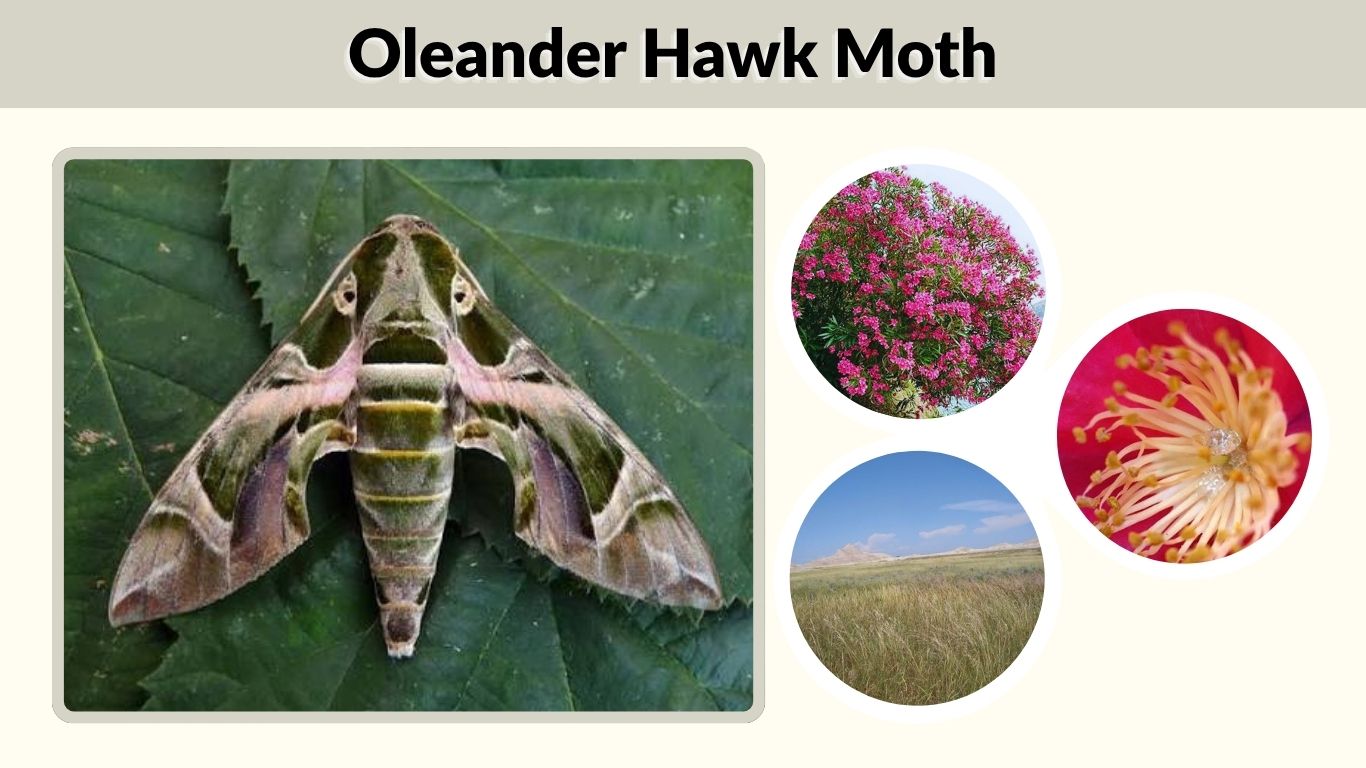
The Oleander Hawk Moth (Daphnis nerii) is a large, beautifully patterned hawk moth famous for its camouflage-like green wings and striking caterpillar. Also called the Oleander Hawk-Moth or Army Green Moth, it belongs to the sphinx moth family, Sphingidae. Its caterpillars commonly feed on oleander and several related plants, while adults visit flowers for nectar. Despite its dramatic appearance and association with poisonous oleander, the moth does not sting and is not considered dangerous to humans.
Oleander Hawk Moth Quick Facts
The Oleander Hawk Moth is a strong-flying species found across warm regions of Africa and Asia, with populations also established in Hawaii. It is migratory and occasionally reaches parts of Europe, including rare appearances in the UK. Adults are particularly distinctive because their green, cream, pinkish, and brown wing markings resemble leaves and natural vegetation.
| Feature | Oleander Hawk Moth |
| Scientific name | Daphnis nerii |
| Family | Sphingidae |
| Other name | Army Green Moth |
| Wingspan | About 90–130 mm |
| Caterpillar size | Around 75–85 mm when mature |
| Adult food | Flower nectar |
| Main larval host | Oleander |
| Dangerous to humans | No |
| Activity | Mostly dusk and nighttime |
What Does an Oleander Hawk Moth Look Like?
Adult Oleander Hawk Moths are among the most colorful large moths. Their wings contain sweeping patterns of olive green, dark green, cream, gray, pinkish-purple, and brown. These colors create excellent camouflage when the moth is resting among leaves. The body is thick and streamlined, while the long wings are built for rapid, powerful flight.
Oleander Hawk Moth Identification
Look for these characteristics:
- Large, streamlined body
- Green or olive-green overall coloration
- Cream and gray bands across the wings
- Pinkish or purple patches
- Long, pointed forewings
- Powerful hawk-moth body shape
- Camouflage-like leaf pattern
- Wingspan of approximately 90–130 mm
The combination of green coloring and sweeping pale wing bands makes an adult relatively easy to recognize compared with many brown or gray hawk moths.
Green, Blue and Purple Oleander Hawk Moths
Searches for a green Oleander Hawk Moth, blue Oleander Hawk Moth, or purple Oleander Hawk Moth usually refer to differences in how the same species appears under different lighting.
Green is the dominant natural color, but parts of the wings may appear bluish, purple, pink, or gray depending on the individual, lighting, camera, and angle. These colors do not normally represent separate blue or purple species.
Oleander Hawk Moth Size
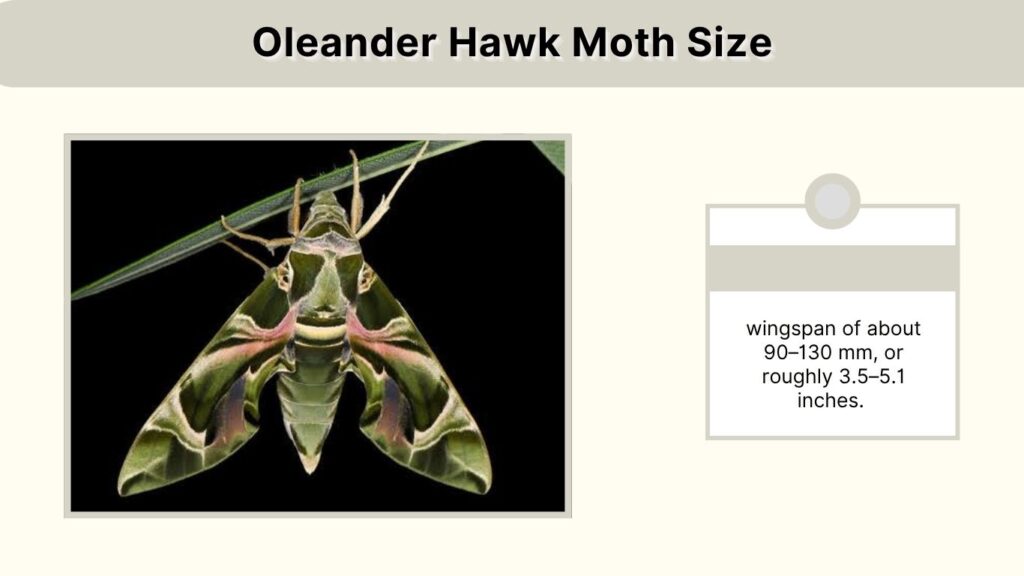
The Oleander Hawk Moth is a fairly large species. Adults have a wingspan of about 90–130 mm, or roughly 3.5–5.1 inches. Its long wings and heavy body make it look even larger when flying around flowers or lights at night.
How Big Is the Caterpillar?
A mature Oleander Hawk Moth caterpillar can reach around 75–85 mm, or approximately 3–3.3 inches long. One documented final-instar caterpillar from Singapore measured about 80 mm.
Young larvae are initially tiny and yellowish, but they become dramatically larger and usually change to green or brown as they develop.
Oleander Hawk Moth Caterpillar
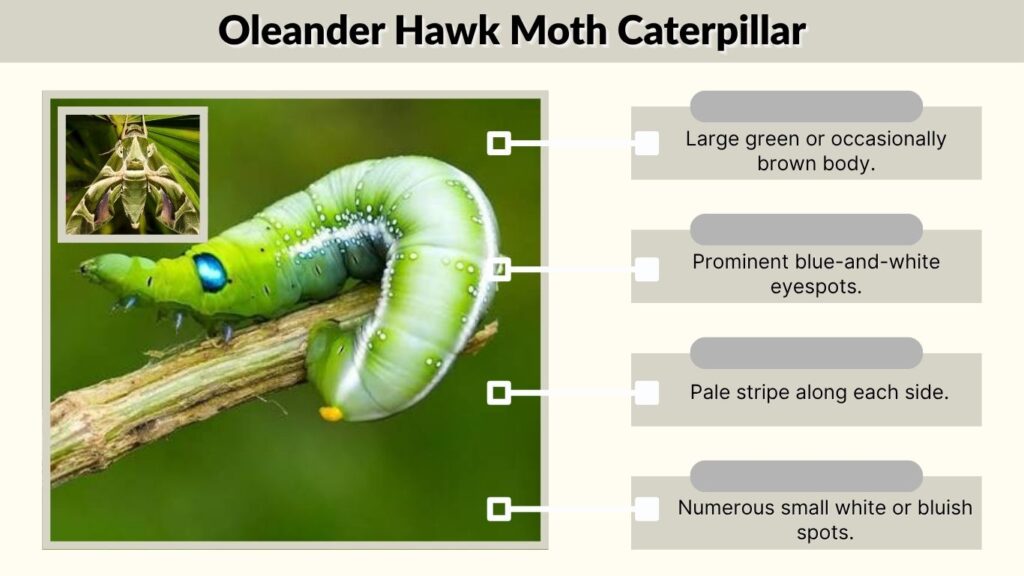
The Oleander Hawk Moth caterpillar is almost as distinctive as the adult. Mature larvae are usually bright green and have enormous blue-and-white false eyespots near the front of the body. When threatened, the caterpillar can pull its head inward, making these eyespots appear even larger.
Caterpillar Identification
Typical features include:
- Large green or occasionally brown body
- Prominent blue-and-white eyespots
- Pale stripe along each side
- Numerous small white or bluish spots
- Yellowish rear horn
- Thick, smooth body
- Length approaching 3 inches or more when mature
Newly hatched caterpillars are only a few millimeters long and initially have a dark rear horn. Their appearance changes considerably as they pass through successive growth stages.
Why Does the Caterpillar Have Eyespots?
The large spots near the head are not real eyes. They are defensive markings.
When disturbed, the caterpillar can retract its head and enlarge the front portion of its body. The prominent eyespots may make it resemble a larger or more threatening animal, potentially discouraging predators.
Is the Oleander Hawk Moth Caterpillar Poisonous?
The Oleander Hawk Moth caterpillar is not a stinging caterpillar and does not have the venomous hairs or spines associated with species such as some tussock or flannel moth caterpillars.
However, its relationship with oleander creates understandable confusion. Oleander contains toxic cardiac glycosides, and Daphnis nerii larvae are physiologically adapted to feeding on these chemically defended plants. Research on sphinx moths also indicates that this species can retain some host-plant defensive compounds during the larval stage.
Is It Dangerous to Humans?
The caterpillar is not known for biting or stinging people. The adult moth cannot sting either.
Still, avoid eating caterpillars or allowing pets to chew them, and wash your hands after handling caterpillars found on oleander. More importantly, oleander itself is highly toxic if ingested, so care should be taken when handling the plant.
What Do Oleander Hawk Moths Eat?
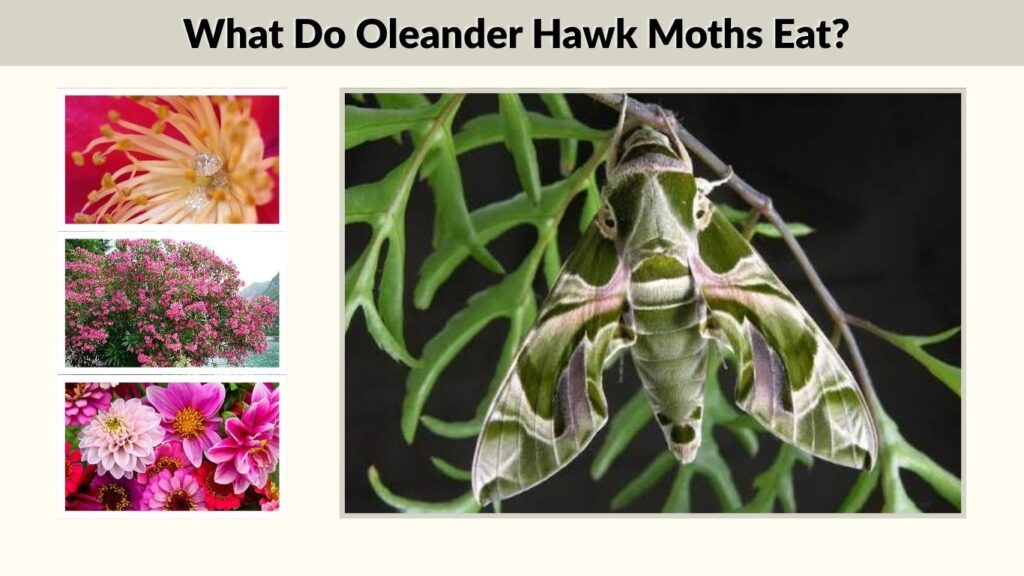
Diet depends entirely on the moth’s life stage. Caterpillars chew leaves, while adults use a long proboscis to drink nectar. This major dietary shift is typical of many moths and allows the caterpillar and adult to use very different food resources.
Oleander Hawk Moth Caterpillar Food
Oleander is its best-known host plant, but larvae can feed on other plants in the dogbane family.
Known food plants include:
- Oleander (Nerium oleander)
- Periwinkle (Vinca species)
- Desert rose (Adenium obesum)
- Pinwheel flower (Tabernaemontana divaricata)
- Other related Apocynaceae plants
UKMoths records oleander and periwinkle among its larval hosts, while documented caterpillars in Singapore have been found feeding on pinwheel flower.
What Do Adult Oleander Hawk Moths Eat?
Adults mainly drink flower nectar.
Like other hawk moths, they can hover in front of flowers while extending their long proboscis into the blossom. They tend to become active around dusk and after sunset.
Their strong flight allows them to travel between widely separated flowering plants.
Oleander Hawk Moth Life Cycle
The life cycle of the Oleander Hawk Moth involves complete metamorphosis, progressing through egg, caterpillar, pupa, and adult stages. Temperature and local climate influence how quickly development occurs.
Egg and Larval Stages
Females lay eggs on appropriate host plants so newly hatched caterpillars have immediate access to food.
Young larvae begin feeding soon after hatching and grow through several stages, becoming increasingly large and developing their characteristic eyespots.
Their droppings, commonly called frass, also become surprisingly large as the caterpillar approaches full size.
Oleander Hawk Moth Pupa
Before pupation, the caterpillar usually changes from bright green to a duller brownish color.
Unlike species that hang exposed chrysalises from plants, Oleander Hawk Moth caterpillars typically pupate close to the ground. The brownish pupa may rest beneath dry leaves, moss, or other loose material rather than being enclosed in a large, obvious silk cocoon.
Adult Moth
After metamorphosis is complete, the adult emerges from the pupa and expands its wings.
The adult’s primary activities are feeding on nectar, finding a mate, and reproducing. Hawk moths are powerful fliers, and Daphnis nerii is sufficiently mobile to migrate considerable distances outside its main breeding range.
Oleander Hawk Moth Lifespan
There is no single reliable lifespan that applies to every Oleander Hawk Moth. Development changes significantly with temperature, climate, food quality, and season.
The caterpillar stage lasts through several growth stages before pupation, and the pupal period can also vary with environmental conditions. Adults represent the final, comparatively short reproductive stage.
Rather than focusing on one exact number, it is more useful to view its lifespan as a complete seasonal cycle from egg through adult.
Oleander Hawk Moth Habitat and Distribution
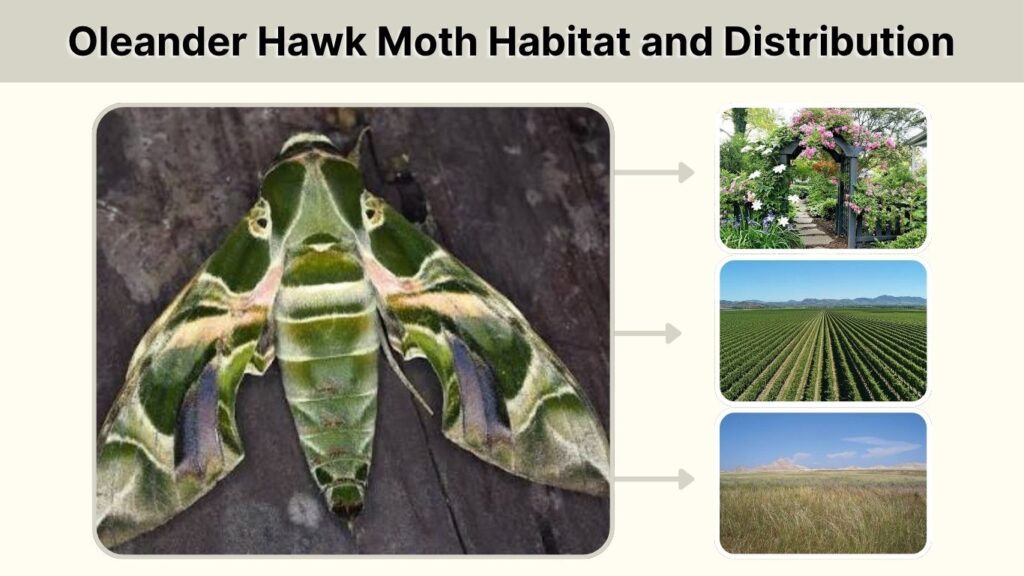
The Oleander Hawk Moth favors warm climates where its caterpillar host plants can grow. It occurs widely across parts of Africa and Asia and is also found in Hawaii. As a migratory species, adults can travel beyond their normal breeding range.
Oleander Hawk Moth in the UK
It is a rare migrant in Britain, rather than a common resident moth.
UK records can occur in different areas, though observations are especially associated with southern and coastal locations. UKMoths reports most records from late summer into autumn, particularly August through November.
Its appearance in Britain is therefore far more unusual than sightings in warmer parts of its geographic range.
Male vs Female Oleander Hawk Moth
Male and female Oleander Hawk Moths have very similar camouflage patterns, making sex determination difficult from coloration alone.
Females generally develop a somewhat fuller abdomen, especially when carrying eggs, whereas males may appear slightly more streamlined.
For casual observers, however, identifying the species is much easier than reliably determining whether an individual is male or female from a photograph.
FAQs
Is the Oleander Hawk Moth poisonous?
The adult Oleander Hawk Moth is not considered poisonous or venomous to humans and cannot sting. Its caterpillars feed on chemically toxic oleander, but their main defense does not involve injecting venom into people.
Can an Oleander Hawk Moth bite?
Oleander Hawk Moths are not considered biting pests. Adults are nectar feeders equipped with a proboscis rather than mouthparts designed to bite people. Their caterpillars also pose little direct threat when left undisturbed.
What does an Oleander Hawk Moth caterpillar eat?
The caterpillar feeds mainly on oleander and related plants. Other documented hosts include periwinkle and pinwheel flowers. Several of these plants belong to the dogbane family, Apocynaceae.
How big does an Oleander Hawk Moth get?
Adults have a wingspan of approximately 90–130 mm, equivalent to roughly 3.5–5.1 inches. Mature caterpillars can reach around 75–85 mm in length.
Is the Oleander Hawk Moth rare?
Its rarity depends on location. It occurs widely in warmer areas of Africa and Asia but is a rare migrant in places such as Britain. Therefore, seeing one may be routine in some regions and highly unusual in others.