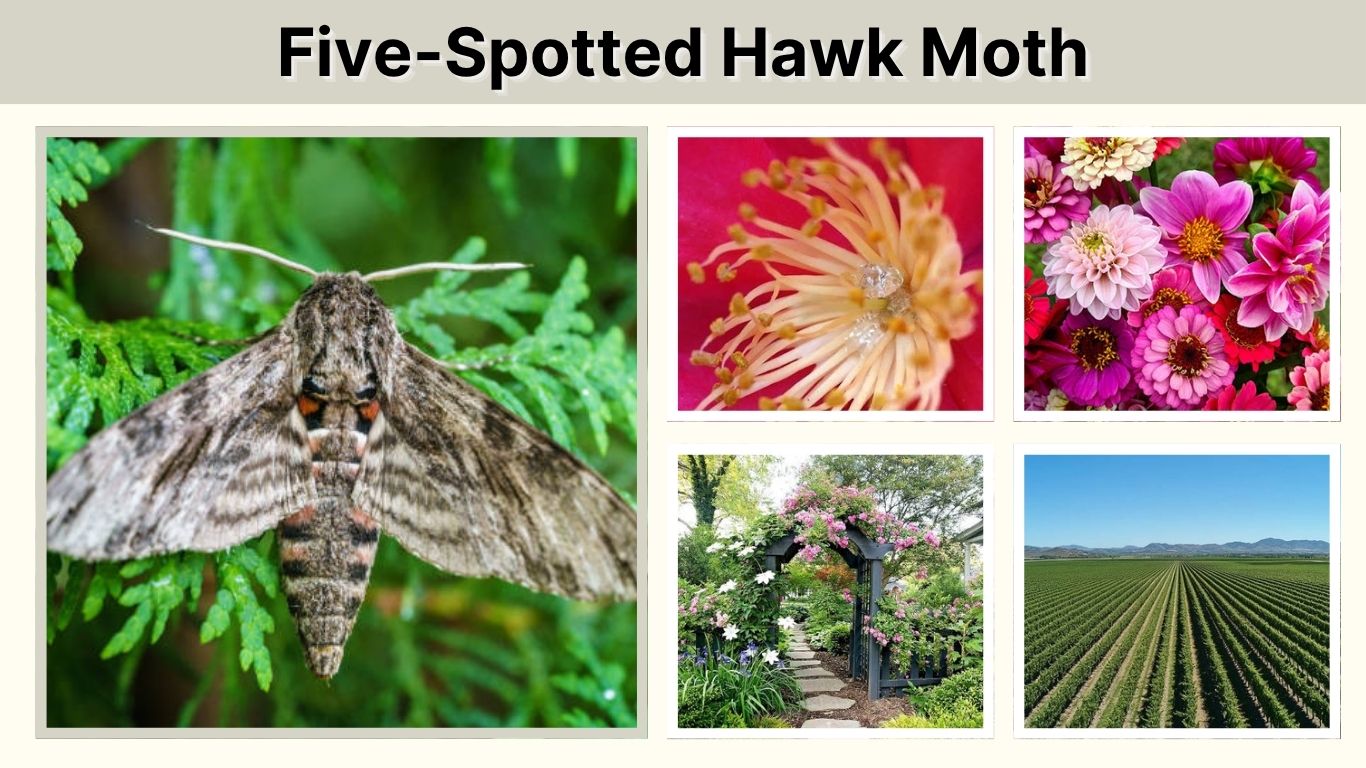
The Five-Spotted Hawk Moth (Manduca quinquemaculata) is a large North American sphinx moth best known for its caterpillar, the tomato hornworm. Adults have powerful wings, gray-brown patterns, and distinctive yellow markings along the abdomen, while the caterpillars are large, green, and equipped with a harmless horn-like projection. Although the adult moth is not dangerous, its larvae can consume large amounts of tomato foliage and other nightshade plants. Understanding its appearance, diet, habitat, life cycle, and similar species makes identification much easier.
Five-Spotted Hawk Moth Quick Facts
The Five-Spotted Hawk Moth belongs to the family Sphingidae, a group commonly called hawk moths or sphinx moths. These moths are known for strong flight and rapid wingbeats. Adults typically become active around dusk or after dark, while the caterpillars spend most of their development feeding on plants in the nightshade family.
| Feature | Five-Spotted Hawk Moth |
| Scientific name | Manduca quinquemaculata |
| Family | Sphingidae |
| Caterpillar name | Tomato hornworm |
| Wingspan | About 3.5–5.3 inches |
| Caterpillar length | Up to about 4 inches |
| Adult diet | Flower nectar |
| Larval diet | Mainly nightshade-family plants |
| Dangerous to humans | No |
| Main activity | Dusk and nighttime |
What Does a Five-Spotted Hawk Moth Look Like?
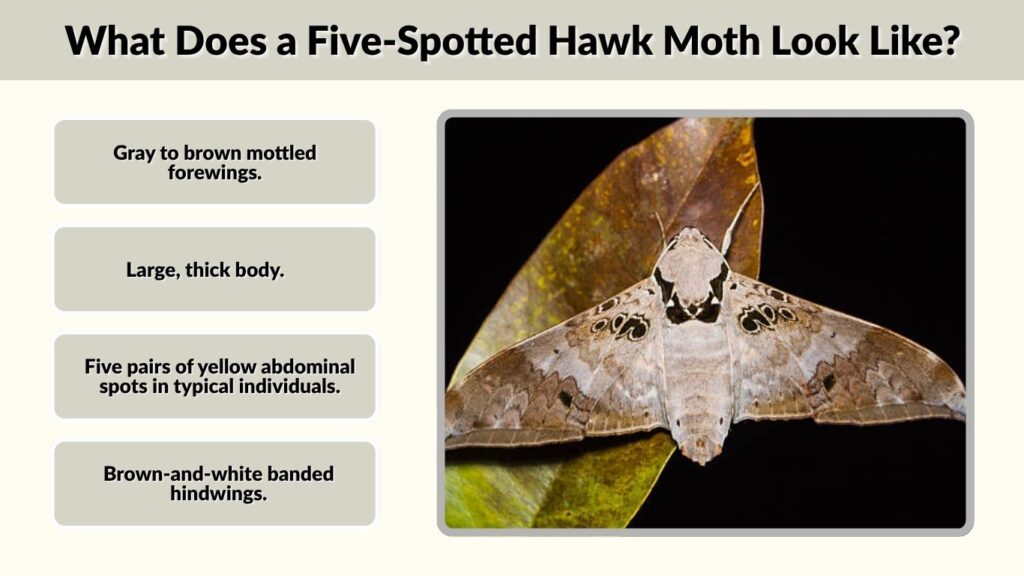
Adult Five-Spotted Hawk Moths are large, heavy-bodied insects with long, narrow wings. Their mottled coloration helps them blend against tree bark and other natural backgrounds when resting. The most recognizable feature is the row of yellow markings along the sides of the abdomen. Their shape and fast flight are typical of sphinx moths.
Five-Spotted Hawk Moth Identification
Look for these features:
- Gray to brown mottled forewings
- Large, thick body
- Five pairs of yellow abdominal spots in typical individuals
- Brown-and-white banded hindwings
- Long, relatively narrow forewings
- Powerful, rapid flight
- Wingspan of roughly 3 9/16 to 5 5/16 inches
- Activity primarily around dusk and nighttime
The number of yellow abdominal markings can occasionally vary, so wing patterns should also be considered during identification.
Five-Spotted Hawk Moth Size
The adult has a wingspan of approximately 9 — 13.5 cm, or about 3.5 — 5.3 inches, making it one of the more impressive moths people encounter around gardens.
Its caterpillar is equally impressive. Fully grown tomato hornworms can reach about 4 inches long and become remarkably thick before leaving their food plant to pupate.
Five-Spotted Hawk Moth Caterpillar
The caterpillar of the Five-Spotted Hawk Moth is commonly called the tomato hornworm. It is one of the largest caterpillars found in vegetable gardens and can consume substantial amounts of foliage as it grows. Its green coloration provides excellent camouflage among tomato leaves, so gardeners often notice damage before finding the caterpillar itself.
How to Identify the Tomato Hornworm
The caterpillar usually has:
- Large green body
- Up to about 4 inches in length
- Eight white V-shaped markings along each side
- Dark green to black horn on the rear
- Small spots along the body
- Thick, smooth appearance
- Strong camouflage among green leaves
The rear horn looks threatening but is simply a projection rather than a stinger.
What Plants Does the Caterpillar Eat?
Tomato is one of its most familiar host plants, but tomato hornworms also feed on other members of the nightshade family.
Common hosts include tomato, potato, eggplant, pepper, and various wild nightshades. Large larvae can remove substantial foliage and may also chew developing fruits.
Five-Spotted Hawk Moth Diet
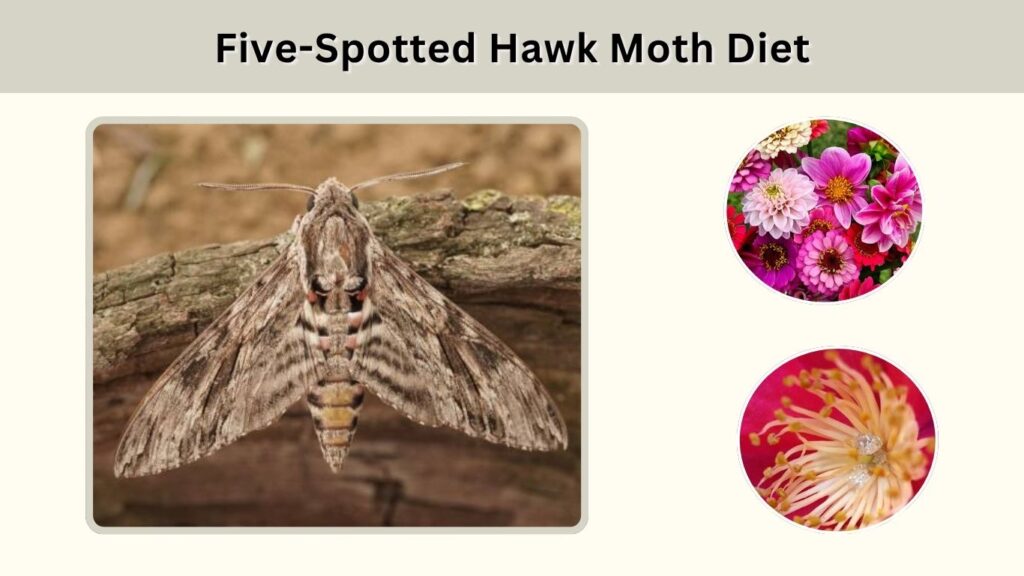
The diet changes dramatically between the caterpillar and adult stages. Caterpillars are leaf-eating insects adapted to nightshade plants, whereas adult hawk moths primarily obtain energy by drinking nectar. Their long mouthparts allow them to feed while hovering near flowers in a manner that can resemble a hummingbird.
What Do Adult Five-Spotted Hawk Moths Eat?
Adults primarily drink flower nectar.
Sphinx moths commonly hover in front of flowers while extending a long proboscis into blossoms. Their powerful flight lets them move rapidly between flowering plants.
Unlike the caterpillar, the adult does not chew tomato leaves. The damaging garden stage is the tomato hornworm larva rather than the moth.
Five-Spotted Hawk Moth Life Cycle
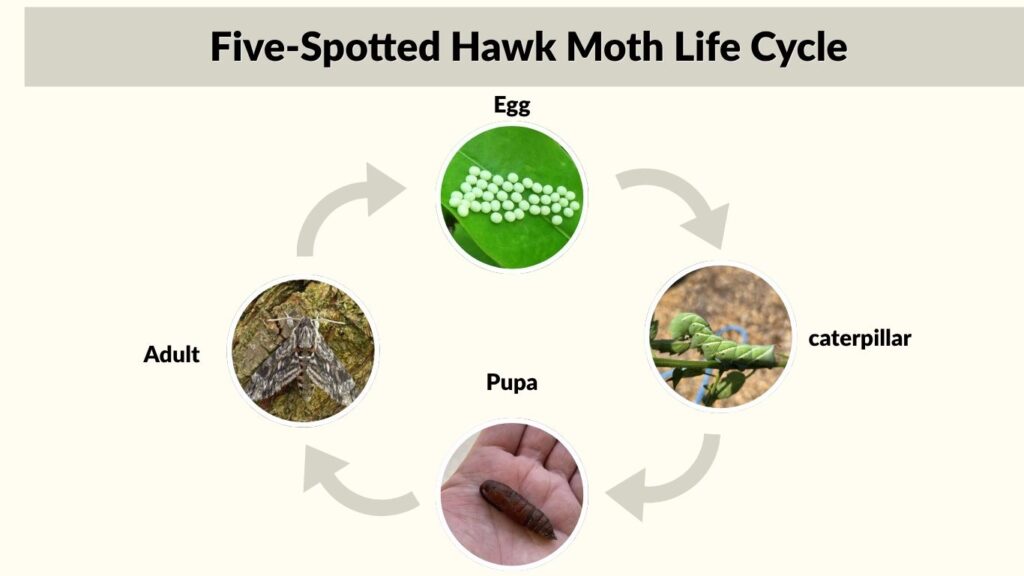
Like other moths, the Five-Spotted Hawk Moth undergoes complete metamorphosis through four stages: egg, caterpillar, pupa, and adult. The timing varies with climate, but in suitable conditions the caterpillar can grow from a newly hatched larva into a large hornworm within only a few weeks.
Eggs and Young Larvae
After mating, females place smooth, pale green eggs individually on host plant leaves.
The young caterpillars hatch and immediately begin feeding. They initially look quite small, but their growth is rapid because they consume large amounts of foliage.
Within approximately three to four weeks, a caterpillar may reach full size.
Five-Spotted Hawk Moth Pupa
A mature tomato hornworm eventually stops eating, leaves the host plant, and crawls to the ground.
It burrows into loose soil and forms a brown pupa below the surface. The pupa has a distinctive curved projection containing the developing moth’s proboscis.
In warm conditions, an adult may emerge after roughly two weeks. Pupae produced late in the season can remain underground through winter and emerge the following year.
Five-Spotted Hawk Moth Lifespan
There is no single fixed lifespan because temperature, season, geographic location, and generation all affect development. The caterpillar stage generally lasts several weeks, while the pupal stage may last only weeks during summer or several months when the insect overwinters.
The adult stage is comparatively short and is primarily devoted to feeding, mating, and reproduction.
How Long Does the Life Cycle Take?
During warm summer conditions, development can move quickly enough for more than one generation to occur.
Caterpillars may become full-grown in about three to four weeks. Summer pupae can produce adults approximately two weeks later, while the final generation of the season remains underground as pupae through winter.
Are Five-Spotted Hawk Moths Poisonous?
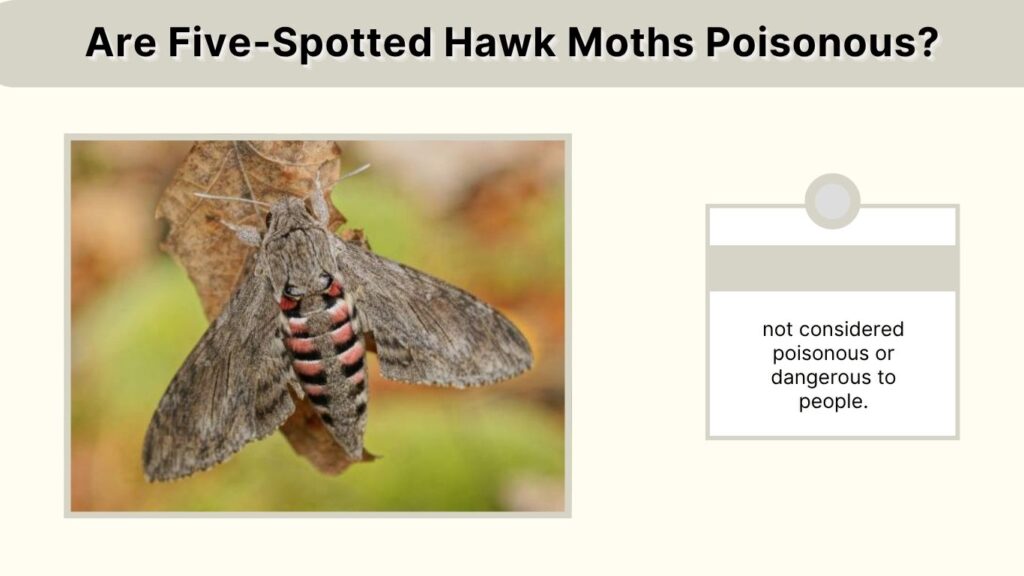
Five-Spotted Hawk Moths are not considered poisonous or dangerous to people. Adult moths do not possess a stinger and are primarily interested in flowers, mating, and reproduction.
The tomato hornworm’s large rear “horn” may make the caterpillar look threatening, but it is not a stinger.
Do Five-Spotted Hawk Moths Sting?
No. Adult Five-Spotted Hawk Moths cannot sting.
Their caterpillars also lack the venomous spines or stinging hairs found on certain other caterpillar species. The main problem associated with tomato hornworms is plant damage rather than danger to humans.
Normal gentle handling is unlikely to cause injury, although unnecessary handling of wild insects is best avoided.
Five-Spotted Hawk Moth Habitat and Range
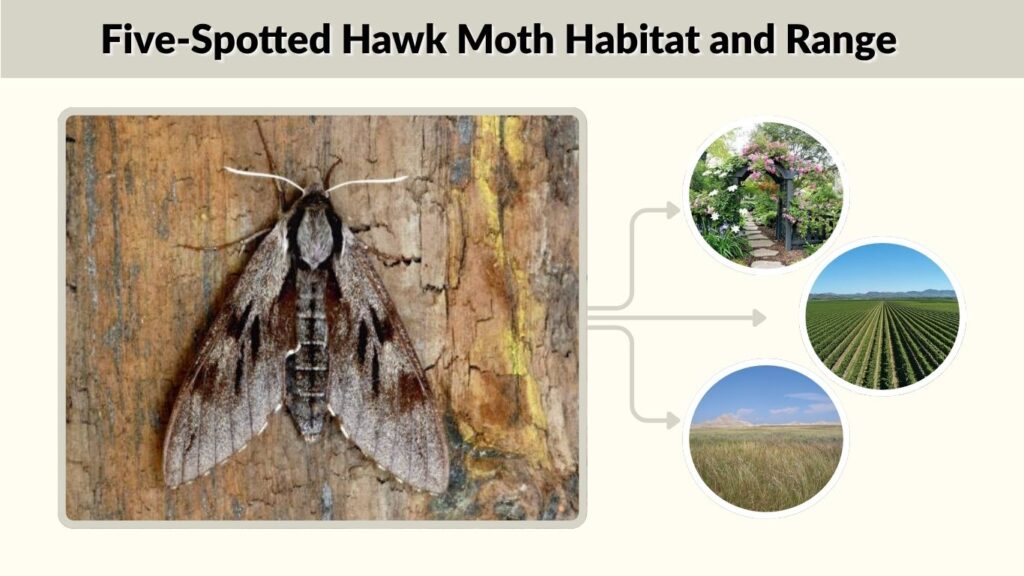
The species occurs across a broad portion of North America and is especially associated with areas where suitable nightshade-family host plants grow.
Gardens, agricultural fields, open habitats, and places containing wild nightshade plants can provide caterpillar habitat. Adults can travel considerable distances and may be noticed visiting flowers or appearing near outdoor lights at night.
Are Five-Spotted Hawk Moths Beneficial?
Adults can contribute to flower pollination while feeding on nectar. However, the caterpillars can become garden pests because they consume tomato leaves and fruit.
This makes the species both ecologically interesting and occasionally problematic for gardeners.
Hornworms also provide food for natural enemies such as predatory insects and parasitoid wasps, making them part of a larger garden food web.
Five-Spotted Hawk Moth vs Carolina Sphinx
The Five-Spotted Hawk Moth is commonly confused with the Carolina sphinx (Manduca sexta), whose caterpillar is called the tobacco hornworm.
| Feature | Five-Spotted Hawk Moth | Carolina Sphinx |
| Scientific name | M. quinquemaculata | M. sexta |
| Caterpillar | Tomato hornworm | Tobacco hornworm |
| Larval side markings | 8 V-shaped marks | 7 diagonal marks |
| Larval horn | Dark/blackish | Usually reddish |
| Adult abdominal spots | Usually 5 pairs | Usually 6 pairs |
These caterpillars are frequently misidentified because both are large, green, and commonly feed on tomatoes and related plants.
Five-Spotted Hawk Moth vs Hummingbird Moth
“Hummingbird moth” is a broad informal name applied to several sphinx moths that hover while feeding from flowers.
The Five-Spotted Hawk Moth belongs to the same family and is capable of hovering nectar-feeding behavior, but it should not be confused with species more commonly called hummingbird or clearwing moths.
Five-Spotted Hawk Moths are mostly active after dusk and have opaque gray-brown wings rather than the transparent wings characteristic of many clearwing moths.
FAQs
Is the Five-Spotted Hawk Moth dangerous?
No. Five-Spotted Hawk Moths do not sting and are not considered dangerous to humans. Their caterpillars may look intimidating because of the large rear horn, but their main impact is feeding damage to garden plants.
Is a Five-Spotted Hawk Moth caterpillar poisonous?
No. The tomato hornworm is not a poisonous or stinging caterpillar. Its rear horn is not a venomous spine. However, the caterpillar can cause extensive damage to tomato plants by consuming foliage and sometimes fruit.
How big does a Five-Spotted Hawk Moth get?
Adults have a wingspan of approximately 3.5 to 5.3 inches, while mature tomato hornworm caterpillars can reach roughly 4 inches long.
What does a Five-Spotted Hawk Moth eat?
Adults primarily drink nectar from flowers. Caterpillars feed on plants in the nightshade family, particularly tomato, but also potato, eggplant, pepper, and various wild nightshades.
Is a tomato hornworm a Five-Spotted Hawk Moth?
Yes. The tomato hornworm is the larval stage of the Five-Spotted Hawk Moth, Manduca quinquemaculata. After feeding and growing, it burrows into soil, pupates, and eventually emerges as the adult moth.