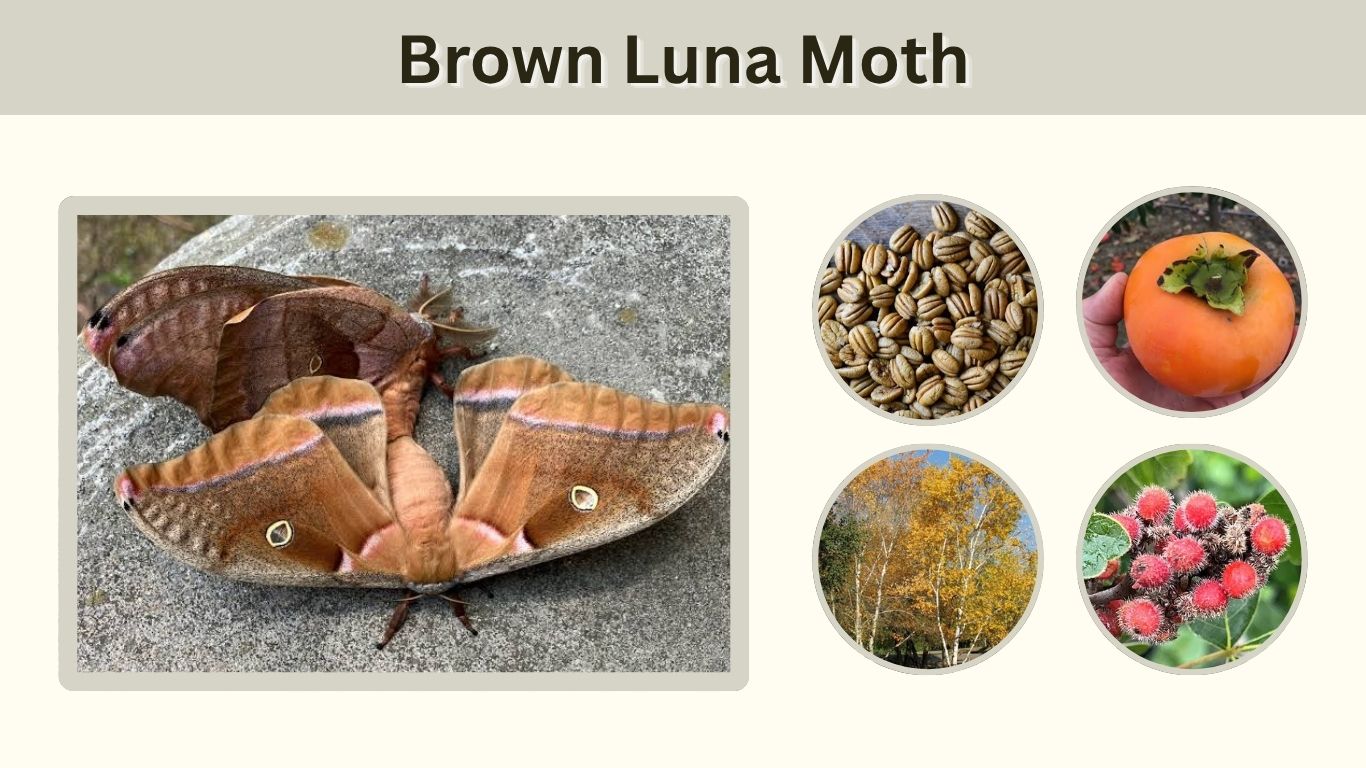
A brown Luna moth can cause confusion because adult Luna moths (Actias luna) are normally pale green rather than brown. A large brown moth that resembles a Luna moth may actually be another giant silk moth, especially the Polyphemus moth. However, brown coloration can appear during other stages of the Luna moth’s life cycle. Mature caterpillars turn reddish-brown shortly before pupating, their cocoons are typically brown, and the pupa inside is dark brown. Adult Luna moths may also show brown or pink along their wing margins, but a completely brown adult is not their normal coloration.
Are There Brown Luna Moths?
Healthy adult Luna moths are not normally brown.
The characteristic adult has:
- Pale green wings
- Long hindwing tails
- Transparent eyespots
- Fuzzy white or yellowish body
- Pink, reddish, yellow, or brownish wing margins
BugGuide describes the adult wings as pale green, with outer margins that may be pink, brown, or yellow depending partly on season and population.
UF/IFAS also notes some color differences between the sexes: males tend to be more yellow-green, whereas females can appear more blue-green.
So a Luna moth may contain some brown coloration, but an adult whose entire wings are brown is probably not displaying the normal Luna moth color pattern.
What Does a Real Luna Moth Look Like?
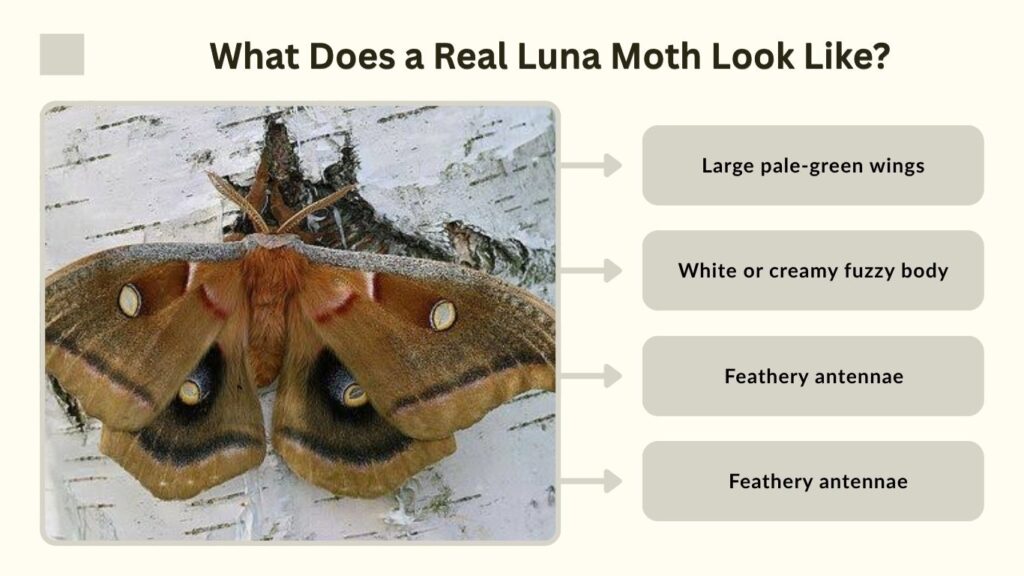
The Luna moth is one of North America’s easiest large moths to recognize.
Adults have a wingspan of approximately 7.5–10.5 cm (3–4.1 inches), although their long tails can make them appear even larger.
Adult Identification
Look for:
- Large pale-green wings
- One transparent eyespot on each wing
- Long curved tails on the hindwings
- White or creamy fuzzy body
- Feathery antennae
- Pink, reddish, brownish, or yellow wing edges
- Four broad wings
Males generally have larger, more strongly feathered antennae than females because they use them to detect female pheromones.
Why Does My Luna Moth Look Brown?
There are several possibilities.
1. It May Be a Different Moth
This is probably the most important explanation.
North America has several huge members of the giant silk moth family Saturniidae. Some are brown and may initially remind people of Luna moths.
The Polyphemus moth (Antheraea polyphemus) is one of the closest visual matches.
2. You May Be Looking at the Cocoon
Luna moth cocoons are normally brown rather than green.
They are made from silk combined with leaves, creating an irregular, papery structure that blends into fallen leaf litter.
3. It May Be a Caterpillar Preparing to Pupate
A mature Luna moth caterpillar dramatically changes color shortly before forming its cocoon.
The normally green caterpillar becomes reddish to reddish-brown before pupation.
This color change is normal and does not mean the caterpillar is sick.
4. The Adult May Be Old or Damaged
Moth wing scales become worn as adults age.
An old, damaged, wet, dried, or dead specimen may therefore look duller or less green than a fresh Luna moth. Lighting and photographs can also make pale green wings appear tan or brownish.
However, a uniformly rich-brown living adult should make you consider another species first.
Brown Luna Moth vs. Polyphemus Moth
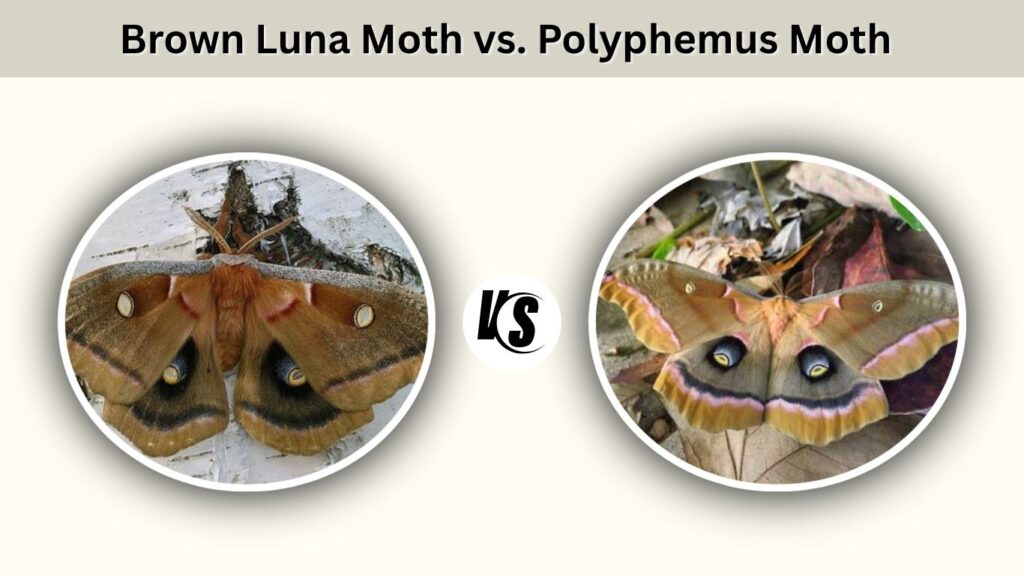
The Polyphemus moth is probably the most useful species to compare with a supposed brown Luna moth.
Both belong to Saturniidae and are very large.
| Feature | Luna Moth | Polyphemus Moth |
| Scientific name | Actias luna | Antheraea polyphemus |
| Adult color | Pale green | Tan to brown |
| Hindwing tails | Very long | Absent |
| Eyespots | Small transparent spots | Huge hindwing eyespots |
| Wingspan | 7.5–10.5 cm | 10–15 cm |
| Family | Saturniidae | Saturniidae |
| Adult feeding | Does not eat | Does not eat |
Polyphemus moths are large brown moths with enormous dark eyespots on their hindwings. Their wingspan may reach about 100–150 mm (4–6 inches).
If your “brown Luna moth” has huge eyespots but no long tails, a Polyphemus moth is a strong possibility.
Brown Luna Moth Caterpillar
Luna moth caterpillars begin their mature stage looking quite different from the adult.
Full-grown larvae are typically:
- Bright green
- About 55–70 mm long
- Thick-bodied
- Sparsely hairy
- Marked with yellowish lines
- Equipped with small raised bumps
The head may range from green to brown.
Why Is My Luna Moth Caterpillar Turning Brown?
A Luna caterpillar turning reddish-brown near the end of its development is generally normal.
Before pupation it stops feeding, begins wandering, and changes from green to reddish or reddish-brown. It then searches for a place to form its cocoon.
The basic sequence is:
Green caterpillar → reddish-brown pre-pupal caterpillar → brown cocoon → pupa → green adult moth
A color change combined with wandering behavior in a mature caterpillar therefore often signals that pupation is approaching.
What Does a Brown Luna Moth Cocoon Look Like?
The Luna moth cocoon is usually much less spectacular than the adult.
It tends to be:
- Brown
- Papery
- Oval or irregular
- Wrapped in dead leaves
- Several centimeters long
- Hidden within leaf litter
The caterpillar spins silk around itself and incorporates leaves into the structure. Because the cocoon is not firmly attached to a twig like those of some other giant silk moths, it may fall to the forest floor along with autumn leaves.
Inside the cocoon is a dark brown pupa.
So finding a brown object wrapped in leaves beneath a Luna moth host tree may represent a cocoon rather than a brown adult moth.
What Do Brown Luna Moths Eat?
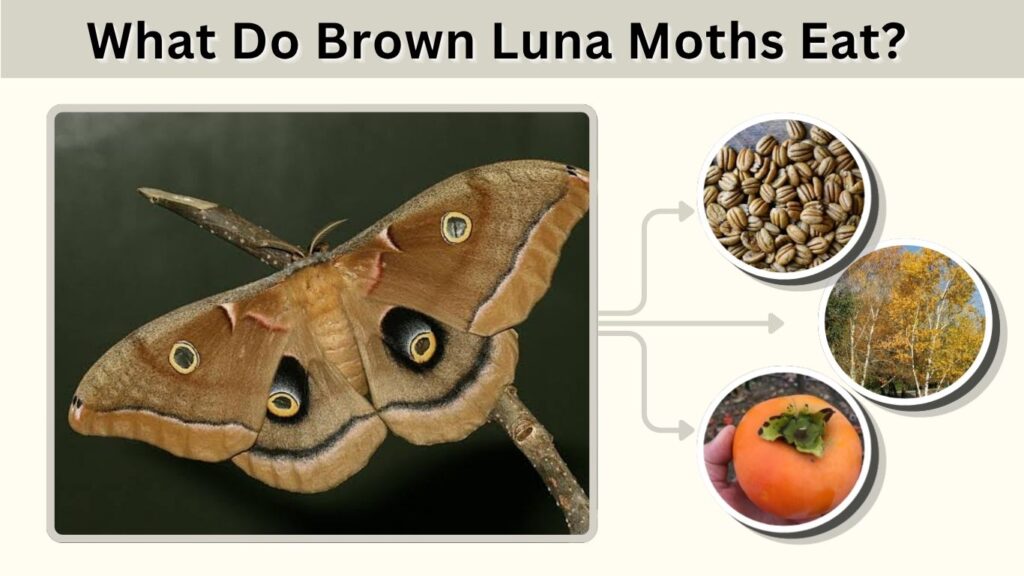
If by “brown Luna moth” you mean the reddish-brown caterpillar immediately before pupation, it has usually stopped feeding.
Earlier green caterpillars feed on leaves from several hardwood trees, including:
- Hickory
- Walnut
- Sweetgum
- Persimmon
- Birch
- Pecan
- Sumac
Host preferences vary geographically.
Do Adult Luna Moths Eat?
No.
Adult Luna moths possess vestigial mouthparts and do not eat or drink nectar.
They survive on energy accumulated during the caterpillar stage.
Their short adult lives are devoted primarily to finding mates and reproducing.
Brown Luna Moth in Oregon
A large brown moth found in Oregon is unlikely to be a typical Luna moth.
Actias luna is principally an eastern North American species, whereas the Polyphemus moth has a much broader North American distribution.
Therefore, a giant brown moth in Oregon with prominent eyespots may be a Polyphemus moth or another western giant silk moth rather than a Luna moth.
Location should always be considered along with color, eyespots, antennae, and wing shape.
Are Brown Luna Moths Poisonous?
Luna moths are not considered poisonous or dangerous to humans.
Adult moths:
- Do not sting
- Do not have venom
- Do not bite people
- Cannot feed on humans
The caterpillars also lack the dangerous stinging spines found on some other caterpillar species.
Their large size can make them intimidating, but they are harmless when left undisturbed.
Brown and Red Luna Moths
Seeing reddish or brown markings does not automatically rule out a Luna moth.
Fresh adults may have a reddish-purple, pink, or brownish border around their wings. Spring individuals can show particularly noticeable reddish-purple outer margins.
The important point is that most of the wings should still be green.
A moth with predominantly brown wings and large circular hindwing eyespots is more consistent with a Polyphemus moth.
Brown Luna Moth Meaning
Luna moths are often given symbolic meanings involving:
- Transformation
- Renewal
- New beginnings
- Personal growth
- Change
- Briefness of life
A brown Luna moth may additionally be interpreted symbolically as representing grounding, transition, or transformation.
These meanings come from modern cultural and spiritual traditions rather than entomology. Scientifically, brown coloration is usually explained by the moth’s developmental stage, natural markings, condition, or misidentification.
How to Identify a Brown Moth That Looks Like a Luna Moth
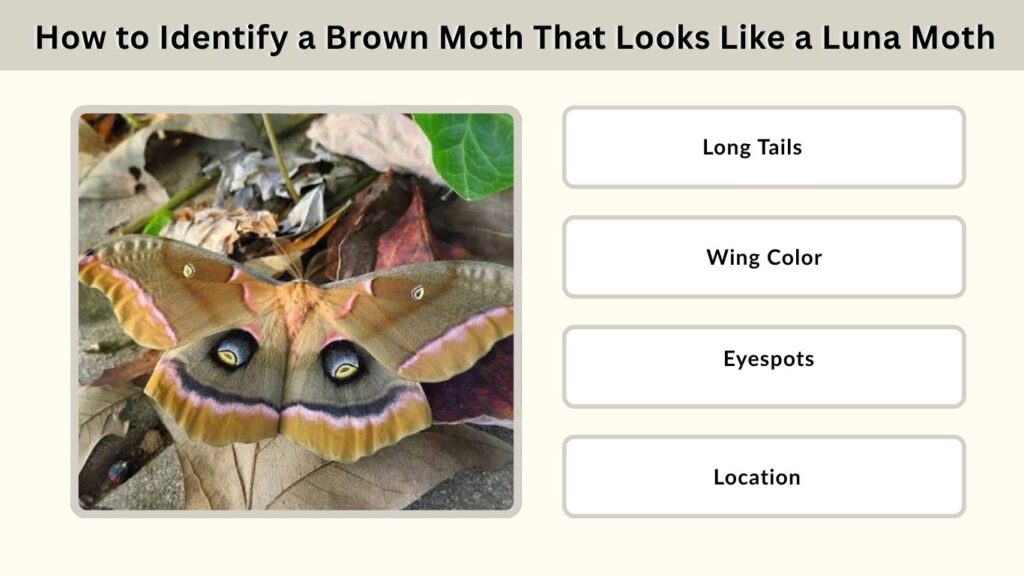
Check these four characteristics first:
Long Tails
True Luna moths have unmistakably long hindwing tails.
Wing Color
A normal adult Luna moth is predominantly pale green.
Eyespots
Luna moth eyespots are comparatively small and transparent. Polyphemus moths have enormous hindwing eyespots.
Location
Luna moths are native primarily to eastern North America. Location can immediately eliminate some look-alike possibilities.
FAQs
1. Can Luna moths be brown?
Adult Luna moths are normally pale green, although their wing edges may contain brown, pink, reddish, or yellow coloration. Their caterpillars can turn reddish-brown before pupating, and both their cocoons and pupae are typically brown.
2. Why did my Luna moth caterpillar turn brown?
A mature Luna moth caterpillar naturally changes from green to reddish or reddish-brown shortly before pupation. It may also stop eating and begin wandering while searching for a suitable location to spin its cocoon.
3. What is the large brown moth that looks like a Luna moth?
A common possibility is the Polyphemus moth (Antheraea polyphemus). It is a giant brown silk moth with enormous eyespots on its hindwings but lacks the long tails characteristic of Luna moths.
4. What color is a Luna moth cocoon?
Luna moth cocoons are generally brown and papery, often containing dead leaves. Their camouflage helps them blend into leaf litter while the pupa develops inside.
5. Are brown Luna moths poisonous?
No. Luna moths are not poisonous or venomous, and adults cannot sting or bite people. If the insect is actually another large brown silk moth such as a Polyphemus moth, it is also generally harmless to people.