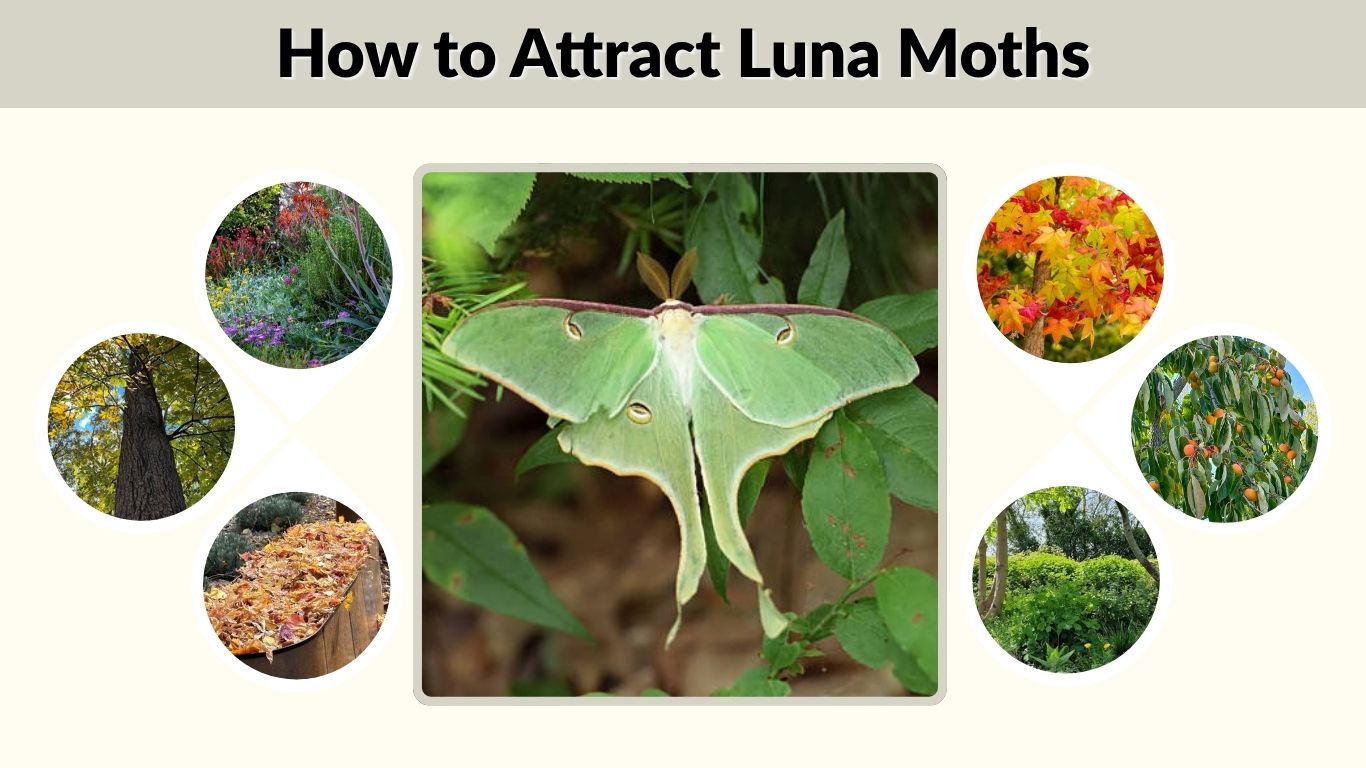
To attract Luna moths (Actias luna), focus less on flowers and more on providing the trees their caterpillars need. Luna moth adults do not eat, so nectar-rich flowers will not attract them in the same way they attract butterflies or hummingbird moths. Instead, planting host trees such as hickory, walnut, sweetgum, persimmon, and birch, reducing pesticide use, preserving leaf litter, and maintaining a dark nighttime yard can make your property much more suitable. Luna moths are also attracted to lights, but excessive outdoor lighting may interfere with their natural nighttime behavior.
What Attracts Luna Moths?
The most important things that attract and support Luna moths are:
- Suitable caterpillar host trees
- Wooded or semi-wooded habitat
- Mature deciduous trees
- Limited pesticide use
- Leaf litter and natural ground cover
- Dark nighttime conditions
- Existing Luna moth populations nearby
Adult Luna moths have only a brief reproductive life. Their primary goals are finding mates and laying eggs rather than searching for food.
Female Luna moths also release chemical signals called sex pheromones, which males detect with their large, feathery antennae. Males may follow these scent trails over considerable distances to locate females.
1. Plant Luna Moth Host Trees
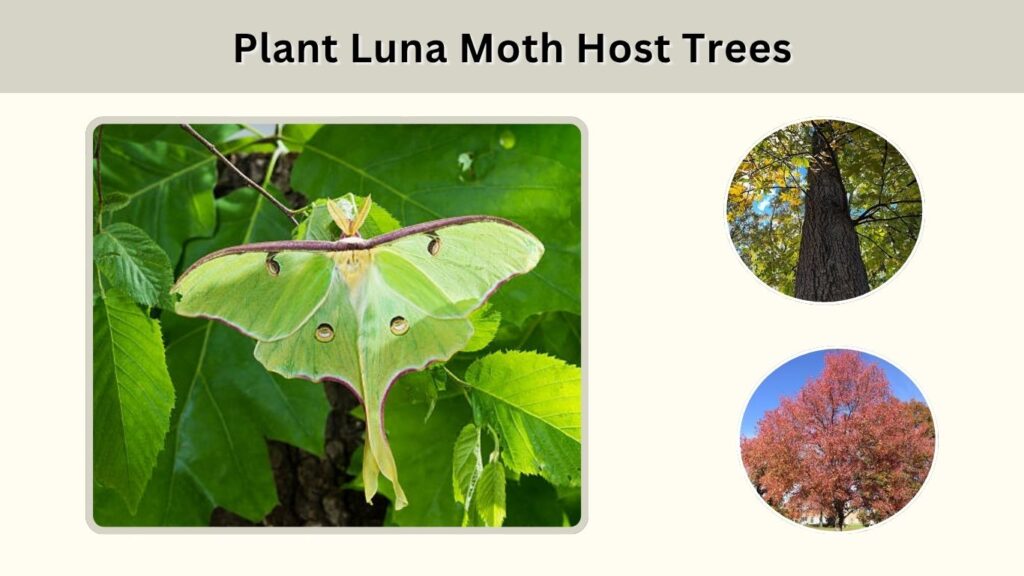
The best long-term way to attract Luna moths is to grow plants their caterpillars can eat.
Females seek appropriate host plants when choosing where to lay their eggs.
Best Plants for Luna Moths
Important host trees include:
| Plant | Use by Luna Moths |
| Hickory | Caterpillar food |
| Black walnut | Caterpillar food |
| Sweetgum | Caterpillar food |
| Persimmon | Caterpillar food |
| Birch | Caterpillar food |
| Pecan | Caterpillar food in parts of the South |
Luna moth caterpillars are known to feed on hickories, walnuts, sweetgum, persimmon, birch, pecan, and several other deciduous trees. Host preferences can differ somewhat among regions.
If you have room for only one tree, choose a native host species that naturally grows in your region.
Native trees are generally better choices than ornamental substitutes because local Luna moth populations are adapted to the plants available within their natural range.
2. Don’t Rely on Flowers to Attract Luna Moths
A common question is: What flowers attract Luna moths?
The answer is unusual: adult Luna moths do not feed from flowers at all.
Unlike many other moths, adult Luna moths have greatly reduced mouthparts and cannot eat. They survive using energy stored during their caterpillar stage.
Therefore, flowers such as:
- Milkweed
- Coneflower
- Phlox
- Bee balm
- Honeysuckle
may be excellent for other pollinating moths and insects, but they are not an important food source for adult Luna moths.
For Luna moths, host trees are much more important than flowers.
3. Preserve Mature Trees and Woodland
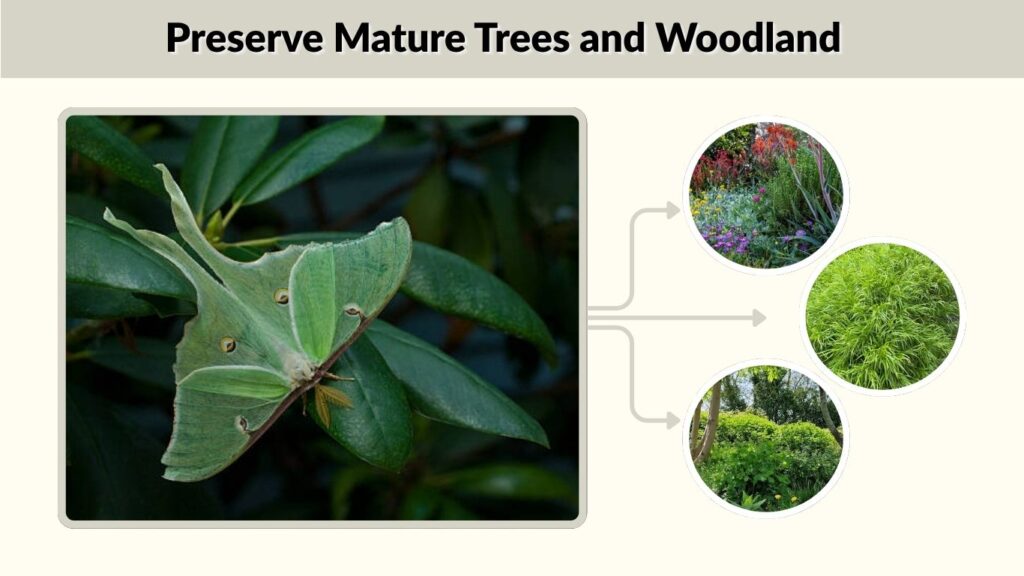
Luna moths naturally occur mainly in deciduous hardwood forests.
A yard that includes trees, shrubs, and relatively natural vegetation is therefore more attractive than an open lawn with few woody plants.
Try to maintain:
- Mature hardwood trees
- Native shrubs
- Woodland edges
- Undisturbed corners
- Natural vegetation beneath trees
You do not need a large forest.
Even a suburban yard bordering mature woodland can provide useful Luna moth habitat.
4. Leave Some Fallen Leaves
Avoid removing every fallen leaf from beneath host trees.
Mature Luna moth caterpillars eventually leave their feeding trees and form cocoons involving leaves. The pupal stage may then remain protected among fallen vegetation.
Keeping a natural layer of leaves beneath trees can provide shelter not only for Luna moths but also for many other insects.
You can still maintain a tidy yard by leaving leaf litter:
- Beneath trees
- Behind garden beds
- Under shrubs
- In designated wildlife areas
This is especially useful compared with removing or shredding every leaf immediately.
5. Avoid Broad-Spectrum Insecticides
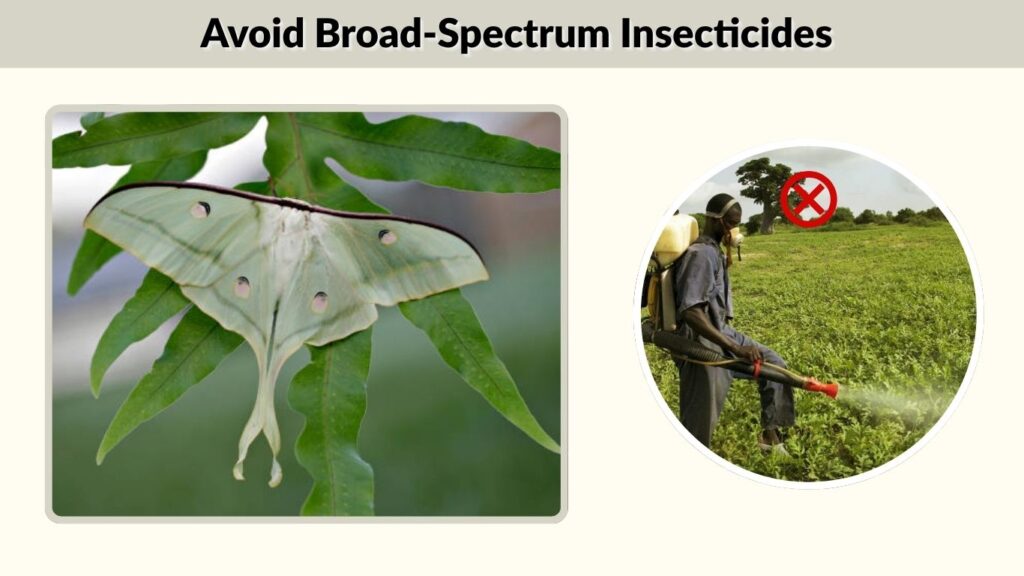
A yard filled with the correct host trees will provide little benefit if caterpillars are repeatedly exposed to insecticides.
Luna moth caterpillars eat leaves directly, so spraying host plants can kill them.
Avoid unnecessary treatments of:
- Hickories
- Walnuts
- Sweetgums
- Persimmons
- Birches
- Pecans
Also be cautious with broad treatments intended to kill caterpillars generally.
A Luna moth caterpillar is large and conspicuous, but it normally does not occur in numbers high enough to seriously damage a mature tree.
6. Are Luna Moths Attracted to Light?
Yes, adult Luna moths can be attracted to artificial lights.
Members of the giant silk moth family are commonly attracted to lights, and this is one reason people sometimes discover Luna moths resting around houses, garages, or porches in the morning.
You may find them near:
- Porch lights
- Garage lights
- Security lights
- Illuminated walls
- Lighted windows
However, deliberately keeping bright lights running all night is not the best way to create healthy Luna moth habitat.
Lights can pull moths away from their normal nighttime activities. If your goal is to support Luna moths rather than merely see one, maintaining relatively dark nights is preferable.
7. How to Attract Luna Moths With a Light Sheet
If your goal is observing moths for a short period, moth enthusiasts sometimes use a light-colored sheet illuminated at night.
A basic setup consists of:
- Hanging a white sheet vertically.
- Positioning an appropriate moth-attracting light in front of it.
- Setting it up near wooded habitat.
- Checking the sheet periodically.
- Turning the light off after observing or photographing visitors.
Never glue, trap, spray, or otherwise restrain moths arriving at the sheet.
There is also no guarantee that a Luna moth will appear. The species must already occur in the surrounding area and adults must be flying at that time of year.
8. Know When Luna Moths Are Active
Timing depends strongly on latitude.
BugGuide reports roughly:
- Northern areas: mainly May through July
- Southern areas: potentially March through September
Northern populations may produce one generation annually, while southern populations can produce multiple generations.
Therefore, the best time to look for Luna moths is during warm nights within their local flight season.
Adults are nocturnal, so they are most active after dark.
How to Attract Luna Moths in North Carolina
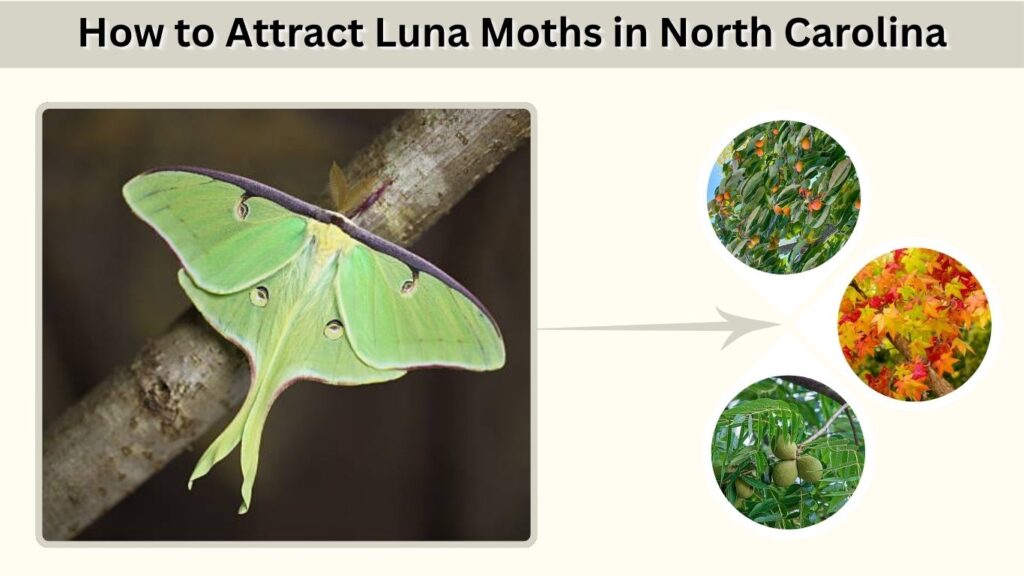
North Carolina is particularly favorable for Luna moths.
The species occurs statewide, from the Coastal Plain through the Piedmont and into the mountains. North Carolina records indicate that Luna moths occupy many types of hardwood forest as well as wooded residential areas.
Good host plants for North Carolina yards include:
- Sweetgum
- American persimmon
- Hickory
- Black walnut
- Pecan
These plants have documented use by Luna moth caterpillars in the state.
Most of North Carolina can also have two distinct broods, giving residents more than one opportunity each year to encounter adults.
Can You Attract Luna Moths in Arizona?
This is much less likely.
The normal range of Actias luna is eastern North America, so Arizona generally falls outside the species’ usual distribution.
Planting host trees cannot reliably attract a species that does not naturally occur nearby.
Arizona has other impressive giant silk moths, so creating native moth habitat there can still attract spectacular species—just not necessarily the Luna moth.
How Female Luna Moths Attract Males
Female Luna moths have their own highly effective attraction method.
They release sex pheromones into the nighttime air.
A male’s enormous feathery antennae contain sensitive sensory structures that allow him to detect these chemicals. He then flies toward the female by following the pheromone plume.
This is why a female Luna moth resting quietly may suddenly be joined by one or more males despite no other moths having been visible beforehand.
What Not to Do When Attracting Luna Moths
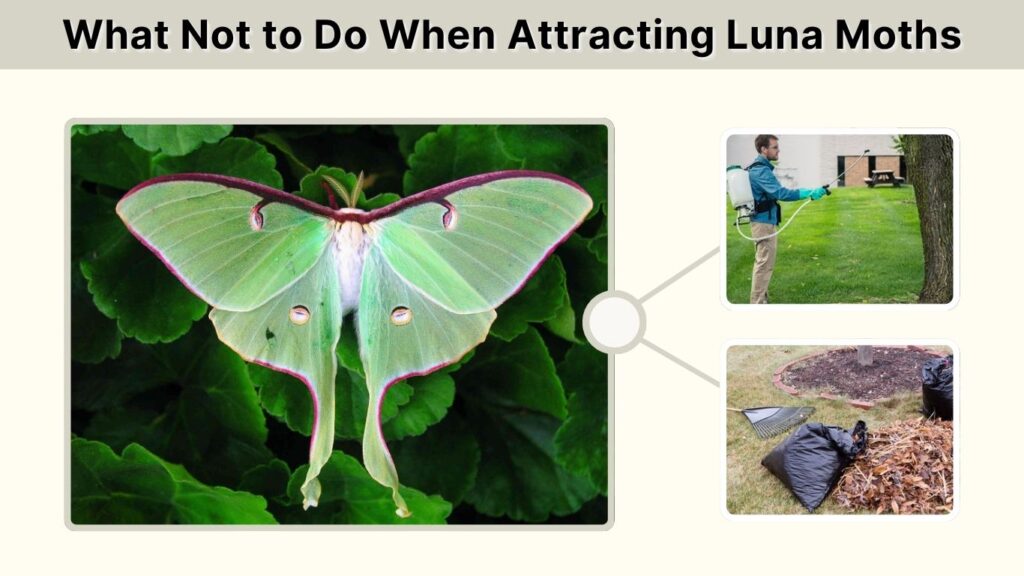
Avoid methods that could harm the moths you are trying to encourage.
Do not:
- Spray host trees with broad insecticides.
- Capture wild adults unnecessarily.
- Handle their wings.
- Remove every caterpillar you find.
- Collect all cocoons.
- Keep bright outdoor lights on all night solely to attract moths.
- Release purchased moths into the wild.
The most effective approach is to improve habitat and allow wild Luna moths to arrive naturally.
Best Luna Moth Yard Setup
For the best chance of seeing Luna moths, create a yard with several complementary habitat features.
| Yard Feature | Importance |
| Native host trees | Very high |
| Mature woodland nearby | Very high |
| No unnecessary pesticides | Very high |
| Leaf litter | High |
| Dark nights | High |
| Nectar flowers | Low for adult Luna moths |
| Artificial lights | Can attract adults temporarily |
Host plants are the key because they allow Luna moths to complete their entire life cycle rather than merely visit your property for one night.
FAQs
1. What is the best plant for attracting Luna moths?
Hickory, walnut, sweetgum, persimmon, birch, and pecan are among the important Luna moth caterpillar host plants. The best choice depends on your region, so planting a host tree native to your local area is usually preferable.
2. What flowers attract Luna moths?
Adult Luna moths do not feed, so no particular flower is needed to provide them with nectar. Their caterpillars depend instead on the leaves of hardwood trees such as hickory, walnut, sweetgum, persimmon, and birch.
3. Are Luna moths attracted to porch lights?
Yes. Luna moths and many other giant silk moths can be attracted to artificial lights at night. This is why adults sometimes appear around illuminated houses and are discovered resting nearby the following morning.
4. How do female Luna moths attract males?
Females release airborne sex pheromones. Males detect these chemical signals using their large feathery antennae and follow the scent trail until they locate a female, often traveling through vegetation to reach her.
5. How can I attract Luna moths to my yard naturally?
Plant native caterpillar host trees, preserve mature hardwoods, avoid unnecessary insecticides, leave some leaf litter, and keep nighttime lighting limited. These steps provide breeding and developmental habitat rather than simply attracting an adult temporarily.