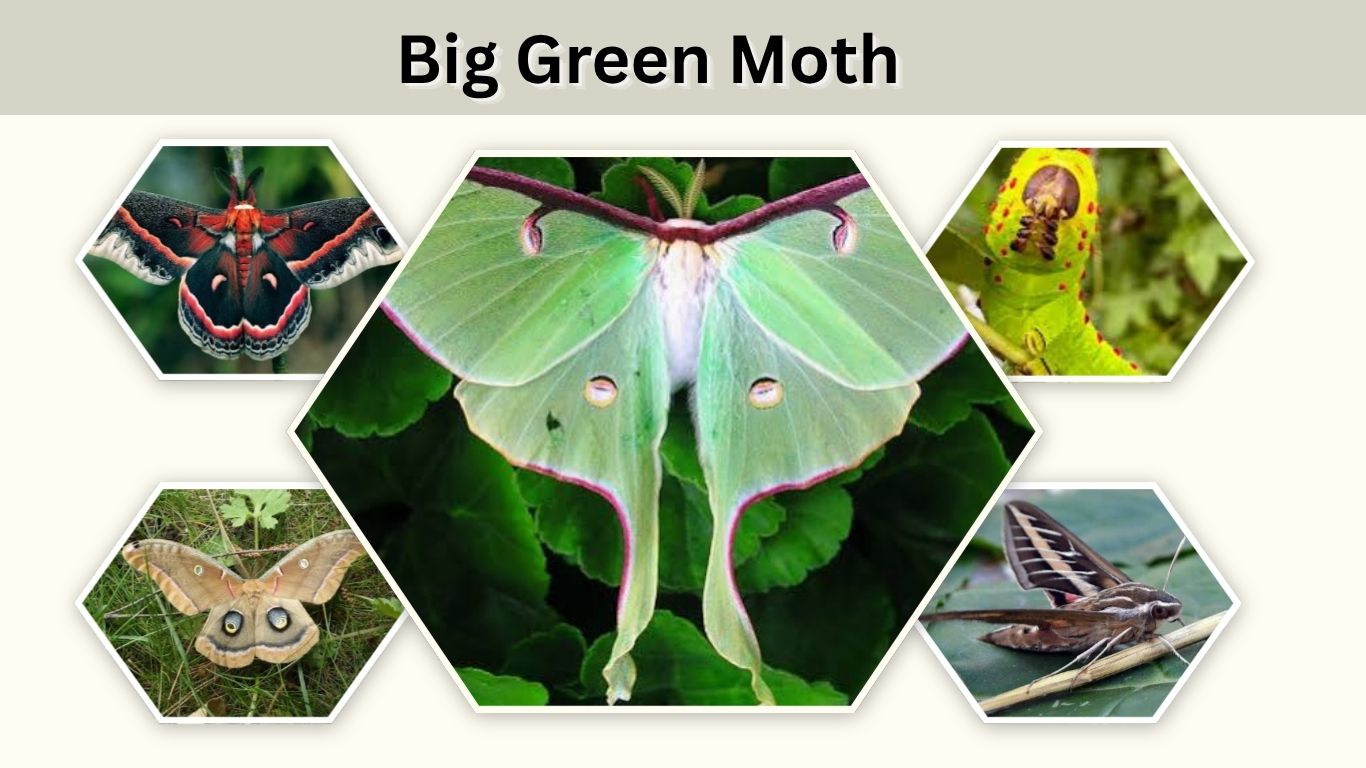
A big green moth seen resting on a tree, wall, or porch is often a luna moth. This impressive North American species has pale-green wings, transparent eyespots, a fluffy body, and long tails extending from its hindwings. However, not every green moth or large green caterpillar belongs to a luna moth. Emerald moths, sphinx moths, and other giant silk moths can create confusion. This guide explains how to identify a big green moth, how large luna moths become, what their caterpillars look like, and which large moths occur in Wisconsin.
What Is the Big Green Moth?
The moth most commonly described as a “big green moth” is the luna moth, Actias luna. It belongs to Saturniidae, the family containing giant silk moths.
Adult luna moths have broad, pale-green wings and a long curved tail on each hindwing. Their distinctive appearance makes them easier to recognize than most North American moths. They occur in wooded habitats across much of eastern North America.
| Feature | Luna moth description |
| Scientific name | Actias luna |
| General color | Pale, lime, mint, or yellow-green |
| Wingspan | Approximately 3–4½ inches |
| Hindwings | Long, curved tails |
| Wing markings | Four transparent eyespots |
| Body | Thick and fluffy |
| Activity | Primarily nocturnal |
| Adult diet | None |
| Adult lifespan | Approximately one week |
How to Identify a Big Green Luna Moth
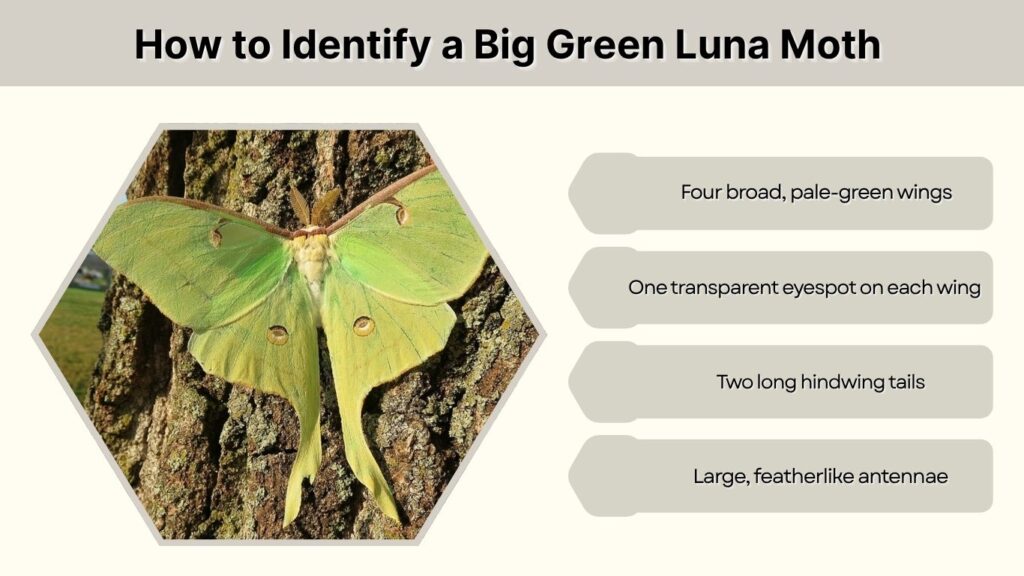
A luna moth’s combination of color, size, eyespots, and hindwing tails is highly distinctive. Look at the entire insect rather than relying on its green color alone.
Main Identification Features
A big green luna moth normally has:
- Four broad, pale-green wings
- One transparent eyespot on each wing
- Two long hindwing tails
- A white or cream-colored furry body
- Pinkish, purple, brown, or yellow wing margins
- Large, featherlike antennae
- A wingspan wider than an adult human hand
Males generally have broader, more heavily feathered antennae, which help them detect female pheromones. Females usually have narrower antennae and larger abdomens containing eggs.
Is It a Moth or a Big Green Butterfly?
A large luna moth is sometimes mistaken for a butterfly because of its bright color and attractive wings. However, it is a moth.
Luna moths are mostly active at night, have thick furry bodies, and commonly rest with their wings spread. Butterflies are generally active during daylight and have antennae ending in small clubs. Luna moth antennae are feathered rather than clubbed.
How Big Is a Luna Moth?
An adult luna moth generally has a wingspan of approximately 3–4½ inches. Some individuals are large enough to cover much of an adult hand when their wings are fully open.
Although luna moths are among North America’s largest moths, they are not always the largest species in a particular area. Cecropia moths can reach broader wingspans and are considered Wisconsin’s largest moths.
Why Does the Moth Look So Large?
Its broad wings and long tails make the luna moth appear larger than its actual body. The body itself is relatively short and thick, while the tails add considerable length to the overall outline.
The hindwing tails also serve a defensive purpose. Their movement can interfere with a hunting bat’s echolocation, directing attacks toward the expendable tails instead of the moth’s body.
Why Is a Luna Moth So Fluffy?
The apparent fur covering the body is made of modified scales and hairlike structures. These scales help insulate the moth and give giant silk moths their characteristic soft appearance.
The fluffy body is normal and does not mean that the moth is carrying mold or another substance. The wings are also covered with delicate scales that can rub off during handling.
A luna moth should therefore be observed without touching it. Handling can damage its wings, legs, tails, or antennae.
Big Green Moth Caterpillar
The caterpillar that becomes a luna moth is also large and green. A mature luna moth caterpillar normally reaches approximately 2½ inches long and has a thick, segmented body.
How to Identify It
Look for:
- A thick lime-green body
- A pale yellow stripe along each side
- Small reddish, orange, or pink raised bumps
- Sparse short hairs
- Several clearly defined body segments
- No large horn at the rear
The caterpillar passes through several growth stages, shedding its skin as it becomes larger. Shortly before making a cocoon, it may change from bright green to reddish or brownish and begin wandering across the ground.
What Does the Caterpillar Eat?
Luna moth caterpillars eat the leaves of particular deciduous trees. Common host plants include hickory, walnut, pecan, sweetgum, persimmon, sumac, and white birch. Preferences vary geographically, and local populations may perform best on the trees naturally used in their region.
Adult luna moths do not eat because they have nonfunctional mouthparts. All energy used during adulthood is stored while the insect is a caterpillar.
Big Lime-Green Caterpillar vs Luna Moth Caterpillar
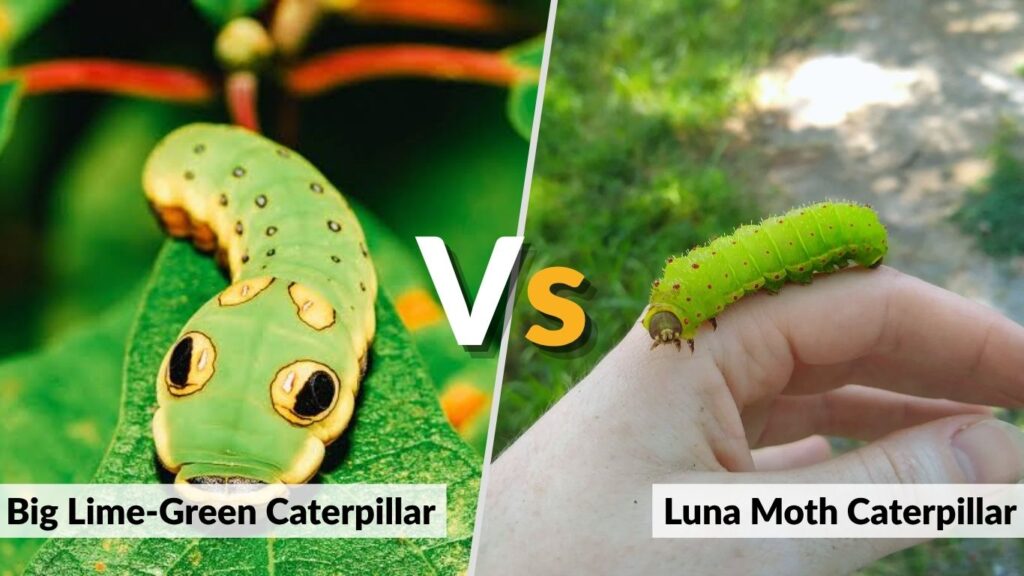
Not every large green caterpillar becomes a luna moth. Tomato hornworms, tobacco hornworms, Polyphemus moth caterpillars, and several sphinx moth caterpillars can look similar.
| Caterpillar | Distinguishing feature |
| Luna moth | Green body, side stripe and small raised bumps |
| Tomato hornworm | Large rear horn and V-shaped side markings |
| Tobacco hornworm | Red rear horn and diagonal white stripes |
| Polyphemus moth | Green body with yellow lines and prominent bumps |
| Sphinx moth | Usually has a noticeable rear horn |
A big green caterpillar feeding on a tomato plant is probably a hornworm rather than a luna moth caterpillar. The plant on which a caterpillar is feeding is often an important identification clue.
Big Green Moths That Are Not Luna Moths
A green moth without long tails or four eyespots may belong to another group.
Emerald Moths
Emerald moths have attractive green wings, sometimes decorated with thin white or wavy lines. Most are considerably smaller and more delicate than luna moths.
Sphinx Moths
Sphinx moths are often large, but they usually have heavy, streamlined bodies, pointed wings, and long abdomens. Some have olive-green markings rather than completely green wings. They may hover near flowers in a manner resembling hummingbirds.
Other Giant Silk Moths
Cecropia, Polyphemus, and promethea moths can equal or exceed the luna moth in size. However, their adult wings are mainly brown, gray, reddish, or patterned rather than uniformly pale green.
Big Moths in Wisconsin
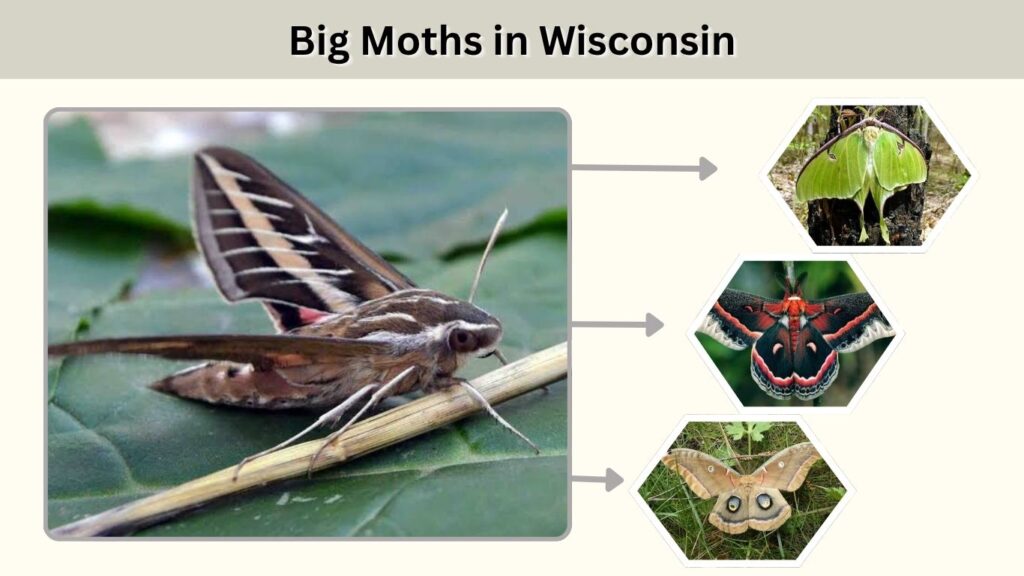
Wisconsin supports several impressive native moths, including luna, cecropia, Polyphemus, promethea, and numerous hawk or sphinx moths. Wisconsin DNR identifies the cecropia as the state’s largest moth and includes luna moths among the large species found in the state.
Common large Wisconsin moths include:
- Luna moth
- Cecropia moth
- Polyphemus moth
- Promethea moth
- Imperial moth
- White-lined sphinx
- Hummingbird clearwing moth
Luna moths in Wisconsin are most likely to be seen during the warmer part of the year. Adults may appear near porch lights at night and remain resting on buildings, trees, or screens the following morning. Wisconsin records place luna moth wingspans at roughly 3–4 inches or slightly more.
How Long Do Big Luna Moths Live?
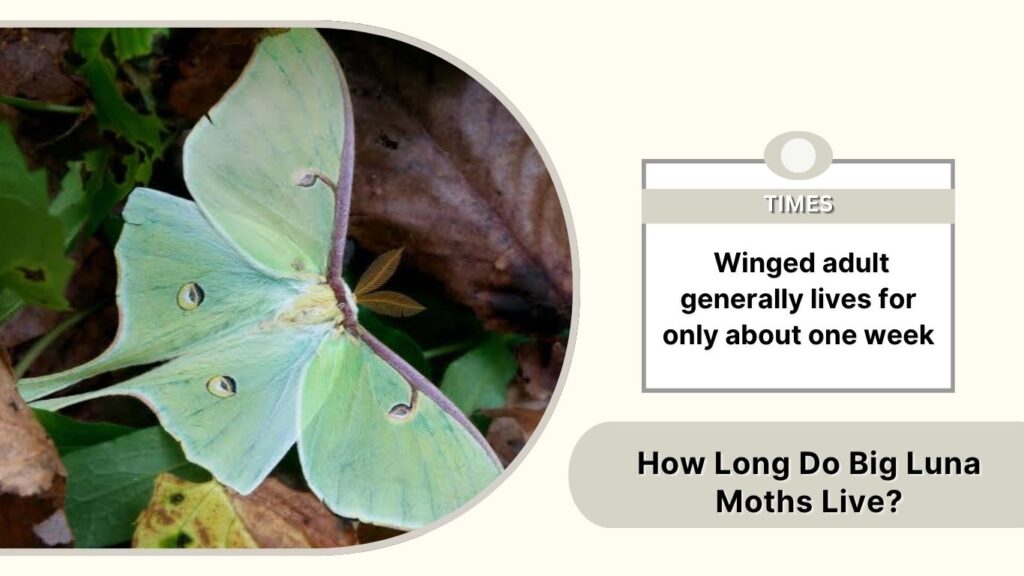
The winged adult generally lives for only about one week. It cannot eat, so its brief adult stage is devoted to finding a mate and reproducing.
The complete life cycle lasts much longer and includes four stages:
- Egg
- Caterpillar
- Pupa inside a cocoon
- Adult moth
The caterpillar spins its cocoon among leaves. The cocoon may eventually fall to the ground and remain concealed in leaf litter until the adult emerges.
What Should You Do After Finding One?
Leave a healthy luna moth where you found it. A moth resting during daylight is not necessarily sick or dying; it may simply be waiting for darkness before becoming active.
Avoid touching its wings, spraying it with insecticide, or attempting to feed it. Adults cannot eat. Reducing outdoor lighting, protecting native host trees, limiting broad-spectrum pesticides, and retaining some fallen leaves can help luna moths complete their life cycle.
FAQs
Is a big green moth dangerous?
A luna moth is harmless. It does not sting, and the adult cannot bite because its mouthparts are nonfunctional. Its large size may look intimidating, but it poses no threat to people, pets, homes, clothing, or stored food.
Why is a big green moth sitting on my house?
Luna moths are active at night and can be attracted to outdoor lights. When daylight arrives, they may rest on walls, doors, screens, or nearby trees. Leave the moth undisturbed, and it may fly away after dark.
Is the luna moth the biggest moth?
It is one of North America’s largest moths but not always the largest. Cecropia moths generally have broader wingspans and are recognized as Wisconsin’s largest moth species. Luna moths appear especially large because of their long hindwing tails.
Are big green luna moths rare?
Luna moths are broadly distributed, but adults are not frequently seen because they fly at night, live for only about one week, and blend well with green leaves. Finding one is unusual without necessarily meaning the species is rare locally.
What does a big green moth turn into?
An adult moth does not transform into another animal; it is the final life stage. Before adulthood, a luna moth develops from an egg into a large green caterpillar, forms a silk cocoon, becomes a pupa, and finally emerges as a winged moth.